2
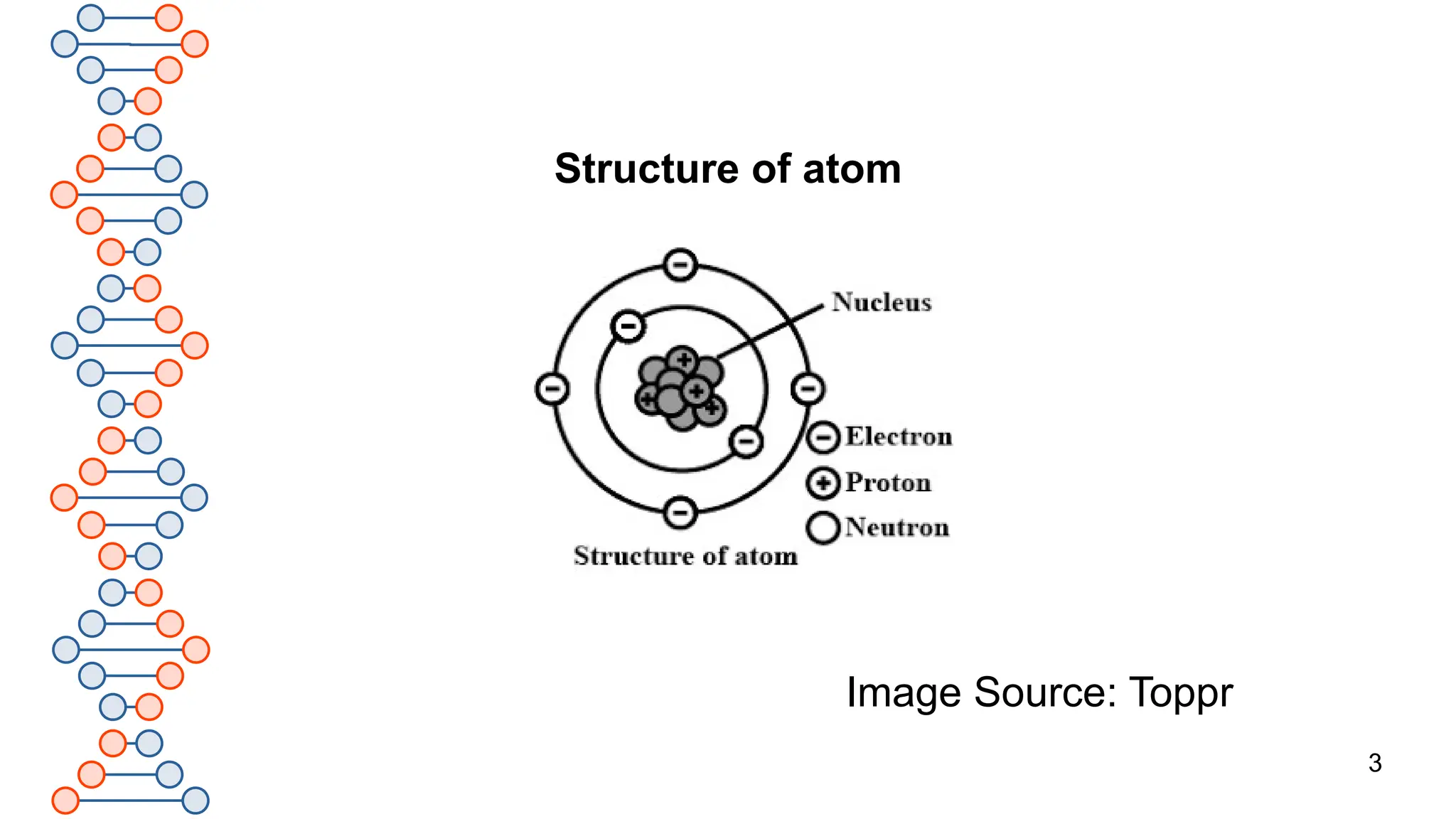
Q. What isdefined atomic structure?
A. An atom is the basic unit of matter. The atomic
structure refers to the structure of an atom
comprising a nucleus(centre) in which the protons
(positively charged) and neutrons (neutral) are
present. The negatively charged particles called
electrons revolve around the centre of the nucleus.
4
Q. What isproton?
A. A proton is a stable subatomic particle, symbol p, with
a positive electric charge of +1e (elementary charge). Its
mass is slightly less than that of neutron and 1836 times
the mass of an electron.
Q. What is the brief history of discovery of protons?
A. The proton was discovered by Ernest Rutherford in the
early 1900’s. Durng this period, his research resulted in a
nuclear reaction which led to the first splitting of the atom,
where he discovered “protons” based on the Greek word
“protos” which means first.
5.
5
Q. How protonwas discovered?
A. In 1909, Rutherford discovered proton in his famous
gold foil experiment.
Gold Foil Experiment: In his gold foil experiment,
Rutherford bombarded a beam of alpha particles on an
ultrathin gold foil and then detected the scattered alpha
particles in zinc sulphide( ZnS) screen.
Results:1. Most of the particles pass through the foil
without any deflection.
Contd.
6.
6
2. Some ofthe alpha particles deflect at small angle.
3. Very few even bounce back(1 in 20,000)
Conclusion: Based on his observations, Rutherford
proposed the following structural features of an atom:
1. Most of the atomic and its entire positive charge are
confined in a small core, called nucleus. The positively
charged particle is called proton.
2. Most of the volume of an atom is an empty space.
Contd.
7.
7
3. The numberof negatively charged electrons dispersed
outside the nucleus is sams as the positively charge in the
nucleus. It explains the overall electrical neutrality of an
atom.
Schematic Gold Foil experiment:
Image Source: Embibe
8.
8
Q. What isan electron?
A. Electron is a negatively charged subatomic
particle. It can either be free or can be bound to the
nucleus of an atom. The number of protons and
electrons are equal in a neutral atom. The electrons
in atoms exists in the round shell of various radii,
around the nucleus, representing the various level
of energy. The mass of an electron is 1/2000 times
lesser than the mass of proton and neutron.
Therfore, the electrons do not contribute to the
mass of the atom.
9.
9
Q. Who discoveredthe electron?
A. Electron was discovered by J.J.Thompson in 1897, when he
was studying the properties of cathode ray.
Q. What is cathode ray
?
A. J.J.Thompson constructed a glass tube which was partially
evacuated. Then he applied a high electrical voltage between
two electrodes at either end of the tube. He detected that a
stream of particle (ray) was coming out from the negatively
charged electrode (cathode) to positively charged electrode
(anode).. This ray is called cathode ray and the whole
construction is called cathode ray tube.
11
Q. What arecathode rays?
A. The cathode rays consists of negatively charged
particles known as electrons.Since these rays emerge
out of negatively charged electrode called cathode,
these rays are called cathode rays.
Q. What are the important properties of cathode rays?
A.1. Cathode rays are negatively charged.
2. Cathode rays travel in a straight line and can cast
sharp shadows.
Contd.
12.
12
3. Cathode raysshow deflection when placed in an electric
field and magnetic field.
4. Cathode rays can penetrate through thin metal plates.
5. The properties of the cathode rays do not depend on the
electrodes and the gas used in the vacuum tube.
Q. What is Millican oil drop experiment?
A. The Millican oil drop experiment was an experiment
performed by Robert A.Millican and Harvey Fletcher in
1909 to measure the charge of an electron.
13.
13
Q. What isthe charge and mass of an electron?
A. The charge of an electron is 1.602*10-19
C.
The mass of an electron is 9.1093837*10-31
kg.
Q. What is neutron?
A. Neutrons are subatomic particles that are one of the
primary constituents of atomic nuclei. They are usually
denoted by the symbol n or n0
. Neutrons do not have
any net electric charge associated with them. They do,
however, have a mass which is slightly greater in
magnitude than that of a proton.
14.
14
Q. What isthe discovery of the neutron?
A. By 1920, physicist knew that most of the mass of the
atom was located in a nucleus at its centre. In May
1932, British physicist Sir James Chadwick announced
that the core also contained a new uncharged particle,
which he called the neutron.
Q. What are the properties of neutrons?
A.1.Neutrons are electrically neutral particles.
2. Neutrons are highly penetrating.
3. The mass of the neutron is 1.675*10-27
kg.
15.
15
Q. How werethe neutron discovered?
A. In 1932, the physicist James Chadwick conducted an
experiment in which he bombarded Beryllium with alpha
particles from the natural radioactive decay of polonium.
This led to the production of uncharged, high
penetrating radiation, which showed penetration through
a lead shield. This could not be explained via the
particles known at that time. So, he concluded that the
unusually penetrating radiation consisted of uncharged
particles having approximately the same mass as of a
proton. These particles were later termed as neutrons.
17
Q. What isatomic number?
A. The atomic number of an atom is equal to the number of
protons in the nucleus of an atom or the number of electrons in
an electrically neutral atom. It is represented by the letter ’Z’.
All the atoms of a particular element have the same number of
protons, and hence the same atomic number.
Atoms of different elements have different atomic numbers.
18.
18
Q. What ismass number?
A. The total number of protons and neutrons present in the
nucleus of an atom is called the mass number. It is represented
by the letter ‘A’.
While the number of protons remains the same in all atoms of
an element, the number of neutrons can vary. Thus, atoms of
the same element can have different mass numbers, and these
are called isotopes.
The weight of an electron is almost negligible. Thus, the atomic
mass of an atom is almost same the same as its mass number.
19.
19
Q. What areisotopes?
A. An isotope is a variation of an element that possess the
same atomic number but a different mass number. A
group of isotopes of any element will always have the same
number of protons and electrons. They will differ in the
number of neutrons held by their respectively nuclei. An
example of a group of isotopes is hydrogen-1 (protium),
hydrogen-2(deuterium), and hydrogen-3 (tritium).
20.
20
Q. What areisobars?
A. Isobars are atoms of different chemical elements that
have the same number of nucleons. Correspondingly,
isobars differ in atomic number (or a number of protons)
but have the same mass number. An example of a
series of isobars would be 40
S, 40
Cl, 40
K, 40
Ca. Chemical
property of isobars is different because there is a
difference in the number of electrons. Another example
of two isobars are iron and nickel. Both have the same
mass number which is 58 whereas the atomic number
of iron is 26, and the atomic number of nickel is 28.
21.
21
Q. What areisotones?
A. Isotones are the atoms that have the same neutron
number but different proton number. For example,
boron-12 and carbon-13 nuclei both contain 7 neutrons,
and so are isotones.
Q. What is Thomson’s atomic model?
A. According to Thomson’s atomic model, an atom is
made up of a positively charged sphere into which
negatively charged electrons are implanted. As
electrons and protons have the same magnitude, an
atom as a whole is electrically neutral.
23
Q. To whichfruit had Thomson’s atomic model been
compared to?
A. Thomson’s atomic model was compared to a
watermelon because the red edible part of a
watermelon was compared to the sphere with a positive
charge, and the black seeds filling the watermelon
resembled the electrons inside the sphere.
Q. What was missing from Thomson’s atomic model?
A. Thomson’s atomic model lacked a nucleus, protons,
and neutrons.
24.
24
Q. Why Thomson’satomic model is also known as
plum pudding model?
A. According to Thomson’s atomic model, an atom is
a spherical positively charged species in which the
negatively charged electrons are randomly placed
over the entire sphere just like the dry fruits in a
christmass pudding. That is why, this model is also
known as plum pudding model.
25.
25
Q. What arethe limitations of Thomson’s atomic model?
A.1.Thomson’s atomic model failed to explain the
stability of an atom because his model of atom failed to
explain how a positive charge holds the negatively
charged electrons in an atom. Therefore, this theory also
failed to account for the position of the nucleus in an
atom.
2. Thomson’s model falied to explain the scattering of
alpha particles by thin metal foils.
3. No experimental evidence in the support of this model.
26.
26
Q. What isRutherford Gold Foil experiment?
A. Rutherford conducted his famous Gold Foil
experiment in which a stream of high energy alpha
particles was directed at a thin foil of gold. A small
portion of the particles had been observed to be
deflected, while the remainder had gone through the
layer. This led Rutherford to infer that at its core, the
mass of an atom was concentrated.
27.
27
Q. What causedthe alpha particles to deflect in Rutherford’s
gold-foil experiment?
A. Rutherford thought that the particles would fly straight through
the foil. However, he found that some alpha particles were
deflected when passing through the foil. This is because like
charges repel each other.
Q. Why gold foil is used in Rutherford’s gold-foil experiment?
A. Gold is the most malleable metal and Rutherford wanted the
thinnest layer as possible. The goldsheet used was around
1000atoms thick. Therefore, Rutherford selected a gold foil in his
alpha scattering experiment.
28.
28
Q. What arethe observations of Rutherford’s Alpha scattering
experiment?
A.1.A major fraction of the alpha-particles bombarded towards
the gold sheet passed through the sheet without any deflection,
and hence most of the space in an atom is empty.
2. Some of the alpha-particles were deflected by the gold sheet
by very small angles, and hence the positive charge in an atom
is not uniformly distributed. The positive charge in an atom is
concentrated in a very small volume.
3. Very few of the alpha particles were deflected back, that is
only a few alpha particles had nearly 1800
angle of deflection.
So, the volume occupied by the positively charged particles in an
atom is very small as compared to the total volume of an atom.
29.
29
Q. What arethe features of Rutherford atomic model?
A.1. The positive charge and most of the mass of an atom is
concentrated in an extremely small volume. He called this
region of the atom as a nucleus.
2. Rutherford’s model proposed that the negatively charged
electrons surround the nucleus of an atom. He also claimed
that the electrons surrounding the nucleus revolve around it
with very high speed in circular paths. He named these
circular paths as orbits.
3. Electrons being negatively charged and nucleus being a
densely concentrated mass of positively charged particles,
are held together by a strong electrostatic force of attraction.
31
Q. What arethe limitations of Rutherford atomic
model?
A.1. Rutherford’s atomic model failed to explain the
stability of atoms.
2. The arrangement of electrons in a circular path
was not defined.
3. Any particle that is moving in a circular path would
undrergo acceleration and radiate energy. Thus, the
revolving electron would lose energy and finally fall
into the nucleus.
32.
32
Q. What isBohr’s model of an atom?
A. The Bohr model of the atom was proposed by
Neil Bohr in 1915. It came into existence with the
modification of Rutherford’s model of an atom.
Rutherford’s model introduced the nuclear model of
an atom, in which he explained that a nucleus
(positively charged) is surrounded by negatively
charged electrons. Bohr modified that model into
electrons and their energy levels.
33.
33
Q. What arethe postulates of Bohr’s model of atom?
A.1. Electrons revolve around the nucleus in fixed paths called
orbits or shells.
2. Electrons in each shell have definite energy, hence shells are
called energy levels.
3. The energy of the shell increases as the distance from the
nucleus increases.
4. The shells around the nucleus can be numbered from near
the nucleus 1,2,3,4... or represented by the letters K, L, M, N...
5. By gaining energy, an electron can jump to an orbital shell
with higher energy, and by losing energy, it can jump to a lower
energy level or orbital shell.
35
Q. What arethe limitations of Bohr’s atomic model?
A.1. It does not comply with the Heisenberg Uncertainty Principle. Neil
Bohr’s atomic model considers electrons to have both known position
and momentum simultaneously, which is unthinkable as indicated by
Heisenberg.
2. Bohr’s atomic model theory made correct predictions for smaller
sized atoms like hydrogen, but poor spectral predictions are obtained
when larger atoms are considered.
3. It failed to explain the Zeeman effect when the spectral line is split
into several components in the presence of a magnetic field.
4. It failed to explain the stark effect when spectral light gets split up
into fine lines in the presence of an electric field.
36.
36
Q. What isa Shell?
A. A shell is the pathway followed by electrons around an atom’s
nucleus. These are also called energy levels since these shells are
arranged around the nucleus according to the energy that an
electron in the shell is composed of. The shell that has the lowest
energy is nearest to the nucleus. Shell are numbered as 1,2,3,4,... or
K,L,M,N,...from the nucleus outwards. But, scientists have named
these shells using quantum numbers. Each shell has its own
quantum number, named as the principal quantum number which
is denoted by ‘n’. The principal quantum number(n) determines the
maximum number of electrons that can be accommodated in a shell
and is represented by the formula,2n2
, where ‘n’ is the shell number.
37.
37
Q. What isa subshell?
A. A subshell is the area in which electron moves within a shell.
Each shell consists of one or more sub-levels, which are called
subshells. The subshells into which electrons are distributed are
based on the azimuthal quantum number (denoted by ‘l’). This
quantum number is dependent on the value of the principal
quantum number, ‘n’. Therefore, when ‘n’ has a value of 4, four
different subshells are possible. For example, in the first shell
(n=1), there is only one subshell which corresponds to l=0. There
are two subshells (l=0,1) in the second shell (n=2). These
subshells are named s,p,d,f respectively. The maximum number of
electrons that can be accommodated by a subshell is given by the
formula 2*(2l+1). Therefore, the s, p, d, and f subshells can
accommodate a maximum of 2,6,10 and 14 electrons respectively.
38.
38
Q. What areorbitals?
A. An orbital can be defined as the space or region where
the electron is most likely to be found. In other words, the
term orbital explains the exact movement of an electron.
A subshell is composed of orbitals. The number of
orbitals present in a subshell is a unique feature for the
subshell. For ‘s’ subshell, number of orbitals is 1. For ‘p’
subshell, number of orbitals is 3. For ‘d’ subshell, number
of orbitals is 5. For ‘f’ subshell, number of orbitals is 10.
However, one orbital can hold only a maximum of two
electrons. These electrons are in the same energy level,
but different from each other according to thir spin.
39.
39
Q. Differentiate amongshell, subshell, and orbital.
A. Shells are the circular paths around the nucleus of an atom along which the
electrons move. The shells are represented by the principal quantum number
‘n’.
Subshell is the pathway in which an electron moves within a shell. Each shell
consists of one or more subshells. There are four subshells: s,p,d, and f. The
subshells into which electrons are distributed are based on the azimuthal
quantum number (denoted by ‘l’). Maximum number of electrons this can hold
depends on the type of subshell.
An orbital is the space where the probability of finding an electron is highest.
Each subshell contais one or more orbitals. To be exact, ‘s’ consists of only 1
orbital, ‘p’ consists of 3 orbitals, ‘d’ consists of only 5 orbitals, and ‘f’ consists
of 7 orbitals. Each orbital can contain a maximum of two electrons, one spin-up
and one spin-down.
![CLASS 11 CHEMISTRY
STRUCTURE OF ATOM
[PART 1]](https://image.slidesharecdn.com/atm-250217055227-e54ddbe4/75/STRUCTURE-OF-ATOM-PART1-CLASS-11-CHEMISTRY-1-2048.jpg)








![CHEMICAL EQUILIBRIUM [PART 2], CLASS 11 CHEMISTRY](https://cdn.slidesharecdn.com/ss_thumbnails/eql2-250303040749-4cd334d1-thumbnail.jpg?width=640&height=640&fit=bounds)


![CHEMICAL BONDING AND MOLECULAR STRUCTURE [PART: 3], CLASS 11 CHEMISTRY](https://cdn.slidesharecdn.com/ss_thumbnails/cb4-250226043559-bf93a4b4-thumbnail.jpg?width=640&height=640&fit=bounds)
![CHEMICAL BONDING & MOLECULAR STRUCTURE [PART 2], CLASS 11 CHEMISTRY](https://cdn.slidesharecdn.com/ss_thumbnails/cb2-250225044619-e600ad65-thumbnail.jpg?width=640&height=640&fit=bounds)


![CARBON AND IT'S COMPOUNDS[CHAPTER 1], CLASS 10, SCIENCE](https://cdn.slidesharecdn.com/ss_thumbnails/carbon-250220043655-8b9e92b9-thumbnail.jpg?width=640&height=640&fit=bounds)
![CARBON AND IT'S COMPOUND[PART 2], CLASS 10, SCIENCE](https://cdn.slidesharecdn.com/ss_thumbnails/carbon2-250220041032-3c163d1d-thumbnail.jpg?width=640&height=640&fit=bounds)

![THERMODYNAMICS[PART 3], CLASS 11, CHEMISTRY](https://cdn.slidesharecdn.com/ss_thumbnails/therm3a-250219054445-0147ea61-thumbnail.jpg?width=640&height=640&fit=bounds)
![THERMODYNAMICS[PART 2], CLASS 11, CHEMISTRY](https://cdn.slidesharecdn.com/ss_thumbnails/therm2-250219053401-f44db038-thumbnail.jpg?width=640&height=640&fit=bounds)
![THERMODYNAMICS[PART 1], CLASS 11, CHEMISTRY](https://cdn.slidesharecdn.com/ss_thumbnails/therm1-250219052302-b7910fcf-thumbnail.jpg?width=640&height=640&fit=bounds)
![ATOMIC STRUCTURE[PART2] CLASS 11, CHEMISTRY](https://cdn.slidesharecdn.com/ss_thumbnails/atm2-250217052334-efd626ba-thumbnail.jpg?width=640&height=640&fit=bounds)


