STRUCTURE OF A MANUSCRIPT
COMPONENTS AND VARIATIONS
Made by:
Abhishek Kumar
Roll No – 04716401521
B.Tech IT 6th Sem
INTRODUCTION TO THE MANUSCRIPT STRUCTURE
 Manuscript structure:
A manuscript typically follows a structured format to effectively
communicate research findings and insights. The standard structure for
research manuscripts is IMRaD, which stands for Introduction, Methods,
Results, and Discussion.
 Importance of organizing a manuscript effectively:
Proper organization enhances readability and comprehension, guiding
readers through the study's objectives, methods, results, and
conclusions in a logical sequence.
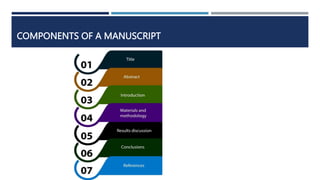
COMPONENTS OF A MANUSCRIPT
ABSTRACT
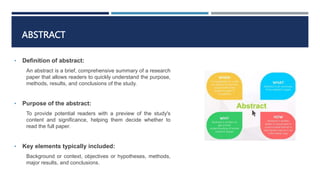
• Definition of abstract:
An abstract is a brief, comprehensive summary of a research
paper that allows readers to quickly understand the purpose,
methods, results, and conclusions of the study.
• Purpose of the abstract:
To provide potential readers with a preview of the study's
content and significance, helping them decide whether to
read the full paper.
• Key elements typically included:
Background or context, objectives or hypotheses, methods,
major results, and conclusions.
INTRODUCTION
• Role of the introduction:
The introduction sets the stage by providing background
information on the topic, establishing its importance, and
outlining the scope of the study.
• Objectives of the introduction:
To engage the reader, justify the research questions or
hypotheses, and review relevant literature to position the
study within existing knowledge.
MATERIALS AND METHODS
• Overview of materials and methods section:
This section describes the experimental design, materials, and
procedures used in the study, ensuring transparency and
reproducibility.
• Importance of reproducibility and clarity:
Clear and detailed descriptions enable other researchers to
replicate the study and verify the findings.
• Types of information typically included:
Study design, sampling or participant selection, data collection
methods, and statistical analysis.
RESULTS
• Purpose of the results section:
The results section presents the findings of the study
objectively, often using tables, figures, or graphs to
summarize data.
• Presentation of findings:
Clear data presentation enhances understanding and
supports the study's conclusions.
DISCUSSION
• Purpose of the discussion section:
The discussion section interprets the results, explains their
significance in relation to the study's objectives, and
discusses implications for future research or practice.
• Addressing study limitations and implications:
Acknowledging limitations and suggesting potential
avenues for further investigation demonstrate critical
thinking and scientific rigor.
CONCLUSION
• Summary of key findings:
The conclusion section provides a concise
summary of the study's main findings and their
implications.
• Future research directions:
Suggestions for future research based on the
study's outcomes highlight avenues for
advancing knowledge in the field.
REFERENCES
• Purpose of References:
• Lists all sources cited in the manuscript.
• Enables readers to locate and verify cited works.
• Components of a Reference Entry:
• Author(s), publication year, title, source details.
• Citation Styles:
• Follow specific styles (e.g., APA, MLA) as per journal guidelines.
• Importance of Accurate Referencing:
• Avoids plagiarism and gives credit to original authors.
• Demonstrates scholarly integrity.
VARIATIONS IN MANUSCRIPT STRUCTURE
 Variations Based on Journal Guidelines:
Different journals and publishers may have
specific manuscript requirements and
formatting guidelines.
 Disciplinary Differences:
Manuscript structures can also vary across
academic disciplines such as Scientific,
Medical, Social Sciences and Humanities.
 Adaptation to Audience and Purpose:
Authors should adapt manuscript structures
based on the target audience and the
specific purpose of the publication.
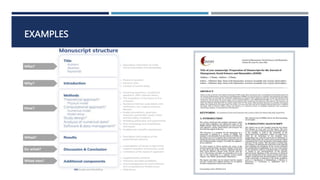
EXAMPLES

Structure of a Manuscript including differences

  • 1.
    STRUCTURE OF AMANUSCRIPT COMPONENTS AND VARIATIONS Made by: Abhishek Kumar Roll No – 04716401521 B.Tech IT 6th Sem
  • 2.
    INTRODUCTION TO THEMANUSCRIPT STRUCTURE  Manuscript structure: A manuscript typically follows a structured format to effectively communicate research findings and insights. The standard structure for research manuscripts is IMRaD, which stands for Introduction, Methods, Results, and Discussion.  Importance of organizing a manuscript effectively: Proper organization enhances readability and comprehension, guiding readers through the study's objectives, methods, results, and conclusions in a logical sequence.
  • 3.
    COMPONENTS OF AMANUSCRIPT
  • 4.
    ABSTRACT • Definition ofabstract: An abstract is a brief, comprehensive summary of a research paper that allows readers to quickly understand the purpose, methods, results, and conclusions of the study. • Purpose of the abstract: To provide potential readers with a preview of the study's content and significance, helping them decide whether to read the full paper. • Key elements typically included: Background or context, objectives or hypotheses, methods, major results, and conclusions.
  • 5.
    INTRODUCTION • Role ofthe introduction: The introduction sets the stage by providing background information on the topic, establishing its importance, and outlining the scope of the study. • Objectives of the introduction: To engage the reader, justify the research questions or hypotheses, and review relevant literature to position the study within existing knowledge.
  • 6.
    MATERIALS AND METHODS •Overview of materials and methods section: This section describes the experimental design, materials, and procedures used in the study, ensuring transparency and reproducibility. • Importance of reproducibility and clarity: Clear and detailed descriptions enable other researchers to replicate the study and verify the findings. • Types of information typically included: Study design, sampling or participant selection, data collection methods, and statistical analysis.
  • 7.
    RESULTS • Purpose ofthe results section: The results section presents the findings of the study objectively, often using tables, figures, or graphs to summarize data. • Presentation of findings: Clear data presentation enhances understanding and supports the study's conclusions.
  • 8.
    DISCUSSION • Purpose ofthe discussion section: The discussion section interprets the results, explains their significance in relation to the study's objectives, and discusses implications for future research or practice. • Addressing study limitations and implications: Acknowledging limitations and suggesting potential avenues for further investigation demonstrate critical thinking and scientific rigor.
  • 9.
    CONCLUSION • Summary ofkey findings: The conclusion section provides a concise summary of the study's main findings and their implications. • Future research directions: Suggestions for future research based on the study's outcomes highlight avenues for advancing knowledge in the field.
  • 10.
    REFERENCES • Purpose ofReferences: • Lists all sources cited in the manuscript. • Enables readers to locate and verify cited works. • Components of a Reference Entry: • Author(s), publication year, title, source details. • Citation Styles: • Follow specific styles (e.g., APA, MLA) as per journal guidelines. • Importance of Accurate Referencing: • Avoids plagiarism and gives credit to original authors. • Demonstrates scholarly integrity.
  • 11.
    VARIATIONS IN MANUSCRIPTSTRUCTURE  Variations Based on Journal Guidelines: Different journals and publishers may have specific manuscript requirements and formatting guidelines.  Disciplinary Differences: Manuscript structures can also vary across academic disciplines such as Scientific, Medical, Social Sciences and Humanities.  Adaptation to Audience and Purpose: Authors should adapt manuscript structures based on the target audience and the specific purpose of the publication.
  • 12.