Structuralism & Semiotics
Algelle Abrantes
Dudes to know:
 Ferdinand deSaussure
 Claude Levi-Strauss
 Roland Barthes
 Jacques Lacan
 Michel Foucault
 Northrop Frye**
Context
 As a literary theory, developed in the
1950s and 1960s, adopted from
theories other areas such as sociology,
psychoanalysis, anthropology, etc.
**All interrelated!**
 Reactionary criticism, attempts to
place literature into a system and
assign value judgments to works.
Principles of Structuralism
 Meaning occurs through difference
and SIGNS’ relationship to each
other. Ex: woman vs. lady
 Much of our imaginative world is
structured in binary sets (opposites)
which assign structure and meaning
to signs. Ex: cruel vs. humane
Principles of Structuralism
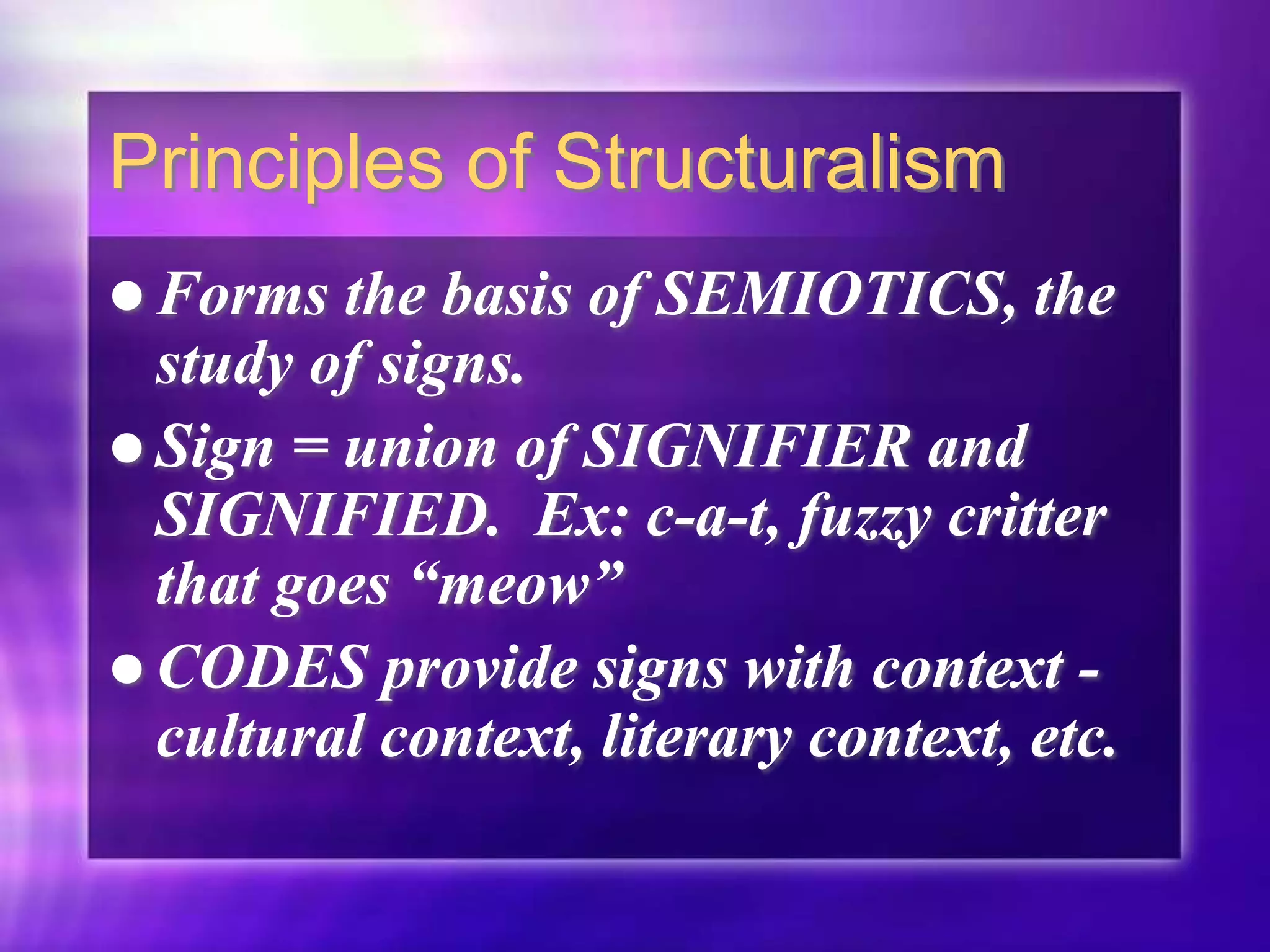
 Forms the basis of SEMIOTICS, the
study of signs.
 Sign = union of SIGNIFIER and
SIGNIFIED. Ex: c-a-t, fuzzy critter
that goes “meow”
 CODES provide signs with context -
cultural context, literary context, etc.
Principles of Structuralism
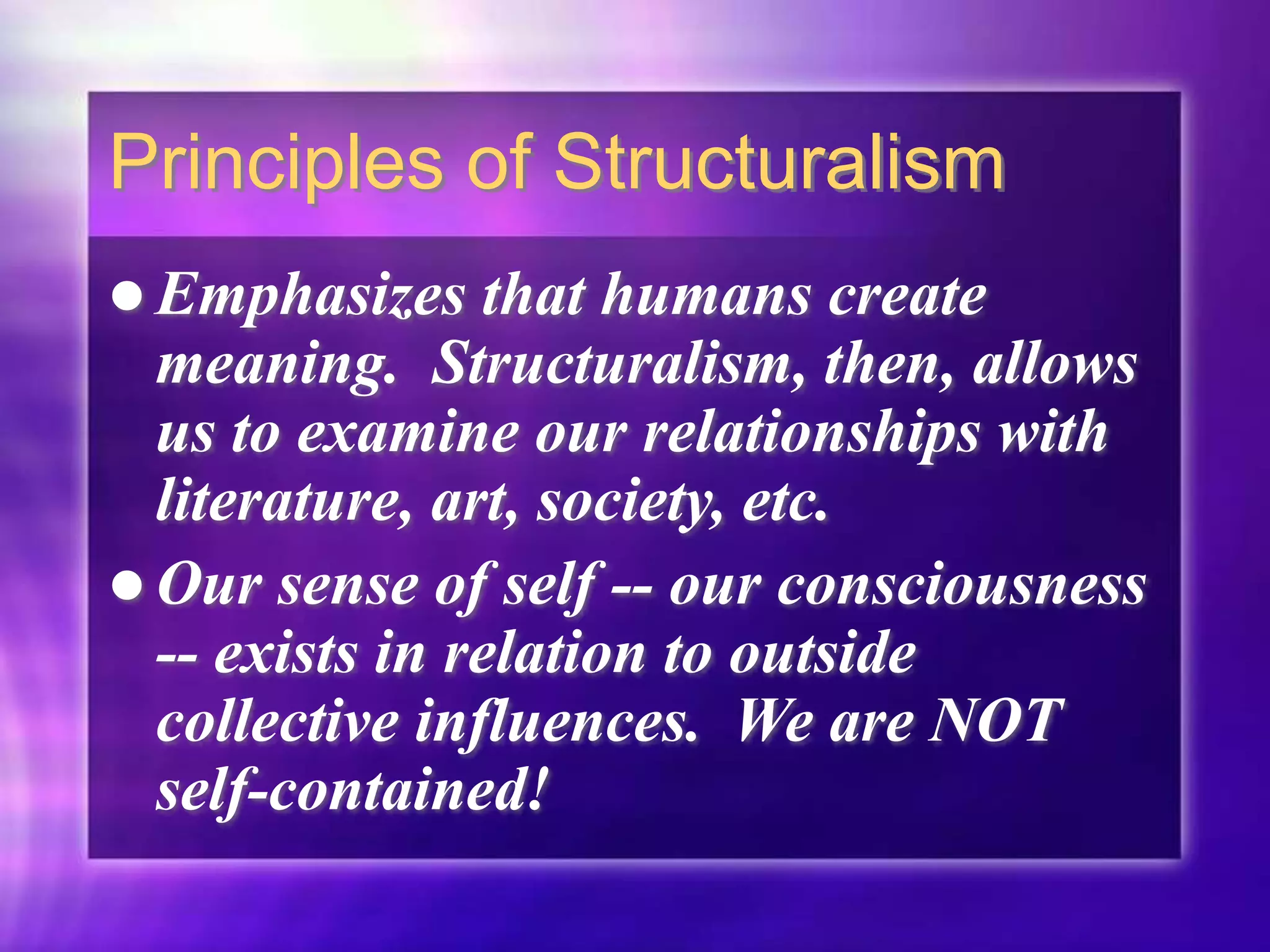
 Emphasizes that humans create
meaning. Structuralism, then, allows
us to examine our relationships with
literature, art, society, etc.
 Our sense of self -- our consciousness
-- exists in relation to outside
collective influences. We are NOT
self-contained!
Principles of Structuralism
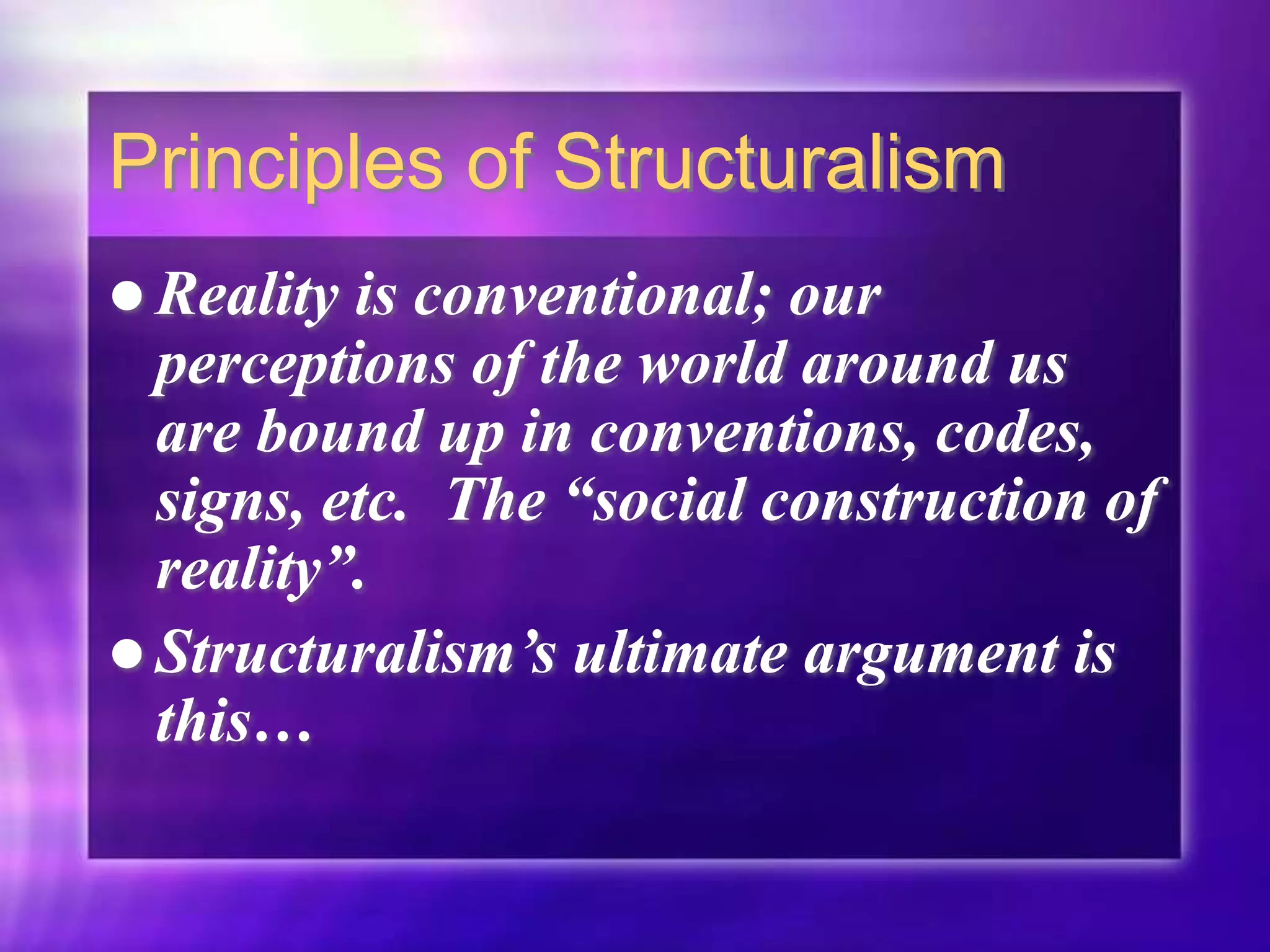
 Reality is conventional; our
perceptions of the world around us
are bound up in conventions, codes,
signs, etc. The “social construction of
reality”.
 Structuralism’s ultimate argument is
this…
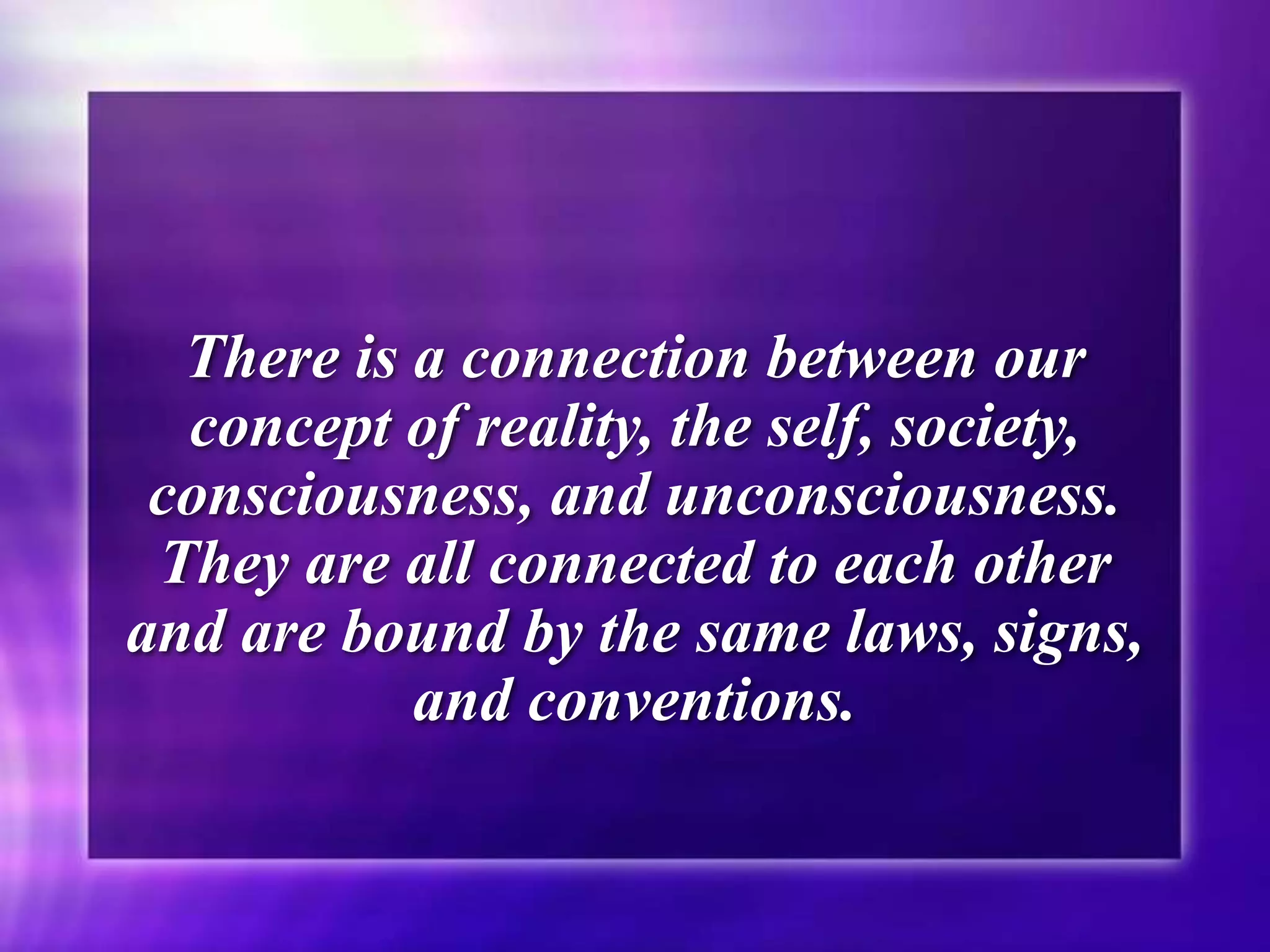
There is a connection between our
concept of reality, the self, society,
consciousness, and unconsciousness.
They are all connected to each other
and are bound by the same laws, signs,
and conventions.
When reading a “text”:
Look for…
 Parallels in plot
 Echoes in structure
 Reflections/repetitions in
character/motive
 Contrasts in situation/circumstance
 Patterns in language/imagery
Barthes’ five “codes”
Barthes identifies five codes which he
says provide the underlying narrative
structures for all literature.
When reading, attempt to place a work
in the system of codes.
The codes are:
1. Proairetic - provides indications of
actions; “reality”. Ex: The ship
sailed at noon.
2. Hermeneutic - poses questions or
enigmas that provide narrative
suspense and involve the reader.
Ex: if the narration indicates a
knock on the door, the reader asks
herself, “Who is it?”
Codes continued
3. Cultural - contains references beyond
the text which are considered
common knowledge (allusions,
metonymy). Ex: if a character is
described as driving a hybrid car,
there are certain cultural assumptions
attached to that character.
Codes continued
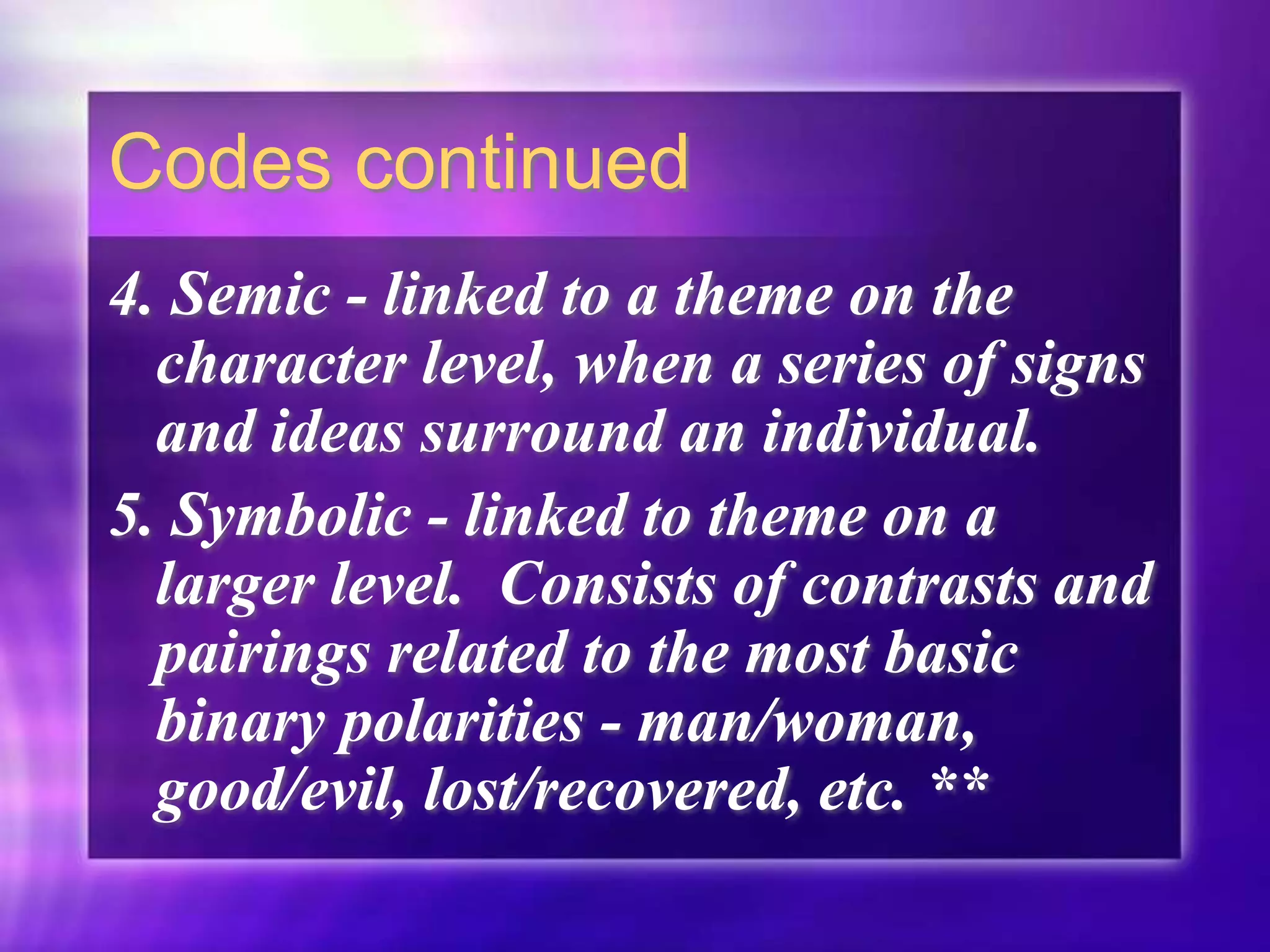
4. Semic - linked to a theme on the
character level, when a series of signs
and ideas surround an individual.
5. Symbolic - linked to theme on a
larger level. Consists of contrasts and
pairings related to the most basic
binary polarities - man/woman,
good/evil, lost/recovered, etc. **
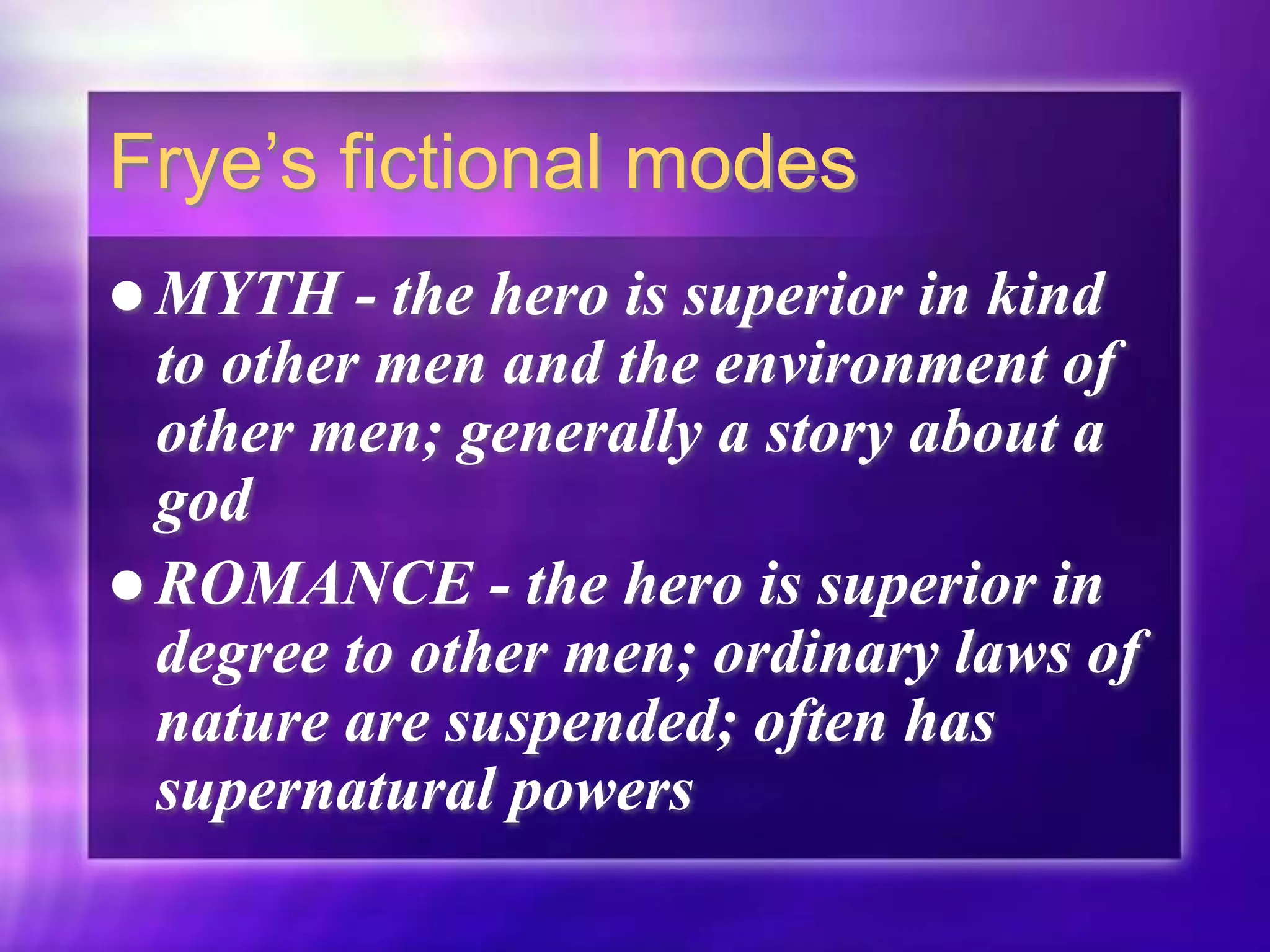
Frye’s fictional modes
 MYTH - the hero is superior in kind
to other men and the environment of
other men; generally a story about a
god
 ROMANCE - the hero is superior in
degree to other men; ordinary laws of
nature are suspended; often has
supernatural powers
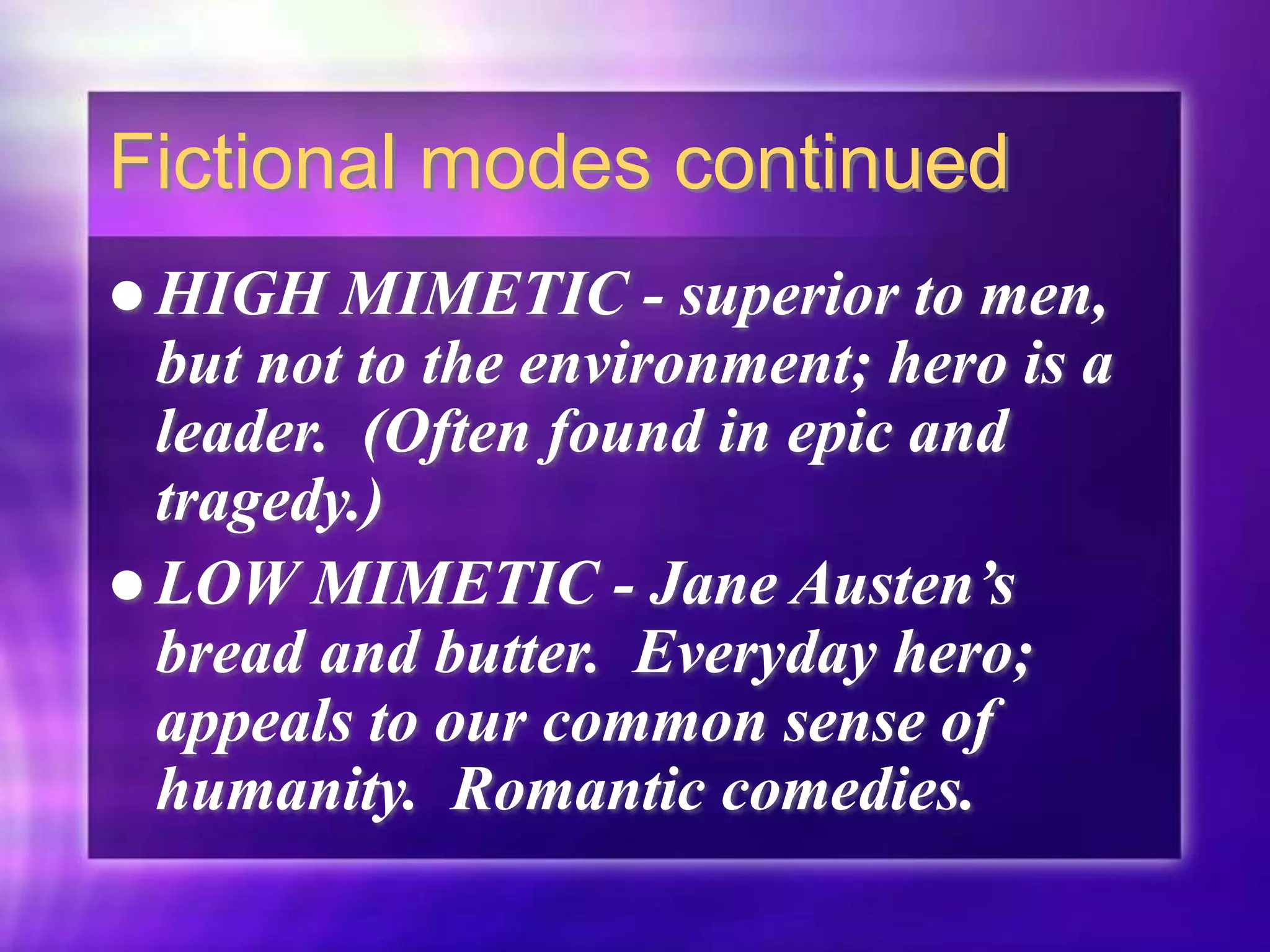
Fictional modes continued
 HIGH MIMETIC - superior to men,
but not to the environment; hero is a
leader. (Often found in epic and
tragedy.)
 LOW MIMETIC - Jane Austen’s
bread and butter. Everyday hero;
appeals to our common sense of
humanity. Romantic comedies.
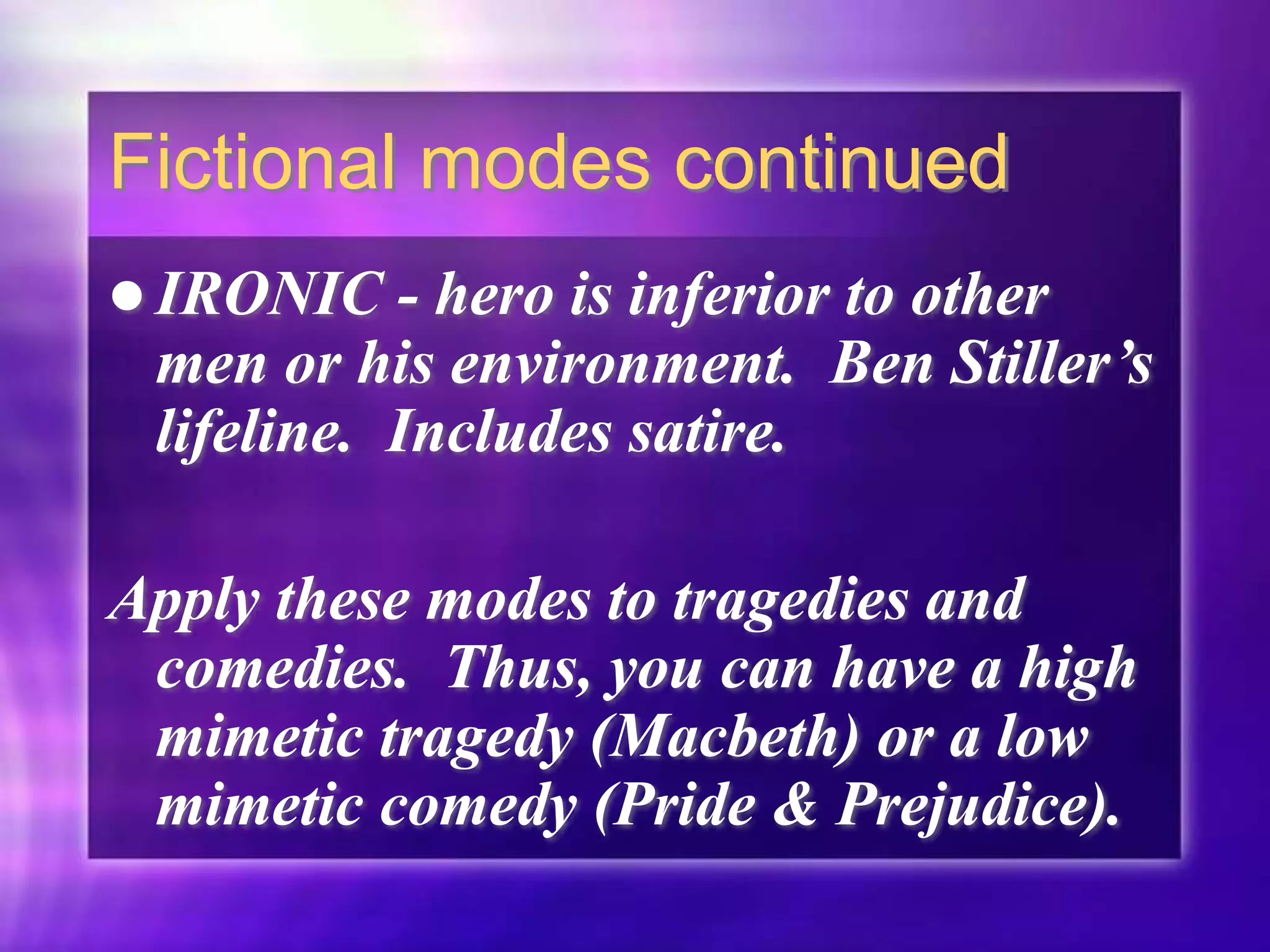
Fictional modes continued
 IRONIC - hero is inferior to other
men or his environment. Ben Stiller’s
lifeline. Includes satire.
Apply these modes to tragedies and
comedies. Thus, you can have a high
mimetic tragedy (Macbeth) or a low
mimetic comedy (Pride & Prejudice).
Archetypes
 Definition: a symbol, usually an
image, which recurs often enough in
literature to be recognizable as an
element of one’s literary experience as
a whole (individually and collectively)
Apocalyptic vs. Demonic
 Apocalyptic: archetypes that reflect
ultimate human desire (roughly
equated with our sense of heaven)
 Demonic: archetypes that reflect
everything that society rejects; a total
inversion of the apocalyptic (roughly
equated with our sense of hell)
Archetypal forms
 Divine world = society of gods
 Human world = society of men
 Animal world = domesticated flocks
 Vegetable world = garden
 Mineral world = cities, construction
Apocalyptic imagery: divine
• One God
• All ultimate unity
• Idealized world
• Magic
• Emphasis on heavenly bodies
** Mythical AND analogical
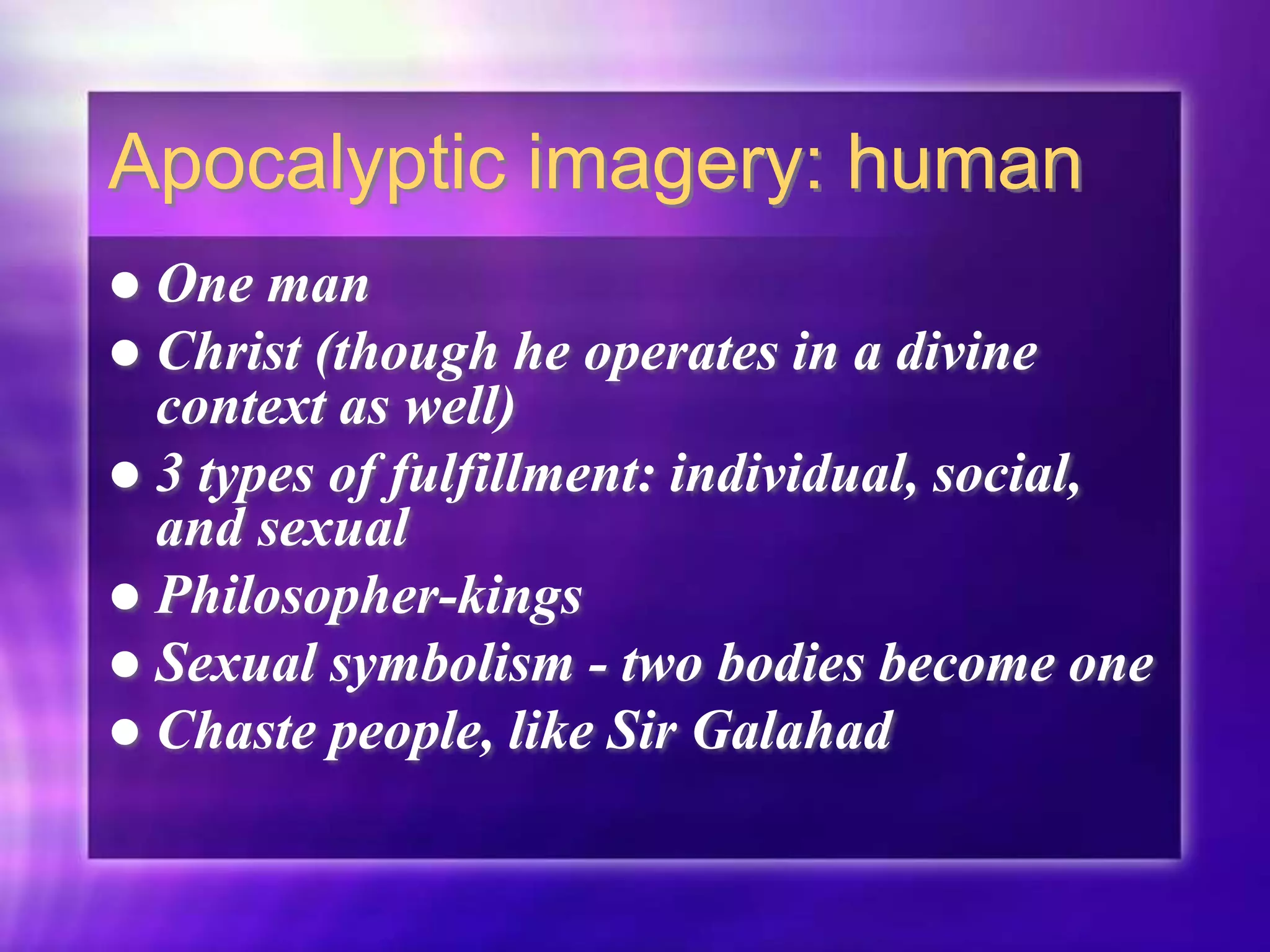
Apocalyptic imagery: human
 One man
 Christ (though he operates in a divine
context as well)
 3 types of fulfillment: individual, social,
and sexual
 Philosopher-kings
 Sexual symbolism - two bodies become one
 Chaste people, like Sir Galahad
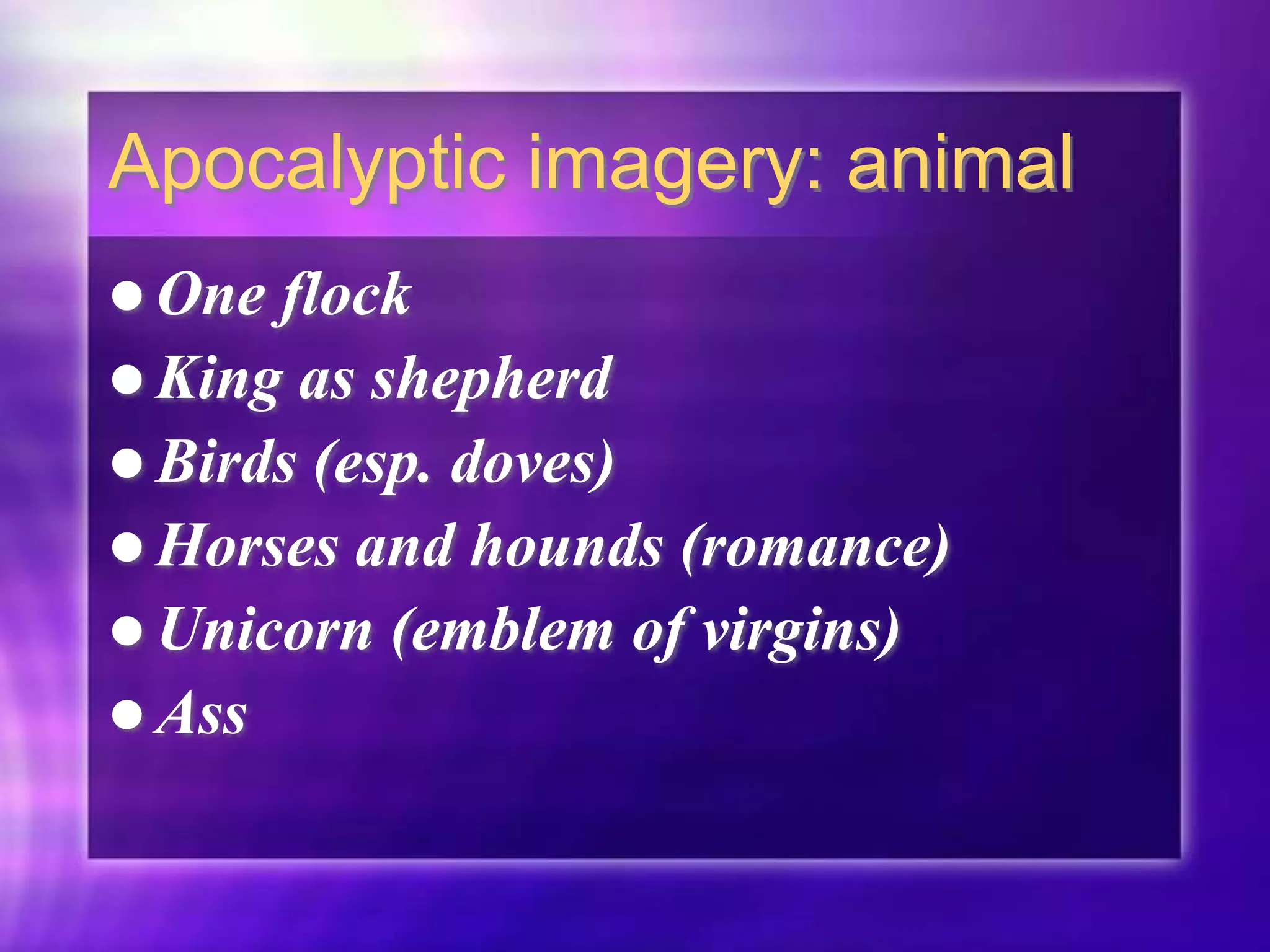
Apocalyptic imagery: animal
 One flock
 King as shepherd
 Birds (esp. doves)
 Horses and hounds (romance)
 Unicorn (emblem of virgins)
 Ass
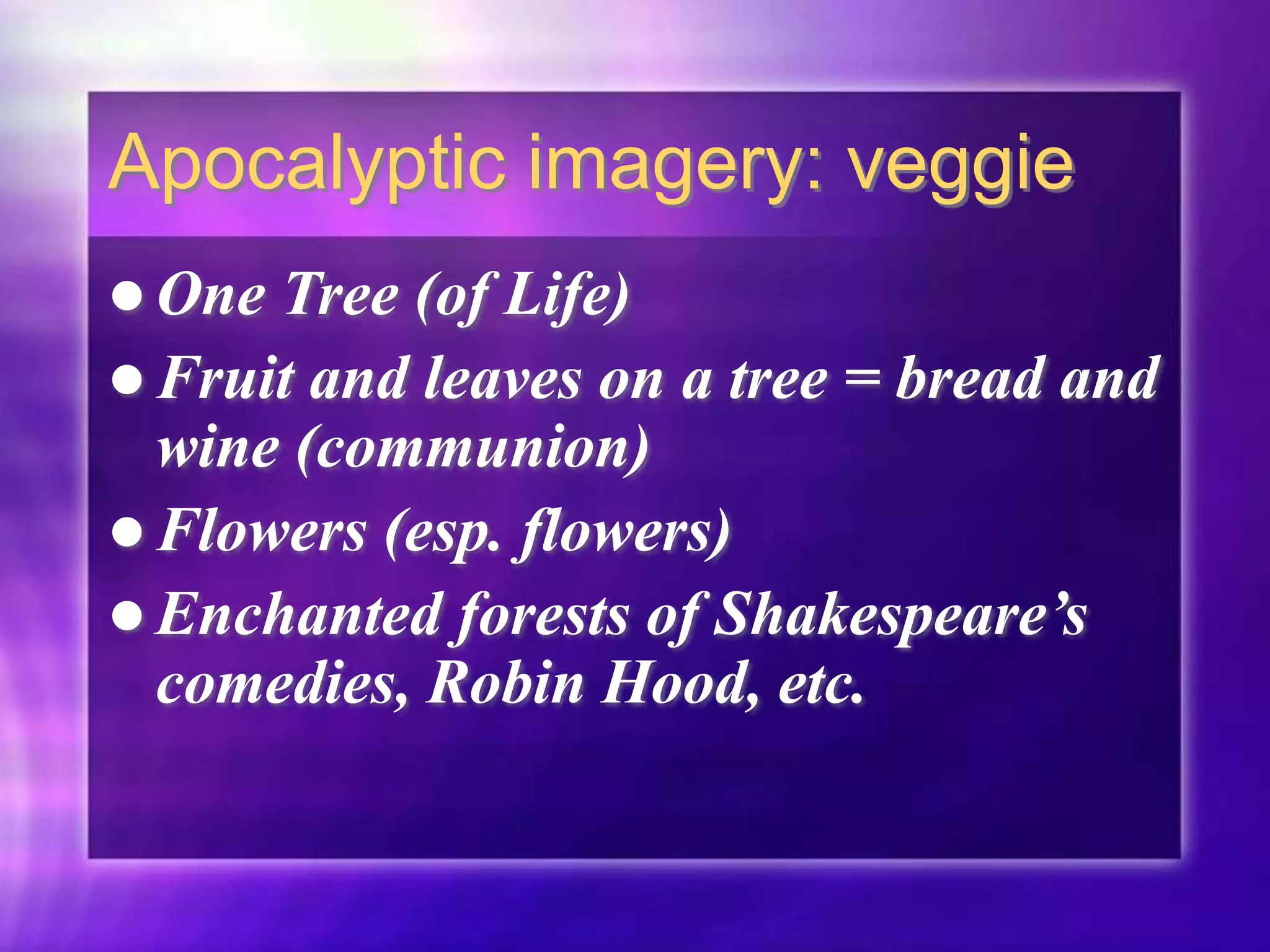
Apocalyptic imagery: veggie
 One Tree (of Life)
 Fruit and leaves on a tree = bread and
wine (communion)
 Flowers (esp. flowers)
 Enchanted forests of Shakespeare’s
comedies, Robin Hood, etc.
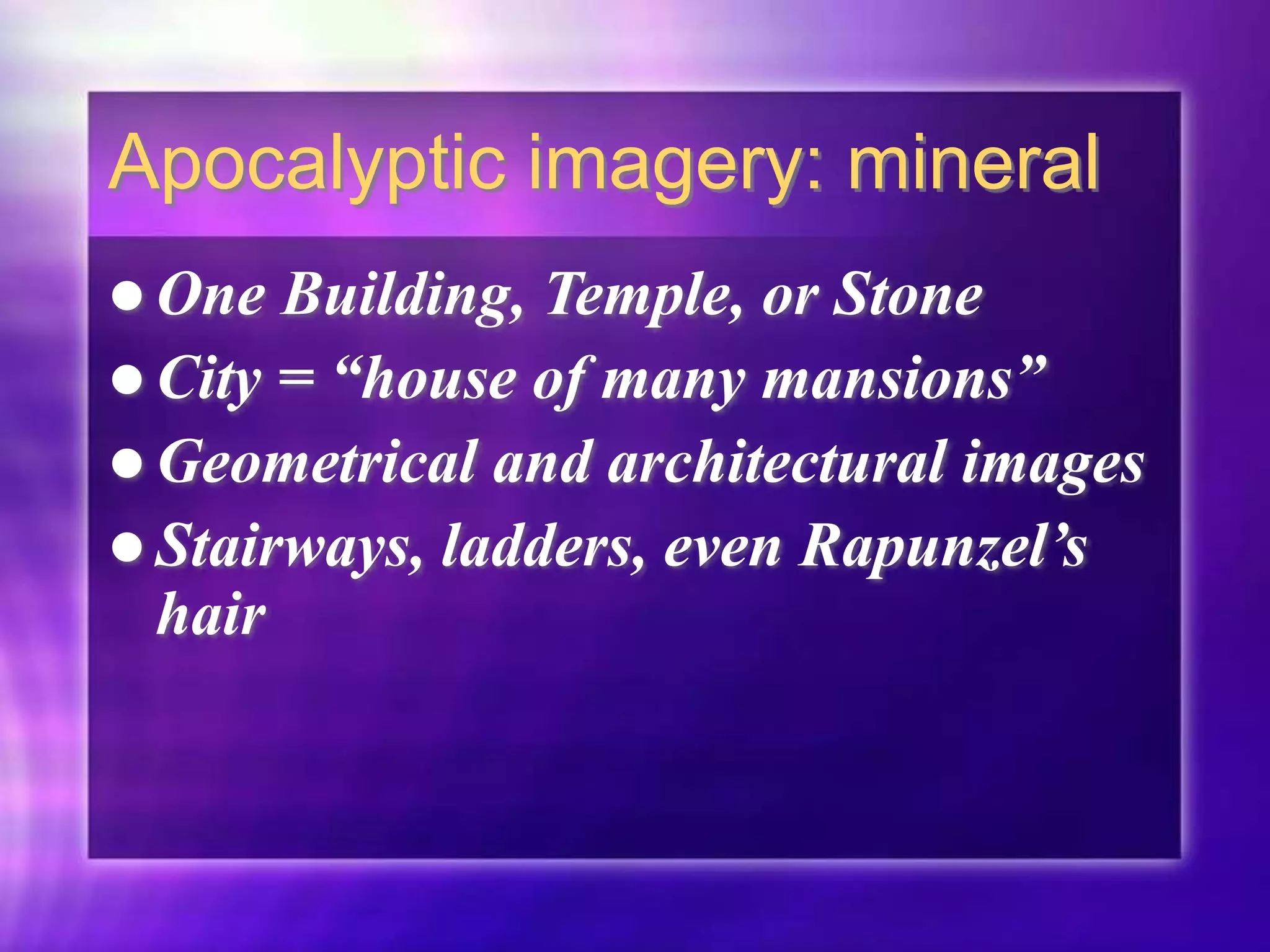
Apocalyptic imagery: mineral
 One Building, Temple, or Stone
 City = “house of many mansions”
 Geometrical and architectural images
 Stairways, ladders, even Rapunzel’s
hair
Demonic imagery: divine
Perversions of apocalyptic imagery are
called MODULATIONS.
 Vast, menacing powers of nature
 Fate
 Sense of human remoteness and
futility
Demonic imagery: human
 Ego runs rampant
 Perversion of the 3 areas of
fulfillment in apocalyptic imagery
 Loyalty to a tyrant diminishes the
individual
 Sacrificial victim, scapegoat
 Mob violence blends the first 2
Demonic imagery: animal
 Monsters, beasts of prey
 Wolf, traditional enemy of sheep
 Tiger
 Vulture
 Serpent
 Dragon (soooo contextual)
Demonic imagery: veggie
 Sinister forest
 Heath (recall Macbeth)
 Waste land
 Scaffold (as a modulation of the tree
of life)
Demonic imagery: mineral
 Waste land (again)
 Cities of sin and destruction (Babel,
Reno, etc.)
 Images of perverted work
(instruments of torture or war)
 Sinister spirals (maelstrom)
Archetypes and Cycles
Images fall into cyclical movements.
1. Divine = death/rebirth
2. Fire-world = heavenly bodies
3. Human = dreaming/waking
4. Animal = life/death
5. Veggie = natural cycles (seasons)
6. Mineral = golden ages, etc.
7. Water cycles
Cycles and Genres
 4 Mythoi: generic plots
 These 4 mythoi can be seen as aspects
of a single unifying myth, which
corresponds this way…
Agon - conflict
Pathos - catastrophe
Sparagmos - anarchy
Anagnorisis - recognition/triumph
Mythos of Spring: Comedy
 Young man wants young woman.
 Resisted by some opposition.
 Twist enables the hero to have his
will.
 Appearance/adoption of a new society
or social order.
 Often paternal figures provide
opposition.
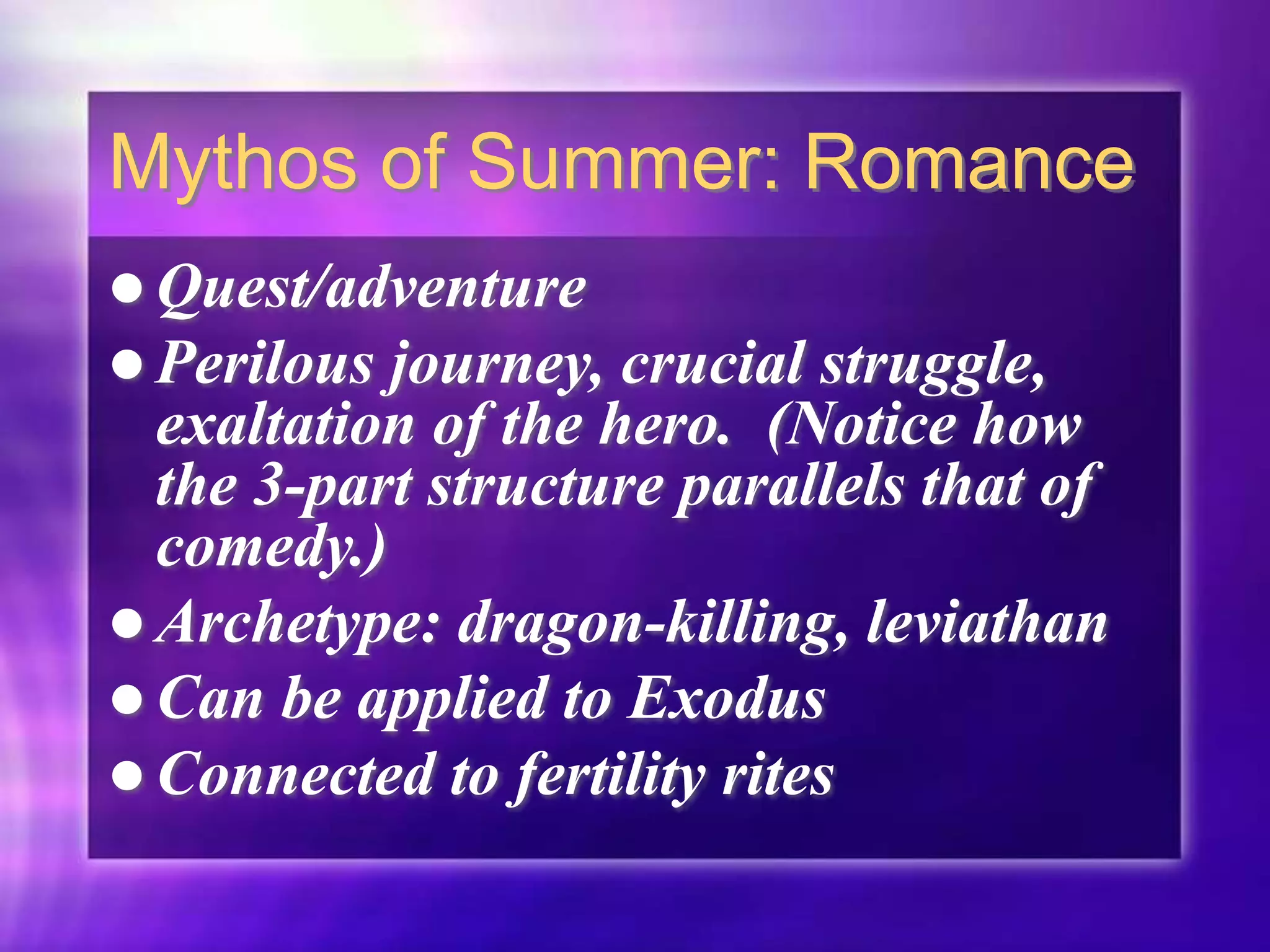
Mythos of Summer: Romance
 Quest/adventure
 Perilous journey, crucial struggle,
exaltation of the hero. (Notice how
the 3-part structure parallels that of
comedy.)
 Archetype: dragon-killing, leviathan
 Can be applied to Exodus
 Connected to fertility rites
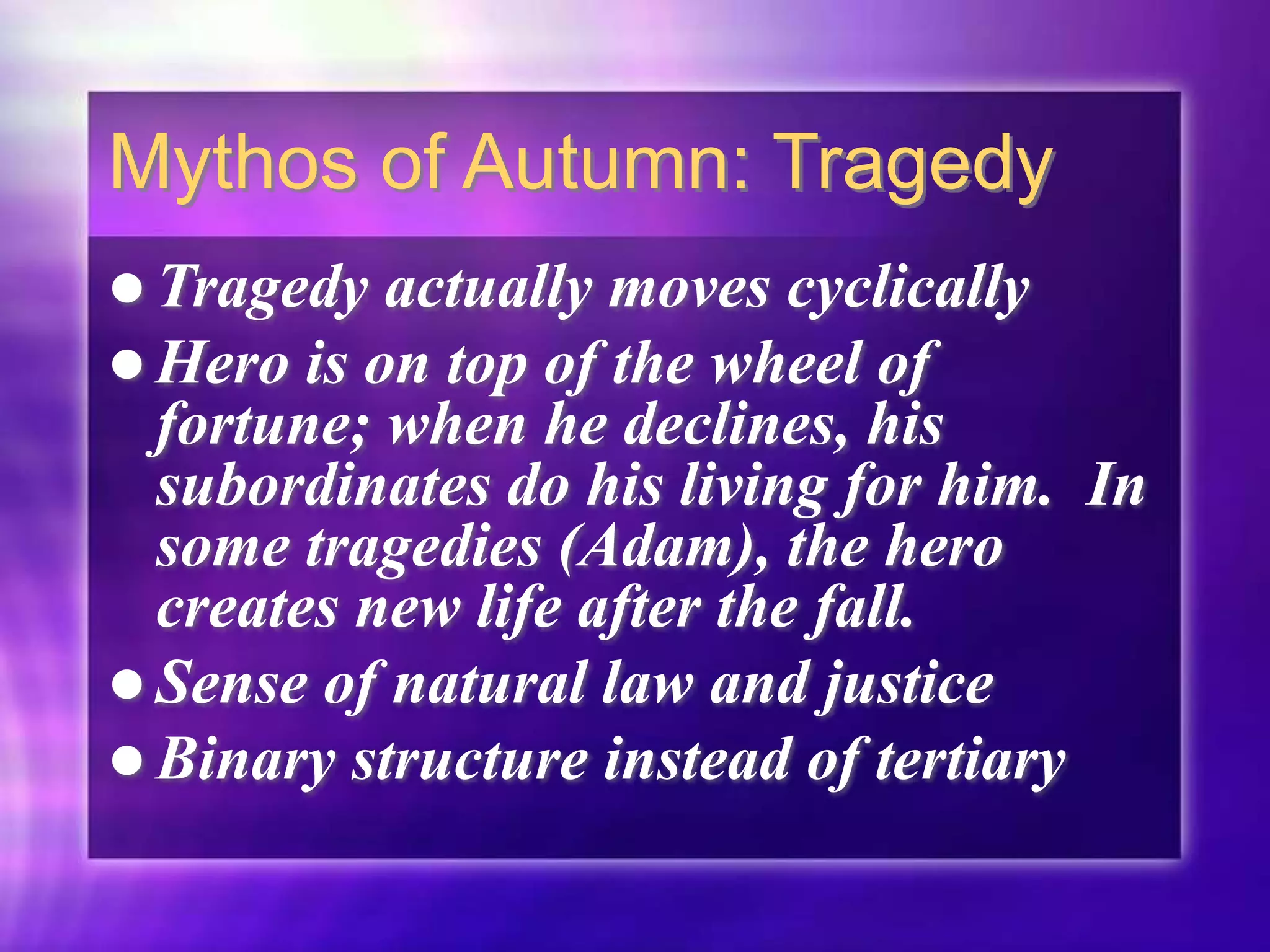
Mythos of Autumn: Tragedy
 Tragedy actually moves cyclically
 Hero is on top of the wheel of
fortune; when he declines, his
subordinates do his living for him. In
some tragedies (Adam), the hero
creates new life after the fall.
 Sense of natural law and justice
 Binary structure instead of tertiary
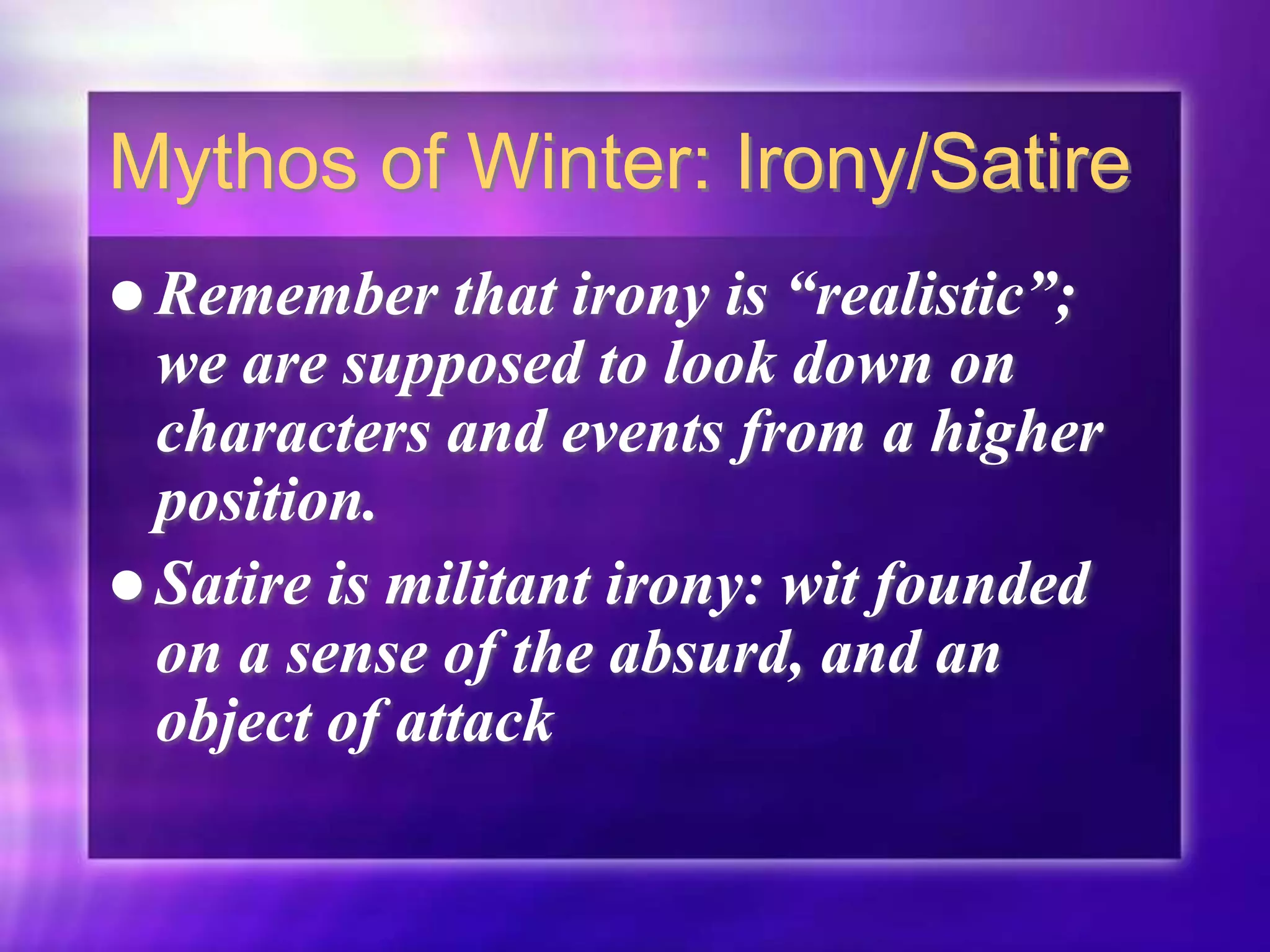
Mythos of Winter: Irony/Satire
 Remember that irony is “realistic”;
we are supposed to look down on
characters and events from a higher
position.
 Satire is militant irony: wit founded
on a sense of the absurd, and an
object of attack
Wheeee! You’re done!

Structuralism_and_Semiotics.ppt

  • 1.
  • 2.
    Dudes to know: Ferdinand deSaussure  Claude Levi-Strauss  Roland Barthes  Jacques Lacan  Michel Foucault  Northrop Frye**
  • 3.
    Context  As aliterary theory, developed in the 1950s and 1960s, adopted from theories other areas such as sociology, psychoanalysis, anthropology, etc. **All interrelated!**  Reactionary criticism, attempts to place literature into a system and assign value judgments to works.
  • 4.
    Principles of Structuralism Meaning occurs through difference and SIGNS’ relationship to each other. Ex: woman vs. lady  Much of our imaginative world is structured in binary sets (opposites) which assign structure and meaning to signs. Ex: cruel vs. humane
  • 5.
    Principles of Structuralism Forms the basis of SEMIOTICS, the study of signs.  Sign = union of SIGNIFIER and SIGNIFIED. Ex: c-a-t, fuzzy critter that goes “meow”  CODES provide signs with context - cultural context, literary context, etc.
  • 6.
    Principles of Structuralism Emphasizes that humans create meaning. Structuralism, then, allows us to examine our relationships with literature, art, society, etc.  Our sense of self -- our consciousness -- exists in relation to outside collective influences. We are NOT self-contained!
  • 7.
    Principles of Structuralism Reality is conventional; our perceptions of the world around us are bound up in conventions, codes, signs, etc. The “social construction of reality”.  Structuralism’s ultimate argument is this…
  • 8.
    There is aconnection between our concept of reality, the self, society, consciousness, and unconsciousness. They are all connected to each other and are bound by the same laws, signs, and conventions.
  • 9.
    When reading a“text”: Look for…  Parallels in plot  Echoes in structure  Reflections/repetitions in character/motive  Contrasts in situation/circumstance  Patterns in language/imagery
  • 10.
    Barthes’ five “codes” Barthesidentifies five codes which he says provide the underlying narrative structures for all literature. When reading, attempt to place a work in the system of codes.
  • 11.
    The codes are: 1.Proairetic - provides indications of actions; “reality”. Ex: The ship sailed at noon. 2. Hermeneutic - poses questions or enigmas that provide narrative suspense and involve the reader. Ex: if the narration indicates a knock on the door, the reader asks herself, “Who is it?”
  • 12.
    Codes continued 3. Cultural- contains references beyond the text which are considered common knowledge (allusions, metonymy). Ex: if a character is described as driving a hybrid car, there are certain cultural assumptions attached to that character.
  • 13.
    Codes continued 4. Semic- linked to a theme on the character level, when a series of signs and ideas surround an individual. 5. Symbolic - linked to theme on a larger level. Consists of contrasts and pairings related to the most basic binary polarities - man/woman, good/evil, lost/recovered, etc. **
  • 14.
    Frye’s fictional modes MYTH - the hero is superior in kind to other men and the environment of other men; generally a story about a god  ROMANCE - the hero is superior in degree to other men; ordinary laws of nature are suspended; often has supernatural powers
  • 15.
    Fictional modes continued HIGH MIMETIC - superior to men, but not to the environment; hero is a leader. (Often found in epic and tragedy.)  LOW MIMETIC - Jane Austen’s bread and butter. Everyday hero; appeals to our common sense of humanity. Romantic comedies.
  • 16.
    Fictional modes continued IRONIC - hero is inferior to other men or his environment. Ben Stiller’s lifeline. Includes satire. Apply these modes to tragedies and comedies. Thus, you can have a high mimetic tragedy (Macbeth) or a low mimetic comedy (Pride & Prejudice).
  • 17.
    Archetypes  Definition: asymbol, usually an image, which recurs often enough in literature to be recognizable as an element of one’s literary experience as a whole (individually and collectively)
  • 18.
    Apocalyptic vs. Demonic Apocalyptic: archetypes that reflect ultimate human desire (roughly equated with our sense of heaven)  Demonic: archetypes that reflect everything that society rejects; a total inversion of the apocalyptic (roughly equated with our sense of hell)
  • 19.
    Archetypal forms  Divineworld = society of gods  Human world = society of men  Animal world = domesticated flocks  Vegetable world = garden  Mineral world = cities, construction
  • 20.
    Apocalyptic imagery: divine •One God • All ultimate unity • Idealized world • Magic • Emphasis on heavenly bodies ** Mythical AND analogical
  • 21.
    Apocalyptic imagery: human One man  Christ (though he operates in a divine context as well)  3 types of fulfillment: individual, social, and sexual  Philosopher-kings  Sexual symbolism - two bodies become one  Chaste people, like Sir Galahad
  • 22.
    Apocalyptic imagery: animal One flock  King as shepherd  Birds (esp. doves)  Horses and hounds (romance)  Unicorn (emblem of virgins)  Ass
  • 23.
    Apocalyptic imagery: veggie One Tree (of Life)  Fruit and leaves on a tree = bread and wine (communion)  Flowers (esp. flowers)  Enchanted forests of Shakespeare’s comedies, Robin Hood, etc.
  • 24.
    Apocalyptic imagery: mineral One Building, Temple, or Stone  City = “house of many mansions”  Geometrical and architectural images  Stairways, ladders, even Rapunzel’s hair
  • 25.
    Demonic imagery: divine Perversionsof apocalyptic imagery are called MODULATIONS.  Vast, menacing powers of nature  Fate  Sense of human remoteness and futility
  • 26.
    Demonic imagery: human Ego runs rampant  Perversion of the 3 areas of fulfillment in apocalyptic imagery  Loyalty to a tyrant diminishes the individual  Sacrificial victim, scapegoat  Mob violence blends the first 2
  • 27.
    Demonic imagery: animal Monsters, beasts of prey  Wolf, traditional enemy of sheep  Tiger  Vulture  Serpent  Dragon (soooo contextual)
  • 28.
    Demonic imagery: veggie Sinister forest  Heath (recall Macbeth)  Waste land  Scaffold (as a modulation of the tree of life)
  • 29.
    Demonic imagery: mineral Waste land (again)  Cities of sin and destruction (Babel, Reno, etc.)  Images of perverted work (instruments of torture or war)  Sinister spirals (maelstrom)
  • 30.
    Archetypes and Cycles Imagesfall into cyclical movements. 1. Divine = death/rebirth 2. Fire-world = heavenly bodies 3. Human = dreaming/waking 4. Animal = life/death 5. Veggie = natural cycles (seasons) 6. Mineral = golden ages, etc. 7. Water cycles
  • 31.
    Cycles and Genres 4 Mythoi: generic plots  These 4 mythoi can be seen as aspects of a single unifying myth, which corresponds this way… Agon - conflict Pathos - catastrophe Sparagmos - anarchy Anagnorisis - recognition/triumph
  • 32.
    Mythos of Spring:Comedy  Young man wants young woman.  Resisted by some opposition.  Twist enables the hero to have his will.  Appearance/adoption of a new society or social order.  Often paternal figures provide opposition.
  • 33.
    Mythos of Summer:Romance  Quest/adventure  Perilous journey, crucial struggle, exaltation of the hero. (Notice how the 3-part structure parallels that of comedy.)  Archetype: dragon-killing, leviathan  Can be applied to Exodus  Connected to fertility rites
  • 34.
    Mythos of Autumn:Tragedy  Tragedy actually moves cyclically  Hero is on top of the wheel of fortune; when he declines, his subordinates do his living for him. In some tragedies (Adam), the hero creates new life after the fall.  Sense of natural law and justice  Binary structure instead of tertiary
  • 35.
    Mythos of Winter:Irony/Satire  Remember that irony is “realistic”; we are supposed to look down on characters and events from a higher position.  Satire is militant irony: wit founded on a sense of the absurd, and an object of attack
  • 36.