Globalization
What is Globalization?
The shift toward a more
integrated and
interdependent world
economy
Two components:
The globalization of markets
The globalization of production
Globalization of
Production
 Vizio flat panel TV is
 designed in a small office in California
 assembled in Mexico
 From
 panels made in South Korea
 electronic components made in China
 microprocessors made in the U.S.
Not just manufacturing…
 Globalization of production has
historically been about manufacturing
 Increasingly companies are using
modern communications to outsource
service activities to low-cost nations
Globalization of markets
 In the past, each country had
its own companies in many industries
and its own products
 I never saw Japanese media (and I saw
little non-US media) in college
Today everyone knows…
 Nintendo
 Starbucks
 Coca-Cola
 Ikea
 McDonald’s
 Samsung
But the most global markets
are for standard goods
Aluminum
Wheat
Microprocessors
Aircraft
 For many consumer end-products,
huge differences still exist among
national markets
 Entertainment, food, clothing
Drivers of Globalization
Two factors underlie globalization
“Decline in barriers to the free flow of
goods, services, and capital” that has
occurred since the end of World War II
Technological change
Declining Trade and
Investment Barriers
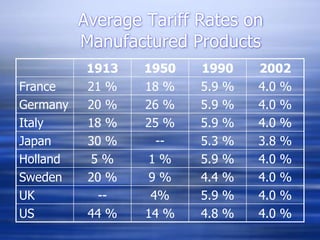
 During the 1920s and ‘30s, many of
nations erected formidable barriers to
international trade and
foreign direct investment
 Advanced industrial nations of the West
committed themselves after World War II
to removing barriers to the free flow of
goods, services, and capital between
nations.
Average Tariff Rates on
Manufactured Products
1913 1950 1990 2002
France 21 % 18 % 5.9 % 4.0 %
Germany 20 % 26 % 5.9 % 4.0 %
Italy 18 % 25 % 5.9 % 4.0 %
Japan 30 % -- 5.3 % 3.8 %
Holland 5 % 1 % 5.9 % 4.0 %
Sweden 20 % 9 % 4.4 % 4.0 %
UK -- 4% 5.9 % 4.0 %
US 44 % 14 % 4.8 % 4.0 %
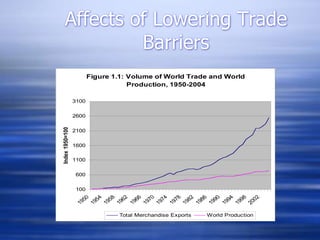
Affects of Lowering Trade
Barriers
Figure 1.1: Volume of World Trade and World
Production, 1950-2004
100
600
1100
1600
2100
2600
3100
1
9
5
0
1
9
5
4
1
9
5
8
1
9
6
2
1
9
6
6
1
9
7
0
1
9
7
4
1
9
7
8
1
9
8
2
1
9
8
6
1
9
9
0
1
9
9
4
1
9
9
8
2
0
0
2
Index
1950=100
Total Merchandise Exports World Production
The Role of Technology
 Lowering of trade barriers made
globalization possible;
 Technology has made it a
transforming movement
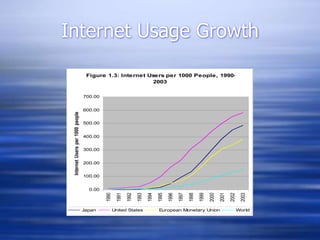
Internet Usage Growth
Figure 1.3: Internet Users per 1000 People, 1990-
2003
0.00
100.00
200.00
300.00
400.00
500.00
600.00
700.00
1990
1991
1992
1993
1994
1995
1996
1997
1998
1999
2000
2001
2002
2003
Internet
Users
per
1000
people
Japan United States European Monetary Union World
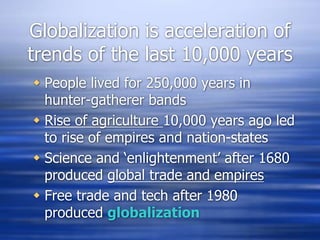
Globalization is acceleration of
trends of the last 10,000 years
 People lived for 250,000 years in
hunter-gatherer bands
 Rise of agriculture 10,000 years ago led
to rise of empires and nation-states
 Science and ‘enlightenment’ after 1680
produced global trade and empires
 Free trade and tech after 1980
produced globalization
The Emergence
of Global Institutions
Notable global institutions include
 the World Trade Organization (WTO) which is
responsible for policing the world trading
system and ensuring that nations adhere to
the rules established in WTO treaties
 In 2008, 151 nations accounting for 97% of world
trade were members of the WTO
 the International Monetary Fund (IMF) which
maintains order in the international monetary
system
The Changing Roles of Countries
in
the Global Economy
In the 1960s:
 The U.S. dominated the world economy and
the world trade picture
 U.S. multinationals dominated the
international business scene
 About half the world-- the centrally planned
economies of the communist world-- was off
limits to Western international business
Today, much of this has changed.
The Changing World Output
and World Trade Picture
 In the early 1960s, the U.S. was the world's
dominant industrial power accounting for
about 40.3% of world manufacturing output
 By 2007, the U.S. accounted for only 20.7%
 Other developed nations experienced a similar
decline
The Changing Nature of
the Multinational Enterprise
 Since the 1960s,
 there has been a rise in non-U.S.
multinationals
 there has been a rise in mini-multinationals
The Globalization Debate
Pro
 Lower prices for goods
and services
 Economic growth
 Increase in consumer
income
 Creates jobs (for many)
 Countries specialize in
production of goods and
services that are
produced most
efficiently
Con
 Destroys manufacturing
jobs in wealthy nations
 Wage rates of unskilled
in advanced countries
decline
 Companies move to
countries with fewer
labor and environment
regulations
 Loss of sovereignty
 Homogenized cultures
Managing in the Global
Marketplace
 Much of this course is concerned
with managing an international
business
 i.e., any business with international
 sales,
 sourcing, or
 Investment
Managing an international
business is different
 Countries are different
 International transactions involve converting
money into different currencies
 Range of problems in an international
business is wider and problems are
more complex
 International business must cope with
different, conflicting government rules
and systems
 Different strategic approaches required
Key terms
 An international business – any
business with international sales,
sourcing, or investment
 A multinational business – any
business with productive activities in
2 or more countries
 A global business – a business that
takes a global approach to production
and sourcing (Coca-Cola, Intel)
The Emergence
of Global Institutions
 the World Bank which promotes economic
development
 the United Nations (UN) which maintains
international peace and security, develops
friendly relations among nations, cooperates
in solving international problems and
promotes respect for human rights, and is a
center for harmonizing the actions of nations

Chapter 01Globaliz.ppt

  • 1.
  • 2.
    What is Globalization? Theshift toward a more integrated and interdependent world economy Two components: The globalization of markets The globalization of production
  • 3.
    Globalization of Production  Vizioflat panel TV is  designed in a small office in California  assembled in Mexico  From  panels made in South Korea  electronic components made in China  microprocessors made in the U.S.
  • 4.
    Not just manufacturing… Globalization of production has historically been about manufacturing  Increasingly companies are using modern communications to outsource service activities to low-cost nations
  • 5.
    Globalization of markets In the past, each country had its own companies in many industries and its own products  I never saw Japanese media (and I saw little non-US media) in college
  • 6.
    Today everyone knows… Nintendo  Starbucks  Coca-Cola  Ikea  McDonald’s  Samsung
  • 7.
    But the mostglobal markets are for standard goods Aluminum Wheat Microprocessors Aircraft  For many consumer end-products, huge differences still exist among national markets  Entertainment, food, clothing
  • 8.
    Drivers of Globalization Twofactors underlie globalization “Decline in barriers to the free flow of goods, services, and capital” that has occurred since the end of World War II Technological change
  • 9.
    Declining Trade and InvestmentBarriers  During the 1920s and ‘30s, many of nations erected formidable barriers to international trade and foreign direct investment  Advanced industrial nations of the West committed themselves after World War II to removing barriers to the free flow of goods, services, and capital between nations.
  • 10.
    Average Tariff Rateson Manufactured Products 1913 1950 1990 2002 France 21 % 18 % 5.9 % 4.0 % Germany 20 % 26 % 5.9 % 4.0 % Italy 18 % 25 % 5.9 % 4.0 % Japan 30 % -- 5.3 % 3.8 % Holland 5 % 1 % 5.9 % 4.0 % Sweden 20 % 9 % 4.4 % 4.0 % UK -- 4% 5.9 % 4.0 % US 44 % 14 % 4.8 % 4.0 %
  • 11.
    Affects of LoweringTrade Barriers Figure 1.1: Volume of World Trade and World Production, 1950-2004 100 600 1100 1600 2100 2600 3100 1 9 5 0 1 9 5 4 1 9 5 8 1 9 6 2 1 9 6 6 1 9 7 0 1 9 7 4 1 9 7 8 1 9 8 2 1 9 8 6 1 9 9 0 1 9 9 4 1 9 9 8 2 0 0 2 Index 1950=100 Total Merchandise Exports World Production
  • 12.
    The Role ofTechnology  Lowering of trade barriers made globalization possible;  Technology has made it a transforming movement
  • 13.
    Internet Usage Growth Figure1.3: Internet Users per 1000 People, 1990- 2003 0.00 100.00 200.00 300.00 400.00 500.00 600.00 700.00 1990 1991 1992 1993 1994 1995 1996 1997 1998 1999 2000 2001 2002 2003 Internet Users per 1000 people Japan United States European Monetary Union World
  • 14.
    Globalization is accelerationof trends of the last 10,000 years  People lived for 250,000 years in hunter-gatherer bands  Rise of agriculture 10,000 years ago led to rise of empires and nation-states  Science and ‘enlightenment’ after 1680 produced global trade and empires  Free trade and tech after 1980 produced globalization
  • 15.
    The Emergence of GlobalInstitutions Notable global institutions include  the World Trade Organization (WTO) which is responsible for policing the world trading system and ensuring that nations adhere to the rules established in WTO treaties  In 2008, 151 nations accounting for 97% of world trade were members of the WTO  the International Monetary Fund (IMF) which maintains order in the international monetary system
  • 16.
    The Changing Rolesof Countries in the Global Economy In the 1960s:  The U.S. dominated the world economy and the world trade picture  U.S. multinationals dominated the international business scene  About half the world-- the centrally planned economies of the communist world-- was off limits to Western international business Today, much of this has changed.
  • 17.
    The Changing WorldOutput and World Trade Picture  In the early 1960s, the U.S. was the world's dominant industrial power accounting for about 40.3% of world manufacturing output  By 2007, the U.S. accounted for only 20.7%  Other developed nations experienced a similar decline
  • 18.
    The Changing Natureof the Multinational Enterprise  Since the 1960s,  there has been a rise in non-U.S. multinationals  there has been a rise in mini-multinationals
  • 19.
    The Globalization Debate Pro Lower prices for goods and services  Economic growth  Increase in consumer income  Creates jobs (for many)  Countries specialize in production of goods and services that are produced most efficiently Con  Destroys manufacturing jobs in wealthy nations  Wage rates of unskilled in advanced countries decline  Companies move to countries with fewer labor and environment regulations  Loss of sovereignty  Homogenized cultures
  • 20.
    Managing in theGlobal Marketplace  Much of this course is concerned with managing an international business  i.e., any business with international  sales,  sourcing, or  Investment
  • 21.
    Managing an international businessis different  Countries are different  International transactions involve converting money into different currencies  Range of problems in an international business is wider and problems are more complex  International business must cope with different, conflicting government rules and systems  Different strategic approaches required
  • 24.
    Key terms  Aninternational business – any business with international sales, sourcing, or investment  A multinational business – any business with productive activities in 2 or more countries  A global business – a business that takes a global approach to production and sourcing (Coca-Cola, Intel)
  • 25.
    The Emergence of GlobalInstitutions  the World Bank which promotes economic development  the United Nations (UN) which maintains international peace and security, develops friendly relations among nations, cooperates in solving international problems and promotes respect for human rights, and is a center for harmonizing the actions of nations