

HERMENEUTICAL ANALYSIS
Gautam Kumar
Pre PhD scholar
RIE, Bhubaneswar
INTRODUCTION
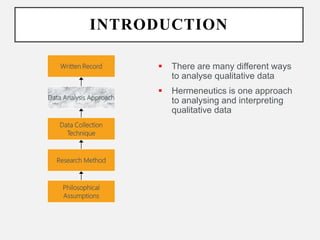
Written Record
Data Analysis Approach
Data Collection
Technique
Research Method
Philosophical
Assumptions
 There are many different ways
to analyse qualitative data
 Hermeneutics is one approach
to analysing and interpreting
qualitative data
HERMENEUTICS
• Hermeneutics focuses primarily on the meaning of qualitative data, especially textual
data.
• The purpose of using hermeneutics is to aid human understanding
MEANING OF HERMENEUTICS
• The origin of the term hermeneutics (from the Greek
hermënuetikós) bears an obvious reference to Hermes, the
messenger god of the ancient Greeks.
• Hermes had to understand and interpret for himself what the
God wanted to communicate before he could translate,
articulate, and explicate this to their people (Mueller-Vollmer,
1986).
• Hermes had to 'explain' what the God’s intentions
were to people, his explanations were clarifications
aimed at rendering what was unclear, clear it in order
to allow people to make sense of and understand what
was being conveyed.
• According to Thompson (1990, p. 230), hermeneutics
was"derived from the Greek verb, henneneueuein, 'to
interpret,' and from the noun, hermeneia, or
interpretation'.
HERMENEUTICS DEFINED
• Hermeneutics is defined as the theory or philosophy of the
interpretation of meaning (Bleicher, 1980).
• Hermeneutics, a method of textual analysis, emphasizes the
sociocultural and historic influences on inquiry. Hermeneutics
pertains to the process of exposing hidden meanings(Allen,
1995; Kisiel, 1985).
• ‘Interpretation, in the sense relevant to hermeneutics, is an
attempt to make clear, to make sense of an object of study. This
object must, therefore, be a text, or a text-analogue, which in
some way is confused, incomplete, cloudy, seemingly
contradictory - in one way or another, unclear. The
interpretation aims to bring to light an underlying coherence or
sense’ (Taylor ,1976)
PERSPECTIVES OF HERMENEUTICS
Coyne (1995) argues that contemporary hermeneutics is
characterized by at least four distinct perspectives, viz.the
conservative, pragmatic, critical, and the radical.
• Conservative. The task is to uncover the original meanings of
the action-text as intended by the author(Emilio Betti (1955) and
Eric Hirsch (1967)).
• Pragmatic Interpretation here involves entering into the
interpretative(Constructivist) norms of a community; meaning
here operates and is to befound within the historical contexts of
the interpreter and interpreted(Hans Georg Gadamer
(1975),Ludwig Wittgenstein (1953).
• Critical The purpose of interpretation here is emancipatory;
conventional wisdoms within communities are challenged in
order to address potential power asymmetries (Karl-Otto Apel
(1980) and Jurgen Habermas (1972,1980).
• Radical Here texts and social action are treated as an endless
play (Deconstructionist) of signs that reveal and conceal
knowledge through the play of difference and
contradiction(Jacques Derrida (1970, 1976).
HERMENEUTIC CONCEPTS
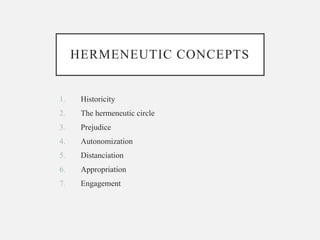
1. Historicity
2. The hermeneutic circle
3. Prejudice
4. Autonomization
5. Distanciation
6. Appropriation
7. Engagement
HISTORICITY
• Historicity refers to the thesis that who we are is
through and through historical
• Who we are is a function of the historical
circumstances and community that we find ourselves
in, the language we speak, the historically evolving
habits and practice we appropriate, the temporally
conditioned choices we make
• Hermeneutics defends the ontological claim that
human beings are their history (Wachterhauser, 1986)
THE HERMENEUTIC CIRCLE
• The hermeneutic circle refers to the dialectic between the
understanding of the text as a whole and the interpretation of its
parts, in which descriptions are guided by anticipated
explanations(Gadamer,1976)
• The hermeneutic circle suggests that we understand a complex
whole from preconceptions about the meanings of its parts
• Human understanding is achieved by iterating between the parts and
the whole which they form
• The goal of interpretation is ‘to produce a reading of the text that
fits all important details into a consistent, coherent message, one
that fits coherently into the context . . .’ (Diesing, 1991: 110)
PREJUDICE
• Hermeneutics suggests that ‘prejudice’, pre-judgement or prior
knowledge plays an important part in our understanding
• Our attempt to understand a text always involves some prior
knowledge or expectation of what the text is about. In fact
we cannot understand a text unless we have some
understanding of the language
• Hermeneutics suggests that understanding always involves
interpretation; interpretation means using one's own
preconceptions so that the meaning of the object can become
clear to us (Gadamer, 1975: 358)
• The critical task of hermeneutics then becomes one of
distinguishing between ’true prejudices, by which we
understand, from the false ones by which we misunderstand’
(Gadamer, 1976b: 124)
• As researchers we need to become aware of how our own
views, biases, culture and personal history have a significant
impact on how we view the world
AUTONOMIZATION
• Ricoeur (1981) makes an important distinction between
verbal speech and written text.
• He says that the author's meaning, once it is inscribed in
a text, takes on a life of its own. This process of
autonomization takes place whenever speech is inscribed
in a text.
• This means that the text now has an autonomous,
‘objective’ existence independent of the author. Once
something is published or in the public domain, it is
virtually impossible to take it back
DISTANCIATION
• Distanciation refers to the inevitable distance that occurs in
time and space between the text and its original author on
the one hand, and the readers of the text (the audience) on
the other.
• Since the text takes on a life of its own, it becomes
dissociated from the original author, the originally intended
audience, and even its original meaning.
APPROPRIATION AND ENGAGEMENT
• Ricoeur suggests that the hermeneutic task is to make
Aristotle's writings our own. The ‘text is the medium
through which we understand ourselves’ (Ricoeur, 1991:
87).
• Gadamer suggests that meaning does not reside in ‘the
subjective feelings of the interpreter’ nor in ‘the
intentions of the author’. Rather, meaning emerges from
the engagement of reader and text.
• This process of critical engagement with the text is
crucial
TYPES OF HERMENEUTICS
• Pure hermeneutics stresses empathic understanding from the
‘inside’ – it sees the text or object as ‘out there’ ready to be
investigated
• Post-modern hermeneutics says there is no such a thing as an
objective or ‘true’ meaning of a text. ‘Facts’ are what a cultural,
conversational community agrees they are (Madison, 1990:
191)
• Critical hermeneutics takes a middle position – the interpreter
has the important task of judging between alternative
explanations
• Depth hermeneutics assumes that the surface meaning of the
‘text’ hides, but also expresses, a deeper meaning
USING HERMENEUTICS
• In qualitative research studies about educational
practices, the ‘text’ is what people say and do
• Interviews, documents and your own field notes
record the views of the actors and describe certain
events, etc.
• This material needs to be ordered, explained and
interpreted in order to ‘make sense’ of the situation
• The ordering is done according to the researcher’s
theoretical position and by comparing one text with
another
• The researcher’s understanding of the whole has to be
continually revised in view of the reinterpretation of
the parts
CRITIQUE OF
HERMENEUTICS
• The main advantage of using hermeneutics is that it enables a
much deeper understanding of people in business settings
• Hermeneutics is well-grounded in philosophy and the social
sciences more generally and hence is relatively easy to justify
• One disadvantage of hermeneutics is that it focuses the
researcher almost entirely on text rather than lived experience
• Another potential disadvantage of hermeneutics is that it can be
difficult to know when to conclude a study: when does the
interpretive process stop?

Hermeneutical Analysis

  • 1.
    HERMENEUTICAL ANALYSIS Gautam Kumar PrePhD scholar RIE, Bhubaneswar
  • 2.
    INTRODUCTION Written Record Data AnalysisApproach Data Collection Technique Research Method Philosophical Assumptions  There are many different ways to analyse qualitative data  Hermeneutics is one approach to analysing and interpreting qualitative data
  • 3.
    HERMENEUTICS • Hermeneutics focusesprimarily on the meaning of qualitative data, especially textual data. • The purpose of using hermeneutics is to aid human understanding
  • 4.
    MEANING OF HERMENEUTICS •The origin of the term hermeneutics (from the Greek hermënuetikós) bears an obvious reference to Hermes, the messenger god of the ancient Greeks. • Hermes had to understand and interpret for himself what the God wanted to communicate before he could translate, articulate, and explicate this to their people (Mueller-Vollmer, 1986).
  • 5.
    • Hermes hadto 'explain' what the God’s intentions were to people, his explanations were clarifications aimed at rendering what was unclear, clear it in order to allow people to make sense of and understand what was being conveyed. • According to Thompson (1990, p. 230), hermeneutics was"derived from the Greek verb, henneneueuein, 'to interpret,' and from the noun, hermeneia, or interpretation'.
  • 6.
    HERMENEUTICS DEFINED • Hermeneuticsis defined as the theory or philosophy of the interpretation of meaning (Bleicher, 1980). • Hermeneutics, a method of textual analysis, emphasizes the sociocultural and historic influences on inquiry. Hermeneutics pertains to the process of exposing hidden meanings(Allen, 1995; Kisiel, 1985). • ‘Interpretation, in the sense relevant to hermeneutics, is an attempt to make clear, to make sense of an object of study. This object must, therefore, be a text, or a text-analogue, which in some way is confused, incomplete, cloudy, seemingly contradictory - in one way or another, unclear. The interpretation aims to bring to light an underlying coherence or sense’ (Taylor ,1976)
  • 7.
    PERSPECTIVES OF HERMENEUTICS Coyne(1995) argues that contemporary hermeneutics is characterized by at least four distinct perspectives, viz.the conservative, pragmatic, critical, and the radical. • Conservative. The task is to uncover the original meanings of the action-text as intended by the author(Emilio Betti (1955) and Eric Hirsch (1967)). • Pragmatic Interpretation here involves entering into the interpretative(Constructivist) norms of a community; meaning here operates and is to befound within the historical contexts of the interpreter and interpreted(Hans Georg Gadamer (1975),Ludwig Wittgenstein (1953).
  • 8.
    • Critical Thepurpose of interpretation here is emancipatory; conventional wisdoms within communities are challenged in order to address potential power asymmetries (Karl-Otto Apel (1980) and Jurgen Habermas (1972,1980). • Radical Here texts and social action are treated as an endless play (Deconstructionist) of signs that reveal and conceal knowledge through the play of difference and contradiction(Jacques Derrida (1970, 1976).
  • 9.
    HERMENEUTIC CONCEPTS 1. Historicity 2.The hermeneutic circle 3. Prejudice 4. Autonomization 5. Distanciation 6. Appropriation 7. Engagement
  • 10.
    HISTORICITY • Historicity refersto the thesis that who we are is through and through historical • Who we are is a function of the historical circumstances and community that we find ourselves in, the language we speak, the historically evolving habits and practice we appropriate, the temporally conditioned choices we make • Hermeneutics defends the ontological claim that human beings are their history (Wachterhauser, 1986)
  • 11.
    THE HERMENEUTIC CIRCLE •The hermeneutic circle refers to the dialectic between the understanding of the text as a whole and the interpretation of its parts, in which descriptions are guided by anticipated explanations(Gadamer,1976) • The hermeneutic circle suggests that we understand a complex whole from preconceptions about the meanings of its parts • Human understanding is achieved by iterating between the parts and the whole which they form • The goal of interpretation is ‘to produce a reading of the text that fits all important details into a consistent, coherent message, one that fits coherently into the context . . .’ (Diesing, 1991: 110)
  • 12.
    PREJUDICE • Hermeneutics suggeststhat ‘prejudice’, pre-judgement or prior knowledge plays an important part in our understanding • Our attempt to understand a text always involves some prior knowledge or expectation of what the text is about. In fact we cannot understand a text unless we have some understanding of the language • Hermeneutics suggests that understanding always involves interpretation; interpretation means using one's own preconceptions so that the meaning of the object can become clear to us (Gadamer, 1975: 358) • The critical task of hermeneutics then becomes one of distinguishing between ’true prejudices, by which we understand, from the false ones by which we misunderstand’ (Gadamer, 1976b: 124) • As researchers we need to become aware of how our own views, biases, culture and personal history have a significant impact on how we view the world
  • 13.
    AUTONOMIZATION • Ricoeur (1981)makes an important distinction between verbal speech and written text. • He says that the author's meaning, once it is inscribed in a text, takes on a life of its own. This process of autonomization takes place whenever speech is inscribed in a text. • This means that the text now has an autonomous, ‘objective’ existence independent of the author. Once something is published or in the public domain, it is virtually impossible to take it back
  • 14.
    DISTANCIATION • Distanciation refersto the inevitable distance that occurs in time and space between the text and its original author on the one hand, and the readers of the text (the audience) on the other. • Since the text takes on a life of its own, it becomes dissociated from the original author, the originally intended audience, and even its original meaning.
  • 15.
    APPROPRIATION AND ENGAGEMENT •Ricoeur suggests that the hermeneutic task is to make Aristotle's writings our own. The ‘text is the medium through which we understand ourselves’ (Ricoeur, 1991: 87). • Gadamer suggests that meaning does not reside in ‘the subjective feelings of the interpreter’ nor in ‘the intentions of the author’. Rather, meaning emerges from the engagement of reader and text. • This process of critical engagement with the text is crucial
  • 16.
    TYPES OF HERMENEUTICS •Pure hermeneutics stresses empathic understanding from the ‘inside’ – it sees the text or object as ‘out there’ ready to be investigated • Post-modern hermeneutics says there is no such a thing as an objective or ‘true’ meaning of a text. ‘Facts’ are what a cultural, conversational community agrees they are (Madison, 1990: 191) • Critical hermeneutics takes a middle position – the interpreter has the important task of judging between alternative explanations • Depth hermeneutics assumes that the surface meaning of the ‘text’ hides, but also expresses, a deeper meaning
  • 17.
    USING HERMENEUTICS • Inqualitative research studies about educational practices, the ‘text’ is what people say and do • Interviews, documents and your own field notes record the views of the actors and describe certain events, etc. • This material needs to be ordered, explained and interpreted in order to ‘make sense’ of the situation • The ordering is done according to the researcher’s theoretical position and by comparing one text with another • The researcher’s understanding of the whole has to be continually revised in view of the reinterpretation of the parts
  • 18.
    CRITIQUE OF HERMENEUTICS • Themain advantage of using hermeneutics is that it enables a much deeper understanding of people in business settings • Hermeneutics is well-grounded in philosophy and the social sciences more generally and hence is relatively easy to justify • One disadvantage of hermeneutics is that it focuses the researcher almost entirely on text rather than lived experience • Another potential disadvantage of hermeneutics is that it can be difficult to know when to conclude a study: when does the interpretive process stop?