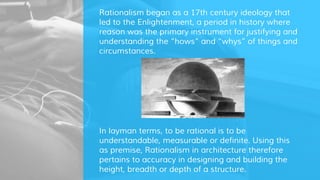
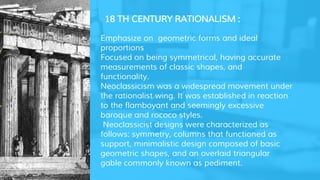
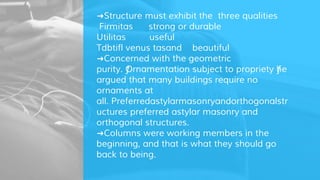
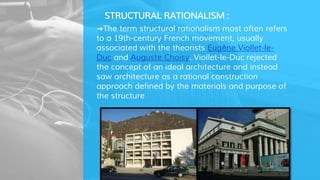
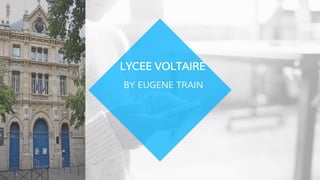
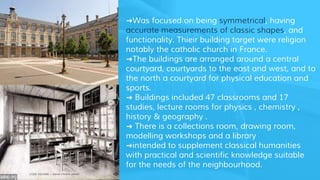
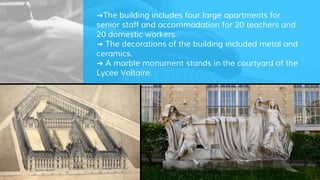
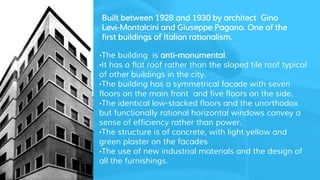
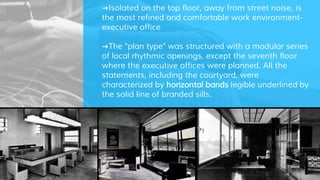
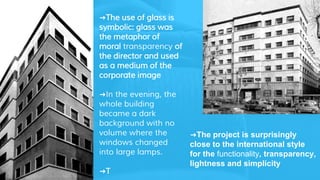
The document discusses structural rationalism in architecture from the 17th century to the 20th century. It began as an ideology focused on using reason and accurate measurements to design structures. In the 18th century, rationalism emphasized symmetrical geometric forms and neoclassical designs. Important rationalist architects like Viollet-le-Duc rejected ornamentation in favor of highlighting the functional structure. Examples given include the Lycee Voltaire school building and Palazzo Gualino office building, both employing modular designs, industrial materials, and functional floor plans.
![““In architecture, there are two necessary ways of being true. It must be true according
to the programme and true according to the methods of construction. To be true
according to the programme is to fulfill exactly and simply the conditions imposed by
need; to be true according to the methods of construction, is to employ the materials
according to their qualities and properties […] purely artistic questions of symmetry
and apparent form are only secondary conditions in the presence of our dominant
principles.”](https://image.slidesharecdn.com/structural-161016150055/85/Structural-rationalism-6-320.jpg)



![unit 1_Modernity&Architecture_251116_104341[1].pdf](https://cdn.slidesharecdn.com/ss_thumbnails/unit1modernityarchitecture2511161043411-251125083522-0646fcef-thumbnail.jpg?width=640&height=640&fit=bounds)


