Introduction to Enterprise Resource
Planning
Learning Advisor
Sanket Senapati
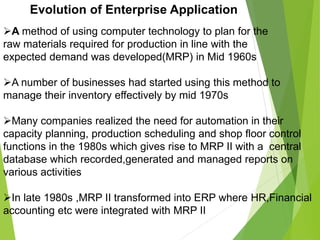
Evolution of Enterprise Application
A method of using computer technology to plan for the
raw materials required for production in line with the
expected demand was developed(MRP) in Mid 1960s
A number of businesses had started using this method to
manage their inventory effectively by mid 1970s
Many companies realized the need for automation in their
capacity planning, production scheduling and shop floor control
functions in the 1980s which gives rise to MRP II with a central
database which recorded,generated and managed reports on
various activities
In late 1980s ,MRP II transformed into ERP where HR,Financial
accounting etc were integrated with MRP II
2000s Extended ERP
1990s
Enterprise Resource Planning
(ERP)
1980s
Manufacturing Resources Planning (MRP II)
1970s
Material Requirements Planning (MRP)
1960s
Inventory Control Packages
ERP : An Overview
ERP is a software application that helps an organization
integrate various functions, make optimum utilization of
management resources and improve it’s process efficiency
Data entered in any one module is available to other
modules that need the data(Proves consistency and
Integrity of data)
What is ERP?
 The practice of consolidating an enterprise’s
planning, manufacturing, sales and marketing
efforts into one management system.
 Combines all databases across departments into a
single database that can be accessed by all
employees.
 ERP automates the tasks involved in performing a
business process.
5
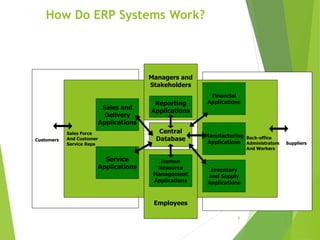
How Do ERP Systems Work?
6
Employees
Managers and
Stakeholders
Central
Database
Reporting
Applications
Human
Resource
Management
Applications
Financial
Applications
Manufacturing
Applications
Inventory
And Supply
Applications
Human
Resource
Management
Applications
Service
Applications
Sales and
Delivery
Applications
Sales Force
And Customer
Service Reps
Customers Back-office
Administrators
And Workers
Suppliers
ERP Requires
 Strong executive support to implement
 Process approach rather than “silos”
 Change in business procedures (BPR)
 Change in organizational structure, culture,
strategy
 Technology change
ERP
 Difficult to install
 Very large and complex software
 Provides info about all aspects of the business --
worldwide
 Reduces inventory, waste
 Easy communication with customers, suppliers
Before ERP
 Multiple systems, different interfaces,
difficult to extract info about customers,
sales,...
 Hard to maintain, many languages,
databases, inconsistencies
 Can take weeks or months to obtain info
about customers, or where systems
changes are needed
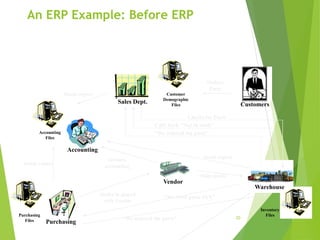
An ERP Example: Before ERP
10
Customers
Customer
Demographic
Files
Sales Dept.
Vendor
Orders
Parts
Accounting
Accounting
Files
Purchasing
Purchasing
Files
Order is placed
with Vendor
Invoices
accounting
Inventory
Files
Warehouse
Checks for Parts
Calls back “Not in stock”
“We ordered the parts”
“We Need parts #XX”
“We ordered the parts”
Sends report
Sends report
Sends report
Ships parts
After ERP
 Integrated systems
 Consistent interface
 One database
 Access to current data
 Improved planning capabilities
 Multinational capabilities
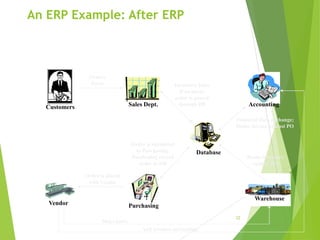
An ERP Example: After ERP
12
Database
Customers Sales Dept.
Purchasing
Warehouse
Accounting
Vendor
Inventory Data
If no parts,
order is placed
through DB
Orders
Parts
Order is submitted
to Purchasing.
Purchasing record
order in DB
Order is placed
with Vendor
And invoices accounting
Financial Data exchange;
Books invoice against PO
Books inventory
against PO
Ships parts
System automatically:
 Schedules shipping
 Reserves material
 Orders parts from suppliers
 Schedules assembly
 Checks customer credit limit
 Updates sales & production forecasts
 Creates MRP & bill-of-material lists
System automatically:
 Updates salesperson's payroll
 commission
 travel account
 Calculates product cost & profitability
 Updates accounting, financial records
Definition of Enterprise Architecture
The enterprise architecture is the organizing logic for a
firm’s core business processes and IT capabilities captured
in a set of principles, policies and technical choices to
achieve the business standardization and integration
requirements of the firm’s operating model.
Enterprise Architecture Planning
 ERP Architecture is multi layered which communicates
and transact among the members of Supply Chain with
ease
 It’s comprises hardware layer, relational database
layer,database access layer and application software
layers)
 One of the first activities of ERP
 A ERP architecture ensures management that the ERP
system supports the business processes intended
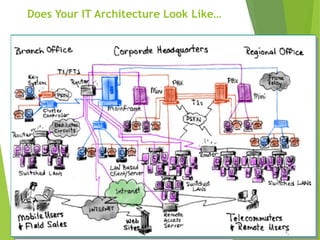
Does Your IT Architecture Look Like…
Why Enterprise Architecture
 IT costs too much
 Costs of managing complexity
 Eliminate redundancy
 Growing IT ecosystem
 Demanding rate of change
 Need for info sharing
 Outsourcing (BPO)
 Future-proofing
If you don’t have strong architecture strategy, everyone does their
own thing and you end up with six kinds of servers and (software)
platforms … you get silos of everything and that explodes your
costs”
Andy Miller VP of Technical Architecture, Corporate
Factors responsible for successful ERP
Ipmlementation
 Understanding Corporate needs and Culture
 Complete Business Process Changes
 Communicate Across the Organization
 Strong Project Leadership
 Efficient and Capable Project Leader
 Balanced Teams
ERP Vendor Selection
Whether to buy a module or whole package ??
Features and benefits of ERP Implementation
outlined
Decision on evaluation team building with senior IT
Managers and
senior business managers
Invitation of bids from vendors by specifying
requirements
The vendors are asked to
Submit scope of their ERP Software
The Plan
Their methods of Implementation
The final vendor selection should take not more
than six months of the bid being announced
After Bid….
 Commercial and Technical evaluation
Basis
 knowledge of vendor in the respective
industry
 Skill of the implementation team of vendor
 Past implementation history of vendor
 Now RFP is prepared with the help of consulting companies with all
aspects of ERP Selection criteria i.e
hardware,software,support,functionalities,implementation and cost.
 Vendors are supposed to demonstrate how their product will meet the
objectives.Here the Evaluation team should be careful enough .
Next….
 A team of representatives collect the data of the
clients of the vendor
 Representatives meet the people of the clients and
collect their feedback on vendor and the service
provided by the vendor.
 These meetings normally excludes the vendors
 Contract is awarded on overall scores to a vendor
ERP Implementation
 “As-is” Process Study
 “To-Be” Process Design
 Simulation
 Actual Implementation
Factors responsible for successful ERP
Ipmlementation
 Understanding Corporate needs and Culture
 Complete Business Process Changes
 Communicate Across the Organization
 Strong Project Leadership
 Efficient and Capable Project Leader
 Balanced Teams
Operational Advantages of ERP
Implementation
 Lead time Reduction
 Punctuality in Shipment
 Reduction in Cycle Time
 Improved Supplier Performance
 Flexibility and Reduction in Quality Cost
 Improved resource utility
Reasons for Failure
 Cultural
 Lack of commitment of top management
 Political
 Failure to follow “proper” system selection
methodology
 Lack of sufficient implementation planning/ project
management
Next Generation ERP…
 Provides IDSS and Integration capabilities
 Supported by SCP Systems
 SCP systems extracts data from each component of
supply chain & present it in a proper format that helps the
management understand the entire market scenario & get
a clear picture of where the organization is heading
 Management can develop a production plan and review it
with the help of the SCP system
 SCP helps management to analyze the impact of a plan
across the supply chain as well as on the customer demand
Thank You

Introduction to ERP

  • 1.
    Introduction to EnterpriseResource Planning Learning Advisor Sanket Senapati
  • 2.
    Evolution of EnterpriseApplication A method of using computer technology to plan for the raw materials required for production in line with the expected demand was developed(MRP) in Mid 1960s A number of businesses had started using this method to manage their inventory effectively by mid 1970s Many companies realized the need for automation in their capacity planning, production scheduling and shop floor control functions in the 1980s which gives rise to MRP II with a central database which recorded,generated and managed reports on various activities In late 1980s ,MRP II transformed into ERP where HR,Financial accounting etc were integrated with MRP II
  • 3.
    2000s Extended ERP 1990s EnterpriseResource Planning (ERP) 1980s Manufacturing Resources Planning (MRP II) 1970s Material Requirements Planning (MRP) 1960s Inventory Control Packages
  • 4.
    ERP : AnOverview ERP is a software application that helps an organization integrate various functions, make optimum utilization of management resources and improve it’s process efficiency Data entered in any one module is available to other modules that need the data(Proves consistency and Integrity of data)
  • 5.
    What is ERP? The practice of consolidating an enterprise’s planning, manufacturing, sales and marketing efforts into one management system.  Combines all databases across departments into a single database that can be accessed by all employees.  ERP automates the tasks involved in performing a business process. 5
  • 6.
    How Do ERPSystems Work? 6 Employees Managers and Stakeholders Central Database Reporting Applications Human Resource Management Applications Financial Applications Manufacturing Applications Inventory And Supply Applications Human Resource Management Applications Service Applications Sales and Delivery Applications Sales Force And Customer Service Reps Customers Back-office Administrators And Workers Suppliers
  • 7.
    ERP Requires  Strongexecutive support to implement  Process approach rather than “silos”  Change in business procedures (BPR)  Change in organizational structure, culture, strategy  Technology change
  • 8.
    ERP  Difficult toinstall  Very large and complex software  Provides info about all aspects of the business -- worldwide  Reduces inventory, waste  Easy communication with customers, suppliers
  • 9.
    Before ERP  Multiplesystems, different interfaces, difficult to extract info about customers, sales,...  Hard to maintain, many languages, databases, inconsistencies  Can take weeks or months to obtain info about customers, or where systems changes are needed
  • 10.
    An ERP Example:Before ERP 10 Customers Customer Demographic Files Sales Dept. Vendor Orders Parts Accounting Accounting Files Purchasing Purchasing Files Order is placed with Vendor Invoices accounting Inventory Files Warehouse Checks for Parts Calls back “Not in stock” “We ordered the parts” “We Need parts #XX” “We ordered the parts” Sends report Sends report Sends report Ships parts
  • 11.
    After ERP  Integratedsystems  Consistent interface  One database  Access to current data  Improved planning capabilities  Multinational capabilities
  • 12.
    An ERP Example:After ERP 12 Database Customers Sales Dept. Purchasing Warehouse Accounting Vendor Inventory Data If no parts, order is placed through DB Orders Parts Order is submitted to Purchasing. Purchasing record order in DB Order is placed with Vendor And invoices accounting Financial Data exchange; Books invoice against PO Books inventory against PO Ships parts
  • 13.
    System automatically:  Schedulesshipping  Reserves material  Orders parts from suppliers  Schedules assembly  Checks customer credit limit  Updates sales & production forecasts  Creates MRP & bill-of-material lists
  • 14.
    System automatically:  Updatessalesperson's payroll  commission  travel account  Calculates product cost & profitability  Updates accounting, financial records
  • 15.
    Definition of EnterpriseArchitecture The enterprise architecture is the organizing logic for a firm’s core business processes and IT capabilities captured in a set of principles, policies and technical choices to achieve the business standardization and integration requirements of the firm’s operating model.
  • 16.
    Enterprise Architecture Planning ERP Architecture is multi layered which communicates and transact among the members of Supply Chain with ease  It’s comprises hardware layer, relational database layer,database access layer and application software layers)  One of the first activities of ERP  A ERP architecture ensures management that the ERP system supports the business processes intended
  • 17.
    Does Your ITArchitecture Look Like…
  • 18.
    Why Enterprise Architecture IT costs too much  Costs of managing complexity  Eliminate redundancy  Growing IT ecosystem  Demanding rate of change  Need for info sharing  Outsourcing (BPO)  Future-proofing If you don’t have strong architecture strategy, everyone does their own thing and you end up with six kinds of servers and (software) platforms … you get silos of everything and that explodes your costs” Andy Miller VP of Technical Architecture, Corporate
  • 19.
    Factors responsible forsuccessful ERP Ipmlementation  Understanding Corporate needs and Culture  Complete Business Process Changes  Communicate Across the Organization  Strong Project Leadership  Efficient and Capable Project Leader  Balanced Teams
  • 20.
    ERP Vendor Selection Whetherto buy a module or whole package ?? Features and benefits of ERP Implementation outlined Decision on evaluation team building with senior IT Managers and senior business managers Invitation of bids from vendors by specifying requirements The vendors are asked to Submit scope of their ERP Software The Plan Their methods of Implementation The final vendor selection should take not more than six months of the bid being announced
  • 21.
    After Bid….  Commercialand Technical evaluation Basis  knowledge of vendor in the respective industry  Skill of the implementation team of vendor  Past implementation history of vendor  Now RFP is prepared with the help of consulting companies with all aspects of ERP Selection criteria i.e hardware,software,support,functionalities,implementation and cost.  Vendors are supposed to demonstrate how their product will meet the objectives.Here the Evaluation team should be careful enough .
  • 22.
    Next….  A teamof representatives collect the data of the clients of the vendor  Representatives meet the people of the clients and collect their feedback on vendor and the service provided by the vendor.  These meetings normally excludes the vendors  Contract is awarded on overall scores to a vendor
  • 23.
    ERP Implementation  “As-is”Process Study  “To-Be” Process Design  Simulation  Actual Implementation
  • 24.
    Factors responsible forsuccessful ERP Ipmlementation  Understanding Corporate needs and Culture  Complete Business Process Changes  Communicate Across the Organization  Strong Project Leadership  Efficient and Capable Project Leader  Balanced Teams
  • 25.
    Operational Advantages ofERP Implementation  Lead time Reduction  Punctuality in Shipment  Reduction in Cycle Time  Improved Supplier Performance  Flexibility and Reduction in Quality Cost  Improved resource utility
  • 26.
    Reasons for Failure Cultural  Lack of commitment of top management  Political  Failure to follow “proper” system selection methodology  Lack of sufficient implementation planning/ project management
  • 27.
    Next Generation ERP… Provides IDSS and Integration capabilities  Supported by SCP Systems  SCP systems extracts data from each component of supply chain & present it in a proper format that helps the management understand the entire market scenario & get a clear picture of where the organization is heading  Management can develop a production plan and review it with the help of the SCP system  SCP helps management to analyze the impact of a plan across the supply chain as well as on the customer demand
  • 28.