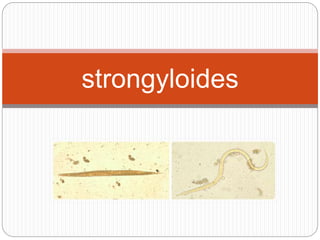
strongyloides
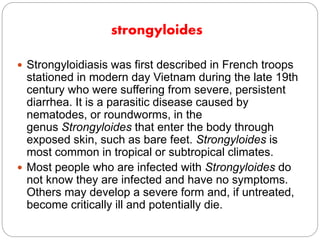
 Strongyloidiasis was first described in French troops
stationed in modern day Vietnam during the late 19th
century who were suffering from severe, persistent
diarrhea. It is a parasitic disease caused by
nematodes, or roundworms, in the
genus Strongyloides that enter the body through
exposed skin, such as bare feet. Strongyloides is
most common in tropical or subtropical climates.
 Most people who are infected with Strongyloides do
not know they are infected and have no symptoms.
Others may develop a severe form and, if untreated,
become critically ill and potentially die.
strongyloides
 Strongyloides is known to exist on all continents except for
Antarctica, but it is most common in the tropics, subtropics,
and in warm temperate regions. The global prevalence
of Strongyloides is unknown, but experts estimate that there
are between 30–100 million infected persons worldwide.
 In the United States, a series of small studies in select
populations have shown that between 0-6.1% of persons
sampled were infected. Studies in immigrant populations have
shown a much higher percentage of infected persons ranging
from 0-46.1%.
 Strongyloides is found more frequently in the
socioeconomically disadvantaged, in institutionalized
populations, and in rural areas. It is often associated with
agricultural activities.
Epidemiology & Risk Factors
 The most common way of becoming infected
with Strongyloides is by contacting soil that is contaminated
with Strongyloides larvae. Therefore, activities that increase
contact with the soil increase the risk of becoming infected,
such as:
1. walking with bare feet
2. contact with human waste or sewage
3. occupations that increase contact with contaminated soil
such as farming and coal mining.
 Furthermore, many studies have shown an association
with Strongyloides and infection with Human T-Cell
Lymphotropic Virus-1 (HTLV-1). These studies have shown
that people infected with HTLV-1 are more likely to become
infected with Strongyloides, and that once infected, are more
likely to develop severe cases of strongyloidiasis.
 Of note, being infected with HIV/AIDS has not been shown to
be a risk factor for developingStrongyloides or having a worse
clinical course.
Life cycle
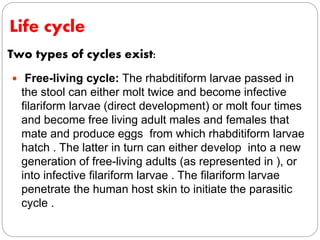
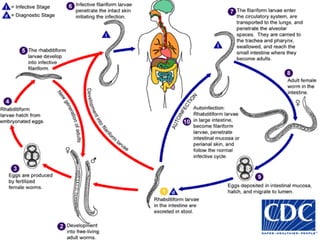
 Free-living cycle: The rhabditiform larvae passed in
the stool can either molt twice and become infective
filariform larvae (direct development) or molt four times
and become free living adult males and females that
mate and produce eggs from which rhabditiform larvae
hatch . The latter in turn can either develop into a new
generation of free-living adults (as represented in ), or
into infective filariform larvae . The filariform larvae
penetrate the human host skin to initiate the parasitic
cycle .
Two types of cycles exist:
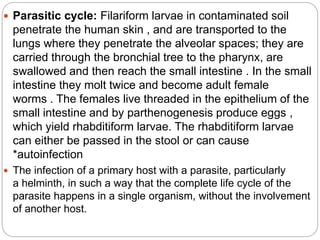
 Parasitic cycle: Filariform larvae in contaminated soil
penetrate the human skin , and are transported to the
lungs where they penetrate the alveolar spaces; they are
carried through the bronchial tree to the pharynx, are
swallowed and then reach the small intestine . In the small
intestine they molt twice and become adult female
worms . The females live threaded in the epithelium of the
small intestine and by parthenogenesis produce eggs ,
which yield rhabditiform larvae. The rhabditiform larvae
can either be passed in the stool or can cause
*autoinfection
 The infection of a primary host with a parasite, particularly
a helminth, in such a way that the complete life cycle of the
parasite happens in a single organism, without the involvement
of another host.
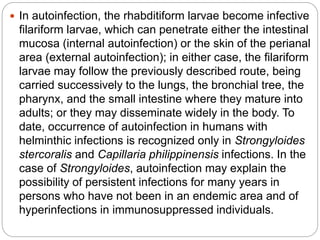
 In autoinfection, the rhabditiform larvae become infective
filariform larvae, which can penetrate either the intestinal
mucosa (internal autoinfection) or the skin of the perianal
area (external autoinfection); in either case, the filariform
larvae may follow the previously described route, being
carried successively to the lungs, the bronchial tree, the
pharynx, and the small intestine where they mature into
adults; or they may disseminate widely in the body. To
date, occurrence of autoinfection in humans with
helminthic infections is recognized only in Strongyloides
stercoralis and Capillaria philippinensis infections. In the
case of Strongyloides, autoinfection may explain the
possibility of persistent infections for many years in
persons who have not been in an endemic area and of
hyperinfections in immunosuppressed individuals.
Disease
 Most people infected with Strongyloides do not know they’re
infected. If they do feel sick the most common complaints are the
following:
1. Abdominal
 stomachache, bloating, and heartburn
 intermittent episodes of diarrhea and constipation
 nausea and loss of appetite
2. Respiratory
 dry cough
 throat irritation
3. Skin
 an itchy, red rash that occurs where the worm entered the skin
 recurrent raised red rash typically along the thighs and buttocks.
Diagnosis
 Strongyloides is usually diagnosed by seeing larvae in
stool when examined under the microscope. This may
require that you provide multiple stool samples to your
doctor or the laboratory. Some laboratories are
capable of diagnosing Strongyloides with blood tests.
Treatment
 Treatment for strongyloidiasis is recommended for all
persons found to be infected, whether symptomatic or
not, due to the risk of developing hyperinfection
syndrome and/or disseminated strongyloidiasis.
Furthermore, it is recommended that patients be
considered for testing prior to being initiated on any
immunosuppressive therapy, particularly
corticosteroids.
 A 40-year-old female presented to hospital with rapidly
progressive renal failure secondary to antineutrophil
cytoplasmic antibody (ANCA)-positive crescentic
glomerulonephritis. She was started on
immunosuppressive therapy (oral steroids and oral
cyclophosphamide) and hemodialysis. She re-presented
with persistent fever, persistent vomiting and dry cough
135 days after starting immunosuppression. A chest X-ray
revealed left lower zone consolidation. Repeated sputum
Gram stains were negative, and both sputum and blood
cultures were sterile. A sputum smear was negative for
acid-fast bacilli. The patient's fever did not respond to
empirical antibiotics or antitubercular therapy.
Bronchoscopic alveolar lavage and stool examination
revealed larval forms of Strongyloides stercoralis.
Clinical case

Strongyloides

  • 1.
  • 2.
     Strongyloidiasis wasfirst described in French troops stationed in modern day Vietnam during the late 19th century who were suffering from severe, persistent diarrhea. It is a parasitic disease caused by nematodes, or roundworms, in the genus Strongyloides that enter the body through exposed skin, such as bare feet. Strongyloides is most common in tropical or subtropical climates.  Most people who are infected with Strongyloides do not know they are infected and have no symptoms. Others may develop a severe form and, if untreated, become critically ill and potentially die. strongyloides
  • 3.
     Strongyloides isknown to exist on all continents except for Antarctica, but it is most common in the tropics, subtropics, and in warm temperate regions. The global prevalence of Strongyloides is unknown, but experts estimate that there are between 30–100 million infected persons worldwide.  In the United States, a series of small studies in select populations have shown that between 0-6.1% of persons sampled were infected. Studies in immigrant populations have shown a much higher percentage of infected persons ranging from 0-46.1%.  Strongyloides is found more frequently in the socioeconomically disadvantaged, in institutionalized populations, and in rural areas. It is often associated with agricultural activities. Epidemiology & Risk Factors
  • 4.
     The mostcommon way of becoming infected with Strongyloides is by contacting soil that is contaminated with Strongyloides larvae. Therefore, activities that increase contact with the soil increase the risk of becoming infected, such as: 1. walking with bare feet 2. contact with human waste or sewage 3. occupations that increase contact with contaminated soil such as farming and coal mining.  Furthermore, many studies have shown an association with Strongyloides and infection with Human T-Cell Lymphotropic Virus-1 (HTLV-1). These studies have shown that people infected with HTLV-1 are more likely to become infected with Strongyloides, and that once infected, are more likely to develop severe cases of strongyloidiasis.  Of note, being infected with HIV/AIDS has not been shown to be a risk factor for developingStrongyloides or having a worse clinical course.
  • 5.
    Life cycle  Free-livingcycle: The rhabditiform larvae passed in the stool can either molt twice and become infective filariform larvae (direct development) or molt four times and become free living adult males and females that mate and produce eggs from which rhabditiform larvae hatch . The latter in turn can either develop into a new generation of free-living adults (as represented in ), or into infective filariform larvae . The filariform larvae penetrate the human host skin to initiate the parasitic cycle . Two types of cycles exist:
  • 6.
     Parasitic cycle:Filariform larvae in contaminated soil penetrate the human skin , and are transported to the lungs where they penetrate the alveolar spaces; they are carried through the bronchial tree to the pharynx, are swallowed and then reach the small intestine . In the small intestine they molt twice and become adult female worms . The females live threaded in the epithelium of the small intestine and by parthenogenesis produce eggs , which yield rhabditiform larvae. The rhabditiform larvae can either be passed in the stool or can cause *autoinfection  The infection of a primary host with a parasite, particularly a helminth, in such a way that the complete life cycle of the parasite happens in a single organism, without the involvement of another host.
  • 8.
     In autoinfection,the rhabditiform larvae become infective filariform larvae, which can penetrate either the intestinal mucosa (internal autoinfection) or the skin of the perianal area (external autoinfection); in either case, the filariform larvae may follow the previously described route, being carried successively to the lungs, the bronchial tree, the pharynx, and the small intestine where they mature into adults; or they may disseminate widely in the body. To date, occurrence of autoinfection in humans with helminthic infections is recognized only in Strongyloides stercoralis and Capillaria philippinensis infections. In the case of Strongyloides, autoinfection may explain the possibility of persistent infections for many years in persons who have not been in an endemic area and of hyperinfections in immunosuppressed individuals.
  • 9.
    Disease  Most peopleinfected with Strongyloides do not know they’re infected. If they do feel sick the most common complaints are the following: 1. Abdominal  stomachache, bloating, and heartburn  intermittent episodes of diarrhea and constipation  nausea and loss of appetite 2. Respiratory  dry cough  throat irritation 3. Skin  an itchy, red rash that occurs where the worm entered the skin  recurrent raised red rash typically along the thighs and buttocks.
  • 10.
    Diagnosis  Strongyloides isusually diagnosed by seeing larvae in stool when examined under the microscope. This may require that you provide multiple stool samples to your doctor or the laboratory. Some laboratories are capable of diagnosing Strongyloides with blood tests.
  • 11.
    Treatment  Treatment forstrongyloidiasis is recommended for all persons found to be infected, whether symptomatic or not, due to the risk of developing hyperinfection syndrome and/or disseminated strongyloidiasis. Furthermore, it is recommended that patients be considered for testing prior to being initiated on any immunosuppressive therapy, particularly corticosteroids.
  • 12.
     A 40-year-oldfemale presented to hospital with rapidly progressive renal failure secondary to antineutrophil cytoplasmic antibody (ANCA)-positive crescentic glomerulonephritis. She was started on immunosuppressive therapy (oral steroids and oral cyclophosphamide) and hemodialysis. She re-presented with persistent fever, persistent vomiting and dry cough 135 days after starting immunosuppression. A chest X-ray revealed left lower zone consolidation. Repeated sputum Gram stains were negative, and both sputum and blood cultures were sterile. A sputum smear was negative for acid-fast bacilli. The patient's fever did not respond to empirical antibiotics or antitubercular therapy. Bronchoscopic alveolar lavage and stool examination revealed larval forms of Strongyloides stercoralis. Clinical case