
Codex Standards of Meat and
Poultry Products
Standards
According to ISO, standards are documented agreements
containing technical specifications or other precise criteria to be used
consistently as rules, guidelines or definitions, to ensure that materials,
products, processes and services are fit for their purpose
(ISO, 1996)
Standard is a part of a law or regulation that is enforceable by the
regulatory agency having jurisdiction
(ICMSF, 1983)
Product Standards
Product standards are specifications and criteria for the
characteristics of products
The Codex definition of a microbiological criterion consists of five
components:
(1) A statement of the organisms of concern and/or their toxins
(2) The analytical methods for their detection and quantitation,
(3) Sampling plan, including when and where samples are to be taken
(4) Microbiological limits considered appropriate to the food
(5) The number of sample units that should conform to these limits.
These five components are embodied in a sampling plan.
Testing Microorganism
• Indicator tests for meat
 Indicator organisms are groups of bacteria that indicate the possible
presence of organisms of concern, and may point to the origins of microbial
contamination.
• Organisms of concern or Pathogens:
 Pathogens causing food borne infection: Salmonella, Listeria
monocytogenes, Shiga toxin-producing Escherichia coli (STEC).
 Pathogens causing food borne intoxication: Bacillus cereus, Staphylococus
aureus and Clostridium perfringens cause illness through intoxication.
Food safety criteria: If exceeded, indicate that the batch tested is
unsatisfactory and should be removed from or not placed on the market.
Process hygiene criteria: The results provide an indication of
performance and control of the slaughter, dressing and production
process at the time of sampling, and must be used accordingly.
Failure to meet either class of criteria should always result in an investigation to
find the cause of contamination and action taken to prevent contamination of
future production.
Two different types of Microbiological criteria
Demonstration of compliance
Demonstration of compliance with process hygiene criteria for
meat and processed meat is required as follows:
• Aerobic Plate Count
• Yeast and Mold Count
• Escherichia coli
• Staphylococcus aureus (Coagulase +ve)
Demonstration of compliance with food safety criteria for meat
and processed meat is required as follows:
• Salmonella
• Listeria monocytogenes
• Sulphite Reducing Clostridia
• Clostridium botulinum
• Campylobacter Spp*
Sampling plan
The sampling plan summarises the requirements (limits) and
defines their stringency. It is the basis for the decision on
release / acceptance of tested lots.
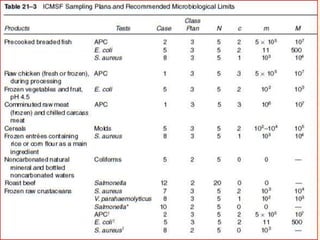
• Sampling plans are expressed by 3 or 4 parameters
• ICMSF (1974) has suggested 2 and 3 class sampling plans
1) Two class plan/two attribute scheme:
• Two attributes, i.e, presence or absence of an organism in a given
sampling unit.
• Applied for more hazardous organisms. e.g. Clostridium botulinum.
2) Three class plan: are frequently used to examine for hygiene
indicator where enumeration of microbes in a unit volume or mass
is possible. Such plans can be used to separate the quality of a lot
into acceptable, marginally acceptable and unacceptable
The terms n, c, m and M used in this standard have the following meaning:
n = number of samples or units analyzed.
c = maximum allowable number of sample units yielding marginal results, i.e.
results between m and M.
m = microbiological level that separates good quality from defective, or in a
three-class plan good from marginally acceptable quality.
M = microbiological level in a three class plan that separates marginally
acceptable from unacceptable (defective) quality. Note: In a two-class plan M
is assimilated to m.
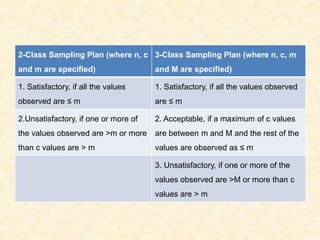
2-Class Sampling Plan (where n, c
and m are specified)
3-Class Sampling Plan (where n, c, m
and M are specified)
1. Satisfactory, if all the values
observed are ≤ m
1. Satisfactory, if all the values observed
are ≤ m
2.Unsatisfactory, if one or more of
the values observed are >m or more
than c values are > m
2. Acceptable, if a maximum of c values
are between m and M and the rest of the
values are observed as ≤ m
3. Unsatisfactory, if one or more of the
values observed are >M or more than c
values are > m
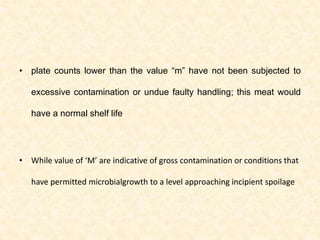
• plate counts lower than the value “m” have not been subjected to
excessive contamination or undue faulty handling; this meat would
have a normal shelf life
• While value of ‘M’ are indicative of gross contamination or conditions that
have permitted microbialgrowth to a level approaching incipient spoilage
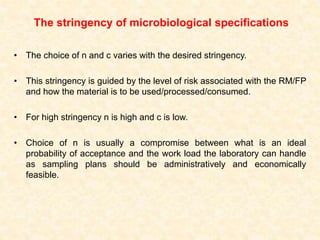
The stringency of microbiological specifications
• The choice of n and c varies with the desired stringency.
• This stringency is guided by the level of risk associated with the RM/FP
and how the material is to be used/processed/consumed.
• For high stringency n is high and c is low.
• Choice of n is usually a compromise between what is an ideal
probability of acceptance and the work load the laboratory can handle
as sampling plans should be administratively and economically
feasible.
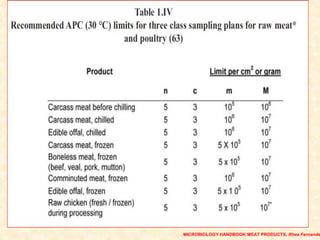
MICROBIOLOGY HANDBOOK MEAT PRODUCTS, Rhea Fernande
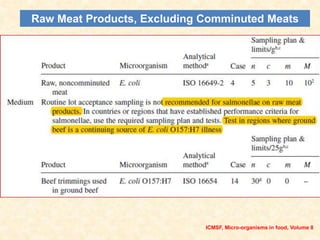
Raw Meat Products, Excluding Comminuted Meats
ICMSF, Micro-organisms in food, Volume 8
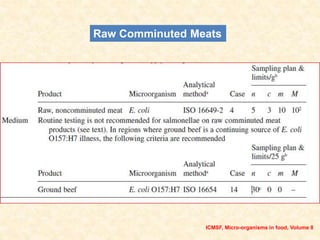
Raw Comminuted Meats
ICMSF, Micro-organisms in food, Volume 8
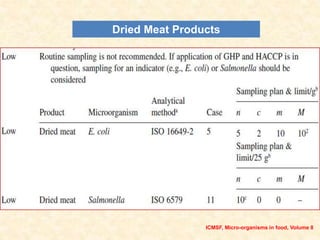
Dried Meat Products
ICMSF, Micro-organisms in food, Volume 8
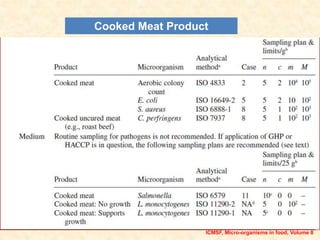
Cooked Meat Product
ICMSF, Micro-organisms in food, Volume 8
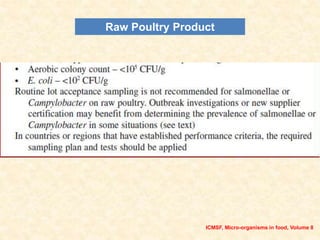
Raw Poultry Product
ICMSF, Micro-organisms in food, Volume 8
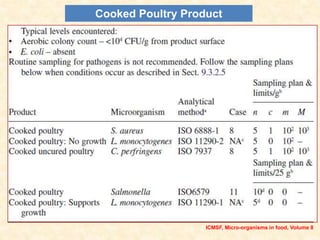
Cooked Poultry Product
ICMSF, Micro-organisms in food, Volume 8
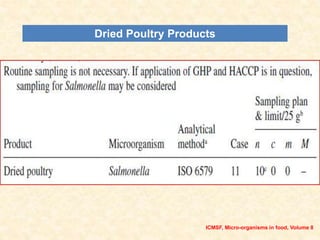
Dried Poultry Products
ICMSF, Micro-organisms in food, Volume 8
Thank You

Codex standards for meat and meat products

  • 1.
    Codex Standards ofMeat and Poultry Products
  • 2.
    Standards According to ISO,standards are documented agreements containing technical specifications or other precise criteria to be used consistently as rules, guidelines or definitions, to ensure that materials, products, processes and services are fit for their purpose (ISO, 1996) Standard is a part of a law or regulation that is enforceable by the regulatory agency having jurisdiction (ICMSF, 1983) Product Standards Product standards are specifications and criteria for the characteristics of products
  • 3.
    The Codex definitionof a microbiological criterion consists of five components: (1) A statement of the organisms of concern and/or their toxins (2) The analytical methods for their detection and quantitation, (3) Sampling plan, including when and where samples are to be taken (4) Microbiological limits considered appropriate to the food (5) The number of sample units that should conform to these limits. These five components are embodied in a sampling plan.
  • 4.
    Testing Microorganism • Indicatortests for meat  Indicator organisms are groups of bacteria that indicate the possible presence of organisms of concern, and may point to the origins of microbial contamination. • Organisms of concern or Pathogens:  Pathogens causing food borne infection: Salmonella, Listeria monocytogenes, Shiga toxin-producing Escherichia coli (STEC).  Pathogens causing food borne intoxication: Bacillus cereus, Staphylococus aureus and Clostridium perfringens cause illness through intoxication.
  • 5.
    Food safety criteria:If exceeded, indicate that the batch tested is unsatisfactory and should be removed from or not placed on the market. Process hygiene criteria: The results provide an indication of performance and control of the slaughter, dressing and production process at the time of sampling, and must be used accordingly. Failure to meet either class of criteria should always result in an investigation to find the cause of contamination and action taken to prevent contamination of future production. Two different types of Microbiological criteria
  • 6.
    Demonstration of compliance Demonstrationof compliance with process hygiene criteria for meat and processed meat is required as follows: • Aerobic Plate Count • Yeast and Mold Count • Escherichia coli • Staphylococcus aureus (Coagulase +ve) Demonstration of compliance with food safety criteria for meat and processed meat is required as follows: • Salmonella • Listeria monocytogenes • Sulphite Reducing Clostridia • Clostridium botulinum • Campylobacter Spp*
  • 7.
    Sampling plan The samplingplan summarises the requirements (limits) and defines their stringency. It is the basis for the decision on release / acceptance of tested lots. • Sampling plans are expressed by 3 or 4 parameters • ICMSF (1974) has suggested 2 and 3 class sampling plans 1) Two class plan/two attribute scheme: • Two attributes, i.e, presence or absence of an organism in a given sampling unit. • Applied for more hazardous organisms. e.g. Clostridium botulinum. 2) Three class plan: are frequently used to examine for hygiene indicator where enumeration of microbes in a unit volume or mass is possible. Such plans can be used to separate the quality of a lot into acceptable, marginally acceptable and unacceptable
  • 8.
    The terms n,c, m and M used in this standard have the following meaning: n = number of samples or units analyzed. c = maximum allowable number of sample units yielding marginal results, i.e. results between m and M. m = microbiological level that separates good quality from defective, or in a three-class plan good from marginally acceptable quality. M = microbiological level in a three class plan that separates marginally acceptable from unacceptable (defective) quality. Note: In a two-class plan M is assimilated to m.
  • 9.
    2-Class Sampling Plan(where n, c and m are specified) 3-Class Sampling Plan (where n, c, m and M are specified) 1. Satisfactory, if all the values observed are ≤ m 1. Satisfactory, if all the values observed are ≤ m 2.Unsatisfactory, if one or more of the values observed are >m or more than c values are > m 2. Acceptable, if a maximum of c values are between m and M and the rest of the values are observed as ≤ m 3. Unsatisfactory, if one or more of the values observed are >M or more than c values are > m
  • 10.
    • plate countslower than the value “m” have not been subjected to excessive contamination or undue faulty handling; this meat would have a normal shelf life • While value of ‘M’ are indicative of gross contamination or conditions that have permitted microbialgrowth to a level approaching incipient spoilage
  • 11.
    The stringency ofmicrobiological specifications • The choice of n and c varies with the desired stringency. • This stringency is guided by the level of risk associated with the RM/FP and how the material is to be used/processed/consumed. • For high stringency n is high and c is low. • Choice of n is usually a compromise between what is an ideal probability of acceptance and the work load the laboratory can handle as sampling plans should be administratively and economically feasible.
  • 12.
    MICROBIOLOGY HANDBOOK MEATPRODUCTS, Rhea Fernande
  • 14.
    Raw Meat Products,Excluding Comminuted Meats ICMSF, Micro-organisms in food, Volume 8
  • 15.
    Raw Comminuted Meats ICMSF,Micro-organisms in food, Volume 8
  • 16.
    Dried Meat Products ICMSF,Micro-organisms in food, Volume 8
  • 17.
    Cooked Meat Product ICMSF,Micro-organisms in food, Volume 8
  • 18.
    Raw Poultry Product ICMSF,Micro-organisms in food, Volume 8
  • 19.
    Cooked Poultry Product ICMSF,Micro-organisms in food, Volume 8
  • 20.
    Dried Poultry Products ICMSF,Micro-organisms in food, Volume 8
  • 21.