02/24/2025 Chapter 52
General Characteristics
Non segmented cylindrical (Roundworms) & pointed at both
ends
Shiny cuticle => smooth, with spine or ridged
=> used for Protection and evasion (IR)
Movement = undulating motion
=> contraction & relaxation of the longitudinal muscles
Have Pseudocoel (body cavity)
Male < Female - size
3.
02/24/2025 Chapter 53
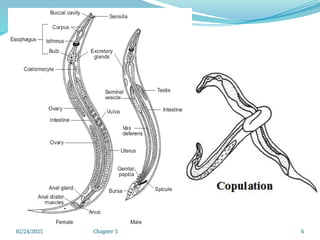
Mouth: surrounded by lips or papillae => teeth/cutting plates
Sexes are separate (dioecious) => female’s organ is double
The male has a testis with copulatory organs = spicules
Copulatory bursa => hold female during copulation
Females => viviparous (larvae), oviparous (eggs) or ovo-
viviparous (egg containing larvae)
4.
02/24/2025 Chapter 54
Cont’d
Nematodes (in Human) => live in intestine, blood or tissue
Have a direct life cycle
Tissue nematodes => transmitted by insect vectors
Intestinal nematodes => transmitted by fecal-oral route & soil
Have a complete DS with both oral & anal openings
=> esophagus or pharynx sucks food into intestine
5.
02/24/2025 Chapter 55
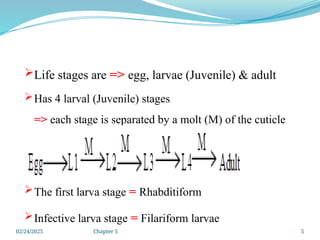
Life stages are => egg, larvae (Juvenile) & adult
Has 4 larval (Juvenile) stages
=> each stage is separated by a molt (M) of the cuticle
The first larva stage = Rhabditiform
Infective larva stage = Filariform larvae
02/24/2025 Chapter 57
A. Trichinella spiralis
GeogD: worldwide => 3 sub-species:
T. S. nelsoni = Africa & southern Europe
Habitat: Adults: in small intestine mucosa of Pigs, Rat, Man, Dog
Larvae: encysted in muscle
Egg: No eggs (adult is Viviparous)
Morphology: Adults: thread-like, white and viviparous
Larva: black in color & coiled tail
8.
02/24/2025 Chapter 58
Conti…T. spiralis
Life cycle: The same animal (man)=>definitive + intermediate host
Infection => by eating flesh of animal’s (infective larvae)
ÞLarvae released (acid-pepsin digestion) larvae molt (4)
adult worm (small intestine) male dies (a/r mating) &
females gives larvae (viviparous)
ÞLarvae (penetrate intestinal wall & body circulation)
striated muscles (form cyst)
Reservoir host is swine
9.
02/24/2025 Chapter 59
Conti…T. spiralis
Pathology: Trichinellosis (trichinosis)
Nausea, vomiting, abdominal pain, diarrhea, headache, fever,
blurred vision, & eosinophilia
Migration of newborn juveniles damage blood vessels cause
edema in the face and hands, also cause pneumonia, deafness,
brain or eye damage, and death resulting from myocarditis
(inflammation of heart muscle)
10.
02/24/2025 Chapter 510
Conti… T. spiralis
Lab Diagnosis:
Finding the larvae in striated muscle
Muscle Biopsy
Testing serum for Trichinella antibodies.
Treatment: Thiabendazole and Mebendazole
Prevention and Control:
Avoid eating of raw or undercooked pork
Inspecting meat for infective larvae
Treatment
11.
02/24/2025 Chapter 511
B. Trichuris trichiura (The Whip-worm)
Thin whip-like anterior (attach) & a thick fleshy posterior part
GeogD: Cosmopolitan (warm area), fairly common in Ethiopia
Habitat: Adult (oviparous): in large intestine
Eggs: In the feces
Morphology: Adults: whip-like shape,
Male: has coiled tail; Female: oviparous and has straight tail
Egg: barrel-shaped and yellow brown
12.
02/24/2025 Chapter 512
Conti… T. trichiura
Transmission is by => ingesting eggs containing infective larvae
=> contaminated hands, food or drink, or
=> swallowing soil that contains embryonated eggs
Life Cycle: Egg (ingested) Larva (hatch) small intestine villa
(penetrate) large intestine(migrate) Adult immature Egg (a/r
mating) soil with stool (embryonated egg) Larvae (Warm soil)
Egg contain infective larvae
13.
02/24/2025 Chapter 513
Conti… T. trichiura
Pathology: asymptomatic but in children wz heavy worm (200-
1000) => chronic diarrhea, intestinal ulceration with dysentery,
iron deficiency anemia, weight loss and rectum prolapse
=>Rectal prolapse: loss of muscle tone on rectum wall (worm)
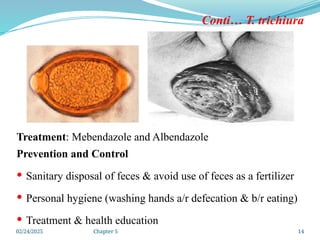
Lab Diagnosis: eggs in the feces
=> adult worms in rectal mucosa in prolapsed rectum
14.
02/24/2025 Chapter 514
Conti… T. trichiura
Treatment: Mebendazole and Albendazole
Prevention and Control
Sanitary disposal of feces & avoid use of feces as a fertilizer
Personal hygiene (washing hands a/r defecation & b/r eating)
Treatment & health education
15.
02/24/2025 Chapter 515
C. Strongyloides stercoralis (The dwarf thread worm)
GeogD: worldwide (Facultative in host & soil)
Habitat: Adults female: in the small intestine mucosa,
=> Male mostly is not parasite
Rhabditiform larvae: in feces (active motile) & external env’ts
Filariform larvae: soil and water (infective stage)
16.
02/24/2025 Chapter 516
Conti… S. stercoralis
Morphology: Adult Female (parasitic): straight posterior end (Ovo-
viviparous)
Life cycle: Infection is by filariform larva penetrating the skin.
Larvae enter blood vessels => heart-lung (develop)
At trachea the larvae swallowed & mature (intestinal tract)
Female lay eggs in small intestine (develop) => rhabditiform
→ Form Filariform => internal autoinfection ↑se adult No
= Hyper-infection
17.
02/24/2025 Chapter 517
Conti… S. stercoralis
→ Or passed out with feces and follow free living way of life
=> or it develops in to the infective stage (filariform larvae) &
penetrate the skin of same host = external autoinfection
Pathology: Strongyloidiasis (Cochin China diarrhea) & 3 phases
1. Cutaneous phase (skin penetration): itching & erythema
2. Pulmonary phase (migration of larvae in the lungs)
=> cough, wheezing and fever.
3. Intestinal phase (adult invasion) => abdominal pain, ulceration,
inflammation, malabsorption & mucus diarrhea, constipation,
nausea, vomiting and anemia
18.
02/24/2025 Chapter 518
Conti… S. stercoralis
Lab Diagnosis: larvae & eggs (sometimes) in feces
=> eggs are few in number
Treatment: Mebendazole & Albendazole
Prevention and Control
1. Sanitary disposal of feces & avoid use of feces as a fertilizer
2. Wearing protective footwear
3. Treatment & Health education.
19.
02/24/2025 Chapter 519
D. HOOKWORMS
Þ2 sp. Ancylostoma duodenale (Old World) &
Necator americanus (New World hookworm).
No intermediate host & man is the only definitive host
Both found in Ethiopia but N. americanus (most common)
Both species are similar with some differences
20.
02/24/2025 Chapter 520
Conti… HOOKWORMS
GeogD: => N. americanus: Far East, South Asia, pacific Islands,
Tropical Africa, Central & South America
=> A. duodenale: China, Japan, Europe, North Africa, southern
Europe, Middle East
Habitat: Adult: small intestine of man
Eggs: In the feces; not infective to man
Infective larvae: free in soil and water
21.
02/24/2025 Chapter 521
Conti… HOOKWORMS
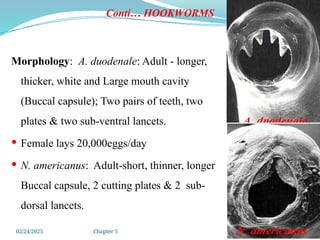
Morphology: A. duodenale: Adult - longer,
thicker, white and Large mouth cavity
(Buccal capsule); Two pairs of teeth, two
plates & two sub-ventral lancets.
Female lays 20,000eggs/day
N. americanus: Adult-short, thinner, longer
Buccal capsule, 2 cutting plates & 2 sub-
dorsal lancets.
22.
02/24/2025 Chapter 522
Conti… HOOKWORMS
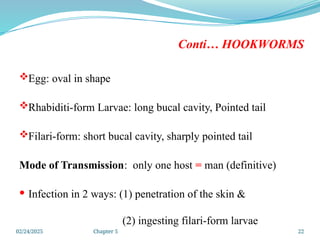
Egg: oval in shape
Rhabiditi-form Larvae: long bucal cavity, Pointed tail
Filari-form: short bucal cavity, sharply pointed tail
Mode of Transmission: only one host = man (definitive)
Infection in 2 ways: (1) penetration of the skin &
(2) ingesting filari-form larvae
23.
02/24/2025 Chapter 523
Conti… HOOKWORMS
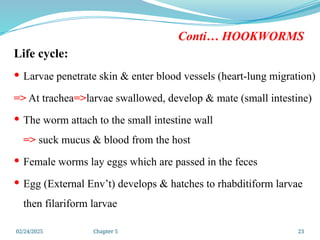
Life cycle:
Larvae penetrate skin & enter blood vessels (heart-lung migration)
=> At trachea=>larvae swallowed, develop & mate (small intestine)
The worm attach to the small intestine wall
=> suck mucus & blood from the host
Female worms lay eggs which are passed in the feces
Egg (External Env’t) develops & hatches to rhabditiform larvae
then filariform larvae
24.
02/24/2025 Chapter 524
Conti… HOOKWORMS
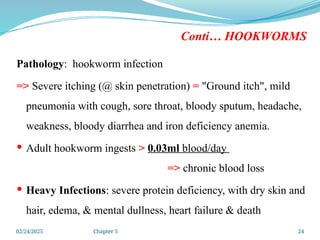
Pathology: hookworm infection
=> Severe itching (@ skin penetration) = "Ground itch", mild
pneumonia with cough, sore throat, bloody sputum, headache,
weakness, bloody diarrhea and iron deficiency anemia.
Adult hookworm ingests > 0.03ml blood/day
=> chronic blood loss
Heavy Infections: severe protein deficiency, with dry skin and
hair, edema, & mental dullness, heart failure & death
25.
02/24/2025 Chapter 525
Conti… HOOKWORMS
3 factors for Severity of disease: Number of worms,
Species of hookworm, &
host Nutritional condition
N. americanus: < 25 worms = no symptoms
>1000 worms causes severe symptoms, very grave damage &
Fatal
Ancylostoma spp: fewer worms (100) => greater disease
=> b/se it sucks more blood than N. americanus
26.
02/24/2025 Chapter 526
Conti… HOOKWORMS
Lab Diagnosis: ova (egg) in feces
Treatment: Mebendazole with balanced diet & oral iron
supplementation
Prevention and control:-
1. Sanitary disposal of feces & avoid use of feces as fertilizer
2. Using foot ware for adequate protective
3. Treatment and health education.
27.
02/24/2025 Chapter 527
E. Entrobius vermicularis (Pin Worm)
GeogD: Cosmopolitan (children > adult)
Habitat: Adult: small intestine & gravid female in large intestine
Eggs: In feces or deposited on perianal skin
Embryonated eggs are infective to human
Morphology: Adults: yellow white;
Female: thin pointed tail and Male: Coiled tailed
Egg: oval & shell is double, smooth & thin
28.
02/24/2025 Chapter 528
Conti… E. vermicularis
Life Cycle: infection is by ingestion of embryonated egg
(with contaminated hand, food or drink)
Infective eggs hatch larvae adult worms (large intestine)
The female worms migrate to the rectum (After mating)
The gravid females pass out of the anus and lay eggs on the peri-
anal skin (night)
=> Females die soon a/r oviposition, & males die soon a/r copulation
29.
02/24/2025 Chapter 529
Conti… E. vermicularis
Human can acquire infection;
1) Ingestion of eggs from anus to mouth = Finger (children)
2) handling of night clothes or bedding
3) inhalation of air-borne eggs and
4) Retro-infection: unclean perianal folds, attached eggs hatch
and juveniles may wander into the anus
30.
02/24/2025 Chapter 530
Conti… E. vermicularis
Pathology: two aspects: => worms within the intestine &
=> egg deposition around the anus
The worm => intestinal ulcer, inflammation & bacterial infection
The worms migration => allergic reactions around the anus & during
night it causes nocturnal itching (perianal pruritus) & Enuresis
The worms may obstruct the appendix causing Appendicitis
Gravid female worms can migrate from the anus into the female
genital tract that leads to vaginal infections
31.
02/24/2025 Chapter 531
Conti… E. vermicularis
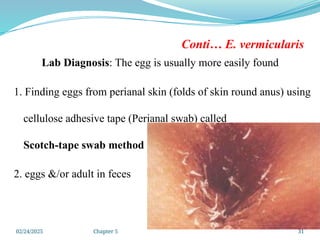
Lab Diagnosis: The egg is usually more easily found
1. Finding eggs from perianal skin (folds of skin round anus) using
cellulose adhesive tape (Perianal swab) called
Scotch-tape swab method
2. eggs &/or adult in feces
32.
02/24/2025 Chapter 532
Conti… E. vermicularis
Treatment: Mebendazole or Albendazole
Prevention and Control:
Treating all members of a family
Washing of the anal skin each morning soon after waking.
Washing of night clothes
33.
02/24/2025 Chapter 533
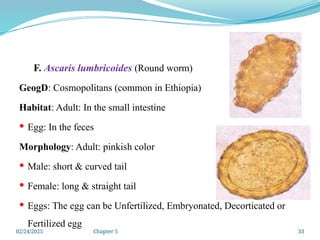
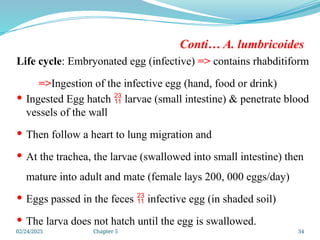
F. Ascaris lumbricoides (Round worm)
GeogD: Cosmopolitans (common in Ethiopia)
Habitat: Adult: In the small intestine
Egg: In the feces
Morphology: Adult: pinkish color
Male: short & curved tail
Female: long & straight tail
Eggs: The egg can be Unfertilized, Embryonated, Decorticated or
Fertilized egg
34.
02/24/2025 Chapter 534
Conti… A. lumbricoides
Life cycle: Embryonated egg (infective) => contains rhabditiform
=>Ingestion of the infective egg (hand, food or drink)
Ingested Egg hatch larvae (small intestine) & penetrate blood
vessels of the wall
Then follow a heart to lung migration and
At the trachea, the larvae (swallowed into small intestine) then
mature into adult and mate (female lays 200, 000 eggs/day)
Eggs passed in the feces infective egg (in shaded soil)
The larva does not hatch until the egg is swallowed.
35.
02/24/2025 Chapter 535
Conti… A. lumbricoides
Pathology: migration of Ascaris larva => inflammatory &
hypersensitive reactions => coughing and bronchial asthma
Adult worms (intestine) => pain, nausea, diarrhea & vomiting
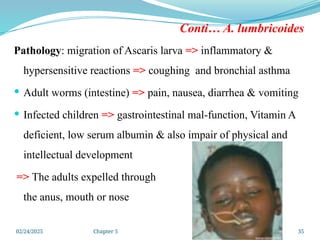
Infected children => gastrointestinal mal-function, Vitamin A
deficient, low serum albumin & also impair of physical and
intellectual development
=> The adults expelled through
the anus, mouth or nose
36.
02/24/2025 Chapter 536
Conti… A. lumbricoides
Lab Diagnosis:
Finding the eggs in feces
Identifying adult worms expelled through the anus, nose or mouth
Treatment: Mebendazole (Vermox) or Albendazole
Prevention and Control:
1.Prevent soil contamination with feces & avoid using as a fertilizer
2.Washing hands b/r eating & not eating uncooked vegetables
3.Treatment & health education.
37.
02/24/2025 Chapter 537
G. Dracunculus medinensis (Guinea or Medina worm)
GeogD: India, Yemen & sub-Sahara (lowlands of Ethiopia)
=> It will be eradicate in the near feature.
Habitat: Adults: Female in the subcutaneous and muscular
connective tissues; especially water contact parts E.g. ankle.
Male: in the retroperitoneal connective tissues & dies a/r mate
First stage larvae: In the ulcers
Infective filariform larvae: In the Cyclops
38.
02/24/2025 Chapter 538
Conti… D. medinensis
Morphology: Adults: thread like & White with smooth surface
Male: coiled posterior end & Female: Viviparous
Larva: rounded anterior end & pointed tail
Life cycle: Man, dogs & cats (definitive) & Cyclops (intermediate)
=> Infection: swallowing of larvae infected Cyclops with water
Larvae: freed & penetrate duodenal wall & migrate to connective
tissues
In connective tissues larvae develop to adult & mate
39.
02/24/2025 Chapter 539
Conti…life cycle of D. medinensis
A/r mate, female worm migrates to connective tissues (lower
limbs) => the ankle, foot, arms & shoulders (in contact wz water)
Female worm form blister (ulcer) & buries its anterior end
When the blister (ulcer) is bathed in the water first stage larvae
released
The larvae are unable to swim but are actively motile, coiling &
uncoiling tail
The larvae ingested by Cyclops & develop in to infective larvae in
its body cavity
40.
02/24/2025 Chapter 540
Conti… D. medinensis
Pathogenesis: asymptomatic
=> until female worm reaches to surface of the skin
Female guinea worm releases toxic histamine (migration)
=> allergies
Worm under the skin form blister
=> burning pain (relieved by applying water)
The blister bursts & the larvae released during water contact
41.
02/24/2025 Chapter 541
Conti… D. medinensis
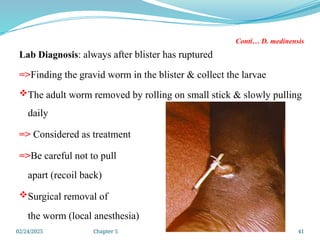
Lab Diagnosis: always after blister has ruptured
=>Finding the gravid worm in the blister & collect the larvae
The adult worm removed by rolling on small stick & slowly pulling
daily
=> Considered as treatment
=>Be careful not to pull
apart (recoil back)
Surgical removal of
the worm (local anesthesia)
42.
02/24/2025 Chapter 542
Conti… D. medinensis
For laboratory confirmation of the larvae,
1. Place few drops of water on the ulcer => larvae move out
2. After a few minutes collect the water in a pipette
3. prepare a wet mount, then examine motile larvae
Prevention and Control:
1.Prevent water contamination with the larvae and avoid drinking
infected water
2.Destroy the Cyclops by using chemicals, e.g. chlorine
3.Treatement & health education not to in to water
=> Or cover the blister with a water proof dressing


![Ch_5_Agri Biotech.pdfpy5;y]]']we[l[5tt=[l[t;t[](https://cdn.slidesharecdn.com/ss_thumbnails/ch5agribiotech-250225152434-2d8e7718-thumbnail.jpg?width=640&height=640&fit=bounds)
![4_5958421195031319849.pptpe[e[];/[;wql,dmx](https://cdn.slidesharecdn.com/ss_thumbnails/45958421195031319849-250225152329-349fbdd2-thumbnail.jpg?width=640&height=640&fit=bounds)


