Stroke
Dima	Lotfie
13901022
Types	of	stroke
• Ischemic	85%	and	hemorrhagic	15%.
Non	contrast	CT	Scan	in	stroke
• First	line	imaging	modality	for	the	evaluation	of	acute	ischemic	stroke.
• Advantages:
1. Widespread	availability	
2. Short	scan	time
3. Non-invasive
• The	only	limitation	is	limited	sensitivity	in	the	acute	setting.
Goals	of	CT	Scan	in	the	acute	setting
1. Exclude	intracranial	hemorrhage,	which	would	preclude	
thrombolysis.
1. Look	for	any	early	features	of	infarction	
1. Rule	out	any	other	intracranial	pathologies	that	may	mimic	a	stroke,	
such	as	tumors.
Stages
• Early	hyper-acute:	<	6	hours
• Late	hyper-acute:	6	– 24	hours
• Acute:	24	hours	- 1	week
• Subacute:	1	– 3	weeks
• Chronic:	>	3	weeks.
Immediate	findings
• The	earliest	CT	sign	visible	is	a	hyperdense	
segment	of	a	vessel	(mostly	seen	in	the	
middle	cerebral	artery)	representing	direct	
visualization	of	the	intravascular	
thrombus/embolus.
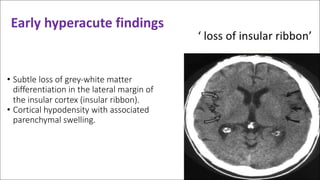
Early	hyperacute	findings	
• Subtle	loss	of	grey-white	matter	
differentiation	in	the	lateral	margin	of	
the	insular	cortex	(insular	ribbon).
• Cortical	hypodensity	with	associated	
parenchymal	swelling.
Acute	findings
• With	time	the	hypodensity	and	swelling	
(due	to	break	down	of	BBB)	become	
more	marked	resulting	in	a	significant	
mass	effect.	This	is	a	major	cause	of	
secondary	damage	in	large	infarcts.
• Maximum	swelling	occurs	during	the	
first	week,	typically	on	day	3.
• In	this	case	the	swelling	is	so	severe,	a	
decompression	craniotomy	was	needed.
Subacute	findings
• As	time	goes	on,	the	swelling starts	to	
subside and	the	density	increases due	
to	small	amounts	of	cortical	petechial	
hemorrhages.	(Fogging	phenomenon)
• Can	mimic	a	normal	CT	Scan.
Fogging	phenomenon.
Chronic	findings	
• A	region	of	low	density	with	negative	mass	effect.
• Focal	loss	of	tissue	leaving	a	vague	“ghost”	of	the	
previous	gyral	pattern.
MRI
• More	time	consuming	
• Less	available	
But	has	significantly	higher	sensitivity	and	specificity	in	the	diagnosis	
especially	in	the	first	few	hours	of	onset.
• Axial	FLAIR	image	demonstrates	intra-arterial	high	signal	in	the	left	
middle	cerebral	artery	(MCA)	of	this	patient	with	early	stroke.
• Fluid	attenuated	inversion	recovery	MRI
• Diffusion	weighted	MRI
• Apparent	diffusion	coefficient	MRI
Increased	Intracranial	Tension	
• normal	ICP is	5	- 15 mmHg.
• Causes	of	high	ICP:
1. Head	trauma
2. Hydrocephalus	
3. Intracranial	tumors
4. Hepatic	encephalopathy	
5. Cerebral	edema
• Increased	ICP	can	lead	to	death	or	devastating	neurological	damage	
by:
1. Reducing	cerebral	perfusion	pressure	(CPP)
2. Causing	cerebral	ischemia	
3. Compressing	and	causing	herniation	of	the	brainstem	or	other	vital	
structures.
• Symptoms:
1. Headache	(worse	in	the	morning)
2. Projectile	vomiting	
3. Blurry	vision
4. Altered	level	of	consciousness	
5. Cushing	triad:	Bradycardia	+	hypertension	+	irregular	respiration.
Treatment
• Elevate	the	head	(promotes	more	venous	drainage)
• Diuretics:	Mannitol
• Hyperventilation	
• Sedation	+/- muscle	relaxants	
• Hemicraniotomy
• Treat	the	underlying	cause.
References
• https://radiopaedia.org/articles/ischaemic-stroke
• Medscape

Stroke imaging