Evaluation	of	headache	in	the	ED
Dima	Lotfie
13901022
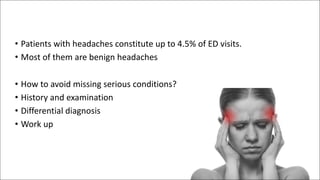
• Patients	with	headaches	constitute	up	to	4.5%	of	ED	visits.
• Most	of	them	are	benign	headaches	
• How	to	avoid	missing	serious	conditions?
• History	and	examination
• Differential	diagnosis	
• Work	up
A	patient	with	headache	in	the	ED:	History	taking		
• SOCRATES
• Focus	on:
1. Onset	(when	and	how)
2. Progression:	“was	it	the	worst	when	it	started?	Did	it	get	any	better	
or	worse?”
3. Severity:	“how	do	you	compare	the	severity	of	this	headache	to	
other	headaches	you	had	in	the	past?”
• These	questions	will	narrow	down	your	differential	and	guid	you	to	a	
diagnosis.
• Red	flags	of	subarachnoid	hemorrhage.
A	patient	with	headache	in	the	ED:	History	taking	
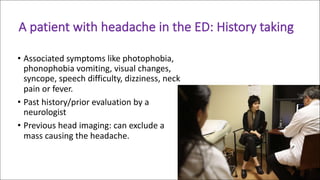
• Associated	symptoms	like	photophobia,	
phonophobia	vomiting,	visual	changes,	
syncope,	speech	difficulty,	dizziness,	neck	
pain	or	fever.
• Past	history/prior	evaluation	by	a	
neurologist	
• Previous	head	imaging:	can	exclude	a	
mass	causing	the	headache.
A	patient	with	headache	in	the	ED:	Examination	
• A	brief	neurological	examination:	make	sure	you	cover	all	the	
important	findings	you	need	to	rule	out	serious	conditions.
• Head	to	toe:	
o Speech
o HMFs
o Cranial	nerves	(briefly):	
o 2nd:	pupillary	reflexes,	papilledema.
o 3rd,	4th and	6th :	eye	movements	(check	for	nystagmus)
o5th :	facial	sensation
o7th :	elevate	eyebrows,	smile,	puff	cheeks.
A	patient	with	headache	in	the	ED:	Examination	
• Neck:	for	meningisim
• Limbs:	tone	and	power
• Cerebellar	examination:	finger	nose	test,	heel	shin	test,	gait.
• Sensory
Differential	Diagnosis	
1. Subarachnoid	hemorrhage: sudden	+	maximal	at	onset	+	worst	
severity.
2. Bacterial	meningitis/	encephalitis: fever	+	ill	patient	+	neck	stiffness	
3. Temporal	arteritis: elderly	+	unilateral	throbbing	temporal	or	forehead	
headache	+	tenderness	on	a	palpable	cord	like	temporal	artery.
4. Carbon	monoxide	poisoning: suspected	if	many	members	of	the	
family	have	headache,	cold	climate,	wood-burning	or	gas	fireplace.
5. Tumor:	insidious	onset,	gradual	+/- neurological	deficits.
Differential	Diagnosis	
6.	Intracranial	bleeding: anticoagulants	+	no	history	of	trauma
Or	a	normal	patient	with	history	of	trauma.
7.	Hypertensive	emergency: very	high	BP	(>	180/120)	+	end	organ	
damage	like	intracranial	bleeding,	stroke..
8.	Tension	headache: band	like	+	dull	+	no	systemic	associated	
symptoms	+	does	not	increase	with	activity	
9. Migraine:	unilateral	+	pulsating	or	throbbing	+	increases	with	
activity	+	associated	symptoms	(nausea	,	vomiting,	photophobia,	
phonophobia)	and	maybe	an	aura.
10. Cluster	headache:	young	patient	+	unilateral	+	tearing	and	injection	
of	the	eye	on	the	effected	side
Work	up
• CBC:	to	check	for	coagulopathy.
• Non	contrast	CT to	diagnose	subarachnoid	hemorrhage,	
intracranial	hemorrhage,	masses	or	stroke.
• CT	scan	is	not	needed	if	there	are	no	red	flags	especially	
if	the	patient	has	history	of	the	same	headache	like	in	
migraines.
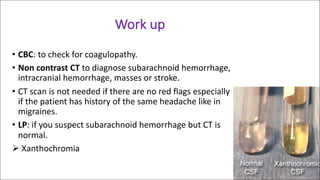
• LP:	if	you	suspect	subarachnoid	hemorrhage	but	CT	is	
normal.
Ø Xanthochromia
Headache	in	pediatrics	age	group	
• Most	cases	is	benign	
• Red	flags:	same	as	adults,	but	be	especially	aware	of	vomiting.
• Vomiting	that’s	been	going	on	for	a	while	can	point	towards	the	
possibility	of	having	a	mass.
• GI	vomiting	vs	projectile	vomiting
• Due	to	increased	ICP,	nausea,	happens	mostly	in	the	morning	or	as	
soon	as	the	patient	wakes	up.
• Consult	a	neurologist/neurosurgeon	in	the	patient	needs	admission.
References
• Up-to-date
• EM	basic

Headache (Evaluation in the ER)