STRIDORSTRIDOR
ARUN KUMAR
M S (E N T)
2015-2018Magit/Pransky: AAO Stridor 2007
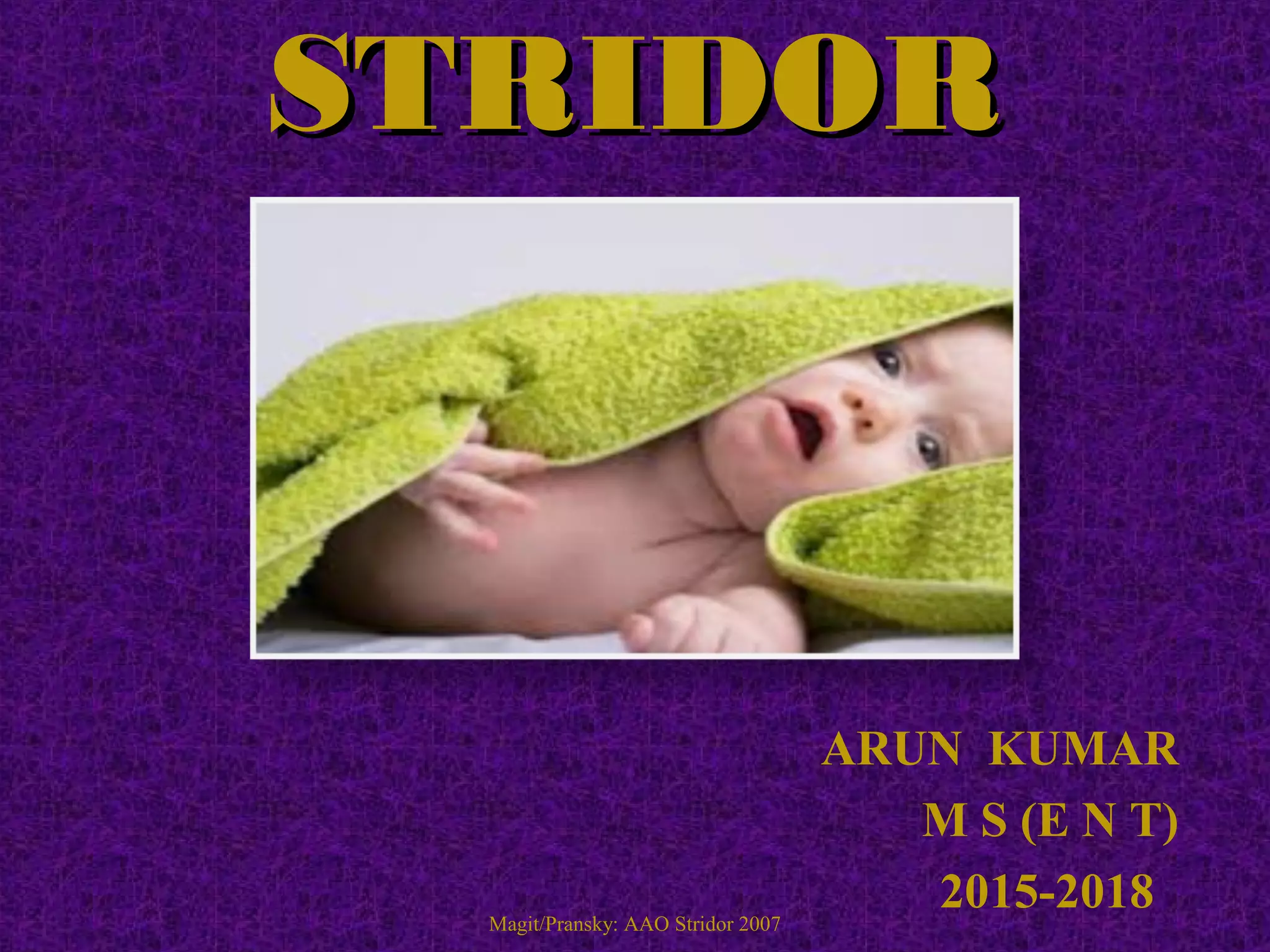
 Stridor is defind as an abnormal harsh high
pitched noise generated due to turbulent flow
of air through a partial obstruction of the
airway in the larynx or trachea
* Usually associated with dysnea
*It indicates an emergency and should always
be evaluated immediatly
Stridor
OTHER TYPES OF NOISYOTHER TYPES OF NOISY
BREATHINGBREATHING
 Stertor harsh, low pitched
turbulent sound during
respiration due to partial
obstruction proximal to larynx
(Nasopharynx and oropharynx)
 Snoring same as stertor which
occures only during sleep
Magit/Pransky: AAO Stridor 2007
TYPES OF STRIDOR AND THEIR SITETYPES OF STRIDOR AND THEIR SITE
OF ORIGINOF ORIGIN
1. In children ,chronic stridor is usually
due to congenital lesions, mostly due to
laryngomalacia
2. In childron,acute stridor is most
commonly coused by acute upper
respiratory tract infection
3. In adults, stridor is much less common.
Chronic stridor in adults and old ages
often indicates a serious underlying
pathology e.g. Laryngeal carcinoma
Magit/Pransky: AAO Stridor 2007
 Congenital Laryngeal Anomalies
 Laryngomalacia-different types
 Tracheomalacia
 Vocal Cord Paralysis
 Laryngeal Clefts
 Vascular Rings and Slings
 Infectious
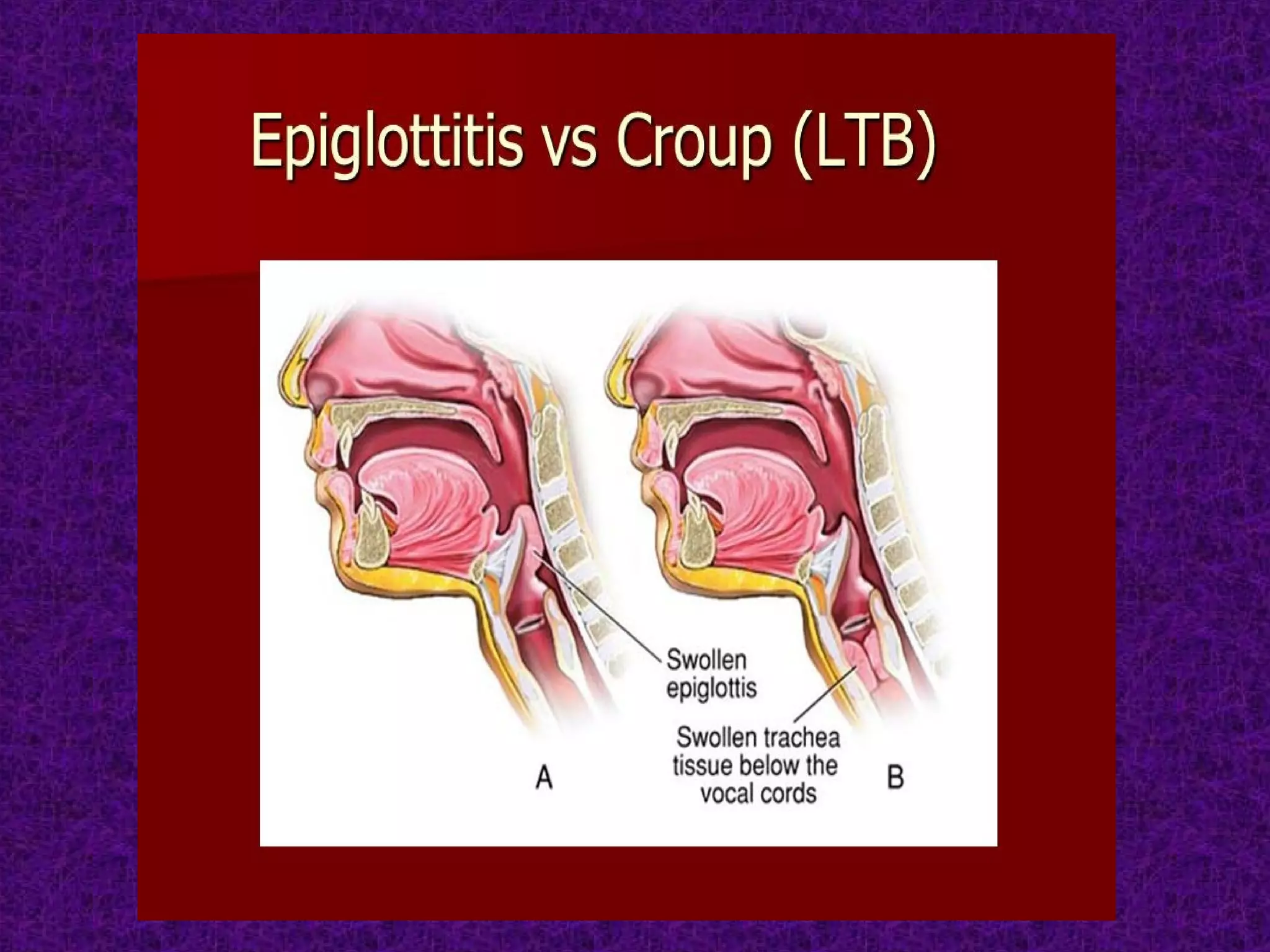
 “Croup” (Laryngotracheitis)
 Epiglottitis
 Tracheitis
 Trauma
 Croup Masquerade
 Subglottic Hemangioma
 Recurrent Respiratory
Papillomatosis
 Post Intubation Glottic and
Subglottic Lesions
 Congenital Glottic and
Subglottic Stenosis
 Extra-Esophageal
(Gastroesophageal) Reflux
Disease/Eosinophilic
Esophagitis
 Foreign Body
 Tracheal
 Esophageal
Laryngeal Stridor: Etiology
 Guide to diagnosis and intervention
Age
Congenital vs. Acquired
Characteristics of stridor
Clinical picture
Assessment Strategies
Clinical picture -HistoryClinical picture -History
 Enquire about the prematurity and require
ventilation if any,as it would had required intubation
and prolonged ventilation
 Enquire about Laryngomalacia usually become
symtomatic only after first few weeks
 Vocal cord palsy result in stridor , which manifest at
birth
 In laryngeal mass like polyp, stridor is noted when
the child is in supine position
 Stridor during feeding or during sleep and which
decreases when the child cry is indicative of
bilateral chonal atresia
Approach to StridorApproach to Stridor
Detailed history:
time & mode of onset
Duration & progression
 relation to feeding
 cyanotic spells
Trauma
Foreign body aspiration or ingestion
Detailed examinationDetailed examination
 Level of consciousness / responsiveness
 Signs of hypoxia ( tachypnea, tachycardia,
cyanosis, irritability)
 Fever
 Type of stridor
 Vitals
 Relation to cry & body positions
 Complete examination of Oral, Nose, Neck &
Chest
Fever
Drooling (new onset)
Change in cry or voice
Decrease in oral intake
Cough can be a sign of aspiration ( typical feature
of tracheoesophageal fistula and tracheomalacia)
Apnoeas with cyanosis are typical of severe
tracheobronchomalacia and these two are termed
as Dying spell
Detailed examination:
INVESTIGATIONSINVESTIGATIONS
 X-RAY neck AP/Lateral view
 Chest X-RAY PA/Lateral view
 X-RAY Chest in expiratory and inspiratory phases
 Barium swallow with valsalva and under
fluoroscopy
 Rigid/Flexible fibreoptic laryngoscopy
 Contrast-enhanced CT scan/ MRI – Neck /
mediastinum
 Rigid/Flexible Bronchoscopy
TREATMENTTREATMENT
 Conservative – O2 supplementation, parenteral antibiotics,
steroids, bronchodilators etc
 Intubation
 Cricothyroidotomy
 Tracheostomy
 Further specific medical & surgical therapy
 Endoscopic appearance
Omega epiglottis
Foreshortenend aryepiglottic folds
Cuneiform prolapse
Laryngomalacia
Ω
 Treatment:
- Vast majority are mild
conservative: reassurance
- Severe laryngomalacia:
Aryepiglottic fold division (Aryepiglottoplasty)
Cold, Laser, Microdebrider
Tracheostomy
LaryngomalaciaLaryngomalacia
 Treatment:
 BiPAP / CPAP
 Tracheotomy – variable tube length
 Stenting – if no other choice
Tracheomalacia
 Begins about 6 months to 3year,
male child M/C
 Xray of neck AP view symmetric
steeple or funnel shaped
narrowing of the subglottic region
(“steeple sign”)
 Endoscopically: 2 “sets” of vocal
cords
 Hospitalisation ; IV steroids, cold
mist tent, hydration, O2 sat
monitor
Croup
(Laryngotracheobronchitis)
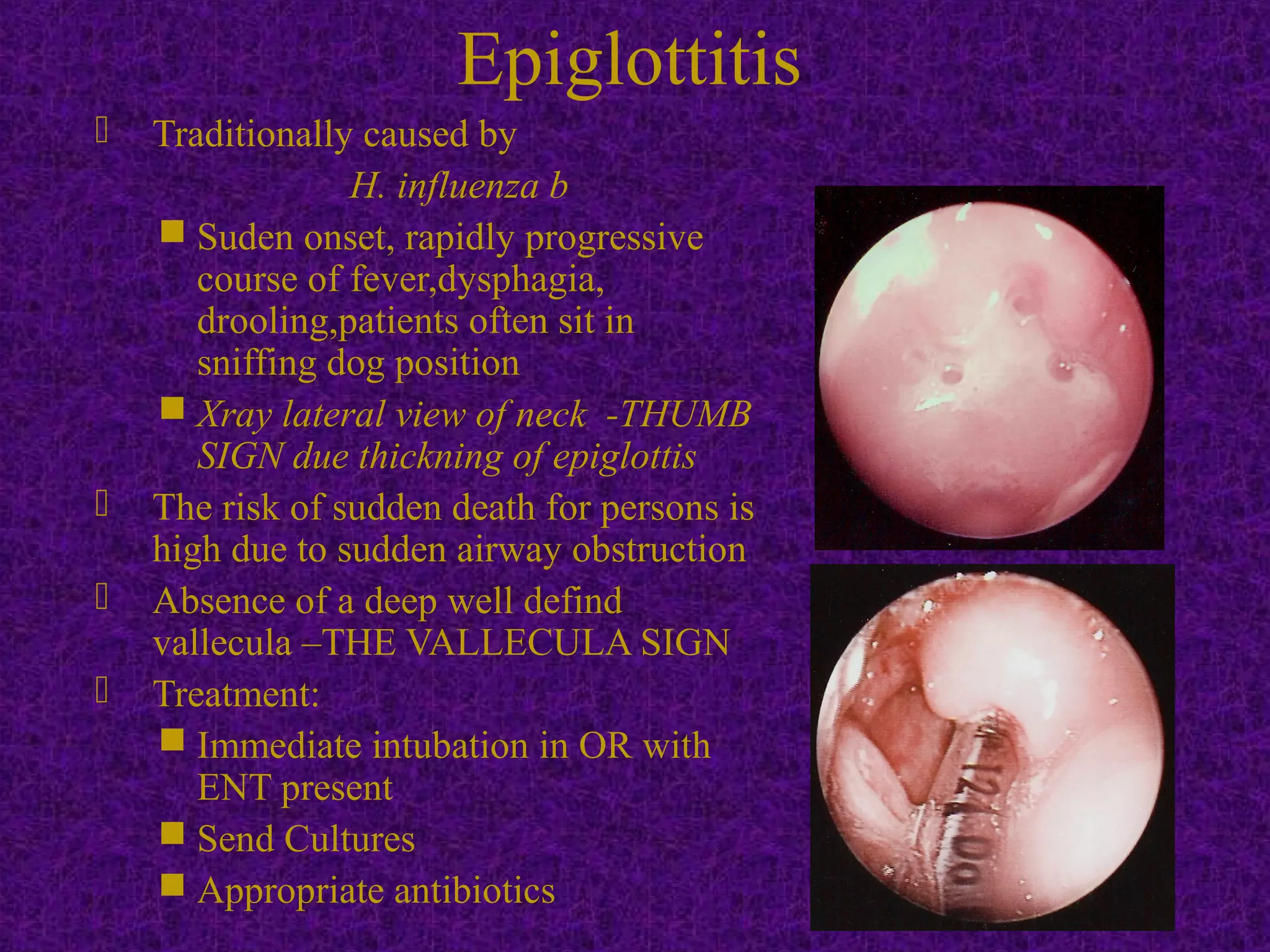
 Traditionally caused by
H. influenza b
 Suden onset, rapidly progressive
course of fever,dysphagia,
drooling,patients often sit in
sniffing dog position
 Xray lateral view of neck -THUMB
SIGN due thickning of epiglottis
 The risk of sudden death for persons is
high due to sudden airway obstruction
 Absence of a deep well defind
vallecula –THE VALLECULA SIGN
 Treatment:
 Immediate intubation in OR with
ENT present
 Send Cultures
 Appropriate antibiotics
Epiglottitis
 Acute lower airway
infection
 Typically develops as
bacterial super-infection
after viral croup
 Acute airway
obstruction, high fever,
elevated WBC develop
2-3 days after onset viral
illness
 Treatment:
 Monitor, Humidified O2
 Bronchoscopy for
suctioning of purulent
secretions and culture
 Antibiotics:
 Consider Staph aureus
(MRSA), H. flu, B-
hemolytic strep,
pneumococcus
 Treat for 7-10 days
 Tracheotomy in severe
cases
Tracheitis
Subglottic Hemangioma
 Usual time of presentation- after 3- 6 months of age
 Crying may worsen the stridor
 Laryngoscopy:- Reddish blue mass below vocal cords
 Treatment:
- tracheostomy
- steroid therapy
- CO2 laser excision
 New Management Options - Propanolol!
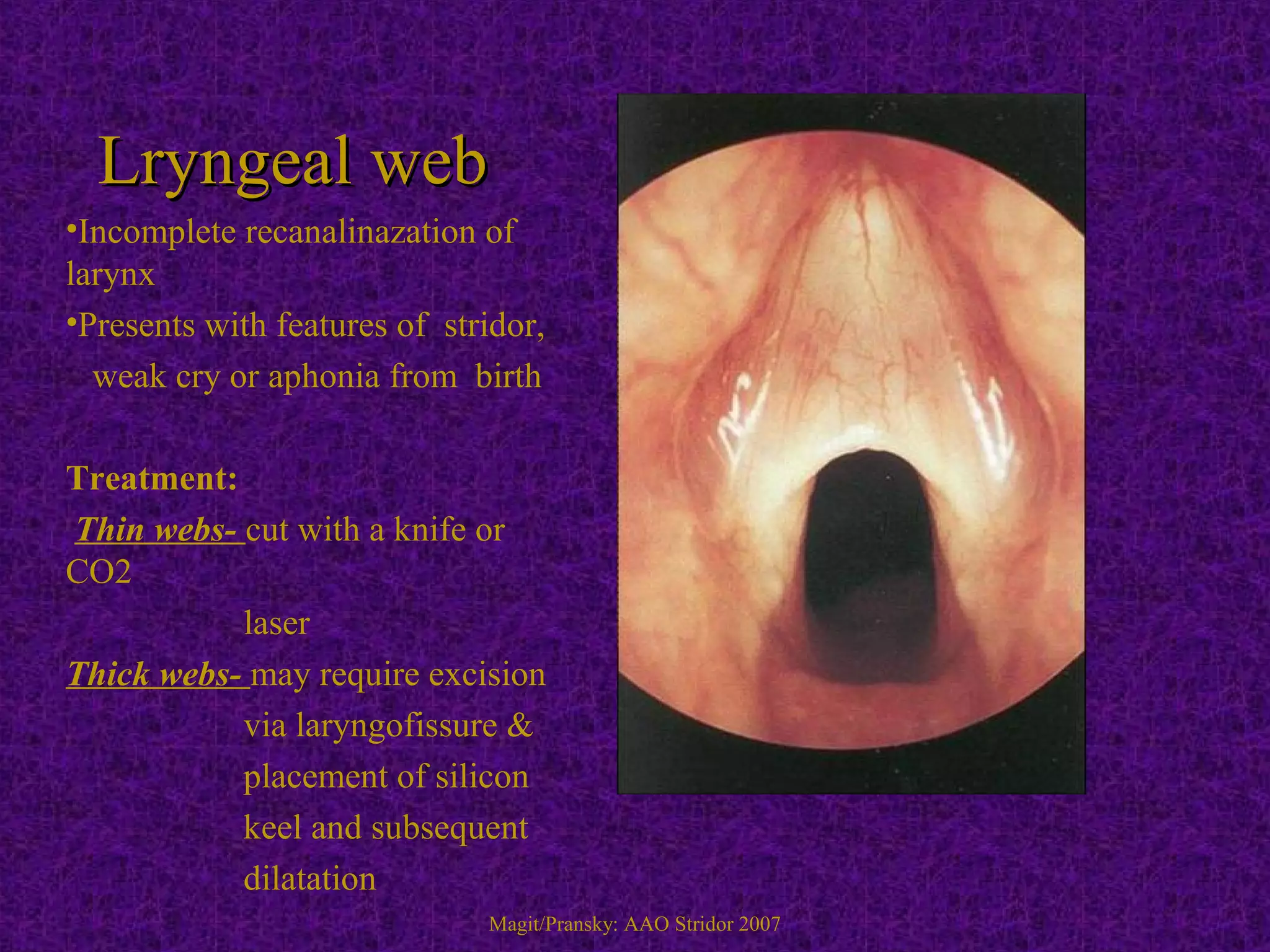
Lryngeal webLryngeal web
•Incomplete recanalinazation of
larynx
•Presents with features of stridor,
weak cry or aphonia from birth
Treatment:
Thin webs- cut with a knife or
CO2
laser
Thick webs- may require excision
via laryngofissure &
placement of silicon
keel and subsequent
dilatation
Magit/Pransky: AAO Stridor 2007
Airway foreign bodiesAirway foreign bodies
 Treatment:
- Heimlich manoeuvre
- Cricothyroidotomy
- Emergency tracheostomy
- Removal by direct laryngoscopy/ rigid or flexible
bronchoscope
Airway foreignAirway foreign
bodiesbodies
Treatment:
- Heimlich manoeuvre
- Cricothyroidotomy
- Emergency
tracheostomy
- Removal by direct
laryngoscopy/ rigid or
flexible bronchoscope
Magit/Pransky: AAO Stridor 2007
Post Intubation InjuriesPost Intubation Injuries
Seen in
Intubation--even transient
NICU patients
Treatment:
-Endoscopic division
-Laryngeal keel
-Short term post-op
intubation
-Mitomycin (?)
Magit/Pransky: AAO Stridor 2007
THANK YOUTHANK YOU
Magit/Pransky: AAO Stridor 2007

Stridor 2018

  • 1.
    STRIDORSTRIDOR ARUN KUMAR M S(E N T) 2015-2018Magit/Pransky: AAO Stridor 2007
  • 2.
     Stridor isdefind as an abnormal harsh high pitched noise generated due to turbulent flow of air through a partial obstruction of the airway in the larynx or trachea * Usually associated with dysnea *It indicates an emergency and should always be evaluated immediatly Stridor
  • 3.
    OTHER TYPES OFNOISYOTHER TYPES OF NOISY BREATHINGBREATHING  Stertor harsh, low pitched turbulent sound during respiration due to partial obstruction proximal to larynx (Nasopharynx and oropharynx)  Snoring same as stertor which occures only during sleep
  • 4.
  • 8.
    TYPES OF STRIDORAND THEIR SITETYPES OF STRIDOR AND THEIR SITE OF ORIGINOF ORIGIN
  • 9.
    1. In children,chronic stridor is usually due to congenital lesions, mostly due to laryngomalacia 2. In childron,acute stridor is most commonly coused by acute upper respiratory tract infection 3. In adults, stridor is much less common. Chronic stridor in adults and old ages often indicates a serious underlying pathology e.g. Laryngeal carcinoma Magit/Pransky: AAO Stridor 2007
  • 10.
     Congenital LaryngealAnomalies  Laryngomalacia-different types  Tracheomalacia  Vocal Cord Paralysis  Laryngeal Clefts  Vascular Rings and Slings  Infectious  “Croup” (Laryngotracheitis)  Epiglottitis  Tracheitis  Trauma  Croup Masquerade  Subglottic Hemangioma  Recurrent Respiratory Papillomatosis  Post Intubation Glottic and Subglottic Lesions  Congenital Glottic and Subglottic Stenosis  Extra-Esophageal (Gastroesophageal) Reflux Disease/Eosinophilic Esophagitis  Foreign Body  Tracheal  Esophageal Laryngeal Stridor: Etiology
  • 11.
     Guide todiagnosis and intervention Age Congenital vs. Acquired Characteristics of stridor Clinical picture Assessment Strategies
  • 12.
    Clinical picture -HistoryClinicalpicture -History  Enquire about the prematurity and require ventilation if any,as it would had required intubation and prolonged ventilation  Enquire about Laryngomalacia usually become symtomatic only after first few weeks  Vocal cord palsy result in stridor , which manifest at birth  In laryngeal mass like polyp, stridor is noted when the child is in supine position  Stridor during feeding or during sleep and which decreases when the child cry is indicative of bilateral chonal atresia
  • 13.
    Approach to StridorApproachto Stridor Detailed history: time & mode of onset Duration & progression  relation to feeding  cyanotic spells Trauma Foreign body aspiration or ingestion
  • 14.
    Detailed examinationDetailed examination Level of consciousness / responsiveness  Signs of hypoxia ( tachypnea, tachycardia, cyanosis, irritability)  Fever  Type of stridor  Vitals  Relation to cry & body positions  Complete examination of Oral, Nose, Neck & Chest
  • 15.
    Fever Drooling (new onset) Changein cry or voice Decrease in oral intake Cough can be a sign of aspiration ( typical feature of tracheoesophageal fistula and tracheomalacia) Apnoeas with cyanosis are typical of severe tracheobronchomalacia and these two are termed as Dying spell Detailed examination:
  • 16.
    INVESTIGATIONSINVESTIGATIONS  X-RAY neckAP/Lateral view  Chest X-RAY PA/Lateral view  X-RAY Chest in expiratory and inspiratory phases  Barium swallow with valsalva and under fluoroscopy  Rigid/Flexible fibreoptic laryngoscopy  Contrast-enhanced CT scan/ MRI – Neck / mediastinum  Rigid/Flexible Bronchoscopy
  • 17.
    TREATMENTTREATMENT  Conservative –O2 supplementation, parenteral antibiotics, steroids, bronchodilators etc  Intubation  Cricothyroidotomy  Tracheostomy  Further specific medical & surgical therapy
  • 18.
     Endoscopic appearance Omegaepiglottis Foreshortenend aryepiglottic folds Cuneiform prolapse Laryngomalacia Ω
  • 19.
     Treatment: - Vastmajority are mild conservative: reassurance - Severe laryngomalacia: Aryepiglottic fold division (Aryepiglottoplasty) Cold, Laser, Microdebrider Tracheostomy LaryngomalaciaLaryngomalacia
  • 20.
     Treatment:  BiPAP/ CPAP  Tracheotomy – variable tube length  Stenting – if no other choice Tracheomalacia
  • 21.
     Begins about6 months to 3year, male child M/C  Xray of neck AP view symmetric steeple or funnel shaped narrowing of the subglottic region (“steeple sign”)  Endoscopically: 2 “sets” of vocal cords  Hospitalisation ; IV steroids, cold mist tent, hydration, O2 sat monitor Croup (Laryngotracheobronchitis)
  • 22.
     Traditionally causedby H. influenza b  Suden onset, rapidly progressive course of fever,dysphagia, drooling,patients often sit in sniffing dog position  Xray lateral view of neck -THUMB SIGN due thickning of epiglottis  The risk of sudden death for persons is high due to sudden airway obstruction  Absence of a deep well defind vallecula –THE VALLECULA SIGN  Treatment:  Immediate intubation in OR with ENT present  Send Cultures  Appropriate antibiotics Epiglottitis
  • 24.
     Acute lowerairway infection  Typically develops as bacterial super-infection after viral croup  Acute airway obstruction, high fever, elevated WBC develop 2-3 days after onset viral illness  Treatment:  Monitor, Humidified O2  Bronchoscopy for suctioning of purulent secretions and culture  Antibiotics:  Consider Staph aureus (MRSA), H. flu, B- hemolytic strep, pneumococcus  Treat for 7-10 days  Tracheotomy in severe cases Tracheitis
  • 25.
    Subglottic Hemangioma  Usualtime of presentation- after 3- 6 months of age  Crying may worsen the stridor  Laryngoscopy:- Reddish blue mass below vocal cords  Treatment: - tracheostomy - steroid therapy - CO2 laser excision  New Management Options - Propanolol!
  • 26.
    Lryngeal webLryngeal web •Incompleterecanalinazation of larynx •Presents with features of stridor, weak cry or aphonia from birth Treatment: Thin webs- cut with a knife or CO2 laser Thick webs- may require excision via laryngofissure & placement of silicon keel and subsequent dilatation Magit/Pransky: AAO Stridor 2007
  • 27.
    Airway foreign bodiesAirwayforeign bodies  Treatment: - Heimlich manoeuvre - Cricothyroidotomy - Emergency tracheostomy - Removal by direct laryngoscopy/ rigid or flexible bronchoscope
  • 28.
    Airway foreignAirway foreign bodiesbodies Treatment: -Heimlich manoeuvre - Cricothyroidotomy - Emergency tracheostomy - Removal by direct laryngoscopy/ rigid or flexible bronchoscope Magit/Pransky: AAO Stridor 2007
  • 29.
    Post Intubation InjuriesPostIntubation Injuries Seen in Intubation--even transient NICU patients Treatment: -Endoscopic division -Laryngeal keel -Short term post-op intubation -Mitomycin (?) Magit/Pransky: AAO Stridor 2007
  • 30.