LAKSHMI SASIKANTH
3rd year MBBS
STRIDOR
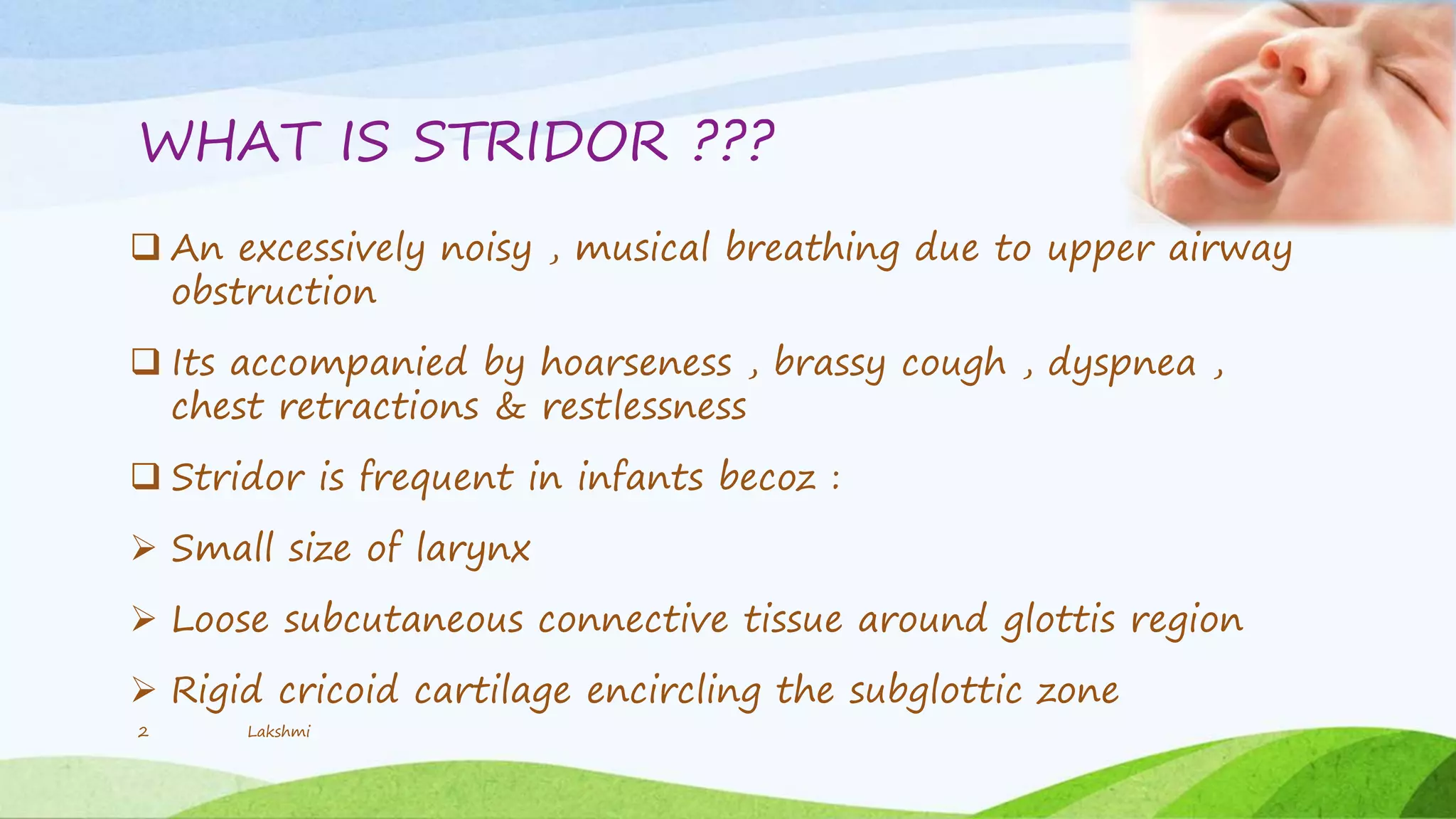
WHAT IS STRIDOR ???
 An excessively noisy , musical breathing due to upper airway
obstruction
 Its accompanied by hoarseness , brassy cough , dyspnea ,
chest retractions & restlessness
 Stridor is frequent in infants becoz :
 Small size of larynx
 Loose subcutaneous connective tissue around glottis region
 Rigid cricoid cartilage encircling the subglottic zone
Lakshmi2
Relationship of stridor to the respiratory cycle often provides a clue to its
etiology :
INSPIRATORY
EXPIRATORY
BIPHASIC
Lakshmi3
Lakshmi4
ACUTE STRIDOR
 Acute upper airway obstruction occurring in the region of
glottis which is produced by inflammation & oedema
 Maybe life threatening
 Obstruction can be
• Supraglottic as in epiglottitis
• subglottic as in infectious croup
Lakshmi5
CHRONIC STRIDOR
Congenital laryngeal stridor
Congenital laryngeal or
tracheal stenosis or web
Laryngeal cyst or neoplasm
Neurogenic stridor Extrinsic obstruction
Miscellaneous causes:
Hydrochephalus, Downs,
micrognathia & glossoptosis ,
macroglossia &
diaphragmatic hernia
Lakshmi6
INFECTIONS
 CROUP
 The term croup is used for used for a variety of conditions in
which a peculiar brassy cough is the main presenting feature
 The diseases include
 ACUTE EPIGLOTTITIS
 LARYNGITIS
 LARYNGOTRACHEOBRONCHITIS
 SPASMODIC LARYNGITIS
Lakshmi7
EPIGLOTTITIS
• H.Influenzae type B – MC cause
• Starts with a minor URTI that progresses
rapidly within few hours
• High grade fever & dysphagia
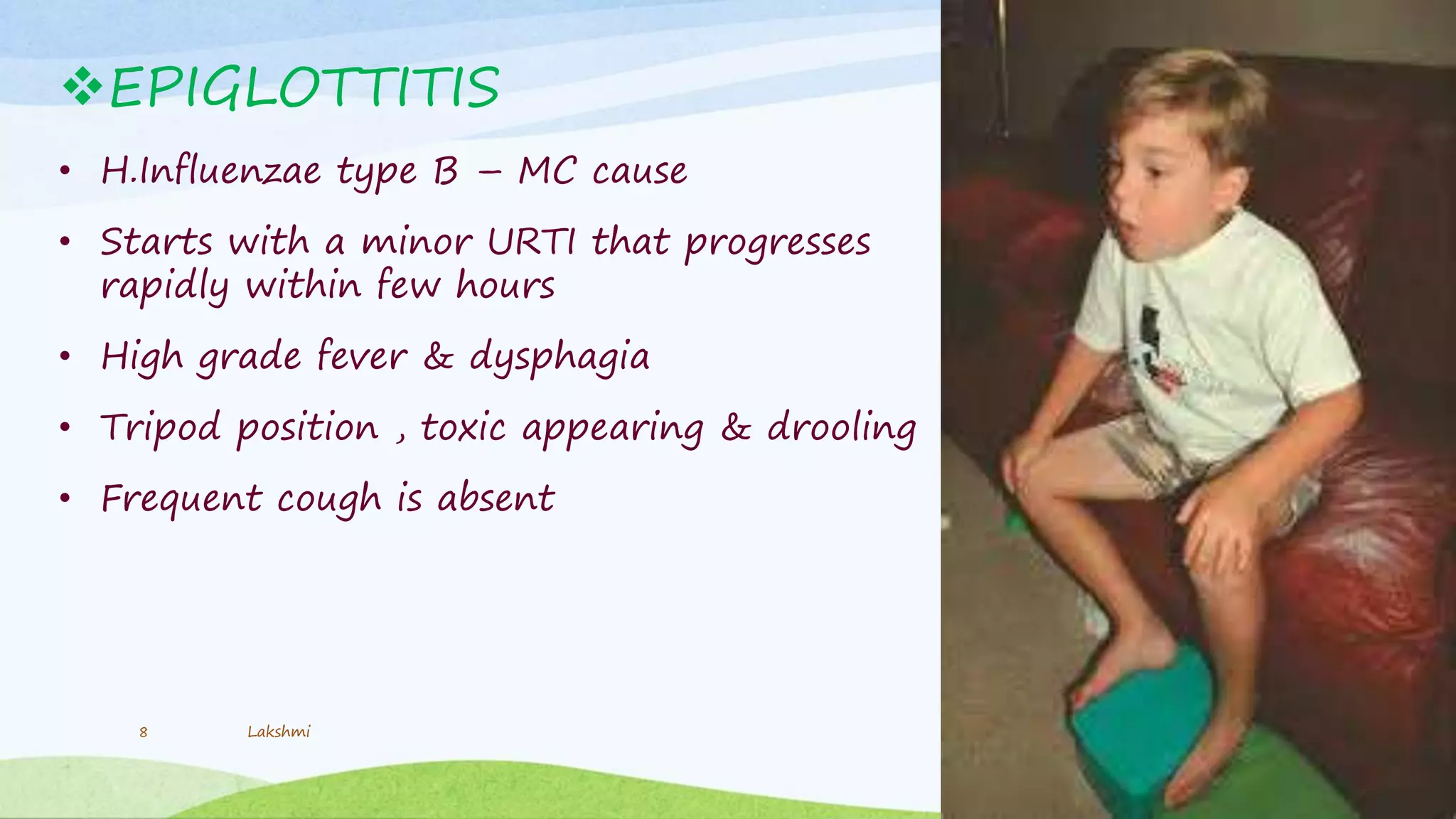
• Tripod position , toxic appearing & drooling
• Frequent cough is absent
Lakshmi8
Lakshmi9
LARYNGITIS & LARYNGOTRACHEOBRONCHITIS
• Infectious croup
• Viral infection with parainfluenza type 1 – MC
• Also parainfluenza types 2 & 3 , influenza virus , adenovirus
& rhinovirus
• Mild cold develops to brassy cough & mild inspiratory stridor
• Child becomes restless , tachypnoec & hypoxic
• Cyanosis appears
• As obstruction worsens breath sounds become inaudible &
stridor apparently decreases
Lakshmi10
STEEPLE SIGN
Lakshmi11
SPASMODIC CROUP
• Occurs between 1-3 years
• Child wakes up early in morning with brassy cough &
noisy breathing
• Recurrent episodes but complete recovery
• Cause – unknown
• Mgmt. : humidification of the child’s room
Lakshmi12
MANAGEMENT
• Hospitalization
• Rapid airway management
• Intubation
• Broad spectrum antibiotics ( coamoxiclav, ceftriaxone ..)
• Rx with nebulized epinephrine
• Single i.m dose of dexamethasone
Lakshmi13
OTHER INFECTIONS
BACTERIAL TRACHEITIS
RETROPHARYNGEAL ABSCESS
Lakshmi14
CONGENITAL CAUSES
LARYNGOMALACIA
• MC congenital laryngeal anomaly & MC cause of infant stridor
• Inspiratory stridor – hallmark aggravated while supine or crying
• Dx : flexible endoscopy – partial collapse of flaccid supraglottic
airway with inspiration
• Its benign & resolve by 18 months
• Rx : surgical intervention in case of resp. distress
or FTT
Lakshmi15
VOCAL CORD PARALYSIS
• 2nd MC congenital laryngeal anomaly
• B/L VCP – high pitched inspiratory stridor &
cyanosis
• Idiopathic or mostly iatrogenic ( Erb’s palsy of
recurrent nerve during vaginal delivery )
• U/L VCP – mild stridor &/or aspiration
• MCC-Iatrogenic injury during ligation of PDA
• Rx : tracheostomy in B/L VCP
Lakshmi16
CONGENITAL SUBGLOTTIC STENOSIS
• 3rd MC congenital laryngeal anomaly
• Cause : incomplete recanalization of laryngotracheal tube
during embryonic development
• C/F : recurrent episodes of biphasic stridor (mis dx. as croup)
• Severe cases tracheostomy & surgical excision of stenosis
Lakshmi17
VASCULAR RING
• Great vessel anomaly causing
compression of both trachea &
oesophagus
• C/F : stridor & dysphagia
• Rx : surgical
Lakshmi18
SUBGLOTTIC HEMANGIOMA
• Benign vascular tumor present in trachea
• Biphasic stridor with barking cough
 CONGENITAL SACCULAR CYST
 LARYNGEAL WEB
 LARYNGEAL ATRESIA
Lakshmi19
IATROGENIC CAUSES
ACQUIRED SUBGLOTTIC STENOSIS
• MC congenital laryngeal anomaly & MC cause of infant stridor
• Inspiratory stridor – hallmark aggravated while supine or crying
• Dx : flexible endoscopy – partial collapse of flaccid supraglottic
airway with inspiration
• Its benign & resolve by 18 months
• Rx : surgical intervention in case of resp. distress
or FTT
Lakshmi20
Lakshmi21
 LARYNGEAL GRANULOMA
• Results from prolonged intubation
• Dx : Endoscopy reveals vocal cord granuloma
Lakshmi22
NEOPLASMS
RECURRENT RESPIRATORY PAPPILOMA
• MC benign laryngeal TUMOR
• Presents with gradual airway obstruction
• Caused by HPV types 6 & 11
• MOT : Passage of fetus through infected birth canal
• Dx : Endoscopy – single or multiple irregular warty masses
in larynx or pharynx
Lakshmi23
• Rx : CO2 laser ablation or excision of the papilloma
anti virals & interferons
Lakshmi24
FOREIGN BODY ASPIRATION
• Potential cause of stridor in children
• MC are food & coins
• Urgent endoscopic visualization required
• Immediate removal by surgery
Lakshmi25
Lakshmi26

STRIDOR

  • 1.
  • 2.
    WHAT IS STRIDOR???  An excessively noisy , musical breathing due to upper airway obstruction  Its accompanied by hoarseness , brassy cough , dyspnea , chest retractions & restlessness  Stridor is frequent in infants becoz :  Small size of larynx  Loose subcutaneous connective tissue around glottis region  Rigid cricoid cartilage encircling the subglottic zone Lakshmi2
  • 3.
    Relationship of stridorto the respiratory cycle often provides a clue to its etiology : INSPIRATORY EXPIRATORY BIPHASIC Lakshmi3
  • 4.
  • 5.
    ACUTE STRIDOR  Acuteupper airway obstruction occurring in the region of glottis which is produced by inflammation & oedema  Maybe life threatening  Obstruction can be • Supraglottic as in epiglottitis • subglottic as in infectious croup Lakshmi5
  • 6.
    CHRONIC STRIDOR Congenital laryngealstridor Congenital laryngeal or tracheal stenosis or web Laryngeal cyst or neoplasm Neurogenic stridor Extrinsic obstruction Miscellaneous causes: Hydrochephalus, Downs, micrognathia & glossoptosis , macroglossia & diaphragmatic hernia Lakshmi6
  • 7.
    INFECTIONS  CROUP  Theterm croup is used for used for a variety of conditions in which a peculiar brassy cough is the main presenting feature  The diseases include  ACUTE EPIGLOTTITIS  LARYNGITIS  LARYNGOTRACHEOBRONCHITIS  SPASMODIC LARYNGITIS Lakshmi7
  • 8.
    EPIGLOTTITIS • H.Influenzae typeB – MC cause • Starts with a minor URTI that progresses rapidly within few hours • High grade fever & dysphagia • Tripod position , toxic appearing & drooling • Frequent cough is absent Lakshmi8
  • 9.
  • 10.
    LARYNGITIS & LARYNGOTRACHEOBRONCHITIS •Infectious croup • Viral infection with parainfluenza type 1 – MC • Also parainfluenza types 2 & 3 , influenza virus , adenovirus & rhinovirus • Mild cold develops to brassy cough & mild inspiratory stridor • Child becomes restless , tachypnoec & hypoxic • Cyanosis appears • As obstruction worsens breath sounds become inaudible & stridor apparently decreases Lakshmi10
  • 11.
  • 12.
    SPASMODIC CROUP • Occursbetween 1-3 years • Child wakes up early in morning with brassy cough & noisy breathing • Recurrent episodes but complete recovery • Cause – unknown • Mgmt. : humidification of the child’s room Lakshmi12
  • 13.
    MANAGEMENT • Hospitalization • Rapidairway management • Intubation • Broad spectrum antibiotics ( coamoxiclav, ceftriaxone ..) • Rx with nebulized epinephrine • Single i.m dose of dexamethasone Lakshmi13
  • 14.
  • 15.
    CONGENITAL CAUSES LARYNGOMALACIA • MCcongenital laryngeal anomaly & MC cause of infant stridor • Inspiratory stridor – hallmark aggravated while supine or crying • Dx : flexible endoscopy – partial collapse of flaccid supraglottic airway with inspiration • Its benign & resolve by 18 months • Rx : surgical intervention in case of resp. distress or FTT Lakshmi15
  • 16.
    VOCAL CORD PARALYSIS •2nd MC congenital laryngeal anomaly • B/L VCP – high pitched inspiratory stridor & cyanosis • Idiopathic or mostly iatrogenic ( Erb’s palsy of recurrent nerve during vaginal delivery ) • U/L VCP – mild stridor &/or aspiration • MCC-Iatrogenic injury during ligation of PDA • Rx : tracheostomy in B/L VCP Lakshmi16
  • 17.
    CONGENITAL SUBGLOTTIC STENOSIS •3rd MC congenital laryngeal anomaly • Cause : incomplete recanalization of laryngotracheal tube during embryonic development • C/F : recurrent episodes of biphasic stridor (mis dx. as croup) • Severe cases tracheostomy & surgical excision of stenosis Lakshmi17
  • 18.
    VASCULAR RING • Greatvessel anomaly causing compression of both trachea & oesophagus • C/F : stridor & dysphagia • Rx : surgical Lakshmi18
  • 19.
    SUBGLOTTIC HEMANGIOMA • Benignvascular tumor present in trachea • Biphasic stridor with barking cough  CONGENITAL SACCULAR CYST  LARYNGEAL WEB  LARYNGEAL ATRESIA Lakshmi19
  • 20.
    IATROGENIC CAUSES ACQUIRED SUBGLOTTICSTENOSIS • MC congenital laryngeal anomaly & MC cause of infant stridor • Inspiratory stridor – hallmark aggravated while supine or crying • Dx : flexible endoscopy – partial collapse of flaccid supraglottic airway with inspiration • Its benign & resolve by 18 months • Rx : surgical intervention in case of resp. distress or FTT Lakshmi20
  • 21.
  • 22.
     LARYNGEAL GRANULOMA •Results from prolonged intubation • Dx : Endoscopy reveals vocal cord granuloma Lakshmi22
  • 23.
    NEOPLASMS RECURRENT RESPIRATORY PAPPILOMA •MC benign laryngeal TUMOR • Presents with gradual airway obstruction • Caused by HPV types 6 & 11 • MOT : Passage of fetus through infected birth canal • Dx : Endoscopy – single or multiple irregular warty masses in larynx or pharynx Lakshmi23
  • 24.
    • Rx :CO2 laser ablation or excision of the papilloma anti virals & interferons Lakshmi24
  • 25.
    FOREIGN BODY ASPIRATION •Potential cause of stridor in children • MC are food & coins • Urgent endoscopic visualization required • Immediate removal by surgery Lakshmi25
  • 26.