!  Toshio Fukuoka MD
   !  Cardiovascular Surgery, Emergency Department
   !  and Vice Director of ICU

   !  Nagoya National Hospital
   !  Nagoya, JAPAN


Nov. 16 2003       Joint Congress of KSCCM & JSICM in Seoul
!    Scenario and Questions


                  Joint Congress of KSCCM & JSICM in
 Nov. 16 2003
                                  Seoul
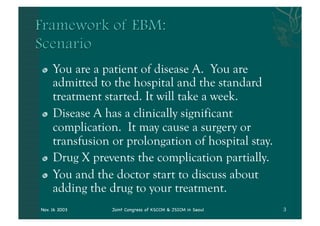
"    You are a patient of disease A. You are
     admitted to the hospital and the standard
     treatment started. It will take a week.
"    Disease A has a clinically significant
     complication. It may cause a surgery or
     transfusion or prolongation of hospital stay.
"    Drug X prevents the complication partially.
"    You and the doctor start to discuss about
     adding the drug to your treatment.
Nov. 16 2003     Joint Congress of KSCCM & JSICM in Seoul
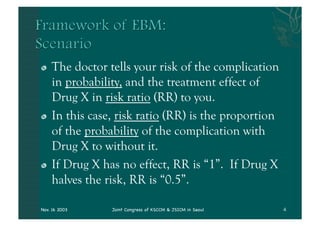
"   The doctor tells your risk of the complication
    in probability, and the treatment effect of
    Drug X in risk ratio (RR) to you.
"   In this case, risk ratio (RR) is the proportion
    of the probability of the complication with
    Drug X to without it.
"   If Drug X has no effect, RR is “1”. If Drug X
    halves the risk, RR is “0.5”.

Nov. 16 2003    Joint Congress of KSCCM & JSICM in Seoul
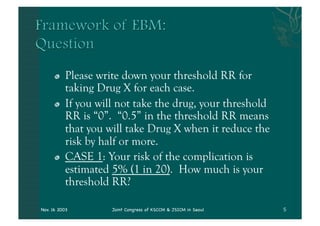
"   Please write down your threshold RR for
          taking Drug X for each case.
      "   If you will not take the drug, your threshold
          RR is “0”. “0.5” in the threshold RR means
          that you will take Drug X when it reduce the
          risk by half or more.
      "   CASE 1: Your risk of the complication is
          estimated 5% (1 in 20). How much is your
          threshold RR?

Nov. 16 2003        Joint Congress of KSCCM & JSICM in Seoul
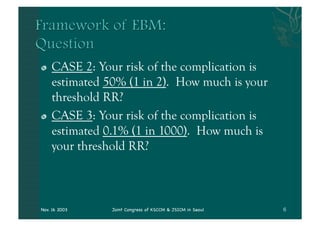
"   CASE 2: Your risk of the complication is
    estimated 50% (1 in 2). How much is your
    threshold RR?
"   CASE 3: Your risk of the complication is
    estimated 0.1% (1 in 1000). How much is
    your threshold RR?


Nov. 16 2003   Joint Congress of KSCCM & JSICM in Seoul
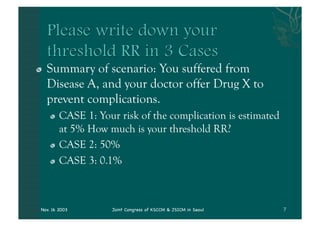
"     Summary of scenario: You suffered from
      Disease A, and your doctor offer Drug X to
      prevent complications.
        "   CASE 1: Your risk of the complication is estimated
            at 5% How much is your threshold RR?
        "   CASE 2: 50%
        "   CASE 3: 0.1%


    Nov. 16 2003        Joint Congress of KSCCM & JSICM in Seoul
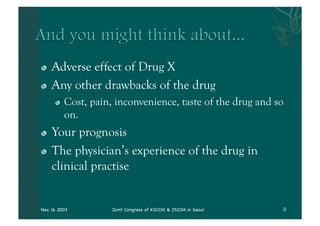
"   Adverse effect of Drug X
"   Any other drawbacks of the drug
      "   Cost, pain, inconvenience, taste of the drug and so
          on.
"   Your prognosis
"   The physician’s experience of the drug in
    clinical practise


Nov. 16 2003         Joint Congress of KSCCM & JSICM in Seoul
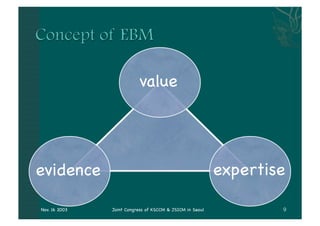
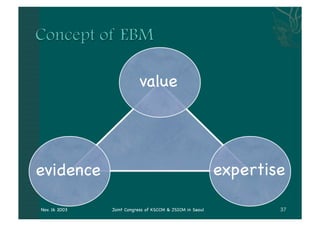
value


evidence                                                  expertise

Nov. 16 2003   Joint Congress of KSCCM & JSICM in Seoul
Joint Congress of KSCCM & JSICM in
Nov. 16 2003
                               Seoul
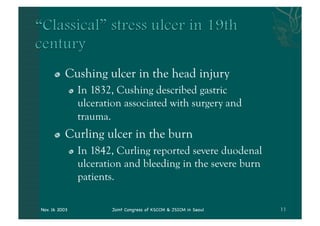
"   Cushing ulcer in the head injury
               "   In 1832, Cushing described gastric
                   ulceration associated with surgery and
                   trauma.
      "   Curling ulcer in the burn
               "   In 1842, Curling reported severe duodenal
                   ulceration and bleeding in the severe burn
                   patients.

Nov. 16 2003               Joint Congress of KSCCM & JSICM in Seoul
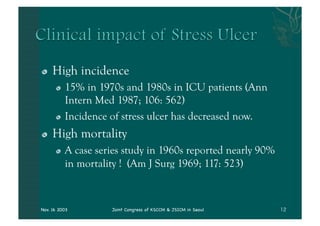
"    High incidence
      "   15% in 1970s and 1980s in ICU patients (Ann
          Intern Med 1987; 106: 562)
      "   Incidence of stress ulcer has decreased now.
"    High mortality
      "   A case series study in 1960s reported nearly 90%
          in mortality ! (Am J Surg 1969; 117: 523)


Nov. 16 2003        Joint Congress of KSCCM & JSICM in Seoul
"   Most of the stress ulcerations are superficial
    mucosal erosions
"   Such erosions are common in patients after
    stressful event, such as major surgery and
    trauma


Nov. 16 2003    Joint Congress of KSCCM & JSICM in Seoul
"    Gastric or Duodenal
       ulcer. Mucosal defect is
       obvious.
  "    Bleeding from a
       submucosal vessel might
       result in massive
       bleeding.
  "    Deep ulcer might cause
       perforation.

Nov. 16 2003      Joint Congress of KSCCM & JSICM in Seoul
"   Acute gastric mucosal
                                         erosions. Superficial
                                         mucosal defect.
                                     "   Oozing of blood from
                                         capillary vessels.


Nov. 16 2003   Joint Congress of KSCCM & JSICM in Seoul
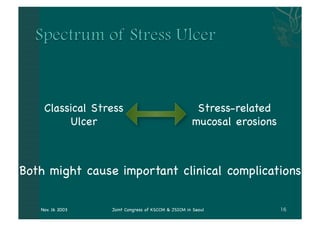
Classical Stress                                 Stress-related
         Ulcer                                      mucosal erosions


Both might cause important clinical complications

   Nov. 16 2003   Joint Congress of KSCCM & JSICM in Seoul
"   Significant gastrointestinal (GI) bleeding
      "   Hemodynamic instability
      "   Anemia and Transfusion
"   Gastrointestinal perforation
"   Peritonitis
"   => Laparotomy


Nov. 16 2003        Joint Congress of KSCCM & JSICM in Seoul
Joint Congress of KSCCM & JSICM in
Nov. 16 2003
                               Seoul
"    2,252 ICU patient from 4 Canadian
       centres.
  "    Definition of clinically significant bleeding
        "      Overt GI bleeding with hemodynamic change in
               BP or HR, or progression of anemia
  "    Nearly half of the patients are associated in
       cardiovascular operations. Several patient
       subgroups were very few, such as trauma,
       head injury, burn and transplantation.
Nov. 16 2003           Joint Congress of KSCCM & JSICM in Seoul
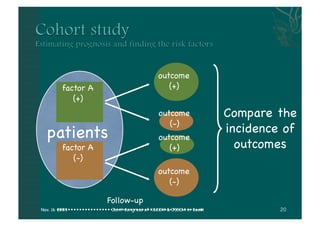
outcome
         factor A                           (+)
            (+)
                                         outcome                Compare the
                                            (-)
  patients                                                      incidence of
                                         outcome
         factor A                           (+)                   outcomes
            (-)
                                         outcome
                                            (-)

                    Follow-up
Nov. 16 2003         Joint Congress of KSCCM & JSICM in Seoul
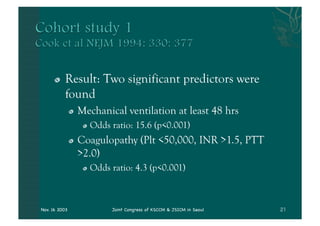
"   Result: Two significant predictors were
          found
               "   Mechanical ventilation at least 48 hrs
                    "   Odds ratio: 15.6 (p<0.001)
               "   Coagulopathy (Plt <50,000, INR >1.5, PTT
                   >2.0)
                    "   Odds ratio: 4.3 (p<0.001)


Nov. 16 2003                 Joint Congress of KSCCM & JSICM in Seoul
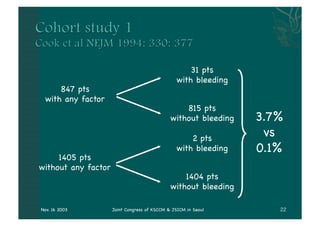
31 pts
                                                with bleeding
     847 pts
 with any factor
                                                  815 pts
                                              without bleeding   3.7%
                                                    2 pts
                                                                  vs
                                                with bleeding    0.1%
     1405 pts
without any factor
                                                  1404 pts
                                              without bleeding

Nov. 16 2003         Joint Congress of KSCCM & JSICM in Seoul
Joint Congress of KSCCM & JSICM in
Nov. 16 2003
                               Seoul
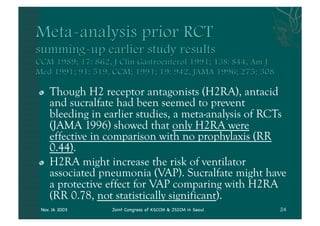
"      Though H2 receptor antagonists (H2RA), antacid
       and sucralfate had been seemed to prevent
       bleeding in earlier studies, a meta-analysis of RCTs
       (JAMA 1996) showed that only H2RA were
       effective in comparison with no prophylaxis (RR
       0.44).
"      H2RA might increase the risk of ventilator
       associated pneumonia (VAP). Sucralfate might have
       a protective effect for VAP comparing with H2RA
       (RR 0.78, not statistically significant).
    Nov. 16 2003    Joint Congress of KSCCM & JSICM in Seoul
"    Difficulty in conducting RCT of this topic.
       "   Low incidence of the outcomes: “Assuming a
           bleeding rate of 2.0%... an RCT with 75% power
           to detect 25% relative risk reduction (0.75 in RR)
           in bleeding would have required approximately
           19000 patients.” (Cook DJ in Intens Care Med
           2001; 27: 347)
 "    Then they conducted a RCT of H2RA and
      sucralfate in mechanically ventilated patients,
      patients at the high risk of bleeding.
Nov. 16 2003         Joint Congress of KSCCM & JSICM in Seoul
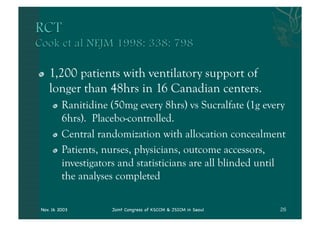
"      1,200 patients with ventilatory support of
       longer than 48hrs in 16 Canadian centers.
         "   Ranitidine (50mg every 8hrs) vs Sucralfate (1g every
             6hrs). Placebo-controlled.
         "   Central randomization with allocation concealment
         "   Patients, nurses, physicians, outcome accessors,
             investigators and statisticians are all blinded until
             the analyses completed

    Nov. 16 2003        Joint Congress of KSCCM & JSICM in Seoul
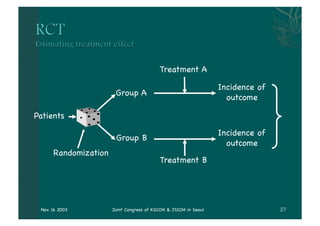
Treatment A

                                                                 Incidence of
                       Group A
                                                                   outcome

Patients

                                                                 Incidence of
                       Group B
                                                                   outcome
      Randomization
                                          Treatment B


 Nov. 16 2003         Joint Congress of KSCCM & JSICM in Seoul
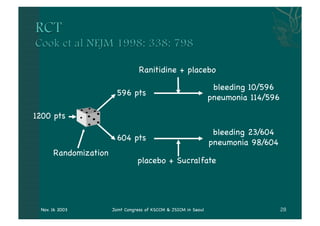
Ranitidine + placebo

                                                                  bleeding 10/596
                        596 pts
                                                                 pneumonia 114/596

1200 pts
                                                                  bleeding 23/604
                        604 pts
                                                                 pneumonia 98/604
      Randomization
                                 placebo + Sucralfate


 Nov. 16 2003         Joint Congress of KSCCM & JSICM in Seoul
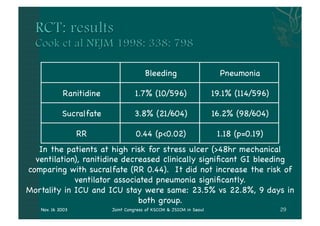
Bleeding                       Pneumonia

            Ranitidine            1.7% (10/596)                     19.1% (114/596)

            Sucralfate            3.8% (21/604)                     16.2% (98/604)

                  RR               0.44 (p<0.02)                     1.18 (p=0.19)
   In the patients at high risk for stress ulcer (>48hr mechanical
  ventilation), ranitidine decreased clinically significant GI bleeding
comparing with sucralfate (RR 0.44). It did not increase the risk of
             ventilator associated pneumonia significantly.
Mortality in ICU and ICU stay were same: 23.5% vs 22.8%, 9 days in
                               both group.
   Nov. 16 2003          Joint Congress of KSCCM & JSICM in Seoul
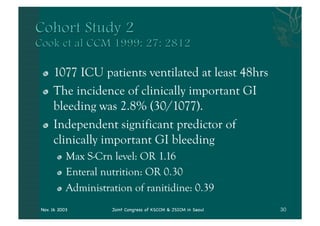
"    1077 ICU patients ventilated at least 48hrs
"    The incidence of clinically important GI
     bleeding was 2.8% (30/1077).
"    Independent significant predictor of
     clinically important GI bleeding
       "   Max S-Crn level: OR 1.16
       "   Enteral nutrition: OR 0.30
       "   Administration of ranitidine: 0.39
Nov. 16 2003         Joint Congress of KSCCM & JSICM in Seoul
!    The controversy continues...


                   Joint Congress of KSCCM & JSICM in
 Nov. 16 2003
                                   Seoul
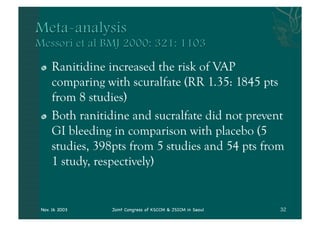
"   Ranitidine increased the risk of VAP
    comparing with scuralfate (RR 1.35: 1845 pts
    from 8 studies)
"   Both ranitidine and sucralfate did not prevent
    GI bleeding in comparison with placebo (5
    studies, 398pts from 5 studies and 54 pts from
    1 study, respectively)


Nov. 16 2003   Joint Congress of KSCCM & JSICM in Seoul
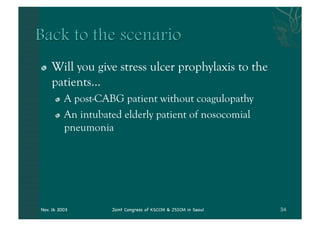
"   Will you give stress ulcer prophylaxis to the
    patients...
      "   A post-CABG patient without coagulopathy
      "   An intubated elderly patient of nosocomial
          pneumonia


Nov. 16 2003        Joint Congress of KSCCM & JSICM in Seoul
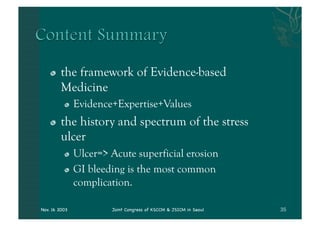
"    the framework of Evidence-based
         Medicine
          "    Evidence+Expertise+Values
    "    the history and spectrum of the stress
         ulcer
          "    Ulcer=> Acute superficial erosion
          "    GI bleeding is the most common
               complication.

Nov. 16 2003           Joint Congress of KSCCM & JSICM in Seoul
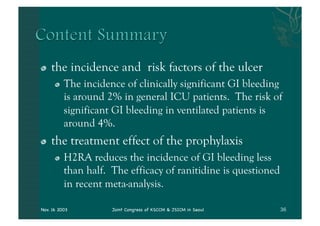
"   the incidence and risk factors of the ulcer
      "   The incidence of clinically significant GI bleeding
          is around 2% in general ICU patients. The risk of
          significant GI bleeding in ventilated patients is
          around 4%.
"   the treatment effect of the prophylaxis
      "   H2RA reduces the incidence of GI bleeding less
          than half. The efficacy of ranitidine is questioned
          in recent meta-analysis.

Nov. 16 2003         Joint Congress of KSCCM & JSICM in Seoul
value


evidence                                                  expertise

Nov. 16 2003   Joint Congress of KSCCM & JSICM in Seoul

Stress Ulcer Prophylaxis in ICU

  • 1.
    !  Toshio FukuokaMD !  Cardiovascular Surgery, Emergency Department !  and Vice Director of ICU !  Nagoya National Hospital !  Nagoya, JAPAN Nov. 16 2003 Joint Congress of KSCCM & JSICM in Seoul
  • 2.
    !  Scenario and Questions Joint Congress of KSCCM & JSICM in Nov. 16 2003 Seoul
  • 3.
    " You are a patient of disease A. You are admitted to the hospital and the standard treatment started. It will take a week. " Disease A has a clinically significant complication. It may cause a surgery or transfusion or prolongation of hospital stay. " Drug X prevents the complication partially. " You and the doctor start to discuss about adding the drug to your treatment. Nov. 16 2003 Joint Congress of KSCCM & JSICM in Seoul
  • 4.
    " The doctor tells your risk of the complication in probability, and the treatment effect of Drug X in risk ratio (RR) to you. " In this case, risk ratio (RR) is the proportion of the probability of the complication with Drug X to without it. " If Drug X has no effect, RR is “1”. If Drug X halves the risk, RR is “0.5”. Nov. 16 2003 Joint Congress of KSCCM & JSICM in Seoul
  • 5.
    " Please write down your threshold RR for taking Drug X for each case. " If you will not take the drug, your threshold RR is “0”. “0.5” in the threshold RR means that you will take Drug X when it reduce the risk by half or more. " CASE 1: Your risk of the complication is estimated 5% (1 in 20). How much is your threshold RR? Nov. 16 2003 Joint Congress of KSCCM & JSICM in Seoul
  • 6.
    " CASE 2: Your risk of the complication is estimated 50% (1 in 2). How much is your threshold RR? " CASE 3: Your risk of the complication is estimated 0.1% (1 in 1000). How much is your threshold RR? Nov. 16 2003 Joint Congress of KSCCM & JSICM in Seoul
  • 7.
    " Summary of scenario: You suffered from Disease A, and your doctor offer Drug X to prevent complications. " CASE 1: Your risk of the complication is estimated at 5% How much is your threshold RR? " CASE 2: 50% " CASE 3: 0.1% Nov. 16 2003 Joint Congress of KSCCM & JSICM in Seoul
  • 8.
    " Adverse effect of Drug X " Any other drawbacks of the drug " Cost, pain, inconvenience, taste of the drug and so on. " Your prognosis " The physician’s experience of the drug in clinical practise Nov. 16 2003 Joint Congress of KSCCM & JSICM in Seoul
  • 9.
    value evidence expertise Nov. 16 2003 Joint Congress of KSCCM & JSICM in Seoul
  • 10.
    Joint Congress ofKSCCM & JSICM in Nov. 16 2003 Seoul
  • 11.
    " Cushing ulcer in the head injury " In 1832, Cushing described gastric ulceration associated with surgery and trauma. " Curling ulcer in the burn " In 1842, Curling reported severe duodenal ulceration and bleeding in the severe burn patients. Nov. 16 2003 Joint Congress of KSCCM & JSICM in Seoul
  • 12.
    " High incidence " 15% in 1970s and 1980s in ICU patients (Ann Intern Med 1987; 106: 562) " Incidence of stress ulcer has decreased now. " High mortality " A case series study in 1960s reported nearly 90% in mortality ! (Am J Surg 1969; 117: 523) Nov. 16 2003 Joint Congress of KSCCM & JSICM in Seoul
  • 13.
    " Most of the stress ulcerations are superficial mucosal erosions " Such erosions are common in patients after stressful event, such as major surgery and trauma Nov. 16 2003 Joint Congress of KSCCM & JSICM in Seoul
  • 14.
    " Gastric or Duodenal ulcer. Mucosal defect is obvious. " Bleeding from a submucosal vessel might result in massive bleeding. " Deep ulcer might cause perforation. Nov. 16 2003 Joint Congress of KSCCM & JSICM in Seoul
  • 15.
    " Acute gastric mucosal erosions. Superficial mucosal defect. " Oozing of blood from capillary vessels. Nov. 16 2003 Joint Congress of KSCCM & JSICM in Seoul
  • 16.
    Classical Stress Stress-related Ulcer mucosal erosions Both might cause important clinical complications Nov. 16 2003 Joint Congress of KSCCM & JSICM in Seoul
  • 17.
    " Significant gastrointestinal (GI) bleeding " Hemodynamic instability " Anemia and Transfusion " Gastrointestinal perforation " Peritonitis " => Laparotomy Nov. 16 2003 Joint Congress of KSCCM & JSICM in Seoul
  • 18.
    Joint Congress ofKSCCM & JSICM in Nov. 16 2003 Seoul
  • 19.
    " 2,252 ICU patient from 4 Canadian centres. " Definition of clinically significant bleeding " Overt GI bleeding with hemodynamic change in BP or HR, or progression of anemia " Nearly half of the patients are associated in cardiovascular operations. Several patient subgroups were very few, such as trauma, head injury, burn and transplantation. Nov. 16 2003 Joint Congress of KSCCM & JSICM in Seoul
  • 20.
    outcome factor A (+) (+) outcome Compare the (-) patients incidence of outcome factor A (+) outcomes (-) outcome (-) Follow-up Nov. 16 2003 Joint Congress of KSCCM & JSICM in Seoul
  • 21.
    " Result: Two significant predictors were found " Mechanical ventilation at least 48 hrs " Odds ratio: 15.6 (p<0.001) " Coagulopathy (Plt <50,000, INR >1.5, PTT >2.0) " Odds ratio: 4.3 (p<0.001) Nov. 16 2003 Joint Congress of KSCCM & JSICM in Seoul
  • 22.
    31 pts with bleeding 847 pts with any factor 815 pts without bleeding 3.7% 2 pts vs with bleeding 0.1% 1405 pts without any factor 1404 pts without bleeding Nov. 16 2003 Joint Congress of KSCCM & JSICM in Seoul
  • 23.
    Joint Congress ofKSCCM & JSICM in Nov. 16 2003 Seoul
  • 24.
    " Though H2 receptor antagonists (H2RA), antacid and sucralfate had been seemed to prevent bleeding in earlier studies, a meta-analysis of RCTs (JAMA 1996) showed that only H2RA were effective in comparison with no prophylaxis (RR 0.44). " H2RA might increase the risk of ventilator associated pneumonia (VAP). Sucralfate might have a protective effect for VAP comparing with H2RA (RR 0.78, not statistically significant). Nov. 16 2003 Joint Congress of KSCCM & JSICM in Seoul
  • 25.
    " Difficulty in conducting RCT of this topic. " Low incidence of the outcomes: “Assuming a bleeding rate of 2.0%... an RCT with 75% power to detect 25% relative risk reduction (0.75 in RR) in bleeding would have required approximately 19000 patients.” (Cook DJ in Intens Care Med 2001; 27: 347) " Then they conducted a RCT of H2RA and sucralfate in mechanically ventilated patients, patients at the high risk of bleeding. Nov. 16 2003 Joint Congress of KSCCM & JSICM in Seoul
  • 26.
    " 1,200 patients with ventilatory support of longer than 48hrs in 16 Canadian centers. " Ranitidine (50mg every 8hrs) vs Sucralfate (1g every 6hrs). Placebo-controlled. " Central randomization with allocation concealment " Patients, nurses, physicians, outcome accessors, investigators and statisticians are all blinded until the analyses completed Nov. 16 2003 Joint Congress of KSCCM & JSICM in Seoul
  • 27.
    Treatment A Incidence of Group A outcome Patients Incidence of Group B outcome Randomization Treatment B Nov. 16 2003 Joint Congress of KSCCM & JSICM in Seoul
  • 28.
    Ranitidine + placebo bleeding 10/596 596 pts pneumonia 114/596 1200 pts bleeding 23/604 604 pts pneumonia 98/604 Randomization placebo + Sucralfate Nov. 16 2003 Joint Congress of KSCCM & JSICM in Seoul
  • 29.
    Bleeding Pneumonia Ranitidine 1.7% (10/596) 19.1% (114/596) Sucralfate 3.8% (21/604) 16.2% (98/604) RR 0.44 (p<0.02) 1.18 (p=0.19) In the patients at high risk for stress ulcer (>48hr mechanical ventilation), ranitidine decreased clinically significant GI bleeding comparing with sucralfate (RR 0.44). It did not increase the risk of ventilator associated pneumonia significantly. Mortality in ICU and ICU stay were same: 23.5% vs 22.8%, 9 days in both group. Nov. 16 2003 Joint Congress of KSCCM & JSICM in Seoul
  • 30.
    " 1077 ICU patients ventilated at least 48hrs " The incidence of clinically important GI bleeding was 2.8% (30/1077). " Independent significant predictor of clinically important GI bleeding " Max S-Crn level: OR 1.16 " Enteral nutrition: OR 0.30 " Administration of ranitidine: 0.39 Nov. 16 2003 Joint Congress of KSCCM & JSICM in Seoul
  • 31.
    !  The controversy continues... Joint Congress of KSCCM & JSICM in Nov. 16 2003 Seoul
  • 32.
    " Ranitidine increased the risk of VAP comparing with scuralfate (RR 1.35: 1845 pts from 8 studies) " Both ranitidine and sucralfate did not prevent GI bleeding in comparison with placebo (5 studies, 398pts from 5 studies and 54 pts from 1 study, respectively) Nov. 16 2003 Joint Congress of KSCCM & JSICM in Seoul
  • 33.
    Nov. 16 2003 Joint Congress of KSCCM & JSICM in Seoul
  • 34.
    " Will you give stress ulcer prophylaxis to the patients... " A post-CABG patient without coagulopathy " An intubated elderly patient of nosocomial pneumonia Nov. 16 2003 Joint Congress of KSCCM & JSICM in Seoul
  • 35.
    " the framework of Evidence-based Medicine " Evidence+Expertise+Values " the history and spectrum of the stress ulcer " Ulcer=> Acute superficial erosion " GI bleeding is the most common complication. Nov. 16 2003 Joint Congress of KSCCM & JSICM in Seoul
  • 36.
    " the incidence and risk factors of the ulcer " The incidence of clinically significant GI bleeding is around 2% in general ICU patients. The risk of significant GI bleeding in ventilated patients is around 4%. " the treatment effect of the prophylaxis " H2RA reduces the incidence of GI bleeding less than half. The efficacy of ranitidine is questioned in recent meta-analysis. Nov. 16 2003 Joint Congress of KSCCM & JSICM in Seoul
  • 37.
    value evidence expertise Nov. 16 2003 Joint Congress of KSCCM & JSICM in Seoul