Dr. Gaurav Kumar 
Emergency Medicine Resident 
Aiims 
9/27/2014 1
Background 
STICH –pontaneous supratentorial lobar intracerebral 
haematomas. 
9/27/2014 2
Background 
Spontaneous intracerebral haemorrhage (ICH) accounts for 10 to 
40% of all cases of stroke 
The morbidity and mortality exceed 60%. 
Young disabled survivors are a significant burden to both Health 
Services and family. 
9/27/2014 3
Background 
Within the spectrum of spontaneous intracerebral haemorrhage there 
are some patients with large or space occupying haemorrhage who 
require surgery for neurological deterioration . 
 And others with small haematomas who should be managed 
conservatively. 
There is equipoise about the management of patients between these 
two extremes. 
9/27/2014 4
Findings of previous trials 
The first randomised trial of Surgical Treatment of ICH, published in 
1961. 
But it did not show a significant advantage for either surgical or 
conservative treatment. 
Many other studies were done after this but none showed benefit of 
one over other method of Rx. 
9/27/2014 5
STICH I 
The need to gain evidence to support clinical decision making led to 
the initiation of the Surgical Trial in Intracerebral Haemorrhage 
(STICH). 
Started in 1998, this trial is the largest to date and successfully 
recruited 1033 patients from 87 centres around the world. 
9/27/2014 6
RESULT OF STICH I 
 Showed a small non-significant advantage for surgery (Mendelow et 
al. 2005) 
9/27/2014 7
UNFORTUNATE OUTCOME OF STICH I 
Had been that many people misinterpreted the 
results to argue that there was no need to operate on 
patients with ICH at all ! 
9/27/2014 8
Neurosurgeons know that early removal of an intracranial 
haemorrhage is highly effective in the context of trauma. 
 It seems unlikely that surgery would be of benefit in one scenario and 
not in the other. 
Hence the STICH II Trial. 
9/27/2014 9
TRIAL DESIGN 
Prospective, randomized, parallel group trial. 
In all, 129 NSx units in 39 countries. 
 Only patients for whom the treating neurosurgeon is in equipoise 
about the benefits of early craniotomy compared to initial conservative 
treatment are eligible for the trial. 
 Outcome is measured at six months via a postal questionnaire 
9/27/2014 10
INCLUSION CRITERIA 
All of the following : 
 Evidence of a spontaneous lobar ICH on CT scan (1 cm or less from 
the cortex surface of the brain) 
Patient within 48 hours of ictus. 
 Best MOTOR score on the Glasgow Coma Scale (GCS) of 5 or 6 and 
best EYE score on the GCS of 2 or more 
Volume of haematoma between 10 and 100 ml [Calculated using 
(a × b × c)/2 method]. 
9/27/2014 11
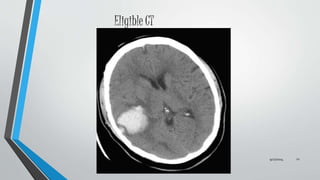
Eligible CT 
9/27/2014 12
EXCLUSION CRITERIA 
Any of them : 
Clear evidence that the haemorrhage is due to an aneurysm or 
angiographically proven arteriovenous malformation. 
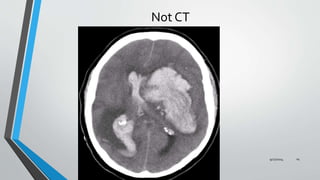
Intraventricular haemorrhage of any sort. 
ICH secondary to tumour or trauma. 
9/27/2014 13
Not CT 
9/27/2014 14
EXCLUSION CRITERIA 
Basal ganglia, thalamic, cerebellar or brainstem haemorrhage or 
extension of a lobar haemorrhage into any of these regions 
If surgery cannot be performed within 12 hours. 
 Patients who did not consent to participate 
9/27/2014 15
INTERVENTIONS 
 Patients were randomly allocated to either early surgery or initial 
conservative treatment. 
All patient must have an baseline CT head. 
In the early surgery group, surgeons were expected to undertake 
evacuation of the haematomas within 12 h. 
 In the initial conservative treatment group, delayed evacuation was 
permitted if judged clinically appropriate. 
9/27/2014 16
RANDOMIZATION 
It is not possible to blind either patients or treating surgeons to when 
the patient has had surgery or whether they have had surgery. 
To minimise possible sources of bias randomisation is undertaken 
centrally by an independent organization. 
Centre for Healthcare Randomised Trials, Aberdeen. 
9/27/2014 17
RANDOMIZATION 
Randomisation must take place within 48 hours of ictus 
Eligible patients randomly assigned in a 1:1 ratio to early surgery or 
early medical treatment group. 
Randomization done with the use of telephone and internet based 
system with stratification according to country and planned operation. 
9/27/2014 18
STUDY END POINTS 
Primary end point : 
 DEATH. 
Severe disability. 
9/27/2014 19
STUDY END POINTS 
Secondary end point : 
mortality, 
 time to death, 
prognosis-based dichotomised Rankin and GOSE, and Rankin 
and EuroQol; all measured at 6 months. 
9/27/2014 20
Statistical analysis 
 Analysis will be on an “intention to treat” basis 
 a sample size of 566 (283 in each group) was needed to show a 12% 
benefit from surgery (two-sided significance level of 0·05) with 80% 
power. 
Hence a sample size of 600 patients to allow for withdrawals and 
crossovers. 
9/27/2014 21
Statistical analysis 
Primary outcome analysis was a simple categorical frequency 
comparison by use of the χ2 test for prognosis-based favourable and 
unfavourable outcome on GOSE(GLASGOW OUTCOME SCALE-EXTENDED) 
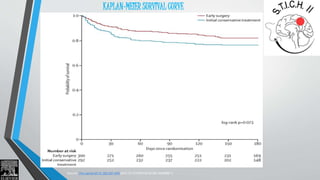
Secondary analysis consisted of a Kaplan-Meier survival curve with 
log-rank test, χ2 test for mortality at 6 months, and 6 month prognosis-based 
Rankin 
9/27/2014 22
RESULTS 
9/27/2014 23
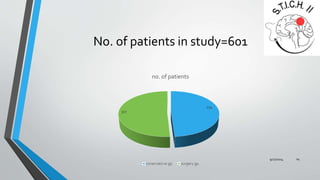
No. of patients in study=601 
294 
307 
no. of patients 
conervaticve gp. surgery gp. 
9/27/2014 24
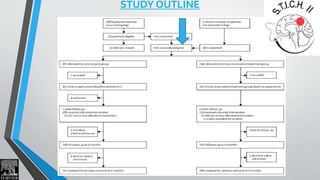
STUDY OUTLINE
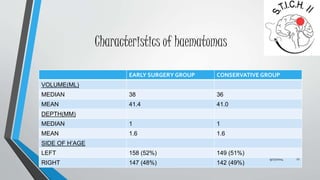
The two groups were well matched at baseline, 
57% of total were male and median age was 65. 
50% of patient in early surgery group and 49% in early conservative 
group had a GCS of 14 or 15 at the time of randomization. 
9/27/2014 26
Characteristics of haematomas 
EARLY SURGERY GROUP CONSERVATIVE GROUP 
VOLUME(ML) 
MEDIAN 38 36 
MEAN 41.4 41.0 
DEPTH(MM) 
MEDIAN 1 1 
MEAN 1.6 1.6 
SIDE OF H’AGE 
LEFT 158 (52%) 149 (51%) 
RIGHT 147 (48%) 142 (49%) 
9/27/2014 27
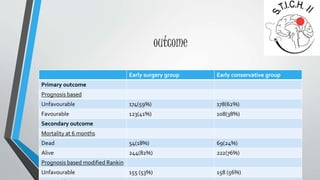
outcome 
Early surgery group Early conservative group 
9/27/2014 28 
Primary outcome 
Prognosis based 
Unfavourable 174(59%) 178(62%) 
Favourable 123(41%) 108(38%) 
Secondary outcome 
Mortality at 6 months 
Dead 54(18%) 69(24%) 
Alive 244(82%) 222(76%) 
Prognosis based modified Rankin 
Unfavourable 155 (53%) 158 (56%) 
Favourable 140 (47%) 126 (43%)
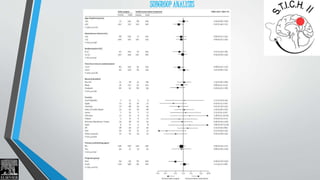
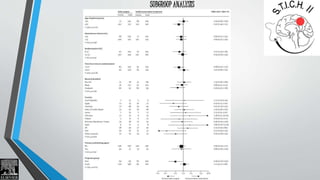
SUBGROUP ANALYSIS
KAPLAN-MEIER SURVIVAL CURVE 
Source: The Lancet 2013; 382:397-408 (DOI:10.1016/S0140-6736(13)60986-1)
Discussion 
 DID not find significant evidence to support that early surgery 
compared with initial conservative treatment (with delayed surgery if 
the patient deteriorates) improves outcome in conscious patients in 
whom there is a superficial intracerebral haemorrhage of 10—100 mL 
and no evidence of intraventricular haemorrhage. 
9/27/2014 31
Strengths of the study 
Prospective randomized trial. 
Baseline characteristics of patients similar. 
Early randomization and early surgery. 
9/27/2014 32
Limitations of the study 
Cross over : 62 (21%) of 291 patients assigned to initial conservative 
treatment went on to have delayed surgery.But because of the 
intention-to-treat analysis they remained in the initial conservative 
treatment group. 
9/27/2014 33
Limitations of the study 
More than half of the patients had good prognosis(i.e. 66% pt inearly 
surgery group and 64% pt inconsevative group) 
But the patients who benefited most from surgery were poor 
prognosis group. 
9/27/2014 34
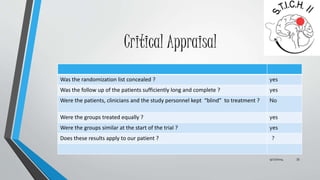
Critical Appraisal 
Was the randomization list concealed ? yes 
Was the follow up of the patients sufficiently long and complete ? yes 
Were the patients, clinicians and the study personnel kept “blind” to treatment ? No 
Were the groups treated equally ? yes 
Were the groups similar at the start of the trial ? yes 
Does these results apply to our patient ? ? 
9/27/2014 35
SUBGROUP ANALYSIS

Stich ii trial for supratentorial intra cerebral bleed

  • 1.
    Dr. Gaurav Kumar Emergency Medicine Resident Aiims 9/27/2014 1
  • 2.
    Background STICH –pontaneoussupratentorial lobar intracerebral haematomas. 9/27/2014 2
  • 3.
    Background Spontaneous intracerebralhaemorrhage (ICH) accounts for 10 to 40% of all cases of stroke The morbidity and mortality exceed 60%. Young disabled survivors are a significant burden to both Health Services and family. 9/27/2014 3
  • 4.
    Background Within thespectrum of spontaneous intracerebral haemorrhage there are some patients with large or space occupying haemorrhage who require surgery for neurological deterioration .  And others with small haematomas who should be managed conservatively. There is equipoise about the management of patients between these two extremes. 9/27/2014 4
  • 5.
    Findings of previoustrials The first randomised trial of Surgical Treatment of ICH, published in 1961. But it did not show a significant advantage for either surgical or conservative treatment. Many other studies were done after this but none showed benefit of one over other method of Rx. 9/27/2014 5
  • 6.
    STICH I Theneed to gain evidence to support clinical decision making led to the initiation of the Surgical Trial in Intracerebral Haemorrhage (STICH). Started in 1998, this trial is the largest to date and successfully recruited 1033 patients from 87 centres around the world. 9/27/2014 6
  • 7.
    RESULT OF STICHI  Showed a small non-significant advantage for surgery (Mendelow et al. 2005) 9/27/2014 7
  • 8.
    UNFORTUNATE OUTCOME OFSTICH I Had been that many people misinterpreted the results to argue that there was no need to operate on patients with ICH at all ! 9/27/2014 8
  • 9.
    Neurosurgeons know thatearly removal of an intracranial haemorrhage is highly effective in the context of trauma.  It seems unlikely that surgery would be of benefit in one scenario and not in the other. Hence the STICH II Trial. 9/27/2014 9
  • 10.
    TRIAL DESIGN Prospective,randomized, parallel group trial. In all, 129 NSx units in 39 countries.  Only patients for whom the treating neurosurgeon is in equipoise about the benefits of early craniotomy compared to initial conservative treatment are eligible for the trial.  Outcome is measured at six months via a postal questionnaire 9/27/2014 10
  • 11.
    INCLUSION CRITERIA Allof the following :  Evidence of a spontaneous lobar ICH on CT scan (1 cm or less from the cortex surface of the brain) Patient within 48 hours of ictus.  Best MOTOR score on the Glasgow Coma Scale (GCS) of 5 or 6 and best EYE score on the GCS of 2 or more Volume of haematoma between 10 and 100 ml [Calculated using (a × b × c)/2 method]. 9/27/2014 11
  • 12.
  • 13.
    EXCLUSION CRITERIA Anyof them : Clear evidence that the haemorrhage is due to an aneurysm or angiographically proven arteriovenous malformation. Intraventricular haemorrhage of any sort. ICH secondary to tumour or trauma. 9/27/2014 13
  • 14.
  • 15.
    EXCLUSION CRITERIA Basalganglia, thalamic, cerebellar or brainstem haemorrhage or extension of a lobar haemorrhage into any of these regions If surgery cannot be performed within 12 hours.  Patients who did not consent to participate 9/27/2014 15
  • 16.
    INTERVENTIONS  Patientswere randomly allocated to either early surgery or initial conservative treatment. All patient must have an baseline CT head. In the early surgery group, surgeons were expected to undertake evacuation of the haematomas within 12 h.  In the initial conservative treatment group, delayed evacuation was permitted if judged clinically appropriate. 9/27/2014 16
  • 17.
    RANDOMIZATION It isnot possible to blind either patients or treating surgeons to when the patient has had surgery or whether they have had surgery. To minimise possible sources of bias randomisation is undertaken centrally by an independent organization. Centre for Healthcare Randomised Trials, Aberdeen. 9/27/2014 17
  • 18.
    RANDOMIZATION Randomisation musttake place within 48 hours of ictus Eligible patients randomly assigned in a 1:1 ratio to early surgery or early medical treatment group. Randomization done with the use of telephone and internet based system with stratification according to country and planned operation. 9/27/2014 18
  • 19.
    STUDY END POINTS Primary end point :  DEATH. Severe disability. 9/27/2014 19
  • 20.
    STUDY END POINTS Secondary end point : mortality,  time to death, prognosis-based dichotomised Rankin and GOSE, and Rankin and EuroQol; all measured at 6 months. 9/27/2014 20
  • 21.
    Statistical analysis Analysis will be on an “intention to treat” basis  a sample size of 566 (283 in each group) was needed to show a 12% benefit from surgery (two-sided significance level of 0·05) with 80% power. Hence a sample size of 600 patients to allow for withdrawals and crossovers. 9/27/2014 21
  • 22.
    Statistical analysis Primaryoutcome analysis was a simple categorical frequency comparison by use of the χ2 test for prognosis-based favourable and unfavourable outcome on GOSE(GLASGOW OUTCOME SCALE-EXTENDED) Secondary analysis consisted of a Kaplan-Meier survival curve with log-rank test, χ2 test for mortality at 6 months, and 6 month prognosis-based Rankin 9/27/2014 22
  • 23.
  • 24.
    No. of patientsin study=601 294 307 no. of patients conervaticve gp. surgery gp. 9/27/2014 24
  • 25.
  • 26.
    The two groupswere well matched at baseline, 57% of total were male and median age was 65. 50% of patient in early surgery group and 49% in early conservative group had a GCS of 14 or 15 at the time of randomization. 9/27/2014 26
  • 27.
    Characteristics of haematomas EARLY SURGERY GROUP CONSERVATIVE GROUP VOLUME(ML) MEDIAN 38 36 MEAN 41.4 41.0 DEPTH(MM) MEDIAN 1 1 MEAN 1.6 1.6 SIDE OF H’AGE LEFT 158 (52%) 149 (51%) RIGHT 147 (48%) 142 (49%) 9/27/2014 27
  • 28.
    outcome Early surgerygroup Early conservative group 9/27/2014 28 Primary outcome Prognosis based Unfavourable 174(59%) 178(62%) Favourable 123(41%) 108(38%) Secondary outcome Mortality at 6 months Dead 54(18%) 69(24%) Alive 244(82%) 222(76%) Prognosis based modified Rankin Unfavourable 155 (53%) 158 (56%) Favourable 140 (47%) 126 (43%)
  • 29.
  • 30.
    KAPLAN-MEIER SURVIVAL CURVE Source: The Lancet 2013; 382:397-408 (DOI:10.1016/S0140-6736(13)60986-1)
  • 31.
    Discussion  DIDnot find significant evidence to support that early surgery compared with initial conservative treatment (with delayed surgery if the patient deteriorates) improves outcome in conscious patients in whom there is a superficial intracerebral haemorrhage of 10—100 mL and no evidence of intraventricular haemorrhage. 9/27/2014 31
  • 32.
    Strengths of thestudy Prospective randomized trial. Baseline characteristics of patients similar. Early randomization and early surgery. 9/27/2014 32
  • 33.
    Limitations of thestudy Cross over : 62 (21%) of 291 patients assigned to initial conservative treatment went on to have delayed surgery.But because of the intention-to-treat analysis they remained in the initial conservative treatment group. 9/27/2014 33
  • 34.
    Limitations of thestudy More than half of the patients had good prognosis(i.e. 66% pt inearly surgery group and 64% pt inconsevative group) But the patients who benefited most from surgery were poor prognosis group. 9/27/2014 34
  • 35.
    Critical Appraisal Wasthe randomization list concealed ? yes Was the follow up of the patients sufficiently long and complete ? yes Were the patients, clinicians and the study personnel kept “blind” to treatment ? No Were the groups treated equally ? yes Were the groups similar at the start of the trial ? yes Does these results apply to our patient ? ? 9/27/2014 35
  • 36.