Rencontres Interventionnelles - Transradial Approach
                        Prague, Czech Republic,
             Thursday 29th & Friday 30th September 2011


BLEEDING
IS IT A REAL PROBLEM?


                                             Philip Urban
                                             La Tour Hospital
                                             Geneva, Switzerland
BLEEDING: IS IT A REAL PROBLEM?
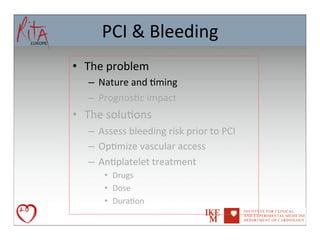
PCI	
  &	
  Bleeding	
  
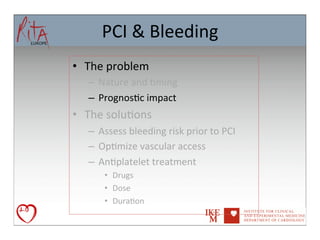
•  The	
  problem	
  
    –  Nature	
  and	
  8ming	
  
    –  Prognos8c	
  impact	
  
•  The	
  solu8ons	
  
    –  Assess	
  bleeding	
  risk	
  prior	
  to	
  PCI	
  
    –  Op8mize	
  vascular	
  access	
  
    –  An8platelet	
  treatment	
  
         •  Drugs	
  
         •  Dose	
  
         •  Dura8on	


Circula8on	
  2011;123:	
  2736	
  
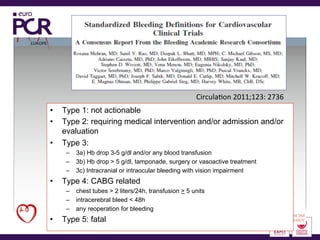
•    Type 1: not actionable
•    Type 2: requiring medical intervention and/or admission and/or
     evaluation
•    Type 3:
      –  3a) Hb drop 3-5 g/dl and/or any blood transfusion
      –  3b) Hb drop > 5 g/dl, tamponade, surgery or vasoactive treatment
      –  3c) Intracranial or intraocular bleeding with vision impairment
•    Type 4: CABG related
      –  chest tubes > 2 liters/24h, transfusion > 5 units
      –  intracerebral bleed < 48h
      –  any reoperation for bleeding
•    Type 5: fatal
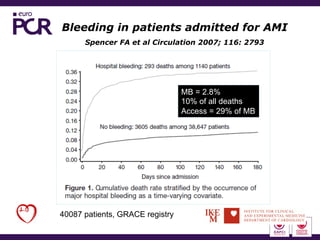
Bleeding in patients admitted for AMI
      Spencer FA et al Circulation 2007; 116: 2793


                                 MB = 2.8%
                                 10% of all deaths
                                 Access = 29% of MB


40087 patients, GRACE registry
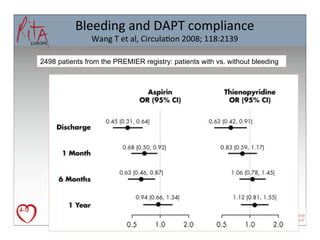
Bleeding	
  and	
  DAPT	
  compliance                           	


              Wang	
  T	
  et	
  al,	
  Circula8on	
  2008;	
  118:2139

2498 patients from the PREMIER registry: patients with vs. without bleeding
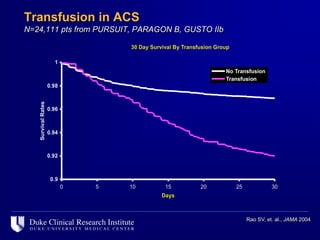
Transfusion in ACS
N=24,111 pts from PURSUIT, PARAGON B, GUSTO IIb


                                                  Rao SV, et. al., JAMA 2004
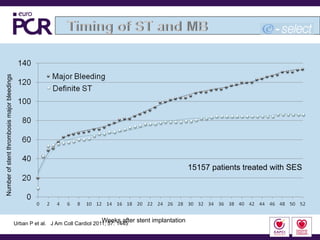
Number of stent thrombosis major bleedings


                                                                                                                  15157 patients treated with SES


                                                                                 Weeks after stent implantation
                                             Urban P et al. J Am Coll Cardiol 2011; 57: 1445
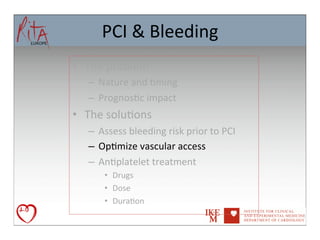
PCI	
  &	
  Bleeding	
  
•  The	
  problem	
  
    –  Nature	
  and	
  8ming	
  
    –  Prognos8c	
  impact	
  
•  The	
  solu8ons	
  
    –  Assess	
  bleeding	
  risk	
  prior	
  to	
  PCI	
  
    –  Op8mize	
  vascular	
  access	
  
    –  An8platelet	
  treatment	
  
         •  Drugs	
  
         •  Dose	
  
         •  Dura8on	


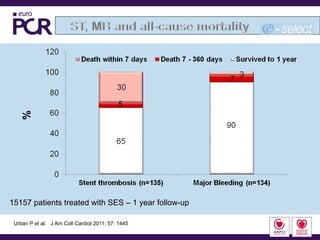
%


15157 patients treated with SES – 1 year follow-up

 Urban P et al. J Am Coll Cardiol 2011; 57: 1445
PCI	
  &	
  Bleeding	
  
•  The	
  problem	
  
    –  Nature	
  and	
  8ming	
  
    –  Prognos8c	
  impact	
  
•  The	
  solu8ons	
  
    –  Assess	
  bleeding	
  risk	
  prior	
  to	
  PCI	
  
    –  Op8mize	
  vascular	
  access	
  
    –  An8platelet	
  treatment	
  
         •  Drugs	
  
         •  Dose	
  
         •  Dura8on	


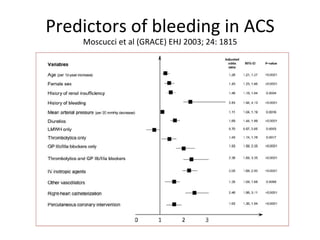
Predictors	
  of	
  bleeding	
  in	
  ACS                             	


    Moscucci	
  et	
  al	
  (GRACE)	
  EHJ	
  2003;	
  24:	
  1815
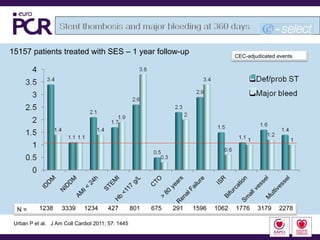
15157 patients treated with SES – 1 year follow-up                                 CEC-adjudicated events


  N=       1238     3339     1234      427         801   675   291   1596   1062   1776    3179    2278

 Urban P et al. J Am Coll Cardiol 2011; 57: 1445
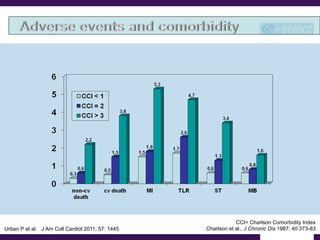
CCI= Charlson Comorbidity Index
Urban P et al. J Am Coll Cardiol 2011; 57: 1445   Charlson et al., J Chronic Dis 1987; 40:373-83
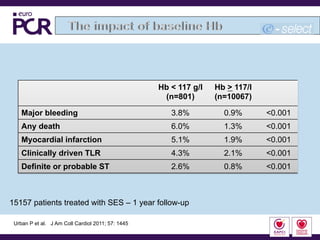
Hb < 117 g/l   Hb > 117/l
                                                    (n=801)       (n=10067)

    Major bleeding                                    3.8%          0.9%       <0.001
    Any death                                     6.0%              1.3%       <0.001
                                          15147 patients
    Myocardial infarction                             5.1%          1.9%       <0.001
    Clinically driven TLR                             4.3%          2.1%       <0.001
    Definite or probable ST                           2.6%          0.8%       <0.001


15157 patients treated with SES – 1 year follow-up

 Urban P et al. J Am Coll Cardiol 2011; 57: 1445
PCI	
  &	
  Bleeding	
  
•  The	
  problem	
  
    –  Nature	
  and	
  8ming	
  
    –  Prognos8c	
  impact	
  
•  The	
  solu8ons	
  
    –  Assess	
  bleeding	
  risk	
  prior	
  to	
  PCI	
  
    –  Op8mize	
  vascular	
  access	
  
    –  An8platelet	
  treatment	
  
         •  Drugs	
  
         •  Dose	
  
         •  Dura8on	


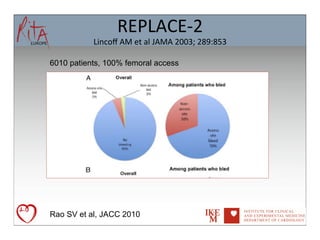
REPLACE-­‐2	


           Lincoff	
  AM	
  et	
  al	
  JAMA	
  2003;	
  289:853

6010 patients, 100% femoral access


Rao SV et al, JACC 2010
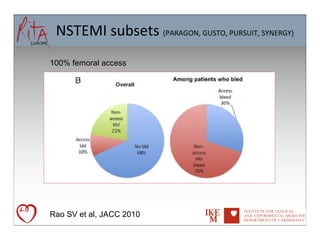
NSTEMI	
  subsets	
  (PARAGON,	
  GUSTO,	
  PURSUIT,	
  SYNERGY)
                                                                	
  
100% femoral access


Rao SV et al, JACC 2010
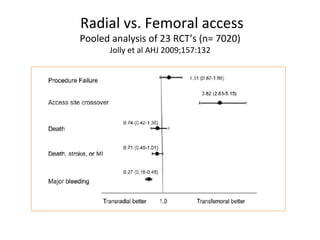
 Radial	
  vs.	
  Femoral	
  access
                                     	
  
Pooled	
  analysis	
  of	
  23	
  RCT’s	
  (n=	
  7020)


          Jolly	
  et	
  al	
  AHJ	
  2009;157:132
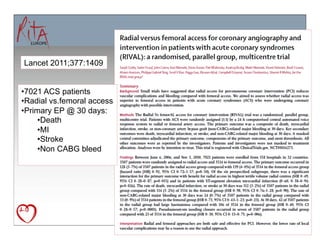
Lancet 2011;377:1409


• 7021 ACS patients
• Radial vs.femoral access
• Primary EP @ 30 days:
      • Death
      • MI
      • Stroke
      • Non CABG bleed
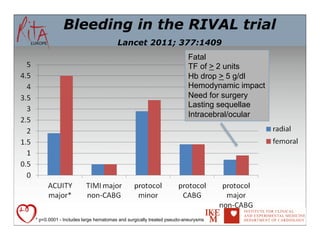
Bleeding in the RIVAL trial
                                     Lancet 2011; 377:1409
                                                                     Fatal
                                                                     TF of > 2 units
                                                                     Hb drop > 5 g/dl
                                                                     Hemodynamic impact
                                                                     Need for surgery
                                                                     Lasting sequellae
                                                                     Intracebral/ocular


* p<0.0001 - Includes large hematomas and surgically treated pseudo-aneurysms
PCI	
  &	
  Bleeding	
  
•  The	
  problem	
  
    –  Nature	
  and	
  8ming	
  
    –  Prognos8c	
  impact	
  
•  The	
  solu8ons	
  
    –  Assess	
  bleeding	
  risk	
  prior	
  to	
  PCI	
  
    –  Op8mize	
  vascular	
  access	
  
    –  An8platelet	
  treatment	
  
         •  Drugs	
  
         •  Dose	
  
         •  Dura8on	


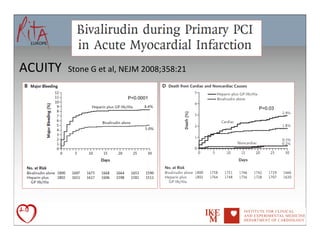
ACUITY	
  	
  Stone	
  G	
  et	
  al,	
  NEJM	
  2008;358:21	
  
                                        P<0.0001

                                                                   P=0.03
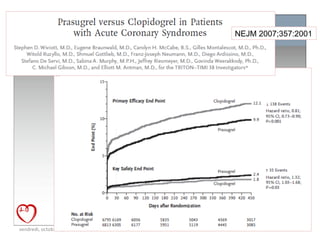
NEJM 2007;357:2001


vendredi,	
  octobre	
  7,	
  2011	
                   25	
  
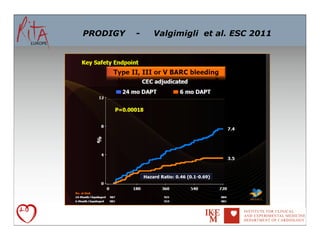
HR for protocol-defined major bleeding = 1.04 (0.95-1.13)
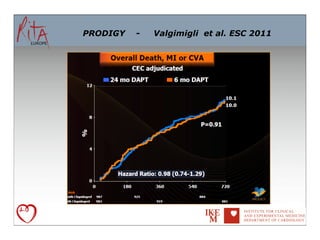
PRODIGY   -   Valgimigli et al. ESC 2011
Conclusions	
  (I)
                                                  	
  
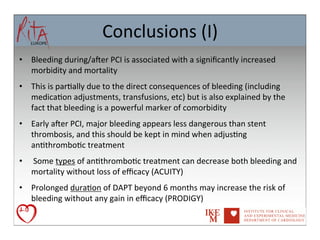
•  Bleeding	
  during/ader	
  PCI	
  is	
  associated	
  with	
  a	
  significantly	
  increased	
  
   morbidity	
  and	
  mortality	
  
•  This	
  is	
  par8ally	
  due	
  to	
  the	
  direct	
  consequences	
  of	
  bleeding	
  (including	
  
   medica8on	
  adjustments,	
  transfusions,	
  etc)	
  but	
  is	
  also	
  explained	
  by	
  the	
  
   fact	
  that	
  bleeding	
  is	
  a	
  powerful	
  marker	
  of	
  comorbidity	
  
•  Early	
  ader	
  PCI,	
  major	
  bleeding	
  appears	
  less	
  dangerous	
  than	
  stent	
  
   thrombosis,	
  and	
  this	
  should	
  be	
  kept	
  in	
  mind	
  when	
  adjus8ng	
  
   an8thrombo8c	
  treatment	
  
•  	
  Some	
  types	
  of	
  an8thrombo8c	
  treatment	
  can	
  decrease	
  both	
  bleeding	
  and	
  
   mortality	
  without	
  loss	
  of	
  efficacy	
  (ACUITY)	
  
•  Prolonged	
  dura8on	
  of	
  DAPT	
  beyond	
  6	
  months	
  may	
  increase	
  the	
  risk	
  of	
  
   bleeding	
  without	
  any	
  gain	
  in	
  efficacy	
  (PRODIGY)	
  
Conclusions	
  (II)
                                                  	
  
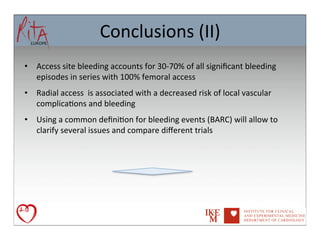
•  Access	
  site	
  bleeding	
  accounts	
  for	
  30-­‐70%	
  of	
  all	
  significant	
  bleeding	
  
   episodes	
  in	
  series	
  with	
  100%	
  femoral	
  access	
  
•  Radial	
  access	
  	
  is	
  associated	
  with	
  a	
  decreased	
  risk	
  of	
  local	
  vascular	
  
   complica8ons	
  and	
  bleeding	
  
•  Using	
  a	
  common	
  defini8on	
  for	
  bleeding	
  events	
  (BARC)	
  will	
  allow	
  to	
  
   clarify	
  several	
  issues	
  and	
  compare	
  different	
  trials	
  
Thank you!
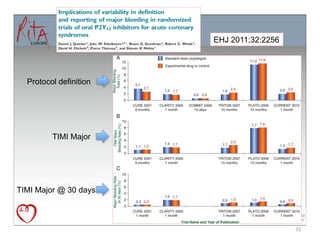
EHJ 2011;32:2256


  Protocol definition


         TIMI Major


TIMI Major @ 30 days


                                           32	
  
Title of your presentation…

Urban P

  • 1.
    Rencontres Interventionnelles -Transradial Approach Prague, Czech Republic, Thursday 29th & Friday 30th September 2011 BLEEDING IS IT A REAL PROBLEM? Philip Urban La Tour Hospital Geneva, Switzerland
  • 2.
    BLEEDING: IS ITA REAL PROBLEM?
  • 3.
    PCI  &  Bleeding   •  The  problem   –  Nature  and  8ming   –  Prognos8c  impact   •  The  solu8ons   –  Assess  bleeding  risk  prior  to  PCI   –  Op8mize  vascular  access   –  An8platelet  treatment   •  Drugs   •  Dose   •  Dura8on      
  • 4.
    Circula8on  2011;123:  2736   •  Type 1: not actionable •  Type 2: requiring medical intervention and/or admission and/or evaluation •  Type 3: –  3a) Hb drop 3-5 g/dl and/or any blood transfusion –  3b) Hb drop > 5 g/dl, tamponade, surgery or vasoactive treatment –  3c) Intracranial or intraocular bleeding with vision impairment •  Type 4: CABG related –  chest tubes > 2 liters/24h, transfusion > 5 units –  intracerebral bleed < 48h –  any reoperation for bleeding •  Type 5: fatal
  • 5.
    Bleeding in patientsadmitted for AMI Spencer FA et al Circulation 2007; 116: 2793 MB = 2.8% 10% of all deaths Access = 29% of MB 40087 patients, GRACE registry
  • 7.
    Bleeding  and  DAPT  compliance     Wang  T  et  al,  Circula8on  2008;  118:2139 2498 patients from the PREMIER registry: patients with vs. without bleeding
  • 8.
    Transfusion in ACS N=24,111pts from PURSUIT, PARAGON B, GUSTO IIb Rao SV, et. al., JAMA 2004
  • 9.
    Number of stentthrombosis major bleedings 15157 patients treated with SES Weeks after stent implantation Urban P et al. J Am Coll Cardiol 2011; 57: 1445
  • 10.
    PCI  &  Bleeding   •  The  problem   –  Nature  and  8ming   –  Prognos8c  impact   •  The  solu8ons   –  Assess  bleeding  risk  prior  to  PCI   –  Op8mize  vascular  access   –  An8platelet  treatment   •  Drugs   •  Dose   •  Dura8on      
  • 11.
    % 15157 patients treatedwith SES – 1 year follow-up Urban P et al. J Am Coll Cardiol 2011; 57: 1445
  • 12.
    PCI  &  Bleeding   •  The  problem   –  Nature  and  8ming   –  Prognos8c  impact   •  The  solu8ons   –  Assess  bleeding  risk  prior  to  PCI   –  Op8mize  vascular  access   –  An8platelet  treatment   •  Drugs   •  Dose   •  Dura8on      
  • 13.
    Predictors  of  bleeding  in  ACS     Moscucci  et  al  (GRACE)  EHJ  2003;  24:  1815
  • 14.
    15157 patients treatedwith SES – 1 year follow-up CEC-adjudicated events N= 1238 3339 1234 427 801 675 291 1596 1062 1776 3179 2278 Urban P et al. J Am Coll Cardiol 2011; 57: 1445
  • 15.
    CCI= Charlson ComorbidityIndex Urban P et al. J Am Coll Cardiol 2011; 57: 1445 Charlson et al., J Chronic Dis 1987; 40:373-83
  • 16.
    Hb < 117g/l Hb > 117/l (n=801) (n=10067) Major bleeding 3.8% 0.9% <0.001 Any death 6.0% 1.3% <0.001 15147 patients Myocardial infarction 5.1% 1.9% <0.001 Clinically driven TLR 4.3% 2.1% <0.001 Definite or probable ST 2.6% 0.8% <0.001 15157 patients treated with SES – 1 year follow-up Urban P et al. J Am Coll Cardiol 2011; 57: 1445
  • 17.
    PCI  &  Bleeding   •  The  problem   –  Nature  and  8ming   –  Prognos8c  impact   •  The  solu8ons   –  Assess  bleeding  risk  prior  to  PCI   –  Op8mize  vascular  access   –  An8platelet  treatment   •  Drugs   •  Dose   •  Dura8on      
  • 18.
    REPLACE-­‐2     Lincoff  AM  et  al  JAMA  2003;  289:853 6010 patients, 100% femoral access Rao SV et al, JACC 2010
  • 19.
    NSTEMI  subsets  (PARAGON,  GUSTO,  PURSUIT,  SYNERGY)   100% femoral access Rao SV et al, JACC 2010
  • 20.
     Radial  vs.  Femoral  access   Pooled  analysis  of  23  RCT’s  (n=  7020)     Jolly  et  al  AHJ  2009;157:132
  • 21.
    Lancet 2011;377:1409 • 7021 ACSpatients • Radial vs.femoral access • Primary EP @ 30 days: • Death • MI • Stroke • Non CABG bleed
  • 22.
    Bleeding in theRIVAL trial Lancet 2011; 377:1409 Fatal TF of > 2 units Hb drop > 5 g/dl Hemodynamic impact Need for surgery Lasting sequellae Intracebral/ocular * p<0.0001 - Includes large hematomas and surgically treated pseudo-aneurysms
  • 23.
    PCI  &  Bleeding   •  The  problem   –  Nature  and  8ming   –  Prognos8c  impact   •  The  solu8ons   –  Assess  bleeding  risk  prior  to  PCI   –  Op8mize  vascular  access   –  An8platelet  treatment   •  Drugs   •  Dose   •  Dura8on      
  • 24.
    ACUITY    Stone  G  et  al,  NEJM  2008;358:21   P<0.0001 P=0.03
  • 25.
  • 26.
    HR for protocol-definedmajor bleeding = 1.04 (0.95-1.13)
  • 27.
    PRODIGY - Valgimigli et al. ESC 2011
  • 28.
    PRODIGY - Valgimigli et al. ESC 2011
  • 29.
    Conclusions  (I)   •  Bleeding  during/ader  PCI  is  associated  with  a  significantly  increased   morbidity  and  mortality   •  This  is  par8ally  due  to  the  direct  consequences  of  bleeding  (including   medica8on  adjustments,  transfusions,  etc)  but  is  also  explained  by  the   fact  that  bleeding  is  a  powerful  marker  of  comorbidity   •  Early  ader  PCI,  major  bleeding  appears  less  dangerous  than  stent   thrombosis,  and  this  should  be  kept  in  mind  when  adjus8ng   an8thrombo8c  treatment   •   Some  types  of  an8thrombo8c  treatment  can  decrease  both  bleeding  and   mortality  without  loss  of  efficacy  (ACUITY)   •  Prolonged  dura8on  of  DAPT  beyond  6  months  may  increase  the  risk  of   bleeding  without  any  gain  in  efficacy  (PRODIGY)  
  • 30.
    Conclusions  (II)   •  Access  site  bleeding  accounts  for  30-­‐70%  of  all  significant  bleeding   episodes  in  series  with  100%  femoral  access   •  Radial  access    is  associated  with  a  decreased  risk  of  local  vascular   complica8ons  and  bleeding   •  Using  a  common  defini8on  for  bleeding  events  (BARC)  will  allow  to   clarify  several  issues  and  compare  different  trials  
  • 31.
  • 32.
    EHJ 2011;32:2256 Protocol definition TIMI Major TIMI Major @ 30 days 32  
  • 33.
    Title of yourpresentation…