
ESC 2012 research highlights:
A slideshow presentation
ESC 2012 Research Highlights
                     he European Society of Cardiology (ESC) 2012 Congress
                     took place in Munich, Germany from August 25 through August
                     29, 2012.

                     Key trials presented at the sessions include:

                     WOEST: Drop aspirin in stent patients on oral anticoagulants
                     ALTITUDE: Details on why the trial was stopped, including the
                     role of ischemic stroke
                     FAME II: FFR-guided PCI reduces urgent reinterventions, but
                     does not change mortality, MI
                     TRILOGY ACS: No win for prasugrel in high-risk patients with
                     ACS who are medically managed without revascularization
                     ACCESS EU: Encouraging registry data on the MitraClip
                     PURE: Healthy lifestyle factors and diet linked with income
                     GARY: TAVI in-hospital death, stroke rates stay low even as
                     use climbs
                     IABP SHOCK II: No survival benefit of balloon pump in AMI
                     with shock
                     PARAMOUNT: Dual-action agent shows promise in preserved-
                     EF heart failure
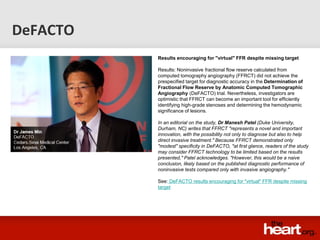
                     DeFACTO: Results encouraging for "virtual" FFR despite
                     missing target
WOEST
        Drop aspirin in stent patients on oral anticoagulants

        Results: Patients on oral anticoagulant therapy undergoing stenting
        should be treated with clopidogrel but not aspirin, according to
        results reported at the ESC 2012. The study showed a large
        reduction in overall TIMI bleeding in patients receiving dual therapy
        with oral anticoagulants and clopidogrel compared with those
        receiving triple therapy including aspirin. And efficacy did not seem to
        be compromised. If anything, there appeared to be lower rates of
        ischemic events and a significant reduction in all-cause mortality.

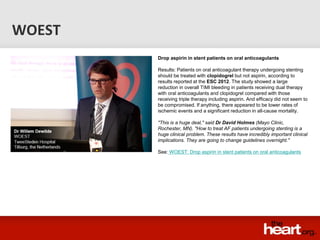
        "This is a huge deal," said Dr David Holmes (Mayo Clinic,
        Rochester, MN). "How to treat AF patients undergoing stenting is a
        huge clinical problem. These results have incredibly important clinical
        implications. They are going to change guidelines overnight."

        See: WOEST: Drop aspirin in stent patients on oral anticoagulants
ALTITUDE
                                                               Increase in ischemic stroke played role in decision to stop trial

                                                               Results: New data from the trial with the direct renin inhibitor
                                                               aliskiren (Tekturna, Novartis) in diabetic patients were released at
                                                               the ESC 2012, shedding more light on why the trial was halted
                                                               prematurely. The trial, which was studying the effects of aliskiren on
                                                               top of ACE-inhibitor or angiotensin-receptor-blocker (ARB) therapy in
                                                               diabetic patients with renal disease (glomerular filtration rate <60
                                                               mL/min per 1.73 m2 or microalbuminuria), was stopped late last year
                                                               by the data and safety monitoring board. The reason given was no
                                                               apparent benefit and an increase in adverse events, including
                                                               nonfatal stroke, renal complications, hyperkalemia, and hypotension.
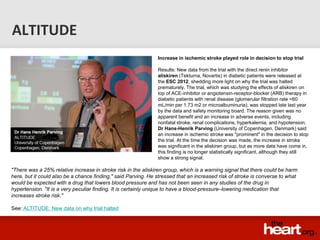
                                                               Dr Hans-Henrik Parving (University of Copenhagen, Denmark) said
                                                               an increase in ischemic stroke was "prominent" in the decision to stop
                                                               the trial. At the time the decision was made, the increase in stroke
                                                               was significant in the aliskiren group, but as more data have come in,
                                                               this finding is no longer statistically significant, although they still
                                                               show a strong signal.

"There was a 25% relative increase in stroke risk in the aliskiren group, which is a warning signal that there could be harm
here, but it could also be a chance finding," said Parving. He stressed that an increased risk of stroke is converse to what
would be expected with a drug that lowers blood pressure and has not been seen in any studies of the drug in
hypertension. "It is a very peculiar finding. It is certainly unique to have a blood-pressure–lowering medication that
increases stroke risk."

See: ALTITUDE: New data on why trial halted
FAME II
                                                               FFR-guided PCI reduces urgent reinterventions, but does
                                                               not change mortality, MI

                                                               Results: Stable patients who got a stent to treat a functionally
                                                               significant coronary lesion were less likely to need an urgent
                                                               reintervention than those treated with medical therapy alone.
                                                               However, all the other outcomes, including mortality, were the
                                                               same with either therapy, so the significance of the trial's
                                                               findings remains controversial. The trial was stopped last
                                                               winter—over the objections of some outside observers—after
                                                               an interim analysis clearly showed that patients randomized to
                                                               PCI were much less likely to need an urgent revascularization
                                                               than patients randomized to optimal medical therapy.


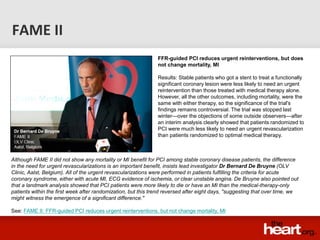
Although FAME II did not show any mortality or MI benefit for PCI among stable coronary disease patients, the difference
in the need for urgent revascularizations is an important benefit, insists lead investigator Dr Bernard De Bruyne (OLV
Clinic, Aalst, Belgium). All of the urgent revascularizations were performed in patients fulfilling the criteria for acute
coronary syndrome, either with acute MI, ECG evidence of ischemia, or clear unstable angina. De Bruyne also pointed out
that a landmark analysis showed that PCI patients were more likely to die or have an MI than the medical-therapy-only
patients within the first week after randomization, but this trend reversed after eight days, "suggesting that over time, we
might witness the emergence of a significant difference."

See: FAME II: FFR-guided PCI reduces urgent reinterventions, but not change mortality, MI
TRILOGY ACS
              No win for prasugrel (over clopidogrel) in high-risk patients
              with ACS who are medically managed without
              revascularization

              Results: In one of the few studies to focus on high-risk patients
              with acute coronary syndrome (ACS) who are medically
              managed without revascularization, the newer antiplatelet agent
              prasugrel (Effient, Lilly/Daiichi-Sanyo) has failed to show a
              reduction in major cardiovascular events compared with
              clopidogrel.

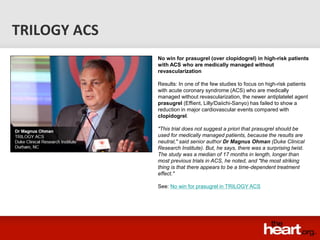
              "This trial does not suggest a priori that prasugrel should be
              used for medically managed patients, because the results are
              neutral," said senior author Dr Magnus Ohman (Duke Clinical
              Research Institute). But, he says, there was a surprising twist.
              The study was a median of 17 months in length, longer than
              most previous trials in ACS, he noted, and "the most striking
              thing is that there appears to be a time-dependent treatment
              effect."

              See: No win for prasugrel in TRILOGY ACS
ACCESS EU
                                                              Encouraging registry data on MitraClip

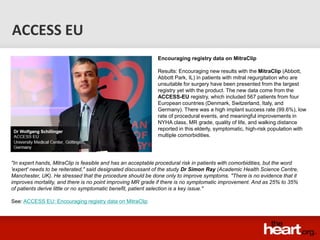
                                                              Results: Encouraging new results with the MitraClip (Abbott,
                                                              Abbott Park, IL) in patients with mitral regurgitation who are
                                                              unsuitable for surgery have been presented from the largest
                                                              registry yet with the product. The new data come from the
                                                              ACCESS-EU registry, which included 567 patients from four
                                                              European countries (Denmark, Switzerland, Italy, and
                                                              Germany). There was a high implant success rate (99.6%), low
                                                              rate of procedural events, and meaningful improvements in
                                                              NYHA class, MR grade, quality of life, and walking distance
                                                              reported in this elderly, symptomatic, high-risk population with
                                                              multiple comorbidities.


"In expert hands, MitraClip is feasible and has an acceptable procedural risk in patients with comorbidities, but the word
'expert' needs to be reiterated," said designated discussant of the study Dr Simon Ray (Academic Health Science Centre,
Manchester, UK). He stressed that the procedure should be done only to improve symptoms. "There is no evidence that it
improves mortality, and there is no point improving MR grade if there is no symptomatic improvement. And as 25% to 35%
of patients derive little or no symptomatic benefit, patient selection is a key issue."

See: ACCESS EU: Encouraging registry data on MitraClip
PURE
                                                                Healthy lifestyle factors and diet linked with income

                                                                Results: In this newest analysis, energy from total fat, saturated fats,
                                                                and protein increased almost linearly with increasing incomes.
                                                                Carbohydrate intake, on the other hand, made up approximately 65%
                                                                of energy from diets in poor nations, with the percentage declining in
                                                                wealthier nations. The consumption of fruits and vegetables
                                                                increased among nations with a higher gross domestic product (GDP)
                                                                and wealth index, but this was offset by an increase in the amount of
                                                                energy obtained from total and saturated fats, as well as from protein.
                                                                In terms of physical activity, the researchers observed that the
                                                                amount of recreational physical activity increased with increasing
                                                                GDP and wealth, but this increase was offset by a reduction in the
                                                                amount of obligatory physical activity, such as activity required for
                                                                physical labor. Overall, the net result was a reduction of
                                                                approximately 2000 METS/minute/week, or 2.7 hours of brisk walking
                                                                every day, among countries with higher incomes.

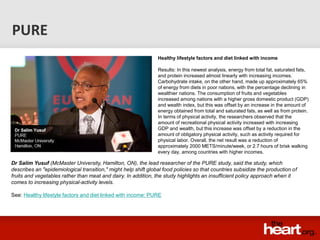
Dr Salim Yusuf (McMaster University, Hamilton, ON), the lead researcher of the PURE study, said the study, which
describes an "epidemiological transition," might help shift global food policies so that countries subsidize the production of
fruits and vegetables rather than meat and dairy. In addition, the study highlights an insufficient policy approach when it
comes to increasing physical-activity levels.

See: Healthy lifestyle factors and diet linked with income: PURE
GARY


TAVI in-hospital death, stroke rates stay low even as use climbs

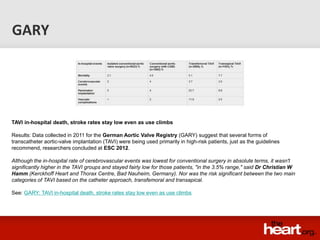
Results: Data collected in 2011 for the German Aortic Valve Registry (GARY) suggest that several forms of
transcatheter aortic-valve implantation (TAVI) were being used primarily in high-risk patients, just as the guidelines
recommend, researchers concluded at ESC 2012.

Although the in-hospital rate of cerebrovascular events was lowest for conventional surgery in absolute terms, it wasn't
significantly higher in the TAVI groups and stayed fairly low for those patients, "in the 3.5% range," said Dr Christian W
Hamm (Kerckhoff Heart and Thorax Centre, Bad Nauheim, Germany). Nor was the risk significant between the two main
categories of TAVI based on the catheter approach, transfemoral and transapical.

See: GARY: TAVI in-hospital death, stroke rates stay low even as use climbs
IABP SHOCK II
                No survival benefit of balloon pump in AMI with shock

                Results: Use of an intra-aortic balloon pump (IABP) offered no
                mortality benefits at 30 days in the 600-patient IABP SHOCK II trial,
                according the trial results presented in a hot-line session at ESC
                2012. While use of the pump may make PCI safer by improving left
                ventricular unloading, this did not translate into any survival benefit or
                give a boost to any of the secondary end points in the study,
                investigators observed.

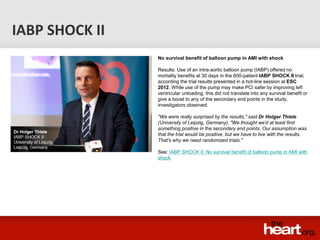
                "We were really surprised by the results," said Dr Holger Thiele
                (University of Leipzig, Germany). "We thought we'd at least find
                something positive in the secondary end points. Our assumption was
                that the trial would be positive, but we have to live with the results.
                That's why we need randomized trials."

                See: IABP SHOCK II: No survival benefit of balloon pump in AMI with
                shock
PARAMOUNT
                                                                Dual-action agent shows promise in preserved-EF heart
                                                                failure

                                                                Results: In a randomized comparison, in a phase 2 study of the
                                                                angiotensin-receptor/neprilysin inhibitor (ARNI) LCZ696
                                                                (Novartis) vs the angiotensin-receptor blocker (ARB) valsartan,
                                                                levels of a heart-failure severity biomarker dropped significantly
                                                                in patients with heart failure and preserved ejection fraction
                                                                (HF-PEF) who received the newer agent for 12 weeks,
                                                                compared with those who received the ARB. Systolic blood
                                                                pressure fell significantly more in patients receiving LCZ696.
                                                                And the drug was associated with significant improvements in
                                                                left atrial size and volume and in NYHA functional class at 36
                                                                weeks.


"LCZ696 was effective for the primary [natriuretic-peptide] end point in every single one of the subgroups tested," said
lead investigator, Dr Scott D Solomon (Brigham and Women's Hospital, Boston, MA). The subgroup analysis broke
patients out by age, normal vs elevated systolic blood pressure, low vs preserved left ventricular ejection fraction, with vs
without atrial fibrillation or poor renal function, and with vs without a prior HF admission. "But there was one subgroup in
which [LCZ696] was more effective." There was a significant interaction in patients with diabetes, added Solomon. "It
appeared to be even more efficacious in that subgroup, even though it was effective in every subgroup."

See: PARAMOUNT phase 2 study: Dual-action agent shows promise in preserved-EF heart failure
New European STEMI guidelines emphasize
care coordination
                  Summary: Authors of the new European Society of Cardiology (ESC)
                  guidelines for the management of patients with acute ST-elevation MI
                  (STEMI) hope their recommendations spur efforts to improve the speed
                  and efficiency of STEMI care in Europe.

                  The new guidelines are "much more demanding [than the 2008 guidelines]
                  in terms of delays," said Dr Gabriel Steg, chair of the task force that wrote
                  the new recommendations. The new standard for time from medical
                  contact to ECG is 10 minutes, and "the fact that you use primary PCI
                  should not lead to complacency about the delays. You should target 60
                  minutes." Two hours is the limit of acceptable delay for a patient
                  transferred from a non-PCI center to a PCI center, but the target should be
                  90 minutes, Steg said. If PCI within two hours of presentation appears to
                  be impossible, then fibrinolysis should be administered within 30 minutes.

                  See: New European STEMI guidelines emphasize care coordination
DeFACTO
          Results encouraging for "virtual" FFR despite missing target

          Results: Noninvasive fractional flow reserve calculated from
          computed tomography angiography (FFRCT) did not achieve the
          prespecified target for diagnostic accuracy in the Determination of
          Fractional Flow Reserve by Anatomic Computed Tomographic
          Angiography (DeFACTO) trial. Nevertheless, investigators are
          optimistic that FFRCT can become an important tool for efficiently
          identifying high-grade stenoses and determining the hemodynamic
          significance of lesions.

          In an editorial on the study, Dr Manesh Patel (Duke University,
          Durham, NC) writes that FFRCT "represents a novel and important
          innovation, with the possibility not only to diagnose but also to help
          direct invasive treatment." Because FFRCT demonstrated only
          "modest" specificity in DeFACTO, "at first glance, readers of the study
          may consider FFRCT technology to be limited based on the results
          presented," Patel acknowledges. "However, this would be a naive
          conclusion, likely based on the published diagnostic performance of
          noninvasive tests compared only with invasive angiography."

          See: DeFACTO results encouraging for "virtual" FFR despite missing
          target
For more information
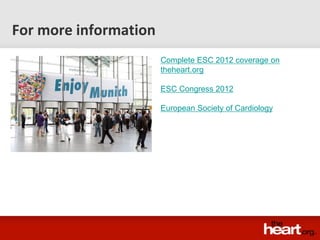
                       Complete ESC 2012 coverage on
                       theheart.org

                       ESC Congress 2012

                       European Society of Cardiology
Credits and disclosures
                 Editor:                                  Journalists:
                 Shelley Wood                             Sue Hughes, theheart.org
                 Managing Editor, heartwire               London, UK
                 theheart.org                             Disclosure: Sue Hughes has disclosed no
                 Kelowna, BC                              relevant financial relationships.
                 Disclosure: Shelley Wood has disclosed
                 no relevant financial relationships.     Reed Miller, theheart.org
                                                          State College, PA
                 Contributors:
                                                          Disclosure: Reed Miller has disclosed no
                 Steven Rourke
                                                          relevant financial relationships.
                 Editorial Director
                 theheart.org
                 Montreal, QC
                                                          Lisa Nainggolan, theheart.org
                 Disclosure: Steven Rourke has            London, UK
                 disclosed no relevant financial          Disclosure: Lisa Nainggolan has disclosed
                 relationships.                           no relevant financial relationships.

                 Maria Turner                             Michael O'Riordan, theheart.org
                 Montreal, QC                             Toronto, ON
                 Disclosure: Maria Turner has disclosed   Disclosure: Michael O'Riordan has
                 no relevant financial relationships.     disclosed no relevant financial
                                                          relationships.

                                                          Steve Stiles, theheart.org
                                                          Fremont, CA
                                                          Disclosure: Steve Stiles has disclosed no
                                                          relevant financial relationships.
More slideshows
                  EuroPCR 2012 research highlights

                  HRS 2012 research highlights

                  ACC 2012 research highlights
Become a member of http://www.theheart.org
    Become a fan on Facebook: http://www.facebook.com/theheartorg
          Follow us on Twitter: http://www.twitter.com/theheartorg

theheart.org is the leading online source of independent cardiology news.
We are the top provider of news and opinions for over 100 000 physicians.

ESC 2012 research highlights: A slideshow presentation

  • 1.
    ESC 2012 researchhighlights: A slideshow presentation
  • 2.
    ESC 2012 ResearchHighlights he European Society of Cardiology (ESC) 2012 Congress took place in Munich, Germany from August 25 through August 29, 2012. Key trials presented at the sessions include: WOEST: Drop aspirin in stent patients on oral anticoagulants ALTITUDE: Details on why the trial was stopped, including the role of ischemic stroke FAME II: FFR-guided PCI reduces urgent reinterventions, but does not change mortality, MI TRILOGY ACS: No win for prasugrel in high-risk patients with ACS who are medically managed without revascularization ACCESS EU: Encouraging registry data on the MitraClip PURE: Healthy lifestyle factors and diet linked with income GARY: TAVI in-hospital death, stroke rates stay low even as use climbs IABP SHOCK II: No survival benefit of balloon pump in AMI with shock PARAMOUNT: Dual-action agent shows promise in preserved- EF heart failure DeFACTO: Results encouraging for "virtual" FFR despite missing target
  • 3.
    WOEST Drop aspirin in stent patients on oral anticoagulants Results: Patients on oral anticoagulant therapy undergoing stenting should be treated with clopidogrel but not aspirin, according to results reported at the ESC 2012. The study showed a large reduction in overall TIMI bleeding in patients receiving dual therapy with oral anticoagulants and clopidogrel compared with those receiving triple therapy including aspirin. And efficacy did not seem to be compromised. If anything, there appeared to be lower rates of ischemic events and a significant reduction in all-cause mortality. "This is a huge deal," said Dr David Holmes (Mayo Clinic, Rochester, MN). "How to treat AF patients undergoing stenting is a huge clinical problem. These results have incredibly important clinical implications. They are going to change guidelines overnight." See: WOEST: Drop aspirin in stent patients on oral anticoagulants
  • 4.
    ALTITUDE Increase in ischemic stroke played role in decision to stop trial Results: New data from the trial with the direct renin inhibitor aliskiren (Tekturna, Novartis) in diabetic patients were released at the ESC 2012, shedding more light on why the trial was halted prematurely. The trial, which was studying the effects of aliskiren on top of ACE-inhibitor or angiotensin-receptor-blocker (ARB) therapy in diabetic patients with renal disease (glomerular filtration rate <60 mL/min per 1.73 m2 or microalbuminuria), was stopped late last year by the data and safety monitoring board. The reason given was no apparent benefit and an increase in adverse events, including nonfatal stroke, renal complications, hyperkalemia, and hypotension. Dr Hans-Henrik Parving (University of Copenhagen, Denmark) said an increase in ischemic stroke was "prominent" in the decision to stop the trial. At the time the decision was made, the increase in stroke was significant in the aliskiren group, but as more data have come in, this finding is no longer statistically significant, although they still show a strong signal. "There was a 25% relative increase in stroke risk in the aliskiren group, which is a warning signal that there could be harm here, but it could also be a chance finding," said Parving. He stressed that an increased risk of stroke is converse to what would be expected with a drug that lowers blood pressure and has not been seen in any studies of the drug in hypertension. "It is a very peculiar finding. It is certainly unique to have a blood-pressure–lowering medication that increases stroke risk." See: ALTITUDE: New data on why trial halted
  • 5.
    FAME II FFR-guided PCI reduces urgent reinterventions, but does not change mortality, MI Results: Stable patients who got a stent to treat a functionally significant coronary lesion were less likely to need an urgent reintervention than those treated with medical therapy alone. However, all the other outcomes, including mortality, were the same with either therapy, so the significance of the trial's findings remains controversial. The trial was stopped last winter—over the objections of some outside observers—after an interim analysis clearly showed that patients randomized to PCI were much less likely to need an urgent revascularization than patients randomized to optimal medical therapy. Although FAME II did not show any mortality or MI benefit for PCI among stable coronary disease patients, the difference in the need for urgent revascularizations is an important benefit, insists lead investigator Dr Bernard De Bruyne (OLV Clinic, Aalst, Belgium). All of the urgent revascularizations were performed in patients fulfilling the criteria for acute coronary syndrome, either with acute MI, ECG evidence of ischemia, or clear unstable angina. De Bruyne also pointed out that a landmark analysis showed that PCI patients were more likely to die or have an MI than the medical-therapy-only patients within the first week after randomization, but this trend reversed after eight days, "suggesting that over time, we might witness the emergence of a significant difference." See: FAME II: FFR-guided PCI reduces urgent reinterventions, but not change mortality, MI
  • 6.
    TRILOGY ACS No win for prasugrel (over clopidogrel) in high-risk patients with ACS who are medically managed without revascularization Results: In one of the few studies to focus on high-risk patients with acute coronary syndrome (ACS) who are medically managed without revascularization, the newer antiplatelet agent prasugrel (Effient, Lilly/Daiichi-Sanyo) has failed to show a reduction in major cardiovascular events compared with clopidogrel. "This trial does not suggest a priori that prasugrel should be used for medically managed patients, because the results are neutral," said senior author Dr Magnus Ohman (Duke Clinical Research Institute). But, he says, there was a surprising twist. The study was a median of 17 months in length, longer than most previous trials in ACS, he noted, and "the most striking thing is that there appears to be a time-dependent treatment effect." See: No win for prasugrel in TRILOGY ACS
  • 7.
    ACCESS EU Encouraging registry data on MitraClip Results: Encouraging new results with the MitraClip (Abbott, Abbott Park, IL) in patients with mitral regurgitation who are unsuitable for surgery have been presented from the largest registry yet with the product. The new data come from the ACCESS-EU registry, which included 567 patients from four European countries (Denmark, Switzerland, Italy, and Germany). There was a high implant success rate (99.6%), low rate of procedural events, and meaningful improvements in NYHA class, MR grade, quality of life, and walking distance reported in this elderly, symptomatic, high-risk population with multiple comorbidities. "In expert hands, MitraClip is feasible and has an acceptable procedural risk in patients with comorbidities, but the word 'expert' needs to be reiterated," said designated discussant of the study Dr Simon Ray (Academic Health Science Centre, Manchester, UK). He stressed that the procedure should be done only to improve symptoms. "There is no evidence that it improves mortality, and there is no point improving MR grade if there is no symptomatic improvement. And as 25% to 35% of patients derive little or no symptomatic benefit, patient selection is a key issue." See: ACCESS EU: Encouraging registry data on MitraClip
  • 8.
    PURE Healthy lifestyle factors and diet linked with income Results: In this newest analysis, energy from total fat, saturated fats, and protein increased almost linearly with increasing incomes. Carbohydrate intake, on the other hand, made up approximately 65% of energy from diets in poor nations, with the percentage declining in wealthier nations. The consumption of fruits and vegetables increased among nations with a higher gross domestic product (GDP) and wealth index, but this was offset by an increase in the amount of energy obtained from total and saturated fats, as well as from protein. In terms of physical activity, the researchers observed that the amount of recreational physical activity increased with increasing GDP and wealth, but this increase was offset by a reduction in the amount of obligatory physical activity, such as activity required for physical labor. Overall, the net result was a reduction of approximately 2000 METS/minute/week, or 2.7 hours of brisk walking every day, among countries with higher incomes. Dr Salim Yusuf (McMaster University, Hamilton, ON), the lead researcher of the PURE study, said the study, which describes an "epidemiological transition," might help shift global food policies so that countries subsidize the production of fruits and vegetables rather than meat and dairy. In addition, the study highlights an insufficient policy approach when it comes to increasing physical-activity levels. See: Healthy lifestyle factors and diet linked with income: PURE
  • 9.
    GARY TAVI in-hospital death,stroke rates stay low even as use climbs Results: Data collected in 2011 for the German Aortic Valve Registry (GARY) suggest that several forms of transcatheter aortic-valve implantation (TAVI) were being used primarily in high-risk patients, just as the guidelines recommend, researchers concluded at ESC 2012. Although the in-hospital rate of cerebrovascular events was lowest for conventional surgery in absolute terms, it wasn't significantly higher in the TAVI groups and stayed fairly low for those patients, "in the 3.5% range," said Dr Christian W Hamm (Kerckhoff Heart and Thorax Centre, Bad Nauheim, Germany). Nor was the risk significant between the two main categories of TAVI based on the catheter approach, transfemoral and transapical. See: GARY: TAVI in-hospital death, stroke rates stay low even as use climbs
  • 10.
    IABP SHOCK II No survival benefit of balloon pump in AMI with shock Results: Use of an intra-aortic balloon pump (IABP) offered no mortality benefits at 30 days in the 600-patient IABP SHOCK II trial, according the trial results presented in a hot-line session at ESC 2012. While use of the pump may make PCI safer by improving left ventricular unloading, this did not translate into any survival benefit or give a boost to any of the secondary end points in the study, investigators observed. "We were really surprised by the results," said Dr Holger Thiele (University of Leipzig, Germany). "We thought we'd at least find something positive in the secondary end points. Our assumption was that the trial would be positive, but we have to live with the results. That's why we need randomized trials." See: IABP SHOCK II: No survival benefit of balloon pump in AMI with shock
  • 11.
    PARAMOUNT Dual-action agent shows promise in preserved-EF heart failure Results: In a randomized comparison, in a phase 2 study of the angiotensin-receptor/neprilysin inhibitor (ARNI) LCZ696 (Novartis) vs the angiotensin-receptor blocker (ARB) valsartan, levels of a heart-failure severity biomarker dropped significantly in patients with heart failure and preserved ejection fraction (HF-PEF) who received the newer agent for 12 weeks, compared with those who received the ARB. Systolic blood pressure fell significantly more in patients receiving LCZ696. And the drug was associated with significant improvements in left atrial size and volume and in NYHA functional class at 36 weeks. "LCZ696 was effective for the primary [natriuretic-peptide] end point in every single one of the subgroups tested," said lead investigator, Dr Scott D Solomon (Brigham and Women's Hospital, Boston, MA). The subgroup analysis broke patients out by age, normal vs elevated systolic blood pressure, low vs preserved left ventricular ejection fraction, with vs without atrial fibrillation or poor renal function, and with vs without a prior HF admission. "But there was one subgroup in which [LCZ696] was more effective." There was a significant interaction in patients with diabetes, added Solomon. "It appeared to be even more efficacious in that subgroup, even though it was effective in every subgroup." See: PARAMOUNT phase 2 study: Dual-action agent shows promise in preserved-EF heart failure
  • 12.
    New European STEMIguidelines emphasize care coordination Summary: Authors of the new European Society of Cardiology (ESC) guidelines for the management of patients with acute ST-elevation MI (STEMI) hope their recommendations spur efforts to improve the speed and efficiency of STEMI care in Europe. The new guidelines are "much more demanding [than the 2008 guidelines] in terms of delays," said Dr Gabriel Steg, chair of the task force that wrote the new recommendations. The new standard for time from medical contact to ECG is 10 minutes, and "the fact that you use primary PCI should not lead to complacency about the delays. You should target 60 minutes." Two hours is the limit of acceptable delay for a patient transferred from a non-PCI center to a PCI center, but the target should be 90 minutes, Steg said. If PCI within two hours of presentation appears to be impossible, then fibrinolysis should be administered within 30 minutes. See: New European STEMI guidelines emphasize care coordination
  • 13.
    DeFACTO Results encouraging for "virtual" FFR despite missing target Results: Noninvasive fractional flow reserve calculated from computed tomography angiography (FFRCT) did not achieve the prespecified target for diagnostic accuracy in the Determination of Fractional Flow Reserve by Anatomic Computed Tomographic Angiography (DeFACTO) trial. Nevertheless, investigators are optimistic that FFRCT can become an important tool for efficiently identifying high-grade stenoses and determining the hemodynamic significance of lesions. In an editorial on the study, Dr Manesh Patel (Duke University, Durham, NC) writes that FFRCT "represents a novel and important innovation, with the possibility not only to diagnose but also to help direct invasive treatment." Because FFRCT demonstrated only "modest" specificity in DeFACTO, "at first glance, readers of the study may consider FFRCT technology to be limited based on the results presented," Patel acknowledges. "However, this would be a naive conclusion, likely based on the published diagnostic performance of noninvasive tests compared only with invasive angiography." See: DeFACTO results encouraging for "virtual" FFR despite missing target
  • 14.
    For more information Complete ESC 2012 coverage on theheart.org ESC Congress 2012 European Society of Cardiology
  • 15.
    Credits and disclosures Editor: Journalists: Shelley Wood Sue Hughes, theheart.org Managing Editor, heartwire London, UK theheart.org Disclosure: Sue Hughes has disclosed no Kelowna, BC relevant financial relationships. Disclosure: Shelley Wood has disclosed no relevant financial relationships. Reed Miller, theheart.org State College, PA Contributors: Disclosure: Reed Miller has disclosed no Steven Rourke relevant financial relationships. Editorial Director theheart.org Montreal, QC Lisa Nainggolan, theheart.org Disclosure: Steven Rourke has London, UK disclosed no relevant financial Disclosure: Lisa Nainggolan has disclosed relationships. no relevant financial relationships. Maria Turner Michael O'Riordan, theheart.org Montreal, QC Toronto, ON Disclosure: Maria Turner has disclosed Disclosure: Michael O'Riordan has no relevant financial relationships. disclosed no relevant financial relationships. Steve Stiles, theheart.org Fremont, CA Disclosure: Steve Stiles has disclosed no relevant financial relationships.
  • 16.
    More slideshows EuroPCR 2012 research highlights HRS 2012 research highlights ACC 2012 research highlights
  • 17.
    Become a memberof http://www.theheart.org Become a fan on Facebook: http://www.facebook.com/theheartorg Follow us on Twitter: http://www.twitter.com/theheartorg theheart.org is the leading online source of independent cardiology news. We are the top provider of news and opinions for over 100 000 physicians.