Drought Tolerance in Plants
By Syed Inam Ul Haq
MSc. Molecular Biology & Plant Biotechnology.
DPB, FOH, SKUAST-K.
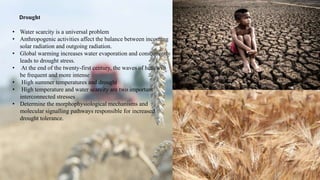
Drought
• Water scarcity is a universal problem
• Anthropogenic activities affect the balance between incoming
solar radiation and outgoing radiation.
• Global warming increases water evaporation and consequently
leads to drought stress.
• At the end of the twenty-first century, the waves of heat will
be frequent and more intense
• High summer temperatures and drought
• High temperature and water scarcity are two important
interconnected stresses
• Determine the morphophysiological mechanisms and
molecular signalling pathways responsible for increased
drought tolerance.
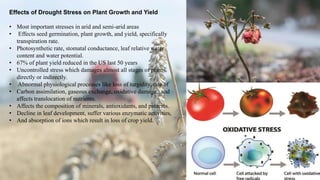
Effects of Drought Stress on Plant Growth and Yield
• Most important stresses in arid and semi-arid areas
• Effects seed germination, plant growth, and yield, specifically
transpiration rate.
• Photosynthetic rate, stomatal conductance, leaf relative water
content and water potential.
• 67% of plant yield reduced in the US last 50 years
• Uncontrolled stress which damages almost all stages of plants
directly or indirectly.
• Abnormal physiological processes like loss of turgidity, rate of
• Carbon assimilation, gaseous exchange, oxidative damage, and
affects translocation of nutrients.
• Affects the composition of minerals, antioxidants, and proteins.
• Decline in leaf development, suffer various enzymatic activities,
• And absorption of ions which result in loss of crop yield.
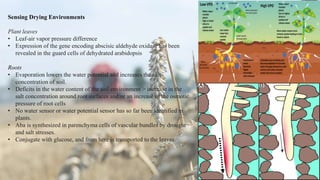
Sensing Drying Environments
Plant leaves
• Leaf-air vapor pressure difference
• Expression of the gene encoding abscisic aldehyde oxidase has been
revealed in the guard cells of dehydrated arabidopsis
Roots
• Evaporation lowers the water potential and increases the salt
concentration of soil.
• Deficits in the water content of the soil environment > increase in the
salt concentration around root surfaces and/or an increase in the osmotic
pressure of root cells
• No water sensor or water potential sensor has so far been identified in
plants.
• Aba is synthesized in parenchyma cells of vascular bundles by drought
and salt stresses.
• Conjugate with glucose, and from here is transported to the leaves.
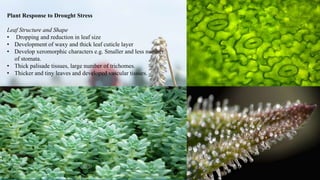
Plant Response to Drought Stress
Leaf Structure and Shape
• Dropping and reduction in leaf size
• Development of waxy and thick leaf cuticle layer
• Develop xeromorphic characters e.g. Smaller and less number
of stomata.
• Thick palisade tissues, large number of trichomes.
• Thicker and tiny leaves and developed vascular tissues.
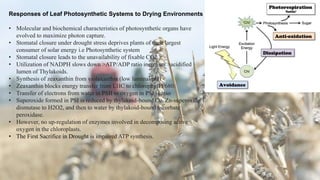
Responses of Leaf Photosynthetic Systems to Drying Environments
• Molecular and biochemical characteristics of photosynthetic organs have
evolved to maximize photon capture.
• Stomatal closure under drought stress deprives plants of their largest
consumer of solar energy i.e Photosynthetic system
• Stomatal closure leads to the unavailability of fixable CO2.
• Utilization of NADPH slows down >ATP/ADP ratio increases >acidified
lumen of Thylakoids.
• Synthesis of zeaxanthin from violaxanthin (low luminal pH)
• Zeaxanthin blocks energy transfer from LHC to chlorophyll P680.
• Transfer of electrons from water in PSII to oxygen in PSI is also
• Superoxide formed in PSI is reduced by thylakoid-bound Cu, Zn-superoxide
dismutase to H2O2, and then to water by thylakoid-bound ascorbate
peroxidase.
• However, no up-regulation of enzymes involved in decomposing active
oxygen in the chloroplasts.
• The First Sacrifice in Drought is impaired ATP synthesis.
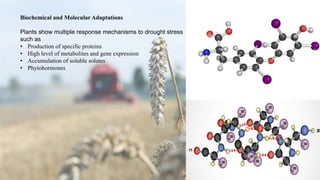
Biochemical and Molecular Adaptations
Plants show multiple response mechanisms to drought stress
such as
• Production of specific proteins
• High level of metabolites and gene expression
• Accumulation of soluble solutes
• Phytohormones
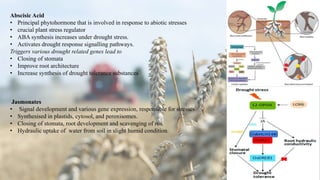
Abscisic Acid
• Principal phytohormone that is involved in response to abiotic stresses
• crucial plant stress regulator
• ABA synthesis increases under drought stress.
• Activates drought response signalling pathways.
Triggers various drought related genes lead to
• Closing of stomata
• Improve root architecture
• Increase synthesis of drought tolerance substances
Jasmonates
• Signal development and various gene expression, responsible for stresses
• Synthesised in plastids, cytosol, and peroxisomes.
• Closing of stomata, root development and scavenging of ros.
• Hydraulic uptake of water from soil in slight humid condition.
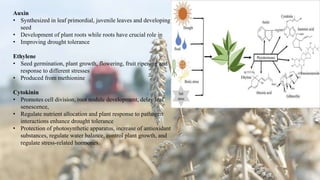
Auxin
• Synthesized in leaf primordial, juvenile leaves and developing
seed
• Development of plant roots while roots have crucial role in
• Improving drought tolerance
Ethylene
• Seed germination, plant growth, flowering, fruit ripening and
response to different stresses
• Produced from methionine
Cytokinin
• Promotes cell division, root nodule development, delay leaf
senescence,
• Regulate nutrient allocation and plant response to pathogen
interactions enhance drought tolerance
• Protection of photosynthetic apparatus, increase of antioxidant
substances, regulate water balance, control plant growth, and
regulate stress-related hormones.
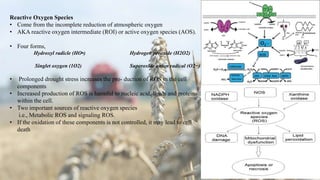
Reactive Oxygen Species
• Come from the incomplete reduction of atmospheric oxygen
• AKA reactive oxygen intermediate (ROI) or active oxygen species (AOS).
• Four forms,
Hydroxyl radicle (HO•) Hydrogen peroxide (H2O2)
Singlet oxygen (1O2) Superoxide anion radical (O2−)
• Prolonged drought stress increases the pro- duction of ROS in the cell
components
• Increased production of ROS is harmful to nucleic acid, lipids and proteins
within the cell.
• Two important sources of reactive oxygen species
i.e., Metabolic ROS and signaling ROS.
• If the oxidation of these components is not controlled, it may lead to cell
death
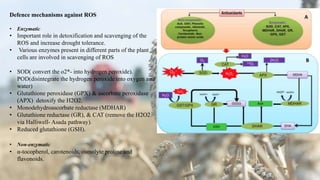
Defence mechanisms against ROS
• Enzymatic
• Important role in detoxification and scavenging of the
ROS and increase drought tolerance.
• Various enzymes present in different parts of the plant
cells are involved in scavenging of ROS
• SOD( convert the o2*- into hydrogen peroxide).
POD(disintegrate the hydrogen peroxide into oxygen and
water)
• Glutathione peroxidase (GPX) & ascorbate peroxidase
(APX) detoxify the H2O2.
• Monodehydroascorbate reductase (MDHAR)
• Glutathione reductase (GR), & CAT (remove the H2O2
via Halliwell- Asada pathway).
• Reduced glutathione (GSH).
• Non-enzymatic
• α-tocopherol, carotenoids, osmolyte proline and
flavonoids.
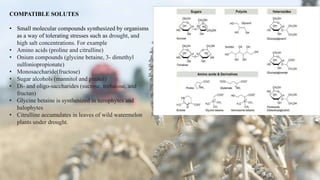
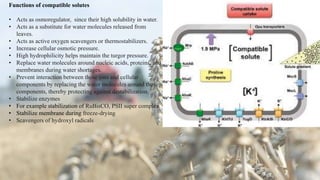
COMPATIBLE SOLUTES
• Small molecular compounds synthesized by organisms
as a way of tolerating stresses such as drought, and
high salt concentrations. For example
• Amino acids (proline and citrulline)
• Onium compounds (glycine betaine, 3- dimethyl
sulfoniopropionate)
• Monosaccharide(fructose)
• Sugar alcohols (mannitol and pinitol)
• Di- and oligo-saccharides (sucrose, trehalose, and
fructan)
• Glycine betaine is synthesized in xerophytes and
halophytes
• Citrulline accumulates in leaves of wild watermelon
plants under drought.
Functions of compatible solutes
• Acts as osmoregulator, since their high solubility in water.
• Acts as a substitute for water molecules released from
leaves.
• Acts as active oxygen scavengers or thermostabilizers.
• Increase cellular osmotic pressure.
• High hydrophilicity helps maintain the turgor pressure.
• Replace water molecules around nucleic acids, proteins, and
membranes during water shortages.
• Prevent interaction between these ions and cellular
components by replacing the water molecules around these
components, thereby protecting against destabilization.
• Stabilize enzymes
• For example stabilization of RuBisCO, PSII super complex
• Stabilize membrane during freeze-drying
• Scavengers of hydroxyl radicals
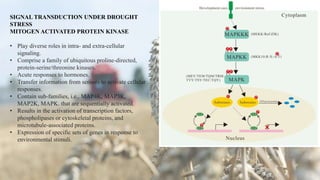
SIGNAL TRANSDUCTION UNDER DROUGHT
STRESS
MITOGEN ACTIVATED PROTEIN KINASE
• Play diverse roles in intra- and extra-cellular
signaling.
• Comprise a family of ubiquitous proline-directed,
protein-serine/threonine kinases.
• Acute responses to hormones.
• Transfer information from sensors to activate cellular
responses.
• Contain sub-families, i.e., MAP4K, MAP3K,
MAP2K, MAPK. that are sequentially activated.
• Results in the activation of transcription factors,
phospholipases or cytoskeletal proteins, and
microtubule-associated proteins.
• Expression of specific sets of genes in response to
environmental stimuli.
Calcium Signalling
• Important ubiquitous intracellular second messenger
molecules.
• Cytosolic free Ca2+ concentration ([Ca2+]cyt) increases in
response to drought stress
• Increased level of Ca2+ is recognised by some Ca2+-sensors or
calcium-binding protein.
• Calcium-binding proteins activate many calcium-dependent
protein kinases.
• CDPKs phosphorylate various transcription factors.
• CDPKs regulate the function of stress-responsive genes,
resulting in the phenotypic response of stress tolerance.
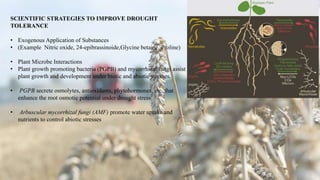
SCIENTIFIC STRATEGIES TO IMPROVE DROUGHT
TOLERANCE
• Exogenous Application of Substances
• (Example Nitric oxide, 24-epibrassinoide,Glycine betaine, Proline)
• Plant Microbe Interactions
• Plant growth promoting bacteria (PGPB) and mycorrhizal fungi assist
plant growth and development under biotic and abiotic stresses.
• PGPB secrete osmolytes, antioxidants, phytohormones, etc. that
enhance the root osmotic potential under drought stress.
• Arbuscular mycorrhizal fungi (AMF) promote water uptake and
nutrients to control abiotic stresses
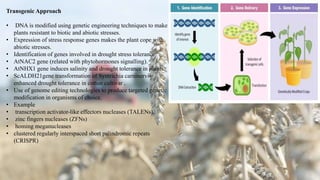
Transgenic Approach
• DNA is modified using genetic engineering techniques to make
plants resistant to biotic and abiotic stresses.
• Expression of stress response genes makes the plant cope with
abiotic stresses.
• Identification of genes involved in drought stress tolerance.
• AtNAC2 gene (related with phytohormones signalling).
• AtNHX1 gene induces salinity and drought tolerance in plants.
• ScALDH21gene transformation of Syntrichia carninervis
enhanced drought tolerance in cotton cultivar .
• Use of genome editing technologies to produce targeted genetic
modification in organisms of choice.
• Example
• transcription activator-like effectors nucleases (TALENs),
• zinc fingers nucleases (ZFNs)
• homing meganucleases
• clustered regularly interspaced short palindromic repeats
(CRISPR)
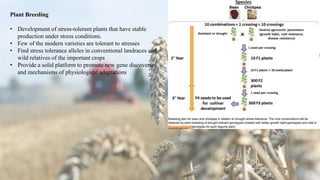
Plant Breeding
• Development of stress-tolerant plants that have stable
production under stress conditions.
• Few of the modern varieties are tolerant to stresses
• Find stress tolerance alleles in conventional landraces and
wild relatives of the important crops
• Provide a solid platform to promote new gene discoveries
and mechanisms of physiological adaptations
Conclusions and Future Recommendations
• Increasing world population and global warming challenges our
capability to feed the world
• International interest in increasing yield and plant drought tolerance due
to the severe losses in crop production.
• Aim of the current study was to aggregate various drought tolerance
mechanisms and to further improve these processes.
• In order to be prepared for the upcoming food and shelter crisis, high
yielding drought tolerant crops should be developed via integrating
above discussed approaches.
• In this regard, various new technologies
• Containing gene selection (GS), microarrays,
• Transcriptomics, next-generation sequencing,
• RT-PCR, , ELISA, AFLP, TALEN, CRISPR
• Immunofluorescence, and Western blotting,
will enable the scientists to understand and improve drought tolerance in
major crops.
Thank you for
your attention!
Questions?

Drought Tolerence in Plants.pptx

  • 1.
    Drought Tolerance inPlants By Syed Inam Ul Haq MSc. Molecular Biology & Plant Biotechnology. DPB, FOH, SKUAST-K.
  • 2.
    Drought • Water scarcityis a universal problem • Anthropogenic activities affect the balance between incoming solar radiation and outgoing radiation. • Global warming increases water evaporation and consequently leads to drought stress. • At the end of the twenty-first century, the waves of heat will be frequent and more intense • High summer temperatures and drought • High temperature and water scarcity are two important interconnected stresses • Determine the morphophysiological mechanisms and molecular signalling pathways responsible for increased drought tolerance.
  • 3.
    Effects of DroughtStress on Plant Growth and Yield • Most important stresses in arid and semi-arid areas • Effects seed germination, plant growth, and yield, specifically transpiration rate. • Photosynthetic rate, stomatal conductance, leaf relative water content and water potential. • 67% of plant yield reduced in the US last 50 years • Uncontrolled stress which damages almost all stages of plants directly or indirectly. • Abnormal physiological processes like loss of turgidity, rate of • Carbon assimilation, gaseous exchange, oxidative damage, and affects translocation of nutrients. • Affects the composition of minerals, antioxidants, and proteins. • Decline in leaf development, suffer various enzymatic activities, • And absorption of ions which result in loss of crop yield.
  • 4.
    Sensing Drying Environments Plantleaves • Leaf-air vapor pressure difference • Expression of the gene encoding abscisic aldehyde oxidase has been revealed in the guard cells of dehydrated arabidopsis Roots • Evaporation lowers the water potential and increases the salt concentration of soil. • Deficits in the water content of the soil environment > increase in the salt concentration around root surfaces and/or an increase in the osmotic pressure of root cells • No water sensor or water potential sensor has so far been identified in plants. • Aba is synthesized in parenchyma cells of vascular bundles by drought and salt stresses. • Conjugate with glucose, and from here is transported to the leaves.
  • 5.
    Plant Response toDrought Stress Leaf Structure and Shape • Dropping and reduction in leaf size • Development of waxy and thick leaf cuticle layer • Develop xeromorphic characters e.g. Smaller and less number of stomata. • Thick palisade tissues, large number of trichomes. • Thicker and tiny leaves and developed vascular tissues.
  • 6.
    Responses of LeafPhotosynthetic Systems to Drying Environments • Molecular and biochemical characteristics of photosynthetic organs have evolved to maximize photon capture. • Stomatal closure under drought stress deprives plants of their largest consumer of solar energy i.e Photosynthetic system • Stomatal closure leads to the unavailability of fixable CO2. • Utilization of NADPH slows down >ATP/ADP ratio increases >acidified lumen of Thylakoids. • Synthesis of zeaxanthin from violaxanthin (low luminal pH) • Zeaxanthin blocks energy transfer from LHC to chlorophyll P680. • Transfer of electrons from water in PSII to oxygen in PSI is also • Superoxide formed in PSI is reduced by thylakoid-bound Cu, Zn-superoxide dismutase to H2O2, and then to water by thylakoid-bound ascorbate peroxidase. • However, no up-regulation of enzymes involved in decomposing active oxygen in the chloroplasts. • The First Sacrifice in Drought is impaired ATP synthesis.
  • 7.
    Biochemical and MolecularAdaptations Plants show multiple response mechanisms to drought stress such as • Production of specific proteins • High level of metabolites and gene expression • Accumulation of soluble solutes • Phytohormones
  • 8.
    Abscisic Acid • Principalphytohormone that is involved in response to abiotic stresses • crucial plant stress regulator • ABA synthesis increases under drought stress. • Activates drought response signalling pathways. Triggers various drought related genes lead to • Closing of stomata • Improve root architecture • Increase synthesis of drought tolerance substances Jasmonates • Signal development and various gene expression, responsible for stresses • Synthesised in plastids, cytosol, and peroxisomes. • Closing of stomata, root development and scavenging of ros. • Hydraulic uptake of water from soil in slight humid condition.
  • 9.
    Auxin • Synthesized inleaf primordial, juvenile leaves and developing seed • Development of plant roots while roots have crucial role in • Improving drought tolerance Ethylene • Seed germination, plant growth, flowering, fruit ripening and response to different stresses • Produced from methionine Cytokinin • Promotes cell division, root nodule development, delay leaf senescence, • Regulate nutrient allocation and plant response to pathogen interactions enhance drought tolerance • Protection of photosynthetic apparatus, increase of antioxidant substances, regulate water balance, control plant growth, and regulate stress-related hormones.
  • 10.
    Reactive Oxygen Species •Come from the incomplete reduction of atmospheric oxygen • AKA reactive oxygen intermediate (ROI) or active oxygen species (AOS). • Four forms, Hydroxyl radicle (HO•) Hydrogen peroxide (H2O2) Singlet oxygen (1O2) Superoxide anion radical (O2−) • Prolonged drought stress increases the pro- duction of ROS in the cell components • Increased production of ROS is harmful to nucleic acid, lipids and proteins within the cell. • Two important sources of reactive oxygen species i.e., Metabolic ROS and signaling ROS. • If the oxidation of these components is not controlled, it may lead to cell death
  • 11.
    Defence mechanisms againstROS • Enzymatic • Important role in detoxification and scavenging of the ROS and increase drought tolerance. • Various enzymes present in different parts of the plant cells are involved in scavenging of ROS • SOD( convert the o2*- into hydrogen peroxide). POD(disintegrate the hydrogen peroxide into oxygen and water) • Glutathione peroxidase (GPX) & ascorbate peroxidase (APX) detoxify the H2O2. • Monodehydroascorbate reductase (MDHAR) • Glutathione reductase (GR), & CAT (remove the H2O2 via Halliwell- Asada pathway). • Reduced glutathione (GSH). • Non-enzymatic • α-tocopherol, carotenoids, osmolyte proline and flavonoids.
  • 12.
    COMPATIBLE SOLUTES • Smallmolecular compounds synthesized by organisms as a way of tolerating stresses such as drought, and high salt concentrations. For example • Amino acids (proline and citrulline) • Onium compounds (glycine betaine, 3- dimethyl sulfoniopropionate) • Monosaccharide(fructose) • Sugar alcohols (mannitol and pinitol) • Di- and oligo-saccharides (sucrose, trehalose, and fructan) • Glycine betaine is synthesized in xerophytes and halophytes • Citrulline accumulates in leaves of wild watermelon plants under drought.
  • 13.
    Functions of compatiblesolutes • Acts as osmoregulator, since their high solubility in water. • Acts as a substitute for water molecules released from leaves. • Acts as active oxygen scavengers or thermostabilizers. • Increase cellular osmotic pressure. • High hydrophilicity helps maintain the turgor pressure. • Replace water molecules around nucleic acids, proteins, and membranes during water shortages. • Prevent interaction between these ions and cellular components by replacing the water molecules around these components, thereby protecting against destabilization. • Stabilize enzymes • For example stabilization of RuBisCO, PSII super complex • Stabilize membrane during freeze-drying • Scavengers of hydroxyl radicals
  • 14.
    SIGNAL TRANSDUCTION UNDERDROUGHT STRESS MITOGEN ACTIVATED PROTEIN KINASE • Play diverse roles in intra- and extra-cellular signaling. • Comprise a family of ubiquitous proline-directed, protein-serine/threonine kinases. • Acute responses to hormones. • Transfer information from sensors to activate cellular responses. • Contain sub-families, i.e., MAP4K, MAP3K, MAP2K, MAPK. that are sequentially activated. • Results in the activation of transcription factors, phospholipases or cytoskeletal proteins, and microtubule-associated proteins. • Expression of specific sets of genes in response to environmental stimuli.
  • 15.
    Calcium Signalling • Importantubiquitous intracellular second messenger molecules. • Cytosolic free Ca2+ concentration ([Ca2+]cyt) increases in response to drought stress • Increased level of Ca2+ is recognised by some Ca2+-sensors or calcium-binding protein. • Calcium-binding proteins activate many calcium-dependent protein kinases. • CDPKs phosphorylate various transcription factors. • CDPKs regulate the function of stress-responsive genes, resulting in the phenotypic response of stress tolerance.
  • 16.
    SCIENTIFIC STRATEGIES TOIMPROVE DROUGHT TOLERANCE • Exogenous Application of Substances • (Example Nitric oxide, 24-epibrassinoide,Glycine betaine, Proline) • Plant Microbe Interactions • Plant growth promoting bacteria (PGPB) and mycorrhizal fungi assist plant growth and development under biotic and abiotic stresses. • PGPB secrete osmolytes, antioxidants, phytohormones, etc. that enhance the root osmotic potential under drought stress. • Arbuscular mycorrhizal fungi (AMF) promote water uptake and nutrients to control abiotic stresses
  • 17.
    Transgenic Approach • DNAis modified using genetic engineering techniques to make plants resistant to biotic and abiotic stresses. • Expression of stress response genes makes the plant cope with abiotic stresses. • Identification of genes involved in drought stress tolerance. • AtNAC2 gene (related with phytohormones signalling). • AtNHX1 gene induces salinity and drought tolerance in plants. • ScALDH21gene transformation of Syntrichia carninervis enhanced drought tolerance in cotton cultivar . • Use of genome editing technologies to produce targeted genetic modification in organisms of choice. • Example • transcription activator-like effectors nucleases (TALENs), • zinc fingers nucleases (ZFNs) • homing meganucleases • clustered regularly interspaced short palindromic repeats (CRISPR)
  • 18.
    Plant Breeding • Developmentof stress-tolerant plants that have stable production under stress conditions. • Few of the modern varieties are tolerant to stresses • Find stress tolerance alleles in conventional landraces and wild relatives of the important crops • Provide a solid platform to promote new gene discoveries and mechanisms of physiological adaptations
  • 19.
    Conclusions and FutureRecommendations • Increasing world population and global warming challenges our capability to feed the world • International interest in increasing yield and plant drought tolerance due to the severe losses in crop production. • Aim of the current study was to aggregate various drought tolerance mechanisms and to further improve these processes. • In order to be prepared for the upcoming food and shelter crisis, high yielding drought tolerant crops should be developed via integrating above discussed approaches. • In this regard, various new technologies • Containing gene selection (GS), microarrays, • Transcriptomics, next-generation sequencing, • RT-PCR, , ELISA, AFLP, TALEN, CRISPR • Immunofluorescence, and Western blotting, will enable the scientists to understand and improve drought tolerance in major crops.
  • 20.
    Thank you for yourattention! Questions?