DR. MOHIT BANSAL
PGT-2
Dept of psychiatry
Katihar medical college
STRESS MANAGEMENT
Objectives of session
• Define stress , including its positive and
negative aspects.
• Discuss health impact of stress.
• Discuss spectrum of various risk taking
behavior and ways to manage.
• Learning various stress management
techniques.
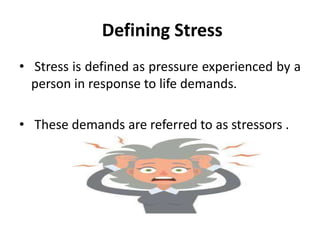
Defining Stress
• Stress is defined as pressure experienced by a
person in response to life demands.
• These demands are referred to as stressors .
IS STRESS ALWAYS BAD ??
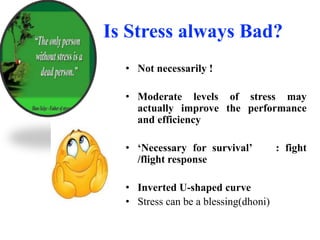
Is Stress always Bad?
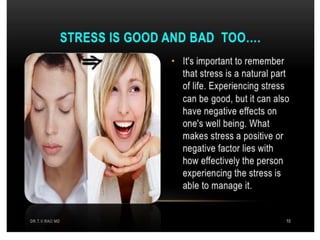
• Not necessarily !
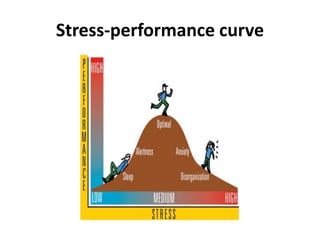
• Moderate levels of stress may
actually improve the performance
and efficiency
• ‘Necessary for survival’ : fight
/flight response
• Inverted U-shaped curve
• Stress can be a blessing(dhoni)
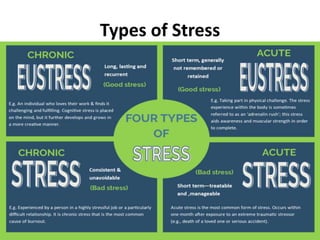
TYPES OF STRESS
• EUSTRESS (Positive stress)
• DISTRESS/STRESS (Negative stress)
Types of Stress
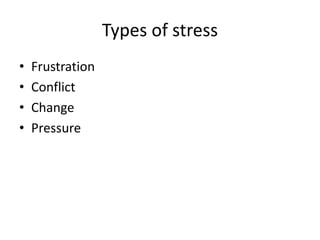
Types of stress
• Frustration
• Conflict
• Change
• Pressure
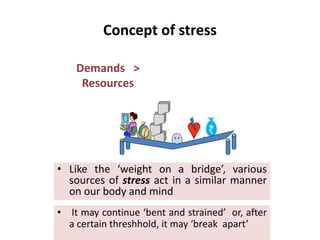
Concept of stress
Demands >
Resources
• Like the ‘weight on a bridge’, various
sources of stress act in a similar manner
on our body and mind
• It may continue ‘bent and strained’ or, after
a certain threshhold, it may ‘break apart’
Stress-performance curve
• When is stress experienced as bad?
• Why same stressor evoke different
reactions in different people ?
• Why different people are affected
to a varying degree with same
stressor?
Among other individual factors, the
role of perception is very important
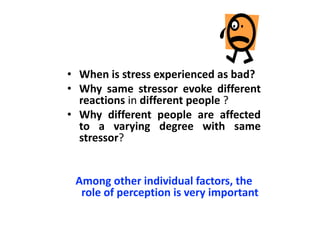
To illustrate…
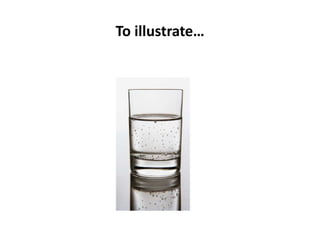
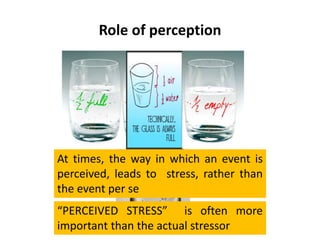
Role of perception
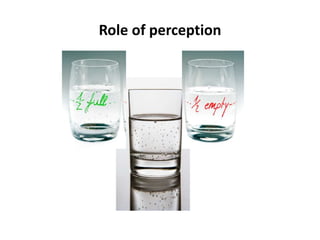
Role of perception
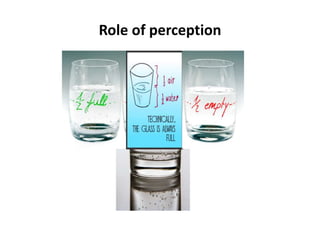
Role of perception
At times, the way in which an event is
perceived, leads to stress, rather than
the event per se
“PERCEIVED STRESS” is often more
important than the actual stressor
Common sources of
stress
What’s Your Experience of Sources
of Stress?
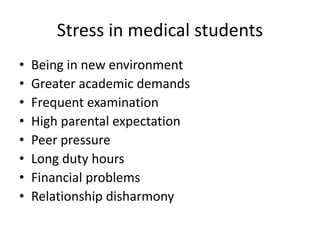
Stress in medical students
• Being in new environment
• Greater academic demands
• Frequent examination
• High parental expectation
• Peer pressure
• Long duty hours
• Financial problems
• Relationship disharmony
• Numerous studies have been reported that
medical students suffer from higher perceived
stress compared to students in other
academic fields and general population.
Stress And Risk Taking Behavior In
Medical Students
• Behavior that may lead to violence or injury
( Being in fight , bullying ,carrying a weapon, being bullied)
• Substance abuse (M>F)
• Unsafe driving or riding
• Self harm behavior ( act with an non fatal
outcome)
• Poor self care
• Unsafe sexual behavior
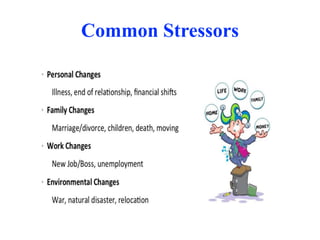
Common Stressors
Causes of stress
 Environmental
(physical
surroundings)
 Family and
relationship
problems
 Work-related (e.g
dissatisfaction,
overload,)
 Social stressors (e.g.
financial constraints)
 Uncertainty or worries
 Pessimistic attitude
 Self-criticism
 Unrealistic expectations
or beliefs
 Perfectionism
 Low self-esteem
 Excessive or unexpressed
anger
 Lack of assertiveness
Extern
al
Interna
l
EFFECTS OF STRESS
STRESS CAN EFFECT -
• BODY
• MOOD
• BEHAVIOR
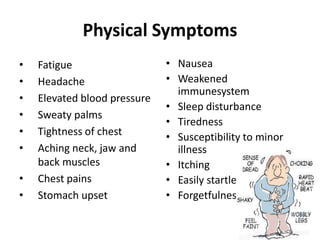
Physical Symptoms
• Fatigue
• Headache
• Elevated blood pressure
• Sweaty palms
• Tightness of chest
• Aching neck, jaw and
back muscles
• Chest pains
• Stomach upset
• Nausea
• Weakened
immunesystem
• Sleep disturbance
• Tiredness
• Susceptibility to minor
illness
• Itching
• Easily startled
• Forgetfulness
EFFECTS ON MOOD
• Anxiety
• Restlessness
• Irritability
• Sadness
• Depression
• Low self esteem & self
confidence.
• Lack of attention and
concentration.
Behavioral
• Aggression
• Catharsis
• Learned helplessness
• Displacement
• Social withdrawal
• Indulging oneself
• Over eat or under eat
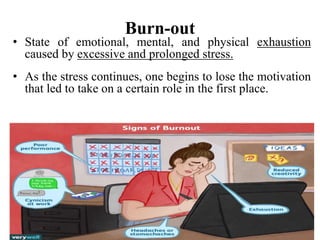
Burn-out
• State of emotional, mental, and physical exhaustion
caused by excessive and prolonged stress.
• As the stress continues, one begins to lose the motivation
that led to take on a certain role in the first place.
Dealing with stress
TIP 1
• Identify source of stress in your life
Look closely your habits, attitude and excuses.
Work (dead lines)
Studies
Relationship ( in laws , friends , maid , boyfriend , girl friend …
Start to keep a stress journal
• What caused you stress (make a guess)
• How you felt (physically / emotionally)
• How you acted upon it
• What you did to make yourself feel better.
• TIP 2 – Practice 4As of stress management.
Avoid
Alter
Adapt
Accept
• How to Avoid
a) Learn to say no
b) Distinguish between should and must
c) Avoid people who stress you out
d) Try to make a balance between family and work
Alter the situation
a) Express your feelings instead of bottling them up
b) Be willing to compromise
c) Alter environment
d) Create a balanced schedule
• Adapt to the stressor
a) Reframe problems
b) Adjust your standards
c) Practice gratitude
 Look at your positive qualities
 See the one behind you
 Perfectionism is major source of stress
ACCEPT
• Accept the things you can’t change
Aiims ,Pmch,kmch
• Learn to forgive
• Share your feelings
EMOTIONAL TECHNIQUES
Ventilation
• तकलीफ बाटने से कम होती है...छु पाने से नहीीं !
• Develop a support network (through family
members and friends) and talk about all your
emotions
• It’s not events always which are stressful but how
we perceive them. Others emotional support helps
us to gain better perspective over the stress
• Maintain a journal and express your emotions
regularly
Build Up Daily Positive Emotions
• Regularly engage in activities that evokes
positive emptions in you
• Don’t keep hobbies for weekends or some
imagined breaks
• It can be as simple as listening to music, going
to a park, drawing or playing with your child
etc.
• Find “Your Time” everyday
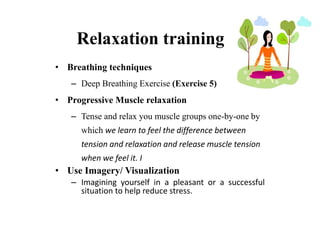
Relaxation training
• Breathing techniques
– Deep Breathing Exercise (Exercise 5)
• Progressive Muscle relaxation
– Tense and relax you muscle groups one-by-one by
which we learn to feel the difference between
tension and relaxation and release muscle tension
when we feel it. I
• Use Imagery/ Visualization
– Imagining yourself in a pleasant or a successful
situation to help reduce stress.
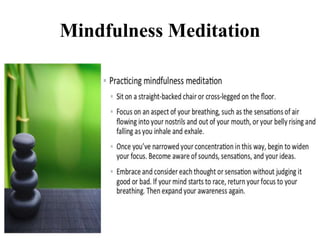
Mindfulness Meditation
40
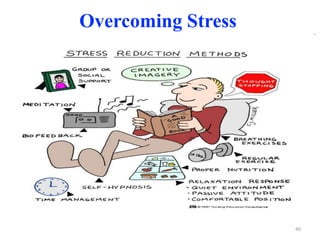
Overcoming Stress
What You Must Have Known By
Now
1. Healthy eating habits
2. Getting regular exercise
3. Maintaining sleep hygiene
4. Thinking Positive
BEHAVIORAL TECHNIQUES
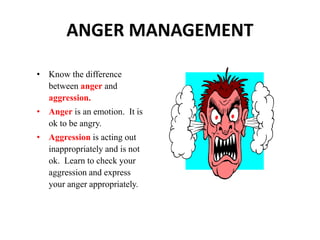
ANGER MANAGEMENT
• Know the difference
between anger and
aggression.
• Anger is an emotion. It is
ok to be angry.
• Aggression is acting out
inappropriately and is not
ok. Learn to check your
aggression and express
your anger appropriately.
When you are ANGRY and UPSET
Remember…
1-2-3-4 TURTLE
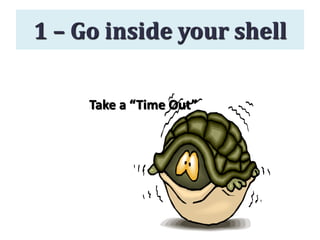
1 – Go inside your shell
Take a “Time Out”
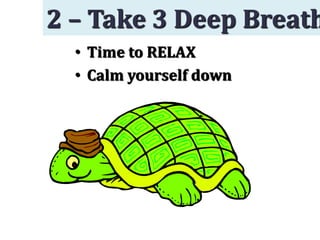
• Time to RELAX
• Calm yourself down
2 – Take 3 Deep Breath
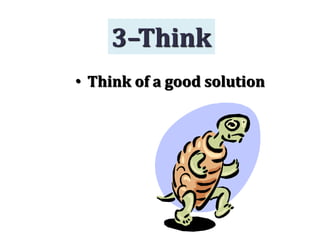
• Think of a good solution
3–Think
4– Come Back and Talk About It
But Skillfully
Remember…
• You cannot change others as easily as you
can change yourself
• Expectation breeds frustration. Frustration
breeds anger.
• Never reply to a letter/ email when
you are angry.
• Accept what you cannot change & change
what you cannot accept
• Organize your mind and organize your desk
for 5 minutes every hour
• Don’t have to hold on to my anger…TALK
about it..!!
• No BLAME GAME
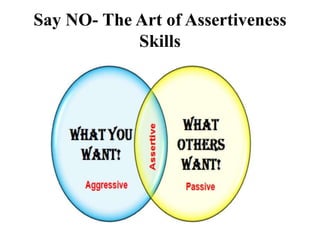
Say NO- The Art of Assertiveness
Skills
• Assertiveness is a skill regularly referred to in
social and communication skills training.
• Being assertive means being able to stand up
for your own or other people’s rights in a calm
and positive way, without being either
aggressive or passively accepting wrong .
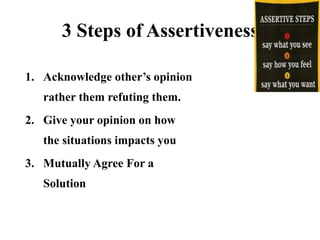
3 Steps of Assertiveness
1. Acknowledge other’s opinion
rather them refuting them.
2. Give your opinion on how
the situations impacts you
3. Mutually Agree For a
Solution
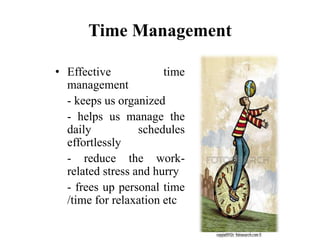
Time Management
• Effective time
management
- keeps us organized
- helps us manage the
daily schedules
effortlessly
- reduce the work-
related stress and hurry
- frees up personal time
/time for relaxation etc
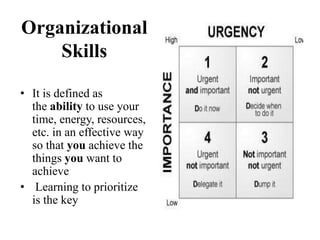
Organizational
Skills
• It is defined as
the ability to use your
time, energy, resources,
etc. in an effective way
so that you achieve the
things you want to
achieve
• Learning to prioritize
is the key
OTHER TECHNIQUES
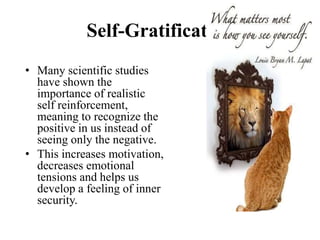
Self-Gratification
• Many scientific studies
have shown the
importance of realistic
self reinforcement,
meaning to recognize the
positive in us instead of
seeing only the negative.
• This increases motivation,
decreases emotional
tensions and helps us
develop a feeling of inner
security.
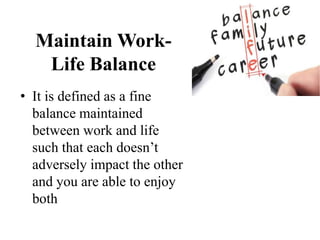
Maintain Work-
Life Balance
• It is defined as a fine
balance maintained
between work and life
such that each doesn’t
adversely impact the other
and you are able to enjoy
both
Thank
You
• “Grant me the courage to
change the things I can
change, the serenity to
accept those that I cannot
change and the wisdom to
know the difference”

STRESS MANAGEMENT ppt.pptx

  • 1.
    DR. MOHIT BANSAL PGT-2 Deptof psychiatry Katihar medical college STRESS MANAGEMENT
  • 2.
    Objectives of session •Define stress , including its positive and negative aspects. • Discuss health impact of stress. • Discuss spectrum of various risk taking behavior and ways to manage. • Learning various stress management techniques.
  • 3.
    Defining Stress • Stressis defined as pressure experienced by a person in response to life demands. • These demands are referred to as stressors .
  • 4.
  • 5.
    Is Stress alwaysBad? • Not necessarily ! • Moderate levels of stress may actually improve the performance and efficiency • ‘Necessary for survival’ : fight /flight response • Inverted U-shaped curve • Stress can be a blessing(dhoni)
  • 7.
    TYPES OF STRESS •EUSTRESS (Positive stress) • DISTRESS/STRESS (Negative stress)
  • 8.
  • 9.
    Types of stress •Frustration • Conflict • Change • Pressure
  • 10.
    Concept of stress Demands> Resources • Like the ‘weight on a bridge’, various sources of stress act in a similar manner on our body and mind • It may continue ‘bent and strained’ or, after a certain threshhold, it may ‘break apart’
  • 11.
  • 12.
    • When isstress experienced as bad? • Why same stressor evoke different reactions in different people ? • Why different people are affected to a varying degree with same stressor? Among other individual factors, the role of perception is very important
  • 13.
  • 14.
  • 15.
  • 16.
    Role of perception Attimes, the way in which an event is perceived, leads to stress, rather than the event per se “PERCEIVED STRESS” is often more important than the actual stressor
  • 17.
    Common sources of stress What’sYour Experience of Sources of Stress?
  • 18.
    Stress in medicalstudents • Being in new environment • Greater academic demands • Frequent examination • High parental expectation • Peer pressure • Long duty hours • Financial problems • Relationship disharmony
  • 19.
    • Numerous studieshave been reported that medical students suffer from higher perceived stress compared to students in other academic fields and general population.
  • 20.
    Stress And RiskTaking Behavior In Medical Students • Behavior that may lead to violence or injury ( Being in fight , bullying ,carrying a weapon, being bullied) • Substance abuse (M>F) • Unsafe driving or riding • Self harm behavior ( act with an non fatal outcome) • Poor self care • Unsafe sexual behavior
  • 21.
  • 22.
    Causes of stress Environmental (physical surroundings)  Family and relationship problems  Work-related (e.g dissatisfaction, overload,)  Social stressors (e.g. financial constraints)  Uncertainty or worries  Pessimistic attitude  Self-criticism  Unrealistic expectations or beliefs  Perfectionism  Low self-esteem  Excessive or unexpressed anger  Lack of assertiveness Extern al Interna l
  • 23.
    EFFECTS OF STRESS STRESSCAN EFFECT - • BODY • MOOD • BEHAVIOR
  • 24.
    Physical Symptoms • Fatigue •Headache • Elevated blood pressure • Sweaty palms • Tightness of chest • Aching neck, jaw and back muscles • Chest pains • Stomach upset • Nausea • Weakened immunesystem • Sleep disturbance • Tiredness • Susceptibility to minor illness • Itching • Easily startled • Forgetfulness
  • 25.
    EFFECTS ON MOOD •Anxiety • Restlessness • Irritability • Sadness • Depression • Low self esteem & self confidence. • Lack of attention and concentration.
  • 26.
    Behavioral • Aggression • Catharsis •Learned helplessness • Displacement • Social withdrawal • Indulging oneself • Over eat or under eat
  • 27.
    Burn-out • State ofemotional, mental, and physical exhaustion caused by excessive and prolonged stress. • As the stress continues, one begins to lose the motivation that led to take on a certain role in the first place.
  • 28.
    Dealing with stress TIP1 • Identify source of stress in your life Look closely your habits, attitude and excuses. Work (dead lines) Studies Relationship ( in laws , friends , maid , boyfriend , girl friend …
  • 29.
    Start to keepa stress journal • What caused you stress (make a guess) • How you felt (physically / emotionally) • How you acted upon it • What you did to make yourself feel better.
  • 30.
    • TIP 2– Practice 4As of stress management. Avoid Alter Adapt Accept
  • 31.
    • How toAvoid a) Learn to say no b) Distinguish between should and must c) Avoid people who stress you out d) Try to make a balance between family and work
  • 32.
    Alter the situation a)Express your feelings instead of bottling them up b) Be willing to compromise c) Alter environment d) Create a balanced schedule
  • 33.
    • Adapt tothe stressor a) Reframe problems b) Adjust your standards c) Practice gratitude  Look at your positive qualities  See the one behind you  Perfectionism is major source of stress
  • 34.
    ACCEPT • Accept thethings you can’t change Aiims ,Pmch,kmch • Learn to forgive • Share your feelings
  • 35.
  • 36.
    Ventilation • तकलीफ बाटनेसे कम होती है...छु पाने से नहीीं ! • Develop a support network (through family members and friends) and talk about all your emotions • It’s not events always which are stressful but how we perceive them. Others emotional support helps us to gain better perspective over the stress • Maintain a journal and express your emotions regularly
  • 37.
    Build Up DailyPositive Emotions • Regularly engage in activities that evokes positive emptions in you • Don’t keep hobbies for weekends or some imagined breaks • It can be as simple as listening to music, going to a park, drawing or playing with your child etc. • Find “Your Time” everyday
  • 38.
    Relaxation training • Breathingtechniques – Deep Breathing Exercise (Exercise 5) • Progressive Muscle relaxation – Tense and relax you muscle groups one-by-one by which we learn to feel the difference between tension and relaxation and release muscle tension when we feel it. I • Use Imagery/ Visualization – Imagining yourself in a pleasant or a successful situation to help reduce stress.
  • 39.
  • 40.
  • 41.
    What You MustHave Known By Now 1. Healthy eating habits 2. Getting regular exercise 3. Maintaining sleep hygiene 4. Thinking Positive
  • 42.
  • 43.
    ANGER MANAGEMENT • Knowthe difference between anger and aggression. • Anger is an emotion. It is ok to be angry. • Aggression is acting out inappropriately and is not ok. Learn to check your aggression and express your anger appropriately.
  • 44.
    When you areANGRY and UPSET Remember… 1-2-3-4 TURTLE
  • 45.
    1 – Goinside your shell Take a “Time Out”
  • 46.
    • Time toRELAX • Calm yourself down 2 – Take 3 Deep Breath
  • 47.
    • Think ofa good solution 3–Think
  • 48.
    4– Come Backand Talk About It But Skillfully
  • 49.
    Remember… • You cannotchange others as easily as you can change yourself • Expectation breeds frustration. Frustration breeds anger. • Never reply to a letter/ email when you are angry. • Accept what you cannot change & change what you cannot accept • Organize your mind and organize your desk for 5 minutes every hour • Don’t have to hold on to my anger…TALK about it..!! • No BLAME GAME
  • 50.
    Say NO- TheArt of Assertiveness Skills
  • 51.
    • Assertiveness isa skill regularly referred to in social and communication skills training. • Being assertive means being able to stand up for your own or other people’s rights in a calm and positive way, without being either aggressive or passively accepting wrong .
  • 52.
    3 Steps ofAssertiveness 1. Acknowledge other’s opinion rather them refuting them. 2. Give your opinion on how the situations impacts you 3. Mutually Agree For a Solution
  • 53.
    Time Management • Effectivetime management - keeps us organized - helps us manage the daily schedules effortlessly - reduce the work- related stress and hurry - frees up personal time /time for relaxation etc
  • 54.
    Organizational Skills • It isdefined as the ability to use your time, energy, resources, etc. in an effective way so that you achieve the things you want to achieve • Learning to prioritize is the key
  • 55.
  • 56.
    Self-Gratification • Many scientificstudies have shown the importance of realistic self reinforcement, meaning to recognize the positive in us instead of seeing only the negative. • This increases motivation, decreases emotional tensions and helps us develop a feeling of inner security.
  • 57.
    Maintain Work- Life Balance •It is defined as a fine balance maintained between work and life such that each doesn’t adversely impact the other and you are able to enjoy both
  • 58.
    Thank You • “Grant methe courage to change the things I can change, the serenity to accept those that I cannot change and the wisdom to know the difference”