Stress Management
Content
What a Stress
Types of Stress
Signs of Stress
Effects of stress
Stress tool box
Mediation
Stress and Modern Life
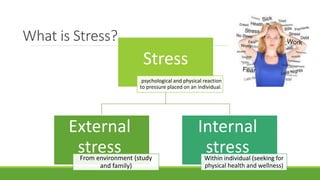
What is Stress?
Stress
psychological and physical reaction
to pressure placed on an individual.
External
stressFrom environment (study
and family)
Internal
stressWithin individual (seeking for
physical health and wellness)
Is Stress Bad or Good ?
•Stress is neither a bad nor a good thing
•It is a sign that you are involved with your life.
•You can get stress from both sad and happy news.
•To illustrate, both death in the family and addition of a new baby to the family
exert stress and pressure, but in different perceptions.
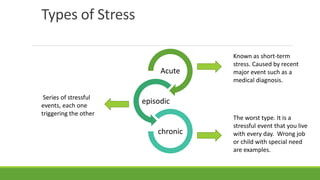
Types of Stress
Acute
episodic
chronic
Known as short-term
stress. Caused by recent
major event such as a
medical diagnosis.
The worst type. It is a
stressful event that you live
with every day. Wrong job
or child with special need
are examples.
Series of stressful
events, each one
triggering the other
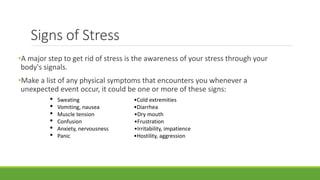
Signs of Stress
•A major step to get rid of stress is the awareness of your stress through your
body's signals.
•Make a list of any physical symptoms that encounters you whenever a
unexpected event occur, it could be one or more of these signs:
• Sweating •Cold extremities
• Vomiting, nausea •Diarrhea
• Muscle tension •Dry mouth
• Confusion •Frustration
• Anxiety, nervousness •Irritability, impatience
• Panic •Hostility, aggression
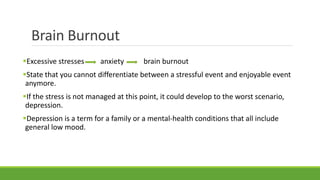
Brain Burnout
Excessive stresses anxiety brain burnout
State that you cannot differentiate between a stressful event and enjoyable event
anymore.
If the stress is not managed at this point, it could develop to the worst scenario,
depression.
Depression is a term for a family or a mental-health conditions that all include
general low mood.
Contributes in compromising general wellbeing
Affecting digestive system "irritable bowel disease",
Cardiovascular system "hypertension and heart diseases"
Immune system and skin" acnes and psoriasis".
Other Effects of stress
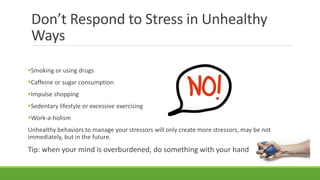
Don’t Respond to Stress in Unhealthy
Ways
Smoking or using drugs
Caffeine or sugar consumption
Impulse shopping
Sedentary lifestyle or excessive exercising
Work-a-holism
Unhealthy behaviors to manage your stressors will only create more stressors, may be not
immediately, but in the future.
Tip: when your mind is overburdened, do something with your hand
Stress Tool-box
 A collection of habits and intervention that keep us healthy, in order to stop the stress
before it stops you.
 To start the stress tool-box, there must be some basic tools, as it is impossible to
manage stress if you lack these basic tools, which are the following:
1. Ability to say no to new demands on your time and resources
2. Healthy diet
◦ Always remember, "Eating to feel better is not good for your feelings or for your
waistline"
3. Exercise
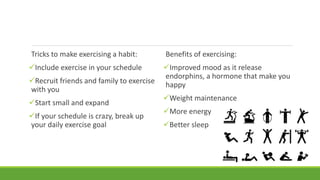
Benefits of exercising:
Improved mood as it release
endorphins, a hormone that make you
happy
Weight maintenance
More energy
Better sleep
Tricks to make exercising a habit:
Include exercise in your schedule
Recruit friends and family to exercise
with you
Start small and expand
If your schedule is crazy, break up
your daily exercise goal
4. Hobbies that you enjoy
5. Adequate, restful sleep
Make sleep a priority
Create a bedtime routine
Make the bedroom dark and comfortable
Keep technology out of the bedroom
Exercise regularly, but not right before bed
Limit nicotine and caffeine
Avoid eating two to three hours before bed
If you lack one of these tools start this week by one or two tools and as you gain in confidence,
add couple more next week and so on.
After developing the basic tools, reflect on your life to figure out how you already manage
stress and write them down.
Common stress busting tools may include:
Be creative and open to new tools, always try something new and totally unlike you
Playing computer games
Eating
Bubble bath with candles
Working out
Shopping
Watching movies
Helping your body run efficiently and effectively is a foundation for good health
and effective stress management
Pessimism Never Pay
Anyone can drive his or her stress into creative force by positive and optimistic
thinking
Exercising, eating healthy, sleeping well are all tools to insure that you are
physically stress resilient, what about mind and spirit
Keep yourself positive and optimist to bust stress
For paced and relaxed mind, mediation, therapy, religion, nature are the
answers
Mediation- "mediate" origin from Latin, meaning to remedy or solve.
The benefits of mediation include, slowing down heart rate and breathing,
normalizing blood pressure, spreading oxygen throughout the body, and better
luck quitting bad habits.
Some common mediation practices:
◦ Breath mediation (focus on your breathing)
◦ Walking mediation (focus on your steps)
◦ Guided imagery mediation (listening to an audio recording or live instructor telling
you what to imagine)
◦ Mantra mediation (focusing on a word or image to clear the mind)
◦ Transcendental meditation (resting in silence)
◦ Mindfulness mediation (focusing on your environment)
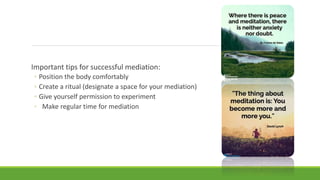
Important tips for successful mediation:
◦ Position the body comfortably
◦ Create a ritual (designate a space for your mediation)
◦ Give yourself permission to experiment
◦ Make regular time for mediation
Therapy - Increases stress awareness and gives you control over your life
 Family system therapy (learn ways to change unhealthy behaviors toward your family that
cause you stress and pain)
 Cognitive behavioral therapy (focused on forming new habits to manage life better)
 Jungian psychotherapy (the Jungian psychoanalyst delves into unconsciousness and it is
effective in healing depression, anxiety, and other emotional disorders)
 Biofeedback therapy (helpful in healing stress-related illnesses such as headache, irritable
bowel syndrome, and high blood pressure)
 Anger management therapy (helpful for people who tend to be physically, verbally, or
emotionally abusive when stressed)
 Group therapy (offers environment for sharing and support in mental healing)
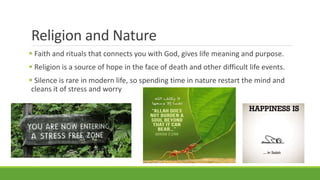
Religion and Nature
 Faith and rituals that connects you with God, gives life meaning and purpose.
 Religion is a source of hope in the face of death and other difficult life events.
 Silence is rare in modern life, so spending time in nature restart the mind and
cleans it of stress and worry
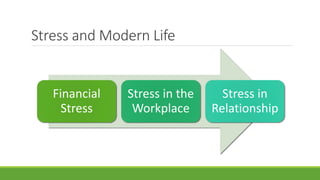
Stress and Modern Life
Financial
Stress
Stress in the
Workplace
Stress in
Relationship
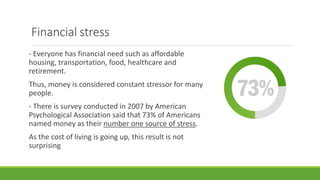
Financial stress
- Everyone has financial need such as affordable
housing, transportation, food, healthcare and
retirement.
Thus, money is considered constant stressor for many
people.
- There is survey conducted in 2007 by American
Psychological Association said that 73% of Americans
named money as their number one source of stress.
As the cost of living is going up, this result is not
surprising
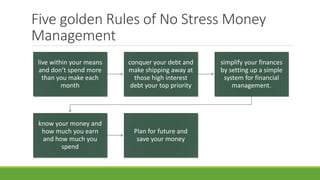
Five golden Rules of No Stress Money
Management
live within your means
and don’t spend more
than you make each
month
conquer your debt and
make shipping away at
those high interest
debt your top priority
simplify your finances
by setting up a simple
system for financial
management.
know your money and
how much you earn
and how much you
spend
Plan for future and
save your money
How to manage Stress in the workplace
The first step to masterminding work stress is to learn what exactly stress you
at work
 Take all the breaks and lunch break and actually enjoy them
Taking breaks not only increase your productivity, but also gives you mush needed rest and
relaxation
 Prioritize your schedule
 Learn how to say NO nicely
- Reposition your body periodically if you perform repetitive work
- Advocate for your own needs.
- Schedule time to drink water and go for bathroom into your day
- Train your coworkers to respect you by doing what you say you will do
Even though some stressors of work won't change, but you have
power to change your perception of the work.
Stress in Relationship
-Each relationship category requires attention it needs to survive, the closer the person is to
you, the more attention that relationship needs or the stress will occur.
For example, if you don’t have true friend who is listening to you, you may end up paying a
therapist to listen to you because no one else cares.
-Another form of relationship stress is when you put people in the wrong category.
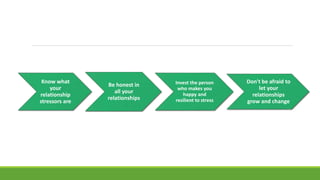
Know what
your
relationship
stressors are
Be honest in
all your
relationships
Invest the person
who makes you
happy and
resilient to stress
Don't be afraid to
let your
relationships
grow and change
Our book

Stress management

  • 1.
  • 2.
    Content What a Stress Typesof Stress Signs of Stress Effects of stress Stress tool box Mediation Stress and Modern Life
  • 3.
    What is Stress? Stress psychologicaland physical reaction to pressure placed on an individual. External stressFrom environment (study and family) Internal stressWithin individual (seeking for physical health and wellness)
  • 4.
    Is Stress Bador Good ? •Stress is neither a bad nor a good thing •It is a sign that you are involved with your life. •You can get stress from both sad and happy news. •To illustrate, both death in the family and addition of a new baby to the family exert stress and pressure, but in different perceptions.
  • 5.
    Types of Stress Acute episodic chronic Knownas short-term stress. Caused by recent major event such as a medical diagnosis. The worst type. It is a stressful event that you live with every day. Wrong job or child with special need are examples. Series of stressful events, each one triggering the other
  • 6.
    Signs of Stress •Amajor step to get rid of stress is the awareness of your stress through your body's signals. •Make a list of any physical symptoms that encounters you whenever a unexpected event occur, it could be one or more of these signs: • Sweating •Cold extremities • Vomiting, nausea •Diarrhea • Muscle tension •Dry mouth • Confusion •Frustration • Anxiety, nervousness •Irritability, impatience • Panic •Hostility, aggression
  • 7.
    Brain Burnout Excessive stressesanxiety brain burnout State that you cannot differentiate between a stressful event and enjoyable event anymore. If the stress is not managed at this point, it could develop to the worst scenario, depression. Depression is a term for a family or a mental-health conditions that all include general low mood.
  • 8.
    Contributes in compromisinggeneral wellbeing Affecting digestive system "irritable bowel disease", Cardiovascular system "hypertension and heart diseases" Immune system and skin" acnes and psoriasis". Other Effects of stress
  • 9.
    Don’t Respond toStress in Unhealthy Ways Smoking or using drugs Caffeine or sugar consumption Impulse shopping Sedentary lifestyle or excessive exercising Work-a-holism Unhealthy behaviors to manage your stressors will only create more stressors, may be not immediately, but in the future. Tip: when your mind is overburdened, do something with your hand
  • 10.
    Stress Tool-box  Acollection of habits and intervention that keep us healthy, in order to stop the stress before it stops you.  To start the stress tool-box, there must be some basic tools, as it is impossible to manage stress if you lack these basic tools, which are the following: 1. Ability to say no to new demands on your time and resources 2. Healthy diet ◦ Always remember, "Eating to feel better is not good for your feelings or for your waistline" 3. Exercise
  • 11.
    Benefits of exercising: Improvedmood as it release endorphins, a hormone that make you happy Weight maintenance More energy Better sleep Tricks to make exercising a habit: Include exercise in your schedule Recruit friends and family to exercise with you Start small and expand If your schedule is crazy, break up your daily exercise goal
  • 12.
    4. Hobbies thatyou enjoy 5. Adequate, restful sleep Make sleep a priority Create a bedtime routine Make the bedroom dark and comfortable Keep technology out of the bedroom Exercise regularly, but not right before bed Limit nicotine and caffeine Avoid eating two to three hours before bed
  • 13.
    If you lackone of these tools start this week by one or two tools and as you gain in confidence, add couple more next week and so on. After developing the basic tools, reflect on your life to figure out how you already manage stress and write them down. Common stress busting tools may include: Be creative and open to new tools, always try something new and totally unlike you Playing computer games Eating Bubble bath with candles Working out Shopping Watching movies Helping your body run efficiently and effectively is a foundation for good health and effective stress management
  • 14.
    Pessimism Never Pay Anyonecan drive his or her stress into creative force by positive and optimistic thinking Exercising, eating healthy, sleeping well are all tools to insure that you are physically stress resilient, what about mind and spirit Keep yourself positive and optimist to bust stress For paced and relaxed mind, mediation, therapy, religion, nature are the answers
  • 15.
    Mediation- "mediate" originfrom Latin, meaning to remedy or solve. The benefits of mediation include, slowing down heart rate and breathing, normalizing blood pressure, spreading oxygen throughout the body, and better luck quitting bad habits. Some common mediation practices: ◦ Breath mediation (focus on your breathing) ◦ Walking mediation (focus on your steps) ◦ Guided imagery mediation (listening to an audio recording or live instructor telling you what to imagine) ◦ Mantra mediation (focusing on a word or image to clear the mind) ◦ Transcendental meditation (resting in silence) ◦ Mindfulness mediation (focusing on your environment)
  • 16.
    Important tips forsuccessful mediation: ◦ Position the body comfortably ◦ Create a ritual (designate a space for your mediation) ◦ Give yourself permission to experiment ◦ Make regular time for mediation
  • 17.
    Therapy - Increasesstress awareness and gives you control over your life  Family system therapy (learn ways to change unhealthy behaviors toward your family that cause you stress and pain)  Cognitive behavioral therapy (focused on forming new habits to manage life better)  Jungian psychotherapy (the Jungian psychoanalyst delves into unconsciousness and it is effective in healing depression, anxiety, and other emotional disorders)  Biofeedback therapy (helpful in healing stress-related illnesses such as headache, irritable bowel syndrome, and high blood pressure)  Anger management therapy (helpful for people who tend to be physically, verbally, or emotionally abusive when stressed)  Group therapy (offers environment for sharing and support in mental healing)
  • 18.
    Religion and Nature Faith and rituals that connects you with God, gives life meaning and purpose.  Religion is a source of hope in the face of death and other difficult life events.  Silence is rare in modern life, so spending time in nature restart the mind and cleans it of stress and worry
  • 19.
    Stress and ModernLife Financial Stress Stress in the Workplace Stress in Relationship
  • 20.
    Financial stress - Everyonehas financial need such as affordable housing, transportation, food, healthcare and retirement. Thus, money is considered constant stressor for many people. - There is survey conducted in 2007 by American Psychological Association said that 73% of Americans named money as their number one source of stress. As the cost of living is going up, this result is not surprising
  • 21.
    Five golden Rulesof No Stress Money Management live within your means and don’t spend more than you make each month conquer your debt and make shipping away at those high interest debt your top priority simplify your finances by setting up a simple system for financial management. know your money and how much you earn and how much you spend Plan for future and save your money
  • 22.
    How to manageStress in the workplace The first step to masterminding work stress is to learn what exactly stress you at work  Take all the breaks and lunch break and actually enjoy them Taking breaks not only increase your productivity, but also gives you mush needed rest and relaxation  Prioritize your schedule  Learn how to say NO nicely
  • 23.
    - Reposition yourbody periodically if you perform repetitive work - Advocate for your own needs. - Schedule time to drink water and go for bathroom into your day - Train your coworkers to respect you by doing what you say you will do Even though some stressors of work won't change, but you have power to change your perception of the work.
  • 24.
    Stress in Relationship -Eachrelationship category requires attention it needs to survive, the closer the person is to you, the more attention that relationship needs or the stress will occur. For example, if you don’t have true friend who is listening to you, you may end up paying a therapist to listen to you because no one else cares. -Another form of relationship stress is when you put people in the wrong category.
  • 25.
    Know what your relationship stressors are Behonest in all your relationships Invest the person who makes you happy and resilient to stress Don't be afraid to let your relationships grow and change
  • 26.