

STRESS MANAGEMENT IN
STUDENTS
1
THE CHALLENGES IN COLLEGE
• The best years of your life? Expectations..
• Even positive change is stressful
• Greater academic demands
• Unstructured time
• Decreased adult availability
• Being on your own in a new environment
• Changing relations with family
2
CHALLENGES OF
COLLEGE: CHOICES
• Alcohol and other drugs
• Sex-identity, values, practices
• Food
• Sleep
• Balancing Academic and Extracurricular
• Roommates
3
LIFE MANAGEMENT SKILLS:
4
• GENERAL: Life management skills, for the
purposes of this section, include stress
management, time management,
information management, financial
management, personal health
management, and crisis management.
Personal planning and adeptness at
managing each of these issues will
increase the serenity and reduce the
stressors within a busy, productive life.
DR.T.V.RAO MD 5
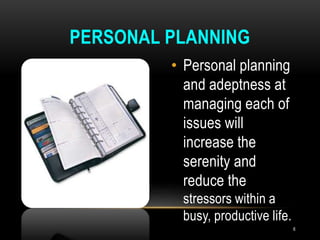
• Personal planning
and adeptness at
managing each of
issues will
increase the
serenity and
reduce the
stressors within a
busy, productive life.
PERSONAL PLANNING
6
EVERY BODY IS UNDER STRESS
• Every human on the earth will experience stress, even
management students and staff--it is a common
denominator in life. Some stress is good stress (eustress) that is
helpful and assists the drive toward achievement and success.
Negative stress (distress) affects life in an adverse manner and
is a common cause of ill health in our society. Individuals who
ignore stress signals or who cope in a negative fashion will
experience escalating symptoms of stress. The symptoms may
appear as burnout, exhaustion, emotional illnesses such as
depression and anxiety, and physical illnesses such as ulcers,
heart attacks, hypertension, and abuse of alcohol and other
drugs with all the social and professional consequences.
7
WHAT IS STRESS?
Stress is your mind and body’s response
or reaction to a real or imagined threat,
event or change.
The threat, event or change are commonly
called stressors. Stressors can be internal
(thoughts, beliefs, attitudes or external
(loss, tragedy, change).
8
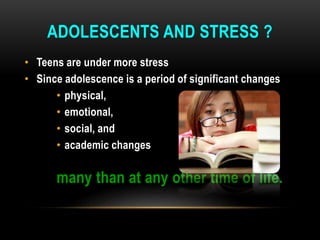
ADOLESCENTS AND STRESS ?
• Teens are under more stress
• Since adolescence is a period of significant changes
• physical,
• emotional,
• social, and
• academic changes
many than at any other time of life.
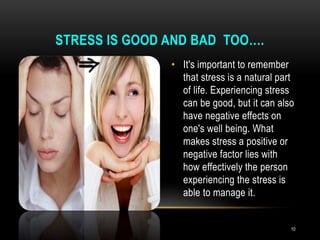
• It's important to remember
that stress is a natural part
of life. Experiencing stress
can be good, but it can also
have negative effects on
one's well being. What
makes stress a positive or
negative factor lies with
how effectively the person
experiencing the stress is
able to manage it.
STRESS IS GOOD AND BAD TOO….
10
SIGNS AND SYMPTOMS OF STRESS
Physical
• Poor appetite or overeating
• Feeing tired and fatigued
• Various aches and pains ---headache body ache
muscle pain
• Nausea & abdominal Pain
• Sleep problems
• Falling sick very often e.g. fever cough cold
diarrhea
( because of lowering of immunity due to stress)
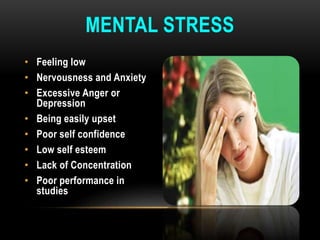
• Feeling low
• Nervousness and Anxiety
• Excessive Anger or
Depression
• Being easily upset
• Poor self confidence
• Low self esteem
• Lack of Concentration
• Poor performance in
studies
MENTAL STRESS
EXERCISE REDUCES STRESS
• As a way of draining off stress energy, nothing beats aerobic
exercise. To understand why, we need to review what stress is.
People often think of stress as pressure at work, a demanding
boss, a sick child or rush-hour traffic. All these may be triggers
but stress is actually the body's reaction to factors such as
these. Stress is the fight-or-flight response in the body,
mediated by adrenaline and other stress hormones, and
comprised of such physiologic changes as increased heart rate
and blood pressure, faster breathing, muscle tension, dilated
pupils, dry mouth and increased blood sugar. In other words,
stress is the state of increased arousal necessary for an
organism to defend itself at a time of danger.
13
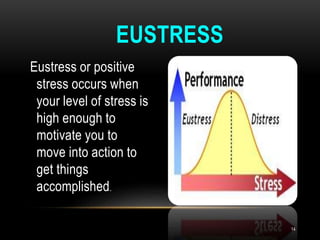
Eustress or positive
stress occurs when
your level of stress is
high enough to
motivate you to
move into action to
get things
accomplished.
EUSTRESS
14
Distress or negative
stress occurs when
your level of stress is
either too high or too
low and your body
and/or mind begin to
respond negatively to
the stressors.
DISTRESS
15
As you begin to experience
a stressful event or
perceive something to be
stressful psychological
changes occur in your
body. This experience or
perception disrupts your
body’s normal balance
and immediately your
body begins to respond
to the stressor(s) as
effectively as possible.
ALARM STAGE
16
• Most people who need care
don’t seek it or receive it
• Stigma, cultural pressure,
mistrust, lack of information
keep people out of care
• So do lack of resources;
treatment and medication
are expensive
• Care is disjointed
• Some schools don’t see
emotional well-being and
growth as in their “mission”
OBSTACLES
17
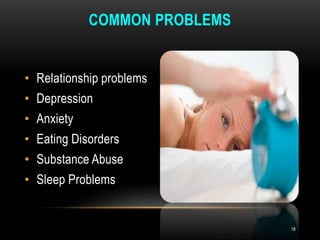
• Relationship problems
• Depression
• Anxiety
• Eating Disorders
• Substance Abuse
• Sleep Problems
COMMON PROBLEMS
18
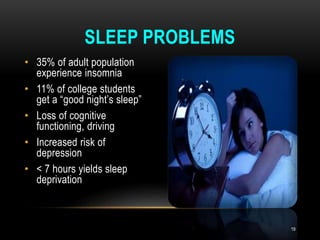
• 35% of adult population
experience insomnia
• 11% of college students
get a “good night’s sleep”
• Loss of cognitive
functioning, driving
• Increased risk of
depression
• < 7 hours yields sleep
deprivation
SLEEP PROBLEMS
19
LEARN STRESS MANAGEMENT
• Laugh
• Eat
• Act
• Running
• Neglect
• Sleep
20
STRESS MANAGEMENT TIPS
• Making little changes in your life can really add up to a big feeling
of relief.
• Learn to recognize when you are feeling stressed and simple
ways you can relax.
• Take a break. Have a cold drink, get some fresh air, or close your
eyes for a minute to refocus.
• Stay positive to help friends and family cope with stress.
• Let others know you're feeling overwhelmed and tell them how
they can help.
• Allow yourself to simply say "no" to friends and family when you
know you cannot meet their demands without becoming
overwhelmed.
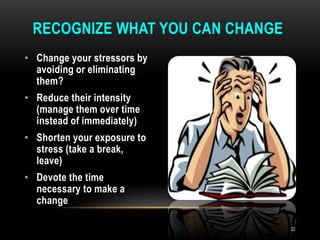
• Change your stressors by
avoiding or eliminating
them?
• Reduce their intensity
(manage them over time
instead of immediately)
• Shorten your exposure to
stress (take a break,
leave)
• Devote the time
necessary to make a
change
RECOGNIZE WHAT YOU CAN CHANGE
22
HUMOR A GREAT TONIC TO STRESS –
ENJOY IT
• Humor is a wonderful stress reducer, an antidote to upsets.
Laughter relieves tension. In fact, we often laugh hardest when
we have been feeling most tense.
23
• Practice time management
• Learn relaxation exercises.
• Rehearse and practice situations.
• Decrease negative self talk.
• Learn to feel good with a workable result – Don’t be a
perfectionist.
• Build a network of friends.
Stress Management Plan
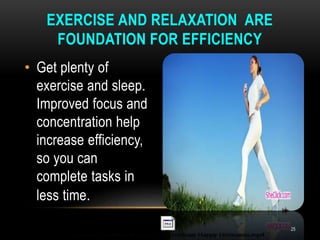
• Get plenty of
exercise and sleep.
Improved focus and
concentration help
increase efficiency,
so you can
complete tasks in
less time.
EXERCISE AND RELAXATION ARE
FOUNDATION FOR EFFICIENCY
25
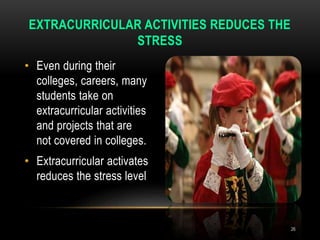
• Even during their
colleges, careers, many
students take on
extracurricular activities
and projects that are
not covered in colleges.
• Extracurricular activates
reduces the stress level
EXTRACURRICULAR ACTIVITIES REDUCES THE
STRESS
26
 Develop mutually
supportive
friendships/relationships.
 Pursue realistic goals which
are meaningful to you,
rather than goals other
have for you that you do
not share.
 Expect some frustrations,
failures and sorrows.
 Always be kind and gentle
with yourself – be a friend
to yourself.
MAINTAIN YOUR
EMOTIONAL RESERVES
27
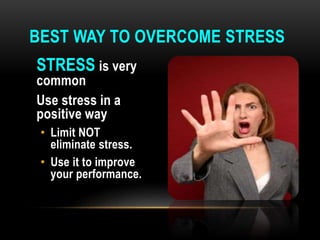
STRESS is very
common
Use stress in a
positive way
• Limit NOT
eliminate stress.
• Use it to improve
your performance.
BEST WAY TO OVERCOME STRESS
• Gather Data
• Provide Rapid Access to
Care
• Offer Education and
Outreach
• Involve Students
• Coordinate Care
• Be aware of community
resources
• Understand your limits
WHAT SHOULD COLLEGES DO?
29
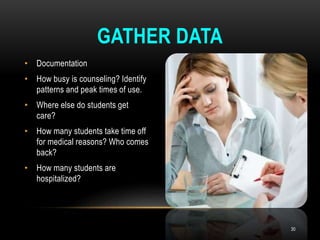
• Documentation
• How busy is counseling? Identify
patterns and peak times of use.
• Where else do students get
care?
• How many students take time off
for medical reasons? Who comes
back?
• How many students are
hospitalized?
GATHER DATA
30
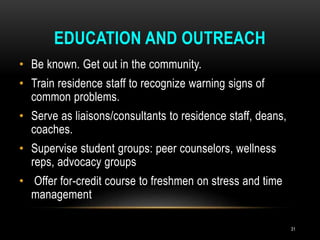
EDUCATION AND OUTREACH
• Be known. Get out in the community.
• Train residence staff to recognize warning signs of
common problems.
• Serve as liaisons/consultants to residence staff, deans,
coaches.
• Supervise student groups: peer counselors, wellness
reps, advocacy groups
• Offer for-credit course to freshmen on stress and time
management
31
WELLNESS ACTIVITIES
• Start a Wellness Center on campus
• Focus on prevention: Eat, Sleep, Exercise
• Engage Students in community- study breaks, hikes,
massage
• Teach yoga, sleep hygiene, relaxation response as part of
leading balanced life.
• Have annual “wellness” or “caring events” or “maximize
academic potential, minimize stress”
• Student Wellness Reps.
32
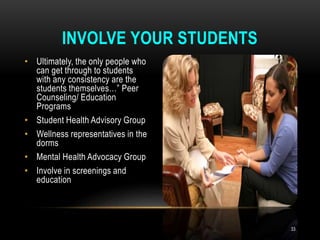
• Ultimately, the only people who
can get through to students
with any consistency are the
students themselves…” Peer
Counseling/ Education
Programs
• Student Health Advisory Group
• Wellness representatives in the
dorms
• Mental Health Advocacy Group
• Involve in screenings and
education
INVOLVE YOUR STUDENTS
33
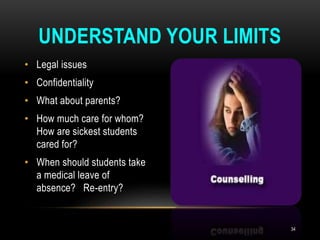
• Legal issues
• Confidentiality
• What about parents?
• How much care for whom?
How are sickest students
cared for?
• When should students take
a medical leave of
absence? Re-entry?
UNDERSTAND YOUR LIMITS
34
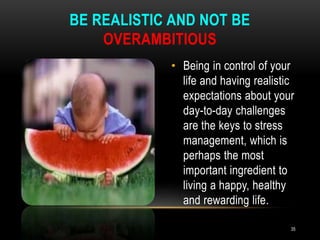
• Being in control of your
life and having realistic
expectations about your
day-to-day challenges
are the keys to stress
management, which is
perhaps the most
important ingredient to
living a happy, healthy
and rewarding life.
BE REALISTIC AND NOT BE
OVERAMBITIOUS
35
THIS PRESENTATION IS MADE BY :
36
• Mohit Mahajan
mohitmahajan077@gmail.com

Stress management

  • 1.
  • 2.
    THE CHALLENGES INCOLLEGE • The best years of your life? Expectations.. • Even positive change is stressful • Greater academic demands • Unstructured time • Decreased adult availability • Being on your own in a new environment • Changing relations with family 2
  • 3.
    CHALLENGES OF COLLEGE: CHOICES •Alcohol and other drugs • Sex-identity, values, practices • Food • Sleep • Balancing Academic and Extracurricular • Roommates 3
  • 4.
    LIFE MANAGEMENT SKILLS: 4 •GENERAL: Life management skills, for the purposes of this section, include stress management, time management, information management, financial management, personal health management, and crisis management. Personal planning and adeptness at managing each of these issues will increase the serenity and reduce the stressors within a busy, productive life.
  • 5.
  • 6.
    • Personal planning andadeptness at managing each of issues will increase the serenity and reduce the stressors within a busy, productive life. PERSONAL PLANNING 6
  • 7.
    EVERY BODY ISUNDER STRESS • Every human on the earth will experience stress, even management students and staff--it is a common denominator in life. Some stress is good stress (eustress) that is helpful and assists the drive toward achievement and success. Negative stress (distress) affects life in an adverse manner and is a common cause of ill health in our society. Individuals who ignore stress signals or who cope in a negative fashion will experience escalating symptoms of stress. The symptoms may appear as burnout, exhaustion, emotional illnesses such as depression and anxiety, and physical illnesses such as ulcers, heart attacks, hypertension, and abuse of alcohol and other drugs with all the social and professional consequences. 7
  • 8.
    WHAT IS STRESS? Stressis your mind and body’s response or reaction to a real or imagined threat, event or change. The threat, event or change are commonly called stressors. Stressors can be internal (thoughts, beliefs, attitudes or external (loss, tragedy, change). 8
  • 9.
    ADOLESCENTS AND STRESS? • Teens are under more stress • Since adolescence is a period of significant changes • physical, • emotional, • social, and • academic changes many than at any other time of life.
  • 10.
    • It's importantto remember that stress is a natural part of life. Experiencing stress can be good, but it can also have negative effects on one's well being. What makes stress a positive or negative factor lies with how effectively the person experiencing the stress is able to manage it. STRESS IS GOOD AND BAD TOO…. 10
  • 11.
    SIGNS AND SYMPTOMSOF STRESS Physical • Poor appetite or overeating • Feeing tired and fatigued • Various aches and pains ---headache body ache muscle pain • Nausea & abdominal Pain • Sleep problems • Falling sick very often e.g. fever cough cold diarrhea ( because of lowering of immunity due to stress)
  • 12.
    • Feeling low •Nervousness and Anxiety • Excessive Anger or Depression • Being easily upset • Poor self confidence • Low self esteem • Lack of Concentration • Poor performance in studies MENTAL STRESS
  • 13.
    EXERCISE REDUCES STRESS •As a way of draining off stress energy, nothing beats aerobic exercise. To understand why, we need to review what stress is. People often think of stress as pressure at work, a demanding boss, a sick child or rush-hour traffic. All these may be triggers but stress is actually the body's reaction to factors such as these. Stress is the fight-or-flight response in the body, mediated by adrenaline and other stress hormones, and comprised of such physiologic changes as increased heart rate and blood pressure, faster breathing, muscle tension, dilated pupils, dry mouth and increased blood sugar. In other words, stress is the state of increased arousal necessary for an organism to defend itself at a time of danger. 13
  • 14.
    Eustress or positive stressoccurs when your level of stress is high enough to motivate you to move into action to get things accomplished. EUSTRESS 14
  • 15.
    Distress or negative stressoccurs when your level of stress is either too high or too low and your body and/or mind begin to respond negatively to the stressors. DISTRESS 15
  • 16.
    As you beginto experience a stressful event or perceive something to be stressful psychological changes occur in your body. This experience or perception disrupts your body’s normal balance and immediately your body begins to respond to the stressor(s) as effectively as possible. ALARM STAGE 16
  • 17.
    • Most peoplewho need care don’t seek it or receive it • Stigma, cultural pressure, mistrust, lack of information keep people out of care • So do lack of resources; treatment and medication are expensive • Care is disjointed • Some schools don’t see emotional well-being and growth as in their “mission” OBSTACLES 17
  • 18.
    • Relationship problems •Depression • Anxiety • Eating Disorders • Substance Abuse • Sleep Problems COMMON PROBLEMS 18
  • 19.
    • 35% ofadult population experience insomnia • 11% of college students get a “good night’s sleep” • Loss of cognitive functioning, driving • Increased risk of depression • < 7 hours yields sleep deprivation SLEEP PROBLEMS 19
  • 20.
    LEARN STRESS MANAGEMENT •Laugh • Eat • Act • Running • Neglect • Sleep 20
  • 21.
    STRESS MANAGEMENT TIPS •Making little changes in your life can really add up to a big feeling of relief. • Learn to recognize when you are feeling stressed and simple ways you can relax. • Take a break. Have a cold drink, get some fresh air, or close your eyes for a minute to refocus. • Stay positive to help friends and family cope with stress. • Let others know you're feeling overwhelmed and tell them how they can help. • Allow yourself to simply say "no" to friends and family when you know you cannot meet their demands without becoming overwhelmed.
  • 22.
    • Change yourstressors by avoiding or eliminating them? • Reduce their intensity (manage them over time instead of immediately) • Shorten your exposure to stress (take a break, leave) • Devote the time necessary to make a change RECOGNIZE WHAT YOU CAN CHANGE 22
  • 23.
    HUMOR A GREATTONIC TO STRESS – ENJOY IT • Humor is a wonderful stress reducer, an antidote to upsets. Laughter relieves tension. In fact, we often laugh hardest when we have been feeling most tense. 23
  • 24.
    • Practice timemanagement • Learn relaxation exercises. • Rehearse and practice situations. • Decrease negative self talk. • Learn to feel good with a workable result – Don’t be a perfectionist. • Build a network of friends. Stress Management Plan
  • 25.
    • Get plentyof exercise and sleep. Improved focus and concentration help increase efficiency, so you can complete tasks in less time. EXERCISE AND RELAXATION ARE FOUNDATION FOR EFFICIENCY 25
  • 26.
    • Even duringtheir colleges, careers, many students take on extracurricular activities and projects that are not covered in colleges. • Extracurricular activates reduces the stress level EXTRACURRICULAR ACTIVITIES REDUCES THE STRESS 26
  • 27.
     Develop mutually supportive friendships/relationships. Pursue realistic goals which are meaningful to you, rather than goals other have for you that you do not share.  Expect some frustrations, failures and sorrows.  Always be kind and gentle with yourself – be a friend to yourself. MAINTAIN YOUR EMOTIONAL RESERVES 27
  • 28.
    STRESS is very common Usestress in a positive way • Limit NOT eliminate stress. • Use it to improve your performance. BEST WAY TO OVERCOME STRESS
  • 29.
    • Gather Data •Provide Rapid Access to Care • Offer Education and Outreach • Involve Students • Coordinate Care • Be aware of community resources • Understand your limits WHAT SHOULD COLLEGES DO? 29
  • 30.
    • Documentation • Howbusy is counseling? Identify patterns and peak times of use. • Where else do students get care? • How many students take time off for medical reasons? Who comes back? • How many students are hospitalized? GATHER DATA 30
  • 31.
    EDUCATION AND OUTREACH •Be known. Get out in the community. • Train residence staff to recognize warning signs of common problems. • Serve as liaisons/consultants to residence staff, deans, coaches. • Supervise student groups: peer counselors, wellness reps, advocacy groups • Offer for-credit course to freshmen on stress and time management 31
  • 32.
    WELLNESS ACTIVITIES • Starta Wellness Center on campus • Focus on prevention: Eat, Sleep, Exercise • Engage Students in community- study breaks, hikes, massage • Teach yoga, sleep hygiene, relaxation response as part of leading balanced life. • Have annual “wellness” or “caring events” or “maximize academic potential, minimize stress” • Student Wellness Reps. 32
  • 33.
    • Ultimately, theonly people who can get through to students with any consistency are the students themselves…” Peer Counseling/ Education Programs • Student Health Advisory Group • Wellness representatives in the dorms • Mental Health Advocacy Group • Involve in screenings and education INVOLVE YOUR STUDENTS 33
  • 34.
    • Legal issues •Confidentiality • What about parents? • How much care for whom? How are sickest students cared for? • When should students take a medical leave of absence? Re-entry? UNDERSTAND YOUR LIMITS 34
  • 35.
    • Being incontrol of your life and having realistic expectations about your day-to-day challenges are the keys to stress management, which is perhaps the most important ingredient to living a happy, healthy and rewarding life. BE REALISTIC AND NOT BE OVERAMBITIOUS 35
  • 36.
    THIS PRESENTATION ISMADE BY : 36 • Mohit Mahajan mohitmahajan077@gmail.com