







STRESS
MANAGEMENT
Prof. Syed Amin Tabish
FRCP (London), FRCP (Edin.), MD, FAMS
Time for change
• Many students discover the need to
develop their time management skills
when they arrive at college
• Unlike high school where teachers
frequently structured your
assignments and classes filled your
day, in college, you will have less inclass time, more outside of class
work, and a great deal of freedom
and flexibility
Why Time Management is
Important

• "The Time Famine"
•Bad time
management =
stress
STRESS
• Every person constantly strives to
reach and maintain a level of
equilibrium
• As this equilibrium level is disturbed by
environmental and internal strain, the
likelihood of disease increases
• Each person has a level of stress
tolerance
• When this level is exceeded the person
breaks down
Stress
• Stress is an adaptive
response mediated by
individual differences
&/or psychological
processes and an event
that places excessive
demands on person
Stress
• Stress is never a result of one single
cause
It is created by factirs like:
• Pressure at work
• Too many social commitments
• An uncomfortable working environ
• Lack of effective time management
• Disturbed family life
How much stress
• Moderate amount of stress is
GOOD and can improve one’s
performance, efficiency &
productivity
• But too much of it may
generate disabling emotions
leading to anxiety, tension,
difficulty in thinking clearly
Stress Factors
•
•
•
•
•
•
•
•
•
•

Unrealistic expectations of self
Lack of organization
Poor time management
Feeling of inadequacy
Low self esteem
Financial problems
Family demands
Marriage
Competitiveness
Frustration
Stress

• Interpersonal
• Job related
Stress
Classification of Individuals:
TYPE A Behaviour
• High probability of Heart attack
• High degree of drive & ambition
• Extremely competitive
• Aggressive
• TYPE B
• High level of patience
• Takes time to enjoy
• works at more leisurely pace
Stress Symptoms
•
•
•
•
•
•
•
•
•

General irritability
Palpitations
High BP
Depression/hyper-excitation
Dryness of mouth
Emotional istability
Urge to cry or run and hide
Inability to concentrate
Prone to accidents
Coping with Stress
• Physical Exercise
• Sensitivity Training (T-Groups):
individuals are brought together
and placed in an environment in
which they are permitted to pour
out frustrations, anxieties and
fears freely
• Executive sabbatical
• Relaxation
Relaxation
•
•
•
•
•
•

Meditation
Prayer
Yoga
Spiritual activities
Biofeedback
A Quiet environment
Managing Your Time

• Managing your time
successfully implies
accomplishing what is most
important for you
• When you don’t accomplish
what you truly want , you
may feel confused,
compromised, and frustrated
Goals/Priorities/Plann
ing
Drucker's Dictum:
Doing things right is
not as important as
doing the right things.
Questions to always
ask
• Why am I doing this?
• What is the goal?
• How will I succeed?
• What happens if I
chose not to do it?
Inspiration

•"If you can dream it,
you can do it"
-- Walt Disney

• Disneyland was built in
366 days
Planning is Important

•Failing to plan is
planning to fail
•Plan Each Day
•Plan Each Week
•Plan Each Semester
Everyone has Good and Bad Times

• Find your
creative/thinking time.
Defend it ruthlessly,
spend it alone
• Find your dead time:
Schedule meetings,
phone calls, and
mundane stuff during it.
Advantages of Time
Management

• gain time
• motivates and initiates
• reduces avoidance
• promotes review
• eliminates cramming
• reduces anxiety
Advantages of Time
Management

• You need to manage time
effectively if you’re going to
be successful.

Better time management
skills can:
• improve your grades
• help you keep stress in
check
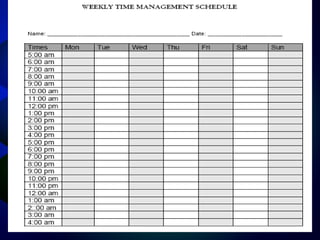
Planning Tools
• A Monthly Planner
• A Weekly Objectives
List
• A Weekly Planner
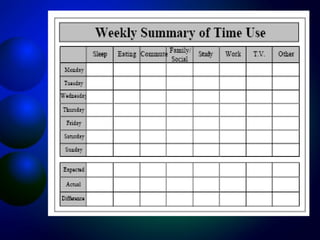
• A Time Log
How much time is
enough?

• The time you spend on task has
some relationship to the quality of
work you end up producing
• A good gauge to follow is to
perform 2-3 hours of College work
outside class for every hour of
class time
• For a full-time student with a 15
hour of class per week load the
recommendation is to do between
30 and 45 hours of homework each
Procrastination
• According to O’Brien (2002)
up to 40% of university
students experience
procrastination as a problem
• Taraban (1999) reported that
students do most of the work
near academic deadlines and
failed to make appropriate
use earlier in the term.
HOW COME I NEVER HAVE ENOUGH
TIME?

• Do you have trouble finding
enough time to study?
• Do you frequently find
yourself rushing to places,
missing deadlines, feeling
you have insufficient time
for relaxation and personal
relationships, or having a
general sense of being
overwhelmed?
How come !
• Do you realize that you
probably have as many as
168 hours(7 D x 24 H) of
available time each week?
• If you go to bed at
midnight and wake up at
8:00 a.m., you are
sleeping 56 hours a week,
leaving 112 waking hours.
HOW COME I NEVER HAVE ENOUGH
TIME?

• Combine those 30 hours with two
hours a day for eating and
personal care, and
• You still has 68 hours of
available time a week.
• Even if you study 30 hours a
week, you still have a
considerable amount of time
left----38 hours--for other
activities!
Principles of Using Time Effectively
• The first is efficiency, the most
output for the least input.
Students:
• who plan
• use their study schedule
efficiently
• avoid wasting time
• are able to get their work done
with the minimum amount of time
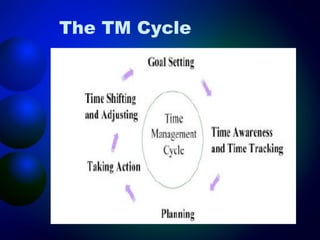
The TM Cycle
Steps to Improved Time Management

• Create a semester
schedule
• Assess and plan your
work load each week
• Adjust your plan each
day
• Evaluate your schedule
Reading and Study
Time

Read in three steps:
• In the first step, survey the
material by reading the titles,
sub-titles, bold print, italics,
definitions, topic sentences,
summaries, and conclusions.
• This will provide you with an
overview of the chapter, give
you direction, and help you to
see the details in relation to the
whole.
Second Step

• Form questions out of
the titles and sub-titles
using the Six Keys to
Reading -- who, what,

why, when, where,
and how; then read to

select what you want to
learn.
Third Step
• Review the material
you have selected or
marked for learning in
order to assimilate it.
Study Time II
• Spend half your reading and study
time in reproducing
• Mere reading is mere impression
• In an hour of study the individual
who spends half of the time trying to
write, say, or think about what he or
she has read will be able to
reproduce twice as many ideas as
the individual who spends all of the
time in passive reading of the
material in that book
Study Time III
• After you have read your book,
close it, and then attempt to
recall what you have read,
review to fill in any gaps in
your knowledge or to find the
right words to express the
ideas, re-test yourself and
review again.
• The cycle is read and recite,
read and recite, read and recite
until you feel confident in your
knowledge
Review when forgetting is
greatest
The greatest amount of forgetting
usually occurs within the first 24
hours after study 
• Notes taken today or material read
today should be reviewed that
same day
• If the material is in outline form,
underlined, probably only ten
percent of the total assignment
need be reviewed. 
• This should normally take 15
minutes for each subject
Stress management
Stress management

Stress management

  • 1.
    STRESS MANAGEMENT Prof. Syed AminTabish FRCP (London), FRCP (Edin.), MD, FAMS
  • 2.
    Time for change •Many students discover the need to develop their time management skills when they arrive at college • Unlike high school where teachers frequently structured your assignments and classes filled your day, in college, you will have less inclass time, more outside of class work, and a great deal of freedom and flexibility
  • 3.
    Why Time Managementis Important • "The Time Famine" •Bad time management = stress
  • 4.
    STRESS • Every personconstantly strives to reach and maintain a level of equilibrium • As this equilibrium level is disturbed by environmental and internal strain, the likelihood of disease increases • Each person has a level of stress tolerance • When this level is exceeded the person breaks down
  • 5.
    Stress • Stress isan adaptive response mediated by individual differences &/or psychological processes and an event that places excessive demands on person
  • 6.
    Stress • Stress isnever a result of one single cause It is created by factirs like: • Pressure at work • Too many social commitments • An uncomfortable working environ • Lack of effective time management • Disturbed family life
  • 7.
    How much stress •Moderate amount of stress is GOOD and can improve one’s performance, efficiency & productivity • But too much of it may generate disabling emotions leading to anxiety, tension, difficulty in thinking clearly
  • 8.
    Stress Factors • • • • • • • • • • Unrealistic expectationsof self Lack of organization Poor time management Feeling of inadequacy Low self esteem Financial problems Family demands Marriage Competitiveness Frustration
  • 9.
  • 10.
    Stress Classification of Individuals: TYPEA Behaviour • High probability of Heart attack • High degree of drive & ambition • Extremely competitive • Aggressive • TYPE B • High level of patience • Takes time to enjoy • works at more leisurely pace
  • 11.
    Stress Symptoms • • • • • • • • • General irritability Palpitations HighBP Depression/hyper-excitation Dryness of mouth Emotional istability Urge to cry or run and hide Inability to concentrate Prone to accidents
  • 12.
    Coping with Stress •Physical Exercise • Sensitivity Training (T-Groups): individuals are brought together and placed in an environment in which they are permitted to pour out frustrations, anxieties and fears freely • Executive sabbatical • Relaxation
  • 13.
  • 14.
    Managing Your Time •Managing your time successfully implies accomplishing what is most important for you • When you don’t accomplish what you truly want , you may feel confused, compromised, and frustrated
  • 15.
    Goals/Priorities/Plann ing Drucker's Dictum: Doing thingsright is not as important as doing the right things.
  • 16.
    Questions to always ask •Why am I doing this? • What is the goal? • How will I succeed? • What happens if I chose not to do it?
  • 17.
    Inspiration •"If you candream it, you can do it" -- Walt Disney • Disneyland was built in 366 days
  • 18.
    Planning is Important •Failingto plan is planning to fail •Plan Each Day •Plan Each Week •Plan Each Semester
  • 19.
    Everyone has Goodand Bad Times • Find your creative/thinking time. Defend it ruthlessly, spend it alone • Find your dead time: Schedule meetings, phone calls, and mundane stuff during it.
  • 20.
    Advantages of Time Management •gain time • motivates and initiates • reduces avoidance • promotes review • eliminates cramming • reduces anxiety
  • 21.
    Advantages of Time Management •You need to manage time effectively if you’re going to be successful. Better time management skills can: • improve your grades • help you keep stress in check
  • 22.
    Planning Tools • AMonthly Planner • A Weekly Objectives List • A Weekly Planner • A Time Log
  • 24.
    How much timeis enough? • The time you spend on task has some relationship to the quality of work you end up producing • A good gauge to follow is to perform 2-3 hours of College work outside class for every hour of class time • For a full-time student with a 15 hour of class per week load the recommendation is to do between 30 and 45 hours of homework each
  • 25.
    Procrastination • According toO’Brien (2002) up to 40% of university students experience procrastination as a problem • Taraban (1999) reported that students do most of the work near academic deadlines and failed to make appropriate use earlier in the term.
  • 26.
    HOW COME INEVER HAVE ENOUGH TIME? • Do you have trouble finding enough time to study? • Do you frequently find yourself rushing to places, missing deadlines, feeling you have insufficient time for relaxation and personal relationships, or having a general sense of being overwhelmed?
  • 27.
    How come ! •Do you realize that you probably have as many as 168 hours(7 D x 24 H) of available time each week? • If you go to bed at midnight and wake up at 8:00 a.m., you are sleeping 56 hours a week, leaving 112 waking hours.
  • 28.
    HOW COME INEVER HAVE ENOUGH TIME? • Combine those 30 hours with two hours a day for eating and personal care, and • You still has 68 hours of available time a week. • Even if you study 30 hours a week, you still have a considerable amount of time left----38 hours--for other activities!
  • 29.
    Principles of UsingTime Effectively • The first is efficiency, the most output for the least input. Students: • who plan • use their study schedule efficiently • avoid wasting time • are able to get their work done with the minimum amount of time
  • 30.
  • 32.
    Steps to ImprovedTime Management • Create a semester schedule • Assess and plan your work load each week • Adjust your plan each day • Evaluate your schedule
  • 33.
    Reading and Study Time Readin three steps: • In the first step, survey the material by reading the titles, sub-titles, bold print, italics, definitions, topic sentences, summaries, and conclusions. • This will provide you with an overview of the chapter, give you direction, and help you to see the details in relation to the whole.
  • 34.
    Second Step • Formquestions out of the titles and sub-titles using the Six Keys to Reading -- who, what, why, when, where, and how; then read to select what you want to learn.
  • 35.
    Third Step • Reviewthe material you have selected or marked for learning in order to assimilate it.
  • 36.
    Study Time II •Spend half your reading and study time in reproducing • Mere reading is mere impression • In an hour of study the individual who spends half of the time trying to write, say, or think about what he or she has read will be able to reproduce twice as many ideas as the individual who spends all of the time in passive reading of the material in that book
  • 37.
    Study Time III •After you have read your book, close it, and then attempt to recall what you have read, review to fill in any gaps in your knowledge or to find the right words to express the ideas, re-test yourself and review again. • The cycle is read and recite, read and recite, read and recite until you feel confident in your knowledge
  • 38.
    Review when forgettingis greatest The greatest amount of forgetting usually occurs within the first 24 hours after study  • Notes taken today or material read today should be reviewed that same day • If the material is in outline form, underlined, probably only ten percent of the total assignment need be reviewed.  • This should normally take 15 minutes for each subject