The importance of getting a good night’s sleep
 Sleep is regulated by our biological rhythms that are generally
governed by the circadian rhythms of the earth, moon, and sun. It is
important for our bodies to be inline with these circadian rhythms, to
be awake in the day and asleep when it is dark.
 Light and melatonin, a neurochemical in our bodies, are key factors
in our sleep-awake cycle. When the sun sets and lights go
low, melatonin is usually released. When the sun rises and light
reappears, the production of melatonin is suppressed. Too much time
under bright lights or in front of computer monitor at night delays the
release of melatonin causing disruption to the sleep-awake cycle.
 Many students also alter their own biological clocks by not going to
sleep when it is dark, not waking at a regular time, and not sleeping
the length of time needed.
 Getting enough sleep…
 helps your body and mind rest and repair
 provides the energy necessary to manage stress
 decreases risk of depression
 improves mood
 increases ability to make rational decisions
 increases motivation, memory, productivity and concentration
 increases creativity and spontaneity
 helps prevent injuries and accidents
 helps prevent stomach upsets and/or headaches
 decreases fatigue
 increases life-span
 positively impacts motor skills and athletic performance
 revitalize the immune system
Sleep and Academics
College students
report that their
top 2 concerns
that have the
greatest impact
on their
academics are
1. Stress
2. Sleep
Source: National College Health
Association’s National College Health
Assessment
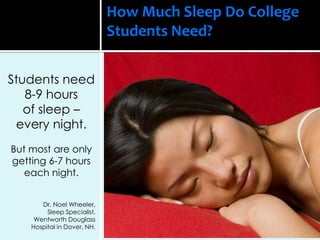
How Much Sleep Do College
Students Need?
Students need
8-9 hours
of sleep –
every night.
But most are only
getting 6-7 hours
each night.
Dr. Noel Wheeler,
Sleep Specialist,
Wentworth Douglass
Hospital in Dover, NH.
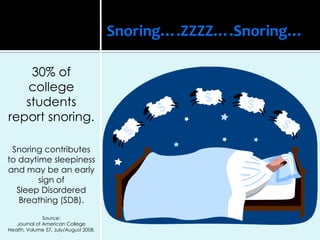
Snoring….ZZZZ….Snoring…
30% of
college
students
report snoring.
Snoring contributes
to daytime sleepiness
and may be an early
sign of
Sleep Disordered
Breathing (SDB).
Source:
Journal of American College
Health, Volume 57, July/August 2008.
JUST SAY
NO!
A 2007 study
found that
college students
who deprived
themselves of
sleep to study all
night had lower
GPAs compared
to those who
make time for
sleep.
Associated Professional Sleep
Societies
“All Nighters”
Learning how to manage
your stress is one of the
best ways to get a better
night’s sleep.
To learn stress
management
techniques, make an
appointment with a
Wellness
Educator/Counselor at
Health Services
(603) 862-3823
Sleep and Stress
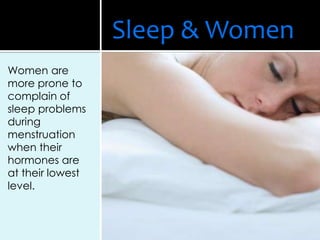
Women are
more prone to
complain of
sleep problems
during
menstruation
when their
hormones are
at their lowest
level.
Sleep & Women
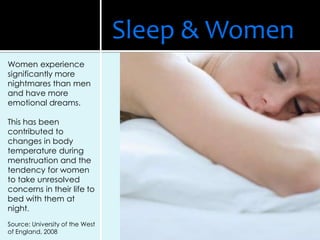
Women experience
significantly more
nightmares than men
and have more
emotional dreams.
This has been
contributed to
changes in body
temperature during
menstruation and the
tendency for women
to take unresolved
concerns in their life to
bed with them at
night.
Source: University of the West
of England, 2008
Sleep & Women
MEN:
Morning erections in men are linked to rapid eye movement
(REM) sleep and testosterone fluctuations in the body.
Women:
Clitoral erections in women are also linked to REM sleep.
Sleep related erections (SREs) have more to do with the
body’s natural sleep rhythms and self-regulating systems than
anything related to stimulating fantasies, dream content or
desire for sex.
SREs are believed to help oxygenate penile tissue, which in
turn can protect against problems that can cause erectile
dysfunction.
The body performs its own routine preventive maintenance
each night during sleep – which can help your current (and
future) sexual health!
Source: The University of Arizona
Sleep Related Erections (SRE)
Say
What?
Sleeping
may
improve
your
sexual
health.
DID YOU KNOW:
It takes a minimum of three days for the body to recover from a night of heavy drinking.
One night of partying on Friday night can effect REM, the deep stage of sleep you need
to wake up feeling rested and mentally and physically refreshed.
Friday night – You are excited to go out after the long week. You have some drinks and
become intoxicated. You get back to your room and sleep for 10 hours but your brain
never fully enters the REM stage. You wake up on Saturday morning feeling tired and
sluggish.
Saturday night – You have no intentions of going out. Tonight you are going to “catch
up” on your sleep. But when you go to bed your sleep-deprived brain enters REM
REBOUND, staying too long in the REM stage. Again, you wake up feeling tired and
sluggish on Sunday – this is not good considering you were planning on doing your
homework today.
Sunday night – Finally, your brain is returning to a normal sleep cycle. You are able to go
to sleep and wake up on Monday morning feeling rested and refreshed. But you didn’t
ever get around to enjoying your weekend or getting your homework done.
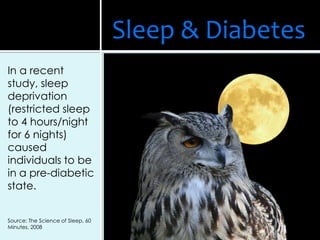
In a recent
study, sleep
deprivation
(restricted sleep
to 4 hours/night
for 6 nights)
caused
individuals to be
in a pre-diabetic
state.
Source: The Science of Sleep, 60
Minutes, 2008
Sleep & Diabetes
How long
does it take
a lab rat to
die of sleep
deprivation?
Sleep Trivia!
Sleep Trivia!
Yikes!
It only takes
5 days
for a mouse
to die from
not getting
enough
sleep!
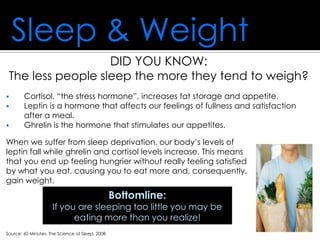
Sleep & Weight
DID YOU KNOW:
The less people sleep the more they tend to weigh?
 Cortisol, “the stress hormone”, increases fat storage and appetite.
 Leptin is a hormone that affects our feelings of fullness and satisfaction
after a meal.
 Ghrelin is the hormone that stimulates our appetites.
When we suffer from sleep deprivation, our body’s levels of
leptin fall while ghrelin and cortisol levels increase. This means
that you end up feeling hungrier without really feeling satisfied
by what you eat, causing you to eat more and, consequently,
gain weight.
Source: 60 Minutes, The Science of Sleep, 2008
Bottomline:
If you are sleeping too little you may be
eating more than you realize!
Eating for Sleep
Eating foods rich in calcium and magnesium may help you sleep. These minerals are
calming and may also help prevent leg cramps.
 Good calcium sources include dairy products (warm milk and honey), calcium
fortified orange juice, almond, figs, peas, beans and dark leafy green vegetables.
 Good magnesium sources include whole grain products, nuts and seeds, peanut
butter, bananas, avocados, chocolate and beans.
Foods rich in B vitamins have a sedative effect.
• Best food sources include whole grains, wheat germ, walnuts, peanuts, bananas and
sunflower seeds.
•Avoid spicy, overly sweet or fatty foods before bed.
• Spicy foods may cause gastrointestinal reflux or heartburn.
• Overly sweet and fatty foods may cause indigestion and/or bloating.
Foods high in tryptophan may help you sleep.
 Foods high in tryptophan (which is then converted to serotonin) include turkey,
dates, figs, milk, tuna and whole grains.
Sleep & Caffeine
Caffeine can have a negative impact
on your sleep cycle.
 Caffeine takes about 6 hours to leave the body
 Caffeine speads up heart rate, blood pressure and brain waves making it
difficult to relax AND sleep.
 In order to evenly block the uptake of adenosine (neurotransmitter that
helps trigger sleep), consume low, steady doses of caffeine.
 The equivalent of a quarter of a cup of coffee (2 ounces or 30 mg. of
caffeine) per hour is optimal. Limit caffeine intake to 250 mg/day.
Source: 2004 Airforce Study as sited by The Center for Health Promotion and Wellness at MIT Medical.
Bottomline:
Try to minimize the amount of caffeine you
consume and don’t have caffeine after lunch.
You can’t make up for not getting enough sleep during the week by “binge
sleeping” on weekends. This only pushes your biological clock further off
schedule.
Power Napping
Napping can be good or bad, depending on you body’s natural sleep
wake cycle. Insomniacs should not nap. Follow these guidelines to good power
napping:
 Try not to take a nap until at least 8 hours after you wake up from a night’s
sleep
 Try to sleep for around 20-35 minutes so that you don’t enter REM, deep
sleep.
 If you have time to take a longer nap, try sleeping for 80-90 minutes. This
allows your body to fall into your natural sleep/wake cycle.
 Even if you don’t fall asleep, finding 20-30 minutes in the course of your day
to lie down, be motionless and close your eyes has numerous benefits.
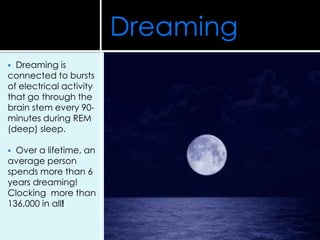
 Dreaming is
connected to bursts
of electrical activity
that go through the
brain stem every 90-
minutes during REM
(deep) sleep.
 Over a lifetime, an
average person
spends more than 6
years dreaming!
Clocking more than
136,000 in all!
Dreaming
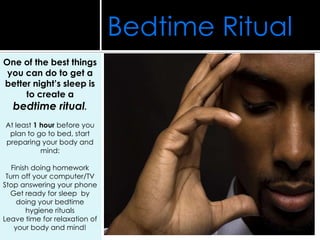
One of the best things
you can do to get a
better night’s sleep is
to create a
bedtime ritual.
At least 1 hour before you
plan to go to bed, start
preparing your body and
mind:
Finish doing homework
Turn off your computer/TV
Stop answering your phone
Get ready for sleep by
doing your bedtime
hygiene rituals
Leave time for relaxation of
your body and mind!
Bedtime Ritual
 Maintain a regular sleep and wake time schedule including
weekends.
 Establish a regular, relaxing bedtime routine such as taking a warm
shower, reading a book, listening to soothing music, meditating or
light stretching.
 Try to create a sleep-conducive environment that is
dark, quiet, comfortable and cool.
 Make your bed with soft sheets, comfortable pillows and if
possible, a mattress topper.
 Use your bed only for sleep and sex. This way your body comes to
recognize your bed as a place for relaxation.
 Finish eating at least 2-3 hours before your regular bedtime.
 Exercise regularly. It is best to complete your workout at least a few
hours before bedtime.
 Avoid caffeine (e.g. coffee, tea, soft drinks, chocolate) within 6-8
hours of going to bed.
 Avoid nicotine (e.g. cigarettes, tobacco products). Used close to
bedtime it can lead to poor sleep.
 Avoid alcohol close to bedtime. Although alcohol may help you fall
asleep, it often disrupts sleep causing frequent nighttime awakenings
and decreases restful sleep.
 Refrain from watching TV before going to bed. The lights and content
on the TV can stimulate your brain and prevent you from falling
asleep.
 If you can’t fall asleep within 15 minutes, get out of bed and do
something relaxing. It is important to get out of bed so that your body
doesn’t begin to think of your bed as a stressful place.
 If your mind is racing with thoughts or things you have to do the next
day, record these in a notebook. Doing this will help you concentrate
more on going to sleep and less on what you need to do the next
day.
 Lay on your back, close your eyes and visualize yourself in a relaxing
and peaceful place.
See a physician or nurse practitioner at Health Services if …
 Lack of sleep is seriously interfering with school, work or relationships with
family and friends
 You rely on sleeping pills to make you sleep or amphetamines and
energy drinks to keep you alert during the day
 You are having a difficult time coping with depression, anxiety or chronic
pain
 You have had a recent change in medication that is effecting your
sleep patterns
 You snore heavily or stop breathing for intervals during the night - you
may have sleep apnea (blocked or partly blocked airway)
 You are feeling overwhelmed and stressed out
Call Health Services at (603) 862-2856
The following education/counseling services are available to all UNH students at Health
services. Most services are covered by the Health Services fee, unless otherwise noted.
 Stress management education/counseling
 Sleep hygiene education/counseling
 Individual and group meditation sessions
 Yoga classes
 Nutrition education/counseling
 Alcohol, tobacco and other drugs education/counseling
 Light therapy
 Massage therapy (student rate: $35/traditional, $45/hot stone)
 Health Services Resource Library (visit the sleep section)
 And MORE!!!
Learn more about sleep at our Web site: www.unh.edu/health-services/ohep/sleep
Download free meditations at our Web site: www.unh.edu/health-services/meditation-cd
Office of Health Education and Promotion, Health Services
(603) 862-3823
We are located across Main Street from Holloway Commons and the MUB, room 249 in Health Services!
Center for Academic Resources (CFAR)
www.cfar.unh.edu, (603) 862-3698
The following academic support services are available to all UNH students:
 Ongoing, individualized learning skills instruction in time management, note-
taking, and test-taking
 Peer support for academic and personal concerns
 Computer cluster
 Syllabi for many UNH courses and summaries of student evaluations of faculty
 Drop-in tutoring for selected courses and referrals for individual & group tutoring
 Weekly peer-led study groups for select highly-enrolled courses
 Information sessions on taking the Graduate Record Exam (GRE) and writing
workshops for graduate application statements
Counseling Center
www.unhcc.unh.edu, (603) 862-2090
 The Counseling Center is the primary mental health facility on campus that offers
counseling and therapy for students who may be experiencing situational or
ongoing psychological difficulties.

Sleepless in durham

  • 1.
    The importance ofgetting a good night’s sleep
  • 2.
     Sleep isregulated by our biological rhythms that are generally governed by the circadian rhythms of the earth, moon, and sun. It is important for our bodies to be inline with these circadian rhythms, to be awake in the day and asleep when it is dark.  Light and melatonin, a neurochemical in our bodies, are key factors in our sleep-awake cycle. When the sun sets and lights go low, melatonin is usually released. When the sun rises and light reappears, the production of melatonin is suppressed. Too much time under bright lights or in front of computer monitor at night delays the release of melatonin causing disruption to the sleep-awake cycle.  Many students also alter their own biological clocks by not going to sleep when it is dark, not waking at a regular time, and not sleeping the length of time needed.
  • 3.
     Getting enoughsleep…  helps your body and mind rest and repair  provides the energy necessary to manage stress  decreases risk of depression  improves mood  increases ability to make rational decisions  increases motivation, memory, productivity and concentration  increases creativity and spontaneity  helps prevent injuries and accidents  helps prevent stomach upsets and/or headaches  decreases fatigue  increases life-span  positively impacts motor skills and athletic performance  revitalize the immune system
  • 4.
    Sleep and Academics Collegestudents report that their top 2 concerns that have the greatest impact on their academics are 1. Stress 2. Sleep Source: National College Health Association’s National College Health Assessment
  • 5.
    How Much SleepDo College Students Need? Students need 8-9 hours of sleep – every night. But most are only getting 6-7 hours each night. Dr. Noel Wheeler, Sleep Specialist, Wentworth Douglass Hospital in Dover, NH.
  • 6.
    Snoring….ZZZZ….Snoring… 30% of college students report snoring. Snoringcontributes to daytime sleepiness and may be an early sign of Sleep Disordered Breathing (SDB). Source: Journal of American College Health, Volume 57, July/August 2008.
  • 7.
    JUST SAY NO! A 2007study found that college students who deprived themselves of sleep to study all night had lower GPAs compared to those who make time for sleep. Associated Professional Sleep Societies “All Nighters”
  • 8.
    Learning how tomanage your stress is one of the best ways to get a better night’s sleep. To learn stress management techniques, make an appointment with a Wellness Educator/Counselor at Health Services (603) 862-3823 Sleep and Stress
  • 9.
    Women are more proneto complain of sleep problems during menstruation when their hormones are at their lowest level. Sleep & Women
  • 10.
    Women experience significantly more nightmaresthan men and have more emotional dreams. This has been contributed to changes in body temperature during menstruation and the tendency for women to take unresolved concerns in their life to bed with them at night. Source: University of the West of England, 2008 Sleep & Women
  • 11.
    MEN: Morning erections inmen are linked to rapid eye movement (REM) sleep and testosterone fluctuations in the body. Women: Clitoral erections in women are also linked to REM sleep. Sleep related erections (SREs) have more to do with the body’s natural sleep rhythms and self-regulating systems than anything related to stimulating fantasies, dream content or desire for sex. SREs are believed to help oxygenate penile tissue, which in turn can protect against problems that can cause erectile dysfunction. The body performs its own routine preventive maintenance each night during sleep – which can help your current (and future) sexual health! Source: The University of Arizona Sleep Related Erections (SRE) Say What? Sleeping may improve your sexual health.
  • 12.
    DID YOU KNOW: Ittakes a minimum of three days for the body to recover from a night of heavy drinking. One night of partying on Friday night can effect REM, the deep stage of sleep you need to wake up feeling rested and mentally and physically refreshed. Friday night – You are excited to go out after the long week. You have some drinks and become intoxicated. You get back to your room and sleep for 10 hours but your brain never fully enters the REM stage. You wake up on Saturday morning feeling tired and sluggish. Saturday night – You have no intentions of going out. Tonight you are going to “catch up” on your sleep. But when you go to bed your sleep-deprived brain enters REM REBOUND, staying too long in the REM stage. Again, you wake up feeling tired and sluggish on Sunday – this is not good considering you were planning on doing your homework today. Sunday night – Finally, your brain is returning to a normal sleep cycle. You are able to go to sleep and wake up on Monday morning feeling rested and refreshed. But you didn’t ever get around to enjoying your weekend or getting your homework done.
  • 13.
    In a recent study,sleep deprivation (restricted sleep to 4 hours/night for 6 nights) caused individuals to be in a pre-diabetic state. Source: The Science of Sleep, 60 Minutes, 2008 Sleep & Diabetes
  • 14.
    How long does ittake a lab rat to die of sleep deprivation? Sleep Trivia!
  • 15.
    Sleep Trivia! Yikes! It onlytakes 5 days for a mouse to die from not getting enough sleep!
  • 16.
    Sleep & Weight DIDYOU KNOW: The less people sleep the more they tend to weigh?  Cortisol, “the stress hormone”, increases fat storage and appetite.  Leptin is a hormone that affects our feelings of fullness and satisfaction after a meal.  Ghrelin is the hormone that stimulates our appetites. When we suffer from sleep deprivation, our body’s levels of leptin fall while ghrelin and cortisol levels increase. This means that you end up feeling hungrier without really feeling satisfied by what you eat, causing you to eat more and, consequently, gain weight. Source: 60 Minutes, The Science of Sleep, 2008 Bottomline: If you are sleeping too little you may be eating more than you realize!
  • 17.
    Eating for Sleep Eatingfoods rich in calcium and magnesium may help you sleep. These minerals are calming and may also help prevent leg cramps.  Good calcium sources include dairy products (warm milk and honey), calcium fortified orange juice, almond, figs, peas, beans and dark leafy green vegetables.  Good magnesium sources include whole grain products, nuts and seeds, peanut butter, bananas, avocados, chocolate and beans. Foods rich in B vitamins have a sedative effect. • Best food sources include whole grains, wheat germ, walnuts, peanuts, bananas and sunflower seeds. •Avoid spicy, overly sweet or fatty foods before bed. • Spicy foods may cause gastrointestinal reflux or heartburn. • Overly sweet and fatty foods may cause indigestion and/or bloating. Foods high in tryptophan may help you sleep.  Foods high in tryptophan (which is then converted to serotonin) include turkey, dates, figs, milk, tuna and whole grains.
  • 18.
    Sleep & Caffeine Caffeinecan have a negative impact on your sleep cycle.  Caffeine takes about 6 hours to leave the body  Caffeine speads up heart rate, blood pressure and brain waves making it difficult to relax AND sleep.  In order to evenly block the uptake of adenosine (neurotransmitter that helps trigger sleep), consume low, steady doses of caffeine.  The equivalent of a quarter of a cup of coffee (2 ounces or 30 mg. of caffeine) per hour is optimal. Limit caffeine intake to 250 mg/day. Source: 2004 Airforce Study as sited by The Center for Health Promotion and Wellness at MIT Medical. Bottomline: Try to minimize the amount of caffeine you consume and don’t have caffeine after lunch.
  • 19.
    You can’t makeup for not getting enough sleep during the week by “binge sleeping” on weekends. This only pushes your biological clock further off schedule. Power Napping Napping can be good or bad, depending on you body’s natural sleep wake cycle. Insomniacs should not nap. Follow these guidelines to good power napping:  Try not to take a nap until at least 8 hours after you wake up from a night’s sleep  Try to sleep for around 20-35 minutes so that you don’t enter REM, deep sleep.  If you have time to take a longer nap, try sleeping for 80-90 minutes. This allows your body to fall into your natural sleep/wake cycle.  Even if you don’t fall asleep, finding 20-30 minutes in the course of your day to lie down, be motionless and close your eyes has numerous benefits.
  • 20.
     Dreaming is connectedto bursts of electrical activity that go through the brain stem every 90- minutes during REM (deep) sleep.  Over a lifetime, an average person spends more than 6 years dreaming! Clocking more than 136,000 in all! Dreaming
  • 21.
    One of thebest things you can do to get a better night’s sleep is to create a bedtime ritual. At least 1 hour before you plan to go to bed, start preparing your body and mind: Finish doing homework Turn off your computer/TV Stop answering your phone Get ready for sleep by doing your bedtime hygiene rituals Leave time for relaxation of your body and mind! Bedtime Ritual
  • 22.
     Maintain aregular sleep and wake time schedule including weekends.  Establish a regular, relaxing bedtime routine such as taking a warm shower, reading a book, listening to soothing music, meditating or light stretching.  Try to create a sleep-conducive environment that is dark, quiet, comfortable and cool.  Make your bed with soft sheets, comfortable pillows and if possible, a mattress topper.  Use your bed only for sleep and sex. This way your body comes to recognize your bed as a place for relaxation.
  • 23.
     Finish eatingat least 2-3 hours before your regular bedtime.  Exercise regularly. It is best to complete your workout at least a few hours before bedtime.  Avoid caffeine (e.g. coffee, tea, soft drinks, chocolate) within 6-8 hours of going to bed.  Avoid nicotine (e.g. cigarettes, tobacco products). Used close to bedtime it can lead to poor sleep.  Avoid alcohol close to bedtime. Although alcohol may help you fall asleep, it often disrupts sleep causing frequent nighttime awakenings and decreases restful sleep.  Refrain from watching TV before going to bed. The lights and content on the TV can stimulate your brain and prevent you from falling asleep.
  • 24.
     If youcan’t fall asleep within 15 minutes, get out of bed and do something relaxing. It is important to get out of bed so that your body doesn’t begin to think of your bed as a stressful place.  If your mind is racing with thoughts or things you have to do the next day, record these in a notebook. Doing this will help you concentrate more on going to sleep and less on what you need to do the next day.  Lay on your back, close your eyes and visualize yourself in a relaxing and peaceful place.
  • 25.
    See a physicianor nurse practitioner at Health Services if …  Lack of sleep is seriously interfering with school, work or relationships with family and friends  You rely on sleeping pills to make you sleep or amphetamines and energy drinks to keep you alert during the day  You are having a difficult time coping with depression, anxiety or chronic pain  You have had a recent change in medication that is effecting your sleep patterns  You snore heavily or stop breathing for intervals during the night - you may have sleep apnea (blocked or partly blocked airway)  You are feeling overwhelmed and stressed out Call Health Services at (603) 862-2856
  • 26.
    The following education/counselingservices are available to all UNH students at Health services. Most services are covered by the Health Services fee, unless otherwise noted.  Stress management education/counseling  Sleep hygiene education/counseling  Individual and group meditation sessions  Yoga classes  Nutrition education/counseling  Alcohol, tobacco and other drugs education/counseling  Light therapy  Massage therapy (student rate: $35/traditional, $45/hot stone)  Health Services Resource Library (visit the sleep section)  And MORE!!! Learn more about sleep at our Web site: www.unh.edu/health-services/ohep/sleep Download free meditations at our Web site: www.unh.edu/health-services/meditation-cd Office of Health Education and Promotion, Health Services (603) 862-3823 We are located across Main Street from Holloway Commons and the MUB, room 249 in Health Services!
  • 27.
    Center for AcademicResources (CFAR) www.cfar.unh.edu, (603) 862-3698 The following academic support services are available to all UNH students:  Ongoing, individualized learning skills instruction in time management, note- taking, and test-taking  Peer support for academic and personal concerns  Computer cluster  Syllabi for many UNH courses and summaries of student evaluations of faculty  Drop-in tutoring for selected courses and referrals for individual & group tutoring  Weekly peer-led study groups for select highly-enrolled courses  Information sessions on taking the Graduate Record Exam (GRE) and writing workshops for graduate application statements Counseling Center www.unhcc.unh.edu, (603) 862-2090  The Counseling Center is the primary mental health facility on campus that offers counseling and therapy for students who may be experiencing situational or ongoing psychological difficulties.