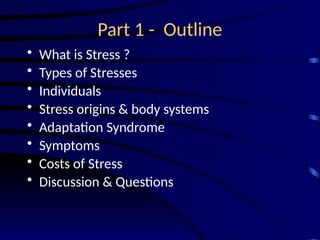
Part 1 -Outline
• What is Stress ?
• Types of Stresses
• Individuals
• Stress origins & body systems
• Adaptation Syndrome
• Symptoms
• Costs of Stress
• Discussion & Questions
5.
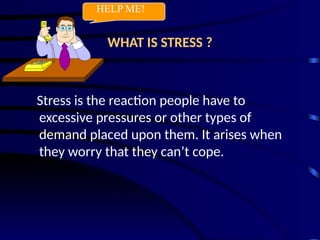
WHAT IS STRESS?
Stress is the reaction people have to
excessive pressures or other types of
demand placed upon them. It arises when
they worry that they can’t cope.
HELP ME!
6.
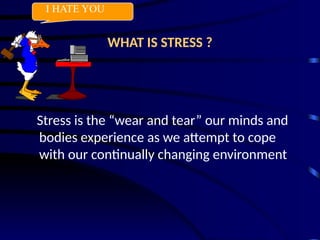
WHAT IS STRESS?
Stress is the “wear and tear” our minds and
bodies experience as we attempt to cope
with our continually changing environment
I HATE YOU
7.
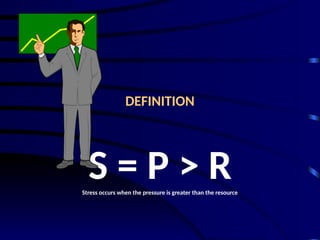
DEFINITION
S = P> R
Stress occurs when the pressure is greater than the resource
NEGATIVE STRESS
It isa contributory factor in minor
conditions, such as headaches, digestive
problems, skin complaints, insomnia and
ulcers.
Excessive, prolonged and unrelieved stress
can have a harmful effect on mental,
physical and spiritual health.
23.
POSITIVE STRESS
Stress canalso have a positive effect,
spurring motivation and awareness,
providing the stimulation to cope with
challenging situations.
Stress also provides the sense of urgency
and alertness needed for survival when
confronting threatening situations.
24.
THE INDIVIDUAL
Everyone isdifferent, with unique
perceptions of, and reactions to, events.
There is no single level of stress that is
optimal for all people. Some are more
sensitive owing to experiences in
childhood, the influence of teachers,
parents and religion etc.
25.
Most of thestress we experience is self-
generated. How we perceive life - whether
an event makes us feel threatened or
stimulated, encouraged or discouraged,
happy or sad - depends to a large extent on
how we perceive ourselves.
26.
Self-generated stress issomething of a
paradox, because so many people think of
external causes when they are upset.
Recognising that we create most of our own
upsets is an important first step towards
coping with them.
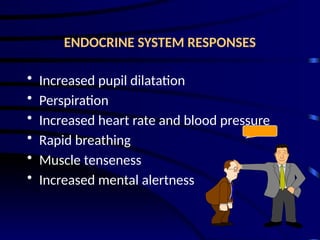
Endocrine System
Stress responsecontrolled by the Endocrine
System.
Demands on the physical or mental systems
of the body result in hormone secretion
(Adrenaline, testosterone)
ALARM RESPONSE
This isthe “ Fight or Flight” response that
prepares the body for immediate action.
32.
ADAPTATION PHASE
If thesource persists, the body prepares for
long-term protection, secreting hormones
to increase blood sugar levels. This phase is
common and not necessarily harmful, but
must include periods of relaxation and rest
to counterbalance the stress response.
Fatigue, concentration lapses, irritability
and lethargy result as the stress turns
negative.
33.
EXHAUSTION
In chronic stresssituations, sufferers enter
the exhaustion phase: emotional, physical
and mental resources suffer heavily, the
body experiences ‘ adrenal exhaustion’
leading to decreased stress tolerance,
progressive mental and physical exhaustion,
illness and collapse.
MENTAL SYMPTOMS
• Lackof concentration
• Memory lapses
• Difficulty in making decisions
• Confusion
• Disorientation
• Panic attacks
37.
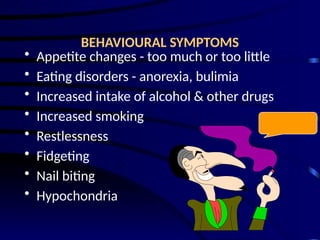
BEHAVIOURAL SYMPTOMS
• Appetitechanges - too much or too little
• Eating disorders - anorexia, bulimia
• Increased intake of alcohol & other drugs
• Increased smoking
• Restlessness
• Fidgeting
• Nail biting
• Hypochondria
38.
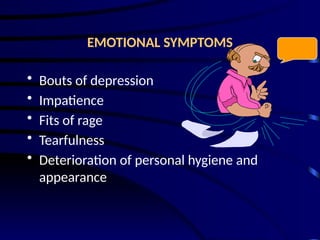
EMOTIONAL SYMPTOMS
• Boutsof depression
• Impatience
• Fits of rage
• Tearfulness
• Deterioration of personal hygiene and
appearance
39.
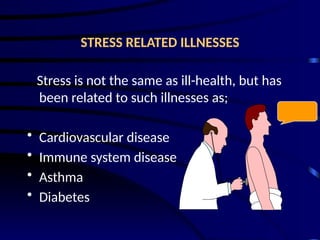
STRESS RELATED ILLNESSES
Stressis not the same as ill-health, but has
been related to such illnesses as;
• Cardiovascular disease
• Immune system disease
• Asthma
• Diabetes
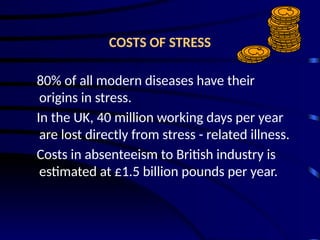
COSTS OF STRESS
80%of all modern diseases have their
origins in stress.
In the UK, 40 million working days per year
are lost directly from stress - related illness.
Costs in absenteeism to British industry is
estimated at £1.5 billion pounds per year.
42.
Summary - Part1
• What is Stress ?
• Types of Stresses
• Individuals
• Stress origins & body systems
• Adaptation Syndrome
• Symptoms
• Costs of Stress
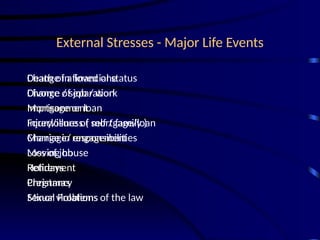
External Stresses -Major Life Events
Death of a loved one
Divorce / separation
Imprisonment
Injury/illness ( self / family )
Marriage/ engagement
Loss of job
Retirement
Pregnancy
Sexual Problems
Change in financial status
Change of job / work
Mortgage or loan
Foreclosure of mortgage/loan
Change in responsibilities
Moving house
Holidays
Christmas
Minor violations of the law
48.
RECOGNISE THE PROBLEM
Themost important point is to recognise
the source of the negative stress.
This is not an admission of weakness or
inability to cope! It is a way to identify the
problem and plan measures to overcome it.
Re-framing
Re-framing is atechnique to change the way
you look at things in order to feel better
about them. There are many ways to
interpret the same situation so pick the one
you like. Re-framing does not change the
external reality, but helps you view things in
a different light and less stressfully.
56.
Positive Thinking
Forget powerlessness,dejection, despair,
failure
Stress leaves us vulnerable to negative
suggestion so focus on positives;
• Focus on your strengths
• Learn from the stress you are under
• Look for opportunities
• Seek out the positive - make a change.
57.
Change your Behaviour
•Be assertive
• Get organised
• Ventilation
• Humour
• Diversion and distraction
58.
Be Assertive
Assertiveness helpsto manage stressful
situations, and will , in time, help to reduce
their frequency.
Lack of assertiveness often shows low self -
esteem and low self - confidence. The key
to assertiveness is verbal and non - verbal
communication. Extending our range of
communication skills will improve our
assertiveness.
59.
Equality and BasicRights
1) The right to express my feelings
2) The right to express opinions / beliefs
3) The right to say ‘Yes/No’ for yourself
4) Right to change your mind
5) Right to say ‘I don’t understand’
6) Right to be yourself, not acting for the
benefit of others
60.
7) The rightto decline responsibility for other
people’s problems
8) The right to make reasonable requests of
others
9) The right to set my own priorities
10) The right to be listened to, and taken
seriously
61.
Being Assertive
Being assertiveinvolves standing up for
your personal rights and expressing your
thoughts, feelings and beliefs directly,
honestly and spontaneously in ways that
don’t infringe the rights of others.
62.
Assertive People
• Respectthemselves and others
• Take responsibility for actions and choices
• Ask openly for what they want
• Disappointed if ‘want’ denied
• Self - confidence remains intact
• Not reliant on the approval of others
63.
Assertive Skills
• Establishgood eye contact / don’t stare
• Stand or sit comfortably - don’t fidget
• Talk in a firm, steady voice
• Use body language
• ‘I think’ / ‘I feel’
• ‘What do you think?’ ‘How do you feel ?’
• Concise and to the point
64.
Benefits
• Higher self-esteem
•Less self-conscious
• Less anxious
• Manage stress more successfully
• Appreciate yourself and others more easily
• Feeling of self-control
65.
Get Organised
Poor organisationis one of the most
common causes of stress. Structured
approaches offer security against ‘out of
the blue’ problems. Prioritising objectives,
duties and activities makes them
manageable and achievable. Don’t overload
your mind. Organisation will help avoid
personal and professional chaos.
66.
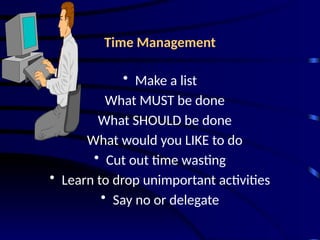
Time Management
• Makea list
What MUST be done
What SHOULD be done
What would you LIKE to do
• Cut out time wasting
• Learn to drop unimportant activities
• Say no or delegate
67.
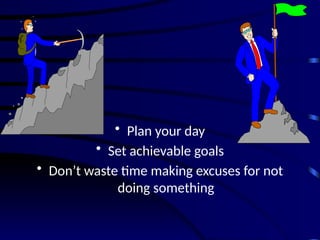
• Plan yourday
• Set achievable goals
• Don’t waste time making excuses for not
doing something
68.
Ventilation
‘A problem sharedis a problem halved’
Develop a support network through friends
or colleagues to talk with. It’s not always
events that are stressful but how we
perceive them.
Writing a diary or notes may help release
feelings but do not re-read what has been
written.
69.
Humour
• Good stress- reducer
• Applies at home and work
• Relieves muscular tension
• Improves breathing
• Pumps endorphins into the bloodstream -
the body’s natural painkillers
70.
Diversion and Distraction
•Take time out
• Get away from things that bother you
• Doesn’t solve the problem
• Reduce stress level
• Calm down
• Think logically
Benefits of Exercise
•Uses up excess energy released by the
‘Fight or Flight’ reaction.
• Improves blood circulation
• Lowers blood pressure
• Clears the mind of worrying thoughts
• Improves self image
• Makes you feel better about yourself
• Increases social contact
75.
Sleep
• Good stressreducer
• Difficult to cope when tired
• Wake refreshed after night’s sleep
• Plenty of daytime energy
76.
Leisure
• Interest
• Givesyou a ‘break’ from stresses
• Provides outlet for relief
• Provides social contact


![[Behav. sci] stress management presentation](https://cdn.slidesharecdn.com/ss_thumbnails/behav-150502143918-conversion-gate02-thumbnail.jpg?width=640&height=640&fit=bounds)
![[Behav. sci] stress management presentation by SIMS Lahore](https://cdn.slidesharecdn.com/ss_thumbnails/lb5ma5dwtf6gr4q4xwyw-signature-413e8c33574c21294a6dc95e37151f54f981375d6b0f4695b85074f597ea60c2-poli-150813085609-lva1-app6891-thumbnail.jpg?width=640&height=640&fit=bounds)


![PPT on Stress Management[1] (1).ppt](https://cdn.slidesharecdn.com/ss_thumbnails/pptonstressmanagement11-231007102152-225f5859-thumbnail.jpg?width=640&height=640&fit=bounds)


