

StressManagement for Adults
Presented by:
Diane Magee, LPC, LCADC, NCC &
Doug Seiden, Ph.D., ACT, BCIA-EEG
March 23, 2016
WHAT IS STRESS?
Stress is a person’s
physical and emotional
response to
Sources of Stress
The Good
Get married
Have children
Buy a new home
Go on vacation
New job
Promotion
The Bad
Break a leg
Spouse loses job
Child gets in
trouble
Lose your wallet
In-laws coming
The Ugly
Nasty car accident
Bankruptcy
Divorce
Illness
Loved one dying
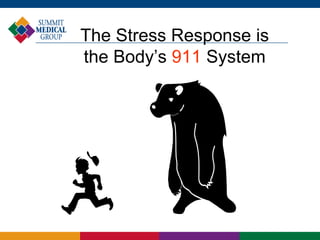
The Stress Response is
the Body’s 911 System
It is a Matter of Perception
 Stress and its associated physical reactions is your body
preparing itself for a threatening situation
 When we perceive Threat we prepare ourselves for action
 Very rarely attacked by Bears so threat is now:
 Social
 Emotional
 Financial
 Work related
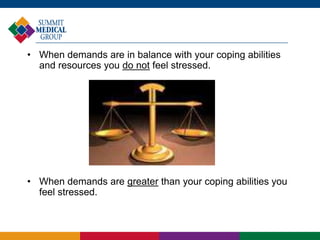
• When demands are in balance with your coping abilities
and resources you do not feel stressed.
• When demands are greater than your coping abilities you
feel stressed.
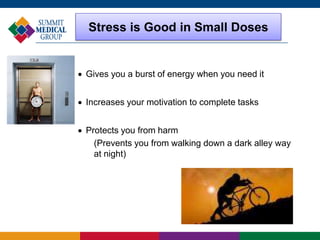
Stress is Good in Small Doses
 Gives you a burst of energy when you need it
 Increases your motivation to complete tasks
 Protects you from harm
(Prevents you from walking down a dark alley way
at night)
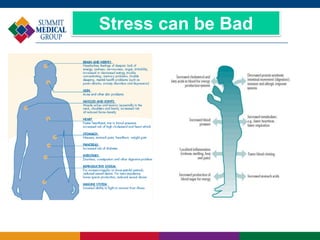
Stress can be Bad
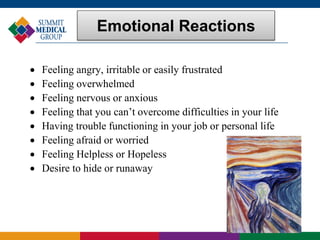
Emotional Reactions
 Feeling angry, irritable or easily frustrated
 Feeling overwhelmed
 Feeling nervous or anxious
 Feeling that you can’t overcome difficulties in your life
 Having trouble functioning in your job or personal life
 Feeling afraid or worried
 Feeling Helpless or Hopeless
 Desire to hide or runaway
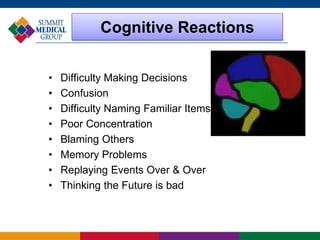
Cognitive Reactions
• Difficulty Making Decisions
• Confusion
• Difficulty Naming Familiar Items
• Poor Concentration
• Blaming Others
• Memory Problems
• Replaying Events Over & Over
• Thinking the Future is bad
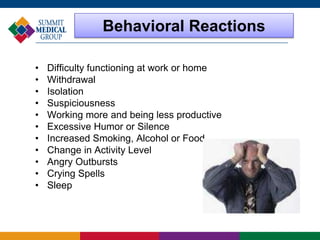
Behavioral Reactions
• Difficulty functioning at work or home
• Withdrawal
• Isolation
• Suspiciousness
• Working more and being less productive
• Excessive Humor or Silence
• Increased Smoking, Alcohol or Food
• Change in Activity Level
• Angry Outbursts
• Crying Spells
• Sleep
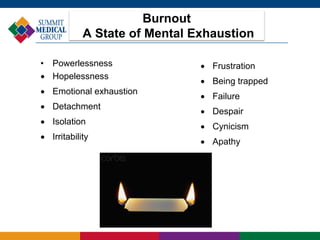
Burnout
A State of Mental Exhaustion
• Powerlessness
 Hopelessness
 Emotional exhaustion
 Detachment
 Isolation
 Irritability
 Frustration
 Being trapped
 Failure
 Despair
 Cynicism
 Apathy
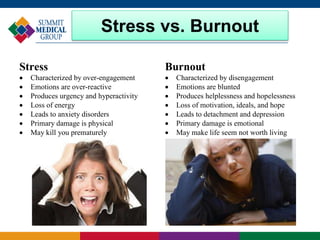
Stress Burnout
 Characterized by over-engagement  Characterized by disengagement
 Emotions are over-reactive  Emotions are blunted
 Produces urgency and hyperactivity  Produces helplessness and hopelessness
 Loss of energy  Loss of motivation, ideals, and hope
 Leads to anxiety disorders  Leads to detachment and depression
 Primary damage is physical  Primary damage is emotional
 May kill you prematurely  May make life seem not worth living
Stress vs. Burnout
So what can we
do about it?
A bunch of things . . .
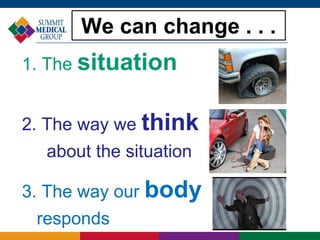
We can change . . .
1. The situation
2. The way we think
about the situation
3. The way our body
responds
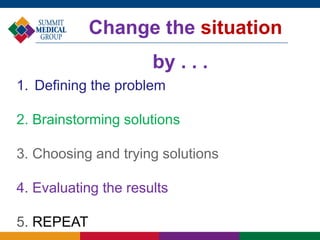
Change the situation
1. Defining the problem
2. Brainstorming solutions
3. Choosing and trying solutions
4. Evaluating the results
5. REPEAT
by . . .
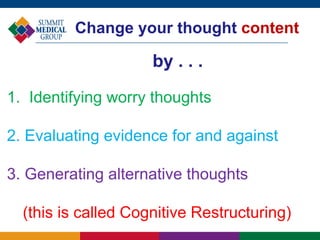
Change your thought content
1. Identifying worry thoughts
2. Evaluating evidence for and against
3. Generating alternative thoughts
(this is called Cognitive Restructuring)
by . . .
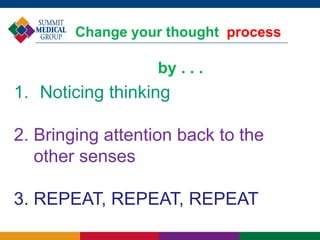
Change your thought process
1. Noticing thinking
2. Bringing attention back to the
other senses
3. REPEAT, REPEAT, REPEAT
by . . .
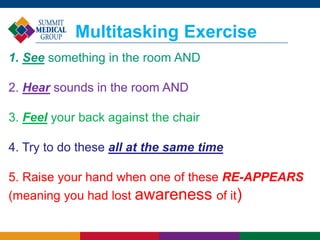
Multitasking Exercise
1. See something in the room AND
2. Hear sounds in the room AND
3. Feel your back against the chair
4. Try to do these all at the same time
5. Raise your hand when one of these RE-APPEARS
(meaning you had lost awareness of it)
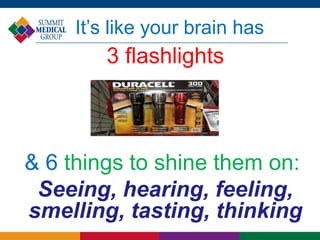
3 flashlights
& 6 things to shine them on:
Seeing, hearing, feeling,
smelling, tasting, thinking
It’s like your brain has
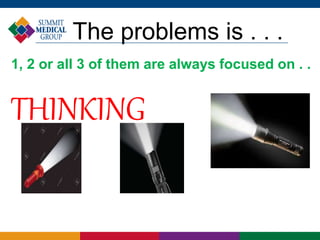
1, 2 or all 3 of them are always focused on . .
THINKING
The problems is . . .
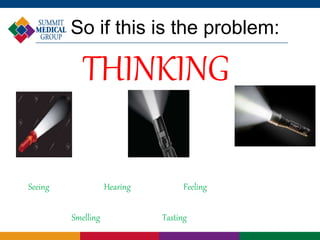
So if this is the problem:
THINKING
Seeing Hearing Feeling
Smelling Tasting
WHAT’S THE SOLUTION?
WHAT SHOULD YOU DO WITH YOUR 3
ATTENTIONAL FLASHLIGHTS?
THAT’S RIGHT!
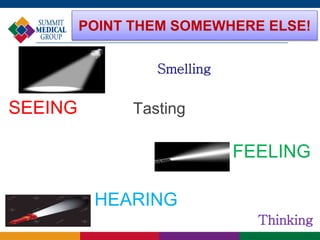
POINT THEM SOMEWHERE ELSE!
Smelling
SEEING Tasting
FEELING
HEARING
Thinking
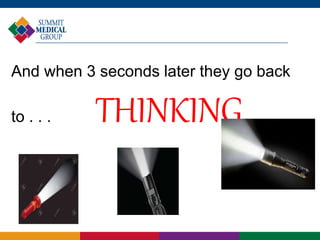
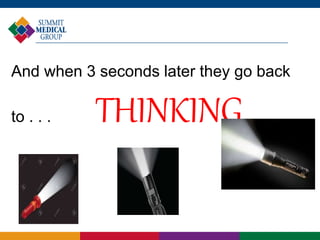
And when 3 seconds later they go back
to . . . THINKING
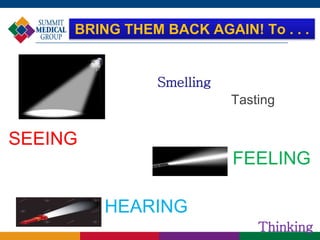
BRING THEM BACK AGAIN! To . . .
Smelling
Tasting
SEEING
FEELING
HEARING
Thinking
And when 3 seconds later they go back
to . . . THINKING
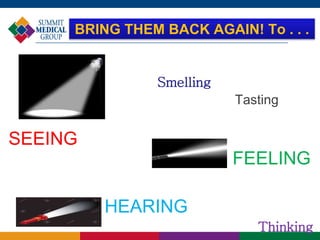
BRING THEM BACK AGAIN! To . . .
Smelling
Tasting
SEEING
FEELING
HEARING
Thinking
THAT’S MINDFULNESS OR
MEDITATION IN ACTIVITY
Meditation and Mindfulness are not:
Keeping the mind still or not thinking
Meditation and Mindfulness are:
Bringing the mind back to it’s focus every
time it starts thinking (which will be OFTEN)
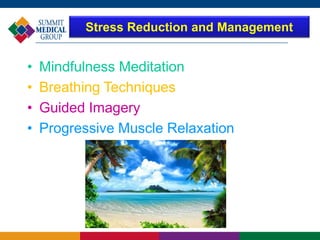
• Mindfulness Meditation
• Breathing Techniques
• Guided Imagery
• Progressive Muscle Relaxation
Stress Reduction and Management
Relaxation Skills
• Breathing Retraining
• Visual Imagery
• Progressive Muscle Relaxation
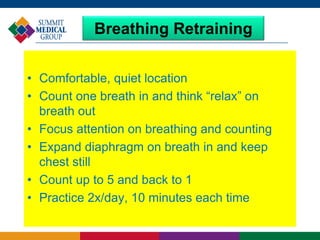
Breathing Retraining
The Calming Response
(Parasympathetic Response)
• Oxygen Consumption Decreases
• Breathing Slows
• Heart Rate Slows
• Blood Pressure Decreases
• Muscle Tension Decreases
• Growing Sense of Ease In Body, Calmness in Mind
Breathing Retraining
• Comfortable, quiet location
• Count one breath in and think “relax” on
breath out
• Focus attention on breathing and counting
• Expand diaphragm on breath in and keep
chest still
• Count up to 5 and back to 1
• Practice 2x/day, 10 minutes each time
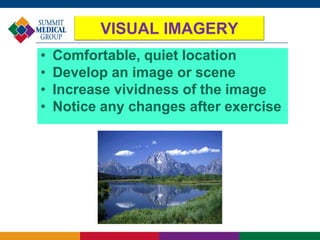
• Comfortable, quiet location
• Develop an image or scene
• Increase vividness of the image
• Notice any changes after exercise
VISUAL IMAGERY
Progressive Muscle
Relaxation
• Comfortable, quiet location
• Loose clothing
• Tense for 5 seconds and relax for 10
seconds the major muscle groups:
Lower legs to upper forehead
• Count from 1 to 5 to deepen relaxation,
breath slowly for 2 minutes, count from 5
to 1 to be more alert
• Practice 2 x’s day
RESOURCES
BOOKS
Cognitive Therapy:
Book: Mind Over Mood: Change How You Feel by Changing the Way You
Think (Greenberger & Padesky)
Mindfulness:
Book: Mindfulness: An Eight-Week Plan for Finding Peace in a Frantic World (Williams,
Penman, Kabat-Zinn)
AUDIOS AND VIDEOS
Mindfulness and Meditation
http://elishagoldstein.com/videos/
http://marc.ucla.edu/body.cfm?id=22
http://health.ucsd.edu/specialties/mindfulness/programs/mbsr/Pages/au
dio.aspx
Progressive Muscle Relaxation and Guided Imagery:
https://www.dartmouth.edu/~healthed/relax/downloads.html
QUESTIONS & ANSWERS

Stress Management for Adults

  • 1.
    StressManagement for Adults Presentedby: Diane Magee, LPC, LCADC, NCC & Doug Seiden, Ph.D., ACT, BCIA-EEG March 23, 2016
  • 2.
    WHAT IS STRESS? Stressis a person’s physical and emotional response to
  • 3.
    Sources of Stress TheGood Get married Have children Buy a new home Go on vacation New job Promotion The Bad Break a leg Spouse loses job Child gets in trouble Lose your wallet In-laws coming The Ugly Nasty car accident Bankruptcy Divorce Illness Loved one dying
  • 5.
    The Stress Responseis the Body’s 911 System
  • 6.
    It is aMatter of Perception  Stress and its associated physical reactions is your body preparing itself for a threatening situation  When we perceive Threat we prepare ourselves for action  Very rarely attacked by Bears so threat is now:  Social  Emotional  Financial  Work related
  • 7.
    • When demandsare in balance with your coping abilities and resources you do not feel stressed. • When demands are greater than your coping abilities you feel stressed.
  • 8.
    Stress is Goodin Small Doses  Gives you a burst of energy when you need it  Increases your motivation to complete tasks  Protects you from harm (Prevents you from walking down a dark alley way at night)
  • 9.
  • 10.
    Emotional Reactions  Feelingangry, irritable or easily frustrated  Feeling overwhelmed  Feeling nervous or anxious  Feeling that you can’t overcome difficulties in your life  Having trouble functioning in your job or personal life  Feeling afraid or worried  Feeling Helpless or Hopeless  Desire to hide or runaway
  • 11.
    Cognitive Reactions • DifficultyMaking Decisions • Confusion • Difficulty Naming Familiar Items • Poor Concentration • Blaming Others • Memory Problems • Replaying Events Over & Over • Thinking the Future is bad
  • 12.
    Behavioral Reactions • Difficultyfunctioning at work or home • Withdrawal • Isolation • Suspiciousness • Working more and being less productive • Excessive Humor or Silence • Increased Smoking, Alcohol or Food • Change in Activity Level • Angry Outbursts • Crying Spells • Sleep
  • 13.
    Burnout A State ofMental Exhaustion • Powerlessness  Hopelessness  Emotional exhaustion  Detachment  Isolation  Irritability  Frustration  Being trapped  Failure  Despair  Cynicism  Apathy
  • 14.
    Stress Burnout  Characterizedby over-engagement  Characterized by disengagement  Emotions are over-reactive  Emotions are blunted  Produces urgency and hyperactivity  Produces helplessness and hopelessness  Loss of energy  Loss of motivation, ideals, and hope  Leads to anxiety disorders  Leads to detachment and depression  Primary damage is physical  Primary damage is emotional  May kill you prematurely  May make life seem not worth living Stress vs. Burnout
  • 15.
    So what canwe do about it? A bunch of things . . .
  • 16.
    We can change. . . 1. The situation 2. The way we think about the situation 3. The way our body responds
  • 17.
    Change the situation 1.Defining the problem 2. Brainstorming solutions 3. Choosing and trying solutions 4. Evaluating the results 5. REPEAT by . . .
  • 18.
    Change your thoughtcontent 1. Identifying worry thoughts 2. Evaluating evidence for and against 3. Generating alternative thoughts (this is called Cognitive Restructuring) by . . .
  • 19.
    Change your thoughtprocess 1. Noticing thinking 2. Bringing attention back to the other senses 3. REPEAT, REPEAT, REPEAT by . . .
  • 20.
    Multitasking Exercise 1. Seesomething in the room AND 2. Hear sounds in the room AND 3. Feel your back against the chair 4. Try to do these all at the same time 5. Raise your hand when one of these RE-APPEARS (meaning you had lost awareness of it)
  • 21.
    3 flashlights & 6things to shine them on: Seeing, hearing, feeling, smelling, tasting, thinking It’s like your brain has
  • 22.
    1, 2 orall 3 of them are always focused on . . THINKING The problems is . . .
  • 23.
    So if thisis the problem: THINKING Seeing Hearing Feeling Smelling Tasting
  • 24.
    WHAT’S THE SOLUTION? WHATSHOULD YOU DO WITH YOUR 3 ATTENTIONAL FLASHLIGHTS?
  • 25.
  • 26.
    POINT THEM SOMEWHEREELSE! Smelling SEEING Tasting FEELING HEARING Thinking
  • 27.
    And when 3seconds later they go back to . . . THINKING
  • 28.
    BRING THEM BACKAGAIN! To . . . Smelling Tasting SEEING FEELING HEARING Thinking
  • 29.
    And when 3seconds later they go back to . . . THINKING
  • 30.
    BRING THEM BACKAGAIN! To . . . Smelling Tasting SEEING FEELING HEARING Thinking
  • 31.
    THAT’S MINDFULNESS OR MEDITATIONIN ACTIVITY Meditation and Mindfulness are not: Keeping the mind still or not thinking Meditation and Mindfulness are: Bringing the mind back to it’s focus every time it starts thinking (which will be OFTEN)
  • 32.
    • Mindfulness Meditation •Breathing Techniques • Guided Imagery • Progressive Muscle Relaxation Stress Reduction and Management
  • 33.
    Relaxation Skills • BreathingRetraining • Visual Imagery • Progressive Muscle Relaxation
  • 34.
    Breathing Retraining The CalmingResponse (Parasympathetic Response) • Oxygen Consumption Decreases • Breathing Slows • Heart Rate Slows • Blood Pressure Decreases • Muscle Tension Decreases • Growing Sense of Ease In Body, Calmness in Mind
  • 35.
    Breathing Retraining • Comfortable,quiet location • Count one breath in and think “relax” on breath out • Focus attention on breathing and counting • Expand diaphragm on breath in and keep chest still • Count up to 5 and back to 1 • Practice 2x/day, 10 minutes each time
  • 36.
    • Comfortable, quietlocation • Develop an image or scene • Increase vividness of the image • Notice any changes after exercise VISUAL IMAGERY
  • 37.
    Progressive Muscle Relaxation • Comfortable,quiet location • Loose clothing • Tense for 5 seconds and relax for 10 seconds the major muscle groups: Lower legs to upper forehead • Count from 1 to 5 to deepen relaxation, breath slowly for 2 minutes, count from 5 to 1 to be more alert • Practice 2 x’s day
  • 38.
    RESOURCES BOOKS Cognitive Therapy: Book: MindOver Mood: Change How You Feel by Changing the Way You Think (Greenberger & Padesky) Mindfulness: Book: Mindfulness: An Eight-Week Plan for Finding Peace in a Frantic World (Williams, Penman, Kabat-Zinn) AUDIOS AND VIDEOS Mindfulness and Meditation http://elishagoldstein.com/videos/ http://marc.ucla.edu/body.cfm?id=22 http://health.ucsd.edu/specialties/mindfulness/programs/mbsr/Pages/au dio.aspx Progressive Muscle Relaxation and Guided Imagery: https://www.dartmouth.edu/~healthed/relax/downloads.html
  • 39.