Stress Management
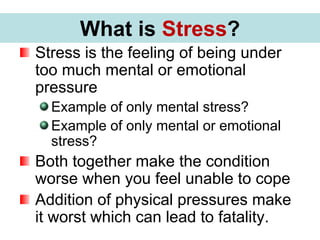
What is Stress?
Stress is the feeling of being under
too much mental or emotional
pressure
Example of only mental stress?
Example of only mental or emotional
stress?
Both together make the condition
worse when you feel unable to cope
Addition of physical pressures make
it worst which can lead to fatality.
What is Stress?
What is Stress?
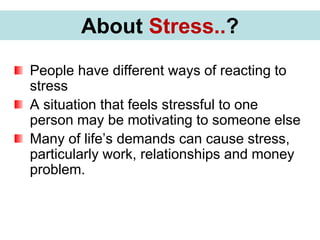
People have different ways of reacting to
stress
A situation that feels stressful to one
person may be motivating to someone else
Many of life’s demands can cause stress,
particularly work, relationships and money
problem.MMany of life’s demands can
cause stress, particularly work, relation
About Stress..?
NEW MARKET SPACE
When you feel stressed, it can get in the way of
how to meet the demands, or can even affect
everything you do.
Stress can affect how you feel, think, behave
and how the body works(palpitation/numbness)
Common signs of stress include sleeping
problems, sweating, loss of appetite and
difficulty concentrating
You may feel anxious, low in self esteem, and
you may have racing thoughts, worry constantly
or go over things in your head.
About Stress..?
You may notice that you lose your temper more
easily, drink more or act unreasonably.
You may also experience headaches, muscle
tension or pain, or dizziness.
Stress causes a surge of hormones in your
body.
Once the pressure or threat has passed, your
stress hormone levels will usually return to
normal.
About Stress..?
NEW MARKET SPACE
Stress is not an illness itself, but it can cause
serious illness if it isn't addressed.
It's important to recognise the symptoms of
stress early
Recognizing the signs and symptoms of stress
will help you figure out ways of coping and save
you from adopting unhealthy coping methods,
such as drinking or smoking
Spotting the early signs of stress will also help
prevent it getting worse and potentially causing
serious complications-like hyper tension
How to manage Stress?
There is little you can do to prevent
stress, but there are many things you
can do to manage stress more
effectively, such as-
Learning how to relax
Taking regular exercise and
Adopting good time-management
techniques.
How to manage Stress..?
• If you've tried self-help techniques and
they aren't working,
• You should go to see your GP. They
may suggest other coping techniques
for you to try or recommend some
form of counselling or cognitive
behavioural therapy (CBT).
When to see your GP about
your stress levels
Cognitive Behavioural
Therapy (CBT)
• CBT is a talking therapy that can help
you manage your problems by changing the
way you think and behave.
• CBT cannot remove your problems, but can
help you manage them in a more positive
way. It encourages you to examine how your
actions can affect how you think and feel.
• Talking and changing your behaviour can
change how you think (cognitive) and what
you do (behaviour). This can make you feel
better about life.
If your stress is causing serious
health problems, such as high blood
pressure, you may need to take
medication or further tests
Mental health issues, including stress,
anxiety and depression, are the
reason for one-in-five visits to a GP.
How to manage Stress..?
There is little you can do to prevent
stress, but there are many things you
can do to manage stress more
effectively, such as-
Learning how to relax
Taking regular exercise and
Adopting good time-management
techniques.
How to manage Stress..?
What is Stress?
If you're not sure what's causing your
stress, keep a diary and make a note of
stressful episodes for two-to-four weeks
Then review it to spot the triggers
Things you might need to write down are:
the date, time and place of a stressful episode
what you were doing
who you were with
how you felt emotionally
what you were thinking
what you started doing
Recognise your stress
triggers
What is Stress?
how you felt physically
take a stress rating (0-10 where 10 is the most
stressed you could ever feel)
You can use the diary to:
work out what triggers your stress
work out how you operate under pressure
develop better coping mechanisms
Doctors sometimes recommend
keeping a stress diary to help them
diagnose stress
PLEASE DO IT AND KEEP BETTER
Recognize your stress
triggers
Crisis Management
What is Stress?
Any event that is expected to lead to an unstable
and dangerous situation affecting individuals,
groups, organizations,community
Crises are deemed to be negative changes,
security, economic, political, public health, or
environmental affairs, especially when they occur
abruptly, with little or no warning.
More loosely, it is a term meaning 'a testing time'
or an 'emergency event'.
Examples:
What is a Crisis?
What is Stress?
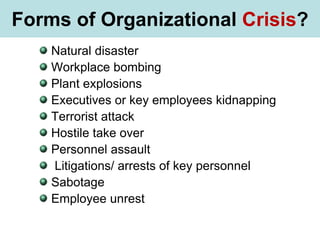
Natural disaster
Workplace bombing
Plant explosions
Executives or key employees kidnapping
Terrorist attack
Hostile take over
Personnel assault
Litigations/ arrests of key personnel
Sabotage
Employee unrest
Forms of Organizational Crisis?
What is Stress?
A crisis Management is systematic
anticipation of and preparation for
events that could damage any
organization
Reputation, profitability or survival
Viewed negatively as “managerial
fire fighting” waiting for things to go
wrong, then scurrying to limit the
damage.
How about Managing Crisis?
What is Stress?
Developing a crisis management
program
Conducting a Crisis Audit
Formulating Contingency Plans
Creating a Crisis Management
Team
Perfecting the program through
Practice
How about Managing Crisis?
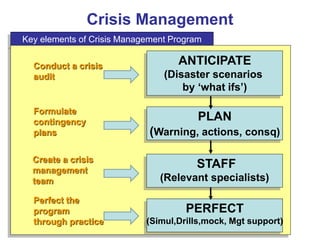
Key elements of Crisis Management Program
Crisis Management
ANTICIPATE
(Disaster scenarios
by ‘what ifs’)
PLAN
(Warning, actions, consq)
STAFF
(Relevant specialists)
PERFECT
(Simul,Drills,mock, Mgt support)
Conduct a crisis
audit
Formulate
contingency
plans
Create a crisis
management
team
Perfect the
program
through practice
THANK YOU FOR
BEING WITH ME
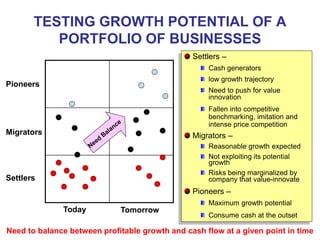
TESTING GROWTH POTENTIAL OF A
PORTFOLIO OF BUSINESSES
Pioneers
Migrators
Settlers
Today Tomorrow
Settlers –
Cash generators
low growth trajectory
Need to push for value
innovation
Fallen into competitive
benchmarking, imitation and
intense price competition
Migrators –
Reasonable growth expected
Not exploiting its potential
growth
Risks being marginalized by
company that value-innovate
Pioneers –
Maximum growth potential
Consume cash at the outset
Need to balance between profitable growth and cash flow at a given point in time
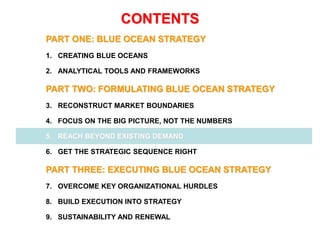
PART ONE: BLUE OCEAN STRATEGY
1. CREATING BLUE OCEANS
2. ANALYTICAL TOOLS AND FRAMEWORKS
PART TWO: FORMULATING BLUE OCEAN STRATEGY
3. RECONSTRUCT MARKET BOUNDARIES
4. FOCUS ON THE BIG PICTURE, NOT THE NUMBERS
5. REACH BEYOND EXISTING DEMAND
6. GET THE STRATEGIC SEQUENCE RIGHT
PART THREE: EXECUTING BLUE OCEAN STRATEGY
7. OVERCOME KEY ORGANIZATIONAL HURDLES
8. BUILD EXECUTION INTO STRATEGY
9. SUSTAINABILITY AND RENEWAL
CONTENTS
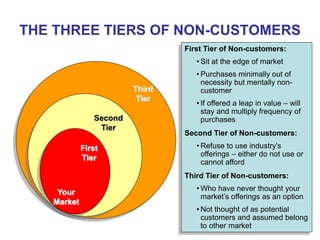
THE THREE TIERS OF NON-CUSTOMERS
Third
Tier
Second
Tier
First
Tier
Your
Market
First Tier of Non-customers:
• Sit at the edge of market
• Purchases minimally out of
necessity but mentally non-
customer
• If offered a leap in value – will
stay and multiply frequency of
purchases
Second Tier of Non-customers:
• Refuse to use industry’s
offerings – either do not use or
cannot afford
Third Tier of Non-customers:
• Who have never thought your
market’s offerings as an option
• Not thought of as potential
customers and assumed belong
to other market
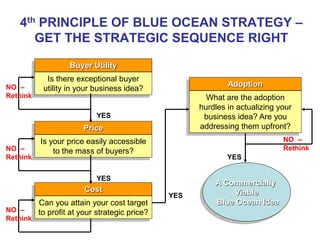
4th PRINCIPLE OF BLUE OCEAN STRATEGY –
GET THE STRATEGIC SEQUENCE RIGHT
Buyer Utility
Is there exceptional buyer
utility in your business idea?
Price
Is your price easily accessible
to the mass of buyers?
Cost
Can you attain your cost target
to profit at your strategic price?
Adoption
What are the adoption
hurdles in actualizing your
business idea? Are you
addressing them upfront?
A Commercially
Viable
Blue Ocean Idea
NO –
Rethink
NO –
Rethink
NO –
Rethink
NO –
Rethink
YES
YES
YES
YES
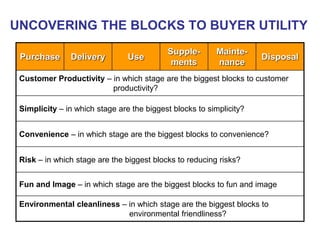
UNCOVERING THE BLOCKS TO BUYER UTILITY
Purchase Delivery Use
Supple-
ments
Mainte-
nance
Disposal
Customer Productivity – in which stage are the biggest blocks to customer
productivity?
Simplicity – in which stage are the biggest blocks to simplicity?
Convenience – in which stage are the biggest blocks to convenience?
Risk – in which stage are the biggest blocks to reducing risks?
Fun and Image – in which stage are the biggest blocks to fun and image
Environmental cleanliness – in which stage are the biggest blocks to
environmental friendliness?
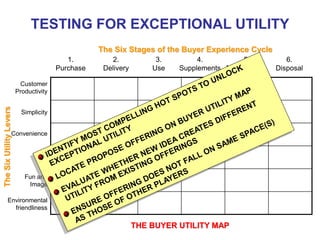
TESTING FOR EXCEPTIONAL UTILITY
1.
Purchase
2.
Delivery
3.
Use
4.
Supplements
5.
Maintenance
6.
Disposal
The Six Stages of the Buyer Experience Cycle
Customer
Productivity
Simplicity
Convenience
Risk
Fun and
Image
Environmental
friendliness
TheSixUtilityLevers
THE BUYER UTILITY MAP
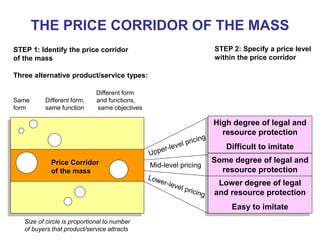
THE PRICE CORRIDOR OF THE MASS
STEP 1: Identify the price corridor
of the mass
Three alternative product/service types:
Different form
Same Different form, and functions,
form same function same objectives
Size of circle is proportional to number
of buyers that product/service attracts
STEP 2: Specify a price level
within the price corridor
High degree of legal and
resource protection
Difficult to imitate
Some degree of legal and
resource protection
Lower degree of legal
and resource protection
Easy to imitate
Mid-level pricingPrice Corridor
of the mass
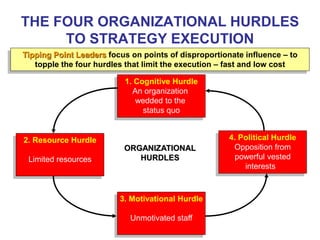
THE FOUR ORGANIZATIONAL HURDLES
TO STRATEGY EXECUTION
1. Cognitive Hurdle
An organization
wedded to the
status quo
2. Resource Hurdle
Limited resources
4. Political Hurdle
Opposition from
powerful vested
interests
3. Motivational Hurdle
Unmotivated staff
Tipping Point Leaders focus on points of disproportionate influence – to
topple the four hurdles that limit the execution – fast and low cost
ORGANIZATIONAL
HURDLES
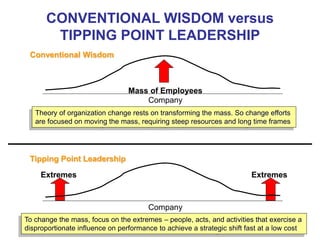
CONVENTIONAL WISDOM versus
TIPPING POINT LEADERSHIP
Company
Mass of Employees
Conventional Wisdom
Company
Extremes Extremes
Tipping Point Leadership
Theory of organization change rests on transforming the mass. So change efforts
are focused on moving the mass, requiring steep resources and long time frames
To change the mass, focus on the extremes – people, acts, and activities that exercise a
disproportionate influence on performance to achieve a strategic shift fast at a low cost
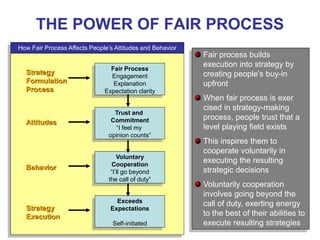
How Fair Process Affects People’s Attitudes and Behavior
THE POWER OF FAIR PROCESS
Fair Process
Engagement
Explanation
Expectation clarity
Trust and
Commitment
“I feel my
opinion counts”
Voluntary
Cooperation
“I’ll go beyond
the call of duty”
Exceeds
Expectations
Self-initiated
Strategy
Formulation
Process
Attitudes
Behavior
Strategy
Execution
Fair process builds
execution into strategy by
creating people’s buy-in
upfront
When fair process is exer
cised in strategy-making
process, people trust that a
level playing field exists
This inspires them to
cooperate voluntarily in
executing the resulting
strategic decisions
Voluntarily cooperation
involves going beyond the
call of duty, exerting energy
to the best of their abilities to
execute resulting strategies
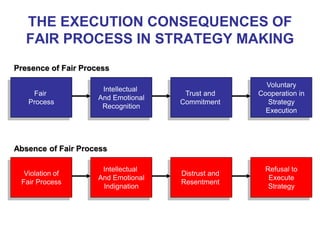
THE EXECUTION CONSEQUENCES OF
FAIR PROCESS IN STRATEGY MAKING
Fair
Process
Intellectual
And Emotional
Recognition
Trust and
Commitment
Voluntary
Cooperation in
Strategy
Execution
Violation of
Fair Process
Intellectual
And Emotional
Indignation
Distrust and
Resentment
Refusal to
Execute
Strategy
Presence of Fair Process
Absence of Fair Process

Stress and crisis management

  • 1.
  • 2.
    What is Stress? Stressis the feeling of being under too much mental or emotional pressure Example of only mental stress? Example of only mental or emotional stress? Both together make the condition worse when you feel unable to cope Addition of physical pressures make it worst which can lead to fatality. What is Stress?
  • 3.
    What is Stress? Peoplehave different ways of reacting to stress A situation that feels stressful to one person may be motivating to someone else Many of life’s demands can cause stress, particularly work, relationships and money problem.MMany of life’s demands can cause stress, particularly work, relation About Stress..?
  • 4.
    NEW MARKET SPACE Whenyou feel stressed, it can get in the way of how to meet the demands, or can even affect everything you do. Stress can affect how you feel, think, behave and how the body works(palpitation/numbness) Common signs of stress include sleeping problems, sweating, loss of appetite and difficulty concentrating You may feel anxious, low in self esteem, and you may have racing thoughts, worry constantly or go over things in your head. About Stress..?
  • 5.
    You may noticethat you lose your temper more easily, drink more or act unreasonably. You may also experience headaches, muscle tension or pain, or dizziness. Stress causes a surge of hormones in your body. Once the pressure or threat has passed, your stress hormone levels will usually return to normal. About Stress..?
  • 6.
    NEW MARKET SPACE Stressis not an illness itself, but it can cause serious illness if it isn't addressed. It's important to recognise the symptoms of stress early Recognizing the signs and symptoms of stress will help you figure out ways of coping and save you from adopting unhealthy coping methods, such as drinking or smoking Spotting the early signs of stress will also help prevent it getting worse and potentially causing serious complications-like hyper tension How to manage Stress?
  • 7.
    There is littleyou can do to prevent stress, but there are many things you can do to manage stress more effectively, such as- Learning how to relax Taking regular exercise and Adopting good time-management techniques. How to manage Stress..?
  • 8.
    • If you'vetried self-help techniques and they aren't working, • You should go to see your GP. They may suggest other coping techniques for you to try or recommend some form of counselling or cognitive behavioural therapy (CBT). When to see your GP about your stress levels
  • 9.
    Cognitive Behavioural Therapy (CBT) •CBT is a talking therapy that can help you manage your problems by changing the way you think and behave. • CBT cannot remove your problems, but can help you manage them in a more positive way. It encourages you to examine how your actions can affect how you think and feel. • Talking and changing your behaviour can change how you think (cognitive) and what you do (behaviour). This can make you feel better about life.
  • 10.
    If your stressis causing serious health problems, such as high blood pressure, you may need to take medication or further tests Mental health issues, including stress, anxiety and depression, are the reason for one-in-five visits to a GP. How to manage Stress..?
  • 11.
    There is littleyou can do to prevent stress, but there are many things you can do to manage stress more effectively, such as- Learning how to relax Taking regular exercise and Adopting good time-management techniques. How to manage Stress..?
  • 12.
    What is Stress? Ifyou're not sure what's causing your stress, keep a diary and make a note of stressful episodes for two-to-four weeks Then review it to spot the triggers Things you might need to write down are: the date, time and place of a stressful episode what you were doing who you were with how you felt emotionally what you were thinking what you started doing Recognise your stress triggers
  • 13.
    What is Stress? howyou felt physically take a stress rating (0-10 where 10 is the most stressed you could ever feel) You can use the diary to: work out what triggers your stress work out how you operate under pressure develop better coping mechanisms Doctors sometimes recommend keeping a stress diary to help them diagnose stress PLEASE DO IT AND KEEP BETTER Recognize your stress triggers
  • 14.
  • 15.
    What is Stress? Anyevent that is expected to lead to an unstable and dangerous situation affecting individuals, groups, organizations,community Crises are deemed to be negative changes, security, economic, political, public health, or environmental affairs, especially when they occur abruptly, with little or no warning. More loosely, it is a term meaning 'a testing time' or an 'emergency event'. Examples: What is a Crisis?
  • 16.
    What is Stress? Naturaldisaster Workplace bombing Plant explosions Executives or key employees kidnapping Terrorist attack Hostile take over Personnel assault Litigations/ arrests of key personnel Sabotage Employee unrest Forms of Organizational Crisis?
  • 17.
    What is Stress? Acrisis Management is systematic anticipation of and preparation for events that could damage any organization Reputation, profitability or survival Viewed negatively as “managerial fire fighting” waiting for things to go wrong, then scurrying to limit the damage. How about Managing Crisis?
  • 18.
    What is Stress? Developinga crisis management program Conducting a Crisis Audit Formulating Contingency Plans Creating a Crisis Management Team Perfecting the program through Practice How about Managing Crisis?
  • 19.
    Key elements ofCrisis Management Program Crisis Management ANTICIPATE (Disaster scenarios by ‘what ifs’) PLAN (Warning, actions, consq) STAFF (Relevant specialists) PERFECT (Simul,Drills,mock, Mgt support) Conduct a crisis audit Formulate contingency plans Create a crisis management team Perfect the program through practice
  • 20.
  • 21.
    TESTING GROWTH POTENTIALOF A PORTFOLIO OF BUSINESSES Pioneers Migrators Settlers Today Tomorrow Settlers – Cash generators low growth trajectory Need to push for value innovation Fallen into competitive benchmarking, imitation and intense price competition Migrators – Reasonable growth expected Not exploiting its potential growth Risks being marginalized by company that value-innovate Pioneers – Maximum growth potential Consume cash at the outset Need to balance between profitable growth and cash flow at a given point in time
  • 22.
    PART ONE: BLUEOCEAN STRATEGY 1. CREATING BLUE OCEANS 2. ANALYTICAL TOOLS AND FRAMEWORKS PART TWO: FORMULATING BLUE OCEAN STRATEGY 3. RECONSTRUCT MARKET BOUNDARIES 4. FOCUS ON THE BIG PICTURE, NOT THE NUMBERS 5. REACH BEYOND EXISTING DEMAND 6. GET THE STRATEGIC SEQUENCE RIGHT PART THREE: EXECUTING BLUE OCEAN STRATEGY 7. OVERCOME KEY ORGANIZATIONAL HURDLES 8. BUILD EXECUTION INTO STRATEGY 9. SUSTAINABILITY AND RENEWAL CONTENTS
  • 23.
    THE THREE TIERSOF NON-CUSTOMERS Third Tier Second Tier First Tier Your Market First Tier of Non-customers: • Sit at the edge of market • Purchases minimally out of necessity but mentally non- customer • If offered a leap in value – will stay and multiply frequency of purchases Second Tier of Non-customers: • Refuse to use industry’s offerings – either do not use or cannot afford Third Tier of Non-customers: • Who have never thought your market’s offerings as an option • Not thought of as potential customers and assumed belong to other market
  • 24.
    4th PRINCIPLE OFBLUE OCEAN STRATEGY – GET THE STRATEGIC SEQUENCE RIGHT Buyer Utility Is there exceptional buyer utility in your business idea? Price Is your price easily accessible to the mass of buyers? Cost Can you attain your cost target to profit at your strategic price? Adoption What are the adoption hurdles in actualizing your business idea? Are you addressing them upfront? A Commercially Viable Blue Ocean Idea NO – Rethink NO – Rethink NO – Rethink NO – Rethink YES YES YES YES
  • 25.
    UNCOVERING THE BLOCKSTO BUYER UTILITY Purchase Delivery Use Supple- ments Mainte- nance Disposal Customer Productivity – in which stage are the biggest blocks to customer productivity? Simplicity – in which stage are the biggest blocks to simplicity? Convenience – in which stage are the biggest blocks to convenience? Risk – in which stage are the biggest blocks to reducing risks? Fun and Image – in which stage are the biggest blocks to fun and image Environmental cleanliness – in which stage are the biggest blocks to environmental friendliness?
  • 26.
    TESTING FOR EXCEPTIONALUTILITY 1. Purchase 2. Delivery 3. Use 4. Supplements 5. Maintenance 6. Disposal The Six Stages of the Buyer Experience Cycle Customer Productivity Simplicity Convenience Risk Fun and Image Environmental friendliness TheSixUtilityLevers THE BUYER UTILITY MAP
  • 27.
    THE PRICE CORRIDOROF THE MASS STEP 1: Identify the price corridor of the mass Three alternative product/service types: Different form Same Different form, and functions, form same function same objectives Size of circle is proportional to number of buyers that product/service attracts STEP 2: Specify a price level within the price corridor High degree of legal and resource protection Difficult to imitate Some degree of legal and resource protection Lower degree of legal and resource protection Easy to imitate Mid-level pricingPrice Corridor of the mass
  • 28.
    THE FOUR ORGANIZATIONALHURDLES TO STRATEGY EXECUTION 1. Cognitive Hurdle An organization wedded to the status quo 2. Resource Hurdle Limited resources 4. Political Hurdle Opposition from powerful vested interests 3. Motivational Hurdle Unmotivated staff Tipping Point Leaders focus on points of disproportionate influence – to topple the four hurdles that limit the execution – fast and low cost ORGANIZATIONAL HURDLES
  • 29.
    CONVENTIONAL WISDOM versus TIPPINGPOINT LEADERSHIP Company Mass of Employees Conventional Wisdom Company Extremes Extremes Tipping Point Leadership Theory of organization change rests on transforming the mass. So change efforts are focused on moving the mass, requiring steep resources and long time frames To change the mass, focus on the extremes – people, acts, and activities that exercise a disproportionate influence on performance to achieve a strategic shift fast at a low cost
  • 30.
    How Fair ProcessAffects People’s Attitudes and Behavior THE POWER OF FAIR PROCESS Fair Process Engagement Explanation Expectation clarity Trust and Commitment “I feel my opinion counts” Voluntary Cooperation “I’ll go beyond the call of duty” Exceeds Expectations Self-initiated Strategy Formulation Process Attitudes Behavior Strategy Execution Fair process builds execution into strategy by creating people’s buy-in upfront When fair process is exer cised in strategy-making process, people trust that a level playing field exists This inspires them to cooperate voluntarily in executing the resulting strategic decisions Voluntarily cooperation involves going beyond the call of duty, exerting energy to the best of their abilities to execute resulting strategies
  • 31.
    THE EXECUTION CONSEQUENCESOF FAIR PROCESS IN STRATEGY MAKING Fair Process Intellectual And Emotional Recognition Trust and Commitment Voluntary Cooperation in Strategy Execution Violation of Fair Process Intellectual And Emotional Indignation Distrust and Resentment Refusal to Execute Strategy Presence of Fair Process Absence of Fair Process