The Major Muscle
Groups
Functionally, focusing on movements over muscles
is often recommended, and rightly so. But don’t fall
into the trap of only focusing on movements and
missing out on the benefits of targeting specific
muscles.
Muscle groups are often referred to based on
whether they are anterior or posterior, which means
the front side and the back side of your body. It is
important to strengthen both your anterior and
posterior muscles to reduce muscle imbalances.
To truly target a muscle, we need to know what the
muscle does…
Anterior Muscles
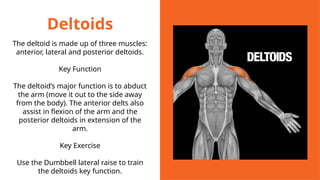
Deltoids
The deltoid is made up of three muscles:
anterior, lateral and posterior deltoids.
Key Function
The deltoid’s major function is to abduct
the arm (move it out to the side away
from the body). The anterior delts also
assist in flexion of the arm and the
posterior deltoids in extension of the
arm.
Key Exercise
Use the Dumbbell lateral raise to train
the deltoids key function.
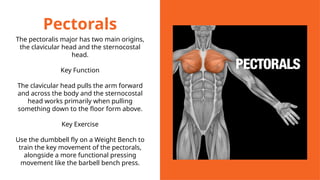
Pectorals
The pectoralis major has two main origins,
the clavicular head and the sternocostal
head.
Key Function
The clavicular head pulls the arm forward
and across the body and the sternocostal
head works primarily when pulling
something down to the floor form above.
Key Exercise
Use the dumbbell fly on a Weight Bench to
train the key movement of the pectorals,
alongside a more functional pressing
movement like the barbell bench press.
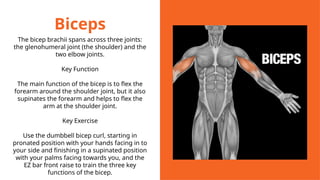
Biceps
The bicep brachii spans across three joints:
the glenohumeral joint (the shoulder) and the
two elbow joints.
Key Function
The main function of the bicep is to flex the
forearm around the shoulder joint, but it also
supinates the forearm and helps to flex the
arm at the shoulder joint.
Key Exercise
Use the dumbbell bicep curl, starting in
pronated position with your hands facing in to
your side and finishing in a supinated position
with your palms facing towards you, and the
EZ bar front raise to train the three key
functions of the bicep.
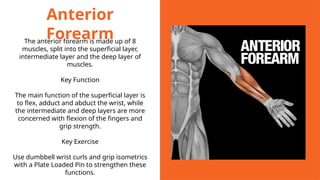
Anterior
Forearm
The anterior forearm is made up of 8
muscles, split into the superficial layer,
intermediate layer and the deep layer of
muscles.
Key Function
The main function of the superficial layer is
to flex, adduct and abduct the wrist, while
the intermediate and deep layers are more
concerned with flexion of the fingers and
grip strength.
Key Exercise
Use dumbbell wrist curls and grip isometrics
with a Plate Loaded Pin to strengthen these
functions.
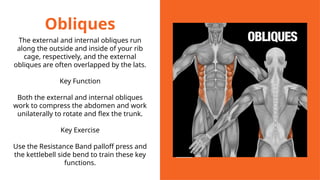
Obliques
The external and internal obliques run
along the outside and inside of your rib
cage, respectively, and the external
obliques are often overlapped by the lats.
Key Function
Both the external and internal obliques
work to compress the abdomen and work
unilaterally to rotate and flex the trunk.
Key Exercise
Use the Resistance Band palloff press and
the kettlebell side bend to train these key
functions.
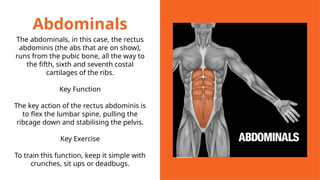
Abdominals
The abdominals, in this case, the rectus
abdominis (the abs that are on show),
runs from the pubic bone, all the way to
the fifth, sixth and seventh costal
cartilages of the ribs.
Key Function
The key action of the rectus abdominis is
to flex the lumbar spine, pulling the
ribcage down and stabilising the pelvis.
Key Exercise
To train this function, keep it simple with
crunches, sit ups or deadbugs.
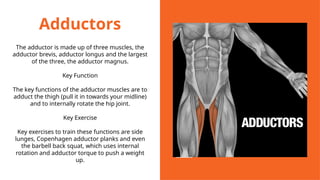
Adductors
The adductor is made up of three muscles, the
adductor brevis, adductor longus and the largest
of the three, the adductor magnus.
Key Function
The key functions of the adductor muscles are to
adduct the thigh (pull it in towards your midline)
and to internally rotate the hip joint.
Key Exercise
Key exercises to train these functions are side
lunges, Copenhagen adductor planks and even
the barbell back squat, which uses internal
rotation and adductor torque to push a weight
up.
Quadriceps
The quadriceps are made up of four
muscles (hence the name): the rectus
femoris, vastus lateralis, vastus medialis
and the vastus intermedius (vasti group).
Key Function
The rectus femoris flexes the thigh at the
hip joint and while the rectus femoris and
the vasti group extend the leg at the knee
joint.
Key Exercise
Use a safety bar step up and seated
straight leg raise to train both these key
functions of the quadriceps.
Posterior Muscles
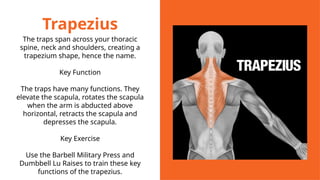
Trapezius
The traps span across your thoracic
spine, neck and shoulders, creating a
trapezium shape, hence the name.
Key Function
The traps have many functions. They
elevate the scapula, rotates the scapula
when the arm is abducted above
horizontal, retracts the scapula and
depresses the scapula.
Key Exercise
Use the Barbell Military Press and
Dumbbell Lu Raises to train these key
functions of the trapezius.
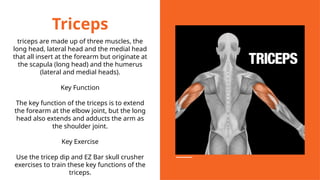
Triceps
triceps are made up of three muscles, the
long head, lateral head and the medial head
that all insert at the forearm but originate at
the scapula (long head) and the humerus
(lateral and medial heads).
Key Function
The key function of the triceps is to extend
the forearm at the elbow joint, but the long
head also extends and adducts the arm as
the shoulder joint.
Key Exercise
Use the tricep dip and EZ Bar skull crusher
exercises to train these key functions of the
triceps.
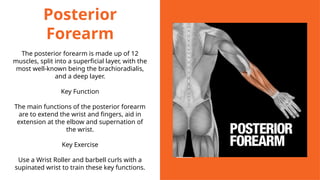
Posterior
Forearm
The posterior forearm is made up of 12
muscles, split into a superficial layer, with the
most well-known being the brachioradialis,
and a deep layer.
Key Function
The main functions of the posterior forearm
are to extend the wrist and fingers, aid in
extension at the elbow and supernation of
the wrist.
Key Exercise
Use a Wrist Roller and barbell curls with a
supinated wrist to train these key functions.
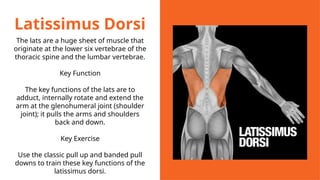
Latissimus Dorsi
The lats are a huge sheet of muscle that
originate at the lower six vertebrae of the
thoracic spine and the lumbar vertebrae.
Key Function
The key functions of the lats are to
adduct, internally rotate and extend the
arm at the glenohumeral joint (shoulder
joint); it pulls the arms and shoulders
back and down.
Key Exercise
Use the classic pull up and banded pull
downs to train these key functions of the
latissimus dorsi.
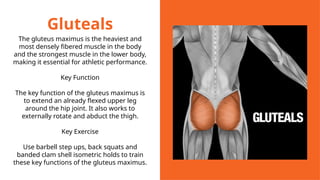
Gluteals
The gluteus maximus is the heaviest and
most densely fibered muscle in the body
and the strongest muscle in the lower body,
making it essential for athletic performance.
Key Function
The key function of the gluteus maximus is
to extend an already flexed upper leg
around the hip joint. It also works to
externally rotate and abduct the thigh.
Key Exercise
Use barbell step ups, back squats and
banded clam shell isometric holds to train
these key functions of the gluteus maximus.
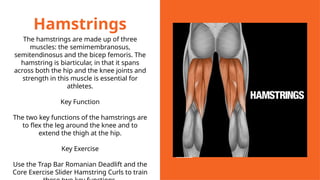
Hamstrings
The hamstrings are made up of three
muscles: the semimembranosus,
semitendinosus and the bicep femoris. The
hamstring is biarticular, in that it spans
across both the hip and the knee joints and
strength in this muscle is essential for
athletes.
Key Function
The two key functions of the hamstrings are
to flex the leg around the knee and to
extend the thigh at the hip.
Key Exercise
Use the Trap Bar Romanian Deadlift and the
Core Exercise Slider Hamstring Curls to train
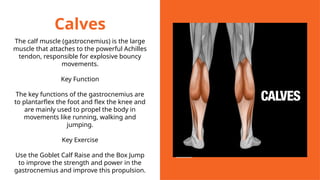
Calves
The calf muscle (gastrocnemius) is the large
muscle that attaches to the powerful Achilles
tendon, responsible for explosive bouncy
movements.
Key Function
The key functions of the gastrocnemius are
to plantarflex the foot and flex the knee and
are mainly used to propel the body in
movements like running, walking and
jumping.
Key Exercise
Use the Goblet Calf Raise and the Box Jump
to improve the strength and power in the
gastrocnemius and improve this propulsion.

The Major Muscle Groups Explained in Detail

  • 1.
  • 2.
    Functionally, focusing onmovements over muscles is often recommended, and rightly so. But don’t fall into the trap of only focusing on movements and missing out on the benefits of targeting specific muscles. Muscle groups are often referred to based on whether they are anterior or posterior, which means the front side and the back side of your body. It is important to strengthen both your anterior and posterior muscles to reduce muscle imbalances. To truly target a muscle, we need to know what the muscle does…
  • 3.
  • 4.
    Deltoids The deltoid ismade up of three muscles: anterior, lateral and posterior deltoids. Key Function The deltoid’s major function is to abduct the arm (move it out to the side away from the body). The anterior delts also assist in flexion of the arm and the posterior deltoids in extension of the arm. Key Exercise Use the Dumbbell lateral raise to train the deltoids key function.
  • 5.
    Pectorals The pectoralis majorhas two main origins, the clavicular head and the sternocostal head. Key Function The clavicular head pulls the arm forward and across the body and the sternocostal head works primarily when pulling something down to the floor form above. Key Exercise Use the dumbbell fly on a Weight Bench to train the key movement of the pectorals, alongside a more functional pressing movement like the barbell bench press.
  • 6.
    Biceps The bicep brachiispans across three joints: the glenohumeral joint (the shoulder) and the two elbow joints. Key Function The main function of the bicep is to flex the forearm around the shoulder joint, but it also supinates the forearm and helps to flex the arm at the shoulder joint. Key Exercise Use the dumbbell bicep curl, starting in pronated position with your hands facing in to your side and finishing in a supinated position with your palms facing towards you, and the EZ bar front raise to train the three key functions of the bicep.
  • 7.
    Anterior Forearm The anterior forearmis made up of 8 muscles, split into the superficial layer, intermediate layer and the deep layer of muscles. Key Function The main function of the superficial layer is to flex, adduct and abduct the wrist, while the intermediate and deep layers are more concerned with flexion of the fingers and grip strength. Key Exercise Use dumbbell wrist curls and grip isometrics with a Plate Loaded Pin to strengthen these functions.
  • 8.
    Obliques The external andinternal obliques run along the outside and inside of your rib cage, respectively, and the external obliques are often overlapped by the lats. Key Function Both the external and internal obliques work to compress the abdomen and work unilaterally to rotate and flex the trunk. Key Exercise Use the Resistance Band palloff press and the kettlebell side bend to train these key functions.
  • 9.
    Abdominals The abdominals, inthis case, the rectus abdominis (the abs that are on show), runs from the pubic bone, all the way to the fifth, sixth and seventh costal cartilages of the ribs. Key Function The key action of the rectus abdominis is to flex the lumbar spine, pulling the ribcage down and stabilising the pelvis. Key Exercise To train this function, keep it simple with crunches, sit ups or deadbugs.
  • 10.
    Adductors The adductor ismade up of three muscles, the adductor brevis, adductor longus and the largest of the three, the adductor magnus. Key Function The key functions of the adductor muscles are to adduct the thigh (pull it in towards your midline) and to internally rotate the hip joint. Key Exercise Key exercises to train these functions are side lunges, Copenhagen adductor planks and even the barbell back squat, which uses internal rotation and adductor torque to push a weight up.
  • 11.
    Quadriceps The quadriceps aremade up of four muscles (hence the name): the rectus femoris, vastus lateralis, vastus medialis and the vastus intermedius (vasti group). Key Function The rectus femoris flexes the thigh at the hip joint and while the rectus femoris and the vasti group extend the leg at the knee joint. Key Exercise Use a safety bar step up and seated straight leg raise to train both these key functions of the quadriceps.
  • 12.
  • 13.
    Trapezius The traps spanacross your thoracic spine, neck and shoulders, creating a trapezium shape, hence the name. Key Function The traps have many functions. They elevate the scapula, rotates the scapula when the arm is abducted above horizontal, retracts the scapula and depresses the scapula. Key Exercise Use the Barbell Military Press and Dumbbell Lu Raises to train these key functions of the trapezius.
  • 14.
    Triceps triceps are madeup of three muscles, the long head, lateral head and the medial head that all insert at the forearm but originate at the scapula (long head) and the humerus (lateral and medial heads). Key Function The key function of the triceps is to extend the forearm at the elbow joint, but the long head also extends and adducts the arm as the shoulder joint. Key Exercise Use the tricep dip and EZ Bar skull crusher exercises to train these key functions of the triceps.
  • 15.
    Posterior Forearm The posterior forearmis made up of 12 muscles, split into a superficial layer, with the most well-known being the brachioradialis, and a deep layer. Key Function The main functions of the posterior forearm are to extend the wrist and fingers, aid in extension at the elbow and supernation of the wrist. Key Exercise Use a Wrist Roller and barbell curls with a supinated wrist to train these key functions.
  • 16.
    Latissimus Dorsi The latsare a huge sheet of muscle that originate at the lower six vertebrae of the thoracic spine and the lumbar vertebrae. Key Function The key functions of the lats are to adduct, internally rotate and extend the arm at the glenohumeral joint (shoulder joint); it pulls the arms and shoulders back and down. Key Exercise Use the classic pull up and banded pull downs to train these key functions of the latissimus dorsi.
  • 17.
    Gluteals The gluteus maximusis the heaviest and most densely fibered muscle in the body and the strongest muscle in the lower body, making it essential for athletic performance. Key Function The key function of the gluteus maximus is to extend an already flexed upper leg around the hip joint. It also works to externally rotate and abduct the thigh. Key Exercise Use barbell step ups, back squats and banded clam shell isometric holds to train these key functions of the gluteus maximus.
  • 18.
    Hamstrings The hamstrings aremade up of three muscles: the semimembranosus, semitendinosus and the bicep femoris. The hamstring is biarticular, in that it spans across both the hip and the knee joints and strength in this muscle is essential for athletes. Key Function The two key functions of the hamstrings are to flex the leg around the knee and to extend the thigh at the hip. Key Exercise Use the Trap Bar Romanian Deadlift and the Core Exercise Slider Hamstring Curls to train
  • 19.
    Calves The calf muscle(gastrocnemius) is the large muscle that attaches to the powerful Achilles tendon, responsible for explosive bouncy movements. Key Function The key functions of the gastrocnemius are to plantarflex the foot and flex the knee and are mainly used to propel the body in movements like running, walking and jumping. Key Exercise Use the Goblet Calf Raise and the Box Jump to improve the strength and power in the gastrocnemius and improve this propulsion.