BIOME- is large, relatively distinct
terrestrial region hat has similar climate,
soil, plants, and animals regardless of
where it occurs.
LANDSCAPE- is a large land area
covering many square kilometers
composed of interacting ecosystems.
Major Factors in Classifying Biomes
• Temperature
• Precipitation
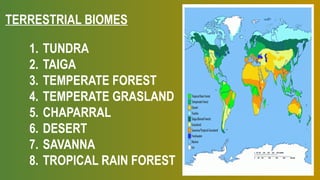
TERRESTRIAL BIOMES
1. TUNDRA
2. TAIGA
3. TEMPERATE FOREST
4. TEMPERATE GRASLAND
5. CHAPARRAL
6. DESERT
7. SAVANNA
8. TROPICAL RAIN FOREST
TUNDRA
• Also called arctic tundra
• Occur in extreme northern latitudes
wherever snow melts seasonally.
• Has long, harsh winters and extremely short
summer.
• There is little precipitation (10-25 cm per
year).
• Tundra soils tend to be geologically young
(nutrient poor and have little organic litter.
• Permafrost- a layer of permanently frozen
ground.
• Abundant with insects.
• There are no reptiles or amphibians.
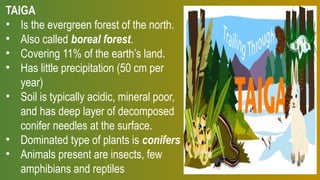
TAIGA
• Is the evergreen forest of the north.
• Also called boreal forest.
• Covering 11% of the earth’s land.
• Has little precipitation (50 cm per
year)
• Soil is typically acidic, mineral poor,
and has deep layer of decomposed
conifer needles at the surface.
• Dominated type of plants is conifers
• Animals present are insects, few
amphibians and reptiles
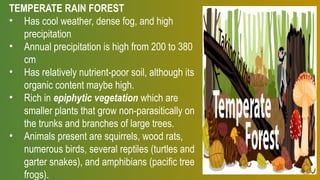
TEMPERATE RAIN FOREST
• Has cool weather, dense fog, and high
precipitation
• Annual precipitation is high from 200 to 380
cm
• Has relatively nutrient-poor soil, although its
organic content maybe high.
• Rich in epiphytic vegetation which are
smaller plants that grow non-parasitically on
the trunks and branches of large trees.
• Animals present are squirrels, wood rats,
numerous birds, several reptiles (turtles and
garter snakes), and amphibians (pacific tree
frogs).
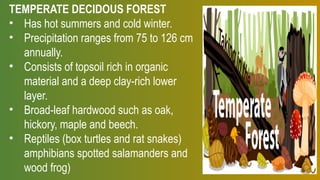
TEMPERATE DECIDOUS FOREST
• Has hot summers and cold winter.
• Precipitation ranges from 75 to 126 cm
annually.
• Consists of topsoil rich in organic
material and a deep clay-rich lower
layer.
• Broad-leaf hardwood such as oak,
hickory, maple and beech.
• Reptiles (box turtles and rat snakes)
amphibians spotted salamanders and
wood frog)
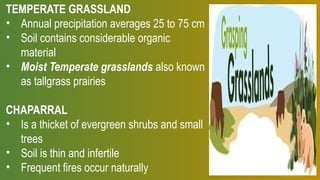
TEMPERATE GRASSLAND
• Annual precipitation averages 25 to 75 cm
• Soil contains considerable organic
material
• Moist Temperate grasslands also known
as tallgrass prairies
CHAPARRAL
• Is a thicket of evergreen shrubs and small
trees
• Soil is thin and infertile
• Frequent fires occur naturally
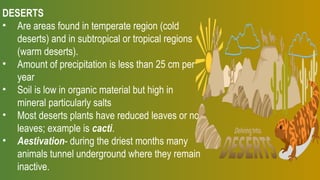
DESERTS
• Are areas found in temperate region (cold
deserts) and in subtropical or tropical regions
(warm deserts).
• Amount of precipitation is less than 25 cm per
year
• Soil is low in organic material but high in
mineral particularly salts
• Most deserts plants have reduced leaves or no
leaves; example is cacti.
• Aestivation- during the driest months many
animals tunnel underground where they remain
inactive.
Spread of Deserts
• About 35% of the earth’s land
surface is currently classified as
arid or semi-arid.
• Every year this area is increased by
about 210,000 sq.km,
predominantly by human activities.
SAVANNA
• Areas of relatively low or seasonal
rainfall with prolonged dry periods.
• Annual precipitation is 85 to 150 cm
• Low in essential minerals in soil
because it is strongly leached.
• Desertification- the conversion of
marginal savanna into desert. A
progressive process that reduces
the productivity of the land,
decreasing its ability to support
crops or livestock.
TROPICAL FORESTS
• Has two types: tropical dry forests or
tropical rainforests
 Tropical Dry Forests- occur in
regions subjected to a wet season
and a dry season, with annual
precipitation of 150 to 200 cm.
 Tropical Rainforests- have annual
precipitation of 200 to 450 cm. Most
trees in tropical rainforests are
evergreen flowering plants.
AQUATIC ECOSYSTEMS
• Are classified primarily on abiotic factors, such
as salinity that help determine an aquatic life
zone’s boundaries.
 3 Main Ecological Categories of Organisms
 Plankton- small or microscopic
organisms that are feeble swimmers.
Subdivided into two major categories:
phytoplankton (photosynthetic
cyanobacteria and free-floating algae),
and zooplankton (nonphotosynthetic
organisms such as protozoa, tiny
cructaceans and the larval stages of
animals.
 Nekton- are larger, strong swimming organisms such
as fishes, turtles and whales.
 Benthos- are bottom-dwelling organisms that fix
themselves to one spot (sponges, oyster, and
barnacles), those that borrow into the sand (many
worms and echinoderms), or simply walk or swim
about on the bottom (crayfish, and brittle stars).
 Freshwater Ecosystem- Although
occupying a small portion (about 2%) of
the earth’s surface, and is important in
the hydrologic cycle.
 Streams and Rivers- the nature of
flowing-water ecosystem changes
its source to its mouth.
• Headwater streams- are
usually shallow, clear, cold,
swiftly flowing and highly
oxygenated.
• Rivers- wider and deep and
contain suspended particulates,
and less oxygenated.
 Lakes and Ponds- are standing-water ecosystems.
Large lakes has three basic zones: Littoral Zone (a
shallow water area along the shore of a lake or pond;
Limnetic Zone (open water beyond the littoral zone,
away from the zone); and Profundal Zone (beneath
the limnetic zone of a large lake).
 Freshwater Wetlands- are transitional between
aquatic and terrestrial ecosystems. It covers about 6%
of the Earth’s surface and are shrinking rapidly.
 Estuaries- is a coastal body of water partly surrounded
by land with access to open ocean and large supply of
freshwater from rivers. It occurs when fresh water and
salt water meet.
 Salt marshes- a shallow wetlands in which salt-
tolerant grasses dominates.
 Mangrove Forests- tropical equivalent of salt
marshes, and covers about 70% of tropical and
subtropical coastal mud flats where tidal waves
fluctuate.
MARINE ECOSYSTEMS
Subdivided into several zones: intertidal zone, the benthic (ocean floor)
environment, and the pelagic (ocean water) environment.
• Intertidal Zone- is the shoreline area between low and high tide.
• Benthic Environment- is the ocean floor, and divided into zones
which one is the abyssal zone.
 Seagrasses- are flowering plants that have adapted to
complete submersion in ocean water.
 Kelps- reaches a length of 60 m are the largest
brown algae.
 Coral reefs- are built from accumulated layers of
calcium carbonate (CaCO3) are found in warm
(usually higher than 21 degrees celsius).
Zooxanthellae, a coral animals require light for a
large number of symbiotic dinoflagellates that live
and photosynthesize in their tissues.
• Neritic province- is open ocean that overlies the
continental shelves, the ocean floor from the shoreline to
the depth of 200 m. Euphotic zone which extends from the
surface to a depth of about 100 m.
• Oceanic Province- is that part of the ocean that covers the
deep ocean basin that is the ocean floor at depths more
than 200m. Most of this portion of the ocean depend on
marine snow, organic debris that drifts down into the
aphotic (without light) region from the upper lighted
regions.
• Ecotones- the transition zone where two communities
or biomes meet and intergrade.
1. It is large, relatively distinct terrestrial region hat has
similar climate, soil, plants, and animals regardless of
where it occurs.
2. It is a layer of permanently frozen ground.
3. It has cool weather, dense fog, and high precipitation
ranging from 200 to 380 cm.
4. It has hot summers and cold winter with a precipitation
ranges from 75 to 126 cm annually.
5. It occur in regions subjected to a wet season and a dry
season, with annual precipitation of 150 to 200 cm.
6. These are built from accumulated layers of calcium
carbonate (CaCO3) are found in warm (usually higher than 21
degrees celsius).
7. It is the shoreline area between low and high tide.
8. An aquatic ecosystem are transitional between aquatic and
terrestrial ecosystems.
9. These small or microscopic organisms that are feeble
swimmers.
10. It is that part of the ocean that covers the deep ocean
basin that is the ocean floor at depths more than 200m.

BIOMES.pptxBIOMES.pptxBIOMES.pptxBIOMESs

  • 3.
    BIOME- is large,relatively distinct terrestrial region hat has similar climate, soil, plants, and animals regardless of where it occurs. LANDSCAPE- is a large land area covering many square kilometers composed of interacting ecosystems. Major Factors in Classifying Biomes • Temperature • Precipitation
  • 4.
    TERRESTRIAL BIOMES 1. TUNDRA 2.TAIGA 3. TEMPERATE FOREST 4. TEMPERATE GRASLAND 5. CHAPARRAL 6. DESERT 7. SAVANNA 8. TROPICAL RAIN FOREST
  • 5.
    TUNDRA • Also calledarctic tundra • Occur in extreme northern latitudes wherever snow melts seasonally. • Has long, harsh winters and extremely short summer. • There is little precipitation (10-25 cm per year). • Tundra soils tend to be geologically young (nutrient poor and have little organic litter. • Permafrost- a layer of permanently frozen ground. • Abundant with insects. • There are no reptiles or amphibians.
  • 6.
    TAIGA • Is theevergreen forest of the north. • Also called boreal forest. • Covering 11% of the earth’s land. • Has little precipitation (50 cm per year) • Soil is typically acidic, mineral poor, and has deep layer of decomposed conifer needles at the surface. • Dominated type of plants is conifers • Animals present are insects, few amphibians and reptiles
  • 7.
    TEMPERATE RAIN FOREST •Has cool weather, dense fog, and high precipitation • Annual precipitation is high from 200 to 380 cm • Has relatively nutrient-poor soil, although its organic content maybe high. • Rich in epiphytic vegetation which are smaller plants that grow non-parasitically on the trunks and branches of large trees. • Animals present are squirrels, wood rats, numerous birds, several reptiles (turtles and garter snakes), and amphibians (pacific tree frogs).
  • 8.
    TEMPERATE DECIDOUS FOREST •Has hot summers and cold winter. • Precipitation ranges from 75 to 126 cm annually. • Consists of topsoil rich in organic material and a deep clay-rich lower layer. • Broad-leaf hardwood such as oak, hickory, maple and beech. • Reptiles (box turtles and rat snakes) amphibians spotted salamanders and wood frog)
  • 9.
    TEMPERATE GRASSLAND • Annualprecipitation averages 25 to 75 cm • Soil contains considerable organic material • Moist Temperate grasslands also known as tallgrass prairies CHAPARRAL • Is a thicket of evergreen shrubs and small trees • Soil is thin and infertile • Frequent fires occur naturally
  • 10.
    DESERTS • Are areasfound in temperate region (cold deserts) and in subtropical or tropical regions (warm deserts). • Amount of precipitation is less than 25 cm per year • Soil is low in organic material but high in mineral particularly salts • Most deserts plants have reduced leaves or no leaves; example is cacti. • Aestivation- during the driest months many animals tunnel underground where they remain inactive.
  • 11.
    Spread of Deserts •About 35% of the earth’s land surface is currently classified as arid or semi-arid. • Every year this area is increased by about 210,000 sq.km, predominantly by human activities.
  • 12.
    SAVANNA • Areas ofrelatively low or seasonal rainfall with prolonged dry periods. • Annual precipitation is 85 to 150 cm • Low in essential minerals in soil because it is strongly leached. • Desertification- the conversion of marginal savanna into desert. A progressive process that reduces the productivity of the land, decreasing its ability to support crops or livestock.
  • 13.
    TROPICAL FORESTS • Hastwo types: tropical dry forests or tropical rainforests  Tropical Dry Forests- occur in regions subjected to a wet season and a dry season, with annual precipitation of 150 to 200 cm.  Tropical Rainforests- have annual precipitation of 200 to 450 cm. Most trees in tropical rainforests are evergreen flowering plants.
  • 14.
    AQUATIC ECOSYSTEMS • Areclassified primarily on abiotic factors, such as salinity that help determine an aquatic life zone’s boundaries.  3 Main Ecological Categories of Organisms  Plankton- small or microscopic organisms that are feeble swimmers. Subdivided into two major categories: phytoplankton (photosynthetic cyanobacteria and free-floating algae), and zooplankton (nonphotosynthetic organisms such as protozoa, tiny cructaceans and the larval stages of animals.
  • 15.
     Nekton- arelarger, strong swimming organisms such as fishes, turtles and whales.  Benthos- are bottom-dwelling organisms that fix themselves to one spot (sponges, oyster, and barnacles), those that borrow into the sand (many worms and echinoderms), or simply walk or swim about on the bottom (crayfish, and brittle stars).
  • 16.
     Freshwater Ecosystem-Although occupying a small portion (about 2%) of the earth’s surface, and is important in the hydrologic cycle.  Streams and Rivers- the nature of flowing-water ecosystem changes its source to its mouth. • Headwater streams- are usually shallow, clear, cold, swiftly flowing and highly oxygenated. • Rivers- wider and deep and contain suspended particulates, and less oxygenated.
  • 17.
     Lakes andPonds- are standing-water ecosystems. Large lakes has three basic zones: Littoral Zone (a shallow water area along the shore of a lake or pond; Limnetic Zone (open water beyond the littoral zone, away from the zone); and Profundal Zone (beneath the limnetic zone of a large lake).  Freshwater Wetlands- are transitional between aquatic and terrestrial ecosystems. It covers about 6% of the Earth’s surface and are shrinking rapidly.
  • 18.
     Estuaries- isa coastal body of water partly surrounded by land with access to open ocean and large supply of freshwater from rivers. It occurs when fresh water and salt water meet.  Salt marshes- a shallow wetlands in which salt- tolerant grasses dominates.  Mangrove Forests- tropical equivalent of salt marshes, and covers about 70% of tropical and subtropical coastal mud flats where tidal waves fluctuate.
  • 19.
    MARINE ECOSYSTEMS Subdivided intoseveral zones: intertidal zone, the benthic (ocean floor) environment, and the pelagic (ocean water) environment. • Intertidal Zone- is the shoreline area between low and high tide. • Benthic Environment- is the ocean floor, and divided into zones which one is the abyssal zone.  Seagrasses- are flowering plants that have adapted to complete submersion in ocean water.
  • 20.
     Kelps- reachesa length of 60 m are the largest brown algae.  Coral reefs- are built from accumulated layers of calcium carbonate (CaCO3) are found in warm (usually higher than 21 degrees celsius). Zooxanthellae, a coral animals require light for a large number of symbiotic dinoflagellates that live and photosynthesize in their tissues.
  • 21.
    • Neritic province-is open ocean that overlies the continental shelves, the ocean floor from the shoreline to the depth of 200 m. Euphotic zone which extends from the surface to a depth of about 100 m. • Oceanic Province- is that part of the ocean that covers the deep ocean basin that is the ocean floor at depths more than 200m. Most of this portion of the ocean depend on marine snow, organic debris that drifts down into the aphotic (without light) region from the upper lighted regions.
  • 22.
    • Ecotones- thetransition zone where two communities or biomes meet and intergrade.
  • 23.
    1. It islarge, relatively distinct terrestrial region hat has similar climate, soil, plants, and animals regardless of where it occurs. 2. It is a layer of permanently frozen ground. 3. It has cool weather, dense fog, and high precipitation ranging from 200 to 380 cm. 4. It has hot summers and cold winter with a precipitation ranges from 75 to 126 cm annually. 5. It occur in regions subjected to a wet season and a dry season, with annual precipitation of 150 to 200 cm.
  • 24.
    6. These arebuilt from accumulated layers of calcium carbonate (CaCO3) are found in warm (usually higher than 21 degrees celsius). 7. It is the shoreline area between low and high tide. 8. An aquatic ecosystem are transitional between aquatic and terrestrial ecosystems. 9. These small or microscopic organisms that are feeble swimmers. 10. It is that part of the ocean that covers the deep ocean basin that is the ocean floor at depths more than 200m.

Editor's Notes

  • #23 Biome Permafrost Temperate rain forests Temperate deciduous forests Tropical dry forests
  • #24 6. Coral reefs 7. Intertidal zone 8. Freshwater Wetlands 9. Plankton 10. Oceanic Province