
EMPLOYEE STATE INSURANCE SCHEME
Abhipsa Mishra
Corporate coach, Content developer & Columnist
• The ESI Scheme is an integrated measure of
Social Insurance come to the life through the
Employees' State Insurance Act – 1948, and is
designed to complete the task of protecting
‘Employees' as defined in the ESI Act – 1948,
against the hazards of sickness, maternity,
disablement or death due to employment injury
and to provide full medical care to insured
persons and their families.
Applicability
 Under Section 2(12) The Act is applicable to the factories employing 10
(Ten) or more persons irrespective of whether power is used in the
process of manufacturing or not.
 Under Section 1(5) of the Act, the Scheme has been extended to
shops, hotels, restaurants, cinemas including preview theatre, road
motor transport undertakings and newspaper establishment employing
20 (Twenty) or more persons.
 Further, u/s 1(5) of the Act, the Scheme has been extended to Private
Medical Institution and Educational Institutions employing 20 (Twenty)
or more persons in certain States .
 The existing wage-limit for coverage under the Act, is Rs.15,000/- per
month (excluding remuneration for overtime) w. e. f:- May 01, 2010.
 AREAS COVERED
The ESI Act is applicable across the length and breadth of the India.
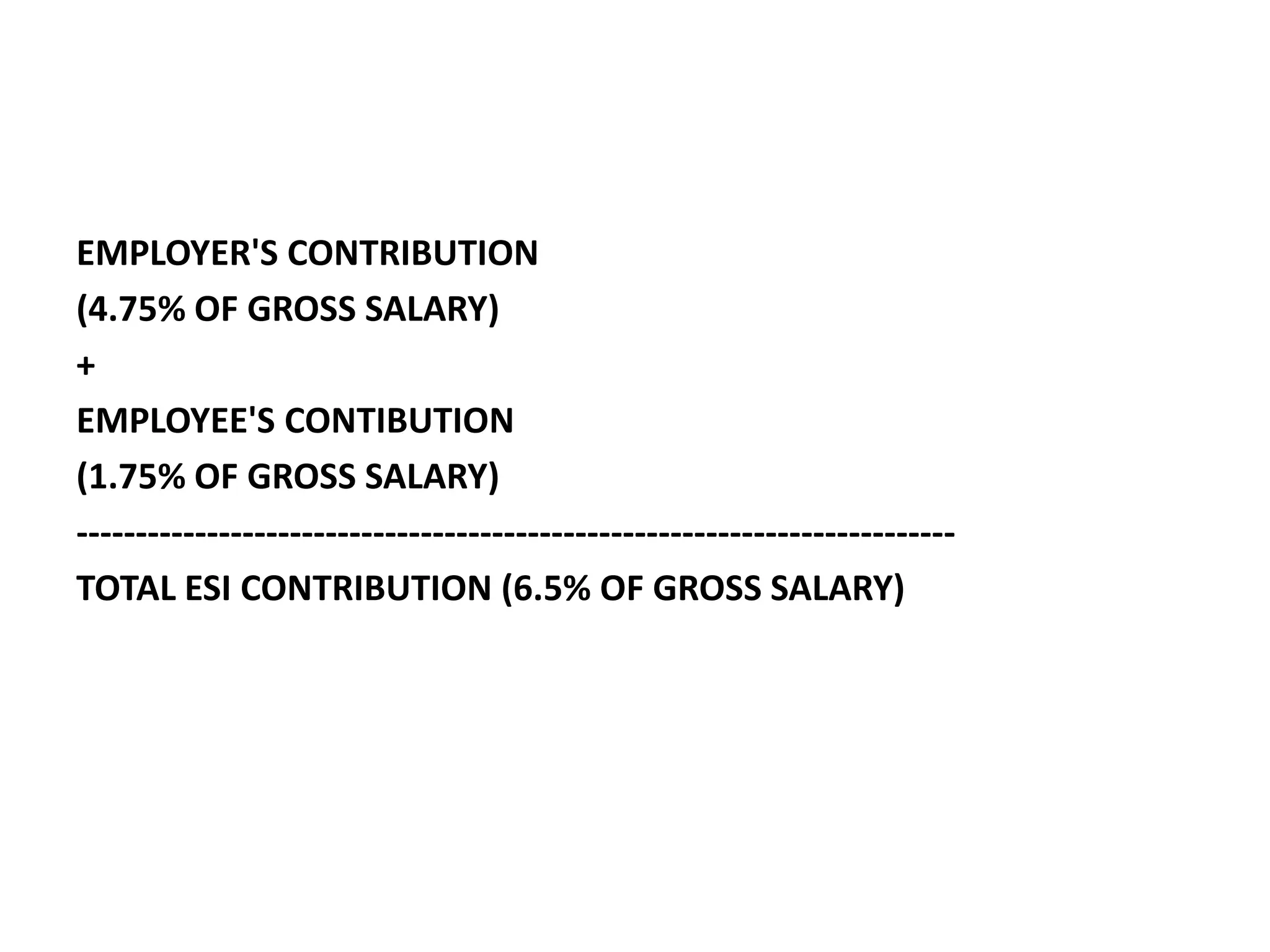
EMPLOYER'S CONTRIBUTION
(4.75% OF GROSS SALARY)
+
EMPLOYEE'S CONTIBUTION
(1.75% OF GROSS SALARY)
--------------------------------------------------------------------------
TOTAL ESI CONTRIBUTION (6.5% OF GROSS SALARY)
Employee Role & Responsibility
• What should we do as an employer?
abhipsa.misra@yahoo.co.uk
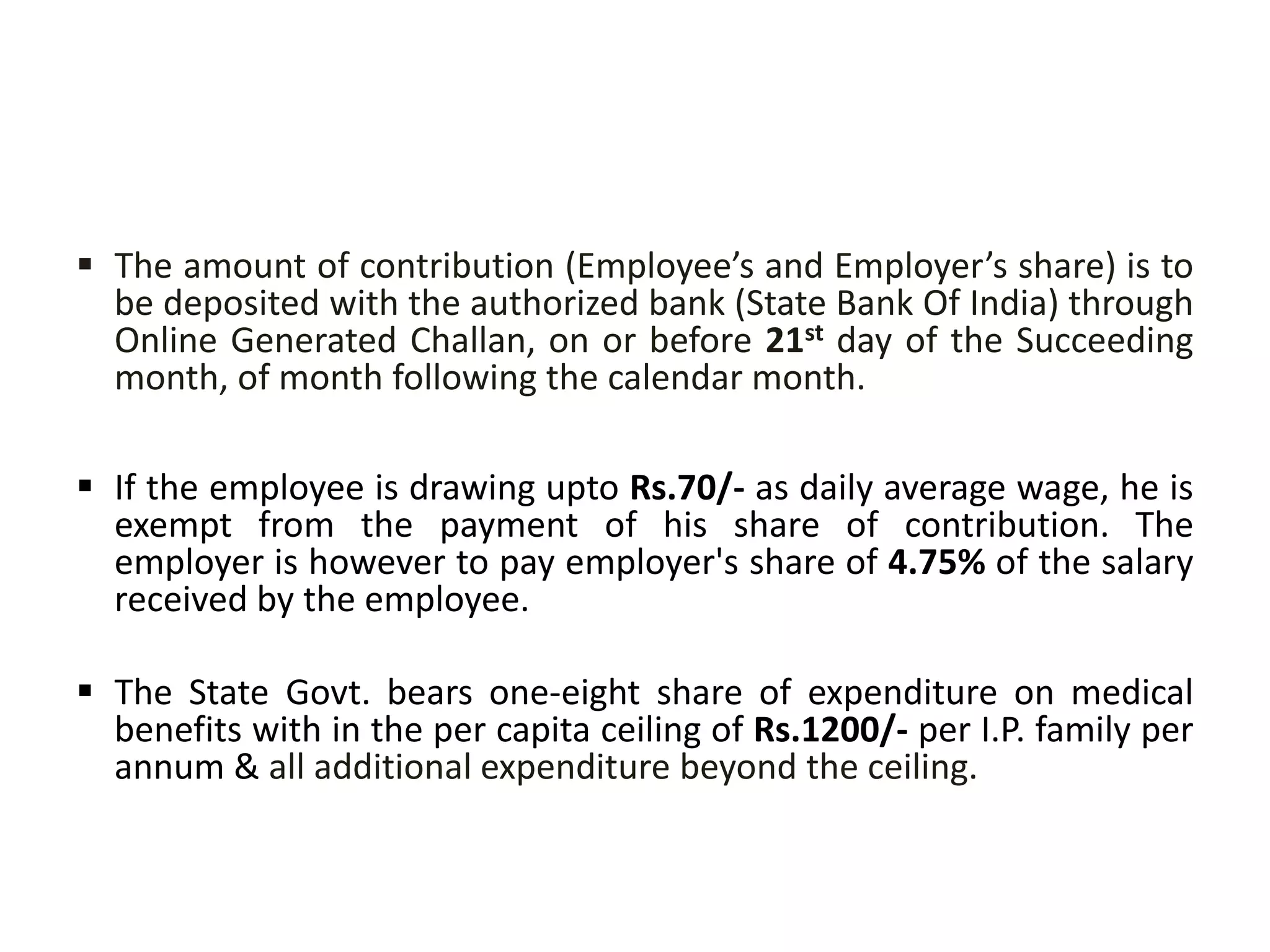
 The amount of contribution (Employee’s and Employer’s share) is to
be deposited with the authorized bank (State Bank Of India) through
Online Generated Challan, on or before 21st day of the Succeeding
month, of month following the calendar month.
 If the employee is drawing upto Rs.70/- as daily average wage, he is
exempt from the payment of his share of contribution. The
employer is however to pay employer's share of 4.75% of the salary
received by the employee.
 The State Govt. bears one-eight share of expenditure on medical
benefits with in the per capita ceiling of Rs.1200/- per I.P. family per
annum & all additional expenditure beyond the ceiling.
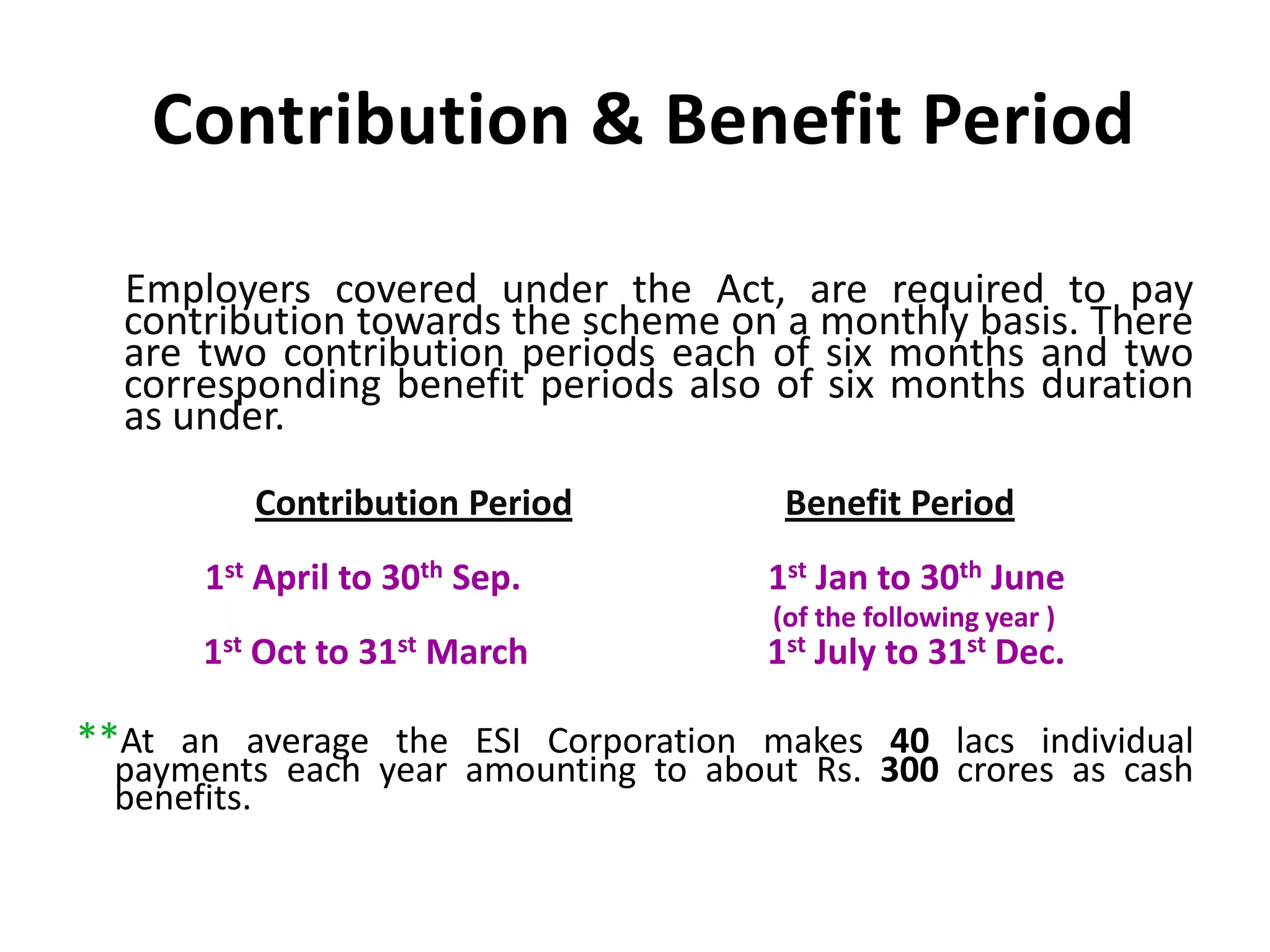
Contribution & Benefit Period
Employers covered under the Act, are required to pay
contribution towards the scheme on a monthly basis. There
are two contribution periods each of six months and two
corresponding benefit periods also of six months duration
as under.
Contribution Period Benefit Period
1st April to 30th Sep. 1st Jan to 30th June
(of the following year )
1st Oct to 31st March 1st July to 31st Dec.
**At an average the ESI Corporation makes 40 lacs individual
payments each year amounting to about Rs. 300 crores as cash
benefits.
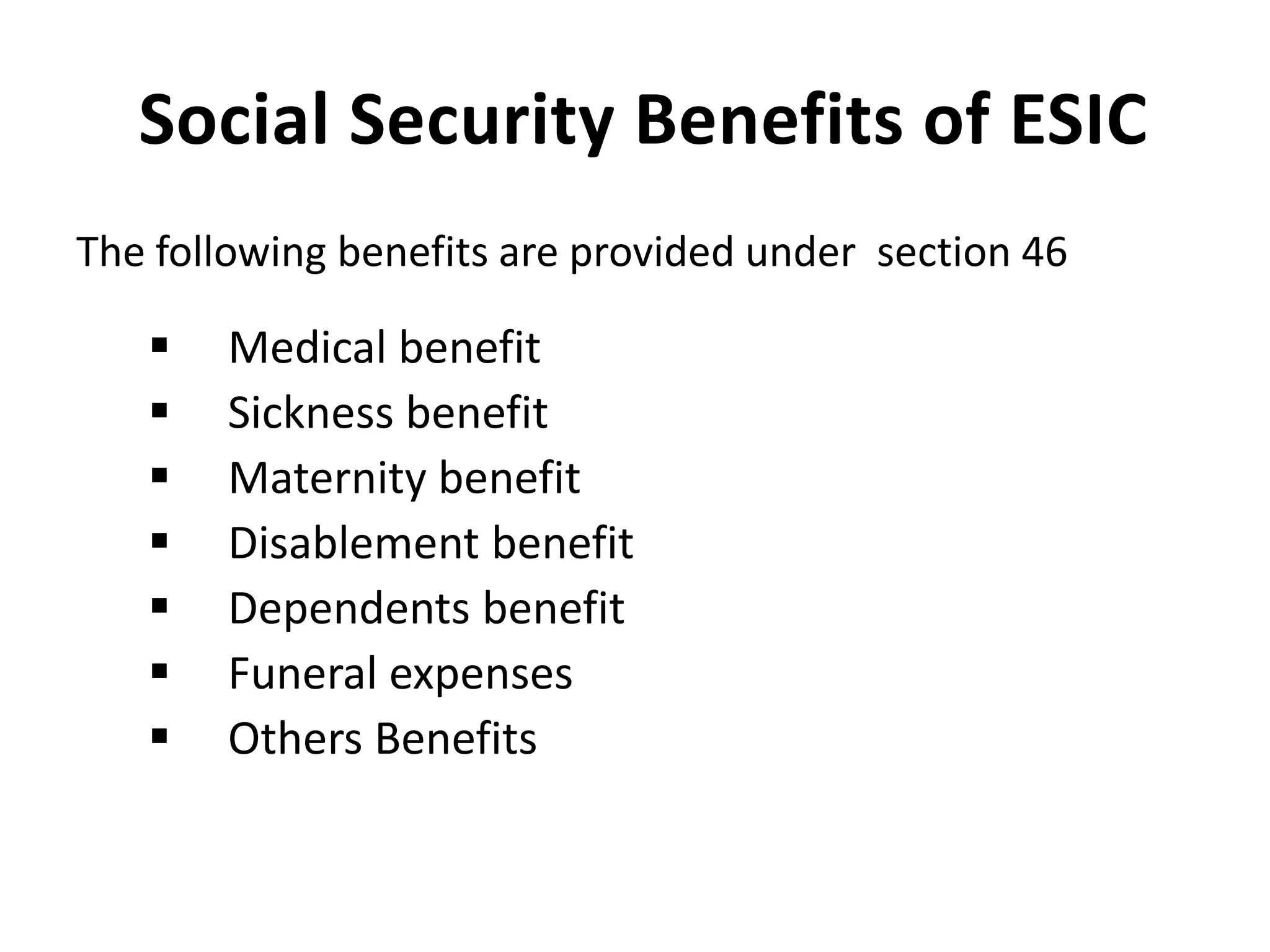
Social Security Benefits of ESIC
The following benefits are provided under section 46
 Medical benefit
 Sickness benefit
 Maternity benefit
 Disablement benefit
 Dependents benefit
 Funeral expenses
 Others Benefits

ESIS

  • 1.
    EMPLOYEE STATE INSURANCESCHEME Abhipsa Mishra Corporate coach, Content developer & Columnist
  • 2.
    • The ESIScheme is an integrated measure of Social Insurance come to the life through the Employees' State Insurance Act – 1948, and is designed to complete the task of protecting ‘Employees' as defined in the ESI Act – 1948, against the hazards of sickness, maternity, disablement or death due to employment injury and to provide full medical care to insured persons and their families.
  • 3.
    Applicability  Under Section2(12) The Act is applicable to the factories employing 10 (Ten) or more persons irrespective of whether power is used in the process of manufacturing or not.  Under Section 1(5) of the Act, the Scheme has been extended to shops, hotels, restaurants, cinemas including preview theatre, road motor transport undertakings and newspaper establishment employing 20 (Twenty) or more persons.  Further, u/s 1(5) of the Act, the Scheme has been extended to Private Medical Institution and Educational Institutions employing 20 (Twenty) or more persons in certain States .  The existing wage-limit for coverage under the Act, is Rs.15,000/- per month (excluding remuneration for overtime) w. e. f:- May 01, 2010.  AREAS COVERED The ESI Act is applicable across the length and breadth of the India.
  • 4.
    EMPLOYER'S CONTRIBUTION (4.75% OFGROSS SALARY) + EMPLOYEE'S CONTIBUTION (1.75% OF GROSS SALARY) -------------------------------------------------------------------------- TOTAL ESI CONTRIBUTION (6.5% OF GROSS SALARY)
  • 5.
    Employee Role &Responsibility • What should we do as an employer? abhipsa.misra@yahoo.co.uk
  • 6.
     The amountof contribution (Employee’s and Employer’s share) is to be deposited with the authorized bank (State Bank Of India) through Online Generated Challan, on or before 21st day of the Succeeding month, of month following the calendar month.  If the employee is drawing upto Rs.70/- as daily average wage, he is exempt from the payment of his share of contribution. The employer is however to pay employer's share of 4.75% of the salary received by the employee.  The State Govt. bears one-eight share of expenditure on medical benefits with in the per capita ceiling of Rs.1200/- per I.P. family per annum & all additional expenditure beyond the ceiling.
  • 7.
    Contribution & BenefitPeriod Employers covered under the Act, are required to pay contribution towards the scheme on a monthly basis. There are two contribution periods each of six months and two corresponding benefit periods also of six months duration as under. Contribution Period Benefit Period 1st April to 30th Sep. 1st Jan to 30th June (of the following year ) 1st Oct to 31st March 1st July to 31st Dec. **At an average the ESI Corporation makes 40 lacs individual payments each year amounting to about Rs. 300 crores as cash benefits.
  • 8.
    Social Security Benefitsof ESIC The following benefits are provided under section 46  Medical benefit  Sickness benefit  Maternity benefit  Disablement benefit  Dependents benefit  Funeral expenses  Others Benefits