Hierarchy of Strategies
Ideas for TODAY and TOMORROW
Topics
 Meaning of Strategy & Strategic Management
 Importance of Strategy
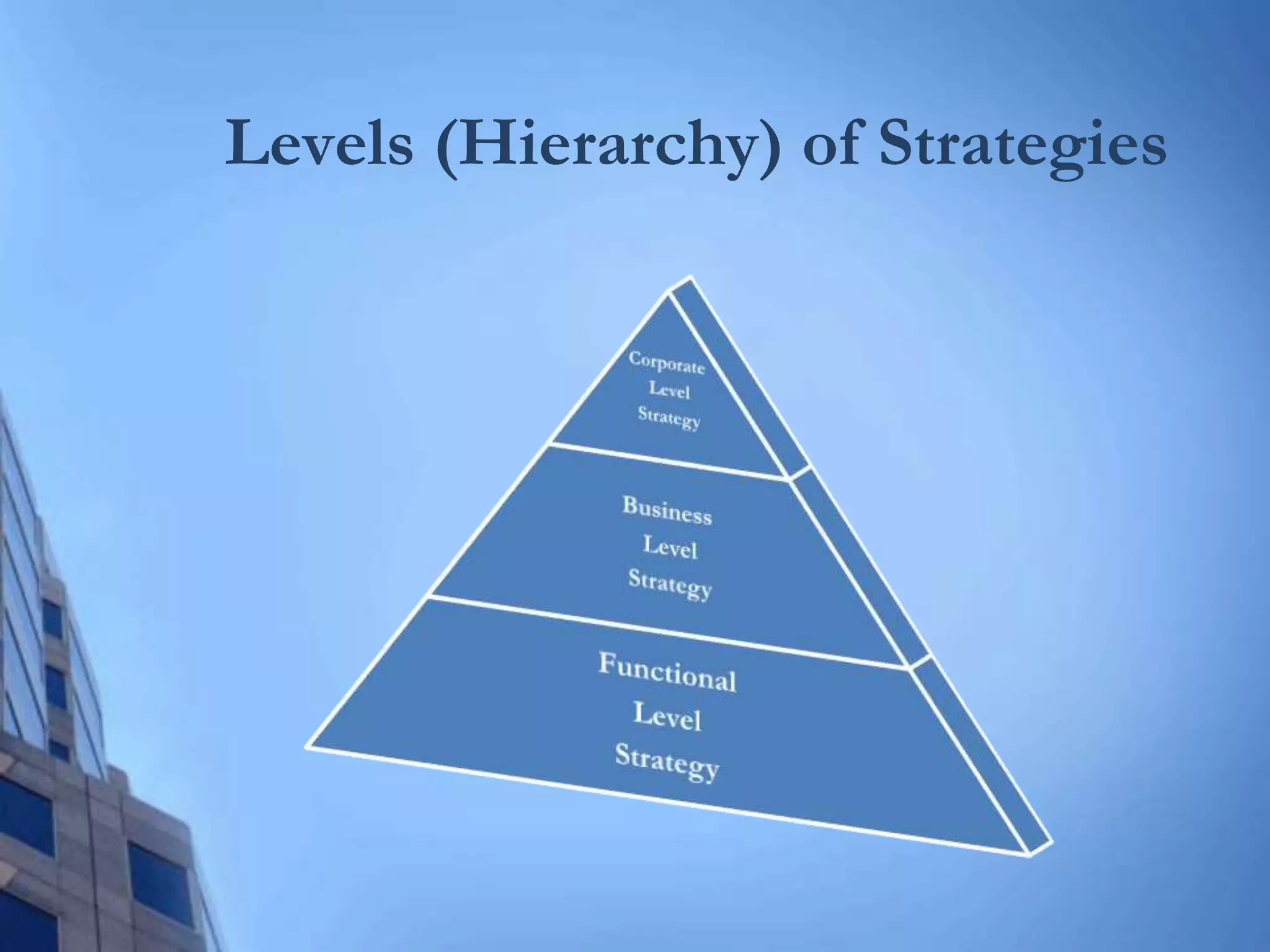
 Levels (Hierarchy) of Strategies
 Corporate Level Strategy
 Business Level Strategy
 Functional Level Strategy
Strategy & Strategic Management
 Strategy is a comprehensive master plan stating HOW the
corporation will achieve its mission and objective.
 Strategic management is the continuous planning,
monitoring, analysis and assessment of all that is necessary
for an organization to meet its goals and objectives.
Importance of Strategy
 Strategic Management seeks to co-ordinate & integrate the
activities of the various functional areas of a business in
order to achieve long-term organizational objectives.
 The initial task in strategic management is typically the
compilation & dissemination of the vision & the mission
statement. This outlines, in essence, the purpose of an
organization.
Importance of Strategy (continued…)
 Strategies are usually derived by the top executives of
the company & presented to the Board of Directors in
order to ensure they are in line with expectations of the
stakeholders.
 The implications of the selected strategy are highly
important.
 All strategic planning deals with atleast 1 of 3 questions
:
a) Where are we now..???
b) Where do we want to go..???
c) How do we get there..???
Levels (Hierarchy) of Strategies
Corporate Level Strategy
 A corporate level strategy involves all the strategic decisions
that are taken by the top executives of the company that
affects the whole organization or company.
 A Balance Scorecard approach
 Grand Strategies :
a) Growth/Expansion Strategy (Internal & External)
b) Stability (it is pause or no change strategy)
c) Retrenchment (Regrouping through cost & asset reduction to
reverse declining sales & profit)
d) Combination Strategy (it is the strategy where more than 1 grand
strategy is used)
Business Level Strategy
 Business level strategy is an integrated and co-ordinated
set of commitments & actions the firm uses to gain a
competitive advantage by exploiting core competencies
in specific product markets.
 The purpose of this strategy is :
a) to create differences between position of a firm & its
competitors
b) firm must make a deliberate choice to :
▬ perform activities differently
▬ perform different activities
Business Level Strategy (continued…)
 Competitive Strategy
a) Differentiation strategy (Approach under which a
firm aims to develop & market unique products for
different customer segments)
b) Low cost strategy (It describes a way to establish the
competitive advantage)
c) Focus strategy (It is usually employed where the
company knows its segment & has products to
competitively satisfy its needs)
Functional Level Strategy
 The functional level of the organization is the level of
operating divisions & departments.
 Functional level strategies in Marketing, Finance,
Human Resources, Operations and Research &
Development involve the development & co-ordination
of resources through which business unit level strategies
can be executed efficiently & effectively.
 Strategies for each functions in the organization are as
follows :
Functional Level Strategy (continued…)
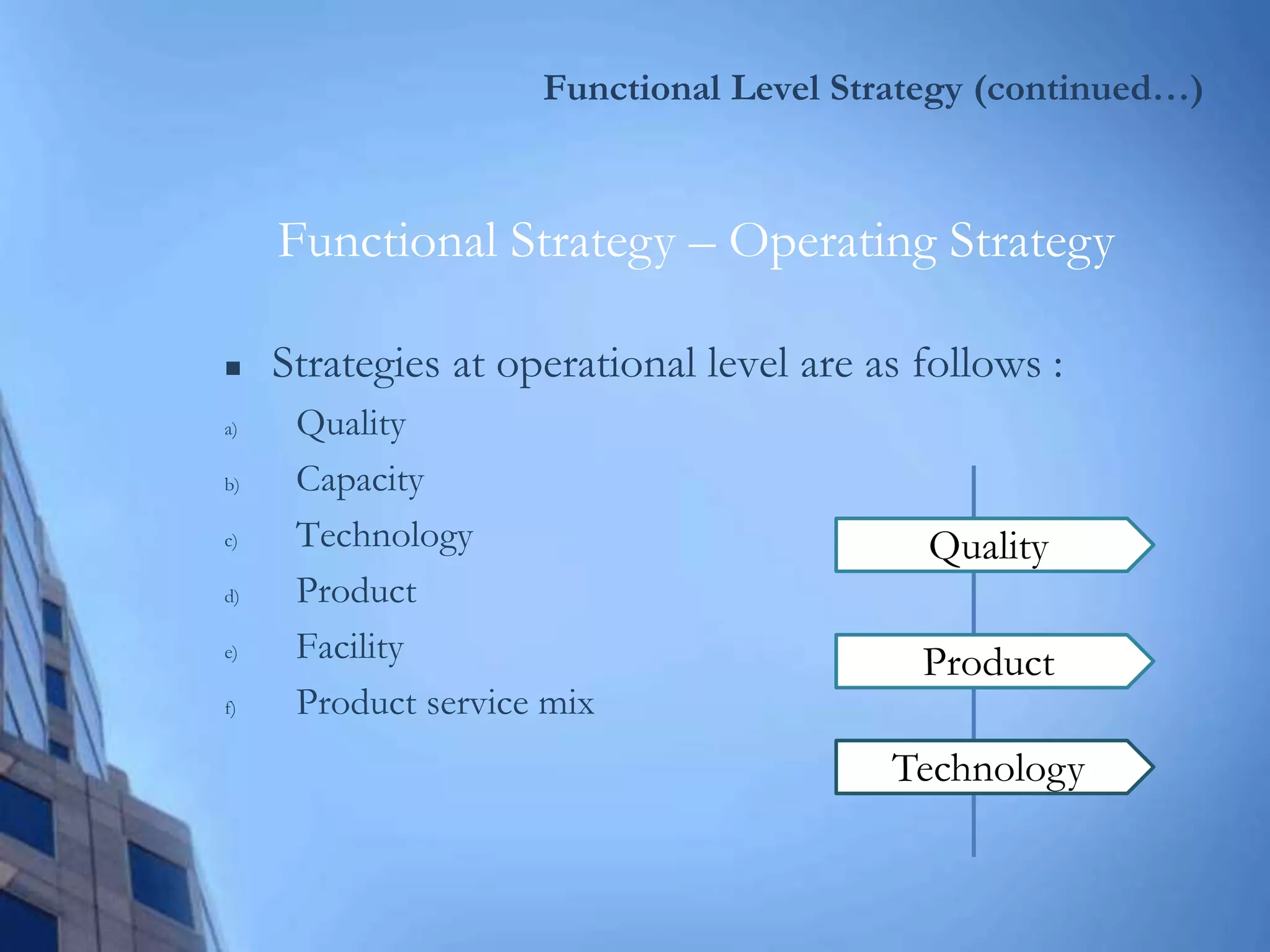
 Strategies at operational level are as follows :
a) Quality
b) Capacity
c) Technology
d) Product
e) Facility
f) Product service mix
Functional Strategy – Operating Strategy
Quality
Product
Technology
Functional Level Strategy (continued…)
 Strategies at financial level are as follows :
a) Procurement of finance
b) Utilization of finance
c) Financial ratio analysis
d) Financial strategy
Functional Strategy – Financing Strategy
Functional Level Strategy (continued…)
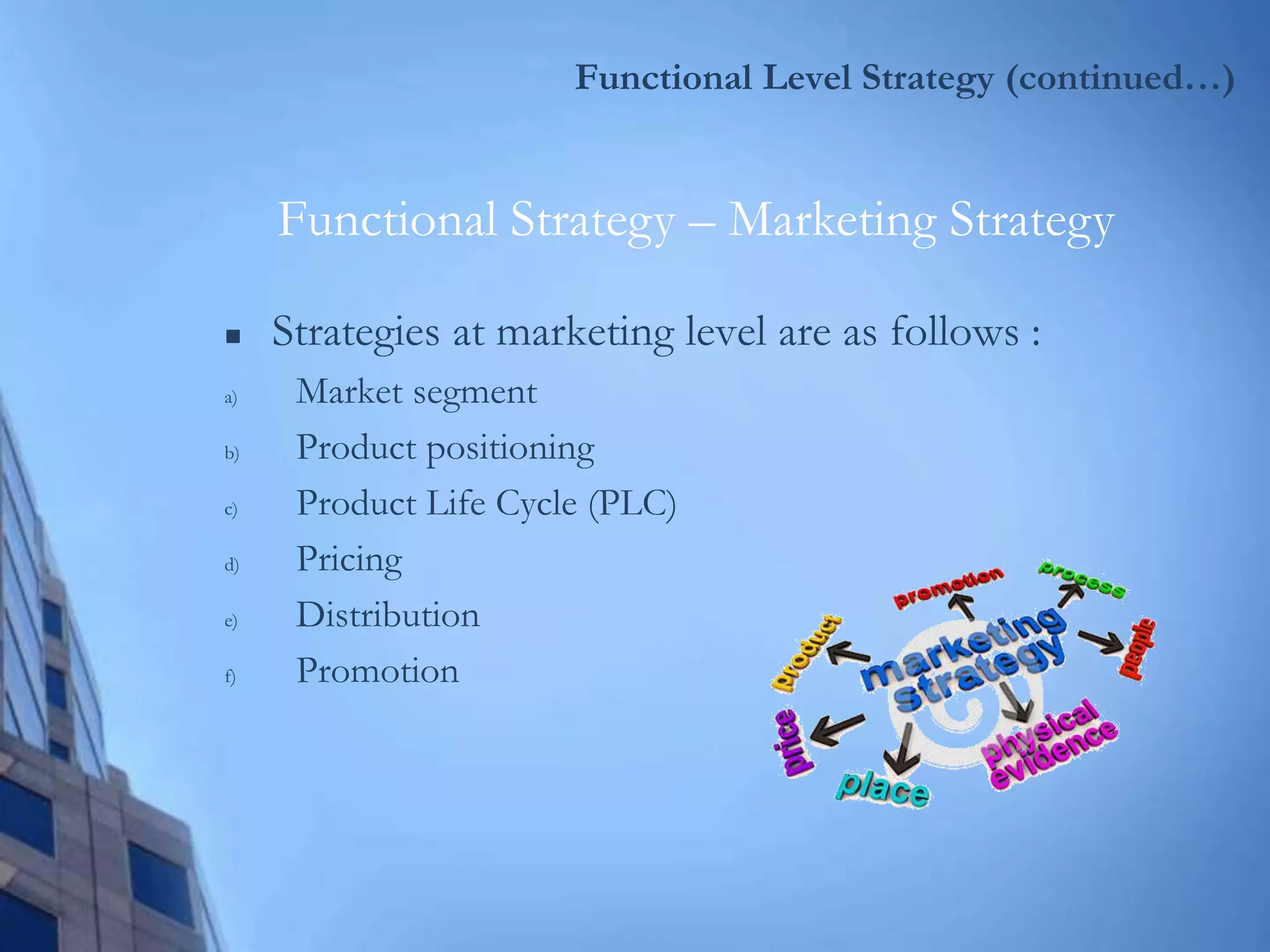
 Strategies at marketing level are as follows :
a) Market segment
b) Product positioning
c) Product Life Cycle (PLC)
d) Pricing
e) Distribution
f) Promotion
Functional Strategy – Marketing Strategy
Functional Level Strategy (continued…)
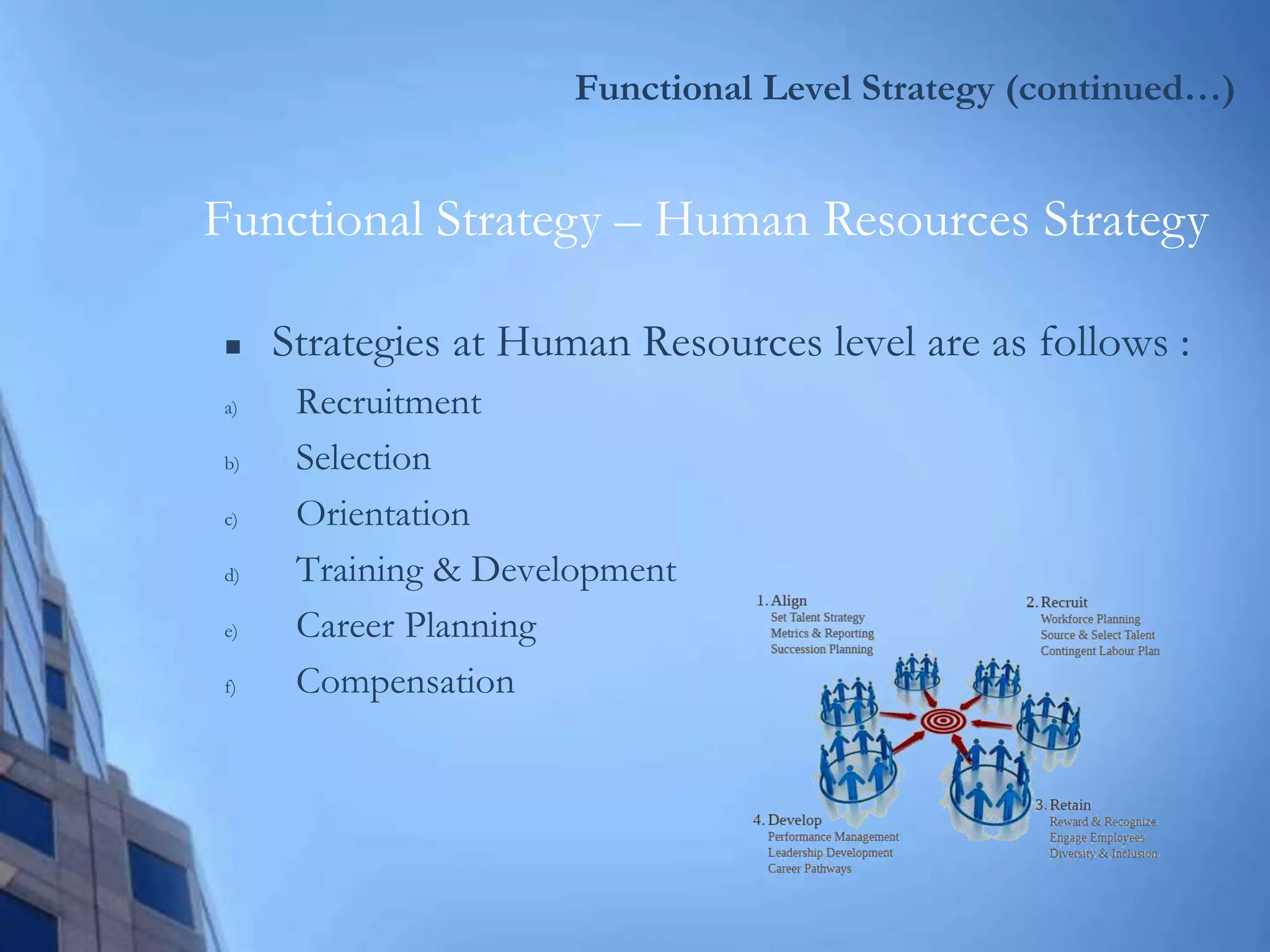
 Strategies at Human Resources level are as follows :
a) Recruitment
b) Selection
c) Orientation
d) Training & Development
e) Career Planning
f) Compensation
Functional Strategy – Human Resources Strategy
Hierarchy of strategies

Hierarchy of strategies

  • 1.
    Hierarchy of Strategies Ideasfor TODAY and TOMORROW
  • 2.
    Topics  Meaning ofStrategy & Strategic Management  Importance of Strategy  Levels (Hierarchy) of Strategies  Corporate Level Strategy  Business Level Strategy  Functional Level Strategy
  • 3.
    Strategy & StrategicManagement  Strategy is a comprehensive master plan stating HOW the corporation will achieve its mission and objective.  Strategic management is the continuous planning, monitoring, analysis and assessment of all that is necessary for an organization to meet its goals and objectives.
  • 4.
    Importance of Strategy Strategic Management seeks to co-ordinate & integrate the activities of the various functional areas of a business in order to achieve long-term organizational objectives.  The initial task in strategic management is typically the compilation & dissemination of the vision & the mission statement. This outlines, in essence, the purpose of an organization.
  • 5.
    Importance of Strategy(continued…)  Strategies are usually derived by the top executives of the company & presented to the Board of Directors in order to ensure they are in line with expectations of the stakeholders.  The implications of the selected strategy are highly important.  All strategic planning deals with atleast 1 of 3 questions : a) Where are we now..??? b) Where do we want to go..??? c) How do we get there..???
  • 6.
  • 7.
    Corporate Level Strategy A corporate level strategy involves all the strategic decisions that are taken by the top executives of the company that affects the whole organization or company.  A Balance Scorecard approach  Grand Strategies : a) Growth/Expansion Strategy (Internal & External) b) Stability (it is pause or no change strategy) c) Retrenchment (Regrouping through cost & asset reduction to reverse declining sales & profit) d) Combination Strategy (it is the strategy where more than 1 grand strategy is used)
  • 8.
    Business Level Strategy Business level strategy is an integrated and co-ordinated set of commitments & actions the firm uses to gain a competitive advantage by exploiting core competencies in specific product markets.  The purpose of this strategy is : a) to create differences between position of a firm & its competitors b) firm must make a deliberate choice to : ▬ perform activities differently ▬ perform different activities
  • 9.
    Business Level Strategy(continued…)  Competitive Strategy a) Differentiation strategy (Approach under which a firm aims to develop & market unique products for different customer segments) b) Low cost strategy (It describes a way to establish the competitive advantage) c) Focus strategy (It is usually employed where the company knows its segment & has products to competitively satisfy its needs)
  • 10.
    Functional Level Strategy The functional level of the organization is the level of operating divisions & departments.  Functional level strategies in Marketing, Finance, Human Resources, Operations and Research & Development involve the development & co-ordination of resources through which business unit level strategies can be executed efficiently & effectively.  Strategies for each functions in the organization are as follows :
  • 11.
    Functional Level Strategy(continued…)  Strategies at operational level are as follows : a) Quality b) Capacity c) Technology d) Product e) Facility f) Product service mix Functional Strategy – Operating Strategy Quality Product Technology
  • 12.
    Functional Level Strategy(continued…)  Strategies at financial level are as follows : a) Procurement of finance b) Utilization of finance c) Financial ratio analysis d) Financial strategy Functional Strategy – Financing Strategy
  • 13.
    Functional Level Strategy(continued…)  Strategies at marketing level are as follows : a) Market segment b) Product positioning c) Product Life Cycle (PLC) d) Pricing e) Distribution f) Promotion Functional Strategy – Marketing Strategy
  • 14.
    Functional Level Strategy(continued…)  Strategies at Human Resources level are as follows : a) Recruitment b) Selection c) Orientation d) Training & Development e) Career Planning f) Compensation Functional Strategy – Human Resources Strategy