Chapter Two
Strategic Training
Objectives
O Discuss how business strategy influences
the type and amount of training in a
company
O Describe the strategic training and
development process
O Discuss how a company’s staffing and
human resource planning strategies
influence training
Copyright © 2017 McGraw-Hill Education. All rights reserved. No reproduction or distribution without the prior written consent of McGraw-Hill Education.
Objectives
O Explain the training needs created by
concentration, internal growth, external
growth, and disinvestment business
strategies
O Discuss the advantages and disadvantages
of centralizing the training function
O Explain a corporate university and its
benefits
Copyright © 2017 McGraw-Hill Education. All rights reserved. No reproduction or distribution without the prior written consent of McGraw-Hill Education.
Objectives
O Discuss the strengths of a business-
embedded learning function
O Discuss how to create a learning or training
brand and why it is important
O Develop a marketing campaign for a
training course or program
Copyright © 2017 McGraw-Hill Education. All rights reserved. No reproduction or distribution without the prior written consent of McGraw-Hill Education.
Training is Strategic
O Training can have both a direct an indirect
impact on organizational success
O Business strategy will shape the training
function
o Strategic impacts what gets trained,
who gets training, and how much
training is valued
O The role of training is evolving
Copyright © 2017 McGraw-Hill Education. All rights reserved. No reproduction or distribution without the prior written consent of McGraw-Hill Education.
The Learning Organization
O A company that has:
o an enhanced capacity to learn, adapt,
and change
o carefully scrutinized and aligned
training processes with company goals
o training as a part of a system designed
to create human capital
Copyright © 2017 McGraw-Hill Education. All rights reserved. No reproduction or distribution without the prior written consent of McGraw-Hill Education.
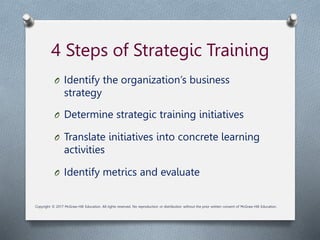
4 Steps of Strategic Training
O Identify the organization’s business
strategy
O Determine strategic training initiatives
O Translate initiatives into concrete learning
activities
O Identify metrics and evaluate
Copyright © 2017 McGraw-Hill Education. All rights reserved. No reproduction or distribution without the prior written consent of McGraw-Hill Education.
The Strategic Process
Copyright © 2017 McGraw-Hill Education. All rights reserved. No reproduction or distribution without the prior written consent of McGraw-Hill Education.
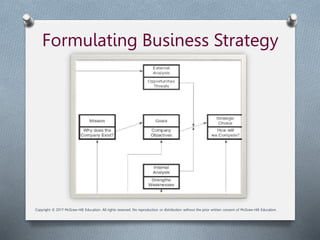
1. Identify Business Strategy
O Determine the company’s mission
O Establish goals
O Perform a SWOT—strengths,
opportunities, weakness, and threats
O Determine strategic choice
Copyright © 2017 McGraw-Hill Education. All rights reserved. No reproduction or distribution without the prior written consent of McGraw-Hill Education.
Formulating Business Strategy
Copyright © 2017 McGraw-Hill Education. All rights reserved. No reproduction or distribution without the prior written consent of McGraw-Hill Education.
2. Determine Strategic
Initiatives
O Learning-related actions that a company
should take to achieve its business
strategy
O A road map to guide specific training
activities
O Avoid the disconnect between strategy
and execution
Copyright © 2017 McGraw-Hill Education. All rights reserved. No reproduction or distribution without the prior written consent of McGraw-Hill Education.
Common Strategic Initiatives
O Diversify the learning portfolio
O Expand who is trained
O Accelerate the pace of learning
O Improve customer service
O Capture and share knowledge
O Ensure the work environment supports
learning and transfer of training
Copyright © 2017 McGraw-Hill Education. All rights reserved. No reproduction or distribution without the prior written consent of McGraw-Hill Education.
Questions to Ask
O What is the vision and mission?
O What capabilities are critical for success?
O What types of training will best attract,
develop, and retain employees?
O Is there a plan to communicate the link
between training and strategy?
O Does senior management support
training?
Copyright © 2017 McGraw-Hill Education. All rights reserved. No reproduction or distribution without the prior written consent of McGraw-Hill Education.
3. Translate Initiatives to
Activities
O The next step is to determine specific,
concrete activities that align with strategic
initiatives
O Such activities will vary based on the
initiatives that were developed
Copyright © 2017 McGraw-Hill Education. All rights reserved. No reproduction or distribution without the prior written consent of McGraw-Hill Education.
4. Identify Metrics & Evaluate
O The final step is to determine if training
investments were successful
O Strategic training evaluation is not intended
to evaluate the effectiveness of an isolated
program, but a set of training activities
O The business-related outcomes examined
should be directly linked to strategy and
goals
Copyright © 2017 McGraw-Hill Education. All rights reserved. No reproduction or distribution without the prior written consent of McGraw-Hill Education.
Balanced Scorecard
O Customer (time, quality, performance, service,
cost)
O Internal business processes (processes that
influence customer satisfaction)
O Innovation and learning (operating efficiency,
employee satisfaction, continuous
improvement)
O Financial (profitability, growth, shareholder
value)
Copyright © 2017 McGraw-Hill Education. All rights reserved. No reproduction or distribution without the prior written consent of McGraw-Hill Education.
Organizational Characteristics
Copyright © 2017 McGraw-Hill Education. All rights reserved. No reproduction or distribution without the prior written consent of McGraw-Hill Education.
Roles of
employees and
managers
Top management
support
Integration of
business units
Global presence
Business
conditions
Other HRM
practices
Strategic value of
jobs and
employee
uniqueness
Unionization
Staff involvement
Roles of Employees &
Managers
O Employees now performing roles once
reserved for management
O Given the prevalence of teams,
employees require more cross-training
and interpersonal skills training
O Managers’ jobs are highly complex,
requiring greater skill and training
Copyright © 2017 McGraw-Hill Education. All rights reserved. No reproduction or distribution without the prior written consent of McGraw-Hill Education.
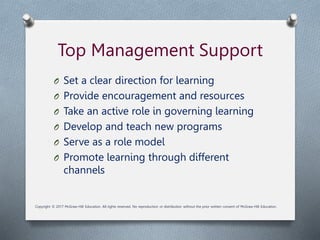
Top Management Support
O Set a clear direction for learning
O Provide encouragement and resources
O Take an active role in governing learning
O Develop and teach new programs
O Serve as a role model
O Promote learning through different
channels
Copyright © 2017 McGraw-Hill Education. All rights reserved. No reproduction or distribution without the prior written consent of McGraw-Hill Education.
Integration of Business Units
O Integration of business units affects the
approach to training
O In a highly integrated business,
employees need to understand all parts of
the company, and training must address
those needs
Copyright © 2017 McGraw-Hill Education. All rights reserved. No reproduction or distribution without the prior written consent of McGraw-Hill Education.
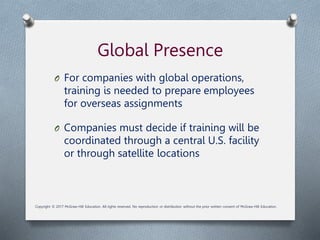
Global Presence
O For companies with global operations,
training is needed to prepare employees
for overseas assignments
O Companies must decide if training will be
coordinated through a central U.S. facility
or through satellite locations
Copyright © 2017 McGraw-Hill Education. All rights reserved. No reproduction or distribution without the prior written consent of McGraw-Hill Education.
Business Conditions
O With low unemployment, it’s difficult to find
top talent
O In unstable environments, training may
become short-term
O When there is growth, training will be in high
demand
Copyright © 2017 McGraw-Hill Education. All rights reserved. No reproduction or distribution without the prior written consent of McGraw-Hill Education.
Business Conditions
O When trying to revitalize and redirect, there
are fewer incentives for training
O When downsizing, training may focus on
continued employability
Copyright © 2017 McGraw-Hill Education. All rights reserved. No reproduction or distribution without the prior written consent of McGraw-Hill Education.
Staffing Strategy & Training
O Fortress—limited resources for training;
recruit from the outside
O Baseball team—creativity needed; recruit
from other companies or new graduates
O Club—highly regulated industries; develop
own talent
O Academy—specialized skills; heavy focus on
developing employees
Copyright © 2017 McGraw-Hill Education. All rights reserved. No reproduction or distribution without the prior written consent of McGraw-Hill Education.
Strategic Value & Uniqueness
O Knowledge-based workers—heavy training
O Job-based employees—less training than
knowledge workers
O Contract employees—limited training
O Alliance/partnerships—sharing expertise
and team training
Copyright © 2017 McGraw-Hill Education. All rights reserved. No reproduction or distribution without the prior written consent of McGraw-Hill Education.
Extent of Unionization
O Presence of a union leads to joint union-
management programs for preparing
employees for jobs
O Given that unions have a significant
impact on HRM practices, they must be
involved in determining strategic training
priorities
O Collaboration is key
Copyright © 2017 McGraw-Hill Education. All rights reserved. No reproduction or distribution without the prior written consent of McGraw-Hill Education.
Staff Involvement
O Managers need to be involved so training
links to business needs and transfer can be
supported
O Managers will be more involved if they are
rewarded for doing so
O +
O Employees now assume greater
responsibility for planning their own
development
Copyright © 2017 McGraw-Hill Education. All rights reserved. No reproduction or distribution without the prior written consent of McGraw-Hill Education.
Training in Different Strategies
O Concentration Strategy
o Skill currency and the development of
the existing workforce
O Internal Growth Strategy
o Creation of new jobs and tasks,
innovation, and talent management
Copyright © 2017 McGraw-Hill Education. All rights reserved. No reproduction or distribution without the prior written consent of McGraw-Hill Education.
Training in Different Strategies
O External Growth Strategy
o Integration, redundancy, and
restructuring
O Disinvestment Strategy
o Efficiency
Copyright © 2017 McGraw-Hill Education. All rights reserved. No reproduction or distribution without the prior written consent of McGraw-Hill Education.
Centralized Training
O There are several advantages:
o Stronger alignment with strategy
o Common set of metrics or scorecards to
evaluate training
o Streamlined processes
o Better integration of programs to
develop leaders
o Easier to manage talent during times of
change
Copyright © 2017 McGraw-Hill Education. All rights reserved. No reproduction or distribution without the prior written consent of McGraw-Hill Education.
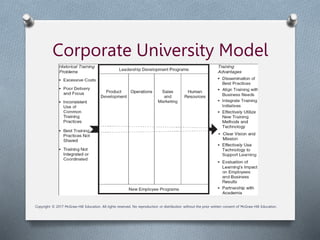
Corporate University Model
Copyright © 2017 McGraw-Hill Education. All rights reserved. No reproduction or distribution without the prior written consent of McGraw-Hill Education.
Corporate University Model
O There are several advantages :
o Dissemination of best practices
o Alignment of training with business
needs
o Integration of training initiatives
o Effective use of new technology and
methods
o Clear vision and mission
o Evaluation of learning focused on
employee and business results
o Partnership with academia
Copyright © 2017 McGraw-Hill Education. All rights reserved. No reproduction or distribution without the prior written consent of McGraw-Hill Education.
Business-Embedded Function
Copyright © 2017 McGraw-Hill Education. All rights reserved. No reproduction or distribution without the prior written consent of McGraw-Hill Education.
Change Model Perspective
O Four change-related problems need to be
addressed before the implementation of
any new training practice.
o Resistance to change
o Loss of control
o Power imbalance
o Task redefinition challenges
Copyright © 2017 McGraw-Hill Education. All rights reserved. No reproduction or distribution without the prior written consent of McGraw-Hill Education.
A Change Model
Copyright © 2017 McGraw-Hill Education. All rights reserved. No reproduction or distribution without the prior written consent of McGraw-Hill Education.
Marketing Training
O Despite its value, some individuals may
not necessarily value training
O Training often needs to be marketed so
key constituents value learning
O Internal marketing involves making
employees and managers excited about
training and learning
Copyright © 2017 McGraw-Hill Education. All rights reserved. No reproduction or distribution without the prior written consent of McGraw-Hill Education.
Internal Marketing Tactics
O Involve the target audience
O Demonstrate how training can solve
business problems
O Show examples of previous successes
O Identify a “champion” who supports
training
O Advertise through multiple channels
O Speak in terms employees understand
Copyright © 2017 McGraw-Hill Education. All rights reserved. No reproduction or distribution without the prior written consent of McGraw-Hill Education.
Outsourcing Training
O Reasons for outsourcing:
o Cost savings
o Time savings that allow a company to
focus on business strategy
o Improvements in compliance with
regulatory training
o Lack of internal capability to meet
learning demands
o Desire to access best training practices
Copyright © 2017 McGraw-Hill Education. All rights reserved. No reproduction or distribution without the prior written consent of McGraw-Hill Education.
Be Strategic
O Outsourcing may not necessarily be the
solution
O Be sure to consider:
o the skill set in question
o resources and expertise
o desire for control
o the quality of the potential vendor
o the importance of training in the
organization
Copyright © 2017 McGraw-Hill Education. All rights reserved. No reproduction or distribution without the prior written consent of McGraw-Hill Education.

Strategic Training.pdf

  • 1.
  • 2.
    Objectives O Discuss howbusiness strategy influences the type and amount of training in a company O Describe the strategic training and development process O Discuss how a company’s staffing and human resource planning strategies influence training Copyright © 2017 McGraw-Hill Education. All rights reserved. No reproduction or distribution without the prior written consent of McGraw-Hill Education.
  • 3.
    Objectives O Explain thetraining needs created by concentration, internal growth, external growth, and disinvestment business strategies O Discuss the advantages and disadvantages of centralizing the training function O Explain a corporate university and its benefits Copyright © 2017 McGraw-Hill Education. All rights reserved. No reproduction or distribution without the prior written consent of McGraw-Hill Education.
  • 4.
    Objectives O Discuss thestrengths of a business- embedded learning function O Discuss how to create a learning or training brand and why it is important O Develop a marketing campaign for a training course or program Copyright © 2017 McGraw-Hill Education. All rights reserved. No reproduction or distribution without the prior written consent of McGraw-Hill Education.
  • 5.
    Training is Strategic OTraining can have both a direct an indirect impact on organizational success O Business strategy will shape the training function o Strategic impacts what gets trained, who gets training, and how much training is valued O The role of training is evolving Copyright © 2017 McGraw-Hill Education. All rights reserved. No reproduction or distribution without the prior written consent of McGraw-Hill Education.
  • 6.
    The Learning Organization OA company that has: o an enhanced capacity to learn, adapt, and change o carefully scrutinized and aligned training processes with company goals o training as a part of a system designed to create human capital Copyright © 2017 McGraw-Hill Education. All rights reserved. No reproduction or distribution without the prior written consent of McGraw-Hill Education.
  • 7.
    4 Steps ofStrategic Training O Identify the organization’s business strategy O Determine strategic training initiatives O Translate initiatives into concrete learning activities O Identify metrics and evaluate Copyright © 2017 McGraw-Hill Education. All rights reserved. No reproduction or distribution without the prior written consent of McGraw-Hill Education.
  • 8.
    The Strategic Process Copyright© 2017 McGraw-Hill Education. All rights reserved. No reproduction or distribution without the prior written consent of McGraw-Hill Education.
  • 9.
    1. Identify BusinessStrategy O Determine the company’s mission O Establish goals O Perform a SWOT—strengths, opportunities, weakness, and threats O Determine strategic choice Copyright © 2017 McGraw-Hill Education. All rights reserved. No reproduction or distribution without the prior written consent of McGraw-Hill Education.
  • 10.
    Formulating Business Strategy Copyright© 2017 McGraw-Hill Education. All rights reserved. No reproduction or distribution without the prior written consent of McGraw-Hill Education.
  • 11.
    2. Determine Strategic Initiatives OLearning-related actions that a company should take to achieve its business strategy O A road map to guide specific training activities O Avoid the disconnect between strategy and execution Copyright © 2017 McGraw-Hill Education. All rights reserved. No reproduction or distribution without the prior written consent of McGraw-Hill Education.
  • 12.
    Common Strategic Initiatives ODiversify the learning portfolio O Expand who is trained O Accelerate the pace of learning O Improve customer service O Capture and share knowledge O Ensure the work environment supports learning and transfer of training Copyright © 2017 McGraw-Hill Education. All rights reserved. No reproduction or distribution without the prior written consent of McGraw-Hill Education.
  • 13.
    Questions to Ask OWhat is the vision and mission? O What capabilities are critical for success? O What types of training will best attract, develop, and retain employees? O Is there a plan to communicate the link between training and strategy? O Does senior management support training? Copyright © 2017 McGraw-Hill Education. All rights reserved. No reproduction or distribution without the prior written consent of McGraw-Hill Education.
  • 14.
    3. Translate Initiativesto Activities O The next step is to determine specific, concrete activities that align with strategic initiatives O Such activities will vary based on the initiatives that were developed Copyright © 2017 McGraw-Hill Education. All rights reserved. No reproduction or distribution without the prior written consent of McGraw-Hill Education.
  • 15.
    4. Identify Metrics& Evaluate O The final step is to determine if training investments were successful O Strategic training evaluation is not intended to evaluate the effectiveness of an isolated program, but a set of training activities O The business-related outcomes examined should be directly linked to strategy and goals Copyright © 2017 McGraw-Hill Education. All rights reserved. No reproduction or distribution without the prior written consent of McGraw-Hill Education.
  • 16.
    Balanced Scorecard O Customer(time, quality, performance, service, cost) O Internal business processes (processes that influence customer satisfaction) O Innovation and learning (operating efficiency, employee satisfaction, continuous improvement) O Financial (profitability, growth, shareholder value) Copyright © 2017 McGraw-Hill Education. All rights reserved. No reproduction or distribution without the prior written consent of McGraw-Hill Education.
  • 17.
    Organizational Characteristics Copyright ©2017 McGraw-Hill Education. All rights reserved. No reproduction or distribution without the prior written consent of McGraw-Hill Education. Roles of employees and managers Top management support Integration of business units Global presence Business conditions Other HRM practices Strategic value of jobs and employee uniqueness Unionization Staff involvement
  • 18.
    Roles of Employees& Managers O Employees now performing roles once reserved for management O Given the prevalence of teams, employees require more cross-training and interpersonal skills training O Managers’ jobs are highly complex, requiring greater skill and training Copyright © 2017 McGraw-Hill Education. All rights reserved. No reproduction or distribution without the prior written consent of McGraw-Hill Education.
  • 19.
    Top Management Support OSet a clear direction for learning O Provide encouragement and resources O Take an active role in governing learning O Develop and teach new programs O Serve as a role model O Promote learning through different channels Copyright © 2017 McGraw-Hill Education. All rights reserved. No reproduction or distribution without the prior written consent of McGraw-Hill Education.
  • 20.
    Integration of BusinessUnits O Integration of business units affects the approach to training O In a highly integrated business, employees need to understand all parts of the company, and training must address those needs Copyright © 2017 McGraw-Hill Education. All rights reserved. No reproduction or distribution without the prior written consent of McGraw-Hill Education.
  • 21.
    Global Presence O Forcompanies with global operations, training is needed to prepare employees for overseas assignments O Companies must decide if training will be coordinated through a central U.S. facility or through satellite locations Copyright © 2017 McGraw-Hill Education. All rights reserved. No reproduction or distribution without the prior written consent of McGraw-Hill Education.
  • 22.
    Business Conditions O Withlow unemployment, it’s difficult to find top talent O In unstable environments, training may become short-term O When there is growth, training will be in high demand Copyright © 2017 McGraw-Hill Education. All rights reserved. No reproduction or distribution without the prior written consent of McGraw-Hill Education.
  • 23.
    Business Conditions O Whentrying to revitalize and redirect, there are fewer incentives for training O When downsizing, training may focus on continued employability Copyright © 2017 McGraw-Hill Education. All rights reserved. No reproduction or distribution without the prior written consent of McGraw-Hill Education.
  • 24.
    Staffing Strategy &Training O Fortress—limited resources for training; recruit from the outside O Baseball team—creativity needed; recruit from other companies or new graduates O Club—highly regulated industries; develop own talent O Academy—specialized skills; heavy focus on developing employees Copyright © 2017 McGraw-Hill Education. All rights reserved. No reproduction or distribution without the prior written consent of McGraw-Hill Education.
  • 25.
    Strategic Value &Uniqueness O Knowledge-based workers—heavy training O Job-based employees—less training than knowledge workers O Contract employees—limited training O Alliance/partnerships—sharing expertise and team training Copyright © 2017 McGraw-Hill Education. All rights reserved. No reproduction or distribution without the prior written consent of McGraw-Hill Education.
  • 26.
    Extent of Unionization OPresence of a union leads to joint union- management programs for preparing employees for jobs O Given that unions have a significant impact on HRM practices, they must be involved in determining strategic training priorities O Collaboration is key Copyright © 2017 McGraw-Hill Education. All rights reserved. No reproduction or distribution without the prior written consent of McGraw-Hill Education.
  • 27.
    Staff Involvement O Managersneed to be involved so training links to business needs and transfer can be supported O Managers will be more involved if they are rewarded for doing so O + O Employees now assume greater responsibility for planning their own development Copyright © 2017 McGraw-Hill Education. All rights reserved. No reproduction or distribution without the prior written consent of McGraw-Hill Education.
  • 28.
    Training in DifferentStrategies O Concentration Strategy o Skill currency and the development of the existing workforce O Internal Growth Strategy o Creation of new jobs and tasks, innovation, and talent management Copyright © 2017 McGraw-Hill Education. All rights reserved. No reproduction or distribution without the prior written consent of McGraw-Hill Education.
  • 29.
    Training in DifferentStrategies O External Growth Strategy o Integration, redundancy, and restructuring O Disinvestment Strategy o Efficiency Copyright © 2017 McGraw-Hill Education. All rights reserved. No reproduction or distribution without the prior written consent of McGraw-Hill Education.
  • 30.
    Centralized Training O Thereare several advantages: o Stronger alignment with strategy o Common set of metrics or scorecards to evaluate training o Streamlined processes o Better integration of programs to develop leaders o Easier to manage talent during times of change Copyright © 2017 McGraw-Hill Education. All rights reserved. No reproduction or distribution without the prior written consent of McGraw-Hill Education.
  • 31.
    Corporate University Model Copyright© 2017 McGraw-Hill Education. All rights reserved. No reproduction or distribution without the prior written consent of McGraw-Hill Education.
  • 32.
    Corporate University Model OThere are several advantages : o Dissemination of best practices o Alignment of training with business needs o Integration of training initiatives o Effective use of new technology and methods o Clear vision and mission o Evaluation of learning focused on employee and business results o Partnership with academia Copyright © 2017 McGraw-Hill Education. All rights reserved. No reproduction or distribution without the prior written consent of McGraw-Hill Education.
  • 33.
    Business-Embedded Function Copyright ©2017 McGraw-Hill Education. All rights reserved. No reproduction or distribution without the prior written consent of McGraw-Hill Education.
  • 34.
    Change Model Perspective OFour change-related problems need to be addressed before the implementation of any new training practice. o Resistance to change o Loss of control o Power imbalance o Task redefinition challenges Copyright © 2017 McGraw-Hill Education. All rights reserved. No reproduction or distribution without the prior written consent of McGraw-Hill Education.
  • 35.
    A Change Model Copyright© 2017 McGraw-Hill Education. All rights reserved. No reproduction or distribution without the prior written consent of McGraw-Hill Education.
  • 36.
    Marketing Training O Despiteits value, some individuals may not necessarily value training O Training often needs to be marketed so key constituents value learning O Internal marketing involves making employees and managers excited about training and learning Copyright © 2017 McGraw-Hill Education. All rights reserved. No reproduction or distribution without the prior written consent of McGraw-Hill Education.
  • 37.
    Internal Marketing Tactics OInvolve the target audience O Demonstrate how training can solve business problems O Show examples of previous successes O Identify a “champion” who supports training O Advertise through multiple channels O Speak in terms employees understand Copyright © 2017 McGraw-Hill Education. All rights reserved. No reproduction or distribution without the prior written consent of McGraw-Hill Education.
  • 38.
    Outsourcing Training O Reasonsfor outsourcing: o Cost savings o Time savings that allow a company to focus on business strategy o Improvements in compliance with regulatory training o Lack of internal capability to meet learning demands o Desire to access best training practices Copyright © 2017 McGraw-Hill Education. All rights reserved. No reproduction or distribution without the prior written consent of McGraw-Hill Education.
  • 39.
    Be Strategic O Outsourcingmay not necessarily be the solution O Be sure to consider: o the skill set in question o resources and expertise o desire for control o the quality of the potential vendor o the importance of training in the organization Copyright © 2017 McGraw-Hill Education. All rights reserved. No reproduction or distribution without the prior written consent of McGraw-Hill Education.