STRATEGIC PLANNING &
MANAGEMENT
(The Planning Process)
by: ALVIN L. GUILLERMO, MAeD
PhD-Educ. Management-Student
https://www.google.com/search?q=short+video+clip+about+strategic+pla
nning+process&rlz=1C1GCEA_enPH971PH971&oq=short+video+clip+about
+strategic+planning+process&aqs=chrome..69i57.21105j0j7&sourceid=chr
ome&ie=UTF-8#kpvalbx=_PWAiYojtO8qM-QbYgrNo12
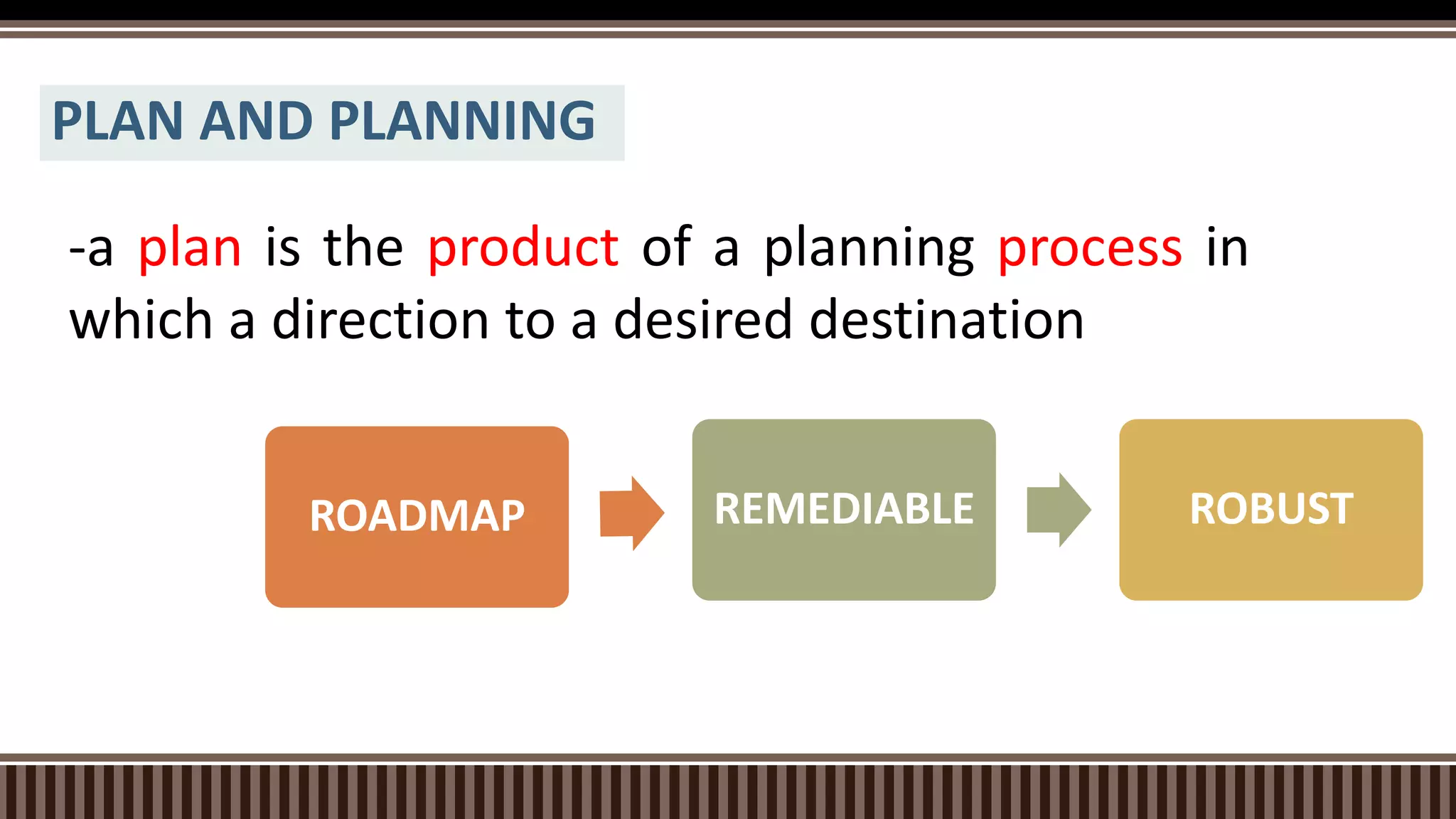
PLAN AND PLANNING
-a plan is the product of a planning process in
which a direction to a desired destination
ROADMAP REMEDIABLE ROBUST
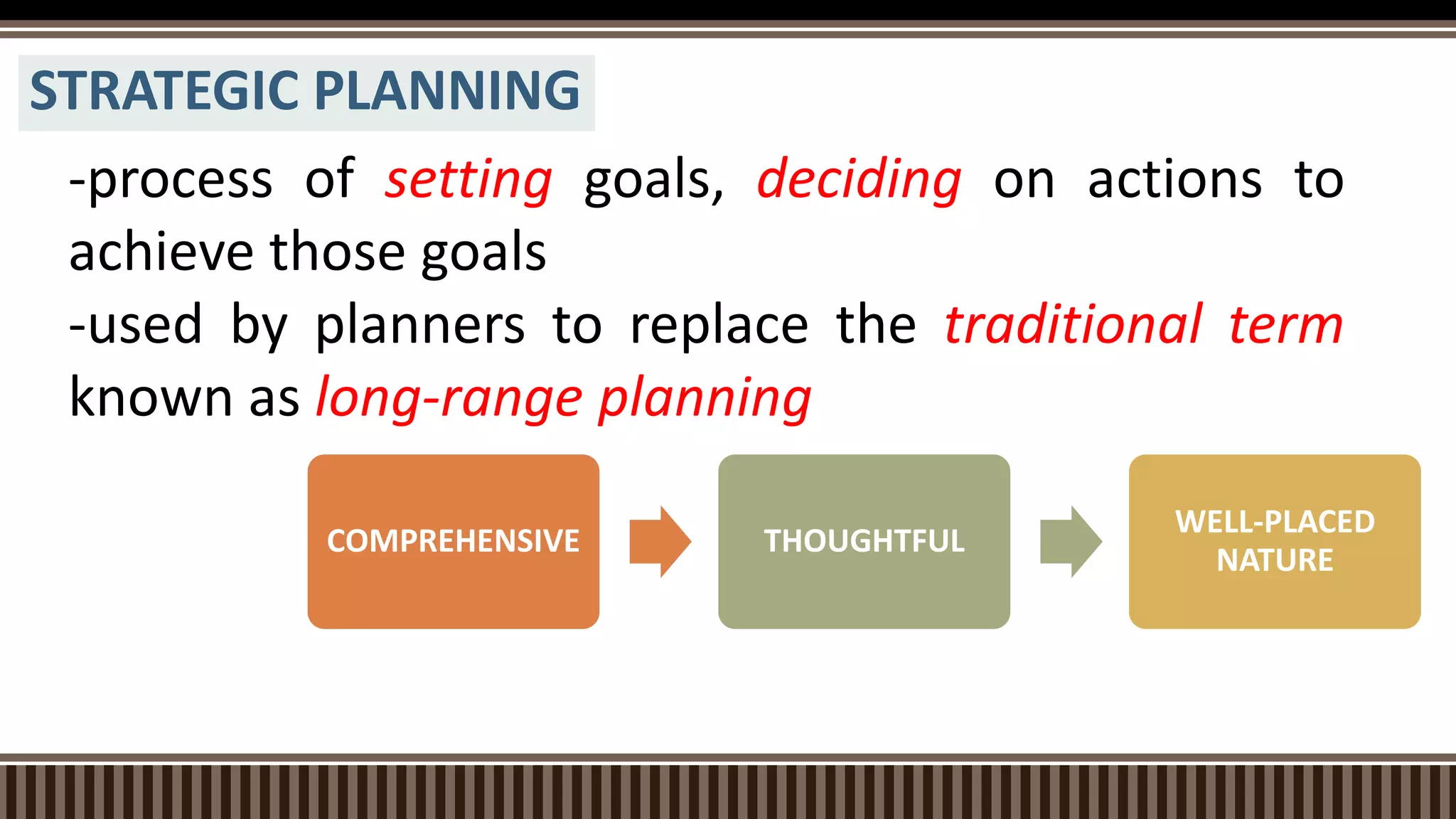
STRATEGIC PLANNING
-process of setting goals, deciding on actions to
achieve those goals
-used by planners to replace the traditional term
known as long-range planning
COMPREHENSIVE THOUGHTFUL
WELL-PLACED
NATURE
PURPOSE OF A STRATEGIC PLAN
1. Communicate the
priorities of an
organization,
2.Ensure that employees
and stakeholders work
toward common goals,
mission, vision and
strategies.
3. Focus energy and
resources,
4. Establish agreement
around intended
outcomes/results
5. Strengthen operations
6.Assess and adjust the
organization's direction in
response to a changing
environment.
STRATEGIC PLANNING PROCESS
- a collective, institution or organization-wide
process for developing creative initiatives that
channel resources to fulfil the institution's mission
and take maximum advantage of trends in the
external and internal environment process of
setting goals, deciding on actions to achieve those
goals, and mobilizing the resources needed to take
those actions.
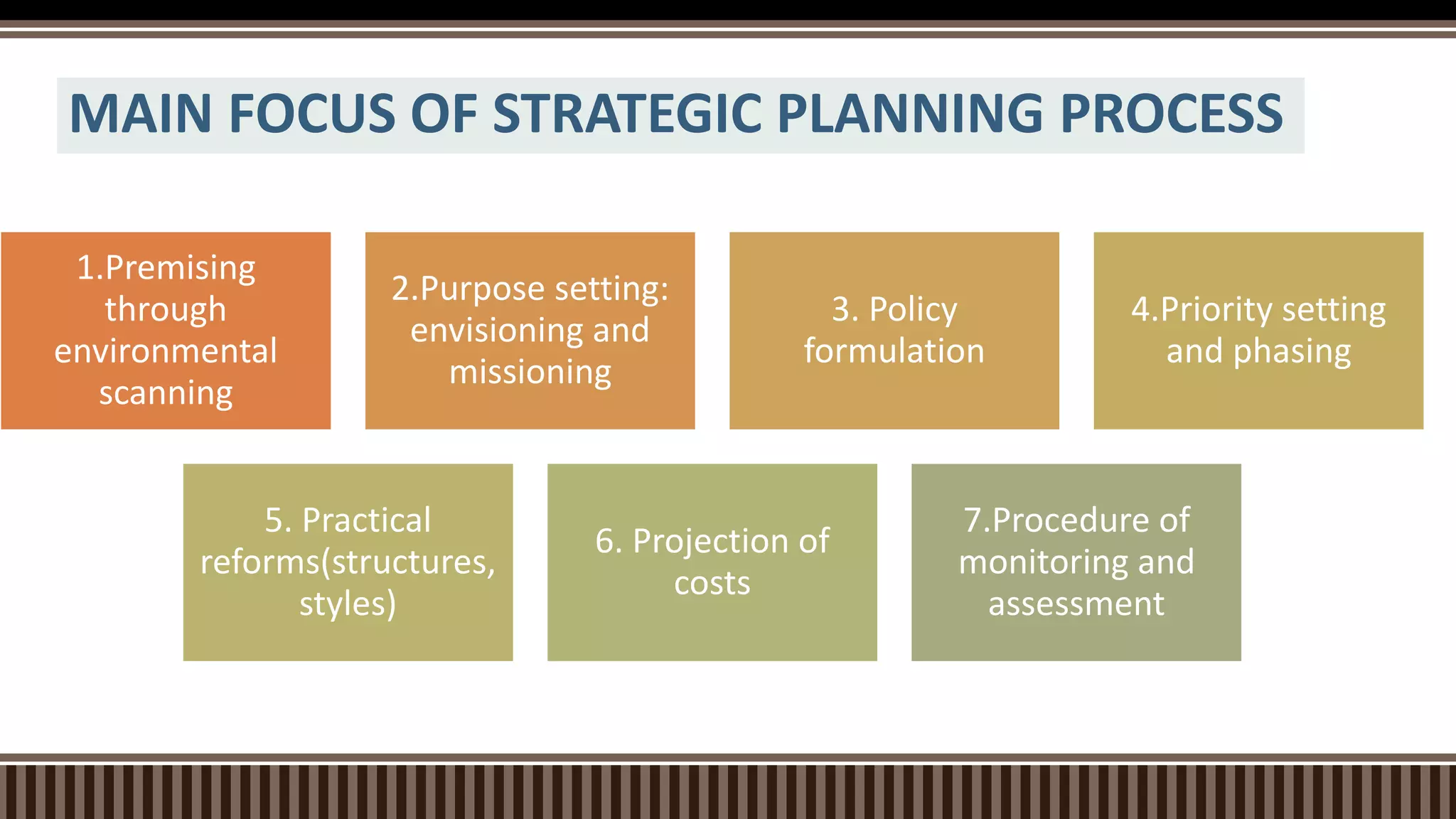
MAIN FOCUS OF STRATEGIC PLANNING PROCESS
1.Premising
through
environmental
scanning
2.Purpose setting:
envisioning and
missioning
3. Policy
formulation
4.Priority setting
and phasing
5. Practical
reforms(structures,
styles)
6. Projection of
costs
7.Procedure of
monitoring and
assessment
A STRATEGIC FORMULATION (THE ADA FRAMEWORK)
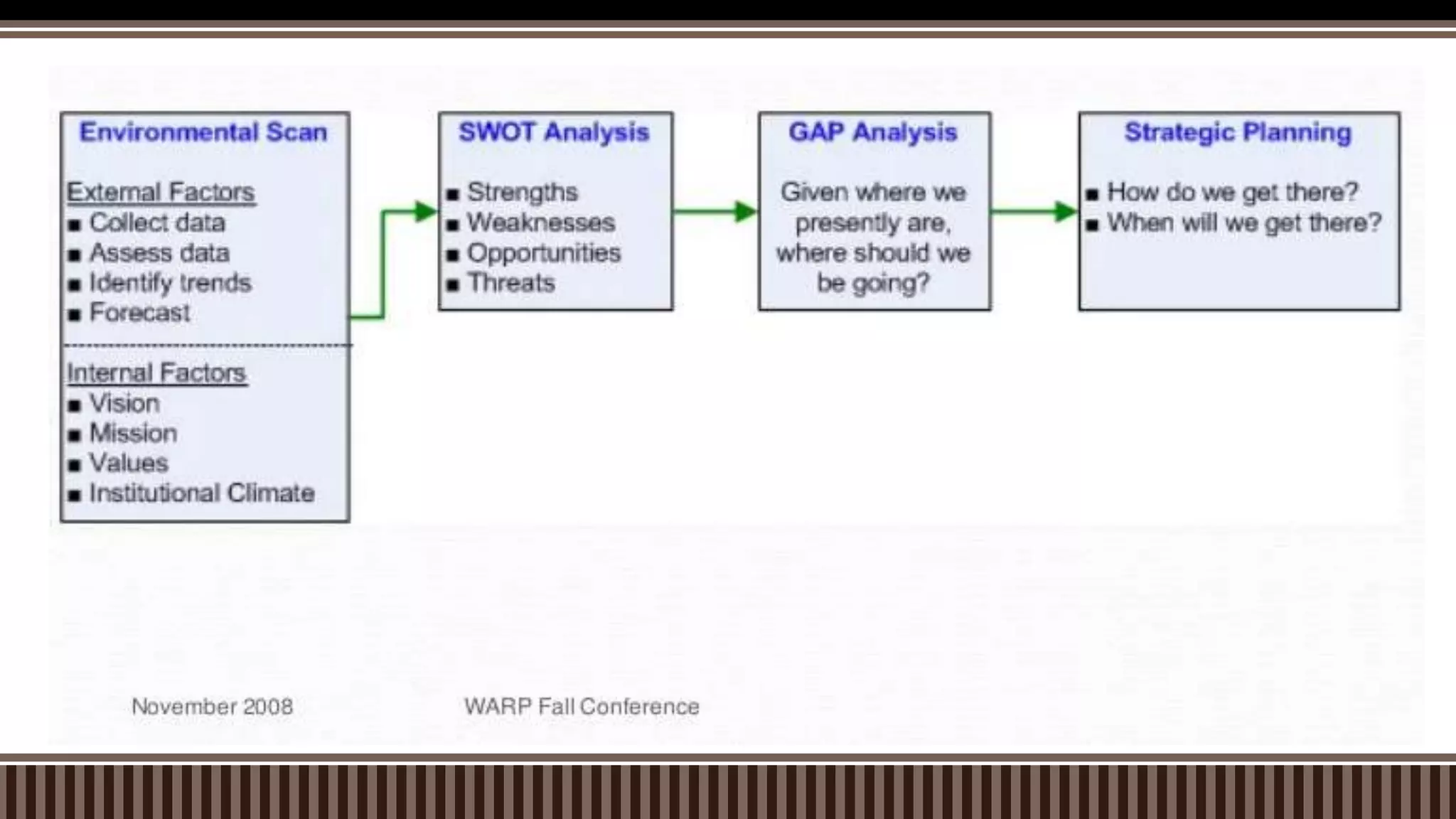
1. STRATEGIC ANALYSIS
This activity can include conducting some sort of
scan, or review, of the organization's environment
(for example, of the political, social, economic and
technical environment).
- driving force in the environment
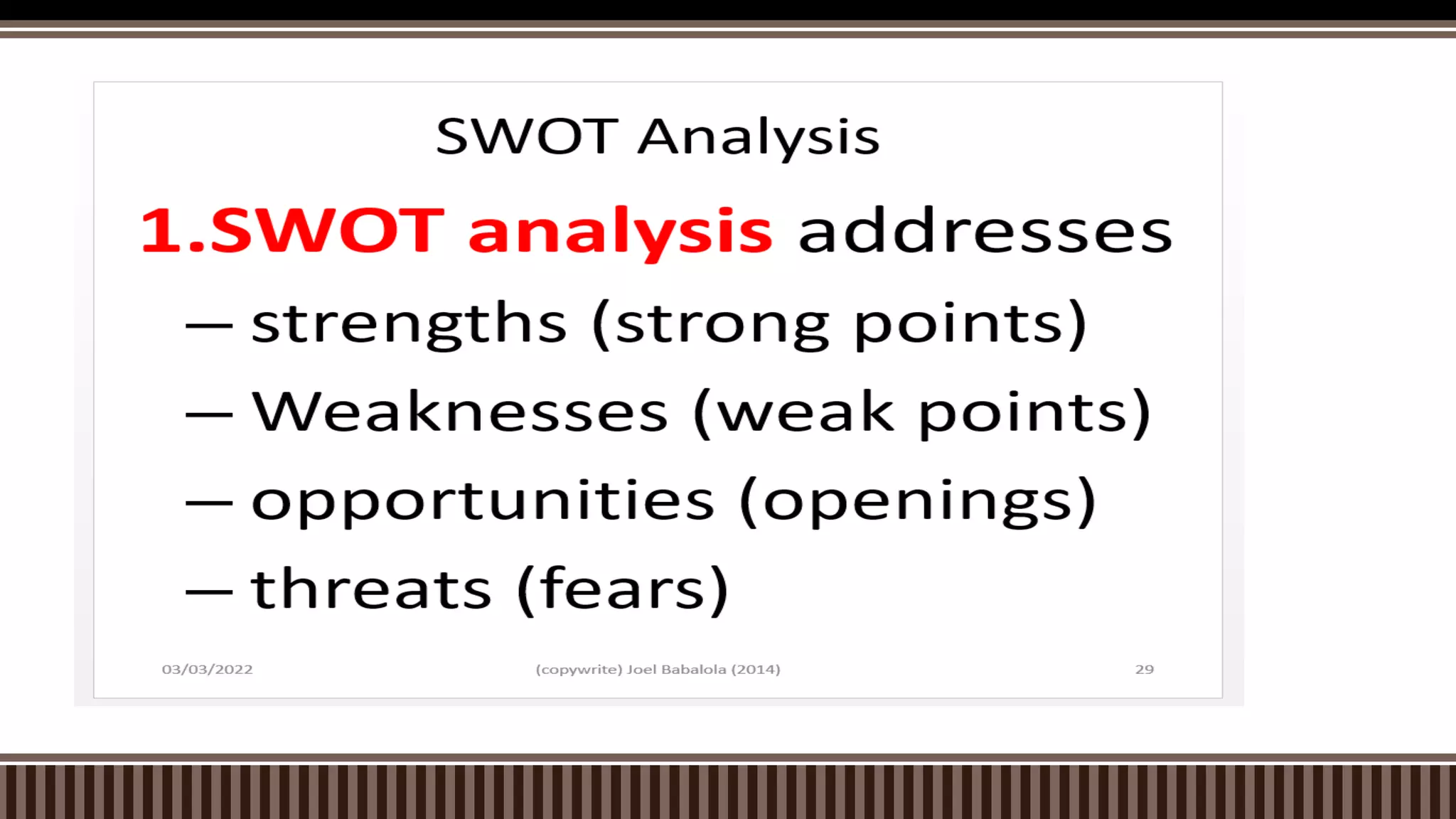
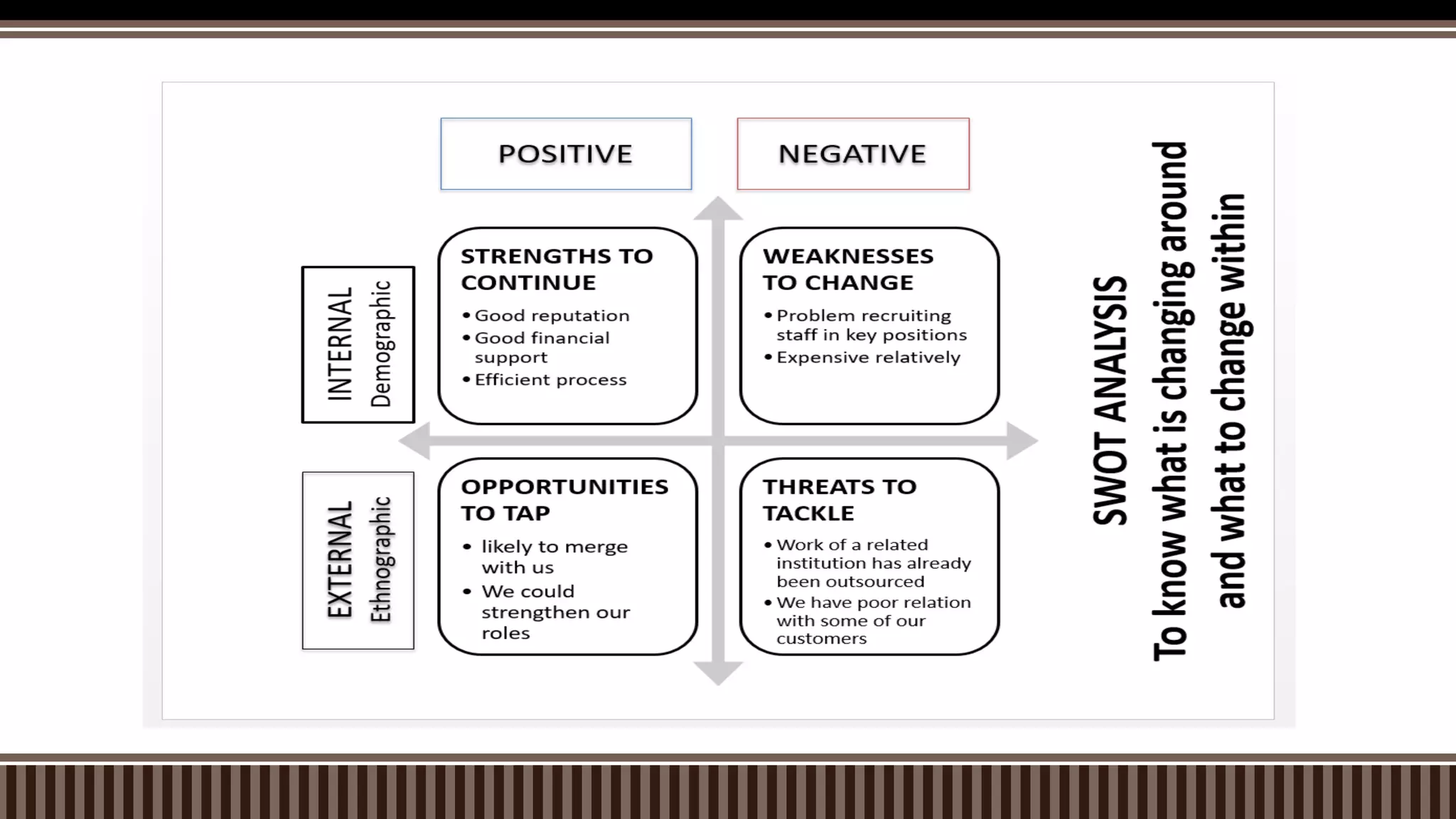
- SWOT of institution
2. SETTING DIRECTION
- Planners carefully come to conclusions about
what the organization must do as a result of the
situation analysis.
- Goals should be designed and worded as much
as possible driving force in the environment
- Strategic "philosophy". This includes identifying
or updating the mission, vision and/or values
statements.
1. Mission statements are brief written
descriptions of the purpose of the organization.
An overall mission statement
A specific purpose statement
2. Vision statements are usually a compelling
description of how the organization will or should
operate at some point in the future and of how
customers or clients are benefiting from the
organization's products and services.
3. Values statements list the overall priorities in
how the organization will operate.
-Moral values are values that suggest overall
priorities in how people ought to act in the
world.
-Operational values which suggest overall
priorities for the organization.
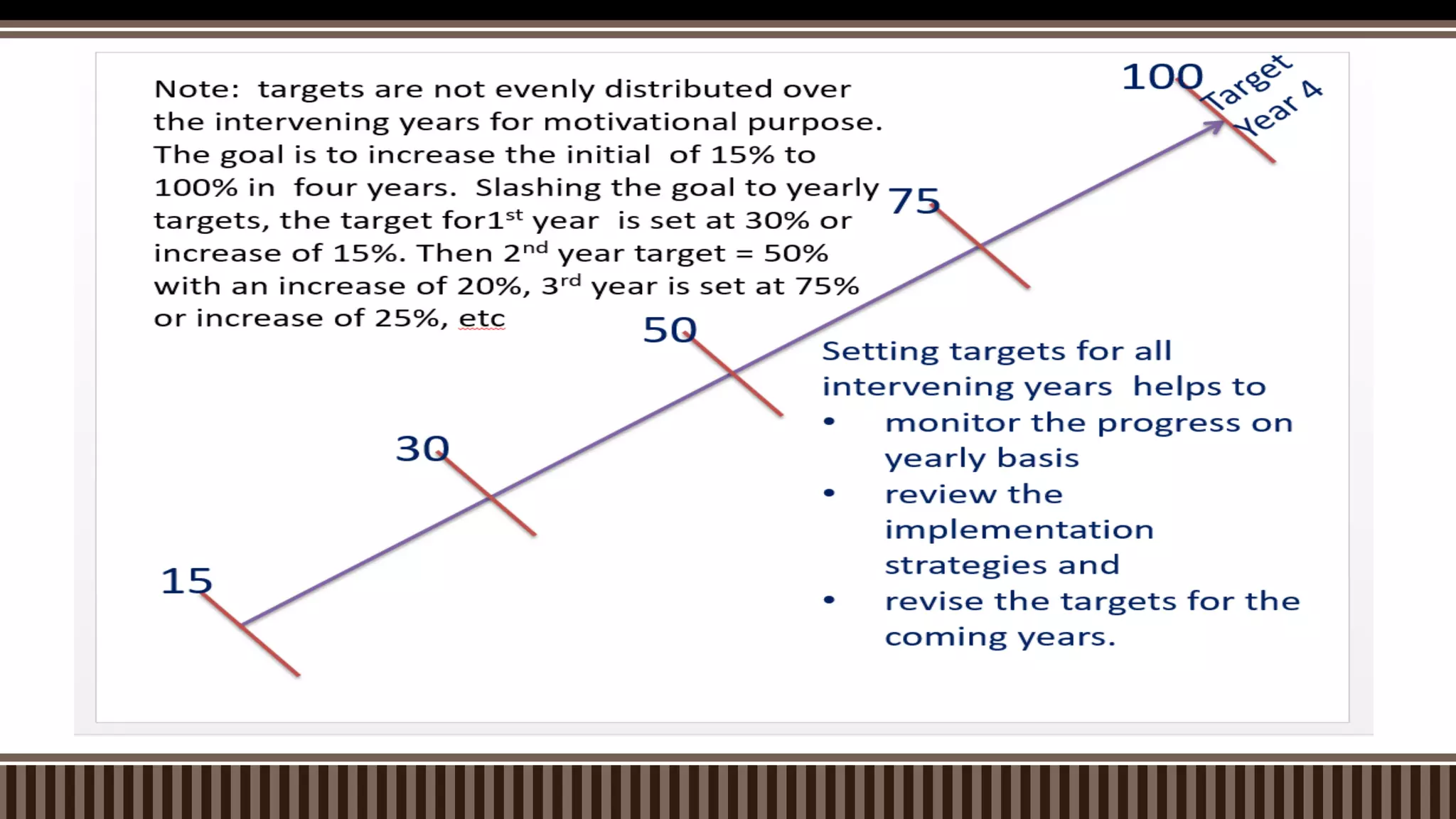
TARGET SETTING
1. Knowing government’s dreams or intentions
(or policy directions or points on
government’s agenda) for the next few
years.
2. Translating each of the strategic policies into
specific, measurable and achievable targets to
achieve each of the policies.
3. STRATEGIC ACTION PLANNING
Goals
(ends)
Objectives
Strategies
(means)
Tactics
Responsibilities
Timeline
-Action planning is carefully laying out how
the strategic goals will be accomplished.
PLANNING PARADIGM
STRATEGIC PLANNING AS A PROCESS
The process may be formal or informal and is typically iterative, with
feedback loops throughout the process.
Some elements of the process may be continuous and others may be
executed as discrete projects with a definitive start and end during a
period.
The end result is the organization's strategy, including a diagnosis of the
environment and competitive situation, a guiding policy on what the
organization intends to accomplish, and key initiatives or action plans
for achieving the guiding policy.
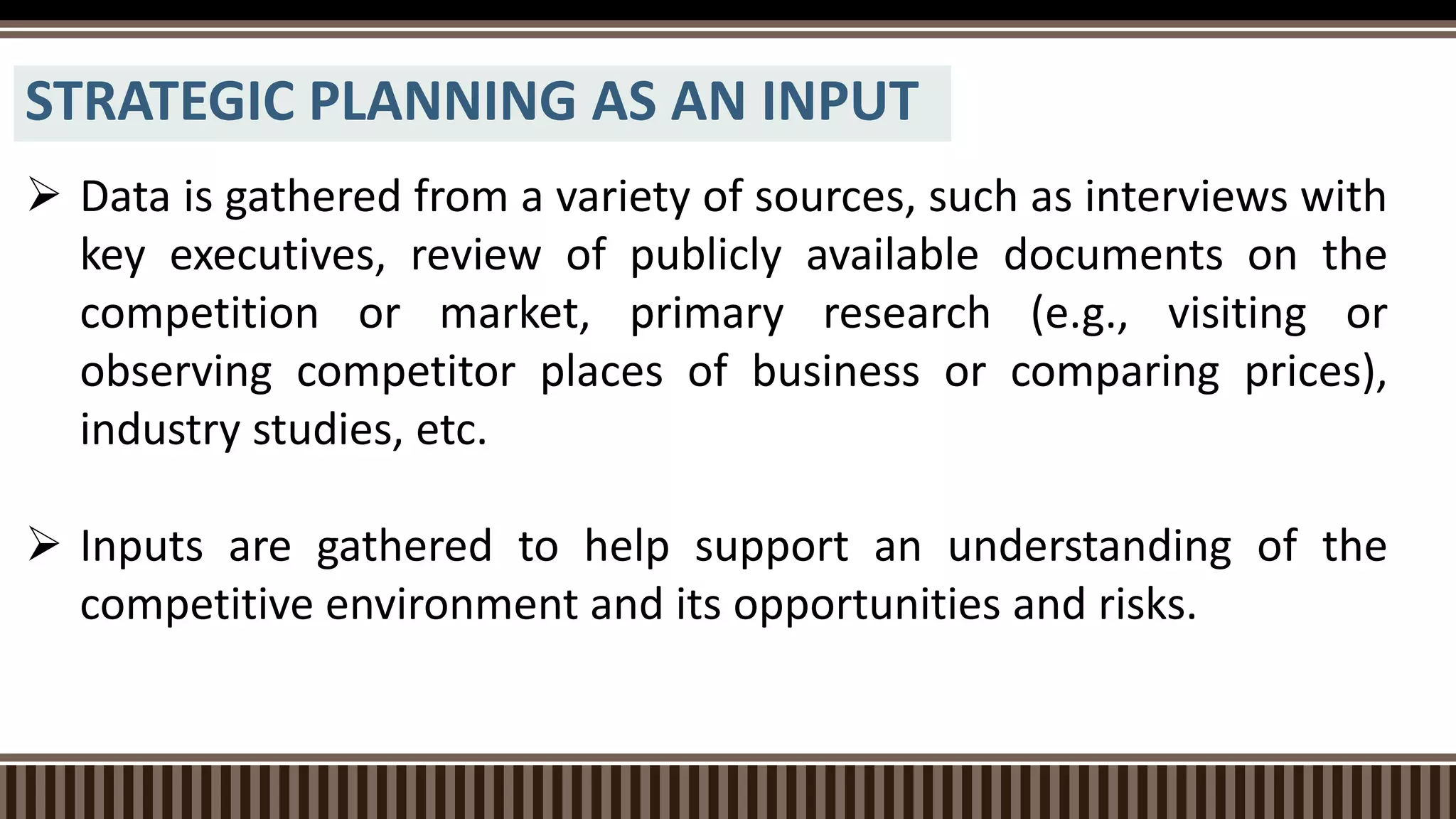
STRATEGIC PLANNING AS AN INPUT
 Data is gathered from a variety of sources, such as interviews with
key executives, review of publicly available documents on the
competition or market, primary research (e.g., visiting or
observing competitor places of business or comparing prices),
industry studies, etc.
 Inputs are gathered to help support an understanding of the
competitive environment and its opportunities and risks.
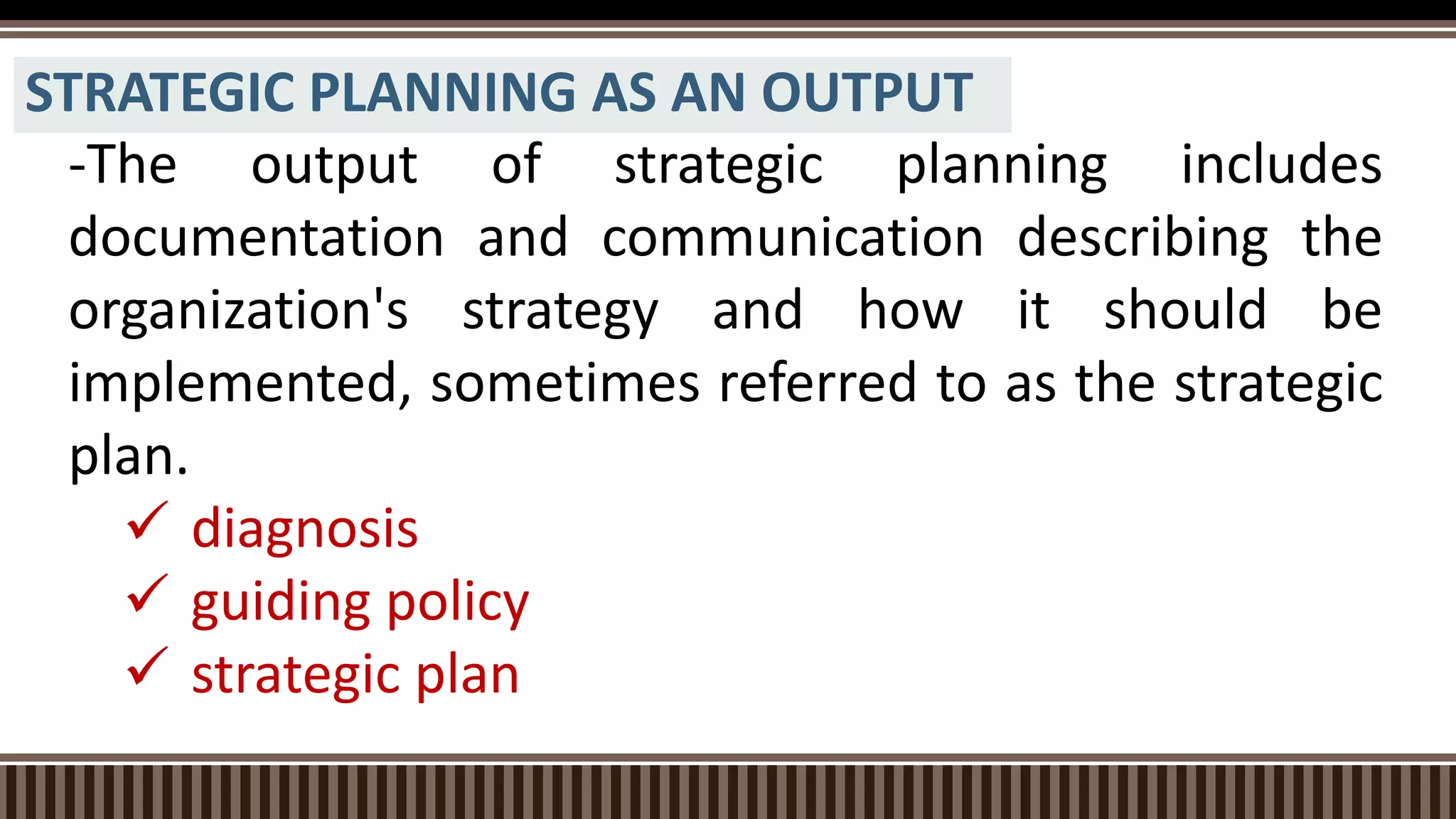
STRATEGIC PLANNING AS AN OUTPUT
-The output of strategic planning includes
documentation and communication describing the
organization's strategy and how it should be
implemented, sometimes referred to as the strategic
plan.
 diagnosis
 guiding policy
 strategic plan
STRATEGIC PLANNING AS AN OUTPUT
• Monitoring
progress
towards the
objective
MONITORING
DOCUMENT
• Plan a financial
statement
FINANCIAL
DOCUMENT
• Describe the
expected
financial
performance of
the organization
ANNUAL
BUDGET
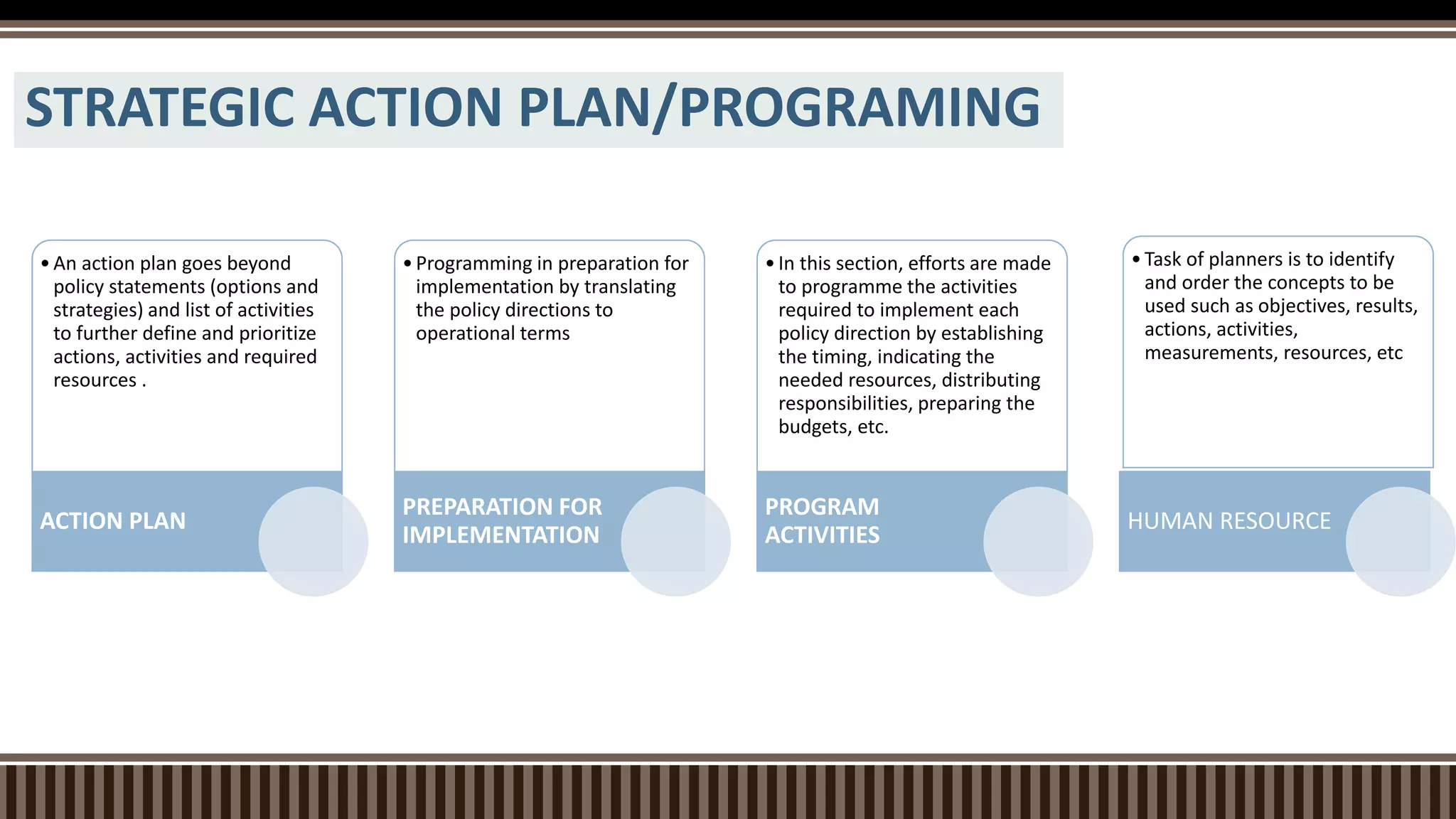
STRATEGIC ACTION PLAN/PROGRAMING
•An action plan goes beyond
policy statements (options and
strategies) and list of activities
to further define and prioritize
actions, activities and required
resources .
ACTION PLAN
•Programming in preparation for
implementation by translating
the policy directions to
operational terms
PREPARATION FOR
IMPLEMENTATION
•In this section, efforts are made
to programme the activities
required to implement each
policy direction by establishing
the timing, indicating the
needed resources, distributing
responsibilities, preparing the
budgets, etc.
PROGRAM
ACTIVITIES
•Task of planners is to identify
and order the concepts to be
used such as objectives, results,
actions, activities,
measurements, resources, etc
HUMAN RESOURCE
PROGRAM IMPLEMENTATION
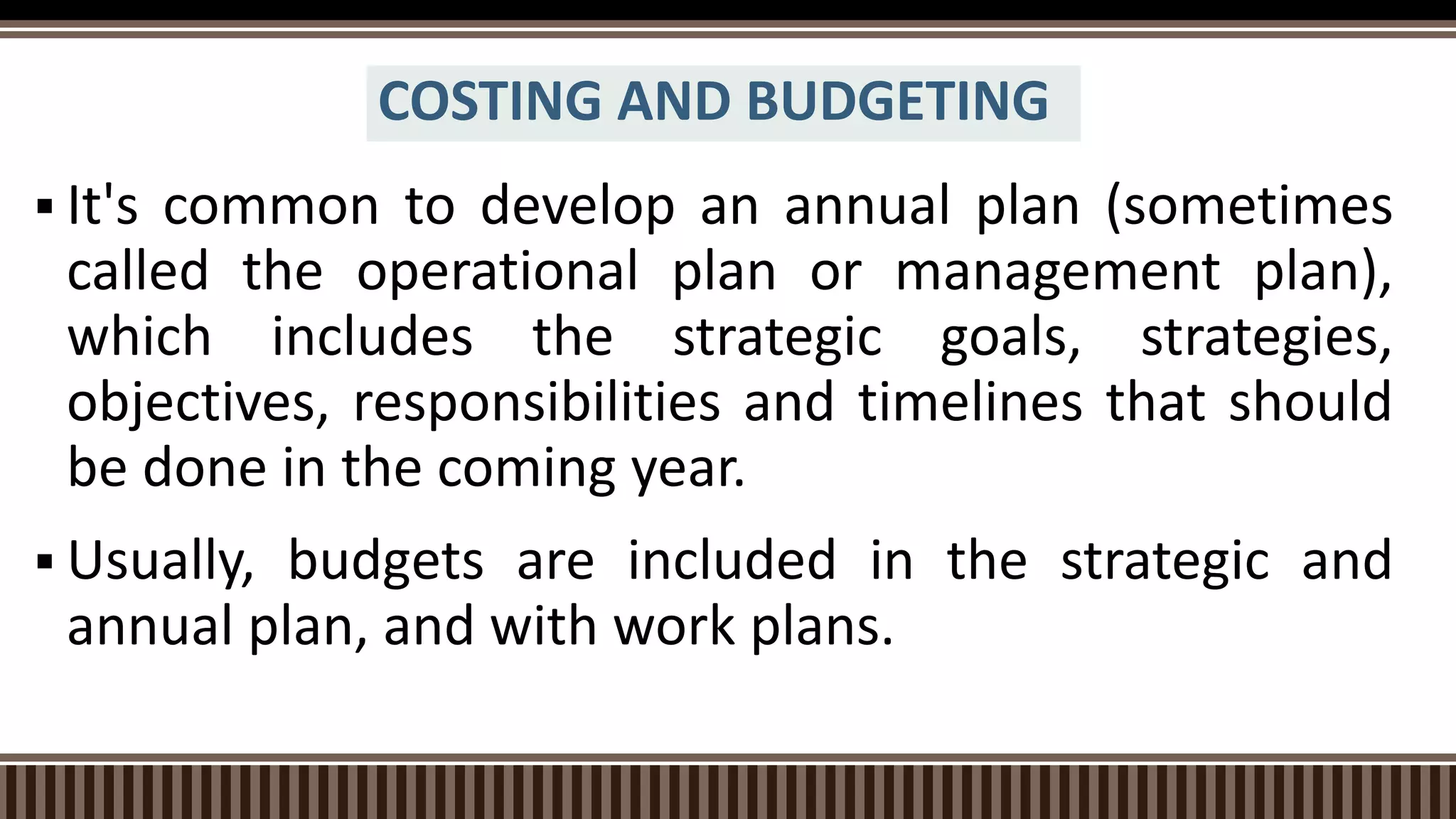
COSTING AND BUDGETING
 It's common to develop an annual plan (sometimes
called the operational plan or management plan),
which includes the strategic goals, strategies,
objectives, responsibilities and timelines that should
be done in the coming year.
 Usually, budgets are included in the strategic and
annual plan, and with work plans.
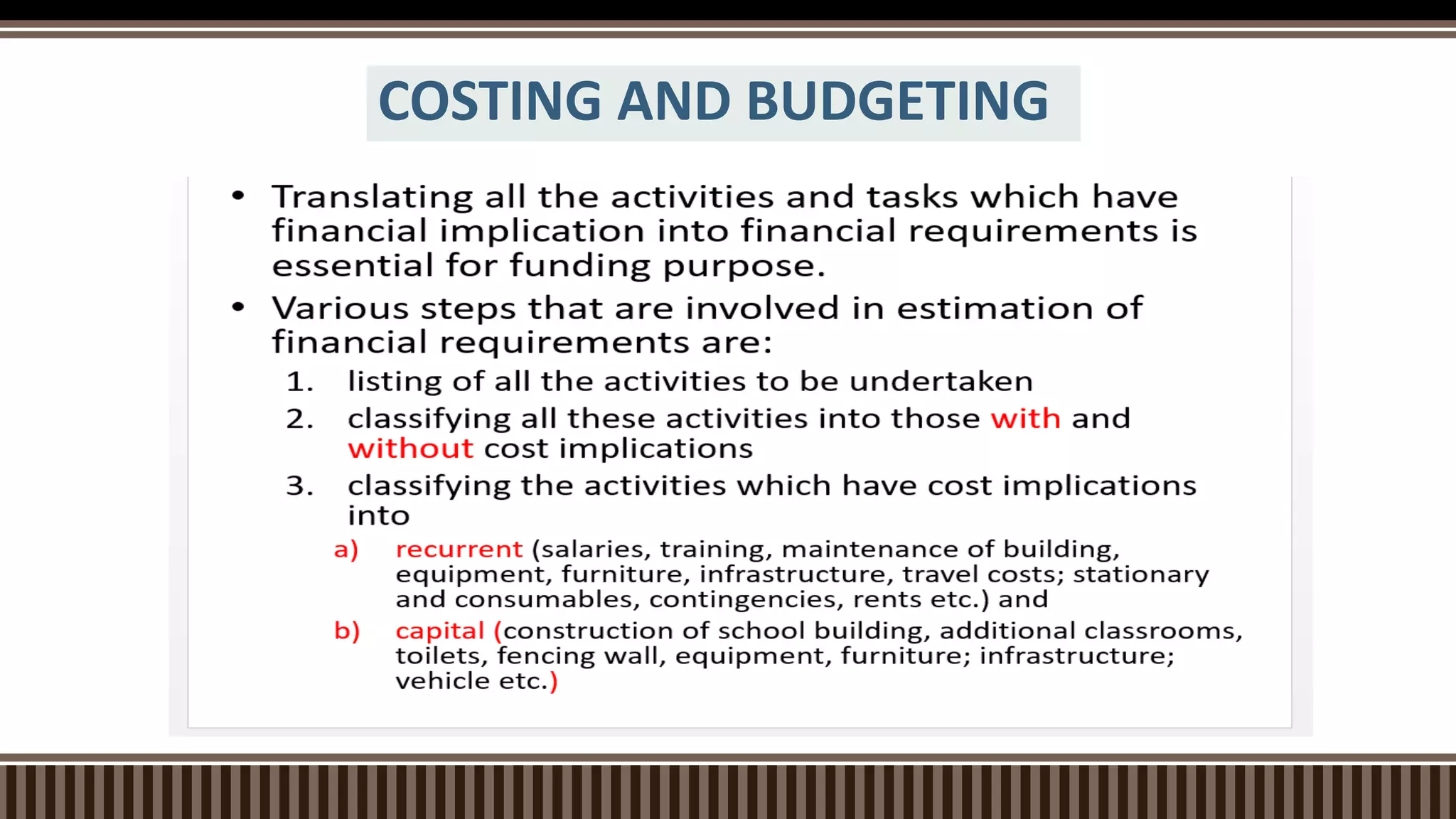
COSTING AND BUDGETING
Sir alvin educ dpe 404

Sir alvin educ dpe 404

  • 1.
    STRATEGIC PLANNING & MANAGEMENT (ThePlanning Process) by: ALVIN L. GUILLERMO, MAeD PhD-Educ. Management-Student https://www.google.com/search?q=short+video+clip+about+strategic+pla nning+process&rlz=1C1GCEA_enPH971PH971&oq=short+video+clip+about +strategic+planning+process&aqs=chrome..69i57.21105j0j7&sourceid=chr ome&ie=UTF-8#kpvalbx=_PWAiYojtO8qM-QbYgrNo12
  • 2.
    PLAN AND PLANNING -aplan is the product of a planning process in which a direction to a desired destination ROADMAP REMEDIABLE ROBUST
  • 3.
    STRATEGIC PLANNING -process ofsetting goals, deciding on actions to achieve those goals -used by planners to replace the traditional term known as long-range planning COMPREHENSIVE THOUGHTFUL WELL-PLACED NATURE
  • 4.
    PURPOSE OF ASTRATEGIC PLAN 1. Communicate the priorities of an organization, 2.Ensure that employees and stakeholders work toward common goals, mission, vision and strategies. 3. Focus energy and resources, 4. Establish agreement around intended outcomes/results 5. Strengthen operations 6.Assess and adjust the organization's direction in response to a changing environment.
  • 5.
    STRATEGIC PLANNING PROCESS -a collective, institution or organization-wide process for developing creative initiatives that channel resources to fulfil the institution's mission and take maximum advantage of trends in the external and internal environment process of setting goals, deciding on actions to achieve those goals, and mobilizing the resources needed to take those actions.
  • 6.
    MAIN FOCUS OFSTRATEGIC PLANNING PROCESS 1.Premising through environmental scanning 2.Purpose setting: envisioning and missioning 3. Policy formulation 4.Priority setting and phasing 5. Practical reforms(structures, styles) 6. Projection of costs 7.Procedure of monitoring and assessment
  • 8.
    A STRATEGIC FORMULATION(THE ADA FRAMEWORK)
  • 9.
    1. STRATEGIC ANALYSIS Thisactivity can include conducting some sort of scan, or review, of the organization's environment (for example, of the political, social, economic and technical environment). - driving force in the environment - SWOT of institution
  • 14.
    2. SETTING DIRECTION -Planners carefully come to conclusions about what the organization must do as a result of the situation analysis. - Goals should be designed and worded as much as possible driving force in the environment
  • 15.
    - Strategic "philosophy".This includes identifying or updating the mission, vision and/or values statements. 1. Mission statements are brief written descriptions of the purpose of the organization. An overall mission statement A specific purpose statement
  • 16.
    2. Vision statementsare usually a compelling description of how the organization will or should operate at some point in the future and of how customers or clients are benefiting from the organization's products and services.
  • 17.
    3. Values statementslist the overall priorities in how the organization will operate. -Moral values are values that suggest overall priorities in how people ought to act in the world. -Operational values which suggest overall priorities for the organization.
  • 18.
    TARGET SETTING 1. Knowinggovernment’s dreams or intentions (or policy directions or points on government’s agenda) for the next few years. 2. Translating each of the strategic policies into specific, measurable and achievable targets to achieve each of the policies.
  • 22.
    3. STRATEGIC ACTIONPLANNING Goals (ends) Objectives Strategies (means) Tactics Responsibilities Timeline -Action planning is carefully laying out how the strategic goals will be accomplished.
  • 23.
  • 24.
    STRATEGIC PLANNING ASA PROCESS The process may be formal or informal and is typically iterative, with feedback loops throughout the process. Some elements of the process may be continuous and others may be executed as discrete projects with a definitive start and end during a period. The end result is the organization's strategy, including a diagnosis of the environment and competitive situation, a guiding policy on what the organization intends to accomplish, and key initiatives or action plans for achieving the guiding policy.
  • 25.
    STRATEGIC PLANNING ASAN INPUT  Data is gathered from a variety of sources, such as interviews with key executives, review of publicly available documents on the competition or market, primary research (e.g., visiting or observing competitor places of business or comparing prices), industry studies, etc.  Inputs are gathered to help support an understanding of the competitive environment and its opportunities and risks.
  • 26.
    STRATEGIC PLANNING ASAN OUTPUT -The output of strategic planning includes documentation and communication describing the organization's strategy and how it should be implemented, sometimes referred to as the strategic plan.  diagnosis  guiding policy  strategic plan
  • 27.
    STRATEGIC PLANNING ASAN OUTPUT • Monitoring progress towards the objective MONITORING DOCUMENT • Plan a financial statement FINANCIAL DOCUMENT • Describe the expected financial performance of the organization ANNUAL BUDGET
  • 28.
    STRATEGIC ACTION PLAN/PROGRAMING •Anaction plan goes beyond policy statements (options and strategies) and list of activities to further define and prioritize actions, activities and required resources . ACTION PLAN •Programming in preparation for implementation by translating the policy directions to operational terms PREPARATION FOR IMPLEMENTATION •In this section, efforts are made to programme the activities required to implement each policy direction by establishing the timing, indicating the needed resources, distributing responsibilities, preparing the budgets, etc. PROGRAM ACTIVITIES •Task of planners is to identify and order the concepts to be used such as objectives, results, actions, activities, measurements, resources, etc HUMAN RESOURCE
  • 29.
  • 30.
  • 31.
    COSTING AND BUDGETING It's common to develop an annual plan (sometimes called the operational plan or management plan), which includes the strategic goals, strategies, objectives, responsibilities and timelines that should be done in the coming year.  Usually, budgets are included in the strategic and annual plan, and with work plans.
  • 32.
  • 33.