STRATEGIC PLANNING
What we will do?
Develop a strategic plan that is directly informed
by our own wisdom and experiences
STRATEGIC PLANNING
What’s this all about?
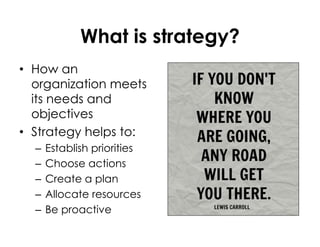
What is strategy?
• How an
organization meets
its needs and
objectives
• Strategy helps to:
– Establish priorities
– Choose actions
– Create a plan
– Allocate resources
– Be proactive
What is a strategic plan?
• A document that
says why an
organization exists,
what it aims to do,
and how it will do it
• It helps to focus the
organization’s vision
and priorities
Strategic planning does not…
• Predict the future
• Replace good leadership and judgment
• Follow a smooth, straightforward process
A strategic plan is a living document — you
can adapt it as needed!
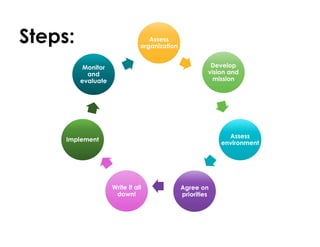
Steps: Assess
organization
Assess
organization
Develop
vision and
mission
Develop
vision and
mission
Assess
environment
Assess
environment
Agree on
priorities
Agree on
priorities
Write it all
down!
Write it all
down!
Implement
Implement
Monitor
and
evaluate
Monitor
and
evaluate
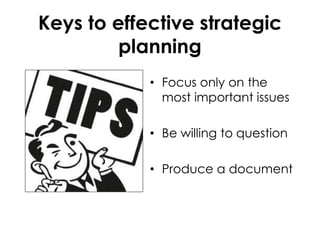
Keys to effective strategic
planning
• Focus only on the
most important issues
• Be willing to question
• Produce a document
VISION
What does success look like?
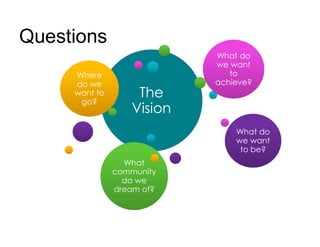
Questions
The
Vision
The
Vision
Where
do we
want to
go?
Where
do we
want to
go?
What do
we want
to
achieve?
What do
we want
to
achieve?
What do
we want
to be?
What do
we want
to be?
What
community
do we
dream of?
What
community
do we
dream of?
MISSION
Why do we exist?
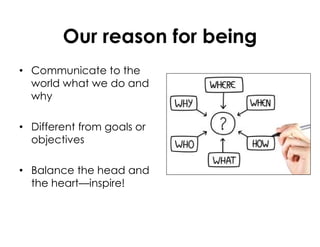
Our reason for being
• Communicate to the
world what we do and
why
• Different from goals or
objectives
• Balance the head and
the heart—inspire!
ASSESSING OUR ENVIRONMENT
Where do we find ourselves?
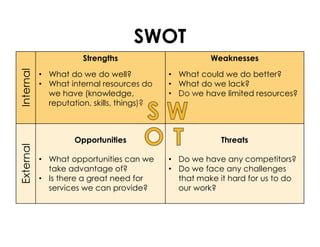
SWOT
Weaknesses
• What could we do better?
• What do we lack?
• Do we have limited resources?
Strengths
• What do we do well?
• What internal resources do
we have (knowledge,
reputation, skills, things)?
Internal
Threats
• Do we have any competitors?
• Do we face any challenges
that make it hard for us to do
our work?
Opportunities
• What opportunities can we
take advantage of?
• Is there a great need for
services we can provide?
External
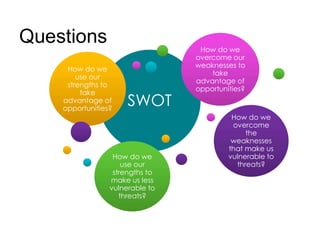
Questions
SWOT
SWOT
How do we
use our
strengths to
take
advantage of
opportunities?
How do we
use our
strengths to
take
advantage of
opportunities?
How do we
overcome our
weaknesses to
take
advantage of
opportunities?
How do we
overcome our
weaknesses to
take
advantage of
opportunities?
How do we
overcome
the
weaknesses
that make us
vulnerable to
threats?
How do we
overcome
the
weaknesses
that make us
vulnerable to
threats?
How do we
use our
strengths to
make us less
vulnerable to
threats?
How do we
use our
strengths to
make us less
vulnerable to
threats?
SETTING PRIORITIES
How can we be most effective?
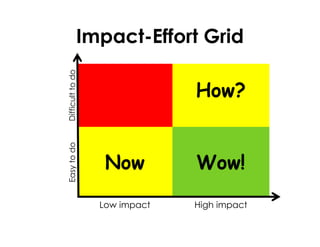
Impact-Effort Grid
How?
Difficult
to
do
Wow!
Now
Easy
to
do
High impact
Low impact
GOALS & OBJECTIVES
How does it all fit together?
Goals vs. Objectives
Goal
• A greater purpose
• A long-term outcome
• May not be easy to
measure
[Example: Support NWT
residents to make healthy
lifestyle choices that reduce
their risk of cancer.]
Objective
• A specific, short-term
action that will contribute
to achieving a goal
• Must be measurable
[Example: Create a website
with accurate and current
information about cancer
risk factors.]
SMART objectives
Specific – Who? What? Where? How?
Measurable – How many? How can this be measured?
Achievable – Is it possible?
Realistic – Is it possible given our time and resources available?
Timebound – When?
Each objective should be written in precise terms that leave no
room for misinterpretation.
[Example: Within 12 months, we will team with the local health
centre to recruit at least 20 men and women for colorectal
cancer screening.]
NEXT STEPS
What now?
• Produce a document
• Develop an action plan and implement
• Monitor and evaluate
• Share progress
• Review and revise
• Share
Your new strategic plan will help to guide you in the
difficult decisions you have to make as a committee—it
will help you to identify the activities that best fit with
your vision, mission, goals, and objectives.
Moving forward
BEHAVIOUR ENTREP 1 - STRATEGIC PLANNING.pdf

BEHAVIOUR ENTREP 1 - STRATEGIC PLANNING.pdf

  • 1.
  • 2.
    What we willdo? Develop a strategic plan that is directly informed by our own wisdom and experiences
  • 3.
  • 5.
    What is strategy? •How an organization meets its needs and objectives • Strategy helps to: – Establish priorities – Choose actions – Create a plan – Allocate resources – Be proactive
  • 6.
    What is astrategic plan? • A document that says why an organization exists, what it aims to do, and how it will do it • It helps to focus the organization’s vision and priorities
  • 7.
    Strategic planning doesnot… • Predict the future • Replace good leadership and judgment • Follow a smooth, straightforward process A strategic plan is a living document — you can adapt it as needed!
  • 8.
    Steps: Assess organization Assess organization Develop vision and mission Develop visionand mission Assess environment Assess environment Agree on priorities Agree on priorities Write it all down! Write it all down! Implement Implement Monitor and evaluate Monitor and evaluate
  • 9.
    Keys to effectivestrategic planning • Focus only on the most important issues • Be willing to question • Produce a document
  • 10.
  • 12.
    Questions The Vision The Vision Where do we want to go? Where dowe want to go? What do we want to achieve? What do we want to achieve? What do we want to be? What do we want to be? What community do we dream of? What community do we dream of?
  • 13.
  • 14.
    Our reason forbeing • Communicate to the world what we do and why • Different from goals or objectives • Balance the head and the heart—inspire!
  • 15.
    ASSESSING OUR ENVIRONMENT Wheredo we find ourselves?
  • 16.
    SWOT Weaknesses • What couldwe do better? • What do we lack? • Do we have limited resources? Strengths • What do we do well? • What internal resources do we have (knowledge, reputation, skills, things)? Internal Threats • Do we have any competitors? • Do we face any challenges that make it hard for us to do our work? Opportunities • What opportunities can we take advantage of? • Is there a great need for services we can provide? External
  • 17.
    Questions SWOT SWOT How do we useour strengths to take advantage of opportunities? How do we use our strengths to take advantage of opportunities? How do we overcome our weaknesses to take advantage of opportunities? How do we overcome our weaknesses to take advantage of opportunities? How do we overcome the weaknesses that make us vulnerable to threats? How do we overcome the weaknesses that make us vulnerable to threats? How do we use our strengths to make us less vulnerable to threats? How do we use our strengths to make us less vulnerable to threats?
  • 18.
    SETTING PRIORITIES How canwe be most effective?
  • 19.
  • 20.
    GOALS & OBJECTIVES Howdoes it all fit together?
  • 21.
    Goals vs. Objectives Goal •A greater purpose • A long-term outcome • May not be easy to measure [Example: Support NWT residents to make healthy lifestyle choices that reduce their risk of cancer.] Objective • A specific, short-term action that will contribute to achieving a goal • Must be measurable [Example: Create a website with accurate and current information about cancer risk factors.]
  • 22.
    SMART objectives Specific –Who? What? Where? How? Measurable – How many? How can this be measured? Achievable – Is it possible? Realistic – Is it possible given our time and resources available? Timebound – When? Each objective should be written in precise terms that leave no room for misinterpretation. [Example: Within 12 months, we will team with the local health centre to recruit at least 20 men and women for colorectal cancer screening.]
  • 23.
  • 24.
    • Produce adocument • Develop an action plan and implement • Monitor and evaluate • Share progress • Review and revise • Share Your new strategic plan will help to guide you in the difficult decisions you have to make as a committee—it will help you to identify the activities that best fit with your vision, mission, goals, and objectives. Moving forward