JOINT SSC STRATEGIC PLANNINGJOINT SSC STRATEGIC PLANNING
WORKSHOPWORKSHOP
October 1 – 2, 2015October 1 – 2, 2015
Multi- media Center, Malama, CampusMulti- media Center, Malama, Campus
BRENT C. BEGAY
Apayao State College
If you do not know where you
are going, probably, you will
end up somewhere else.
 A development plan is a document which
details the overall strategy of an
organization for proper planning and
sustainable development.
 It generally consists of a written statement
and accompanying plans and strategic
interventions.
 The plan usually includes the vision,
mission, goals and objectives of the
organization which are reinforced by more
detailed policies and objectives at the
department levels.
 Strategic planning is a tool for organizing the
present on the basis of the projections of the
desired future. That is, strategic plan is a road
map to lead an organization from where it is now
to where it would like to be in three or six years.
 Strategic planning is a continuous and systematic
process where people make decisions about
intended future outcomes, how outcomes are to
be accomplished, and how success is measured
and evaluated.
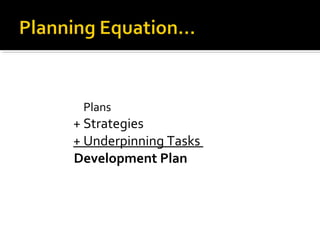
Plans
+ Strategies
+ Underpinning Tasks
Development Plan
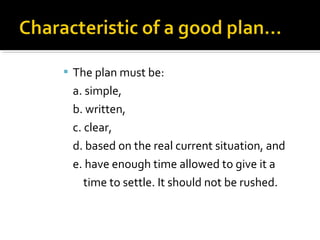
 The plan must be:
a. simple,
b. written,
c. clear,
d. based on the real current situation, and
e. have enough time allowed to give it a
time to settle. It should not be rushed.
 Focus and flexibility
 Action orientation
 Coordination
 Time management
 Control
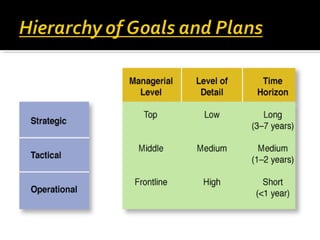
Tactical planning
 A set of procedures for translating broad
strategic goals and plans into specific goals
and plans that are relevant to a distinct
portion of the organization, such as a
functional area like marketing.
Operational planning
 The process of identifying the specific
procedures and processes required at
lower levels of the organization.
 The purpose of strategic or
short/medium/long range planning is to assist
an organization in establishing priorities and
to better serve the needs of its constituency.
 A strategic plan must be flexible and practical
and yet serve as a guide to implementing
programs, evaluating how these programs
are doing, and making adjustments when
necessary.
 the thoughts, feelings, ideas, and wants of
the developers and mold them along with the
organization’s purpose, mission, and
regulations into an integrated document –
Development Plan.
 Implementation, in essence, pulls a plan apart and
diffuses it throughout an organization. Every unit
within the organization which is involved must
then accept the plan, agree to its discretion, and
implement specific actions.
 In order to effectively and efficiently implement a
plan, all individuals involved in its implementation
must function as a whole or the plan is destined for
failure.
VISION AND MISSION
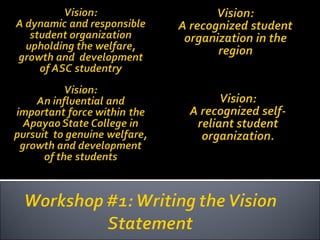
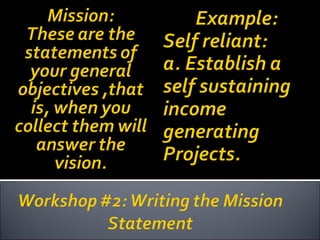
 Identification of the organization’s vision and mission is the
first step of any strategic planning process. The
organization’s vision sets out the reasons for organization’s
existence and the “ideal” state that the organization aims to
achieve; the mission identifies major goals and performance
objectives. Both are defined within the framework of the
organization’s philosophy, and are used as a context for
development and evaluation of intended and emergent
strategies. One cannot overemphasize the importance of a
clear vision and mission; none of the subsequent steps will
matter if the organization is not certain where it is headed.
ENVIRONMENTAL SCAN
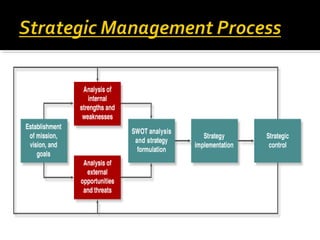
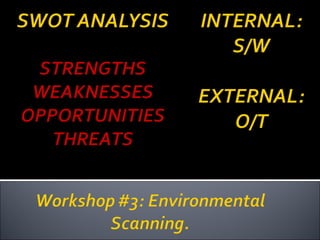
 Once the vision and mission are clearly identified, the
organization must analyze its external and internal
environment. The environmental scan, performed
within the framework of the “Five Forces Model” and
“SWOT”, analyzes information about organization’s
external environment (economic, social, demographic,
political, legal, technological, and international
factors), the industry, and internal organizational
factors.
GAP ANALYSIS
 Organizations evaluate the difference between their current position and
desired future through gap analysis. As a result, the organization can
develop specific strategies and allocate resources to close the gap, and
achieve its desired state.
 A technique that use to determine what steps need to be taken in order
to move from its current state to its desired - future state. Also called
need-gap analysis needs analysis and needs assessment.
 Gap analysis consists of (1) listing of characteristic factors (such as
attributes, competencies, performance levels) of the present
situation(“what is”).(2) listing factors needed to achieve future objectives
(“what should be”), and then (3) highlighting the gaps that exist and need to
be filled. Gap analysis forces an organization to reflect on who it is and ask
who they want to be in the future.
BENCHMARKING
 Measuring and comparing the organization’s
operations, practices, and performance against other is
useful for identifying “best” practices. Through an
ongoing systematic benchmarking process,
organization find a reference point for setting their
own goals and targets.
STRATEGIC ISSUES
 The organization determines its strategic issues based
on (and consistent with) its vision and mission within
the framework of environmental and other analyses.
Strategic issues are the fundamental issues the
organization has to address to achieve its mission and
move towards its desired future.
STRATEGIC PROGRAMMING (Goal Setting)
 Strategic goals are the milestones the organization aims to
achieve that evolve from the strategic issues. The SMART
goals model is essential to setting meaningful goals. The
smart goals are Specific, Measurable, Attainable, Realistic,
and Time/cost bounded.
 “Action plans... define how we get to where we want to
go”, the steps required to reach our strategic goals.
 Tactics are specific actions used to achieve the strategic
goals and implement the strategic plans.
EMERGENT STRATEGIES
 Unpredicted and unintended events frequently occur
that differ from the organization’s intended strategies,
and the organization must respond. Emergent strategy
is “a pattern, a consistency of behaviour of time,” a
realized pattern that was not expressly intended” in the
original planning of strategy. It results from series of
actions converging into a consistent pattern.
EVALUATION OF STRATEGY
 Periodic evaluations of strategies, tactics, and action
programs are essential to assessing success of the strategic
planning process. It is important to measure performance
at least annually (but preferably more often), to evaluate
the effect of specific actions on interim results and on the
organization’s vision and mission. The organization should
measure current performance against previously set
expressions, and consider any changes or events that may
have impacted the desired course of actions.
REVIEW OF THE STRATEGIC PLAN
 Periodic evaluations of strategies, tactics, and action
programs are essential to assessing success of the strategic
planning process. It is important to measure performance
at least annually (but preferably more often), to evaluate
the effect of specific actions on interim results and on the
organization’s vision and mission. The organization should
measure current performance against previously set
expressions, and consider any changes or events that may
have impacted the desired course of actions.
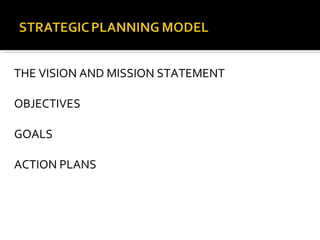
THE VISION AND MISSION STATEMENT
OBJECTIVES
GOALS
ACTION PLANS
THE VISION AND MISSION STATEMENT
 This is the agreed-upon statement by the organization
and explains the reason for its existence. It is
necessarily broad to encompass the diversity within the
organization.
THE OBJECTIVES
 The objectives are the areas of emphasis within the
organization. Rather than specific statements with a
specific goal, objectives state that the organization
plans to continue to do quality work in the following
areas. These objectives ore areas of emphasis need to
be attained by discussion and review of the
organization’s current activities as well as activities in
which it would like to participate.
GOALS
 These need to be both long-term and short term goals;
six months, one-year, three-year, and six-year goals
need to be set so that the strategy for reaching these
goals can be outlined in the plan. Most organizations
recommend setting the long-term goals first and then
setting the short-term goals: those goals which can be
reached as steps to attaining the long-term goal.
ACTION PLAN
 The action plan should be designed after the main
goals and objectives have been set in order to attain
the mission in a straightforward and measurable way.
With an action plan, the goals themselves can be
obtained. Without the action plan, and the measures it
entails, it would be impossible to implement the plan
and measure its success.
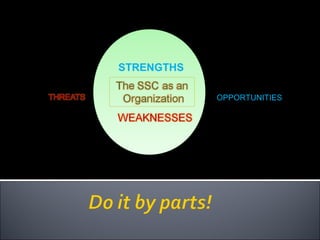
STRENGTHS
OPPORTUNITIES
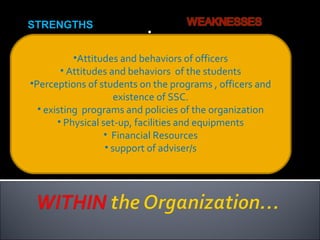
STRENGTHS
•
•Attitudes and behaviors of officers
• Attitudes and behaviors of the students
•Perceptions of students on the programs , officers and
existence of SSC.
• existing programs and policies of the organization
• Physical set-up, facilities and equipments
• Financial Resources
• support of adviser/s
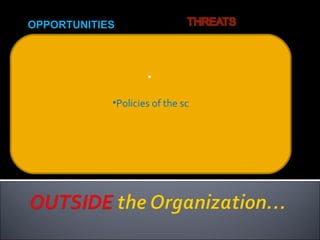
OPPORTUNITIES
•
•Policies of the sc

Strategic Planning

  • 1.
    JOINT SSC STRATEGICPLANNINGJOINT SSC STRATEGIC PLANNING WORKSHOPWORKSHOP October 1 – 2, 2015October 1 – 2, 2015 Multi- media Center, Malama, CampusMulti- media Center, Malama, Campus BRENT C. BEGAY Apayao State College
  • 2.
    If you donot know where you are going, probably, you will end up somewhere else.
  • 3.
     A developmentplan is a document which details the overall strategy of an organization for proper planning and sustainable development.  It generally consists of a written statement and accompanying plans and strategic interventions.  The plan usually includes the vision, mission, goals and objectives of the organization which are reinforced by more detailed policies and objectives at the department levels.
  • 4.
     Strategic planningis a tool for organizing the present on the basis of the projections of the desired future. That is, strategic plan is a road map to lead an organization from where it is now to where it would like to be in three or six years.  Strategic planning is a continuous and systematic process where people make decisions about intended future outcomes, how outcomes are to be accomplished, and how success is measured and evaluated.
  • 5.
    Plans + Strategies + UnderpinningTasks Development Plan
  • 6.
     The planmust be: a. simple, b. written, c. clear, d. based on the real current situation, and e. have enough time allowed to give it a time to settle. It should not be rushed.
  • 7.
     Focus andflexibility  Action orientation  Coordination  Time management  Control
  • 9.
    Tactical planning  Aset of procedures for translating broad strategic goals and plans into specific goals and plans that are relevant to a distinct portion of the organization, such as a functional area like marketing.
  • 10.
    Operational planning  Theprocess of identifying the specific procedures and processes required at lower levels of the organization.
  • 11.
     The purposeof strategic or short/medium/long range planning is to assist an organization in establishing priorities and to better serve the needs of its constituency.  A strategic plan must be flexible and practical and yet serve as a guide to implementing programs, evaluating how these programs are doing, and making adjustments when necessary.
  • 12.
     the thoughts,feelings, ideas, and wants of the developers and mold them along with the organization’s purpose, mission, and regulations into an integrated document – Development Plan.
  • 13.
     Implementation, inessence, pulls a plan apart and diffuses it throughout an organization. Every unit within the organization which is involved must then accept the plan, agree to its discretion, and implement specific actions.  In order to effectively and efficiently implement a plan, all individuals involved in its implementation must function as a whole or the plan is destined for failure.
  • 15.
    VISION AND MISSION Identification of the organization’s vision and mission is the first step of any strategic planning process. The organization’s vision sets out the reasons for organization’s existence and the “ideal” state that the organization aims to achieve; the mission identifies major goals and performance objectives. Both are defined within the framework of the organization’s philosophy, and are used as a context for development and evaluation of intended and emergent strategies. One cannot overemphasize the importance of a clear vision and mission; none of the subsequent steps will matter if the organization is not certain where it is headed.
  • 16.
    ENVIRONMENTAL SCAN  Oncethe vision and mission are clearly identified, the organization must analyze its external and internal environment. The environmental scan, performed within the framework of the “Five Forces Model” and “SWOT”, analyzes information about organization’s external environment (economic, social, demographic, political, legal, technological, and international factors), the industry, and internal organizational factors.
  • 17.
    GAP ANALYSIS  Organizationsevaluate the difference between their current position and desired future through gap analysis. As a result, the organization can develop specific strategies and allocate resources to close the gap, and achieve its desired state.  A technique that use to determine what steps need to be taken in order to move from its current state to its desired - future state. Also called need-gap analysis needs analysis and needs assessment.  Gap analysis consists of (1) listing of characteristic factors (such as attributes, competencies, performance levels) of the present situation(“what is”).(2) listing factors needed to achieve future objectives (“what should be”), and then (3) highlighting the gaps that exist and need to be filled. Gap analysis forces an organization to reflect on who it is and ask who they want to be in the future.
  • 18.
    BENCHMARKING  Measuring andcomparing the organization’s operations, practices, and performance against other is useful for identifying “best” practices. Through an ongoing systematic benchmarking process, organization find a reference point for setting their own goals and targets.
  • 19.
    STRATEGIC ISSUES  Theorganization determines its strategic issues based on (and consistent with) its vision and mission within the framework of environmental and other analyses. Strategic issues are the fundamental issues the organization has to address to achieve its mission and move towards its desired future.
  • 20.
    STRATEGIC PROGRAMMING (GoalSetting)  Strategic goals are the milestones the organization aims to achieve that evolve from the strategic issues. The SMART goals model is essential to setting meaningful goals. The smart goals are Specific, Measurable, Attainable, Realistic, and Time/cost bounded.  “Action plans... define how we get to where we want to go”, the steps required to reach our strategic goals.  Tactics are specific actions used to achieve the strategic goals and implement the strategic plans.
  • 21.
    EMERGENT STRATEGIES  Unpredictedand unintended events frequently occur that differ from the organization’s intended strategies, and the organization must respond. Emergent strategy is “a pattern, a consistency of behaviour of time,” a realized pattern that was not expressly intended” in the original planning of strategy. It results from series of actions converging into a consistent pattern.
  • 22.
    EVALUATION OF STRATEGY Periodic evaluations of strategies, tactics, and action programs are essential to assessing success of the strategic planning process. It is important to measure performance at least annually (but preferably more often), to evaluate the effect of specific actions on interim results and on the organization’s vision and mission. The organization should measure current performance against previously set expressions, and consider any changes or events that may have impacted the desired course of actions.
  • 23.
    REVIEW OF THESTRATEGIC PLAN  Periodic evaluations of strategies, tactics, and action programs are essential to assessing success of the strategic planning process. It is important to measure performance at least annually (but preferably more often), to evaluate the effect of specific actions on interim results and on the organization’s vision and mission. The organization should measure current performance against previously set expressions, and consider any changes or events that may have impacted the desired course of actions.
  • 24.
    THE VISION ANDMISSION STATEMENT OBJECTIVES GOALS ACTION PLANS
  • 25.
    THE VISION ANDMISSION STATEMENT  This is the agreed-upon statement by the organization and explains the reason for its existence. It is necessarily broad to encompass the diversity within the organization.
  • 26.
    THE OBJECTIVES  Theobjectives are the areas of emphasis within the organization. Rather than specific statements with a specific goal, objectives state that the organization plans to continue to do quality work in the following areas. These objectives ore areas of emphasis need to be attained by discussion and review of the organization’s current activities as well as activities in which it would like to participate.
  • 27.
    GOALS  These needto be both long-term and short term goals; six months, one-year, three-year, and six-year goals need to be set so that the strategy for reaching these goals can be outlined in the plan. Most organizations recommend setting the long-term goals first and then setting the short-term goals: those goals which can be reached as steps to attaining the long-term goal.
  • 28.
    ACTION PLAN  Theaction plan should be designed after the main goals and objectives have been set in order to attain the mission in a straightforward and measurable way. With an action plan, the goals themselves can be obtained. Without the action plan, and the measures it entails, it would be impossible to implement the plan and measure its success.
  • 34.
  • 35.
    STRENGTHS • •Attitudes and behaviorsof officers • Attitudes and behaviors of the students •Perceptions of students on the programs , officers and existence of SSC. • existing programs and policies of the organization • Physical set-up, facilities and equipments • Financial Resources • support of adviser/s
  • 36.