INL
Strategic Planning &
Technology Management
Dan Yurman, Strategic Planning Office
Idaho National Laboratory, Idaho Falls, ID 83415
July 17, 2001
Contents
• Situation Analysis (SWOT)
• Priority Issues
• Mission, Vision Statements
• Strategies
• Accountability & Reviews
Quality Quotation
In a process in which requirements are not set
or vague, nonconformance and quality will
be randomly distributed!
Dan Yurman, INEEL 1991
Strategies
• Measures of success
– Expected accomplishments over time
– Critical mission elements
• Expected performance
– Financials
– Program measures
Accountability
• Senior management reviews
accomplishments against strategies
– Quarterly quantitative & qualitative measures
• All managers held accountable for results
relative to commitments in strategic plans at
their respective levels
What Does Management Want
from Strategic Analysis?
• Is it real?
– Product, market?
• Can we win?
– How competitive is our product, company?
• Is it worth it?
– Risk, return?
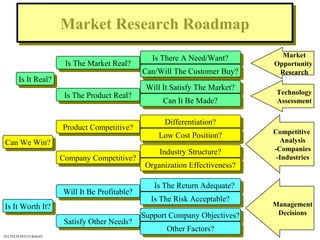
Market Research RoadmapMarket Research Roadmap
Is It Real?Is It Real?
Can We Win?Can We Win?
Is It Worth It?Is It Worth It?
Is The Market Real?Is The Market Real?
Is The Product Real?Is The Product Real?
Product Competitive?Product Competitive?
Company Competitive?Company Competitive?
Will It Be Profitable?Will It Be Profitable?
Satisfy Other Needs?Satisfy Other Needs?
Is There A Need/Want?Is There A Need/Want?
Can/Will The Customer Buy?Can/Will The Customer Buy?
Will It Satisfy The Market?Will It Satisfy The Market?
Can It Be Made?Can It Be Made?
Differentiation?Differentiation?
Low Cost Position?Low Cost Position?
Industry Structure?Industry Structure?
Organization Effectiveness?Organization Effectiveness?
Is The Return Adequate?Is The Return Adequate?
Is The Risk Acceptable?Is The Risk Acceptable?
Support Company Objectives?Support Company Objectives?
Market
Opportunity
Research
Technology
Assessment
Competitive
Analysis
-Companies
-Industries
Other Factors?Other Factors?
Management
Decisions
TELTECH.PPT/YURMAN
Ten Killer Questions
1. Is the proposal technically valid / feasible /
defensible?
2. Is it technically interesting, a paradigm
shift, something worthy of our firm?
3. Who else besides you thinks this is a good
idea? What would our competitors think?
4. How much investment is required to
succeed?
Ten Killer Questions
5. What is the near-term sales potential (12
-24 months)?
6. What effect will this have on other new
business or existing business?
7. Describe any required investments, obvious
advantages or likely difficulties?
Ten Killer Questions
8. Does the proposal have strategic value,
e.g., does it advance the firm”s collective
future?
9. What is the likelihood of failure?
10. If our decision to proceed were to be
reported in the Wall Street Journal, would
we look good?
Strategic Intent
• Based on product offerings and customer
needs
• Derived from situation analysis
• Focused on business objectives for sales
and profits
• Driven by competitive pressures
• Satisfied in bottom line results
How to Evaluate the Opportunity
• Fit with business strategy?
• Durability of advantages gained?
• Competitive position of the technology?
• Risks of technical / business success?
• R&D Costs v. ROI?
• Time to Market v. Competition?
What to Look For in Strategy
• Talent – ability to recognize market
opportunities and customer needs
• Technology – capability to deliver an
innovative product or service to market
• Capital – capacity to commit a pool of
funds
• Know How – synergy between talent,
technology, and capital
Competitive Advantage
• Market position
• Competitive impact of technologies
• Assessment of market pull
• S.W.O.T.
• Marketing mix
Core Competencies
• Specific expertise of the firm
• Combines a company’s knowledge, skills,
and values into cohesive units
• Provides distinct values to customers
• Basis for technology differentiation
• Sets the firm apart from the competition
• Difficult for others to imitate
Core Competencies
• Most firms have two-or-three tops
• Examples
– Honda; engine design and manufacturing
– Cannon; lasers and optics
– Dell; mass customization of personal computers
– Texas Instruments; digital signal processing
semiconductors
Key Capabilities
• Form the basis for core competencies
• Specific science, engineering, and business
disciplines
• Excellence in business practices
• Management skill in organizing talent,
technology, capital, and know-how
Technological Competitive
Advantage
• Benefits of crafting a product portfolio
• Concept of technology differentiation
• Concept of technology maturity
• Benefits of competitive advantage
• Strategies for success in the marketplace
Benefits of Crafting
the Product Portfolio
• The firm is able to articulate why it is
investing in specific technologies
• The importance of these technologies can
be tied to the company’s long-term success
• Each technology is part of a portfolio that
balances short-and-long-term risks and
rewards
Technology Differentiation
Key Questions
• What is the fit between each technology
project and the overall company strategy?
• What is the position of each technology in
its life cycle (maturity)?
• What are the past and future contributions
of each technology?
– Sales, Market Share, Profits?
Technology Maturity
• Value of investments to date v. expectations
of new products in the future?
• Risks and rewards of using “time-to-
market” as a driver of profitability?
• Is it an augmentation or replacement
technology in terms of industry impacts and
customer acceptance?
Technology Strategy
Key Questions
• Does the firm have a strategy for its
portfolio of technologies or is it just a
collection of projects?
• How does the company’s technology
strategy compare with the competition’s?
• Is the company making effective use of
partners, joint R&D projects, and strategic
alliances?
Technology Strategy
• Decide whether the relationships between
risks, rewards, and time-to-market justify
each project.
• Ask whether customers really need / want
the technology, and if so, are they willing to
pay for it, and, at what price?
Technology Strategy
• Convert technology development and
uncertainties to probabilities of success at
each stage of development
• Define each technology development stage
in terms of success factors, e.g., market
needs, functionality, that are necessary to
proceed to the next stage.
Technological Competitive
Advantage
• Measures the degree to which a company
has mastered the key technologies in its
industry
• Compares overall mastery in core
competencies among key competitors
• Effectively promotes technologies in terms
of products, pricing, distribution, and direct
marketing
Competitive Positioning
Pacing Technology
• Potential to change the entire basis of
competition, but is not yet embodied in a
product
• Often develops into products, but
sometimes forms the basis of a key
capabilitiy
Competitive Positioning
Key Technology
• Most critical to competitive success
• Offers opportunities for process or product
differentiation or cost competitiveness
• Offers genuine competitive advantage when
embodied in a strategic plan
• Must be exploited intelligently or not at all
Competitive Positioning
Base Technology
• Necessary and essential to the business
• Offers less potential in terms of competitive
advantage
• Typically in widespread use in the industry
• Can descend into commodity pricing
Key Questions for Setting
the Marketing Mix
• Product – is the offering a product, service,
or both?
• Price – what is the value of the technology
to the customer? Commodity or Premium?
• Distribution – how is the product / service
made available to the customer?
• Promotion – how is the offering marketed?
Gaining Acceptance
• Subject business plans to reality checks
– Technical expertise is not a substitute for
market knowledge
• Get direct funding for projects
– Internal customers will pay for results
they really need
Keeping Your Sanity
• Never put a frog in lukewarm water
– “Disruptive technologies can sneak up on you
• You can lead a fish to water but you can’t
make it leap
– There will always be resistance to adoption of
new technologies
Keeping You Sanity
• Stuffing is for turkeys
– The “value proposition” of a new technology must be
immediately obvious. If you have to bury your
customer in paper to explain it, your product may not
be ready for market.
• Choose honor before elegance
– A working technology beats hype nine times out of ten

Strategic planning and technology management

  • 1.
    INL Strategic Planning & TechnologyManagement Dan Yurman, Strategic Planning Office Idaho National Laboratory, Idaho Falls, ID 83415 July 17, 2001
  • 2.
    Contents • Situation Analysis(SWOT) • Priority Issues • Mission, Vision Statements • Strategies • Accountability & Reviews
  • 3.
    Quality Quotation In aprocess in which requirements are not set or vague, nonconformance and quality will be randomly distributed! Dan Yurman, INEEL 1991
  • 4.
    Strategies • Measures ofsuccess – Expected accomplishments over time – Critical mission elements • Expected performance – Financials – Program measures
  • 5.
    Accountability • Senior managementreviews accomplishments against strategies – Quarterly quantitative & qualitative measures • All managers held accountable for results relative to commitments in strategic plans at their respective levels
  • 6.
    What Does ManagementWant from Strategic Analysis? • Is it real? – Product, market? • Can we win? – How competitive is our product, company? • Is it worth it? – Risk, return?
  • 7.
    Market Research RoadmapMarketResearch Roadmap Is It Real?Is It Real? Can We Win?Can We Win? Is It Worth It?Is It Worth It? Is The Market Real?Is The Market Real? Is The Product Real?Is The Product Real? Product Competitive?Product Competitive? Company Competitive?Company Competitive? Will It Be Profitable?Will It Be Profitable? Satisfy Other Needs?Satisfy Other Needs? Is There A Need/Want?Is There A Need/Want? Can/Will The Customer Buy?Can/Will The Customer Buy? Will It Satisfy The Market?Will It Satisfy The Market? Can It Be Made?Can It Be Made? Differentiation?Differentiation? Low Cost Position?Low Cost Position? Industry Structure?Industry Structure? Organization Effectiveness?Organization Effectiveness? Is The Return Adequate?Is The Return Adequate? Is The Risk Acceptable?Is The Risk Acceptable? Support Company Objectives?Support Company Objectives? Market Opportunity Research Technology Assessment Competitive Analysis -Companies -Industries Other Factors?Other Factors? Management Decisions TELTECH.PPT/YURMAN
  • 8.
    Ten Killer Questions 1.Is the proposal technically valid / feasible / defensible? 2. Is it technically interesting, a paradigm shift, something worthy of our firm? 3. Who else besides you thinks this is a good idea? What would our competitors think? 4. How much investment is required to succeed?
  • 9.
    Ten Killer Questions 5.What is the near-term sales potential (12 -24 months)? 6. What effect will this have on other new business or existing business? 7. Describe any required investments, obvious advantages or likely difficulties?
  • 10.
    Ten Killer Questions 8.Does the proposal have strategic value, e.g., does it advance the firm”s collective future? 9. What is the likelihood of failure? 10. If our decision to proceed were to be reported in the Wall Street Journal, would we look good?
  • 11.
    Strategic Intent • Basedon product offerings and customer needs • Derived from situation analysis • Focused on business objectives for sales and profits • Driven by competitive pressures • Satisfied in bottom line results
  • 12.
    How to Evaluatethe Opportunity • Fit with business strategy? • Durability of advantages gained? • Competitive position of the technology? • Risks of technical / business success? • R&D Costs v. ROI? • Time to Market v. Competition?
  • 13.
    What to LookFor in Strategy • Talent – ability to recognize market opportunities and customer needs • Technology – capability to deliver an innovative product or service to market • Capital – capacity to commit a pool of funds • Know How – synergy between talent, technology, and capital
  • 14.
    Competitive Advantage • Marketposition • Competitive impact of technologies • Assessment of market pull • S.W.O.T. • Marketing mix
  • 15.
    Core Competencies • Specificexpertise of the firm • Combines a company’s knowledge, skills, and values into cohesive units • Provides distinct values to customers • Basis for technology differentiation • Sets the firm apart from the competition • Difficult for others to imitate
  • 16.
    Core Competencies • Mostfirms have two-or-three tops • Examples – Honda; engine design and manufacturing – Cannon; lasers and optics – Dell; mass customization of personal computers – Texas Instruments; digital signal processing semiconductors
  • 17.
    Key Capabilities • Formthe basis for core competencies • Specific science, engineering, and business disciplines • Excellence in business practices • Management skill in organizing talent, technology, capital, and know-how
  • 18.
    Technological Competitive Advantage • Benefitsof crafting a product portfolio • Concept of technology differentiation • Concept of technology maturity • Benefits of competitive advantage • Strategies for success in the marketplace
  • 19.
    Benefits of Crafting theProduct Portfolio • The firm is able to articulate why it is investing in specific technologies • The importance of these technologies can be tied to the company’s long-term success • Each technology is part of a portfolio that balances short-and-long-term risks and rewards
  • 20.
    Technology Differentiation Key Questions •What is the fit between each technology project and the overall company strategy? • What is the position of each technology in its life cycle (maturity)? • What are the past and future contributions of each technology? – Sales, Market Share, Profits?
  • 21.
    Technology Maturity • Valueof investments to date v. expectations of new products in the future? • Risks and rewards of using “time-to- market” as a driver of profitability? • Is it an augmentation or replacement technology in terms of industry impacts and customer acceptance?
  • 22.
    Technology Strategy Key Questions •Does the firm have a strategy for its portfolio of technologies or is it just a collection of projects? • How does the company’s technology strategy compare with the competition’s? • Is the company making effective use of partners, joint R&D projects, and strategic alliances?
  • 23.
    Technology Strategy • Decidewhether the relationships between risks, rewards, and time-to-market justify each project. • Ask whether customers really need / want the technology, and if so, are they willing to pay for it, and, at what price?
  • 24.
    Technology Strategy • Converttechnology development and uncertainties to probabilities of success at each stage of development • Define each technology development stage in terms of success factors, e.g., market needs, functionality, that are necessary to proceed to the next stage.
  • 25.
    Technological Competitive Advantage • Measuresthe degree to which a company has mastered the key technologies in its industry • Compares overall mastery in core competencies among key competitors • Effectively promotes technologies in terms of products, pricing, distribution, and direct marketing
  • 26.
    Competitive Positioning Pacing Technology •Potential to change the entire basis of competition, but is not yet embodied in a product • Often develops into products, but sometimes forms the basis of a key capabilitiy
  • 27.
    Competitive Positioning Key Technology •Most critical to competitive success • Offers opportunities for process or product differentiation or cost competitiveness • Offers genuine competitive advantage when embodied in a strategic plan • Must be exploited intelligently or not at all
  • 28.
    Competitive Positioning Base Technology •Necessary and essential to the business • Offers less potential in terms of competitive advantage • Typically in widespread use in the industry • Can descend into commodity pricing
  • 29.
    Key Questions forSetting the Marketing Mix • Product – is the offering a product, service, or both? • Price – what is the value of the technology to the customer? Commodity or Premium? • Distribution – how is the product / service made available to the customer? • Promotion – how is the offering marketed?
  • 30.
    Gaining Acceptance • Subjectbusiness plans to reality checks – Technical expertise is not a substitute for market knowledge • Get direct funding for projects – Internal customers will pay for results they really need
  • 31.
    Keeping Your Sanity •Never put a frog in lukewarm water – “Disruptive technologies can sneak up on you • You can lead a fish to water but you can’t make it leap – There will always be resistance to adoption of new technologies
  • 32.
    Keeping You Sanity •Stuffing is for turkeys – The “value proposition” of a new technology must be immediately obvious. If you have to bury your customer in paper to explain it, your product may not be ready for market. • Choose honor before elegance – A working technology beats hype nine times out of ten

Editor's Notes

  • #7 Here are a few key questions you can answer to engage management in using CI in the entire product life cycle. Is the product real? What about the market? If customers have needs, what are they willing to pay to meet these needs? Can you firm make the product or deliver the service? Can your firm win in the marketplace? Is the product competitive? Is your firm competitive? What’s your key point of differentiation – cost, technology, etc? Where is your firm positioned in the industry, compared to what? Is it worth it? Will your company be profitable? What are the risk / return issues, and are there other company objectives that benefit?
  • #32 Explain the boiled frog parable Managers hate swimming upstream. Tailor your analyses to their style. Keep explanations simple. Don’t load up your products with data. Provide a summary up front and keep it to one page. Professional integrity is always more important than just looking good.