1
Overview of
SBI’s Opportunity Discovery Process (ODP)
Prepared by:
Dr. Chulho Park
Vice President
Strategic Business Insights
cpark@sbi-i.com
October 2015
2
Opportunity Discovery Process
for Value Creation
3
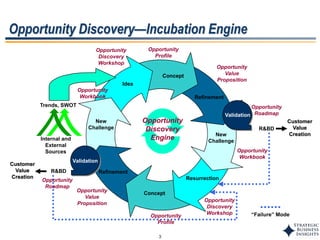
Opportunity Discovery—Incubation Engine
Opportunity
Profile
Trends, SWOT
Idea
Resurrection
New
Challenge
Refinement
Concept
Refinement
New
Challenge
Opportunity
Discovery
EngineInternal and
External
Sources
R&BD
R&BD
“Failure” Mode
Customer
Value
Creation
Customer
Value
Creation
Validation
Validation
Concept
Opportunity
Discovery
Workshop
Opportunity
Value
Proposition
Opportunity
Roadmap
Opportunity
Workbook
Opportunity
Workbook
Opportunity
Discovery
Workshop
Opportunity
Value
Proposition
Opportunity
Profile
Opportunity
Roadmap
4
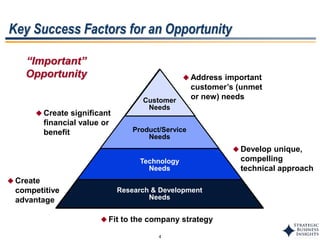
Key Success Factors for an Opportunity
 Address important
customer’s (unmet
or new) needs
 Create significant
financial value or
benefit
 Develop unique,
compelling
technical approach
 Create
competitive
advantage
 Fit to the company strategy
“Important”
Opportunity
Product/Service
Needs
Customer
Needs
Technology
Needs
Research & Development
Needs
5
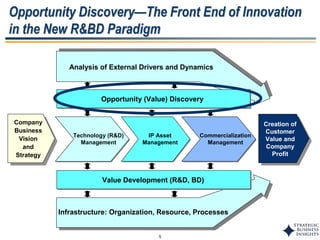
Opportunity Discovery—The Front End of Innovation
in the New R&BD Paradigm
Infrastructure: Organization, Resource, Processes
Analysis of External Drivers and Dynamics
Commercialization
Management
IP Asset
Management
Technology (R&D)
Management
Company
Business
Vision
and
Strategy
Opportunity (Value) Discovery
Value Development (R&D, BD)
Creation of
Customer
Value and
Company
Profit
Infrastructure: Organization, Resource, Processes
Analysis of External Drivers and Dynamics
Commercialization
Management
IP Asset
Management
Technology (R&D)
Management
Company
Business
Vision
and
Strategy
Company
Business
Vision
and
Strategy
Opportunity (Value) Discovery
Value Development (R&D, BD)
Creation of
Customer
Value and
Company
Profit
6
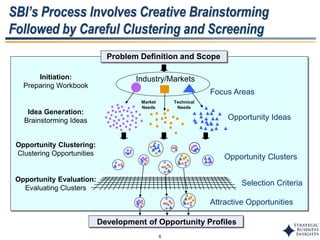
Problem Definition and Scope
Development of Opportunity Profiles
Initiation:
Preparing Workbook
Idea Generation:
Brainstorming Ideas
Opportunity Clustering:
Clustering Opportunities
Opportunity Evaluation:
Evaluating Clusters
Focus Areas
Opportunity Ideas
Attractive Opportunities
Market
Needs
Technical
Needs
Opportunity Clusters
Industry/Markets
Selection Criteria
SBI’s Process Involves Creative Brainstorming
Followed by Careful Clustering and Screening
7
 Bring together multidisciplinary skills: marketing, R&D,
manufacturing, planning
 Develop critical mass of necessary knowledge quickly:
consumers, markets, technologies, competition
 Encourage knowledge sharing and consensus building
 Create broad view and perspectives of market and technology
landscapes with a specific decision focus
 Leverage the expertise, experience and genius of others
 Increase efficiency and productivity for innovative idea generation
 Break down organizational barriers (silos)
 Create learning environment through repetitive use of structured
brainstorming.
Why Structured Brainstorming
8
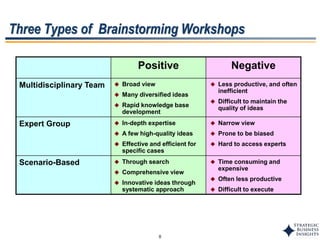
Three Types of Brainstorming Workshops
Positive Negative
Multidisciplinary Team
Expert Group
Scenario-Based
 Broad view
 Many diversified ideas
 Rapid knowledge base
development
 In-depth expertise
 A few high-quality ideas
 Effective and efficient for
specific cases
 Through search
 Comprehensive view
 Innovative ideas through
systematic approach
 Less productive, and often
inefficient
 Difficult to maintain the
quality of ideas
 Narrow view
 Prone to be biased
 Hard to access experts
 Time consuming and
expensive
 Often less productive
 Difficult to execute
9
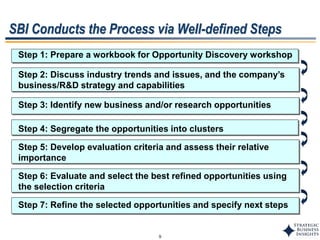
Step 1: Prepare a workbook for Opportunity Discovery workshop
Step 7: Refine the selected opportunities and specify next steps
Step 2: Discuss industry trends and issues, and the company’s
business/R&D strategy and capabilities
Step 3: Identify new business and/or research opportunities
Step 4: Segregate the opportunities into clusters
Step 5: Develop evaluation criteria and assess their relative
importance
Step 6: Evaluate and select the best refined opportunities using
the selection criteria
SBI Conducts the Process via Well-defined Steps
10
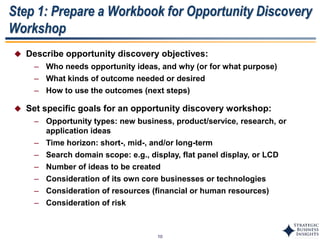
Step 1: Prepare a Workbook for Opportunity Discovery
Workshop
 Describe opportunity discovery objectives:
– Who needs opportunity ideas, and why (or for what purpose)
– What kinds of outcome needed or desired
– How to use the outcomes (next steps)
 Set specific goals for an opportunity discovery workshop:
– Opportunity types: new business, product/service, research, or
application ideas
– Time horizon: short-, mid-, and/or long-term
– Search domain scope: e.g., display, flat panel display, or LCD
– Number of ideas to be created
– Consideration of its own core businesses or technologies
– Consideration of resources (financial or human resources)
– Consideration of risk
11
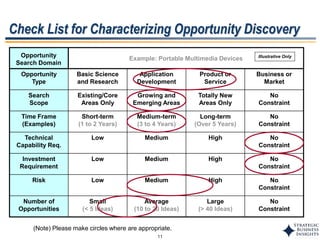
Check List for Characterizing Opportunity Discovery
Opportunity
Type
Basic Science
and Research
Application
Development
Product or
Service
Business or
Market
Search
Scope
Existing/Core
Areas Only
Growing and
Emerging Areas
Totally New
Areas Only
No
Constraint
Time Frame
(Examples)
Short-term
(1 to 2 Years)
Medium-term
(3 to 4 Years)
Long-term
(Over 5 Years)
No
Constraint
Technical
Capability Req.
Low Medium High No
Constraint
Investment
Requirement
Low Medium High No
Constraint
Risk Low Medium High No
Constraint
Number of
Opportunities
Small
(< 5 Ideas)
Average
(10 to 20 Ideas)
Large
(> 40 Ideas)
No
Constraint
Opportunity
Search Domain
Example: Portable Multimedia Devices
(Note) Please make circles where are appropriate.
Illustrative Only
12
Step 1: Prepare a Workbook for Opportunity Discovery
Workshop
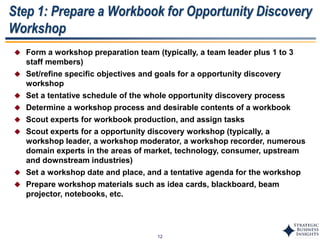
 Form a workshop preparation team (typically, a team leader plus 1 to 3
staff members)
 Set/refine specific objectives and goals for a opportunity discovery
workshop
 Set a tentative schedule of the whole opportunity discovery process
 Determine a workshop process and desirable contents of a workbook
 Scout experts for workbook production, and assign tasks
 Scout experts for a opportunity discovery workshop (typically, a
workshop leader, a workshop moderator, a workshop recorder, numerous
domain experts in the areas of market, technology, consumer, upstream
and downstream industries)
 Set a workshop date and place, and a tentative agenda for the workshop
 Prepare workshop materials such as idea cards, blackboard, beam
projector, notebooks, etc.
13
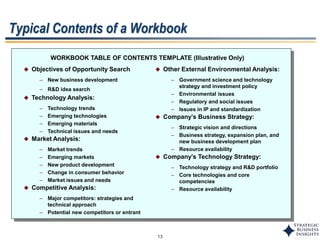
Typical Contents of a Workbook
 Objectives of Opportunity Search
– New business development
– R&D idea search
 Technology Analysis:
– Technology trends
– Emerging technologies
– Emerging materials
– Technical issues and needs
 Market Analysis:
– Market trends
– Emerging markets
– New product development
– Change in consumer behavior
– Market issues and needs
 Competitive Analysis:
– Major competitors: strategies and
technical approach
– Potential new competitors or entrant
 Other External Environmental Analysis:
– Government science and technology
strategy and investment policy
– Environmental issues
– Regulatory and social issues
– Issues in IP and standardization
 Company’s Business Strategy:
– Strategic vision and directions
– Business strategy, expansion plan, and
new business development plan
– Resource availability
 Company’s Technology Strategy:
– Technology strategy and R&D portfolio
– Core technologies and core
competencies
– Resource availability
WORKBOOK TABLE OF CONTENTS TEMPLATE (Illustrative Only)
14
Step 2: Discuss External Environments and
Company’s Capabilities and Issues
 Kickoff the brainstorming workshop: introduction of the workshop
participants and agenda
 Refine and confirm the objective and decision for opportunity
search workshop
 Review the methodologies and processes of the workshop
 Present a workbook: industry overview and more
 Discuss about the guideline for the opportunity search
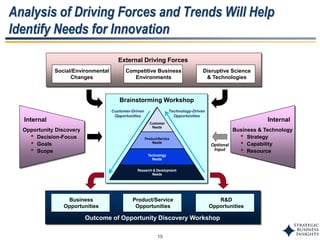
 Analyze major external and internal driving forces and trends to
identify new market and technical needs
15
Analysis of Driving Forces and Trends Will Help
Identify Needs for Innovation
Competitive Business
Environments
Social/Environmental
Changes
Disruptive Science
& Technologies
External Driving Forces
Business
Opportunities
Product/Service
Opportunities
R&D
Opportunities
Outcome of Opportunity Discovery Workshop
Business & Technology
• Strategy
• Capability
• Resource
Internal
Opportunity Discovery
• Decision-Focus
• Goals
• Scope
Internal
Brainstorming Workshop
Technology-Driven
Opportunities
Customer-Driven
Opportunities
Optional
Input
Product/Service
Needs
Customer
Needs
Technology
Needs
Research & Development
Needs
16
Step 3: Identify New Business/Research Opportunities
 Think about a new business or research opportunities and write the
idea in a given standard format. The format includes:
– Name of an idea provider
– Title of the idea
– Description of the idea
– Need: market, consumer, and/or technical needs
– Skills/technologies required for the idea
– Additional notes such as investment, related technologies, competition,
experience, synergy, etc.
 Present the idea to the workshop participants in order to:
– Refine the idea and make a bigger idea
– Reduce duplication of the same idea
– Inspire other ideas to the participants
17
 Put your idea on a card:
– No idea is a bad idea; be creative; take risks
 Get in line to present your ideas
 Make your point briefly and precisely (without interruptions by
others), so that others may also contribute
 Post your idea. Give a two sentence description of the idea while
posting it
 Allow others to express their ideas; no “idea killing” behaviors
 Think of another idea.
 Build on other participants’ ideas
 Leverage the knowledge/genius of others and the workbook
 Only one person speaking at a time; no “sidebar” conversations
Rules of Brainstorming Workshop
18
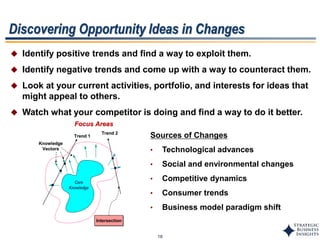
 Identify positive trends and find a way to exploit them.
 Identify negative trends and come up with a way to counteract them.
 Look at your current activities, portfolio, and interests for ideas that
might appeal to others.
 Watch what your competitor is doing and find a way to do it better.
Discovering Opportunity Ideas in Changes
Core
Knowledge
Trend 1
Trend 2
Intersection
Knowledge
Vectors
Focus AreasFocus Areas
Core
Knowledge
Trend 1
Trend 2
IntersectionIntersection
Knowledge
Vectors
Focus AreasFocus Areas
Sources of Changes
• Technological advances
• Social and environmental changes
• Competitive dynamics
• Consumer trends
• Business model paradigm shift
19
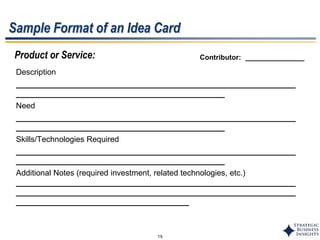
Contributor: _______________
Description
_______________________________________________________________
_______________________________________________
Need
_______________________________________________________________
_______________________________________________
Skills/Technologies Required
_______________________________________________________________
_______________________________________________
Additional Notes (required investment, related technologies, etc.)
_______________________________________________________________
_______________________________________________________________
_______________________________________
Sample Format of an Idea Card
Product or Service:
20
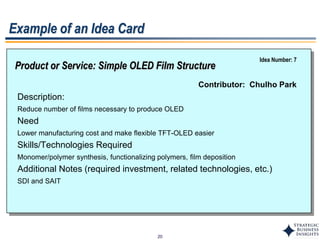
Product or Service: Simple OLED Film Structure
Description:
Reduce number of films necessary to produce OLED
Need
Lower manufacturing cost and make flexible TFT-OLED easier
Skills/Technologies Required
Monomer/polymer synthesis, functionalizing polymers, film deposition
Additional Notes (required investment, related technologies, etc.)
SDI and SAIT
Contributor: Chulho Park
Example of an Idea Card
Idea Number: 7
21
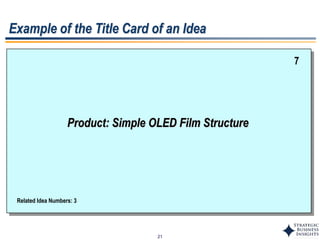
Product: Simple OLED Film Structure
Example of the Title Card of an Idea
7
Related Idea Numbers: 3
22
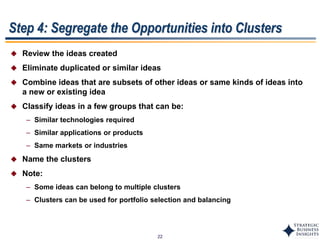
Step 4: Segregate the Opportunities into Clusters
 Review the ideas created
 Eliminate duplicated or similar ideas
 Combine ideas that are subsets of other ideas or same kinds of ideas into
a new or existing idea
 Classify ideas in a few groups that can be:
– Similar technologies required
– Similar applications or products
– Same markets or industries
 Name the clusters
 Note:
– Some ideas can belong to multiple clusters
– Clusters can be used for portfolio selection and balancing
23
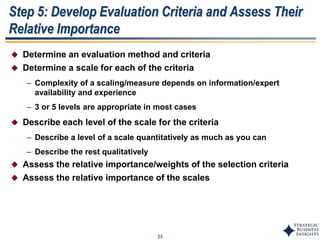
Step 5: Develop Evaluation Criteria and Assess Their
Relative Importance
 Determine an evaluation method and criteria
 Determine a scale for each of the criteria
– Complexity of a scaling/measure depends on information/expert
availability and experience
– 3 or 5 levels are appropriate in most cases
 Describe each level of the scale for the criteria
– Describe a level of a scale quantitatively as much as you can
– Describe the rest qualitatively
 Assess the relative importance/weights of the selection criteria
 Assess the relative importance of the scales
24
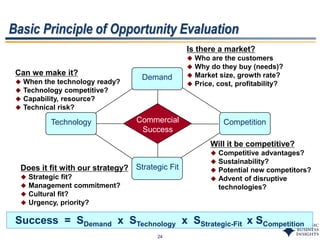
Success = SDemand x STechnology x SStrategic-Fit x SCompetition
Basic Principle of Opportunity Evaluation
Demand
Commercial
Success
Technology Competition
Strategic Fit
Is there a market?
 Who are the customers
 Why do they buy (needs)?
 Market size, growth rate?
 Price, cost, profitability?
Can we make it?
 When the technology ready?
 Technology competitive?
 Capability, resource?
 Technical risk?
Does it fit with our strategy?
 Strategic fit?
 Management commitment?
 Cultural fit?
 Urgency, priority?
Will it be competitive?
 Competitive advantages?
 Sustainability?
 Potential new competitors?
 Advent of disruptive
technologies?
25
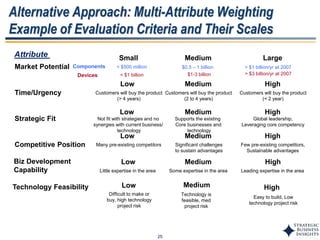
Small Medium Large
Market Potential < $500 million $0.5 – 1 billion > $1 billion/yr at 2007
Low Medium High
Time/Urgency Customers will buy the product
(> 4 years)
Customers will buy the product
(2 to 4 years)
Customers will buy the product
(< 2 year)
Low Medium High
Strategic Fit Not fit with strategies and no
synergies with current business/
technology
Supports the existing
Core businesses and
technology
Global leadership,
Leveraging core competency
Low Medium High
Competitive Position Many pre-existing competitors Significant challenges
to sustain advantages
Few pre-existing competitors,
Sustainable advantages
Low Medium HighBiz Development
Capability Little expertise in the area Some expertise in the area Leading expertise in the area
Low Medium HighTechnology Feasibility
Difficult to make or
buy, high technology
project risk
Technology is
feasible, med
project risk
Components
Devices < $1 billion $1-3 billion > $3 billion/yr at 2007
Easy to build, Low
technology project risk
Alternative Approach: Multi-Attribute Weighting
Example of Evaluation Criteria and Their Scales
Attribute
26
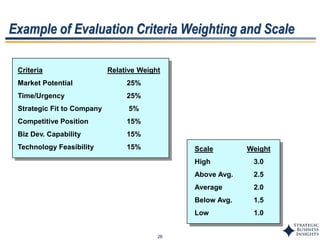
Criteria Relative Weight
Market Potential 25%
Time/Urgency 25%
Strategic Fit to Company 5%
Competitive Position 15%
Biz Dev. Capability 15%
Technology Feasibility 15% Scale Weight
High 3.0
Above Avg. 2.5
Average 2.0
Below Avg. 1.5
Low 1.0
Example of Evaluation Criteria Weighting and Scale
27
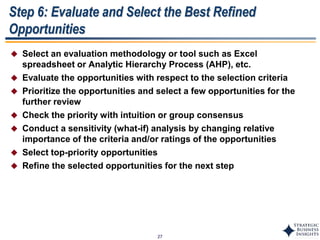
Step 6: Evaluate and Select the Best Refined
Opportunities
 Select an evaluation methodology or tool such as Excel
spreadsheet or Analytic Hierarchy Process (AHP), etc.
 Evaluate the opportunities with respect to the selection criteria
 Prioritize the opportunities and select a few opportunities for the
further review
 Check the priority with intuition or group consensus
 Conduct a sensitivity (what-if) analysis by changing relative
importance of the criteria and/or ratings of the opportunities
 Select top-priority opportunities
 Refine the selected opportunities for the next step
28
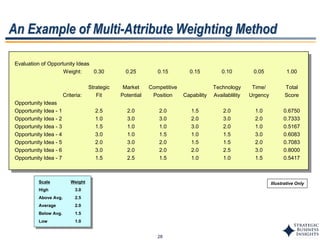
An Example of Multi-Attribute Weighting Method
Evaluation of Opportunity Ideas
Weight: 0.30 0.25 0.15 0.15 0.10 0.05 1.00
Strategic Market Competitive Technology Time/ Total
Criteria: Fit Potential Position Capability Availablility Urgency Score
Opportunity Ideas
Opportunity Idea - 1 2.5 2.0 2.0 1.5 2.0 1.0 0.6750
Opportunity Idea - 2 1.0 3.0 3.0 2.0 3.0 2.0 0.7333
Opportunity Idea - 3 1.5 1.0 1.0 3.0 2.0 1.0 0.5167
Opportunity Idea - 4 3.0 1.0 1.5 1.0 1.5 3.0 0.6083
Opportunity Idea - 5 2.0 3.0 2.0 1.5 1.5 2.0 0.7083
Opportunity Idea - 6 3.0 2.0 2.0 2.0 2.5 3.0 0.8000
Opportunity Idea - 7 1.5 2.5 1.5 1.0 1.0 1.5 0.5417
Scale Weight
High 3.0
Above Avg. 2.5
Average 2.0
Below Avg. 1.5
Low 1.0
Illustrative Only
29
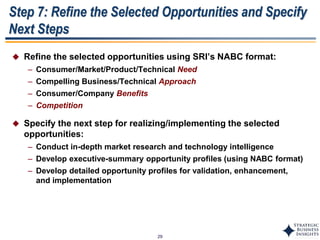
Step 7: Refine the Selected Opportunities and Specify
Next Steps
 Refine the selected opportunities using SRI’s NABC format:
– Consumer/Market/Product/Technical Need
– Compelling Business/Technical Approach
– Consumer/Company Benefits
– Competition
 Specify the next step for realizing/implementing the selected
opportunities:
– Conduct in-depth market research and technology intelligence
– Develop executive-summary opportunity profiles (using NABC format)
– Develop detailed opportunity profiles for validation, enhancement,
and implementation
30
Development of an Opportunity Profile
31
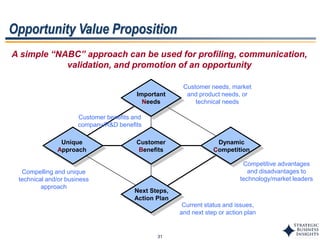
Opportunity Value Proposition
A simple “NABC” approach can be used for profiling, communication,
validation, and promotion of an opportunity
Important
Needs
Unique
Approach
Customer
Benefits
Dynamic
Competition
Next Steps,
Action Plan
Customer needs, market
and product needs, or
technical needs
Compelling and unique
technical and/or business
approach
Competitive advantages
and disadvantages to
technology/market leaders
Current status and issues,
and next step or action plan
Customer benefits and
company/R&D benefits
32
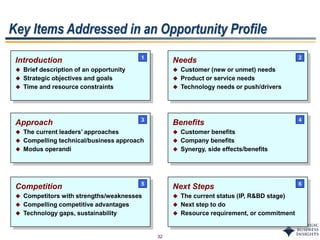
Introduction
 Brief description of an opportunity
 Strategic objectives and goals
 Time and resource constraints
Key Items Addressed in an Opportunity Profile
Needs
 Customer (new or unmet) needs
 Product or service needs
 Technology needs or push/drivers
Competition
 Competitors with strengths/weaknesses
 Compelling competitive advantages
 Technology gaps, sustainability
Next Steps
 The current status (IP, R&BD stage)
 Next step to do
 Resource requirement, or commitment
Approach
 The current leaders’ approaches
 Compelling technical/business approach
 Modus operandi
Benefits
 Customer benefits
 Company benefits
 Synergy, side effects/benefits
1
65
3 4
2
33
Creating a Compelling Opportunity
Pitch
34
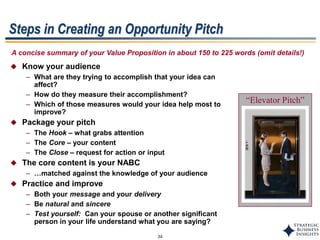
Steps in Creating an Opportunity Pitch
 Know your audience
– What are they trying to accomplish that your idea can
affect?
– How do they measure their accomplishment?
– Which of those measures would your idea help most to
improve?
 Package your pitch
– The Hook – what grabs attention
– The Core – your content
– The Close – request for action or input
 The core content is your NABC
– …matched against the knowledge of your audience
 Practice and improve
– Both your message and your delivery
– Be natural and sincere
– Test yourself: Can your spouse or another significant
person in your life understand what you are saying?
“Elevator Pitch”
A concise summary of your Value Proposition in about 150 to 225 words (omit details!)
35
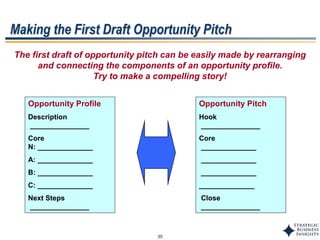
Making the First Draft Opportunity Pitch
Opportunity Profile
Description
_______________
Core
N: ______________
A: ______________
B: ______________
C: ______________
Next Steps
_______________
The first draft of opportunity pitch can be easily made by rearranging
and connecting the components of an opportunity profile.
Try to make a compelling story!
Opportunity Pitch
Hook
_______________
Core
______________
______________
______________
______________
Close
_______________
36
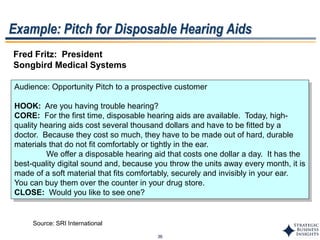
Example: Pitch for Disposable Hearing Aids
Fred Fritz: President
Songbird Medical Systems
Audience: Opportunity Pitch to a prospective customer
HOOK: Are you having trouble hearing?
CORE: For the first time, disposable hearing aids are available. Today, high-
quality hearing aids cost several thousand dollars and have to be fitted by a
doctor. Because they cost so much, they have to be made out of hard, durable
materials that do not fit comfortably or tightly in the ear.
We offer a disposable hearing aid that costs one dollar a day. It has the
best-quality digital sound and, because you throw the units away every month, it is
made of a soft material that fits comfortably, securely and invisibly in your ear.
You can buy them over the counter in your drug store.
CLOSE: Would you like to see one?
Source: SRI International
37
Validating and Incubating
Opportunities
38
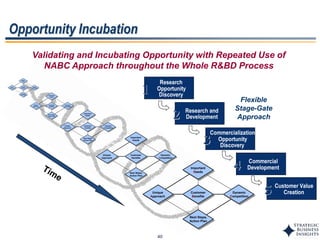
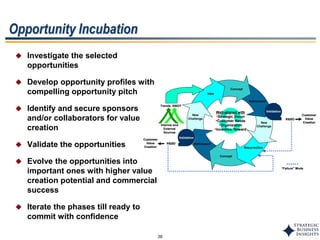
Opportunity Incubation
 Investigate the selected
opportunities
 Develop opportunity profiles with
compelling opportunity pitch
 Identify and secure sponsors
and/or collaborators for value
creation
 Validate the opportunities
 Evolve the opportunities into
important ones with higher value
creation potential and commercial
success
 Iterate the phases till ready to
commit with confidence
Trends, SWOT
Idea
Concept
Resurrection
New
Challenge
Refinement
Concept
Refinement
New
Challenge
Well-aligned with
•Strategic Vision
•Customer Needs
•Organization
•Incentive, Reward
Internal and
External
Sources
R&BD
R&BD
“Failure” Mode
CustomerCustomer
ValueValue
CreationCreation
CustomerCustomer
ValueValue
CreationCreation
Validation
Validation
Trends, SWOT
Idea
Concept
Resurrection
New
Challenge
Refinement
Concept
Refinement
New
Challenge
Well-aligned with
•Strategic Vision
•Customer Needs
•Organization
•Incentive, Reward
Internal and
External
Sources
R&BD
R&BD
“Failure” Mode
CustomerCustomer
ValueValue
CreationCreation
CustomerCustomer
ValueValue
CreationCreation
Validation
Validation
39
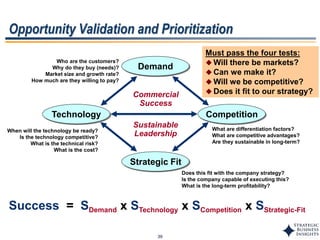
Opportunity Validation and Prioritization
Demand
Technology Competition
Who are the customers?
Why do they buy (needs)?
Market size and growth rate?
How much are they willing to pay?
When will the technology be ready?
Is the technology competitive?
What is the technical risk?
What is the cost?
What are differentiation factors?
What are competitive advantages?
Are they sustainable in long-term?
Commercial
Success
Success = SDemand x STechnology x SCompetition x SStrategic-Fit
Must pass the four tests:
 Will there be markets?
 Can we make it?
 Will we be competitive?
 Does it fit to our strategy?
Strategic Fit
Sustainable
Leadership
Does this fit with the company strategy?
Is the company capable of executing this?
What is the long-term profitability?
40
Opportunity Incubation
Customer Value
Creation55
Commercial
Development44
Research and
Development22
Research
Opportunity
Discovery11
Commercialization
Opportunity
Discovery33
Customer Value
Creation55
Commercial
Development44
Research and
Development22
Research
Opportunity
Discovery11
Commercialization
Opportunity
Discovery33
Customer Value
Creation55
Commercial
Development44
Research and
Development22
Research
Opportunity
Discovery11
Commercialization
Opportunity
Discovery33
Customer Value
Creation55
Commercial
Development44
Research and
Development22
Research
Opportunity
Discovery11
Commercialization
Opportunity
Discovery33
Time
Important
Needs
Unique
Approach
Customer
Benefits
Dynamic
Competition
Next Steps,
Action Plan
Important
Needs
Unique
Approach
Customer
Benefits
Dynamic
Competition
Next Steps,
Action Plan
Important
Needs
Unique
Approach
Customer
Benefits
Dynamic
Competition
Next Steps,
Action Plan
Important
Needs
Unique
Approach
Customer
Benefits
Dynamic
Competition
Next Steps,
Action Plan
Important
Needs
Unique
Approach
Customer
Benefits
Dynamic
Competition
Next Steps,
Action Plan
Important
Needs
Unique
Approach
Customer
Benefits
Dynamic
Competition
Next Steps,
Action Plan
Important
Needs
Unique
Approach
Customer
Benefits
Dynamic
Competition
Next Steps,
Action Plan
Important
Needs
Unique
Approach
Customer
Benefits
Dynamic
Competition
Next Steps,
Action Plan
Important
Needs
Unique
Approach
Customer
Benefits
Dynamic
Competition
Next Steps,
Action Plan
Important
Needs
Unique
Approach
Customer
Benefits
Dynamic
Competition
Next Steps,
Action Plan
Time
Important
Needs
Unique
Approach
Customer
Benefits
Dynamic
Competition
Next Steps,
Action Plan
Important
Needs
Unique
Approach
Customer
Benefits
Dynamic
Competition
Next Steps,
Action Plan
Important
Needs
Unique
Approach
Customer
Benefits
Dynamic
Competition
Next Steps,
Action Plan
Important
Needs
Unique
Approach
Customer
Benefits
Dynamic
Competition
Next Steps,
Action Plan
Important
Needs
Unique
Approach
Customer
Benefits
Dynamic
Competition
Next Steps,
Action Plan
Important
Needs
Unique
Approach
Customer
Benefits
Dynamic
Competition
Next Steps,
Action Plan
Important
Needs
Unique
Approach
Customer
Benefits
Dynamic
Competition
Next Steps,
Action Plan
Important
Needs
Unique
Approach
Customer
Benefits
Dynamic
Competition
Next Steps,
Action Plan
Important
Needs
Unique
Approach
Customer
Benefits
Dynamic
Competition
Next Steps,
Action Plan
Important
Needs
Unique
Approach
Customer
Benefits
Dynamic
Competition
Next Steps,
Action Plan
Flexible
Stage-Gate
Approach
Validating and Incubating Opportunity with Repeated Use of
NABC Approach throughout the Whole R&BD Process
41
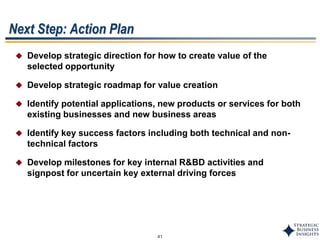
Next Step: Action Plan
 Develop strategic direction for how to create value of the
selected opportunity
 Develop strategic roadmap for value creation
 Identify potential applications, new products or services for both
existing businesses and new business areas
 Identify key success factors including both technical and non-
technical factors
 Develop milestones for key internal R&BD activities and
signpost for uncertain key external driving forces
42
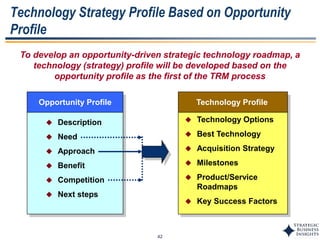
Technology Strategy Profile Based on Opportunity
Profile
To develop an opportunity-driven strategic technology roadmap, a
technology (strategy) profile will be developed based on the
opportunity profile as the first of the TRM process
 Description
 Need
 Approach
 Benefit
 Competition
 Next steps
 Technology Options
 Best Technology
 Acquisition Strategy
 Milestones
 Product/Service
Roadmaps
 Key Success Factors
Opportunity Profile Technology Profile
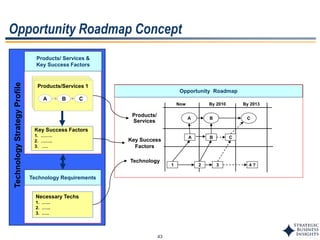
43
TechnologyStrategyProfile
Opportunity Roadmap Concept
Technology Requirements
Products/ Services &
Key Success Factors
Products/ Services 1
A B C
Products/ Services 2Products/Services 1
A B C
Key Success Factors
1. .…….
2. ……..
3. ….
Necessary Techs
1. .…..
2. .…..
3. .….
Opportunity Roadmap
Products/
Services
Key Success
Factors
Technology
Now By 2010 By 2013
A B C
A B C
1 2 3 4 ?

Opportunity Discovery Process

  • 1.
    1 Overview of SBI’s OpportunityDiscovery Process (ODP) Prepared by: Dr. Chulho Park Vice President Strategic Business Insights cpark@sbi-i.com October 2015
  • 2.
  • 3.
    3 Opportunity Discovery—Incubation Engine Opportunity Profile Trends,SWOT Idea Resurrection New Challenge Refinement Concept Refinement New Challenge Opportunity Discovery EngineInternal and External Sources R&BD R&BD “Failure” Mode Customer Value Creation Customer Value Creation Validation Validation Concept Opportunity Discovery Workshop Opportunity Value Proposition Opportunity Roadmap Opportunity Workbook Opportunity Workbook Opportunity Discovery Workshop Opportunity Value Proposition Opportunity Profile Opportunity Roadmap
  • 4.
    4 Key Success Factorsfor an Opportunity  Address important customer’s (unmet or new) needs  Create significant financial value or benefit  Develop unique, compelling technical approach  Create competitive advantage  Fit to the company strategy “Important” Opportunity Product/Service Needs Customer Needs Technology Needs Research & Development Needs
  • 5.
    5 Opportunity Discovery—The FrontEnd of Innovation in the New R&BD Paradigm Infrastructure: Organization, Resource, Processes Analysis of External Drivers and Dynamics Commercialization Management IP Asset Management Technology (R&D) Management Company Business Vision and Strategy Opportunity (Value) Discovery Value Development (R&D, BD) Creation of Customer Value and Company Profit Infrastructure: Organization, Resource, Processes Analysis of External Drivers and Dynamics Commercialization Management IP Asset Management Technology (R&D) Management Company Business Vision and Strategy Company Business Vision and Strategy Opportunity (Value) Discovery Value Development (R&D, BD) Creation of Customer Value and Company Profit
  • 6.
    6 Problem Definition andScope Development of Opportunity Profiles Initiation: Preparing Workbook Idea Generation: Brainstorming Ideas Opportunity Clustering: Clustering Opportunities Opportunity Evaluation: Evaluating Clusters Focus Areas Opportunity Ideas Attractive Opportunities Market Needs Technical Needs Opportunity Clusters Industry/Markets Selection Criteria SBI’s Process Involves Creative Brainstorming Followed by Careful Clustering and Screening
  • 7.
    7  Bring togethermultidisciplinary skills: marketing, R&D, manufacturing, planning  Develop critical mass of necessary knowledge quickly: consumers, markets, technologies, competition  Encourage knowledge sharing and consensus building  Create broad view and perspectives of market and technology landscapes with a specific decision focus  Leverage the expertise, experience and genius of others  Increase efficiency and productivity for innovative idea generation  Break down organizational barriers (silos)  Create learning environment through repetitive use of structured brainstorming. Why Structured Brainstorming
  • 8.
    8 Three Types ofBrainstorming Workshops Positive Negative Multidisciplinary Team Expert Group Scenario-Based  Broad view  Many diversified ideas  Rapid knowledge base development  In-depth expertise  A few high-quality ideas  Effective and efficient for specific cases  Through search  Comprehensive view  Innovative ideas through systematic approach  Less productive, and often inefficient  Difficult to maintain the quality of ideas  Narrow view  Prone to be biased  Hard to access experts  Time consuming and expensive  Often less productive  Difficult to execute
  • 9.
    9 Step 1: Preparea workbook for Opportunity Discovery workshop Step 7: Refine the selected opportunities and specify next steps Step 2: Discuss industry trends and issues, and the company’s business/R&D strategy and capabilities Step 3: Identify new business and/or research opportunities Step 4: Segregate the opportunities into clusters Step 5: Develop evaluation criteria and assess their relative importance Step 6: Evaluate and select the best refined opportunities using the selection criteria SBI Conducts the Process via Well-defined Steps
  • 10.
    10 Step 1: Preparea Workbook for Opportunity Discovery Workshop  Describe opportunity discovery objectives: – Who needs opportunity ideas, and why (or for what purpose) – What kinds of outcome needed or desired – How to use the outcomes (next steps)  Set specific goals for an opportunity discovery workshop: – Opportunity types: new business, product/service, research, or application ideas – Time horizon: short-, mid-, and/or long-term – Search domain scope: e.g., display, flat panel display, or LCD – Number of ideas to be created – Consideration of its own core businesses or technologies – Consideration of resources (financial or human resources) – Consideration of risk
  • 11.
    11 Check List forCharacterizing Opportunity Discovery Opportunity Type Basic Science and Research Application Development Product or Service Business or Market Search Scope Existing/Core Areas Only Growing and Emerging Areas Totally New Areas Only No Constraint Time Frame (Examples) Short-term (1 to 2 Years) Medium-term (3 to 4 Years) Long-term (Over 5 Years) No Constraint Technical Capability Req. Low Medium High No Constraint Investment Requirement Low Medium High No Constraint Risk Low Medium High No Constraint Number of Opportunities Small (< 5 Ideas) Average (10 to 20 Ideas) Large (> 40 Ideas) No Constraint Opportunity Search Domain Example: Portable Multimedia Devices (Note) Please make circles where are appropriate. Illustrative Only
  • 12.
    12 Step 1: Preparea Workbook for Opportunity Discovery Workshop  Form a workshop preparation team (typically, a team leader plus 1 to 3 staff members)  Set/refine specific objectives and goals for a opportunity discovery workshop  Set a tentative schedule of the whole opportunity discovery process  Determine a workshop process and desirable contents of a workbook  Scout experts for workbook production, and assign tasks  Scout experts for a opportunity discovery workshop (typically, a workshop leader, a workshop moderator, a workshop recorder, numerous domain experts in the areas of market, technology, consumer, upstream and downstream industries)  Set a workshop date and place, and a tentative agenda for the workshop  Prepare workshop materials such as idea cards, blackboard, beam projector, notebooks, etc.
  • 13.
    13 Typical Contents ofa Workbook  Objectives of Opportunity Search – New business development – R&D idea search  Technology Analysis: – Technology trends – Emerging technologies – Emerging materials – Technical issues and needs  Market Analysis: – Market trends – Emerging markets – New product development – Change in consumer behavior – Market issues and needs  Competitive Analysis: – Major competitors: strategies and technical approach – Potential new competitors or entrant  Other External Environmental Analysis: – Government science and technology strategy and investment policy – Environmental issues – Regulatory and social issues – Issues in IP and standardization  Company’s Business Strategy: – Strategic vision and directions – Business strategy, expansion plan, and new business development plan – Resource availability  Company’s Technology Strategy: – Technology strategy and R&D portfolio – Core technologies and core competencies – Resource availability WORKBOOK TABLE OF CONTENTS TEMPLATE (Illustrative Only)
  • 14.
    14 Step 2: DiscussExternal Environments and Company’s Capabilities and Issues  Kickoff the brainstorming workshop: introduction of the workshop participants and agenda  Refine and confirm the objective and decision for opportunity search workshop  Review the methodologies and processes of the workshop  Present a workbook: industry overview and more  Discuss about the guideline for the opportunity search  Analyze major external and internal driving forces and trends to identify new market and technical needs
  • 15.
    15 Analysis of DrivingForces and Trends Will Help Identify Needs for Innovation Competitive Business Environments Social/Environmental Changes Disruptive Science & Technologies External Driving Forces Business Opportunities Product/Service Opportunities R&D Opportunities Outcome of Opportunity Discovery Workshop Business & Technology • Strategy • Capability • Resource Internal Opportunity Discovery • Decision-Focus • Goals • Scope Internal Brainstorming Workshop Technology-Driven Opportunities Customer-Driven Opportunities Optional Input Product/Service Needs Customer Needs Technology Needs Research & Development Needs
  • 16.
    16 Step 3: IdentifyNew Business/Research Opportunities  Think about a new business or research opportunities and write the idea in a given standard format. The format includes: – Name of an idea provider – Title of the idea – Description of the idea – Need: market, consumer, and/or technical needs – Skills/technologies required for the idea – Additional notes such as investment, related technologies, competition, experience, synergy, etc.  Present the idea to the workshop participants in order to: – Refine the idea and make a bigger idea – Reduce duplication of the same idea – Inspire other ideas to the participants
  • 17.
    17  Put youridea on a card: – No idea is a bad idea; be creative; take risks  Get in line to present your ideas  Make your point briefly and precisely (without interruptions by others), so that others may also contribute  Post your idea. Give a two sentence description of the idea while posting it  Allow others to express their ideas; no “idea killing” behaviors  Think of another idea.  Build on other participants’ ideas  Leverage the knowledge/genius of others and the workbook  Only one person speaking at a time; no “sidebar” conversations Rules of Brainstorming Workshop
  • 18.
    18  Identify positivetrends and find a way to exploit them.  Identify negative trends and come up with a way to counteract them.  Look at your current activities, portfolio, and interests for ideas that might appeal to others.  Watch what your competitor is doing and find a way to do it better. Discovering Opportunity Ideas in Changes Core Knowledge Trend 1 Trend 2 Intersection Knowledge Vectors Focus AreasFocus Areas Core Knowledge Trend 1 Trend 2 IntersectionIntersection Knowledge Vectors Focus AreasFocus Areas Sources of Changes • Technological advances • Social and environmental changes • Competitive dynamics • Consumer trends • Business model paradigm shift
  • 19.
  • 20.
    20 Product or Service:Simple OLED Film Structure Description: Reduce number of films necessary to produce OLED Need Lower manufacturing cost and make flexible TFT-OLED easier Skills/Technologies Required Monomer/polymer synthesis, functionalizing polymers, film deposition Additional Notes (required investment, related technologies, etc.) SDI and SAIT Contributor: Chulho Park Example of an Idea Card Idea Number: 7
  • 21.
    21 Product: Simple OLEDFilm Structure Example of the Title Card of an Idea 7 Related Idea Numbers: 3
  • 22.
    22 Step 4: Segregatethe Opportunities into Clusters  Review the ideas created  Eliminate duplicated or similar ideas  Combine ideas that are subsets of other ideas or same kinds of ideas into a new or existing idea  Classify ideas in a few groups that can be: – Similar technologies required – Similar applications or products – Same markets or industries  Name the clusters  Note: – Some ideas can belong to multiple clusters – Clusters can be used for portfolio selection and balancing
  • 23.
    23 Step 5: DevelopEvaluation Criteria and Assess Their Relative Importance  Determine an evaluation method and criteria  Determine a scale for each of the criteria – Complexity of a scaling/measure depends on information/expert availability and experience – 3 or 5 levels are appropriate in most cases  Describe each level of the scale for the criteria – Describe a level of a scale quantitatively as much as you can – Describe the rest qualitatively  Assess the relative importance/weights of the selection criteria  Assess the relative importance of the scales
  • 24.
    24 Success = SDemandx STechnology x SStrategic-Fit x SCompetition Basic Principle of Opportunity Evaluation Demand Commercial Success Technology Competition Strategic Fit Is there a market?  Who are the customers  Why do they buy (needs)?  Market size, growth rate?  Price, cost, profitability? Can we make it?  When the technology ready?  Technology competitive?  Capability, resource?  Technical risk? Does it fit with our strategy?  Strategic fit?  Management commitment?  Cultural fit?  Urgency, priority? Will it be competitive?  Competitive advantages?  Sustainability?  Potential new competitors?  Advent of disruptive technologies?
  • 25.
    25 Small Medium Large MarketPotential < $500 million $0.5 – 1 billion > $1 billion/yr at 2007 Low Medium High Time/Urgency Customers will buy the product (> 4 years) Customers will buy the product (2 to 4 years) Customers will buy the product (< 2 year) Low Medium High Strategic Fit Not fit with strategies and no synergies with current business/ technology Supports the existing Core businesses and technology Global leadership, Leveraging core competency Low Medium High Competitive Position Many pre-existing competitors Significant challenges to sustain advantages Few pre-existing competitors, Sustainable advantages Low Medium HighBiz Development Capability Little expertise in the area Some expertise in the area Leading expertise in the area Low Medium HighTechnology Feasibility Difficult to make or buy, high technology project risk Technology is feasible, med project risk Components Devices < $1 billion $1-3 billion > $3 billion/yr at 2007 Easy to build, Low technology project risk Alternative Approach: Multi-Attribute Weighting Example of Evaluation Criteria and Their Scales Attribute
  • 26.
    26 Criteria Relative Weight MarketPotential 25% Time/Urgency 25% Strategic Fit to Company 5% Competitive Position 15% Biz Dev. Capability 15% Technology Feasibility 15% Scale Weight High 3.0 Above Avg. 2.5 Average 2.0 Below Avg. 1.5 Low 1.0 Example of Evaluation Criteria Weighting and Scale
  • 27.
    27 Step 6: Evaluateand Select the Best Refined Opportunities  Select an evaluation methodology or tool such as Excel spreadsheet or Analytic Hierarchy Process (AHP), etc.  Evaluate the opportunities with respect to the selection criteria  Prioritize the opportunities and select a few opportunities for the further review  Check the priority with intuition or group consensus  Conduct a sensitivity (what-if) analysis by changing relative importance of the criteria and/or ratings of the opportunities  Select top-priority opportunities  Refine the selected opportunities for the next step
  • 28.
    28 An Example ofMulti-Attribute Weighting Method Evaluation of Opportunity Ideas Weight: 0.30 0.25 0.15 0.15 0.10 0.05 1.00 Strategic Market Competitive Technology Time/ Total Criteria: Fit Potential Position Capability Availablility Urgency Score Opportunity Ideas Opportunity Idea - 1 2.5 2.0 2.0 1.5 2.0 1.0 0.6750 Opportunity Idea - 2 1.0 3.0 3.0 2.0 3.0 2.0 0.7333 Opportunity Idea - 3 1.5 1.0 1.0 3.0 2.0 1.0 0.5167 Opportunity Idea - 4 3.0 1.0 1.5 1.0 1.5 3.0 0.6083 Opportunity Idea - 5 2.0 3.0 2.0 1.5 1.5 2.0 0.7083 Opportunity Idea - 6 3.0 2.0 2.0 2.0 2.5 3.0 0.8000 Opportunity Idea - 7 1.5 2.5 1.5 1.0 1.0 1.5 0.5417 Scale Weight High 3.0 Above Avg. 2.5 Average 2.0 Below Avg. 1.5 Low 1.0 Illustrative Only
  • 29.
    29 Step 7: Refinethe Selected Opportunities and Specify Next Steps  Refine the selected opportunities using SRI’s NABC format: – Consumer/Market/Product/Technical Need – Compelling Business/Technical Approach – Consumer/Company Benefits – Competition  Specify the next step for realizing/implementing the selected opportunities: – Conduct in-depth market research and technology intelligence – Develop executive-summary opportunity profiles (using NABC format) – Develop detailed opportunity profiles for validation, enhancement, and implementation
  • 30.
    30 Development of anOpportunity Profile
  • 31.
    31 Opportunity Value Proposition Asimple “NABC” approach can be used for profiling, communication, validation, and promotion of an opportunity Important Needs Unique Approach Customer Benefits Dynamic Competition Next Steps, Action Plan Customer needs, market and product needs, or technical needs Compelling and unique technical and/or business approach Competitive advantages and disadvantages to technology/market leaders Current status and issues, and next step or action plan Customer benefits and company/R&D benefits
  • 32.
    32 Introduction  Brief descriptionof an opportunity  Strategic objectives and goals  Time and resource constraints Key Items Addressed in an Opportunity Profile Needs  Customer (new or unmet) needs  Product or service needs  Technology needs or push/drivers Competition  Competitors with strengths/weaknesses  Compelling competitive advantages  Technology gaps, sustainability Next Steps  The current status (IP, R&BD stage)  Next step to do  Resource requirement, or commitment Approach  The current leaders’ approaches  Compelling technical/business approach  Modus operandi Benefits  Customer benefits  Company benefits  Synergy, side effects/benefits 1 65 3 4 2
  • 33.
    33 Creating a CompellingOpportunity Pitch
  • 34.
    34 Steps in Creatingan Opportunity Pitch  Know your audience – What are they trying to accomplish that your idea can affect? – How do they measure their accomplishment? – Which of those measures would your idea help most to improve?  Package your pitch – The Hook – what grabs attention – The Core – your content – The Close – request for action or input  The core content is your NABC – …matched against the knowledge of your audience  Practice and improve – Both your message and your delivery – Be natural and sincere – Test yourself: Can your spouse or another significant person in your life understand what you are saying? “Elevator Pitch” A concise summary of your Value Proposition in about 150 to 225 words (omit details!)
  • 35.
    35 Making the FirstDraft Opportunity Pitch Opportunity Profile Description _______________ Core N: ______________ A: ______________ B: ______________ C: ______________ Next Steps _______________ The first draft of opportunity pitch can be easily made by rearranging and connecting the components of an opportunity profile. Try to make a compelling story! Opportunity Pitch Hook _______________ Core ______________ ______________ ______________ ______________ Close _______________
  • 36.
    36 Example: Pitch forDisposable Hearing Aids Fred Fritz: President Songbird Medical Systems Audience: Opportunity Pitch to a prospective customer HOOK: Are you having trouble hearing? CORE: For the first time, disposable hearing aids are available. Today, high- quality hearing aids cost several thousand dollars and have to be fitted by a doctor. Because they cost so much, they have to be made out of hard, durable materials that do not fit comfortably or tightly in the ear. We offer a disposable hearing aid that costs one dollar a day. It has the best-quality digital sound and, because you throw the units away every month, it is made of a soft material that fits comfortably, securely and invisibly in your ear. You can buy them over the counter in your drug store. CLOSE: Would you like to see one? Source: SRI International
  • 37.
  • 38.
    38 Opportunity Incubation  Investigatethe selected opportunities  Develop opportunity profiles with compelling opportunity pitch  Identify and secure sponsors and/or collaborators for value creation  Validate the opportunities  Evolve the opportunities into important ones with higher value creation potential and commercial success  Iterate the phases till ready to commit with confidence Trends, SWOT Idea Concept Resurrection New Challenge Refinement Concept Refinement New Challenge Well-aligned with •Strategic Vision •Customer Needs •Organization •Incentive, Reward Internal and External Sources R&BD R&BD “Failure” Mode CustomerCustomer ValueValue CreationCreation CustomerCustomer ValueValue CreationCreation Validation Validation Trends, SWOT Idea Concept Resurrection New Challenge Refinement Concept Refinement New Challenge Well-aligned with •Strategic Vision •Customer Needs •Organization •Incentive, Reward Internal and External Sources R&BD R&BD “Failure” Mode CustomerCustomer ValueValue CreationCreation CustomerCustomer ValueValue CreationCreation Validation Validation
  • 39.
    39 Opportunity Validation andPrioritization Demand Technology Competition Who are the customers? Why do they buy (needs)? Market size and growth rate? How much are they willing to pay? When will the technology be ready? Is the technology competitive? What is the technical risk? What is the cost? What are differentiation factors? What are competitive advantages? Are they sustainable in long-term? Commercial Success Success = SDemand x STechnology x SCompetition x SStrategic-Fit Must pass the four tests:  Will there be markets?  Can we make it?  Will we be competitive?  Does it fit to our strategy? Strategic Fit Sustainable Leadership Does this fit with the company strategy? Is the company capable of executing this? What is the long-term profitability?
  • 40.
    40 Opportunity Incubation Customer Value Creation55 Commercial Development44 Researchand Development22 Research Opportunity Discovery11 Commercialization Opportunity Discovery33 Customer Value Creation55 Commercial Development44 Research and Development22 Research Opportunity Discovery11 Commercialization Opportunity Discovery33 Customer Value Creation55 Commercial Development44 Research and Development22 Research Opportunity Discovery11 Commercialization Opportunity Discovery33 Customer Value Creation55 Commercial Development44 Research and Development22 Research Opportunity Discovery11 Commercialization Opportunity Discovery33 Time Important Needs Unique Approach Customer Benefits Dynamic Competition Next Steps, Action Plan Important Needs Unique Approach Customer Benefits Dynamic Competition Next Steps, Action Plan Important Needs Unique Approach Customer Benefits Dynamic Competition Next Steps, Action Plan Important Needs Unique Approach Customer Benefits Dynamic Competition Next Steps, Action Plan Important Needs Unique Approach Customer Benefits Dynamic Competition Next Steps, Action Plan Important Needs Unique Approach Customer Benefits Dynamic Competition Next Steps, Action Plan Important Needs Unique Approach Customer Benefits Dynamic Competition Next Steps, Action Plan Important Needs Unique Approach Customer Benefits Dynamic Competition Next Steps, Action Plan Important Needs Unique Approach Customer Benefits Dynamic Competition Next Steps, Action Plan Important Needs Unique Approach Customer Benefits Dynamic Competition Next Steps, Action Plan Time Important Needs Unique Approach Customer Benefits Dynamic Competition Next Steps, Action Plan Important Needs Unique Approach Customer Benefits Dynamic Competition Next Steps, Action Plan Important Needs Unique Approach Customer Benefits Dynamic Competition Next Steps, Action Plan Important Needs Unique Approach Customer Benefits Dynamic Competition Next Steps, Action Plan Important Needs Unique Approach Customer Benefits Dynamic Competition Next Steps, Action Plan Important Needs Unique Approach Customer Benefits Dynamic Competition Next Steps, Action Plan Important Needs Unique Approach Customer Benefits Dynamic Competition Next Steps, Action Plan Important Needs Unique Approach Customer Benefits Dynamic Competition Next Steps, Action Plan Important Needs Unique Approach Customer Benefits Dynamic Competition Next Steps, Action Plan Important Needs Unique Approach Customer Benefits Dynamic Competition Next Steps, Action Plan Flexible Stage-Gate Approach Validating and Incubating Opportunity with Repeated Use of NABC Approach throughout the Whole R&BD Process
  • 41.
    41 Next Step: ActionPlan  Develop strategic direction for how to create value of the selected opportunity  Develop strategic roadmap for value creation  Identify potential applications, new products or services for both existing businesses and new business areas  Identify key success factors including both technical and non- technical factors  Develop milestones for key internal R&BD activities and signpost for uncertain key external driving forces
  • 42.
    42 Technology Strategy ProfileBased on Opportunity Profile To develop an opportunity-driven strategic technology roadmap, a technology (strategy) profile will be developed based on the opportunity profile as the first of the TRM process  Description  Need  Approach  Benefit  Competition  Next steps  Technology Options  Best Technology  Acquisition Strategy  Milestones  Product/Service Roadmaps  Key Success Factors Opportunity Profile Technology Profile
  • 43.
    43 TechnologyStrategyProfile Opportunity Roadmap Concept TechnologyRequirements Products/ Services & Key Success Factors Products/ Services 1 A B C Products/ Services 2Products/Services 1 A B C Key Success Factors 1. .……. 2. …….. 3. …. Necessary Techs 1. .….. 2. .….. 3. .…. Opportunity Roadmap Products/ Services Key Success Factors Technology Now By 2010 By 2013 A B C A B C 1 2 3 4 ?