Changing the way we approach university technology
commercialization
Dr. Andrew Maxwell P.Eng. MBA
October 2017
The Technology Commercialization Imperative
• Low commercialization success rates
• Most university research is not commercialized
• Research funding increasingly linked to commercialization
• Institutional culture discouraged commercialization
• Challenges of technology entrepreneurship
• Developing a strategy for a start up is challenging
• Requires unique skills and resources to achieve success
• Counter cultural for most researchers
• Missing out on potential
• Limits ability to attract research funding
• Reduces potential for future contract research
• Limits job prospects for graduates
• Reduces potential impact on regional economy
2
Top Ten Reasons for Poor Success Rates
10. Research designed to resolve a technical problem - not commercialization
9. Researchers not motivated to achieve commercial success
8. Researchers don’t have required commercialization expertise
7. Flawed assumptions about technology features and applications
6. Flawed assumptions about initial customers and their adoption decisions
Funding
Initial
Concept /
Research
Funding
Follow-on
Research
(Technical)
Funding
Attempt to
License /
Sell
3
5. Commercialization process only starts after the research is finished
4. Incorrect assumptions about the business model likely to succeed
3. Commercialization is a function under taken by TTOs not innovators
2. Technology design does not sufficiently consider customer needs
1. Limited resources to reduce technology risk before customer adoption
Funding
Initial
Concept /
Research
Funding
Follow-on
Research
(Technical)
Funding
Attempt to
License /
Sell
Top Ten Reasons for Poor Success Rates (contd)
4
The NSF solution….Design Thinking/Lean Startup
5
Using Technology As a Source of Competitive Advantage
Design ThinkingTechnology Centric
6
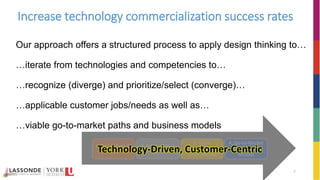
Increase technology commercialization success rates
Our approach offers a structured process to apply design thinking to…
…iterate from technologies and competencies to…
…recognize (diverge) and prioritize/select (converge)…
…applicable customer jobs/needs as well as…
…viable go-to-market paths and business models
1. Technology to
Jobs
2. Jobs to Value
Proposition
3. Value
Proposition to
Go-to-Market
4. Go-to-Market
to Business
Models
Technology-Driven, Customer-Centric
7
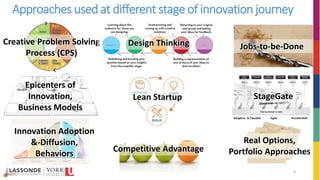
Creative Problem Solving
Process (CPS)
Design Thinking
StageGate
Real Options,
Portfolio Approaches
Jobs-to-be-Done
Innovation Adoption
&-Diffusion,
Behaviors
Lean Startup
Epicenters of
Innovation,
Business Models
Approaches used at different stage of innovation journey
Competitive Advantage
8
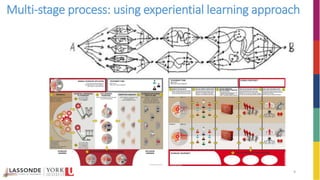
Multi-stage process: using experiential learning approach
9
Create commercialization roadmaps with sustainable competitive advantage:
• Starts by asserting technology innovation provides competitive advantage
• Identifies potential applications where this advantage is greatest
• Focusses on specific customer ‘segments’ most likely to be early adopters
• Develops value propositions to understand motivation to adopt
• Investigates multiple stakeholders to identify barriers to adoption
• Examines alternate offerings and business models to overcame adoption barriers
• At each stage offers decision framework to: pivot, proceed, or park technology
• It helps focus time and resources on activities more likely to succeed
Blended approach that integrates:
Technology Advantage with Customer Needs/Behaviours
10
Experiential Learning
11
Quadrupling the impact of our technology research
Bergeron Entrepreneurs in Science & Technology
Dr. Andrew Maxwell P.Eng
Associate Professor, Entrepreneurial Engineering
Director BEST
Technology Commercialization Institute
https://tinyurl.com/y8k6q3a6
12

Technology commercialization overview

  • 1.
    Changing the waywe approach university technology commercialization Dr. Andrew Maxwell P.Eng. MBA October 2017
  • 2.
    The Technology CommercializationImperative • Low commercialization success rates • Most university research is not commercialized • Research funding increasingly linked to commercialization • Institutional culture discouraged commercialization • Challenges of technology entrepreneurship • Developing a strategy for a start up is challenging • Requires unique skills and resources to achieve success • Counter cultural for most researchers • Missing out on potential • Limits ability to attract research funding • Reduces potential for future contract research • Limits job prospects for graduates • Reduces potential impact on regional economy 2
  • 3.
    Top Ten Reasonsfor Poor Success Rates 10. Research designed to resolve a technical problem - not commercialization 9. Researchers not motivated to achieve commercial success 8. Researchers don’t have required commercialization expertise 7. Flawed assumptions about technology features and applications 6. Flawed assumptions about initial customers and their adoption decisions Funding Initial Concept / Research Funding Follow-on Research (Technical) Funding Attempt to License / Sell 3
  • 4.
    5. Commercialization processonly starts after the research is finished 4. Incorrect assumptions about the business model likely to succeed 3. Commercialization is a function under taken by TTOs not innovators 2. Technology design does not sufficiently consider customer needs 1. Limited resources to reduce technology risk before customer adoption Funding Initial Concept / Research Funding Follow-on Research (Technical) Funding Attempt to License / Sell Top Ten Reasons for Poor Success Rates (contd) 4
  • 5.
    The NSF solution….DesignThinking/Lean Startup 5
  • 6.
    Using Technology Asa Source of Competitive Advantage Design ThinkingTechnology Centric 6
  • 7.
    Increase technology commercializationsuccess rates Our approach offers a structured process to apply design thinking to… …iterate from technologies and competencies to… …recognize (diverge) and prioritize/select (converge)… …applicable customer jobs/needs as well as… …viable go-to-market paths and business models 1. Technology to Jobs 2. Jobs to Value Proposition 3. Value Proposition to Go-to-Market 4. Go-to-Market to Business Models Technology-Driven, Customer-Centric 7
  • 8.
    Creative Problem Solving Process(CPS) Design Thinking StageGate Real Options, Portfolio Approaches Jobs-to-be-Done Innovation Adoption &-Diffusion, Behaviors Lean Startup Epicenters of Innovation, Business Models Approaches used at different stage of innovation journey Competitive Advantage 8
  • 9.
    Multi-stage process: usingexperiential learning approach 9
  • 10.
    Create commercialization roadmapswith sustainable competitive advantage: • Starts by asserting technology innovation provides competitive advantage • Identifies potential applications where this advantage is greatest • Focusses on specific customer ‘segments’ most likely to be early adopters • Develops value propositions to understand motivation to adopt • Investigates multiple stakeholders to identify barriers to adoption • Examines alternate offerings and business models to overcame adoption barriers • At each stage offers decision framework to: pivot, proceed, or park technology • It helps focus time and resources on activities more likely to succeed Blended approach that integrates: Technology Advantage with Customer Needs/Behaviours 10
  • 11.
  • 12.
    Quadrupling the impactof our technology research Bergeron Entrepreneurs in Science & Technology Dr. Andrew Maxwell P.Eng Associate Professor, Entrepreneurial Engineering Director BEST Technology Commercialization Institute https://tinyurl.com/y8k6q3a6 12

Editor's Notes

  • #5 Technology solution seen as outcome, not first stage in commercialization process Technology commercialization viewed simplistically (great technology sells itself) Research addresses technical issues, not holistic customer needs Culture in universities values publications over societal impact Perspective that technical expertise all that is required for successful outcome Limited potential users/customers interactions during development process Narrow view of: technology applications, markets, offerings & business models Over reliance on innovator (limited experience, research career focus ) to drive commercialization (exacerbated in the case of venture creation)
  • #6 Limited understanding of customer discovery process reduces potential impact (People don't know what they want until you show it to them – Steve Jobs) Ignores profound technology advances that can offer radical solutions Limited understanding of technology’s role in creating competitive advantage Identifies market opportunity, but ignores ‘Why You?’ are the best to address Difficult to create a sustainable business, when larger companies see opportunity Building critical technology capabilities/expertise viewed as an afterthought Fails to integrate the technology and business development Can oversimplify customer need and adoption motivation and barriers
  • #8 Improve Likelihood of Technology Commercialization Success Develop a structured, & scalable (divergent-convergent) approach to guide the process Offer an array of creative problem solving tools to navigate and help pivot at each stage Leverage relevant research and leverage existing perspectives/best practices Transform Participant Thinking and Challenge Commercialization Assumptions Focus on the importance of using technology expertise to create competitive advantage Challenge assumptions about the jobs the technology can do (applications) and for whom Encourage experimentation, use evidence to make decisions to continue, fail fast or pivot Create Experiential and Collaborative Learning Opportunities Connect: technologists, business people, academics, students, alumni & stakeholders Encourage technology development and market validation activities to continue in parallel Increase understanding of how to overcome innovation inertia and barriers to adoption
  • #9 TechConnect is essentially an iterative Creative Problem Solving process, following Basadur. It disconnects assumptions about the solution from the problem, and embeds diverging and converging stages through a learning journey. TechConnect is an approach that leverages the epicenters of innovation Business Models (Osterwalder) using the resource based approach. It also uses the Business Model Canvas itself to examine different aspects of the go to market strategy – using different factors of the business model. TechConnect focusses on creating value proposition sufficient to motivation adoption. It uses Moore and Rogers frameworks to both understand the value proposition, and identify (and then overcome) barriers to adoption. The basic design philosophy (IDEO) is an integral part of the overall framework, developing business strategies that leverage core competencies to create competitive advantage (Porter). In addition, it uses a design thinking approach - specifically empathy, as it seeks to identify the specific motivations of different stakeholders (based on Miller Heiman) involved in the decision to buy or adopt. The essential elements of the Lean StartUp (Ries) are core to the development of a process that is designed to both fail fast, and increase the likelihood of commercial success. At each stage, we embed two aspects of Lean StartUp, (1) what is the hypothesis that needs testing before moving to the next stage of the process and what is the lowest cost and fastest way to test this. Linked to this (2) it requires decisions to be made on evidence by talking to experts, users, influencers, and personas to validate assumptions or test hypotheses at each stage. There are a number of tools used at the stage of identifying what other ”jobs” the technology might do….essentially this includes an profound understanding of the jobs to be done framework (Christensen, Ulwick), as well as PEST analysis, new points of differentiation (MacMillan and McGrath), and business ecosystem analysis. The approach also relies on a sequential elimination process, based on StageGate (Cooper), which includes a series of go/no-go decisions, voice of the customer, and constant process improvement. This approach allows us to develop a portfolio approach to innovation, using real Options, where each opportunity is viewed as an option to continue with the project or not (Cooper).