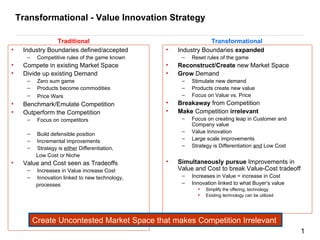
Transformational - Value Innovation Strategy Industry Boundaries defined/accepted Competitive rules of the game known Compete in existing Market Space Divide up existing Demand Zero sum game Products become commodities Price Wars Benchmark/Emulate Competition Outperform the Competition Focus on competitors Build defensible position Incremental improvements Strategy is  either  Differentiation,  Low Cost or Niche Value and Cost seen as Tradeoffs Increases in Value increase Cost Innovation linked to new technology, processes Industry Boundaries  expanded Reset rules of the game Reconstruct/Create  new Market Space Grow  Demand Stimulate new demand Products create new value Focus on Value vs. Price Breakaway  from Competition Make  Competition  irrelevant Focus on creating leap in Customer and Company value Value Innovation Large scale improvements Strategy is Differentiation  and  Low Cost Simultaneously pursue  Improvements in Value and Cost to break Value-Cost tradeoff Increases in Value = increase in Cost Innovation linked to what Buyer’s value Simplify the offering, technology Existing technology can be utilized Create Uncontested Market Space that makes Competition Irrelevant  Traditional Transformational
Value Innovation Strategy Four key questions to challenge industry’s strategic logic  and  business model Which of the industry factors that the industry takes for granted should be  eliminated ? Which factors should be  reduced  well below the industry’s standard? Which factors should be  raised well above  the industry’s standard? Which factors should be  created  that the industry has never offered? Three key elements of strategy Focus  – emphasis on a  few  compelling factors valued by the Customer Divergence  –  unique  value and strategy that differentiates from industry profile Compelling tag line  – communicates  clear  message of what value the company offers Guiding Principles in Strategy Formulation Reconstruct market boundaries  - create uncontested Market Space across diverse industry domains Go beyond incremental improvement to  value innovation Maximize size of opportunity  - aggregate demand vs. Market Segmentation through building on commonality across non-customers Build a viable business model  - allow you to profit from the new space you created Quality of Buyer Experience, Unlocking Exceptional Utility, Strategic Pricing, Target Costing Examples Auto:  Ford Model T, Chrysler Minivan, Japanese Fuel-efficient/Low-Cost Car Invasion Aerospace : Southwest Airlines, NetJets, F-35 Computers : IBM 360, Compaq PC Server, Apple/IBM Home Computer, Dell business model Retail/Entertainment : Starbucks, Cirque du Soleil, Yellow Tail Wine
Reconstruct Market Boundaries
Strategy Visualization
Strategy Canvas for Net Jets Low price of Commercial Airline Travel with  Convenience and Speed of a Private Jet Factors of  Competition Relative Position
Portfolio Management   Revenue, Profitability, Market Share, Customer Satisfaction – measures of company’s current performance Historical, not a predictor of the future as changes in environment are too rapid Value and Innovation utilized as important parameters Value Creation - extent Customers are willing to pay for innovative ideas W/O Innovation, companies are stuck in trap of competitive, incremental improvements Three categories:  Pioneers  – Value curve diverges from competitors, Innovative Value, Highest Growth Migrators  – Marginally better, incremental not innovative value, Reasonable Growth Settlers  – “me-too” business, stuck in the competition, Low Growth A A B B C C D D E E Focus to be shifted toward Pioneers as path to Profitable Growth Balance needed Between Pioneers  (cash users) and Settlers (generators) PMS Map
Reach  Beyond  Existing Demand Key component of achieving value innovation Challenges conventional strategy  of  Focusing on Existing Customers Drive for finer Market Segmentation to accommodate Buyer differences Work to maximize size of opportunity Instead of concentrating solely on Customers – look at  Noncustomers Instead of focusing on Customer differences – build upon  Commonalities  in what Buyers value Instead of finer segmentation – think  Desegmentation Three categories of Buyers : !st Tier : who  minimally purchase  industry’s offering – out of necessity, rather not 2 nd  Tier : who  refuse to use  your industry’s offerings – have seen it, don’t want it 3 rd  Tier : who  have never thought of  your industry’s offerings Your Market 1 st Tier 2 nd Tier 3 rd Tier Examples: Tier 1 – Calloway Golf Clubs Tier 2 – JC Decaux Outdoor Advertising Tier 3 – JSF Program
Business Model Offer to unlock exceptional utility – compelling reason to buy Utility levers  to pull – Productivity, Simplicity, Convenience, Risk, Fun/Image, Environmental Friendliness Across  Stages of buyer Experience  – Purchase, Delivery, Use, Supplements, Maintenance, Disposal Exceptional utility and value achieved by  removing  greatest blocks to utility across entire buyer experience for customers and noncustomers Strategic pricing to attract mass of target buyers – create  leap  in buyer value Consider products of same form; different form, but same function; different form and function, same objective Pricing level dependent upon degree of legal resource protection, ability to imitate Considerations: development cost amortization, economies of scale Target costing – Price  minus  costing  (strategic price - desired margin = target cost)  Requires strategic profile that has divergence and strips out cost Tactics: Streamline Operations (Ford, Swatch), Partnering (SAP), Changing pricing model of industry (NetJets)
Implementation of  Blue Ocean  Strategy Pursue combination of Traditional and Transformational ( Blue Ocean ) strategies Establish Value Innovation Program  concept Discussion with, potential utilization of Blue Ocean authors  Visit a couple of the firms who have implemented strategy – Samsung, etc. Institutionalize use of Strategy Canvas and PMS Maps in Strategic Planning  Establish common language, corporate culture that drives business from “ red ” to “ blue ” oceans Pursue set of strategic projects and establish Core Cross-Functional Teams Setup project rooms – discuss strategic projects, develop strategy canvases, assist in making product/service decisions Establish 4-Step Visualization process Incorporate new business model – Utility, Strategic Pricing, Target Costing Consider funding mechanism  outside  normal business operation – higher risk projects Adoption hurdles addressed upfront  – cognitive need for strategic shift Desire to preserve status quo; limited resources; motivating key players to change; politics - internal & external resistance to change Strategies:  See and Experience operational issues, disgruntled customers Free up low return resources and redirect to high-impact areas Get key influencers involved in implementing change in manageable bites Identify land mines and resistance to change, leverage supporters
Implementation of  Advanced Concepts  Strategy R&D Success requires Collaborative & Cross-Functional approach to max ROI Product/Service concepts and potential evolution – Product/Service Roadmaps Definition of needed competencies, technologies – potential sources, Technology Roadmaps Launch Customers – develop relationships w/Key Customers, Noncustomers Collaboration – Customer needs (Marketing, R&D), Partners for Technology, Market Access, Supply Chain Skunkworks Concept of Operation – outside mainstream of business Core Team – Chief Engineer, Marketing – in the market, comfortable with Customers and technology New Products & Technology different breed – inquisitive, open-minded, solutions vs. product orientation Tools – Market & Customer Research, Focus Groups, Advanced Product concepts Budget and Resources – who owns the Gold? Integration with Business Units – Ideation    Commercialization Selection, Prioritization with Business Units, Pilot on into the Market Maximize size of opportunity while minimizing risk Ideation Project Selection Product Development Commercialization Basic Research – Conception, Definition  of new ideas - # of new ideas per year Apple, Google Keen understanding Of Customers –  End-User Input & Observation Black & Decker, ITW Speed & Efficiency Of Process – Joint Technology Dev. Consortiums Toyota, CAT Doing the  Right  R&D Doing the R&D  Right Bringing to Market, Adaptation - % of Revenues from  Prdts into last 5 yrs Sandisk, Symantec
Implementation of  Advanced Concepts  Strategy “ Product/Technology Pipeline ” is a staged, concept to implementation process flow that provide for exploration of concepts through off-line development to program implementation and reuse. Phased approach for a staged pipeline, gated design process Funding increases as concept mature to off-line development   Need to define Pipeline phase-gate criteria and processes, establish finding mechanism Concepts Technology Maturity Concept Exploration Concept Validation Off-Line Development Ties to technology planning, technology supply chain and customers   Emphasis on   Blue Ocean  strategies CONCEPTS

Blue Ocean Strategy Concepts

  • 1.
    Transformational - ValueInnovation Strategy Industry Boundaries defined/accepted Competitive rules of the game known Compete in existing Market Space Divide up existing Demand Zero sum game Products become commodities Price Wars Benchmark/Emulate Competition Outperform the Competition Focus on competitors Build defensible position Incremental improvements Strategy is either Differentiation, Low Cost or Niche Value and Cost seen as Tradeoffs Increases in Value increase Cost Innovation linked to new technology, processes Industry Boundaries expanded Reset rules of the game Reconstruct/Create new Market Space Grow Demand Stimulate new demand Products create new value Focus on Value vs. Price Breakaway from Competition Make Competition irrelevant Focus on creating leap in Customer and Company value Value Innovation Large scale improvements Strategy is Differentiation and Low Cost Simultaneously pursue Improvements in Value and Cost to break Value-Cost tradeoff Increases in Value = increase in Cost Innovation linked to what Buyer’s value Simplify the offering, technology Existing technology can be utilized Create Uncontested Market Space that makes Competition Irrelevant Traditional Transformational
  • 2.
    Value Innovation StrategyFour key questions to challenge industry’s strategic logic and business model Which of the industry factors that the industry takes for granted should be eliminated ? Which factors should be reduced well below the industry’s standard? Which factors should be raised well above the industry’s standard? Which factors should be created that the industry has never offered? Three key elements of strategy Focus – emphasis on a few compelling factors valued by the Customer Divergence – unique value and strategy that differentiates from industry profile Compelling tag line – communicates clear message of what value the company offers Guiding Principles in Strategy Formulation Reconstruct market boundaries - create uncontested Market Space across diverse industry domains Go beyond incremental improvement to value innovation Maximize size of opportunity - aggregate demand vs. Market Segmentation through building on commonality across non-customers Build a viable business model - allow you to profit from the new space you created Quality of Buyer Experience, Unlocking Exceptional Utility, Strategic Pricing, Target Costing Examples Auto: Ford Model T, Chrysler Minivan, Japanese Fuel-efficient/Low-Cost Car Invasion Aerospace : Southwest Airlines, NetJets, F-35 Computers : IBM 360, Compaq PC Server, Apple/IBM Home Computer, Dell business model Retail/Entertainment : Starbucks, Cirque du Soleil, Yellow Tail Wine
  • 3.
  • 4.
  • 5.
    Strategy Canvas forNet Jets Low price of Commercial Airline Travel with Convenience and Speed of a Private Jet Factors of Competition Relative Position
  • 6.
    Portfolio Management Revenue, Profitability, Market Share, Customer Satisfaction – measures of company’s current performance Historical, not a predictor of the future as changes in environment are too rapid Value and Innovation utilized as important parameters Value Creation - extent Customers are willing to pay for innovative ideas W/O Innovation, companies are stuck in trap of competitive, incremental improvements Three categories: Pioneers – Value curve diverges from competitors, Innovative Value, Highest Growth Migrators – Marginally better, incremental not innovative value, Reasonable Growth Settlers – “me-too” business, stuck in the competition, Low Growth A A B B C C D D E E Focus to be shifted toward Pioneers as path to Profitable Growth Balance needed Between Pioneers (cash users) and Settlers (generators) PMS Map
  • 7.
    Reach Beyond Existing Demand Key component of achieving value innovation Challenges conventional strategy of Focusing on Existing Customers Drive for finer Market Segmentation to accommodate Buyer differences Work to maximize size of opportunity Instead of concentrating solely on Customers – look at Noncustomers Instead of focusing on Customer differences – build upon Commonalities in what Buyers value Instead of finer segmentation – think Desegmentation Three categories of Buyers : !st Tier : who minimally purchase industry’s offering – out of necessity, rather not 2 nd Tier : who refuse to use your industry’s offerings – have seen it, don’t want it 3 rd Tier : who have never thought of your industry’s offerings Your Market 1 st Tier 2 nd Tier 3 rd Tier Examples: Tier 1 – Calloway Golf Clubs Tier 2 – JC Decaux Outdoor Advertising Tier 3 – JSF Program
  • 8.
    Business Model Offerto unlock exceptional utility – compelling reason to buy Utility levers to pull – Productivity, Simplicity, Convenience, Risk, Fun/Image, Environmental Friendliness Across Stages of buyer Experience – Purchase, Delivery, Use, Supplements, Maintenance, Disposal Exceptional utility and value achieved by removing greatest blocks to utility across entire buyer experience for customers and noncustomers Strategic pricing to attract mass of target buyers – create leap in buyer value Consider products of same form; different form, but same function; different form and function, same objective Pricing level dependent upon degree of legal resource protection, ability to imitate Considerations: development cost amortization, economies of scale Target costing – Price minus costing (strategic price - desired margin = target cost) Requires strategic profile that has divergence and strips out cost Tactics: Streamline Operations (Ford, Swatch), Partnering (SAP), Changing pricing model of industry (NetJets)
  • 9.
    Implementation of Blue Ocean Strategy Pursue combination of Traditional and Transformational ( Blue Ocean ) strategies Establish Value Innovation Program concept Discussion with, potential utilization of Blue Ocean authors Visit a couple of the firms who have implemented strategy – Samsung, etc. Institutionalize use of Strategy Canvas and PMS Maps in Strategic Planning Establish common language, corporate culture that drives business from “ red ” to “ blue ” oceans Pursue set of strategic projects and establish Core Cross-Functional Teams Setup project rooms – discuss strategic projects, develop strategy canvases, assist in making product/service decisions Establish 4-Step Visualization process Incorporate new business model – Utility, Strategic Pricing, Target Costing Consider funding mechanism outside normal business operation – higher risk projects Adoption hurdles addressed upfront – cognitive need for strategic shift Desire to preserve status quo; limited resources; motivating key players to change; politics - internal & external resistance to change Strategies: See and Experience operational issues, disgruntled customers Free up low return resources and redirect to high-impact areas Get key influencers involved in implementing change in manageable bites Identify land mines and resistance to change, leverage supporters
  • 10.
    Implementation of Advanced Concepts Strategy R&D Success requires Collaborative & Cross-Functional approach to max ROI Product/Service concepts and potential evolution – Product/Service Roadmaps Definition of needed competencies, technologies – potential sources, Technology Roadmaps Launch Customers – develop relationships w/Key Customers, Noncustomers Collaboration – Customer needs (Marketing, R&D), Partners for Technology, Market Access, Supply Chain Skunkworks Concept of Operation – outside mainstream of business Core Team – Chief Engineer, Marketing – in the market, comfortable with Customers and technology New Products & Technology different breed – inquisitive, open-minded, solutions vs. product orientation Tools – Market & Customer Research, Focus Groups, Advanced Product concepts Budget and Resources – who owns the Gold? Integration with Business Units – Ideation  Commercialization Selection, Prioritization with Business Units, Pilot on into the Market Maximize size of opportunity while minimizing risk Ideation Project Selection Product Development Commercialization Basic Research – Conception, Definition of new ideas - # of new ideas per year Apple, Google Keen understanding Of Customers – End-User Input & Observation Black & Decker, ITW Speed & Efficiency Of Process – Joint Technology Dev. Consortiums Toyota, CAT Doing the Right R&D Doing the R&D Right Bringing to Market, Adaptation - % of Revenues from Prdts into last 5 yrs Sandisk, Symantec
  • 11.
    Implementation of Advanced Concepts Strategy “ Product/Technology Pipeline ” is a staged, concept to implementation process flow that provide for exploration of concepts through off-line development to program implementation and reuse. Phased approach for a staged pipeline, gated design process Funding increases as concept mature to off-line development Need to define Pipeline phase-gate criteria and processes, establish finding mechanism Concepts Technology Maturity Concept Exploration Concept Validation Off-Line Development Ties to technology planning, technology supply chain and customers Emphasis on Blue Ocean strategies CONCEPTS