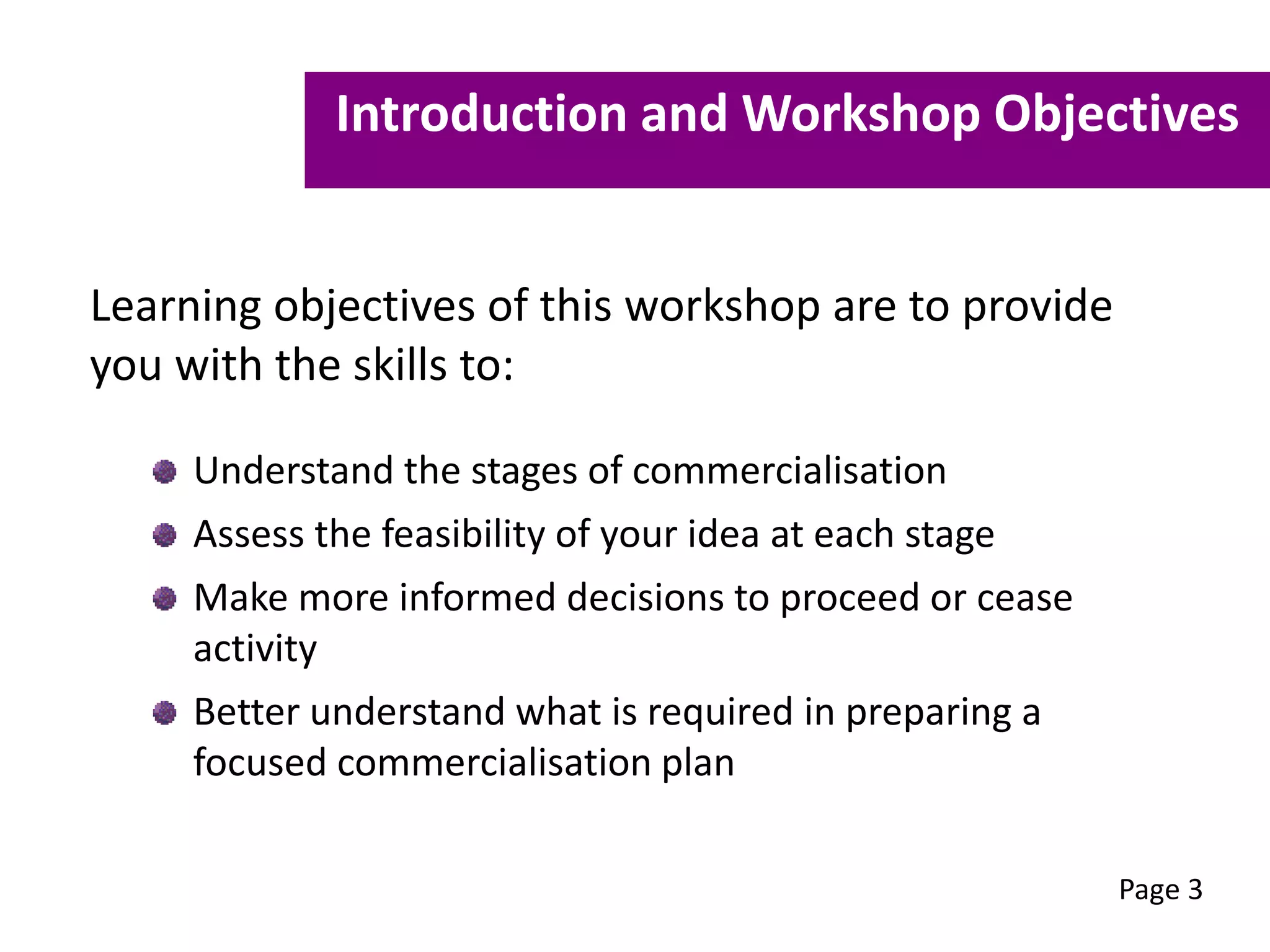
Learning objectives of this workshop are to provide
you with the skills to:
Understand the stages of commercialisation
Assess the feasibility of your idea at each stage
Make more informed decisions to proceed or cease
activity
Better understand what is required in preparing a
focused commercialisation plan
Page 3
Introduction and Workshop Objectives
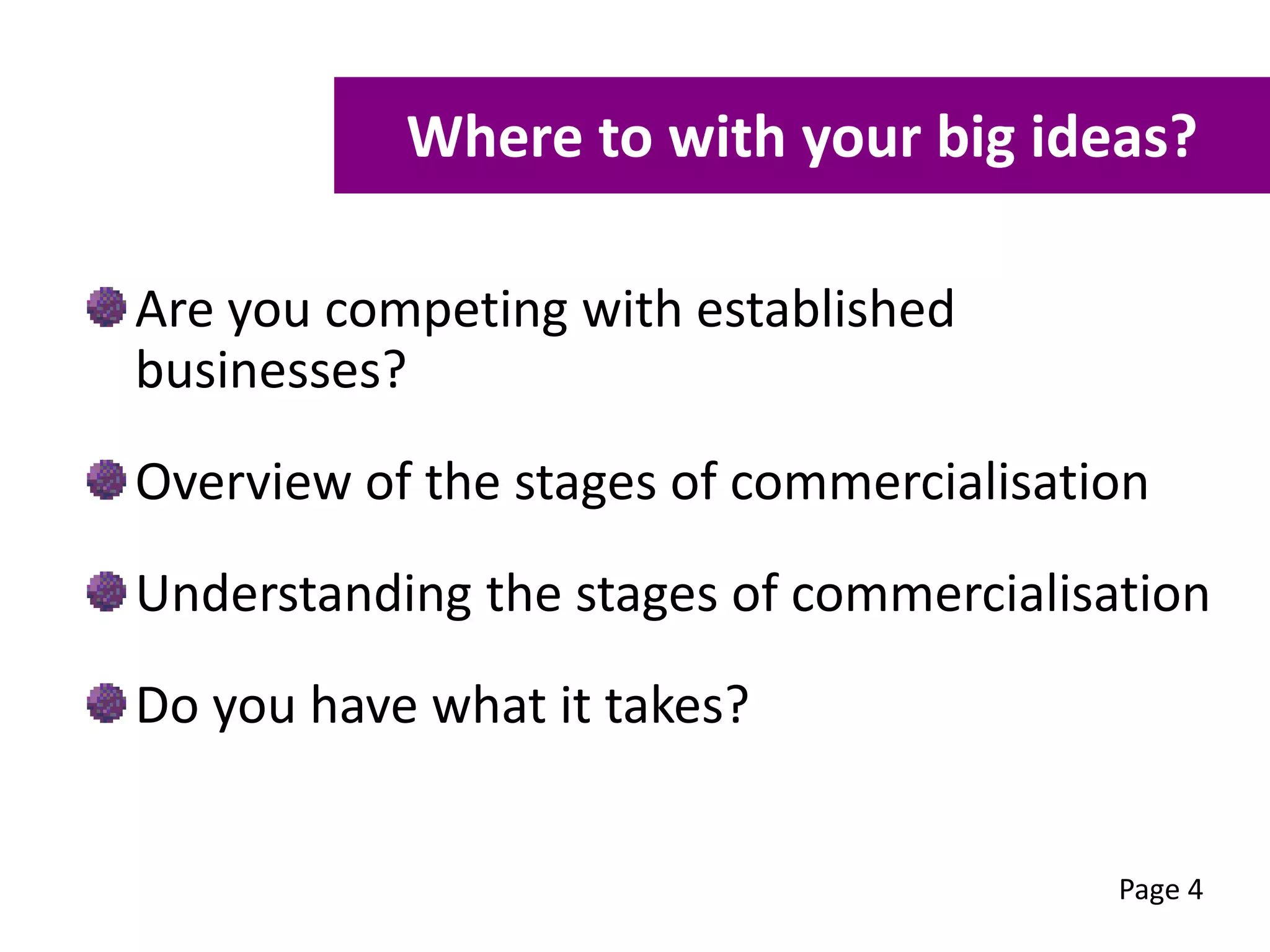
Are you competing with established
businesses?
Overview of the stages of commercialisation
Understanding the stages of commercialisation
Do you have what it takes?
Page 4
Where to with your big ideas?
Page 4 - 5
Are you competing with established businesses?
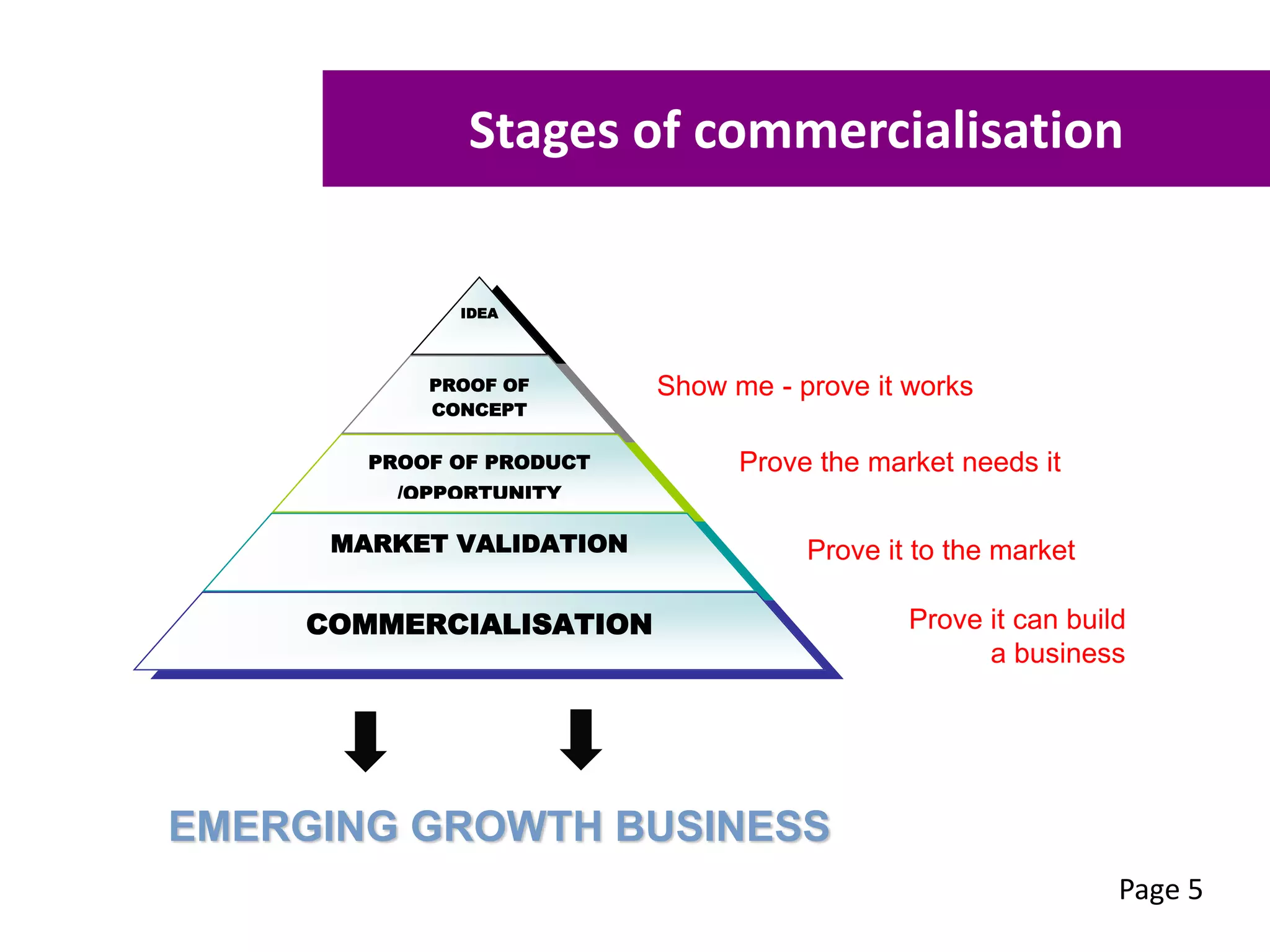
Show me - prove it works
Prove the market needs it
Prove it to the market
Prove it can build
a business
EMERGING GROWTH BUSINESS
IDEA
PROOF OF
CONCEPT
PROOF OF PRODUCT
/OPPORTUNITY
MARKET VALIDATION
COMMERCIALISATION
Page 5
Stages of commercialisation
STAGE : PROOF OF CONCEPT
0
1
2
3
4
5
6
7
8
9
10
STRATEGY
PRODUCT /TECHNOLOGY
IP
MARKETTEAM
OPERATIONS
FINANCE
Proof of Concept
STAGE : PROOF PRODUCT/ OPPORTUNITY
0
1
2
3
4
5
6
7
8
9
10
STRATEGY
PRODUCT /TECHNOLOGY
IP
MARKETTEAM
OPERATIONS
FINANCE
Proof of Product Opportunity
STAGE : MARKET VALIDATION
0
1
2
3
4
5
6
7
8
9
10
STRATEGY
PRODUCT /TECHNOLOGY
IP
MARKETTEAM
OPERATIONS
FINANCE
Market Validation
STAGE : COMMERCIALISATION
0
1
2
3
4
5
6
7
8
9
10
STRATEGY
PRODUCT /TECHNOLOGY
IP
MARKETTEAM
OPERATIONS
FINANCE
Commercialisation
Page 6
Understanding the stages of commercialisation
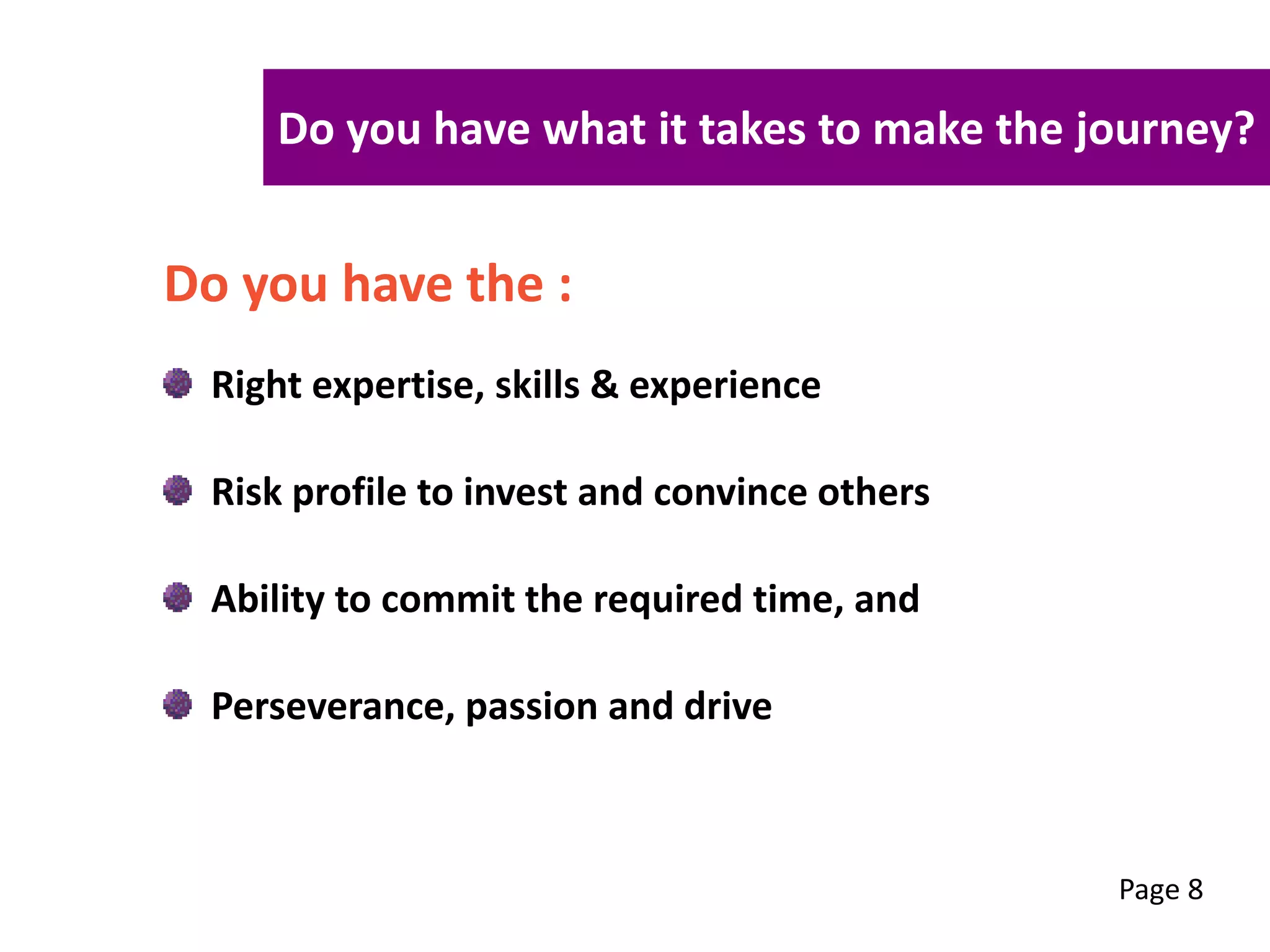
Do you have the :
Right expertise, skills & experience
Risk profile to invest and convince others
Ability to commit the required time, and
Perseverance, passion and drive
Page 8
Do you have what it takes to make the journey?
What is Intellectual Property (IP)?
The most common types of IP
IP strategies & considerations
IP protection structures
Selecting an IP advisor
Page 10
Intellectual Property
Intellectual Property is defined as:
‘a term referring to a number of distinct types of creations of the mind
for which property rights are recognised’
Keeping the ‘secret’
Using confidentiality agreements
Page 10
What is Intellectual Property?
Patents
Trademarks
Designs
Copyright *
Confidentiality agreements / trade secrets
Others – circuit layer rights * & plant breeder rights
www.ipaustralia.gov.au
Page 10-11
The most common types of IP
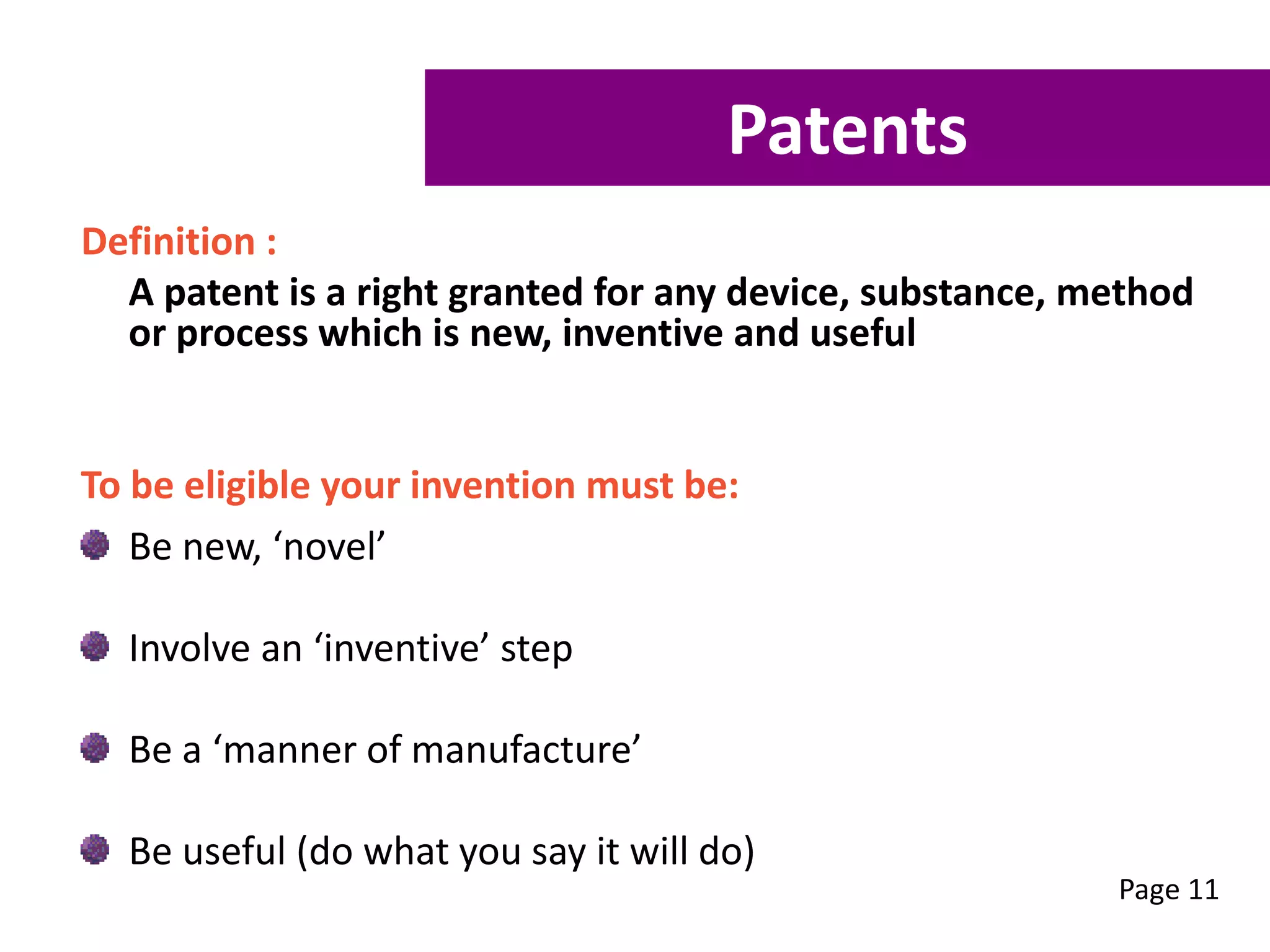
Definition :
A patent is a right granted for any device, substance, method
or process which is new, inventive and useful
To be eligible your invention must be:
Be new, ‘novel’
Involve an ‘inventive’ step
Be a ‘manner of manufacture’
Be useful (do what you say it will do)
Page 11
Patents
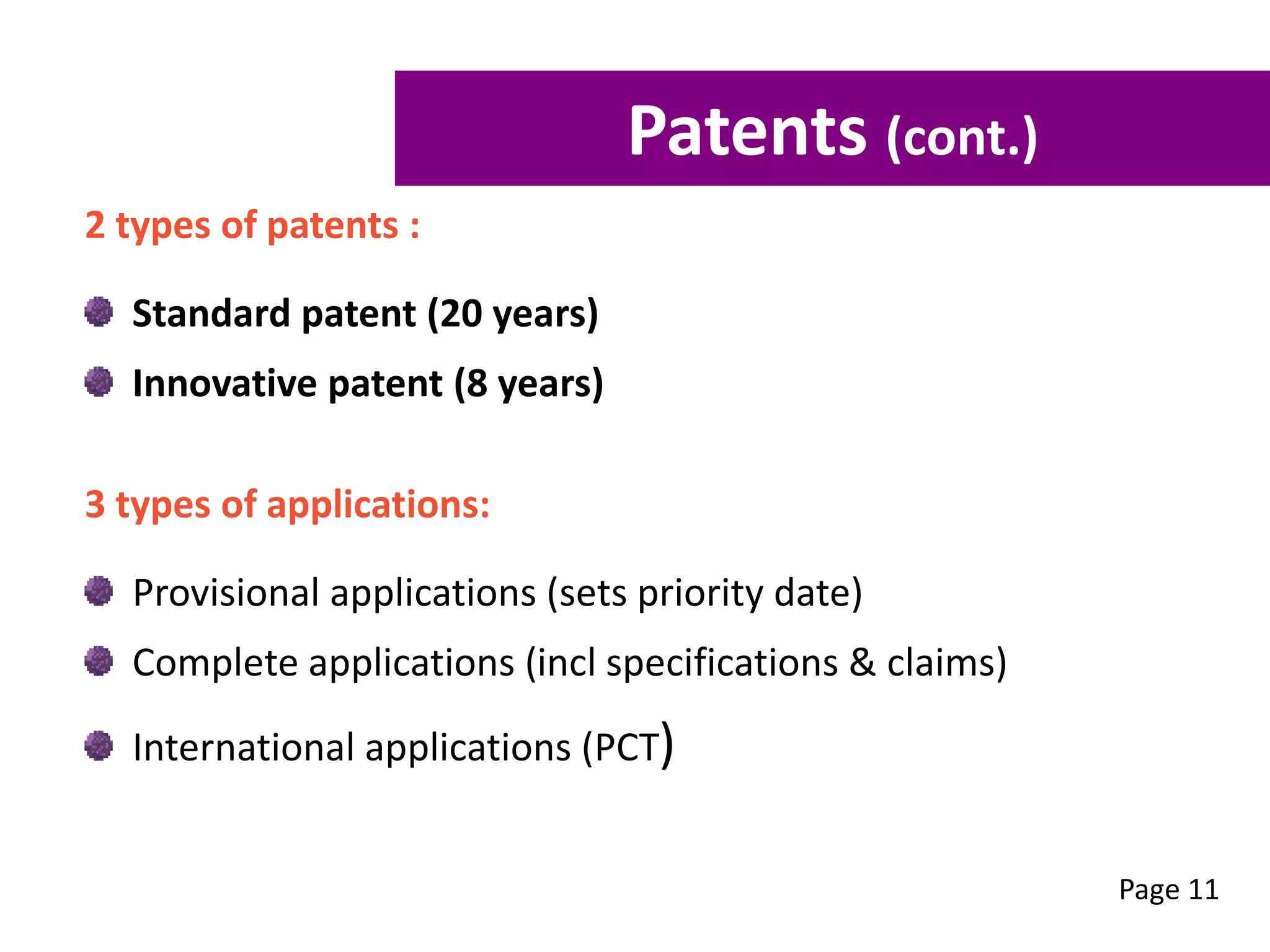
2 types of patents :
Standard patent (20 years)
Innovative patent (8 years)
3 types of applications:
Provisional applications (sets priority date)
Complete applications (incl specifications & claims)
International applications (PCT)
Page 11
Patents (cont.)
Definition :
Trade mark can be a word, phrase, letter, number, sound,
smell, shape, logo, picture, aspect of packaging or a
combination. Used as a marketing tool to distinguish
goods & services from each other
Examples of things you can’t use
Importance of determining what ‘classes’ to register
Page 12 -13
Trademarks
Definition :
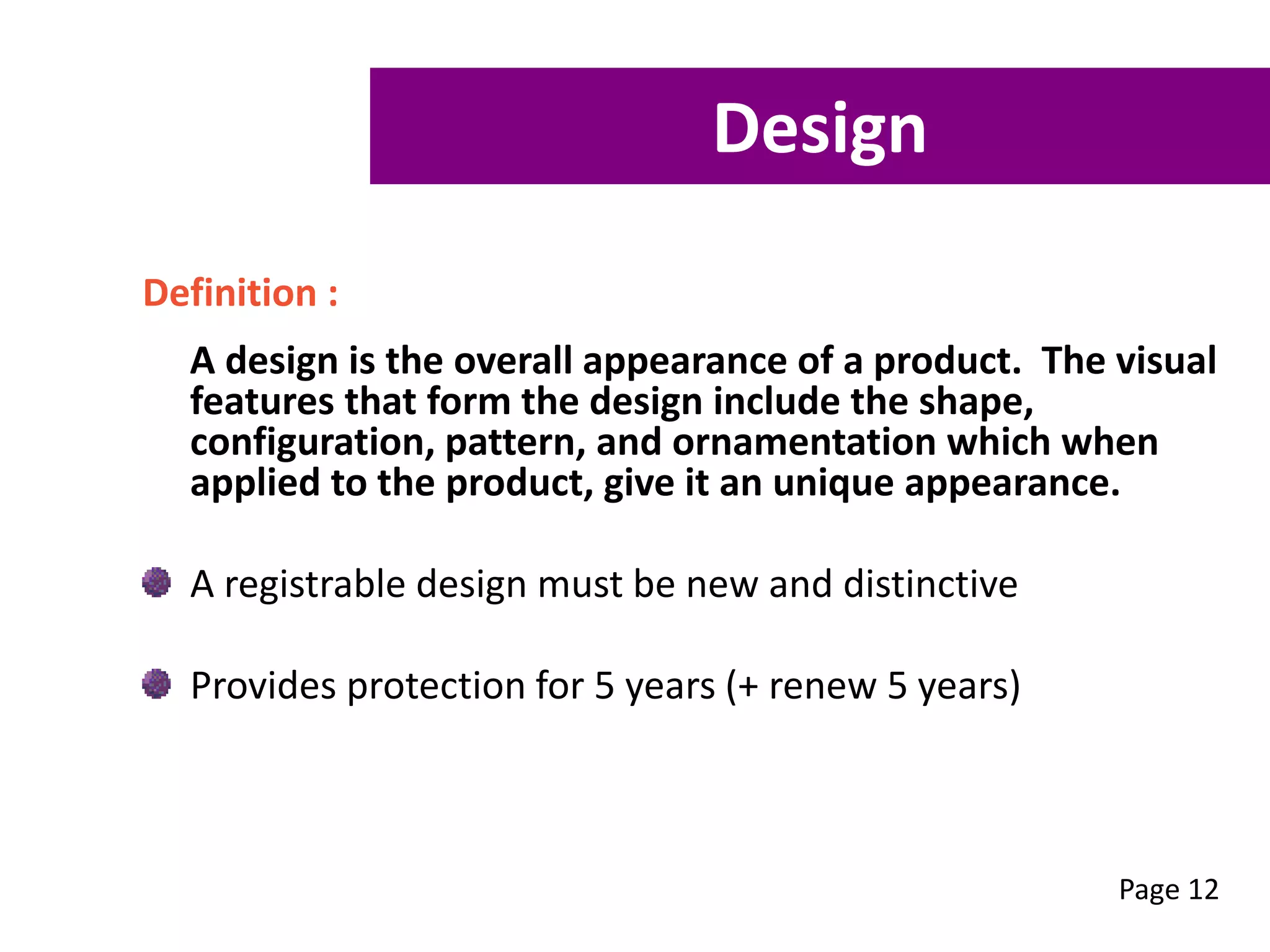
A design is the overall appearance of a product. The visual
features that form the design include the shape,
configuration, pattern, and ornamentation which when
applied to the product, give it an unique appearance.
A registrable design must be new and distinctive
Provides protection for 5 years (+ renew 5 years)
Page 12
Design
Definition :
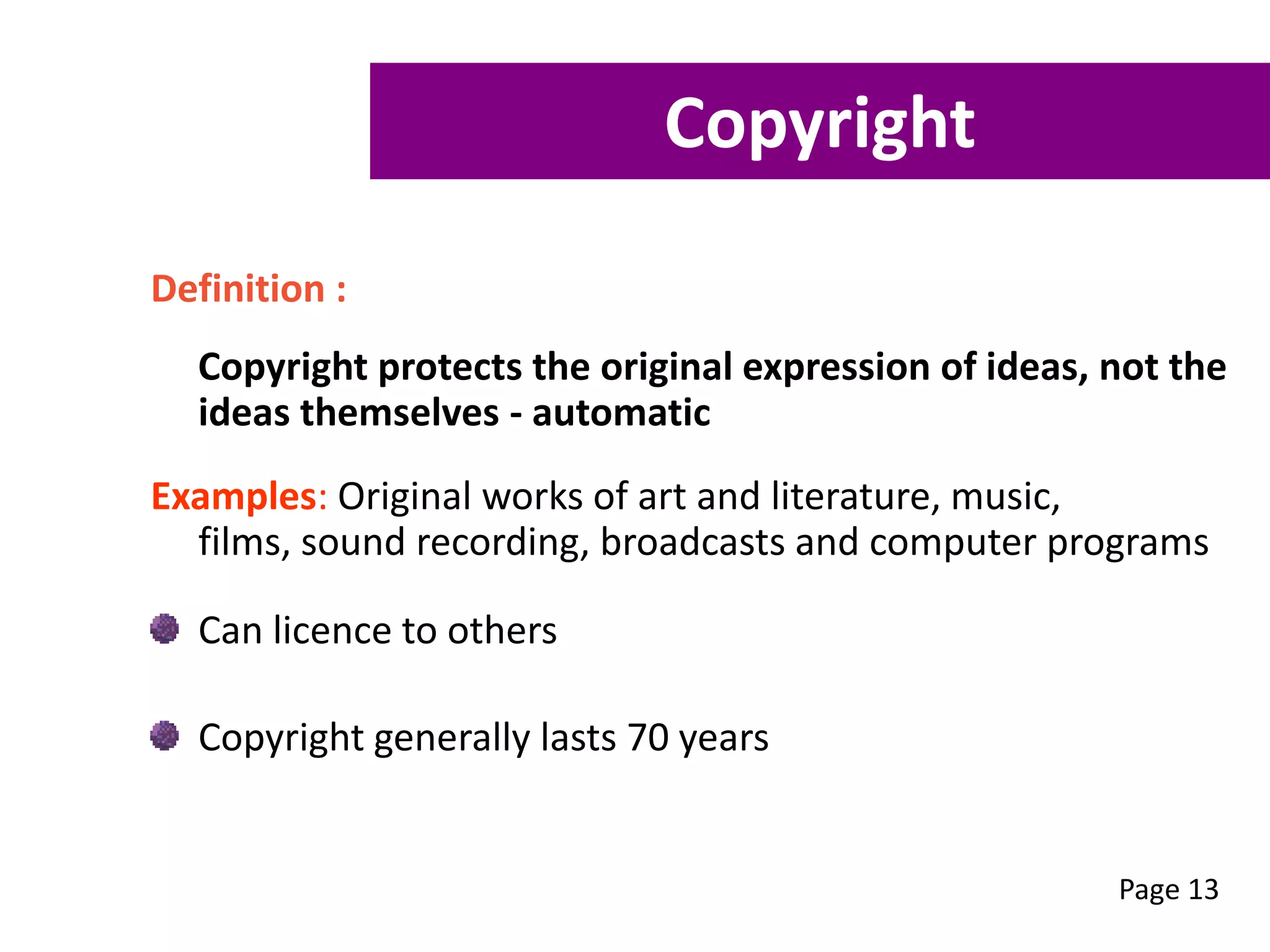
Copyright protects the original expression of ideas, not the
ideas themselves - automatic
Examples: Original works of art and literature, music,
films, sound recording, broadcasts and computer programs
Can licence to others
Copyright generally lasts 70 years
Page 13
Copyright
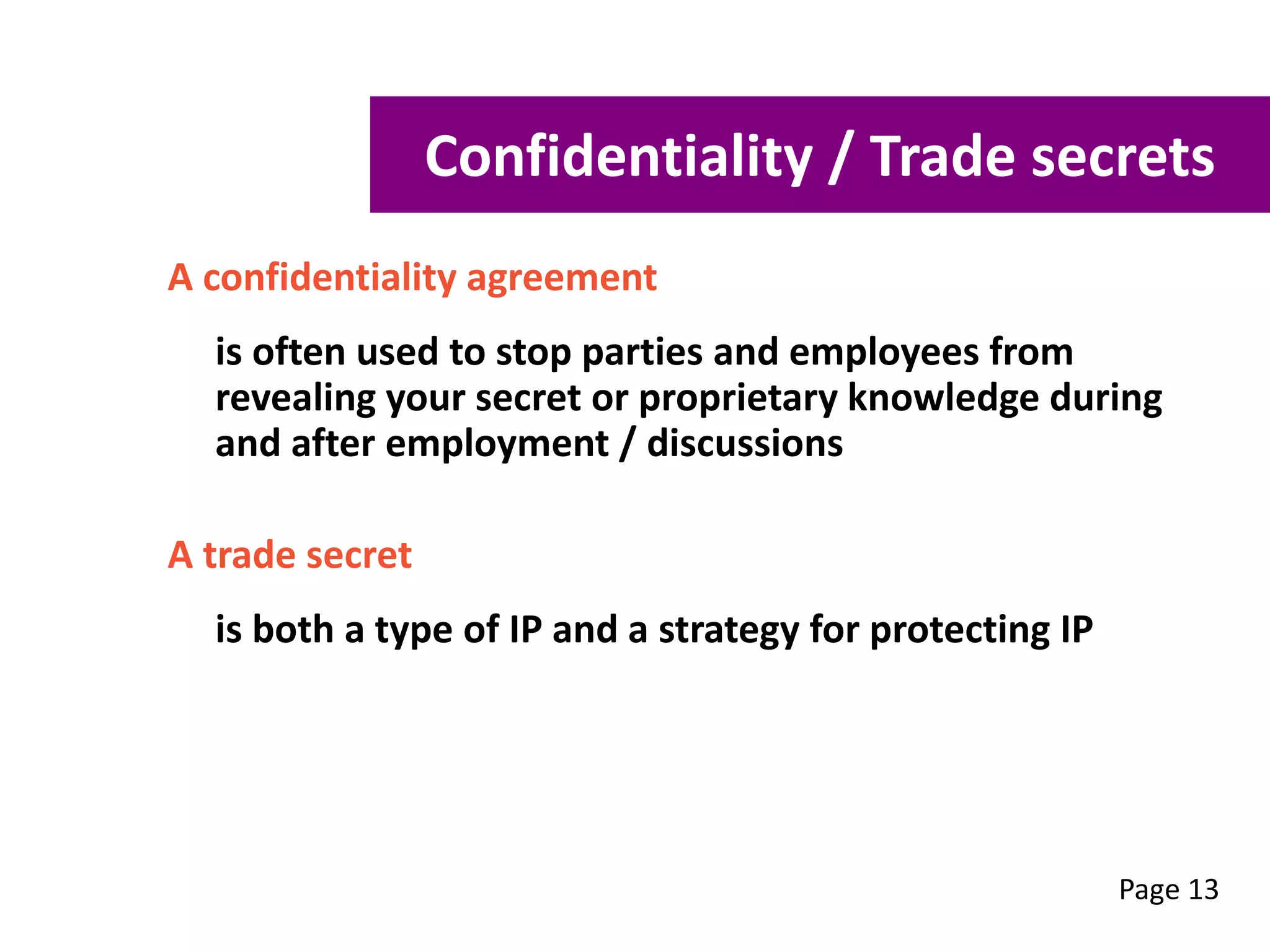
A confidentiality agreement
is often used to stop parties and employees from
revealing your secret or proprietary knowledge during
and after employment / discussions
A trade secret
is both a type of IP and a strategy for protecting IP
Page 13
Confidentiality / Trade secrets
Patent lodgement – starts the ‘clock’ on
commercialisation timetable
Weighing up total IP protection –v- access to funding
How do you decide – which countries?
Alternative strategies for IP protection
Page 13
IP Protection strategies and considerations
The importance of assessing the feasibility of
your idea/product
Key criteria in assessing the feasibility of a
product
Feasibility assessment activity
Page 22
Assessing the feasibility of your idea
Not every good idea will lead to commercial success
Need a balance between innovative skills and your ability to assess
the ‘feasibility’ of your idea
Need to maintain focus on the ‘end goal’
Feasibility assessment will help you :
Decide if you should cease activity (before it costs you significantly)
Refocus during product development stage
Page 22
The importance of feasibility assessment
The 3 P’s – Product, Potential & People
Product – Innovation, product, IP novelty, ability to meet
market need, value proposition
Potential – Market size, access to market channels, target
market, competitive advantage, export potential, barriers
to entry
People – business experience, industry expertise/skills,
management mix of skills, vision, strategy, ability to
adapt, financial/business planning
Key criteria in assessing feasibility of product
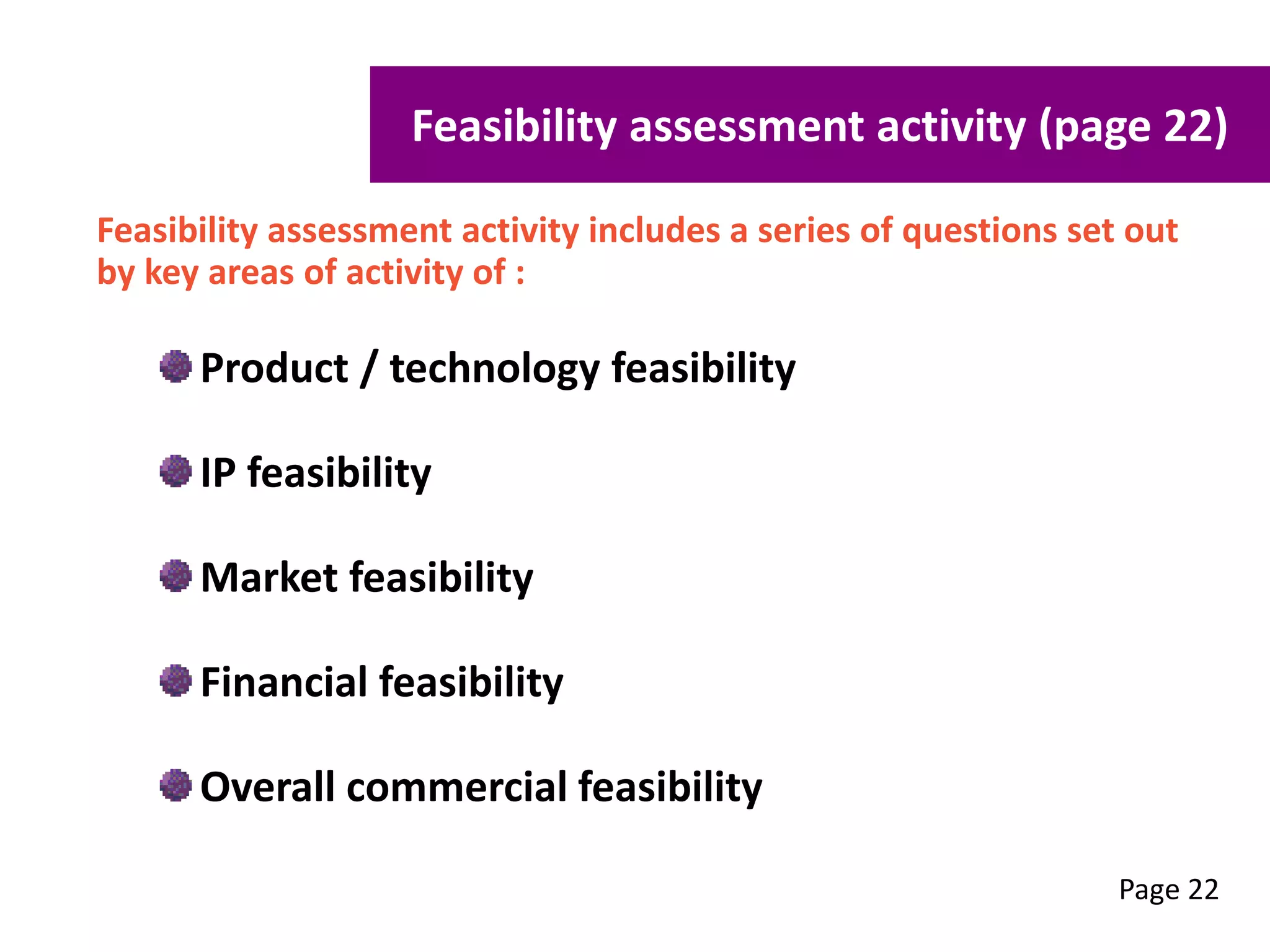
Feasibility assessment activity includes a series of questions set out
by key areas of activity of :
Product / technology feasibility
IP feasibility
Market feasibility
Financial feasibility
Overall commercial feasibility
Page 22
Feasibility assessment activity (page 22)
Assess each area of activities in your commercialisation
Page 26
Feasibility assessment activity (cont.)
Understanding the government regulations in
your country
Understanding the regulations in different
markets
Establishing your business structure
Registering a company & business name
www.asic.gov.au
www.austrade.gov.au
Page 19
Requirements for licenses, registrations and
permits
How a commercialisation plan differs to a business plan
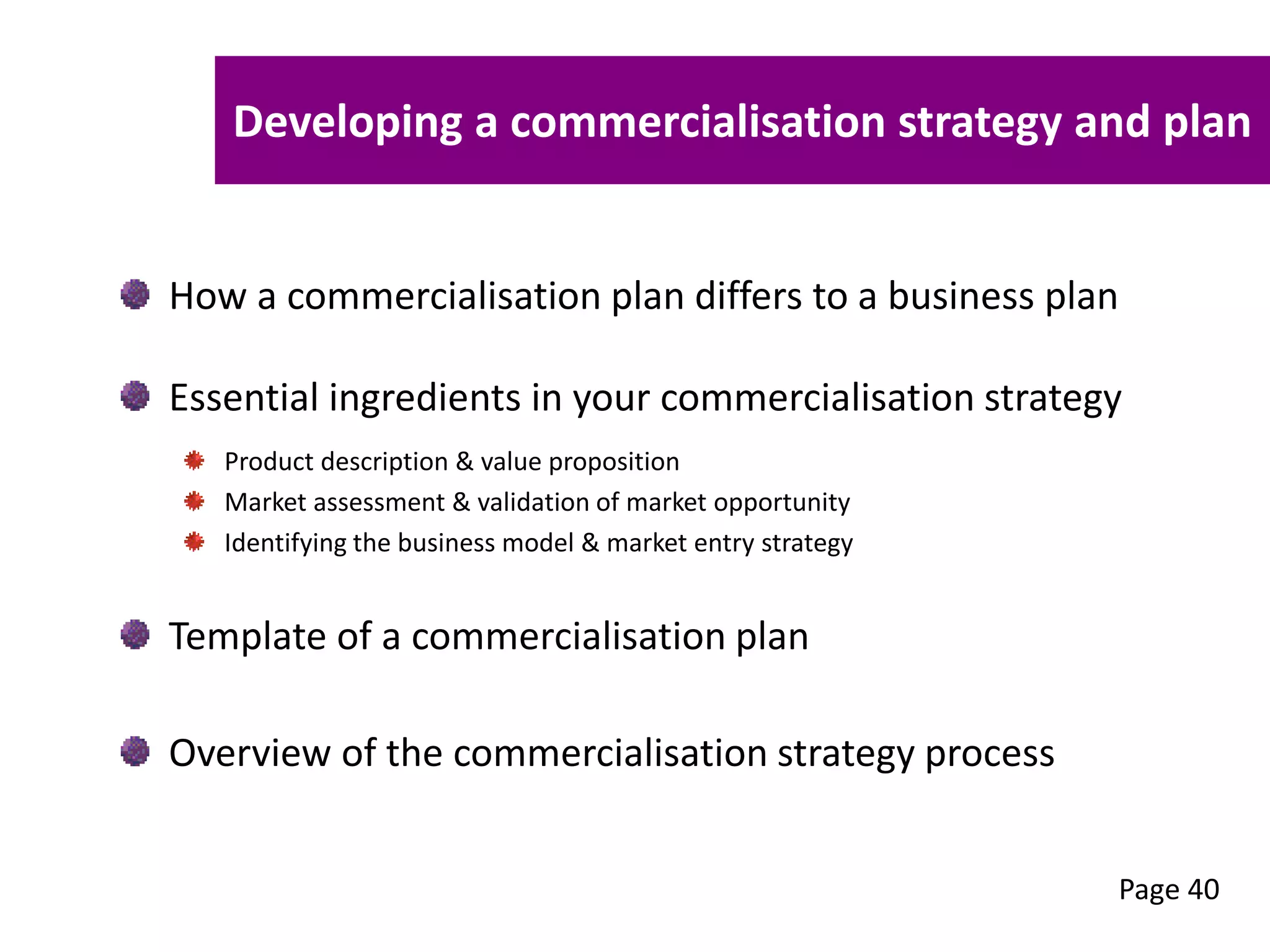
Essential ingredients in your commercialisation strategy
Product description & value proposition
Market assessment & validation of market opportunity
Identifying the business model & market entry strategy
Template of a commercialisation plan
Overview of the commercialisation strategy process
Page 40
Developing a commercialisation strategy and plan
A commercialisation plan often encounters :
No clear comparative model to follow
Multiple variations of ‘the product’ available
Different target markets which need the product
A number of business models options
Page 40
How a commercialisation plan differs to a
business plan
Funding is often the most limiting factor in the process
Requires an open mind to the possibilities & common -
sense approach to the realities
Strategies need to be well researched
How a commercialisation plan differs to a
business plan (cont.)
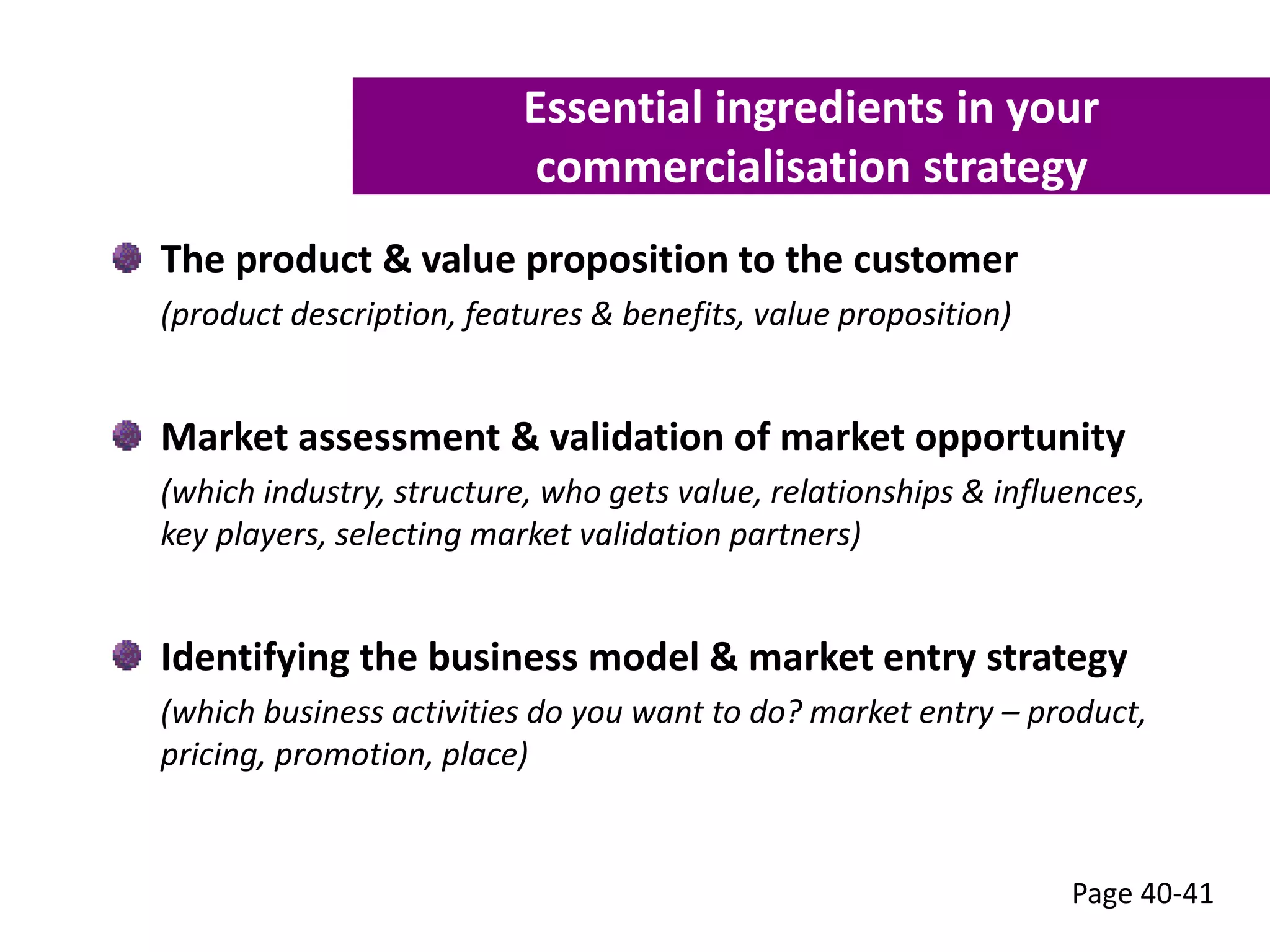
The product & value proposition to the customer
(product description, features & benefits, value proposition)
Market assessment & validation of market opportunity
(which industry, structure, who gets value, relationships & influences,
key players, selecting market validation partners)
Identifying the business model & market entry strategy
(which business activities do you want to do? market entry – product,
pricing, promotion, place)
Page 40-41
Essential ingredients in your
commercialisation strategy
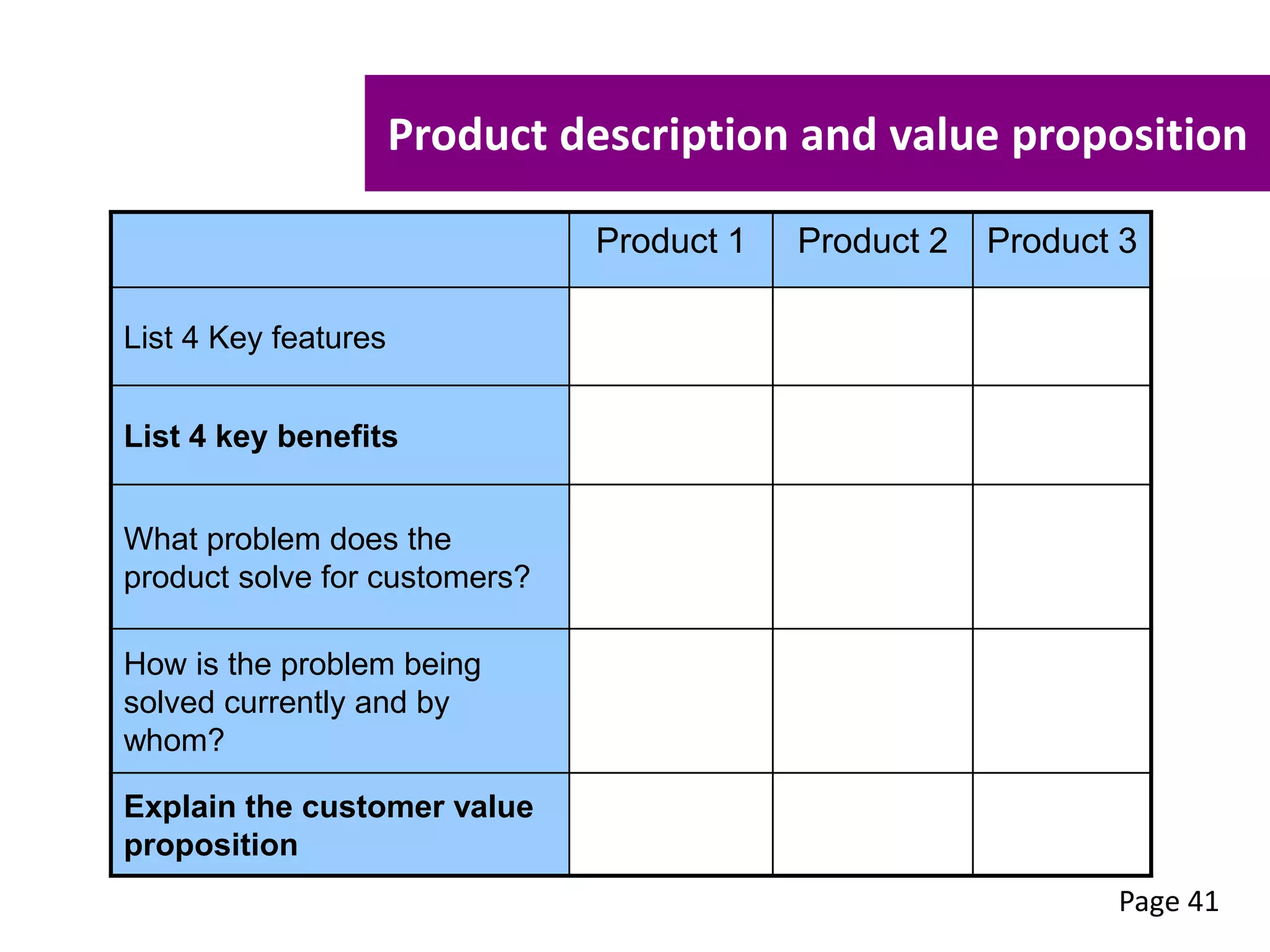
Product 1 Product 2 Product 3
List 4 Key features
List 4 key benefits
What problem does the
product solve for customers?
How is the problem being
solved currently and by
whom?
Explain the customer value
proposition
Page 41
Product description and value proposition
ROUTE TO MARKET INFLUENCERS
PRODUCT
MANUFACTURER
DISTRIBUTER
RETAILER
END CONSUMER ☺☺☺☺☺☺☺☺☺☺☺☺☺☺☺☺☺☺
MARKET / INDUSTRY STRUCTURE
Page 42
Market assessment – industry structure
R&D /
Technology
Distribution
/ Delivery
Sales /
Business
Development
Warranty &
Customer
Support
Manufacturing
/ Assembly
/ Services
KEY BUSINESS ACTIVITIES & COST CENTRES
Page 43
The business model description
TARGET
MARKET
R&D
Product
Manufacturing
/ Assembly
Sales /
Business
Development
Distribution
/ Delivery
Customer
Support /
Warranty
Australia
US
1 = In-house 2 = Outsource 3 = Licensing Page 44
The business model description (cont.)
PRODUCT PLACE PROMOTION PRICE
Developing the
right ‘product’ for
the target market
Getting the right’
product ‘into’ the
target market
‘Informing’ the
market about the
right product
Getting the
‘price’ right
 Product features
& benefits
 Identifying the
value proposition
 Quality
 Packaging /
product branding
 Warranty
 Installation
 Instruction
manual
 Distribution
channels
 Selection &
relationships
with
intermediaries
 Identifying the
influencers in
the market
 Service levels
 Market
exposure
 Identifying sales
staff
 Training /
motivation of staff
 Advertising
 Publicity
 Developing
promotional
material –
brochures,
internet,
testimonials
 Determining the
$$ value pricing
of the product for
each market
 Flexibility to
meet market
demand
 Discount /
rebate policy
Page 45
Key elements of marketing entry strategy
1. Executive summary
2. The product & value proposition
3. IP protection
4. Market profile (industry structure, competitor products, key
industry players, critical success factors)
5. Route to market (business model, commercial partnerships,
market entry strategy)
6. Financial analysis (costing, projections, funding)
7. Team & operations
8. Action Plan
Page 45
Overview of commercialisation plan
R&D development finished
Invention & R&D / working prototype
Commercial design
Testing / certification, technical review
commercial product in place
Identified commercial product offering
Clear product features & benefits
Value proposition / competitive
advantage identified
market place assessment
Detailed market research undertaken -
- Clear understanding of market structure
- Evaluate competitor prods /key players
- Look at industry relationships & CSFs
IP protection &
strategy in place
Management
skills review
Determine your
vision/objectives
market validation
to be done
Plan investment
raising activity
Plan potential
legal structure
commercialisation strategy development
Determine strategic position of product / business
Identify the Business Model to commercialise the product
Commercialisation options evaluation
Market entry strategy determined
= COMMERCIALISATION STRATEGY
STRATEGY
- Comm Plan
- Ongoing bus
strategy
- Strategic
partnership
- Fund raising
strategy
- Direction
IP
- Ongoing
management
-
Confidentialit
y agreements
- Licensing
MARKET
- Target mkt
- Route to mkt
- Pricing
- Distn
channels
- Promotion
FINANCE
- Financial
projections
- Acctounting
system
- Budgets
TEAM /
OPERATIONS
- Management
team
- Recruitment
- Manufacturing
set up
- Location
PRODUCT
- Future R&D
enhancement
- New product
development
Financial
evaluation
$$$
$$$
$$$
COMMERCIALISATION
STRATEGY
FREE Mentoring Session
Business mentors help you to identify a clear direction for you and your
business
You are entitled to 2 free mentoring sessions in this program
Business mentors can advise you on how to:
conduct market research
cost your products or services
develop an effective commercialisation strategy & plan
use other business management tools
move forwards in commercialisation
To arrange a free mentoring session with a business mentor complete
the evaluation form and select FREE Mentoring Session on page 2. You
will then receive an email with details on claiming your free mentoring
session.
Questions?
Thank you for attending
Check out
business.vic.gov.au/events
for more workshop information

Commercialising your New Idea workshop

  • 2.
    Learning objectives ofthis workshop are to provide you with the skills to: Understand the stages of commercialisation Assess the feasibility of your idea at each stage Make more informed decisions to proceed or cease activity Better understand what is required in preparing a focused commercialisation plan Page 3 Introduction and Workshop Objectives
  • 3.
    Are you competingwith established businesses? Overview of the stages of commercialisation Understanding the stages of commercialisation Do you have what it takes? Page 4 Where to with your big ideas?
  • 4.
    Page 4 -5 Are you competing with established businesses?
  • 5.
    Show me -prove it works Prove the market needs it Prove it to the market Prove it can build a business EMERGING GROWTH BUSINESS IDEA PROOF OF CONCEPT PROOF OF PRODUCT /OPPORTUNITY MARKET VALIDATION COMMERCIALISATION Page 5 Stages of commercialisation
  • 6.
    STAGE : PROOFOF CONCEPT 0 1 2 3 4 5 6 7 8 9 10 STRATEGY PRODUCT /TECHNOLOGY IP MARKETTEAM OPERATIONS FINANCE Proof of Concept STAGE : PROOF PRODUCT/ OPPORTUNITY 0 1 2 3 4 5 6 7 8 9 10 STRATEGY PRODUCT /TECHNOLOGY IP MARKETTEAM OPERATIONS FINANCE Proof of Product Opportunity STAGE : MARKET VALIDATION 0 1 2 3 4 5 6 7 8 9 10 STRATEGY PRODUCT /TECHNOLOGY IP MARKETTEAM OPERATIONS FINANCE Market Validation STAGE : COMMERCIALISATION 0 1 2 3 4 5 6 7 8 9 10 STRATEGY PRODUCT /TECHNOLOGY IP MARKETTEAM OPERATIONS FINANCE Commercialisation Page 6 Understanding the stages of commercialisation
  • 7.
    Do you havethe : Right expertise, skills & experience Risk profile to invest and convince others Ability to commit the required time, and Perseverance, passion and drive Page 8 Do you have what it takes to make the journey?
  • 8.
    What is IntellectualProperty (IP)? The most common types of IP IP strategies & considerations IP protection structures Selecting an IP advisor Page 10 Intellectual Property
  • 9.
    Intellectual Property isdefined as: ‘a term referring to a number of distinct types of creations of the mind for which property rights are recognised’ Keeping the ‘secret’ Using confidentiality agreements Page 10 What is Intellectual Property?
  • 10.
    Patents Trademarks Designs Copyright * Confidentiality agreements/ trade secrets Others – circuit layer rights * & plant breeder rights www.ipaustralia.gov.au Page 10-11 The most common types of IP
  • 11.
    Definition : A patentis a right granted for any device, substance, method or process which is new, inventive and useful To be eligible your invention must be: Be new, ‘novel’ Involve an ‘inventive’ step Be a ‘manner of manufacture’ Be useful (do what you say it will do) Page 11 Patents
  • 12.
    2 types ofpatents : Standard patent (20 years) Innovative patent (8 years) 3 types of applications: Provisional applications (sets priority date) Complete applications (incl specifications & claims) International applications (PCT) Page 11 Patents (cont.)
  • 13.
    Definition : Trade markcan be a word, phrase, letter, number, sound, smell, shape, logo, picture, aspect of packaging or a combination. Used as a marketing tool to distinguish goods & services from each other Examples of things you can’t use Importance of determining what ‘classes’ to register Page 12 -13 Trademarks
  • 14.
    Definition : A designis the overall appearance of a product. The visual features that form the design include the shape, configuration, pattern, and ornamentation which when applied to the product, give it an unique appearance. A registrable design must be new and distinctive Provides protection for 5 years (+ renew 5 years) Page 12 Design
  • 15.
    Definition : Copyright protectsthe original expression of ideas, not the ideas themselves - automatic Examples: Original works of art and literature, music, films, sound recording, broadcasts and computer programs Can licence to others Copyright generally lasts 70 years Page 13 Copyright
  • 16.
    A confidentiality agreement isoften used to stop parties and employees from revealing your secret or proprietary knowledge during and after employment / discussions A trade secret is both a type of IP and a strategy for protecting IP Page 13 Confidentiality / Trade secrets
  • 17.
    Patent lodgement –starts the ‘clock’ on commercialisation timetable Weighing up total IP protection –v- access to funding How do you decide – which countries? Alternative strategies for IP protection Page 13 IP Protection strategies and considerations
  • 18.
    The importance ofassessing the feasibility of your idea/product Key criteria in assessing the feasibility of a product Feasibility assessment activity Page 22 Assessing the feasibility of your idea
  • 19.
    Not every goodidea will lead to commercial success Need a balance between innovative skills and your ability to assess the ‘feasibility’ of your idea Need to maintain focus on the ‘end goal’ Feasibility assessment will help you : Decide if you should cease activity (before it costs you significantly) Refocus during product development stage Page 22 The importance of feasibility assessment
  • 20.
    The 3 P’s– Product, Potential & People Product – Innovation, product, IP novelty, ability to meet market need, value proposition Potential – Market size, access to market channels, target market, competitive advantage, export potential, barriers to entry People – business experience, industry expertise/skills, management mix of skills, vision, strategy, ability to adapt, financial/business planning Key criteria in assessing feasibility of product
  • 21.
    Feasibility assessment activityincludes a series of questions set out by key areas of activity of : Product / technology feasibility IP feasibility Market feasibility Financial feasibility Overall commercial feasibility Page 22 Feasibility assessment activity (page 22)
  • 22.
    Assess each areaof activities in your commercialisation Page 26 Feasibility assessment activity (cont.)
  • 23.
    Understanding the governmentregulations in your country Understanding the regulations in different markets Establishing your business structure Registering a company & business name www.asic.gov.au www.austrade.gov.au Page 19 Requirements for licenses, registrations and permits
  • 24.
    How a commercialisationplan differs to a business plan Essential ingredients in your commercialisation strategy Product description & value proposition Market assessment & validation of market opportunity Identifying the business model & market entry strategy Template of a commercialisation plan Overview of the commercialisation strategy process Page 40 Developing a commercialisation strategy and plan
  • 25.
    A commercialisation planoften encounters : No clear comparative model to follow Multiple variations of ‘the product’ available Different target markets which need the product A number of business models options Page 40 How a commercialisation plan differs to a business plan
  • 26.
    Funding is oftenthe most limiting factor in the process Requires an open mind to the possibilities & common - sense approach to the realities Strategies need to be well researched How a commercialisation plan differs to a business plan (cont.)
  • 27.
    The product &value proposition to the customer (product description, features & benefits, value proposition) Market assessment & validation of market opportunity (which industry, structure, who gets value, relationships & influences, key players, selecting market validation partners) Identifying the business model & market entry strategy (which business activities do you want to do? market entry – product, pricing, promotion, place) Page 40-41 Essential ingredients in your commercialisation strategy
  • 28.
    Product 1 Product2 Product 3 List 4 Key features List 4 key benefits What problem does the product solve for customers? How is the problem being solved currently and by whom? Explain the customer value proposition Page 41 Product description and value proposition
  • 29.
    ROUTE TO MARKETINFLUENCERS PRODUCT MANUFACTURER DISTRIBUTER RETAILER END CONSUMER ☺☺☺☺☺☺☺☺☺☺☺☺☺☺☺☺☺☺ MARKET / INDUSTRY STRUCTURE Page 42 Market assessment – industry structure
  • 30.
    R&D / Technology Distribution / Delivery Sales/ Business Development Warranty & Customer Support Manufacturing / Assembly / Services KEY BUSINESS ACTIVITIES & COST CENTRES Page 43 The business model description
  • 31.
    TARGET MARKET R&D Product Manufacturing / Assembly Sales / Business Development Distribution /Delivery Customer Support / Warranty Australia US 1 = In-house 2 = Outsource 3 = Licensing Page 44 The business model description (cont.)
  • 32.
    PRODUCT PLACE PROMOTIONPRICE Developing the right ‘product’ for the target market Getting the right’ product ‘into’ the target market ‘Informing’ the market about the right product Getting the ‘price’ right  Product features & benefits  Identifying the value proposition  Quality  Packaging / product branding  Warranty  Installation  Instruction manual  Distribution channels  Selection & relationships with intermediaries  Identifying the influencers in the market  Service levels  Market exposure  Identifying sales staff  Training / motivation of staff  Advertising  Publicity  Developing promotional material – brochures, internet, testimonials  Determining the $$ value pricing of the product for each market  Flexibility to meet market demand  Discount / rebate policy Page 45 Key elements of marketing entry strategy
  • 33.
    1. Executive summary 2.The product & value proposition 3. IP protection 4. Market profile (industry structure, competitor products, key industry players, critical success factors) 5. Route to market (business model, commercial partnerships, market entry strategy) 6. Financial analysis (costing, projections, funding) 7. Team & operations 8. Action Plan Page 45 Overview of commercialisation plan
  • 34.
    R&D development finished Invention& R&D / working prototype Commercial design Testing / certification, technical review commercial product in place Identified commercial product offering Clear product features & benefits Value proposition / competitive advantage identified market place assessment Detailed market research undertaken - - Clear understanding of market structure - Evaluate competitor prods /key players - Look at industry relationships & CSFs IP protection & strategy in place Management skills review Determine your vision/objectives market validation to be done Plan investment raising activity Plan potential legal structure commercialisation strategy development Determine strategic position of product / business Identify the Business Model to commercialise the product Commercialisation options evaluation Market entry strategy determined = COMMERCIALISATION STRATEGY STRATEGY - Comm Plan - Ongoing bus strategy - Strategic partnership - Fund raising strategy - Direction IP - Ongoing management - Confidentialit y agreements - Licensing MARKET - Target mkt - Route to mkt - Pricing - Distn channels - Promotion FINANCE - Financial projections - Acctounting system - Budgets TEAM / OPERATIONS - Management team - Recruitment - Manufacturing set up - Location PRODUCT - Future R&D enhancement - New product development Financial evaluation $$$ $$$ $$$ COMMERCIALISATION STRATEGY
  • 35.
    FREE Mentoring Session Businessmentors help you to identify a clear direction for you and your business You are entitled to 2 free mentoring sessions in this program Business mentors can advise you on how to: conduct market research cost your products or services develop an effective commercialisation strategy & plan use other business management tools move forwards in commercialisation To arrange a free mentoring session with a business mentor complete the evaluation form and select FREE Mentoring Session on page 2. You will then receive an email with details on claiming your free mentoring session.
  • 36.
    Questions? Thank you forattending Check out business.vic.gov.au/events for more workshop information