GRADES 1 TO
12
DAILY LESSON
LOG
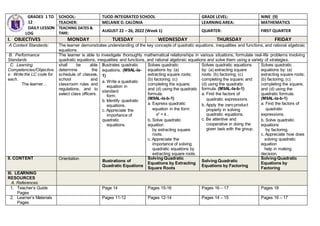
SCHOOL: TUOD INTEGRATED SCHOOL GRADE LEVEL: NINE (9)
TEACHER: MELANIE D. CALONIA LEARNING AREA: MATHEMATICS
TEACHING DATES &
TIME:
AUGUST 22 – 26, 2022 (Week 1) QUARTER: FIRST QUARTER
I. OBJECTIVES MONDAY TUESDAY WEDNESDAY THURSDAY FRIDAY
A.Content Standards: The learner demonstrates understanding of the key concepts of quadratic equations, inequalities and functions, and rational algebraic
equations.
B. Performance
Standards
The learner is able to investigate thoroughly mathematical relationships in various situations, formulate real-life problems involving
quadratic equations, inequalities and functions, and rational algebraic equations and solve them using a variety of strategies.
C. Learning
Competencies/Objective
s: Write the LC code for
each.
The learner…
shall be able
determine the
schedule of classes,
school and
classroom rules and
regulations, and to
select class officers.
Illustrates quadratic
equations. (M9AL-Ia-
1)
a. Write a quadratic
equation in
standard
form.
b. Identify quadratic
equations.
c. Appreciate the
importance of
quadratic
equations.
Solves quadratic
equations by: (a)
extracting square roots;
(b) factoring; (c)
completing the square;
and (d) using the quadratic
formula.
(M9AL-Ia-b-1)
a. Express quadratic
equation in the form
x2
= k .
b. Solve quadratic
equation
by extracting square
roots.
c. Appreciate the
importance of solving
quadratic equations by
extracting square roots.
Solves quadratic equations
by: (a) extracting square
roots; (b) factoring; (c)
completing the square; and
(d) using the quadratic
formula. (M9AL-Ia-b-1)
a. Find the factors of
quadratic expressions.
b. Apply the zero product
property in solving
quadratic equations.
c. Be attentive and
cooperative in doing the
given task with the group.
Solves quadratic
equations by: (a)
extracting square roots;
(b) factoring; (c)
completing the square;
and (d) using the
quadratic formula.
(M9AL-Ia-b-1)
a. Find the factors of
quadratic
expressions.
b. Solve quadratic
equations
by factoring.
c. Appreciate how does
solving quadratic
equation
help in making
decision.
II. CONTENT Orientation
Illustrations of
Quadratic Equations
Solving Quadratic
Equations by Extracting
Square Roots
Solving Quadratic
Equations by Factoring
Solving Quadratic
Equations by
Factoring
III. LEARNING
RESOURCES
A. References
1. Teacher’s Guide
Pages
Page 14 Pages 15-16 Pages 16 – 17 Pages 18
2. Learner’s Materials
Pages
Pages 11-12 Pages 12-14 Pages 14 – 15 Pages 16 – 17
3. Text book Pages Math III SEDP Series
Capalad, Lanniene,
et., al.
21st
Century Math IIIpp.
167-172
Ho, Ju Se T. et., al
Math PACE (Algebra II –
8)pp. 7
Accelerated Christian
Education, Inc.
4. Additional Materials
from Learning
resources(LR)Portal
Math Learner’s
Module
Math Learner’s Module Math Learner’s Module Math Learner’s Module
B. Other Learning
Resources
School Handbook (if
any)
Grade 9 LCTG by DepEd, laptop,
Monitor/Projector, Activity Sheets
Grade 9 LCTG by DepEd, laptop, Monitor/Projector,
Activity Sheets
III. PROCEDURE
A. Reviewing Previous
Lesson or Presenting
New Lesson
Do You Remember
These Products?
Find each indicated
product then answer
the questions that
follow.
1. 3(x2
+7)
2. 2s(s-4)
3. (w+7)(w+3)
4. (x+9)(x-2)
5. (2t-1)(t+5)
6. (x+4)(x+4)
7. (2r-5)(2r-5)
8. (3-4m)2
9. (2h+7)(2h-7)
10. (8-3x)(8+3x)
a. How did you find
each product?
b. In finding each
product, what
mathematics concepts
or principles did you
apply? Explain.
c. How would you
describe the products
obtained?
Find My Roots!
Find the following square
roots. Answer the
questions that follow.
a .How did you find each
square root?
b. How many square roots
does a number have?
c. Does a negative
number have a square
root? Why?
d. Describe the following
numbers:
√8,−√40 , √60 ,𝑎𝑛𝑑 − √90
.
Are the numbers rational
or irrational?
How do you describe
rational numbers?
a. What are the factors
that contribute to
garbage segregation
and disposal?
As an ordinary citizen, what
can we do to help solve the
garbage problem in our
community?
Students are grouped
into 2 (boys vs girls).
Using flashcards, have
each group give the
factors of the following
polynomials mentally.
a. x2
+ 8x – 9 = 0
b. x 2
+ 9x = 10
c. x2
= 3 – 2x
d. x2
– 6 = – 5x
e. x2
+ 6x – 7 = 0
f. x2
+ x – 12 = 0
1. √16 = 6. −√289 =
2. −√25 = 7. √0.16 =
3. √49 = 8. ±√36 =
4. −√64 = 9. √
16
25
=
5. √121 = 10. ±√
169
256
=
How about numbers that
are irrational?
B. Establishing a
Purpose for the
Lesson
Another Kind of
Equation!
Below are different
equations. Use these
equations to answer
the questions that
follow.
1. Which of the
given
equations are
linear?
2. How do you
describe linear
equations?
3. Which of the
given
equations are
not linear?
Why?
How are these
equations different
from those which are
linear? What common
characteristics do
these equations
have?
What Would Make a
Statement True?
Solve each of the following
equations in as many
ways as you can. Answer
the questions that follow.
a. How did you solve each
equation?
b. What mathematics
concepts or principles did
you apply to come up with
the solution of each
equation?
c. Compare the solutions
you got with those of your
classmates. Did you arrive
at the same answer? If
not, why?
d. Which equations did
you find difficult? Why?
Factor each polynomial.
a. x2
– 9x + 20
b. x2
– 8x + 12
c. x2
+ 14x +48
d. x2
– x – 6
e. x2
+ 7x – 18
x2-5x+3=0
c=12n-5
9-4x=15 r2=144
8k-3=12
2s+3t=-7
6p-q=10
1.𝑥 + 7 = 12 6. −5𝑥 = 35
2.𝑡 − 4 = 10 7. 3ℎ − 2 = 16
3.𝑟 + 5 = −3 8. −7𝑥 = −28
4.𝑥 − 10 = −2 9. 3(𝑥 + 7) = 24
5.2𝑠 = 16 10. 2(3𝑘 − 1) = 28
t2-7t+6=0
9r2-25=0
r2=144
2s+3t=-7
C. Presenting
Examples/Instances
of the Lesson
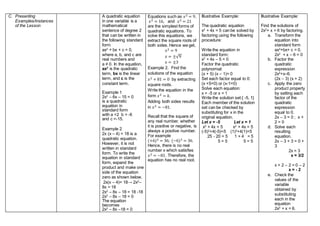
A quadratic equation
in one variable is a
mathematical
sentence of degree 2
that can be written in
the following standard
form
ax2
+ bx + c = 0,
where a, b, and c are
real numbers and
a ≠ 0. In the equation,
ax2
is the quadratic
term, bx is the linear
term, and c is the
constant term.
Example 1
2x2
– 6x – 15 = 0
is a quadratic
equation in
standard form
with a =2 b = -6
and c =-15.
Example 2
2x (x – 4) = 18 is a
quadratic equation.
However, it is not
written in standard
form. To write the
equation in standard
form, expand the
product and make one
side of the equation
zero as shown below.
2x(x – 4)= 18→ 2x2
–
8x = 18
2x2
– 8x – 18 = 18 -18
2x2
– 8x – 18 = 0
The equation
becomes
2x2
– 8x –18 = 0
Equations such as 𝑥2 = 9,
𝑥2 = 16, and 𝑥2 = 21
are the simplest forms of
quadratic equations. To
solve this equations, we
extract the square roots of
both sides. Hence we get,
𝑥2 = 9
𝑥 = ±√9
𝑥 = ±3
Example 2. Find the
solutions of the equation
𝑥2 + 81 = 0 by extracting
square roots.
Write the equation in the
form 𝑥2 = 𝑘.
Adding both sides results
in 𝑥2 = −81.
Recall that the square of
any real number, whether
it is positive or negative, is
always a positive number.
For example
(+6)2 = 36; (−6)2 = 36.
Hence, there is no real
number x which satisfies
𝑥2 = −81. Therefore, the
equation has no real root.
Illustrative Example:
The quadratic equation
x2
+ 4x = 5 can be solved by
factoring using the following
procedure:
Write the equation in
standard form:
x2
+ 4x – 5 = 0
Factor the quadratic
polynomial:
(x + 5) (x – 1)= 0
Set each factor equal to 0:
(x +5=0) or (x-1=0)
Solve each equation:
x = -5 or x = 1
Write the solution set:{ -5, 1}
Each member of the solution
set can be checked by
substituting for x in the
original equation.
Let x = -5 Let x = 1
x2
+ 4x = 5 x2
+ 4x = 5
(-5)2
+4(-5)=5 (1)2
+4(1)=5
25 - 20 = 5 1 + 4 = 5
5 = 5 5 = 5
Illustrative Example:
Find the solutions of
2x2
+ x = 6 by factoring.
a. Transform the
equation into
standard form
ax2
+bx+ c = 0.
2x2
+ x – 6 = 0
b. Factor the
quadratic
expression
2x2
+x–6.
(2x – 3) (x + 2)
c. Apply the zero
product property
by setting each
factor of the
quadratic
expression
equal to 0.
2x – 3 = 0 ; x +
2 = 0
d. Solve each
resulting
equation.
2x – 3 + 3 = 0 +
3
2x = 3
x = 3/2
x + 2 – 2 = 0 – 2
x = - 2
e. Check the
values of the
variable
obtained by
substituting
each in the
equation
2x2
+ x = 6.
which is in standard
form.
In the equation
2x2
- 8x -18 = 0
a = 2, b = - 8, c = -
18.
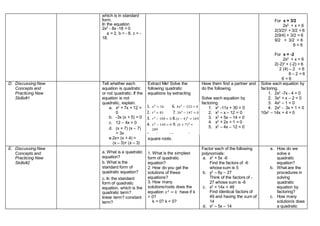
For x = 3/2
2x2
+ x = 6
2(3/2)2
+ 3/2 = 6
2(9/4) + 3/2 = 6
9/2 + 3/2 = 6
6 = 6
For x = -2
2x2
+ x = 6
2(-2)2
+ (-2) = 6
2 (4) – 2 = 6
8 – 2 = 6
6 = 6
D. Discussing New
Concepts and
Practicing New
Skills#1
Tell whether each
equation is quadratic
or not quadratic. If the
equation is not
quadratic, explain.
a. x2
+ 7x + 12 =
0
b. -3x (x + 5) = 0
c. 12 – 4x = 0
d. (x + 7) (x – 7)
= 3x
e.2x+ (x + 4) =
(x – 3)+ (x – 3)
Extract Me! Solve the
following quadratic
equations by extracting
square roots.
Have them find a partner and
do the following.
Solve each equation by
factoring.
1. x2
-11x + 30 = 0
2. x2
– x – 12 = 0
3. x2
+ 5x – 14 = 0
4. x2
+ 2x + 1 = 0
5. x2
– 4x – 12 = 0
Solve each equation by
factoring.
1. 2x2
-7x - 4 = 0
2. 3x2
+ x – 2 = 0
3. 4x2
– 1 = 0
4. 2x2
- 3x + 1 = 0
10x2
– 14x + 4 = 0
E. Discussing New
Concepts and
Practicing New
Skills#2
a. What is a quadratic
equation?
b. What is the
standard form of
quadratic equation?
c. In the standard
form of quadratic
equation, which is the
quadratic term?
linear term? constant
term?
1. What is the simplest
form of quadratic
equation?
2. How do you get the
solutions of these
equations?
3. How many
solutions/roots does the
equation 𝑥2 = 𝑘 have if k
> 0?
k = 0? k < 0?
Factor each of the following
polynomials:
a. x2
+ 5x -6
Find the factors of -6
whose sum is 5
b. y2
– 6y – 27
Think of the factors of -
27 whose sum is -6
c. x2
+ 14x + 49
Find identical factors of
49 and having the sum of
14
d. x2
– 5x – 14
a. How do we
solve a
quadratic
equation?
b. What are the
procedures in
solving
quadratic
equation by
factoring?
c. How many
solution/s does
a quadratic
1. 𝑥2
= 16 6. 4𝑥2
− 225 = 0
2. 𝑡2
= 81 7. 3ℎ2
− 147 = 0
3. 𝑟2
− 100 = 0 8.(𝑥 − 4)2
= 169
4. 𝑥2
− 144 = 0 9. (𝑘 + 7)2
=
289
5. 2𝑠2
= 50 10. (2𝑠 − 1)2
= 225
6.
d. Why is a in the
standard form cannot
be equal to 0?
Determine the factors of
-14 whose sum is -5
e. 2x2
- 7x + 6
Find the missing factors
(2x __)(x __)
equation
have?
d. How do you
call each
solution?
How do we know if the
solution is correct?
F. Developing Mastery
(Leads To Formative
Assessment 3)
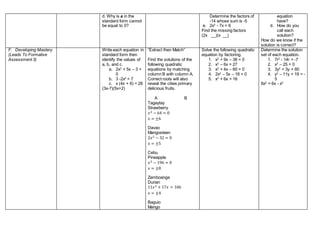
Write each equation in
standard form then
identify the values of
a, b, and c.
a. 2x2
+ 5x – 3 =
0
b. 3 -2x2
= 7
c. x (4x + 6) = 28
(3x-7)(5x+2)
“Extract then Match”
Find the solutions of the
following quadratic
equations by matching
column B with column A.
Correct roots will also
reveal the cities primary
delicious fruits.
A B
Tagaytay
Strawberry
𝑥2 − 64 = 0
𝑥 = ±6
Davao
Mangosteen
2𝑥2 − 32 = 0
𝑥 = ±5
Cebu
Pineapple
𝑥2 − 196 = 0
𝑥 = ±8
Zamboanga
Durian
11𝑥2 + 17𝑥 = 106
𝑥 = ±4
Baguio
Mango
Solve the following quadratic
equation by factoring.
1. x2
+ 9x – 36 = 0
2. x2
– 6x = 27
3. x2
+ 4x – 60 = 0
4. 2x2
– 5x – 18 = 0
5. x2
+ 6x = 16
Determine the solution
set of each equation.
1. 7r2
- 14r = -7
2. x2
– 25 = 0
3. 3y2
= 3y + 60
4. y2
– 11y + 19 = -
5
8x2
= 6x - x2
𝑥
4
=
9
𝑥
𝑥 = ±14
Banana
𝑥 = ±3
G. Finding Practical
Application of
Concepts and Skills
in Daily Living
New houses are being
constructed in
CalleSerye. The
residents of this new
housing project use a
17m long path that
cuts diagonally across
a vacant rectangular
lot. Before the
diagonal lot was
constructed, they had
to walk a total of 23 m
long along the two
sides if they want to
go from one corner to
an opposite corner.
Write the quadratic
equation that
represents the
problem if the shorter
side is x. Identify the
values of a, b, and c.
Solve the problem.
Cora has a piece of cloth
whose area is 32 square
inches. What is the length
of the side of the largest
square that can be formed
using the cloth?
Solve the following problem:
One positive number
exceeds another by 5. The
sum of their squares is 193.
Find both numbers.
Solve the problem:
The length of a
rectangle is 6 cm more
than the width. If the
area is 55 cm2
, find the
dimensions of the
rectangle.
H. Making Generalization
and Abstractions about
the lesson
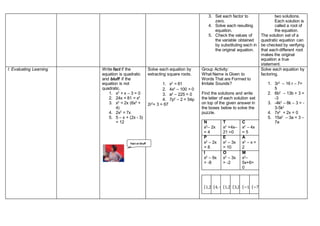
A quadratic equation
is an equation of
degree 2 that can be
written in the form ax2
+ bx + c = 0, where a,
b, and c are real
numbers and a ≠ 0.
To solve an incomplete
quadratic equation:
1. Solve the equation for
the square of the
unknown number.
Find the square roots of
both members of the
equation.
Some quadratic equations
can be solved easily by
factoring. To solve such
equations, the following
procedure can be followed.
1. Transform the
quadratic equation
using standard form in
which one side is
zero.
2. Factor the non-zero
side.
When solving a
quadratic equation,
keep in mind that:
1. The quadratic
equation must
be expressed in
standard form
before you
attempt to factor
the quadratic
polynomial.
2. Every quadratic
equation has
3. Set each factor to
zero.
4. Solve each resulting
equation.
5. Check the values of
the variable obtained
by substituting each in
the original equation.
two solutions.
Each solution is
called a root of
the equation.
The solution set of a
quadratic equation can
be checked by verifying
that each different root
makes the original
equation a true
statement.
I. Evaluating Learning Write fact if the
equation is quadratic
and bluff if the
equation is not
quadratic.
1. x2
+ x – 3 = 0
2. 24x + 81 = x2
3. x2
= 2x (6x2
+
4)
4. 2x2
= 7x
5. 5 – x + (2x - 3)
= 12
Solve each equation by
extracting square roots.
1. x2
= 81
2. 4x2
– 100 = 0
3. a2
– 225 = 0
4. 7p2
– 2 = 54p
2r2
+ 3 = 67
Group Activity:
What Name is Given to
Words That are Formed to
Imitate Sounds?
Find the solutions and write
the letter of each solution set
on top of the given answer in
the boxes below to solve the
puzzle.
N
x2
– 2x
= 4
T
x2
+4x–
21 =0
C
x2
– 4x
= 5
P
x2
– 2x
= 8
E
x2
– 3x
= 10
A
x2
– x =
2
I
x2
– 9x
= -8
O
x2
– 3x
= -2
M
x2
–
5x+6=
0
{1,2}{4,−2}
{1,2}{3,2} {−1,2}
{−7,3}
Solve each equation by
factoring.
1. 3r2
– 16 r – 7=
5
2. 6b2
– 13b + 3 =
-3
3. -4k2
– 8k – 3 = -
3-5k2
4. 7x2
+ 2x = 0
5. 15a2
– 3a = 3 –
7a
Fact or bluff
{1,2} {−2,4}
{1,2} {−2,5}
{1,8}{−1,5 }
J. Additional Activities for
Application or
Remediation
1. Give 5 examples
of quadratic
equations written in
standard form.
Identify the values of
a, b, and c.
2. Study solving
quadratic equation by
extracting the square
root.
a. Do you solve a
quadratic equation by
extracting the square
root?
b. Give the procedure.
Reference:
Learner’s Material pp.
18-20
Find the solutions of the
following equations by
extracting square roots.
1. 2(x+3)2
= 18
2. 4a2
– 147 = a2
3. 1 = ½ x2
4. 54a2
– 6 - 24
3c2
– 5 = 25
Follow-Up
1. Find the solutions of
(x + 3)2
= 25.
Do you agree that x2
+ 5x –
14 = 0 and 14 – 5x – x2
= 0
have the same solutions?
Justify your answer.
Factor the following
Quadratic Equation.
1. x2
+ 4x + 4 = 0
2. x2
– 6x + 9 = 0
3. x2
– 8x + 16 = 0
4. x2
+ 2x + 1 = 0
5. x2
– 10x + 25 =
0
What have you noticed
with their factors?
V. REMARKS The lesson shall be
continued tomorrow.
The lesson shall be
continued tomorrow.
The lesson shall be
continued tomorrow.
The lesson shall be
continued on Monday.
VI. REFLECTION
A. No. of learners who
earned 80% in the
evaluation
B. No. of learners who
required additional
activities for remediation
C. Did the remedial
lessons work?
D. No. of learners who
continue to require
remediation
E. Which of my
teaching strategies work
well? Why did this work?
F. What difficulties did I
encounter which my
principal or supervisor
can help me solve?
G. What innovation or
localized materials did I
used/discover which I
wish to share with other
teachers?
Prepared by: Noted :
Melanie D. Calonia Jenefeir B. Denque
Math Teacher Principal I

DLL week 1 G9.docx

  • 1.
    GRADES 1 TO 12 DAILYLESSON LOG SCHOOL: TUOD INTEGRATED SCHOOL GRADE LEVEL: NINE (9) TEACHER: MELANIE D. CALONIA LEARNING AREA: MATHEMATICS TEACHING DATES & TIME: AUGUST 22 – 26, 2022 (Week 1) QUARTER: FIRST QUARTER I. OBJECTIVES MONDAY TUESDAY WEDNESDAY THURSDAY FRIDAY A.Content Standards: The learner demonstrates understanding of the key concepts of quadratic equations, inequalities and functions, and rational algebraic equations. B. Performance Standards The learner is able to investigate thoroughly mathematical relationships in various situations, formulate real-life problems involving quadratic equations, inequalities and functions, and rational algebraic equations and solve them using a variety of strategies. C. Learning Competencies/Objective s: Write the LC code for each. The learner… shall be able determine the schedule of classes, school and classroom rules and regulations, and to select class officers. Illustrates quadratic equations. (M9AL-Ia- 1) a. Write a quadratic equation in standard form. b. Identify quadratic equations. c. Appreciate the importance of quadratic equations. Solves quadratic equations by: (a) extracting square roots; (b) factoring; (c) completing the square; and (d) using the quadratic formula. (M9AL-Ia-b-1) a. Express quadratic equation in the form x2 = k . b. Solve quadratic equation by extracting square roots. c. Appreciate the importance of solving quadratic equations by extracting square roots. Solves quadratic equations by: (a) extracting square roots; (b) factoring; (c) completing the square; and (d) using the quadratic formula. (M9AL-Ia-b-1) a. Find the factors of quadratic expressions. b. Apply the zero product property in solving quadratic equations. c. Be attentive and cooperative in doing the given task with the group. Solves quadratic equations by: (a) extracting square roots; (b) factoring; (c) completing the square; and (d) using the quadratic formula. (M9AL-Ia-b-1) a. Find the factors of quadratic expressions. b. Solve quadratic equations by factoring. c. Appreciate how does solving quadratic equation help in making decision. II. CONTENT Orientation Illustrations of Quadratic Equations Solving Quadratic Equations by Extracting Square Roots Solving Quadratic Equations by Factoring Solving Quadratic Equations by Factoring III. LEARNING RESOURCES A. References 1. Teacher’s Guide Pages Page 14 Pages 15-16 Pages 16 – 17 Pages 18 2. Learner’s Materials Pages Pages 11-12 Pages 12-14 Pages 14 – 15 Pages 16 – 17
  • 2.
    3. Text bookPages Math III SEDP Series Capalad, Lanniene, et., al. 21st Century Math IIIpp. 167-172 Ho, Ju Se T. et., al Math PACE (Algebra II – 8)pp. 7 Accelerated Christian Education, Inc. 4. Additional Materials from Learning resources(LR)Portal Math Learner’s Module Math Learner’s Module Math Learner’s Module Math Learner’s Module B. Other Learning Resources School Handbook (if any) Grade 9 LCTG by DepEd, laptop, Monitor/Projector, Activity Sheets Grade 9 LCTG by DepEd, laptop, Monitor/Projector, Activity Sheets III. PROCEDURE A. Reviewing Previous Lesson or Presenting New Lesson Do You Remember These Products? Find each indicated product then answer the questions that follow. 1. 3(x2 +7) 2. 2s(s-4) 3. (w+7)(w+3) 4. (x+9)(x-2) 5. (2t-1)(t+5) 6. (x+4)(x+4) 7. (2r-5)(2r-5) 8. (3-4m)2 9. (2h+7)(2h-7) 10. (8-3x)(8+3x) a. How did you find each product? b. In finding each product, what mathematics concepts or principles did you apply? Explain. c. How would you describe the products obtained? Find My Roots! Find the following square roots. Answer the questions that follow. a .How did you find each square root? b. How many square roots does a number have? c. Does a negative number have a square root? Why? d. Describe the following numbers: √8,−√40 , √60 ,𝑎𝑛𝑑 − √90 . Are the numbers rational or irrational? How do you describe rational numbers? a. What are the factors that contribute to garbage segregation and disposal? As an ordinary citizen, what can we do to help solve the garbage problem in our community? Students are grouped into 2 (boys vs girls). Using flashcards, have each group give the factors of the following polynomials mentally. a. x2 + 8x – 9 = 0 b. x 2 + 9x = 10 c. x2 = 3 – 2x d. x2 – 6 = – 5x e. x2 + 6x – 7 = 0 f. x2 + x – 12 = 0 1. √16 = 6. −√289 = 2. −√25 = 7. √0.16 = 3. √49 = 8. ±√36 = 4. −√64 = 9. √ 16 25 = 5. √121 = 10. ±√ 169 256 =
  • 3.
    How about numbersthat are irrational? B. Establishing a Purpose for the Lesson Another Kind of Equation! Below are different equations. Use these equations to answer the questions that follow. 1. Which of the given equations are linear? 2. How do you describe linear equations? 3. Which of the given equations are not linear? Why? How are these equations different from those which are linear? What common characteristics do these equations have? What Would Make a Statement True? Solve each of the following equations in as many ways as you can. Answer the questions that follow. a. How did you solve each equation? b. What mathematics concepts or principles did you apply to come up with the solution of each equation? c. Compare the solutions you got with those of your classmates. Did you arrive at the same answer? If not, why? d. Which equations did you find difficult? Why? Factor each polynomial. a. x2 – 9x + 20 b. x2 – 8x + 12 c. x2 + 14x +48 d. x2 – x – 6 e. x2 + 7x – 18 x2-5x+3=0 c=12n-5 9-4x=15 r2=144 8k-3=12 2s+3t=-7 6p-q=10 1.𝑥 + 7 = 12 6. −5𝑥 = 35 2.𝑡 − 4 = 10 7. 3ℎ − 2 = 16 3.𝑟 + 5 = −3 8. −7𝑥 = −28 4.𝑥 − 10 = −2 9. 3(𝑥 + 7) = 24 5.2𝑠 = 16 10. 2(3𝑘 − 1) = 28 t2-7t+6=0 9r2-25=0 r2=144 2s+3t=-7
  • 4.
    C. Presenting Examples/Instances of theLesson A quadratic equation in one variable is a mathematical sentence of degree 2 that can be written in the following standard form ax2 + bx + c = 0, where a, b, and c are real numbers and a ≠ 0. In the equation, ax2 is the quadratic term, bx is the linear term, and c is the constant term. Example 1 2x2 – 6x – 15 = 0 is a quadratic equation in standard form with a =2 b = -6 and c =-15. Example 2 2x (x – 4) = 18 is a quadratic equation. However, it is not written in standard form. To write the equation in standard form, expand the product and make one side of the equation zero as shown below. 2x(x – 4)= 18→ 2x2 – 8x = 18 2x2 – 8x – 18 = 18 -18 2x2 – 8x – 18 = 0 The equation becomes 2x2 – 8x –18 = 0 Equations such as 𝑥2 = 9, 𝑥2 = 16, and 𝑥2 = 21 are the simplest forms of quadratic equations. To solve this equations, we extract the square roots of both sides. Hence we get, 𝑥2 = 9 𝑥 = ±√9 𝑥 = ±3 Example 2. Find the solutions of the equation 𝑥2 + 81 = 0 by extracting square roots. Write the equation in the form 𝑥2 = 𝑘. Adding both sides results in 𝑥2 = −81. Recall that the square of any real number, whether it is positive or negative, is always a positive number. For example (+6)2 = 36; (−6)2 = 36. Hence, there is no real number x which satisfies 𝑥2 = −81. Therefore, the equation has no real root. Illustrative Example: The quadratic equation x2 + 4x = 5 can be solved by factoring using the following procedure: Write the equation in standard form: x2 + 4x – 5 = 0 Factor the quadratic polynomial: (x + 5) (x – 1)= 0 Set each factor equal to 0: (x +5=0) or (x-1=0) Solve each equation: x = -5 or x = 1 Write the solution set:{ -5, 1} Each member of the solution set can be checked by substituting for x in the original equation. Let x = -5 Let x = 1 x2 + 4x = 5 x2 + 4x = 5 (-5)2 +4(-5)=5 (1)2 +4(1)=5 25 - 20 = 5 1 + 4 = 5 5 = 5 5 = 5 Illustrative Example: Find the solutions of 2x2 + x = 6 by factoring. a. Transform the equation into standard form ax2 +bx+ c = 0. 2x2 + x – 6 = 0 b. Factor the quadratic expression 2x2 +x–6. (2x – 3) (x + 2) c. Apply the zero product property by setting each factor of the quadratic expression equal to 0. 2x – 3 = 0 ; x + 2 = 0 d. Solve each resulting equation. 2x – 3 + 3 = 0 + 3 2x = 3 x = 3/2 x + 2 – 2 = 0 – 2 x = - 2 e. Check the values of the variable obtained by substituting each in the equation 2x2 + x = 6.
  • 5.
    which is instandard form. In the equation 2x2 - 8x -18 = 0 a = 2, b = - 8, c = - 18. For x = 3/2 2x2 + x = 6 2(3/2)2 + 3/2 = 6 2(9/4) + 3/2 = 6 9/2 + 3/2 = 6 6 = 6 For x = -2 2x2 + x = 6 2(-2)2 + (-2) = 6 2 (4) – 2 = 6 8 – 2 = 6 6 = 6 D. Discussing New Concepts and Practicing New Skills#1 Tell whether each equation is quadratic or not quadratic. If the equation is not quadratic, explain. a. x2 + 7x + 12 = 0 b. -3x (x + 5) = 0 c. 12 – 4x = 0 d. (x + 7) (x – 7) = 3x e.2x+ (x + 4) = (x – 3)+ (x – 3) Extract Me! Solve the following quadratic equations by extracting square roots. Have them find a partner and do the following. Solve each equation by factoring. 1. x2 -11x + 30 = 0 2. x2 – x – 12 = 0 3. x2 + 5x – 14 = 0 4. x2 + 2x + 1 = 0 5. x2 – 4x – 12 = 0 Solve each equation by factoring. 1. 2x2 -7x - 4 = 0 2. 3x2 + x – 2 = 0 3. 4x2 – 1 = 0 4. 2x2 - 3x + 1 = 0 10x2 – 14x + 4 = 0 E. Discussing New Concepts and Practicing New Skills#2 a. What is a quadratic equation? b. What is the standard form of quadratic equation? c. In the standard form of quadratic equation, which is the quadratic term? linear term? constant term? 1. What is the simplest form of quadratic equation? 2. How do you get the solutions of these equations? 3. How many solutions/roots does the equation 𝑥2 = 𝑘 have if k > 0? k = 0? k < 0? Factor each of the following polynomials: a. x2 + 5x -6 Find the factors of -6 whose sum is 5 b. y2 – 6y – 27 Think of the factors of - 27 whose sum is -6 c. x2 + 14x + 49 Find identical factors of 49 and having the sum of 14 d. x2 – 5x – 14 a. How do we solve a quadratic equation? b. What are the procedures in solving quadratic equation by factoring? c. How many solution/s does a quadratic 1. 𝑥2 = 16 6. 4𝑥2 − 225 = 0 2. 𝑡2 = 81 7. 3ℎ2 − 147 = 0 3. 𝑟2 − 100 = 0 8.(𝑥 − 4)2 = 169 4. 𝑥2 − 144 = 0 9. (𝑘 + 7)2 = 289 5. 2𝑠2 = 50 10. (2𝑠 − 1)2 = 225 6.
  • 6.
    d. Why isa in the standard form cannot be equal to 0? Determine the factors of -14 whose sum is -5 e. 2x2 - 7x + 6 Find the missing factors (2x __)(x __) equation have? d. How do you call each solution? How do we know if the solution is correct? F. Developing Mastery (Leads To Formative Assessment 3) Write each equation in standard form then identify the values of a, b, and c. a. 2x2 + 5x – 3 = 0 b. 3 -2x2 = 7 c. x (4x + 6) = 28 (3x-7)(5x+2) “Extract then Match” Find the solutions of the following quadratic equations by matching column B with column A. Correct roots will also reveal the cities primary delicious fruits. A B Tagaytay Strawberry 𝑥2 − 64 = 0 𝑥 = ±6 Davao Mangosteen 2𝑥2 − 32 = 0 𝑥 = ±5 Cebu Pineapple 𝑥2 − 196 = 0 𝑥 = ±8 Zamboanga Durian 11𝑥2 + 17𝑥 = 106 𝑥 = ±4 Baguio Mango Solve the following quadratic equation by factoring. 1. x2 + 9x – 36 = 0 2. x2 – 6x = 27 3. x2 + 4x – 60 = 0 4. 2x2 – 5x – 18 = 0 5. x2 + 6x = 16 Determine the solution set of each equation. 1. 7r2 - 14r = -7 2. x2 – 25 = 0 3. 3y2 = 3y + 60 4. y2 – 11y + 19 = - 5 8x2 = 6x - x2
  • 7.
    𝑥 4 = 9 𝑥 𝑥 = ±14 Banana 𝑥= ±3 G. Finding Practical Application of Concepts and Skills in Daily Living New houses are being constructed in CalleSerye. The residents of this new housing project use a 17m long path that cuts diagonally across a vacant rectangular lot. Before the diagonal lot was constructed, they had to walk a total of 23 m long along the two sides if they want to go from one corner to an opposite corner. Write the quadratic equation that represents the problem if the shorter side is x. Identify the values of a, b, and c. Solve the problem. Cora has a piece of cloth whose area is 32 square inches. What is the length of the side of the largest square that can be formed using the cloth? Solve the following problem: One positive number exceeds another by 5. The sum of their squares is 193. Find both numbers. Solve the problem: The length of a rectangle is 6 cm more than the width. If the area is 55 cm2 , find the dimensions of the rectangle. H. Making Generalization and Abstractions about the lesson A quadratic equation is an equation of degree 2 that can be written in the form ax2 + bx + c = 0, where a, b, and c are real numbers and a ≠ 0. To solve an incomplete quadratic equation: 1. Solve the equation for the square of the unknown number. Find the square roots of both members of the equation. Some quadratic equations can be solved easily by factoring. To solve such equations, the following procedure can be followed. 1. Transform the quadratic equation using standard form in which one side is zero. 2. Factor the non-zero side. When solving a quadratic equation, keep in mind that: 1. The quadratic equation must be expressed in standard form before you attempt to factor the quadratic polynomial. 2. Every quadratic equation has
  • 8.
    3. Set eachfactor to zero. 4. Solve each resulting equation. 5. Check the values of the variable obtained by substituting each in the original equation. two solutions. Each solution is called a root of the equation. The solution set of a quadratic equation can be checked by verifying that each different root makes the original equation a true statement. I. Evaluating Learning Write fact if the equation is quadratic and bluff if the equation is not quadratic. 1. x2 + x – 3 = 0 2. 24x + 81 = x2 3. x2 = 2x (6x2 + 4) 4. 2x2 = 7x 5. 5 – x + (2x - 3) = 12 Solve each equation by extracting square roots. 1. x2 = 81 2. 4x2 – 100 = 0 3. a2 – 225 = 0 4. 7p2 – 2 = 54p 2r2 + 3 = 67 Group Activity: What Name is Given to Words That are Formed to Imitate Sounds? Find the solutions and write the letter of each solution set on top of the given answer in the boxes below to solve the puzzle. N x2 – 2x = 4 T x2 +4x– 21 =0 C x2 – 4x = 5 P x2 – 2x = 8 E x2 – 3x = 10 A x2 – x = 2 I x2 – 9x = -8 O x2 – 3x = -2 M x2 – 5x+6= 0 {1,2}{4,−2} {1,2}{3,2} {−1,2} {−7,3} Solve each equation by factoring. 1. 3r2 – 16 r – 7= 5 2. 6b2 – 13b + 3 = -3 3. -4k2 – 8k – 3 = - 3-5k2 4. 7x2 + 2x = 0 5. 15a2 – 3a = 3 – 7a Fact or bluff
  • 9.
    {1,2} {−2,4} {1,2} {−2,5} {1,8}{−1,5} J. Additional Activities for Application or Remediation 1. Give 5 examples of quadratic equations written in standard form. Identify the values of a, b, and c. 2. Study solving quadratic equation by extracting the square root. a. Do you solve a quadratic equation by extracting the square root? b. Give the procedure. Reference: Learner’s Material pp. 18-20 Find the solutions of the following equations by extracting square roots. 1. 2(x+3)2 = 18 2. 4a2 – 147 = a2 3. 1 = ½ x2 4. 54a2 – 6 - 24 3c2 – 5 = 25 Follow-Up 1. Find the solutions of (x + 3)2 = 25. Do you agree that x2 + 5x – 14 = 0 and 14 – 5x – x2 = 0 have the same solutions? Justify your answer. Factor the following Quadratic Equation. 1. x2 + 4x + 4 = 0 2. x2 – 6x + 9 = 0 3. x2 – 8x + 16 = 0 4. x2 + 2x + 1 = 0 5. x2 – 10x + 25 = 0 What have you noticed with their factors? V. REMARKS The lesson shall be continued tomorrow. The lesson shall be continued tomorrow. The lesson shall be continued tomorrow. The lesson shall be continued on Monday. VI. REFLECTION A. No. of learners who earned 80% in the evaluation B. No. of learners who required additional activities for remediation C. Did the remedial lessons work? D. No. of learners who continue to require remediation
  • 10.
    E. Which ofmy teaching strategies work well? Why did this work? F. What difficulties did I encounter which my principal or supervisor can help me solve? G. What innovation or localized materials did I used/discover which I wish to share with other teachers? Prepared by: Noted : Melanie D. Calonia Jenefeir B. Denque Math Teacher Principal I