Segmentation, Targeting &
Positioning
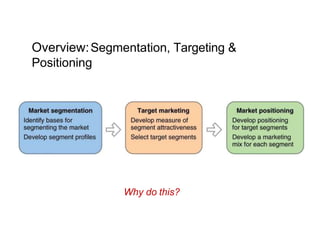
Overview:Segmentation, Targeting &
Positioning
Why do this?
• Segmentation:
Involves finding out what kinds of
consumers with different needs exist.
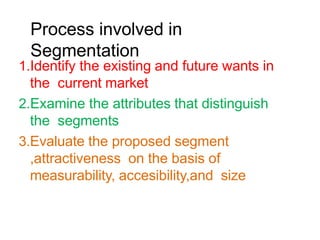
Process involved in
Segmentation
1.Identify the existing and future wants in
the current market
2.Examine the attributes that distinguish
the segments
3.Evaluate the proposed segment
,attractiveness on the basis of
measurability, accesibility,and size
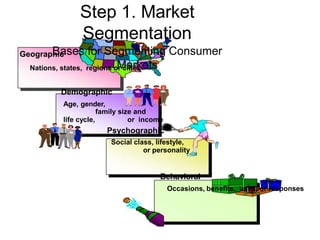
Step 1. Market
Segmentation
Bases for Segmenting Consumer
Markets
Geographic
Nations, states, regions or cities
Demographic
Age, gender,
family size and
life cycle, or income
Psychographic
Social class, lifestyle,
or personality
Behavioral
Occasions, benefits, uses, or responses
Market Segmentation -
Principles
• Segmentation Variables
– Geographic
– Demographic
– Psychographic
– Behavioral
– Other (anything!)
• No single best way to segment a market.
• Often best to combine variables and identify smaller,
better- defined target groups.
Geographic
Segmentation
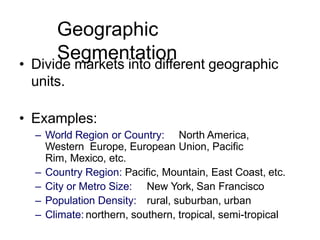
• Divide markets into different geographic
units.
• Examples:
– World Region or Country: North America,
Western Europe, European Union, Pacific
Rim, Mexico, etc.
– Country Region: Pacific, Mountain, East Coast, etc.
– City or Metro Size: New York, San Francisco
– Population Density: rural, suburban, urban
– Climate: northern, southern, tropical, semi-tropical
Demographic
Segmentation
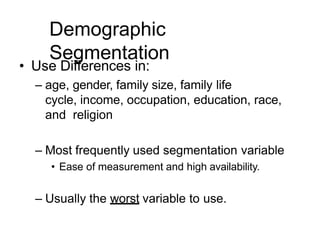
• Use Differences in:
– age, gender, family size, family life
cycle, income, occupation, education, race,
and religion
– Most frequently used segmentation variable
• Ease of measurement and high availability.
– Usually the worst variable to use.
Behavioral
Segmentation
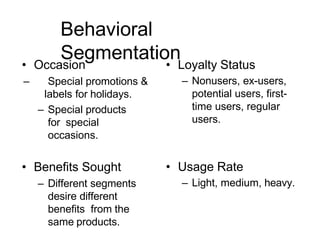
• Occasion
– Special promotions &
labels for holidays.
– Special products
for special
occasions.
• Benefits Sought
– Different segments
desire different
benefits from the
same products.
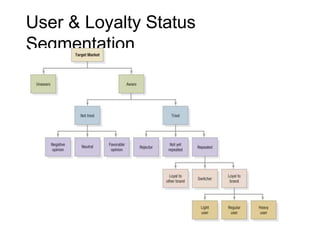
• Loyalty Status
– Nonusers, ex-users,
potential users, first-
time users, regular
users.
• Usage Rate
– Light, medium, heavy.
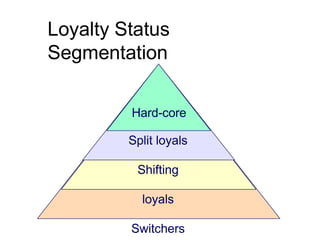
Loyalty Status
Segmentation
Hard-core
Split loyals
Shifting
loyals
Switchers
User & Loyalty Status
Segmentation
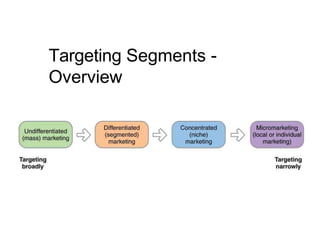
Targeting Segments -
Overview
Step 1. Market
Segmentation
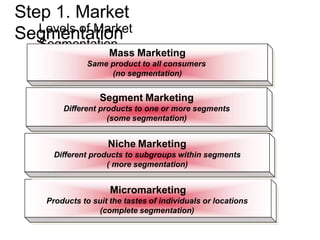
Levels of Market
Segmentation
Mass Marketing
Same product to all consumers
(no segmentation)
Segment Marketing
Different products to one or more segments
(some segmentation)
Niche Marketing
Different products to subgroups within segments
( more segmentation)
Micromarketing
Products to suit the tastes of individuals or locations
(complete segmentation)
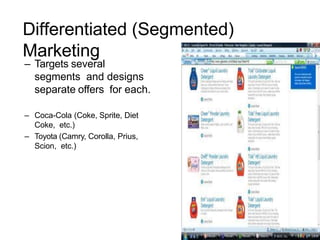
Differentiated (Segmented)
Marketing
– Targets several
segments and designs
separate offers for each.
– Coca-Cola (Coke, Sprite, Diet
Coke, etc.)
– Toyota (Camry, Corolla, Prius,
Scion, etc.)
Micromarketing
• Tailoring products and marketing programs to
suit the tastes of specific individuals and/or
locations.
TARGETING
• Targeting is defined as a group of
people or organisations for which an
organisation designs , impements and
maintains the marketing mix .
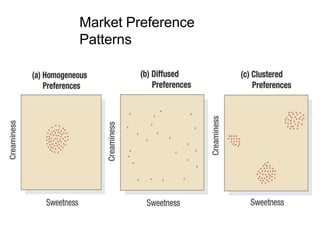
Selecting target market
• Homogeneous preference :- soft
drinks market(Coco cola )
• Diffused preferences :- automobile
market,HUL having different brands for
soaps .
• Clustered preferences :- occupation
having impact on the types cloths
worn.
Market Preference
Patterns
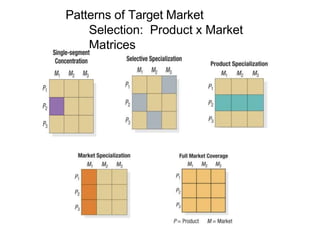
Patterns of Target Market
Selection: Product x Market
Matrices
Positioning
Placing aproduct occupies in consumers’minds
relative to competing products.
Remember this important
point.
Positioning is
all about
'perception'.
Bases of positioning the
product
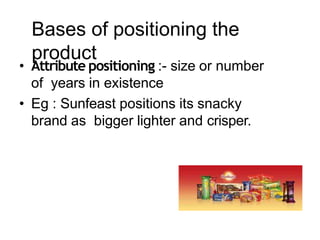
• Attribute positioning :- size or number
of years in existence
• Eg : Sunfeast positions its snacky
brand as bigger lighter and crisper.
• Benefit positioning : Product is positionedd
as the leader in a certain benefit.
• Eg : Hyundai santro
• Headline – India’s best –loved family car
is now also India’s ‘simplestcarto
drive’
• Use orApplicationpositioning
• Positioning the product as best for use
and application .
• Eg: Kenstar positioned its
product as UNEXPECTEDLY
COLD
• User positioning:- for some user
group
• Eg :- Parle-G for kids
• Competitor positiong :- the product
claims to be better in some way than a
particular competitor .
• Quality and price positioning :-
The product is positioned as offering the
best value .
Eg : Big Bazar
Positioning Strategy
• Competitive advantages
• Points of Parity
• Points of Difference => Differentiation
Positioning results from differentiation
and competitive advantages.
Positioning may change over time.
Choosing the Right Competitive
Advantages
• Thebest competitive advantagesare…
– Important
– Distinctive
– Superior
– Communicable
– Pre-emptive
– Affordable (to company and consumer)
– Profitable
Moral: Avoid meaningless
differentiation.
Positioning Errors
• Under-positioning:
– Not positioning strongly enough.
• Over-positioning:
– Giving buyers too narrow a picture of the product.
• Confused Positioning:
– Leaving buyers with a confused image of the
product.

stp.pptx about the stp information #imp #terms

  • 1.
  • 2.
  • 4.
    • Segmentation: Involves findingout what kinds of consumers with different needs exist.
  • 5.
    Process involved in Segmentation 1.Identifythe existing and future wants in the current market 2.Examine the attributes that distinguish the segments 3.Evaluate the proposed segment ,attractiveness on the basis of measurability, accesibility,and size
  • 6.
    Step 1. Market Segmentation Basesfor Segmenting Consumer Markets Geographic Nations, states, regions or cities Demographic Age, gender, family size and life cycle, or income Psychographic Social class, lifestyle, or personality Behavioral Occasions, benefits, uses, or responses
  • 7.
    Market Segmentation - Principles •Segmentation Variables – Geographic – Demographic – Psychographic – Behavioral – Other (anything!) • No single best way to segment a market. • Often best to combine variables and identify smaller, better- defined target groups.
  • 8.
    Geographic Segmentation • Divide marketsinto different geographic units. • Examples: – World Region or Country: North America, Western Europe, European Union, Pacific Rim, Mexico, etc. – Country Region: Pacific, Mountain, East Coast, etc. – City or Metro Size: New York, San Francisco – Population Density: rural, suburban, urban – Climate: northern, southern, tropical, semi-tropical
  • 9.
    Demographic Segmentation • Use Differencesin: – age, gender, family size, family life cycle, income, occupation, education, race, and religion – Most frequently used segmentation variable • Ease of measurement and high availability. – Usually the worst variable to use.
  • 10.
    Behavioral Segmentation • Occasion – Specialpromotions & labels for holidays. – Special products for special occasions. • Benefits Sought – Different segments desire different benefits from the same products. • Loyalty Status – Nonusers, ex-users, potential users, first- time users, regular users. • Usage Rate – Light, medium, heavy.
  • 11.
  • 12.
    User & LoyaltyStatus Segmentation
  • 13.
  • 14.
    Step 1. Market Segmentation Levelsof Market Segmentation Mass Marketing Same product to all consumers (no segmentation) Segment Marketing Different products to one or more segments (some segmentation) Niche Marketing Different products to subgroups within segments ( more segmentation) Micromarketing Products to suit the tastes of individuals or locations (complete segmentation)
  • 15.
    Differentiated (Segmented) Marketing – Targetsseveral segments and designs separate offers for each. – Coca-Cola (Coke, Sprite, Diet Coke, etc.) – Toyota (Camry, Corolla, Prius, Scion, etc.)
  • 16.
    Micromarketing • Tailoring productsand marketing programs to suit the tastes of specific individuals and/or locations.
  • 17.
    TARGETING • Targeting isdefined as a group of people or organisations for which an organisation designs , impements and maintains the marketing mix .
  • 18.
    Selecting target market •Homogeneous preference :- soft drinks market(Coco cola ) • Diffused preferences :- automobile market,HUL having different brands for soaps . • Clustered preferences :- occupation having impact on the types cloths worn.
  • 19.
  • 20.
    Patterns of TargetMarket Selection: Product x Market Matrices
  • 21.
    Positioning Placing aproduct occupiesin consumers’minds relative to competing products.
  • 22.
  • 23.
    Bases of positioningthe product • Attribute positioning :- size or number of years in existence • Eg : Sunfeast positions its snacky brand as bigger lighter and crisper.
  • 24.
    • Benefit positioning: Product is positionedd as the leader in a certain benefit. • Eg : Hyundai santro • Headline – India’s best –loved family car is now also India’s ‘simplestcarto drive’
  • 25.
    • Use orApplicationpositioning •Positioning the product as best for use and application . • Eg: Kenstar positioned its product as UNEXPECTEDLY COLD
  • 26.
    • User positioning:-for some user group • Eg :- Parle-G for kids
  • 27.
    • Competitor positiong:- the product claims to be better in some way than a particular competitor .
  • 28.
    • Quality andprice positioning :- The product is positioned as offering the best value . Eg : Big Bazar
  • 29.
    Positioning Strategy • Competitiveadvantages • Points of Parity • Points of Difference => Differentiation Positioning results from differentiation and competitive advantages. Positioning may change over time.
  • 30.
    Choosing the RightCompetitive Advantages • Thebest competitive advantagesare… – Important – Distinctive – Superior – Communicable – Pre-emptive – Affordable (to company and consumer) – Profitable Moral: Avoid meaningless differentiation.
  • 31.
    Positioning Errors • Under-positioning: –Not positioning strongly enough. • Over-positioning: – Giving buyers too narrow a picture of the product. • Confused Positioning: – Leaving buyers with a confused image of the product.