Segmentation, Targeting
and
Positioning
Unit 2
MBA 4TH
SEM
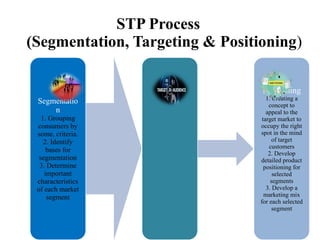
STP Process
(Segmentation, Targeting & Positioning)
Segmentatio
n
1. Grouping
consumers by
some, criteria.
2. Identify
bases for
segmentation
3. Determine
important
characteristics
of each market
segment
Positioning
1. Creating a
concept to
appeal to the
target market to
occupy the right
spot in the mind
of target
customers
2. Develop
detailed product
positioning for
selected
segments
3. Develop a
marketing mix
for each selected
segment
Market Segmentation
• Segmentation refers to the process of dividing of market into smaller groups, having
similar needs and qualities. This helps the company to modify the products or services
to suit the different groups more effectively.
• Market segmentation is the process of dividing a broad consumer or business market,
normally consisting of existing and potential customers, into sub-groups of consumers
based on some type of shared characteristics.
• Marketing segmentation – According to Philip Kotler “Market Segmentation is the
sub-dividing of a market into homogeneous subsets of customers, where any subset
may conceivably be selected on a market target to be reached with a distinct marketing
mix.”
• Market segmentation is a marketing concepts which divides the complete markets into
smaller subsets comprising of consumers with similar taste , demand and preference .
Need for Market Segmentation
• Market segmentation is a consumer-oriented process and can be applied to almost
any type of market. In dividing or segmenting markets, researchers typically look
for shared characteristics such as common needs, common interests, similar
lifestyles or even similar demographic profiles.
• Market segmentation help to marketers to devise the appropriate marketing
strategies and promotional schemes according to the taste of individuals of the
particular market segments.
• Segmentation helps the organization to know and understand the their customer
better
• Market segmentations also gives the clear view to customer what to buy or what to
not
Need for Market Segmentation
Tailor-made marketing
initiatives
Selecting most effective
market
Limited Resources
Identify Opportunities
Determine product
pricing
Limited Resources
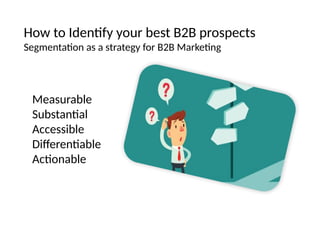
How to Identify your best B2B prospects
Segmentation as a strategy for B2B Marketing
Measurable
Substantial
Accessible
Differentiable
Actionable
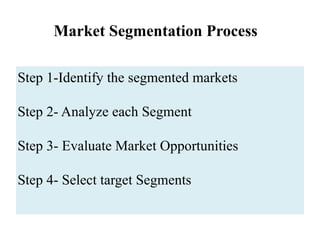
Market Segmentation Process
Step 1-Identify the segmented markets
Step 2- Analyze each Segment
Step 3- Evaluate Market Opportunities
Step 4- Select target Segments
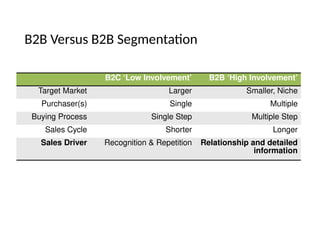
B2B Versus B2B Segmentation
B2C ‘Low Involvement’ B2B ‘High Involvement’
Target Market Larger Smaller, Niche
Purchaser(s) Single Multiple
Buying Process Single Step Multiple Step
Sales Cycle Shorter Longer
Sales Driver Recognition & Repetition Relationship and detailed
information
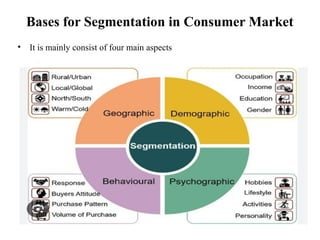
Bases for Segmentation in Consumer Market
• It is mainly consist of four main aspects
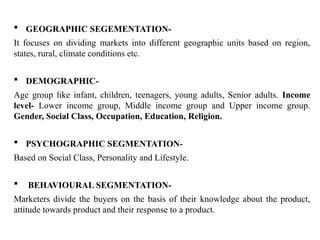
 GEOGRAPHIC SEGEMENTATION-
It focuses on dividing markets into different geographic units based on region,
states, rural, climate conditions etc.
 DEMOGRAPHIC-
Age group like infant, children, teenagers, young adults, Senior adults. Income
level- Lower income group, Middle income group and Upper income group.
Gender, Social Class, Occupation, Education, Religion.
 PSYCHOGRAPHIC SEGMENTATION-
Based on Social Class, Personality and Lifestyle.
 BEHAVIOURAL SEGMENTATION-
Marketers divide the buyers on the basis of their knowledge about the product,
attitude towards product and their response to a product.
Difficulty of segmentation in Industrial Markets
•Operating Differences
•Multiple application of same product
•Purchasing Approach
•Differ in Demographics
Bases for segmenting business markets
(Macro Segmentation)
1 Industrial Sector : Retail, Engineering, Financial Services
2 End Market Served: Products and Services
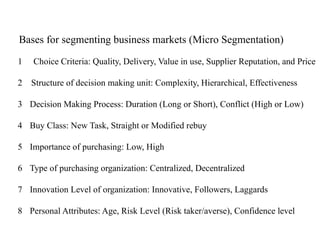
Bases for segmenting business markets (Micro Segmentation)
1 Choice Criteria: Quality, Delivery, Value in use, Supplier Reputation, and Price
2 Structure of decision making unit: Complexity, Hierarchical, Effectiveness
3 Decision Making Process: Duration (Long or Short), Conflict (High or Low)
4 Buy Class: New Task, Straight or Modified rebuy
5 Importance of purchasing: Low, High
6 Type of purchasing organization: Centralized, Decentralized
7 Innovation Level of organization: Innovative, Followers, Laggards
8 Personal Attributes: Age, Risk Level (Risk taker/averse), Confidence level
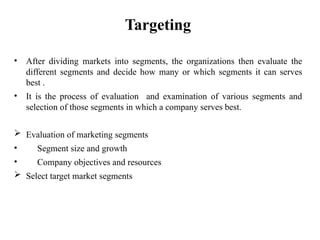
Targeting
• After dividing markets into segments, the organizations then evaluate the
different segments and decide how many or which segments it can serves
best .
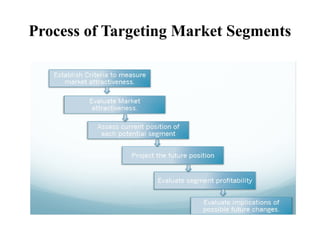
• It is the process of evaluation and examination of various segments and
selection of those segments in which a company serves best.
 Evaluation of marketing segments
• Segment size and growth
• Company objectives and resources
 Select target market segments
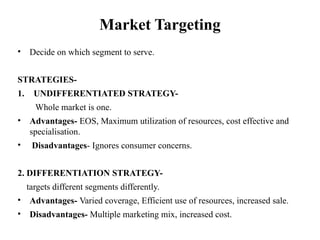
Market Targeting
• Decide on which segment to serve.
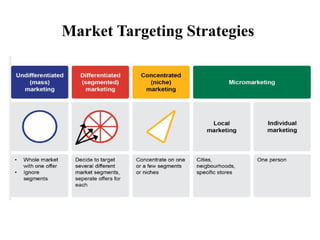
STRATEGIES-
1. UNDIFFERENTIATED STRATEGY-
Whole market is one.
• Advantages- EOS, Maximum utilization of resources, cost effective and
specialisation.
• Disadvantages- Ignores consumer concerns.
2. DIFFERENTIATION STRATEGY-
targets different segments differently.
• Advantages- Varied coverage, Efficient use of resources, increased sale.
• Disadvantages- Multiple marketing mix, increased cost.
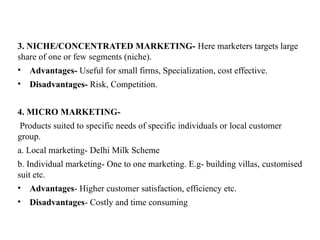
3. NICHE/CONCENTRATED MARKETING- Here marketers targets large
share of one or few segments (niche).
• Advantages- Useful for small firms, Specialization, cost effective.
• Disadvantages- Risk, Competition.
4. MICRO MARKETING-
Products suited to specific needs of specific individuals or local customer
group.
a. Local marketing- Delhi Milk Scheme
b. Individual marketing- One to one marketing. E.g- building villas, customised
suit etc.
• Advantages- Higher customer satisfaction, efficiency etc.
• Disadvantages- Costly and time consuming
Market Targeting Strategies
Process of Targeting Market Segments
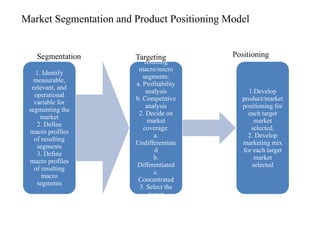
Market Segmentation and Product Positioning Model
1. Identify
measurable,
relevant, and
operational
variable for
segmenting the
market
2. Define
macro profiles
of resulting
segments
3. Define
macro profiles
of resulting
macro
segments
1. Evaluate
resulting
macro/micro
segments:
a. Profitability
analysis
b. Competitive
analysis
2. Decide on
market
coverage:
a.
Undifferentiate
d
b.
Differentiated
c.
Concentrated
3. Select the
target
segments
1.Develop
product/market
positioning for
each target
market
selected.
2. Develop
marketing mix
for each target
market
selected
Segmentation Targeting Positioning
Positioning
It can be defined as the distinct place a product occupies in the minds of the
target customers. It is how the company wants the customers to perceive it.
•Information and Media explosion
•Clutter of products and services
•Selective retention of the human mind
•Limitations of the human mind
•Effect of first, biggest, largest etc
Positioning
• Creating an image of a product in the minds of target customers.
• Positioning is not what a company physically does to the product it is what
a company does to the target customer’s mind
• The way in which a firm’s product is perceived by the customers in relation
to competitors product.
• POSITIONING STRATEGY-
1. On the basis of product characteristics- Shampoos claim smooth and silky
hair, Car company talks about economic aspect in fuel etc.
2. Basis of Price
3. Basis of Quality
4. Basis of User- Sachin- Boost, Aishwarya- L’Oreal etc.
5. Basis of Use- Thanda Matlab….........?, Zindagi ke saath bhi Zindagi ke baad
bhi.......?
6. Basis of Product Class – Milano is premium product of Parle.
7. On the basis of symbols.
• IMPORTANCE OF POSITIONING-
Creates distinct image, creates competitive advantage, helps to highlight USP
etc.
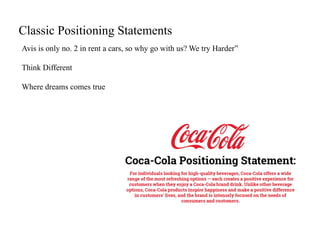
Classic Positioning Statements
Avis is only no. 2 in rent a cars, so why go with us? We try Harder”
Think Different
Where dreams comes true
How to Make a Positioning Statements
•Who you serve
•What Value you offer
•How you position your offer
•Why you’re in business
•What makes you different from the competition
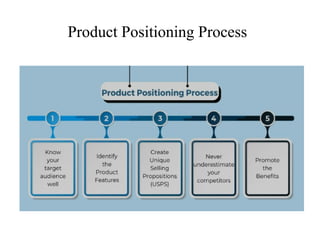
Product Positioning Process
Procedure for Developing
A business marketer should follow the following steps while developing a
Positioning strategy
Identifying major attributes for differentiation
Selecting the differentiating attributes
Communicating the company’s positioning
Identifying Major Attributes for Differentiation
The business firm should also understand the customer’s perception regarding
the various competing products with respect to major attributes
A business marketer can use several variables to differentiate its product from
competing proudcts. They are:
Product Variable
Service Variable
Personal Variable
Image Variable
Thank you

Unit 2 STP - segmenting, positioning and targetingpptx

  • 1.
  • 2.
    STP Process (Segmentation, Targeting& Positioning) Segmentatio n 1. Grouping consumers by some, criteria. 2. Identify bases for segmentation 3. Determine important characteristics of each market segment Positioning 1. Creating a concept to appeal to the target market to occupy the right spot in the mind of target customers 2. Develop detailed product positioning for selected segments 3. Develop a marketing mix for each selected segment
  • 3.
    Market Segmentation • Segmentationrefers to the process of dividing of market into smaller groups, having similar needs and qualities. This helps the company to modify the products or services to suit the different groups more effectively. • Market segmentation is the process of dividing a broad consumer or business market, normally consisting of existing and potential customers, into sub-groups of consumers based on some type of shared characteristics. • Marketing segmentation – According to Philip Kotler “Market Segmentation is the sub-dividing of a market into homogeneous subsets of customers, where any subset may conceivably be selected on a market target to be reached with a distinct marketing mix.” • Market segmentation is a marketing concepts which divides the complete markets into smaller subsets comprising of consumers with similar taste , demand and preference .
  • 4.
    Need for MarketSegmentation • Market segmentation is a consumer-oriented process and can be applied to almost any type of market. In dividing or segmenting markets, researchers typically look for shared characteristics such as common needs, common interests, similar lifestyles or even similar demographic profiles. • Market segmentation help to marketers to devise the appropriate marketing strategies and promotional schemes according to the taste of individuals of the particular market segments. • Segmentation helps the organization to know and understand the their customer better • Market segmentations also gives the clear view to customer what to buy or what to not
  • 5.
    Need for MarketSegmentation Tailor-made marketing initiatives Selecting most effective market Limited Resources Identify Opportunities Determine product pricing Limited Resources
  • 7.
    How to Identifyyour best B2B prospects Segmentation as a strategy for B2B Marketing Measurable Substantial Accessible Differentiable Actionable
  • 8.
    Market Segmentation Process Step1-Identify the segmented markets Step 2- Analyze each Segment Step 3- Evaluate Market Opportunities Step 4- Select target Segments
  • 10.
    B2B Versus B2BSegmentation B2C ‘Low Involvement’ B2B ‘High Involvement’ Target Market Larger Smaller, Niche Purchaser(s) Single Multiple Buying Process Single Step Multiple Step Sales Cycle Shorter Longer Sales Driver Recognition & Repetition Relationship and detailed information
  • 11.
    Bases for Segmentationin Consumer Market • It is mainly consist of four main aspects
  • 12.
     GEOGRAPHIC SEGEMENTATION- Itfocuses on dividing markets into different geographic units based on region, states, rural, climate conditions etc.  DEMOGRAPHIC- Age group like infant, children, teenagers, young adults, Senior adults. Income level- Lower income group, Middle income group and Upper income group. Gender, Social Class, Occupation, Education, Religion.  PSYCHOGRAPHIC SEGMENTATION- Based on Social Class, Personality and Lifestyle.  BEHAVIOURAL SEGMENTATION- Marketers divide the buyers on the basis of their knowledge about the product, attitude towards product and their response to a product.
  • 13.
    Difficulty of segmentationin Industrial Markets •Operating Differences •Multiple application of same product •Purchasing Approach •Differ in Demographics
  • 14.
    Bases for segmentingbusiness markets (Macro Segmentation) 1 Industrial Sector : Retail, Engineering, Financial Services 2 End Market Served: Products and Services
  • 15.
    Bases for segmentingbusiness markets (Micro Segmentation) 1 Choice Criteria: Quality, Delivery, Value in use, Supplier Reputation, and Price 2 Structure of decision making unit: Complexity, Hierarchical, Effectiveness 3 Decision Making Process: Duration (Long or Short), Conflict (High or Low) 4 Buy Class: New Task, Straight or Modified rebuy 5 Importance of purchasing: Low, High 6 Type of purchasing organization: Centralized, Decentralized 7 Innovation Level of organization: Innovative, Followers, Laggards 8 Personal Attributes: Age, Risk Level (Risk taker/averse), Confidence level
  • 16.
    Targeting • After dividingmarkets into segments, the organizations then evaluate the different segments and decide how many or which segments it can serves best . • It is the process of evaluation and examination of various segments and selection of those segments in which a company serves best.  Evaluation of marketing segments • Segment size and growth • Company objectives and resources  Select target market segments
  • 17.
    Market Targeting • Decideon which segment to serve. STRATEGIES- 1. UNDIFFERENTIATED STRATEGY- Whole market is one. • Advantages- EOS, Maximum utilization of resources, cost effective and specialisation. • Disadvantages- Ignores consumer concerns. 2. DIFFERENTIATION STRATEGY- targets different segments differently. • Advantages- Varied coverage, Efficient use of resources, increased sale. • Disadvantages- Multiple marketing mix, increased cost.
  • 18.
    3. NICHE/CONCENTRATED MARKETING-Here marketers targets large share of one or few segments (niche). • Advantages- Useful for small firms, Specialization, cost effective. • Disadvantages- Risk, Competition. 4. MICRO MARKETING- Products suited to specific needs of specific individuals or local customer group. a. Local marketing- Delhi Milk Scheme b. Individual marketing- One to one marketing. E.g- building villas, customised suit etc. • Advantages- Higher customer satisfaction, efficiency etc. • Disadvantages- Costly and time consuming
  • 19.
  • 20.
    Process of TargetingMarket Segments
  • 21.
    Market Segmentation andProduct Positioning Model 1. Identify measurable, relevant, and operational variable for segmenting the market 2. Define macro profiles of resulting segments 3. Define macro profiles of resulting macro segments 1. Evaluate resulting macro/micro segments: a. Profitability analysis b. Competitive analysis 2. Decide on market coverage: a. Undifferentiate d b. Differentiated c. Concentrated 3. Select the target segments 1.Develop product/market positioning for each target market selected. 2. Develop marketing mix for each target market selected Segmentation Targeting Positioning
  • 22.
    Positioning It can bedefined as the distinct place a product occupies in the minds of the target customers. It is how the company wants the customers to perceive it. •Information and Media explosion •Clutter of products and services •Selective retention of the human mind •Limitations of the human mind •Effect of first, biggest, largest etc
  • 23.
    Positioning • Creating animage of a product in the minds of target customers. • Positioning is not what a company physically does to the product it is what a company does to the target customer’s mind • The way in which a firm’s product is perceived by the customers in relation to competitors product. • POSITIONING STRATEGY- 1. On the basis of product characteristics- Shampoos claim smooth and silky hair, Car company talks about economic aspect in fuel etc. 2. Basis of Price 3. Basis of Quality
  • 24.
    4. Basis ofUser- Sachin- Boost, Aishwarya- L’Oreal etc. 5. Basis of Use- Thanda Matlab….........?, Zindagi ke saath bhi Zindagi ke baad bhi.......? 6. Basis of Product Class – Milano is premium product of Parle. 7. On the basis of symbols. • IMPORTANCE OF POSITIONING- Creates distinct image, creates competitive advantage, helps to highlight USP etc.
  • 25.
    Classic Positioning Statements Avisis only no. 2 in rent a cars, so why go with us? We try Harder” Think Different Where dreams comes true
  • 27.
    How to Makea Positioning Statements •Who you serve •What Value you offer •How you position your offer •Why you’re in business •What makes you different from the competition
  • 28.
  • 29.
    Procedure for Developing Abusiness marketer should follow the following steps while developing a Positioning strategy Identifying major attributes for differentiation Selecting the differentiating attributes Communicating the company’s positioning
  • 30.
    Identifying Major Attributesfor Differentiation The business firm should also understand the customer’s perception regarding the various competing products with respect to major attributes A business marketer can use several variables to differentiate its product from competing proudcts. They are: Product Variable Service Variable Personal Variable Image Variable
  • 31.