ISSN 1479-4411 ©Academic Conferences Ltd
Reference this paper as: Girard J.P. and Lambert S (2007) “The Story of Knowledge: Writing Stories that Guide
Organisations into the Future” The Electronic Journal of Knowledge Management Volume 5 Issue 2, pp 161-172 ,
available online at www.ejkm.com
161
The Story of Knowledge: Writing Stories that Guide
Organisations into the Future
John P Girard and Sandra Lambert
Minot State University, North Dakota, USA
john@johngirard.net
sandra.lambert@minotstateu.edu
Abstract: Many organisational gurus highlight the value of oral narrative or storytelling as a catalyst for organisational
change or a way to share knowledge. Tomes of articles describe seasoned raconteurs single handedly inciting
enormous transformation in organisations. Oxymoronically many written works are describing the power of oral narrative.
Surely these printed exposés are themselves motivators for change; so why the continued emphasis on the face-to-face
storytelling? There is no disputing the fact that oral narrative is a powerful form of communicating; however, it is not
always feasible. In fact, there are times when the written word packs a more powerful punch. Often it is simply not
possible to catch the ear of a wide audience simultaneously, or even at all. Many people simply will not take time from
their busy schedules to listen to stories. Busy executives seem to prefer the written word to the spoken. In these cases,
the power of the pen offers a persuasive substitute. This is a tale about such stories in action, each of which seemed to
sow the seed of change. Of course, time will be the real test; however, anecdotal evidence seems to support the
proposition that well-written futuristic stories provide an excellent alternative to face-to-face oral narrative. At least in
these examples, the written story proved to be a motivator for organisational change and an effective way to share
knowledge. This paper is about the use of narrative to share knowledge; it is part tutorial and part theory. Building on the
foundational knowledge developed by Denning, Snowden, Prusak, and others this paper describes the “how to” of
effective storytelling to create and share knowledge within organisations.
Keywords: storytelling, organisational change, knowledge management
1. Introduction
On a foggy autumn day nearly 800 years ago a
traveller happened upon a large group of workers
adjacent to the River Avon. Despite being tardy
for an important rendezvous curiosity convinced
the traveller that he should inquire about their
work. With a slight detour he moved toward the
first of the three tradesmen and said “my dear
fellow what is it that you are doing?” The man
continued his work and grumbled, “I am cutting
stones.” Realising that the mason did not wish to
engage in a conversation the traveller moved
toward the second of the three and repeated the
question. To the traveller’s delight this time the
man stopped his work, ever so briefly, and stated
that he was a stonecutter. He then added “I came
to Salisbury from the north to work but as soon as
I earn ten quid I will return home.” The traveller
thanked the second mason, wished him a safe
journey home and began to head to the third of
the trio.
When he reached the third worker he once again
asked the original question. This time the worker
paused, glanced at the traveller until they made
eye contact and then looked skyward drawing the
traveller’s eyes upward. The third mason replied,
“I am a mason and I am building a cathedral.” He
continued, “I have journeyed many miles to be
part of the team that is constructing this
magnificent cathedral. I have spent many months
away from my family and I miss them dearly.
However, I know how important Salisbury
Cathedral will be one day and I know how many
people will find sanctuary and solace here. I know
this because the Bishop once told me his vision
for this great place. He described how people
would come from all parts to worship here. He
also told that the Cathedral would not be
completed in our days but that the future depends
on our hard work.” He paused and then said, “So I
am prepared to be away from my family because I
know it is the right thing to do. I hope that one day
my son will continue in my footsteps and perhaps
even his son if need be.”
In the past five years or so there has been
tremendous interest in the value of oral narrative
or storytelling as a catalyst for organisational
change. Many of these accounts chronicle
seasoned executives telling stories that spark
massive transformation in their organisations. It
seems, so the story goes, that these organisations
were apparently reluctant or incapable of
considering even the most modest change
initiative. That is until the story was told. The
opening story is an adaptation of a legendary
example of how a well-told story can motivate
men and women to make great sacrifices if they
believe their work is important. One can imagine
that most leaders would wish to have a team of
cathedral builders rather than stonecutters. The
question is, can a story really transform
stonecutters into cathedral builders? To date most
of the work in the domain has focused on the
value of telling stories, in other words oral
narrative. Take, for example, Steve Denning’s
book The Springboard, the subtitle of which is
Electronic Journal of Knowledge Management Volume 5 Issue 2 2007 (161 - 172)
www.ejkm.com 162
How Storytelling Ignites Action in Knowledge-Era
Organisations (2001). In this seminal work,
Denning describes his successes in telling face-
to-face stories. Denning’s work has spawned a
host of other papers and books, most of which
focus on telling oral stories.
Surely these printed exposés are themselves
motivators for change; so why the continued
emphasis on the face-to-face storytelling?
Perhaps there is value in examining writing stories
rather than telling stories that spark change. This
paper is a story of exactly that, writing stories that
help guide organisations.
2. Literature review
‘Stories are a primary mode of human
communication and thinking — and one
that has been used since the dawn of time.
Why? Stories have depth and multiple
dimensions; they help us create human
connections in a world that seems complex,
sometimes (or often) threatening, and
increasingly dehumanising. Stories give us
context’ (Ivy Sea Online, 2005).
2.1 Envisage narratives
Before describing the stories, it is worth reviewing
the literature with a view to determining the
theoretical foundations of these stories. Much like
the cathedral builder’s Bishop, many leaders use
stories to electrify their subordinates and lead
them into the future. The ability to relate to an
audience using a story is a concept that has
passed the test of time. Through a variety of
approaches, present-day executives use stories to
excite and invigorate their teams much as their
predecessors did. Kaye and Jocobson (1999:50)
remind us that “stories tap into our emotions and
intellect in ways that get us to remember and use
the information and wisdom of the past to help us
make informed decisions in the future.” There is
an enormous difference between relating a
message to an audience and sharing a vision to
alter the future of an organisation. The use of
narration or storytelling envisage within a
corporation can grant insight into an alternate
course of action. Chartier, LaPointe, and Bonner
(2005: v) state in Get Real – The Art and Power of
Storytelling in Workplace Communities ‘Stories
are a way to honour our past, describe our
present and shape our future.’ The impact of
conveying an envisioned story, which can change
the future of an organisation, can be magnificent,
in the sense that it can also change lives. Yet,
how does one know that the envisaged narrative
will be received and have the ability to alter the
future of an organisation? How does the manager
know if the message of their narrative has been
received and that their team members can relate?
In oral stories the receivers demonstrate an
attentive and responsive reaction, sometimes
signs of enthusiasm. However, with the written
word the immediate reaction is often lacking.
2.2 The use of story
Throughout time, leaders have used stories to
share knowledge, spark change and generally
enlighten an audience. Some leaders use formal
presentations to achieve these tasks. Although
there are similarities in the techniques, there are
also significant differences. More and more the
evidence is suggesting the PowerPoint style of
knowledge transfer is less effective than many
believe. Janis Forman (1999: 1) argues that ‘Clear
communications between executives and their
audiences has been declining ever since the
advent of souped-up computer graphics and
Internet access to vast quantities of data.’ Neilson
and Stouffer (2005) claim that PowerPoint
presentations lack contextual meaning. According
to McKee (2003: 51) we should ‘Forget about
PowerPoint and statistics. To involve people at
the deepest level, you need stories.’
Steve Denning (2004: 122), the celebrated guru of
storytelling, claims to have moved from
PowerPoint style presentations to storytelling after
watching ‘my audience merely looked dazed.’
Larry Prusak (in Bell, 2004), respected knowledge
management expert, goes one-step further by
suggesting ‘I’ve taken PowerPoint off all my
computers; it’s the enemy of thought.’ Though
Prusak’s action may seem extreme, his point is
very valid; knowledge sharing is sometimes
impeded by an endless stream of charts and
graphs. In their article Narrating the Vision,
Neilson and Stouffer (2005) illustrate the
effectiveness of using futuristic scenarios as a
storytelling technique. They suggest that ‘futuristic
scenarios – stories that paint a vivid picture of a
future state – can help provide a vision and
leadership in a narrative format as well as
communicate the organisation vision’ (Neilson and
Stouffer, 2005: 26). The ability to convey a
message, as in the story Narrating the Vision, is a
great example of a futuristic scenario.
Nevertheless it is important to examine the
effectiveness of the approach of futuristic
scenarios within an organisation. Steve Denning
(2005) stated recently that future scenarios aid in
the exploration of other points of view yet
concluded that a descriptive narrative to support
the scenario is necessary.
2.3 Conveying futuristic views
‘As humans, we are wired to respond to
stories in deep, sometimes unconscious
John P Girard and Sandra Lambert
ISSN 1479-4411 ©Academic Conferences Ltd163
ways. We actually answer with our attention
and focus, when all other efforts may fail.
Watch sometime how body language
changes when someone starts a joke or
story. Notice the slight rise in alertness and
increased presence of the listeners. People
will almost always put down what they are
doing and give full attention. If the teller is
particularly good at storytelling, then the
response is almost always deep focus’
(Baum, 2000, p. 159).
Visualising a future organisational course of action
entails strategies and tactics to build loyalty, focus
effort, and spark creativity according to Robert
Mai and Alan Akerson (2003). The Leader as
Communicator exemplifies the restructuring of
several organisations, each of which uses stories
to communicate a holistic viewpoint with one or
more different angles. The basis of the story is a
problematic statement posing a challenge for the
organisations. The story is used to convey a
guided future course of action for the organisation;
a methodical approach occurs prior to this phase.
Before the plot line can be portrayed, a data
gathering process is needed. The data-gathering
phase will answer questions on the past, current,
and future course of action of the organisation.
One should also consider the buy-in factor of
stakeholders. According to Forman (1999) one
method that can be used to evaluate or test their
envisage narrative is an Analysis Tree.
Determining coherence through a visual analysis
illustrates phases within a story. The corporation’s
past history, current course of action to take, and
the envisaged future will be shown along with the
structural ideas that show a link to strategic
reality. The analysis tree is similar to a storyboard,
which allows visualisation of how the process
relates to another phase. Executives in the
healthcare industry used this particular method.
The advantage of the analysis tree is flexibility to
adapt to the storytellers needs. The storyteller can
adapt the analysis tree to the audience or
stakeholders. Evaluating narratives through the
analysis tree is valuable to an organisation based
on the effectiveness of the story.
Contrary to Forman’s analysis tree, Allen (2005)
suggests that storytelling will not substitute for
analytical thinking, but only enhances
organisational knowledge. However sharing of
knowledge ignites change, which increases the
possibility of success within an organisation.
Altering duty into passion is a requirement to
increase the level of accomplishments. Linking
responsibilities with passions prevents burnout
and remoteness among employees, therefore
benefits the organisation. Storytelling provides the
means to convey messages to an audience or a
method for sharing knowledge. ‘Storytelling can
be the catalyst for change . . . Telling your story
complements analytical thinking and allows
customers to engage feelings, leading to loyalty’
(Allen, 2005:64).
Storytelling can be advantageous to an
organisation in a variety of ways. Matsui (7) stated
‘Stories can be told in a variety of modes that
include: visual accounts, ballads, metaphors, text,
and voice. Telling good stories serves the
organisation with an effective means of collecting
wisdom through experience.’ The use of
storytelling, along with five other components
becomes useful for an organisation to plan a
future course of action. This form of planning is
called Action Mapping and consists of
assemblage, accumulation and production of
wisdom, actions as hypothesis, conservation of
energy, reflection on action, as well as storytelling
(Matsui). The planning phase will consist of
essential components from the data-gathering
phase. Creating the story requires past, present,
and future knowledge of the organisation, which
will in turn be used to develop the future course of
action. Involving the stakeholders in the process
creates an increased success factor of the
envisage narrative. Matsui (7) suggests that ‘The
knowledge and experiences gained from a
journey clarify future actions by identifying
emerging patterns.’ Steve Denning (2001) uses
the catalyst approach and takes storytelling a step
further, through Springboard stories, which
provide the audience or stakeholders with a
deeper level of understanding. Visualising through
the use of realistic events sustains the attention
and consciousness of the audience. The
significant aspect of a springboard story is the use
of a simplistic approach, using fewer details to
allow the audience to imagine the future
possibilities that can occur within the organisation.
This catalyst approach leads the audience without
controlling their views based on an individual’s
field or past experiences. Audience participation in
the creation of the organisation’s future is met with
less resistance and more enthusiasm, therefore
obtaining buy-in from the participants.
2.4 Writing the future
Snowden’s (2002: 3) second heuristic of the new
knowledge management generation is ‘we can
always know more than we can tell, and we will
always tell more than we can write down.’ These
wise words seem to suggest that telling an oral
story may be more effective then a written story.
However, before dismissing the written word it is
worth considering the context of his message.
Snowden (2002:3) suggests ‘I can speak in five
minutes what it will otherwise take me two weeks
to get round to spend a couple of hours writing it
down. The process of writing something down is
Electronic Journal of Knowledge Management Volume 5 Issue 2 2007 (161 - 172)
www.ejkm.com 164
reflective knowledge; it involves both adding and
taking away from the actual experience or original
thought. Reflective knowledge has high value, but
is time consuming and involves loss of control
over its subsequent use’. This deeper examination
of Snowden’s second heuristic seems to imply
that once one takes the time to create a written
story the value may be higher than a less-
reflective oral story. Snowden’s premise is
corroborated by Denning (2004: 127) who wrote
‘A story can help take listeners, from where they
are to where they need to be, by making them
comfortable with an image of the future. The
problem, of course, lies in crafting a credible
narrative about the future when the future is
unknowable.’ Together Denning and Snowden
highlight the challenge of writing future stories –
one must take the time to learn about the future
and then articulate the ideas using the reflective
knowledge Snowden described.
3. Methodology
The literature review concludes that, in theory,
narratives help guide people into the future and
share knowledge. The question remains, can one
use this technique in practice? Perhaps more
specifically, the question is can one use written
narratives to share knowledge and guide people
into the future? One way to answer this question
is by chronicling the success of three recently
written stories. Each was written with the express
aim of guiding people into the future. Before
describing the stories, it is important to
understand that this paper is based on exploratory
research that was designed to field test some
concepts. This paper is not based on empirical
research nor does it report the results of a true
experiment but rather it describes the use of
narratives in real organisations with real people
dealing with real challenges. Most of the results
are anecdotal in nature; nevertheless, it is
believed that the outcome indicates that stories
are a useful tool in some organisations.
One must use caution in determining how the
results should be generalised. Clearly, the stories
achieved the desired end state in the very unique
organisation for which they were designed;
however, it remains entirely possible the success
of the narratives may not be replicated in other
organisations. The results are presented in the
spirit of sharing so that others may decide if the
techniques are appropriate for their organisations.
In addition, it is hoped this exploratory research
will lead to a formal empirical study.
4. Practical Implementation
There is no disputing the fact that oral narrative is
a powerful form of communicating; however, it is
not always feasible. In fact, there are times when
the written word packs a more powerful punch.
Often it is simply not possible to catch the ear of a
wide audience simultaneously, or even at all.
Many people simply will not take time from their
busy schedules to listen to stories, others may be
geographically separated, and still others may
simply be out to lunch or otherwise predisposed.
In these cases the power of the pen offers a
persuasive substitute. This is a tale about a trio of
such stories, which seemed to sow the seed of
change, help guide people into the future, and
share organisational knowledge. Of course, time
will be the real test; however, anecdotal evidence
seems to support the proposition that well written
futuristic stories provide an excellent alternative to
face-to-face oral narrative. At least in these
examples, the written story proved to be a
motivator for organisational change and an
effective way to share knowledge.
4.1 Story one – Guiding government
leaders into the future
The first story was developed to excite change in
a very large bureaucratic organisation – Canada’s
Department of National Defence. The leader of
the Strategic Knowledge Management cell was
keen to explain how and why knowledge
management could help Defence leaders. Clearly
it would not be possible to meet face-to-face with
all of the target audience, so what to do? Against
the advice of many colleagues, pen was put to
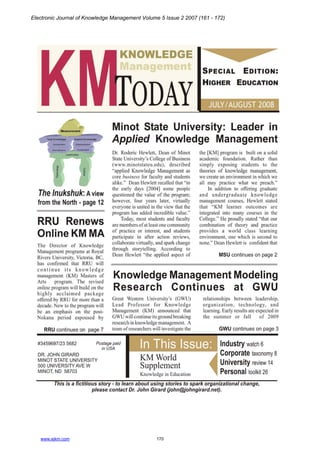
paper to create a story entitled Twelve Hours of
Knowledge (see Appendix 1). The story was an
overwhelming success and it was eventually
included in the Canadian Military Journal – the
journal read by the target audience (Girard, 2004:
24). The story, which was set five years in the
future, intentionally blurred the real with the
imaginary. Many facets of the story were
commonplace in Defence, such as the type of
equipment, ranks, organisations and jargon. Care
was taken not to use any real people’s names;
instead, position titles were used. The tale was
about a Canadian Forces operation on a small
Caribbean island nation, which was dealing with
the aftermath of a natural disaster.
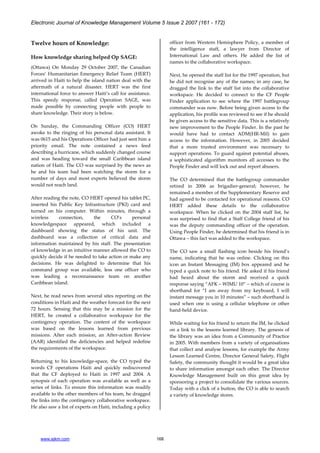
So what made the story a success? Clearly, there
were a number of critical success factors;
however, one of the most important was the look
of the story. The story was designed to resemble
the weekly newspaper of the Canadian Forces
entitled The Maple Leaf. With the editor’s
permission, a story was crafted that appeared to
be The Maple Leaf’s cover story. This allowed the
story to be distributed as a reprint from the paper.
The look was especially useful in capturing
people’s attention, countering to some degree the
old cliché ‘Don’t judge a book by its cover.’ At
John P Girard and Sandra Lambert
ISSN 1479-4411 ©Academic Conferences Ltd165
least in this case it seems the cover was important
to many people. Attracting the target audience is
just the first step; clearly, the content is the vital
ingredient. The story must be believable, realistic,
and most importantly perceived as achievable.
Although the story was set in the future, it did not
rely on futuristic technology, but rather, it
described technology that is commonplace today.
This was a surprise to many readers as they
expected some far-fetched, ridiculously expensive
Star Trek type technology. Instead the narrative
described leadership and culture as the keys to
success – another surprise to many readers. A
crucial component of the story’s success was
executive support. An early draft of the story
caught the attention of one very senior executive
who was delighted with the format and the
message. His endorsement provided the
necessary influence to sway a few less
enthusiastic managers, who may have otherwise
been able to thwart the distribution of the piece.
As is the case with other change initiatives the
support of senior executives is critical to the
success of motivational stories.
4.2 Story two – Guiding faculty into the
future
The second story was developed to excite change
in a small mid-west university (see Appendix 2). A
new faculty member was charged with the
responsibility of integrating knowledge
management into the core curriculum of the
College of Business. This was no easy task,
especially given the number of naysayers who
were perfectly content with the status quo. One
group believed knowledge management was just
a passing fad and they had been involved with
enough fads, thank you very much. A second
group thought this KM stuff was a good idea, just
as long as it did not affect them or their courses.
The final group, which was the majority, had
bought into the idea but did not really know what
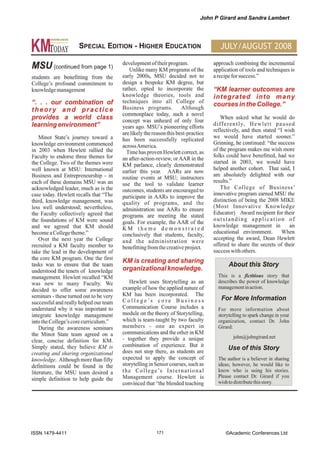
to do next. The story was a mock interview with
the Dean five years hence. The story was
published in a trade journal, entitled KM Today,
shortly after the College was the recipient of the
Most Innovative Knowledge Educator (MIKE)
award. In the interview, the Dean described the
implementation of the program and how it had
improved the quality of education for the students.
The final question asked by the interviewer was
‘What would you do differently?’ to which the
Dean replies ‘I wish we would have started
sooner.’ Grinning, he continued: ‘the success of
the program makes me wish more folks could
have benefited, had we started in 2003, we would
have helped another cohort. That said I am
absolutely delighted with our results.’
Both the trade journal and the award in this story
were fictitious, as were the other organisations
mentioned in the accompanying stories. That said,
they resembled their real alter egos. For example
the genuine trade magazine is entitled KM World
(see www.kmworld.com) while the authentic
award is the Most Admired Knowledge Enterprise
(MAKE) (see www.knowledgebusiness.com). This
allowed the story to be distributed as a reprint
from the paper.
Unlike the first story, this time the story focused
on an individual, the Dean, who was very well
known in the organisation. For this reason, the
Dean’s real name was used and with his
permission, his style was carefully modelled in the
mock interview. This blending of the real and
simulated worlds went some way in helping to
convince the readers that the story was believable
and achievable. Once again, a vital component of
the story’s success was executive support. The
Dean reviewed an early draft of the story and he
was delighted with the format and the message.
4.3 Story three – Guiding students into
the future
Based on the success of the previous stories,
another future based story was penned (see
Appendix 3). This time the target audience was a
group of executive graduate students completing
an accelerated Master of Science in Management
program. A key element to this program is a major
research paper that must be completed before
graduation. Historically all students have
completed the course work based on the
published schedule; however, there tended to be
a handful of students who procrastinated on the
projects. This procrastination caught the attention
of the University administrators who seemed
worried that this tardiness may jeopardise the
program. In the past a variety of techniques were
used to instil a sense of urgency in the students
but needless to say the desired results were still
not being achieved. Once again, the use of
narrative was selected as the way ahead. This
time the story was set just months in the future,
unlike the previous stories that were several years
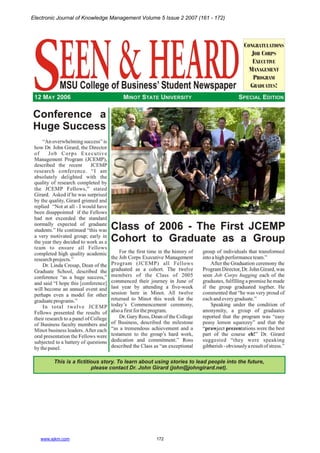
in the future. Specifically the date of the story was
the graduation date of the group with the following
headline ‘Class of 2005 – The First Cohort to
Graduate as a Group.’ The story was published in
a newspaper that featured a striking resemblance
to the University’s student newspaper.
The target audience for this tale was a group of
geographically separated students who needed a
moral boost. The story was printed and mailed to
the students’ homes. At the end of the day, the
story achieved its aim by helping focus the
students on the few remaining months of the
Electronic Journal of Knowledge Management Volume 5 Issue 2 2007 (161 - 172)
www.ejkm.com 166
program. Several students commented that the
story allowed them to see the end of tunnel.
5. Moral of the story
All good stories should end with a moral and this
story is no different. This saga began by reviewing
the timeless story of a stonecutter and a cathedral
builder. Having agreed that most executives
would wish for an army of cathedral builders
rather than stonecutters the literature was
reviewed to see what the gurus were suggesting.
The literature is rich with examples of raconteurs
guiding the way ahead with oral stories; however,
the domain of written stories was far less mature.
After reviewing a trio of future-based written
stories, it is clear that, at least in some cases, the
power of the pen may be as effective as a well-
told oral story. In each case, the written word
proved to be a powerful motivator by capturing the
imagination and attention of the target audience.
Perhaps these types of stories are not well suited
to all audiences; however, for some groups the
written word is more powerful than even the best
oral story. To quote a faculty member who was
initially against the change initiate and now a
supporter of the idea, ‘Now I get it.’ Just four
words, but four words that mean one more team
member is a supporter . . . those are four
important words! The target audience seems to be
a key to the success of these stories – it is not
known or presumed that the success of these
stories may be replicated in other groups.
For some groups it is simply not possible to
capture the attention of all group members with an
oral rendition. This is certainly the case with the
three groups described in this paper. Two of the
groups, the military and student groups, were
separated geographical and it would have been
extremely difficult to have them meet to hear the
story. The majority of the third group, the faculty,
were geographically collocated but as a group
were not very receptive to a gathering to discuss
the subject. Anecdotal evidence seems to support
the premise that the target audiences for these
stories prefer the written word to the spoken word.
The moral of this story is that both written and oral
stories are effective tools in sharing organisational
knowledge, sparking change, and guiding people
into the future. The wise executive should
consider both forms of stories to help guide their
organisations.
References
Allen, K. (2005) ‘Organisational Storytelling’, Franchising World, vol. 37, no. 11, pp. 63-64.
Baum, D. (2000) Lightning in a bottle: proven lessons for leading change, Chicago: Dearborn.
Bell, S. (2004) ‘Trust vital for e-commerce’, Computerworld (New Zealand), 2 April, [Online], Available:
http://www.computerworld.co.nz/news.nsf/PrintDoc/FCA480238A04B632CC256E68007288E0 [2 Aug 2006]
Chartier, B., LaPointe, S., and Bonner, K. (2005). Get real - the art and power of storytelling in workplace communities.
Canada: Her Majesty the Queen in Right of Canada, [Online], Available: http://www.managers-
gestionnaires.gc.ca/get_real/storytelling_e.pdf [2 Aug 2006].
Denning, S. (2001) The springboard: How storytelling ignites action in knowledge-era organisations, Boston: Elsevier.
Denning, S. (2004) ‘Telling Tales’, Harvard Business Review, vol. 8, no. 5, May, pp 122-129.
Denning, S. (2005) ‘Mastering the discipline of business narrative’, Strategy and Leadership, October, [Online],
Available: http://www.stevedenning.com/slides/MasteringBusinessNarrative-Final-Oct2-05.pdf [2 Aug 2006].
Forman, J. (1999) ‘When stories create an organisation’s future’, Briefs, no. 15.
Girard, J. (2004) ‘Defence knowledge management: A passing fad?”, Canadian Military Journal, vol. 5 no. 2, pp. 17-28.
Ivy Sea Online. (2005) Stories and Storytelling. [Online], Available: http://www.ivysea.com/pages/Storytelling_portal.html
[2 Aug 2006].
Kaye, B., and Jacobson, B. (1999) ‘True tales and tall tales the power of organisational storytelling’, Training and
Development, vol. 53, no. 3, March, pp. 45-50.
Mai, R., and Akerson, A. (2003) The Leader as Communicator: Strategies and Tactics to Build Loyalty, Focus Effort, and
Spark Creativity. New York: AMACOM Division American Management Association.
McKee, R. and Fryer, B. (2003) ‘Storytelling that moves people’, Harvard Business Review, vol. 81, no. 6. pp 51-55.
Matsui, B. (n.d.) ‘Action mapping, a planning tool for change’, The Claremont Graduate School, [Online], Available:
http://www.bestdegree.com/courses/masters/pdf/edu731_Action_Mapping.pdf, [2 Aug 2006].
Neilson, R. and Stouffer, D. (2005) ‘Narrating the vision scenarios in action’, The Futurist, vol. 39, no. 3, pp 26-30.
Snowden, D. (2002) ‘Complex acts of knowing: Paradox and descriptive self-awareness’, Journal of Knowledge
Management, vol. 6, no. 2, pp 1-13.
John P Girard and Sandra Lambert
ISSN 1479-4411 ©Academic Conferences Ltd167
Appendices
Electronic Journal of Knowledge Management Volume 5 Issue 2 2007 (161 - 172)
www.ejkm.com 168
Twelve hours of Knowledge:
How knowledge sharing helped Op SAGE:
(Ottawa) On Monday 29 October 2007, the Canadian
Forces’ Humanitarian Emergency Relief Team (HERT)
arrived in Haiti to help the island nation deal with the
aftermath of a natural disaster. HERT was the first
international force to answer Haiti’s call for assistance.
This speedy response, called Operation SAGE, was
made possible by connecting people with people to
share knowledge. Their story is below.
On Sunday, the Commanding Officer (CO) HERT
awoke to the ringing of his personal data assistant. It
was 0615 and his Operations Officer had just sent him a
priority email. The note contained a news feed
describing a hurricane, which suddenly changed course
and was heading toward the small Caribbean island
nation of Haiti. The CO was surprised by the news as
he and his team had been watching the storm for a
number of days and most experts believed the storm
would not reach land.
After reading the note, CO HERT opened his tablet PC,
inserted his Public Key Infrastructure (PKI) card and
turned on his computer. Within minutes, through a
wireless connection, the CO’s personal
knowledgespace appeared, which included a
dashboard showing the status of his unit. The
dashboard was a collection of critical data and
information maintained by his staff. The presentation
of knowledge in an intuitive manner allowed the CO to
quickly decide if he needed to take action or make any
decisions. He was delighted to determine that his
command group was available, less one officer who
was leading a reconnaissance team on another
Caribbean island.
Next, he read news from several sites reporting on the
conditions in Haiti and the weather forecast for the next
72 hours. Sensing that this may be a mission for the
HERT, he created a collaborative workspace for the
contingency operation. The content of the workspace
was based on the lessons learned from previous
missions. After each mission, an After-action Review
(AAR) identified the deficiencies and helped redefine
the requirements of the workspace.
Returning to his knowledge-space, the CO typed the
words CF operations Haiti and quickly rediscovered
that the CF deployed to Haiti in 1997 and 2004. A
synopsis of each operation was available as well as a
series of links. To ensure this information was readily
available to the other members of his team, he dragged
the links into the contingency collaborative workspace.
He also saw a list of experts on Haiti, including a policy
officer from Western Hemisphere Policy, a member of
the intelligence staff, a lawyer from Director of
International Law and others. He added the list of
names to the collaborative workspace.
Next, he opened the staff list for the 1997 operation, but
he did not recognise any of the names; in any case, he
dragged the link to the staff list into the collaborative
workspace. He decided to connect to the CF People
Finder application to see where the 1997 battlegroup
commander was now. Before being given access to the
application, his profile was reviewed to see if he should
be given access to the sensitive data. This is a relatively
new improvement to the People Finder. In the past he
would have had to contact ADM(HR-Mil) to gain
access to the information. However, in 2005 decided
that a more trusted environment was necessary to
support operations. To guard against potential abuses,
a sophisticated algorithm monitors all accesses to the
People Finder and will lock out and report abusers.
The CO determined that the battlegroup commander
retired in 2006 as brigadier-general; however, he
remained a member of the Supplementary Reserve and
had agreed to be contacted for operational reasons. CO
HERT added these details to the collaborative
workspace. When he clicked on the 2004 staff list, he
was surprised to find that a Staff College friend of his
was the deputy commanding officer of the operation.
Using People Finder, he determined that his friend is in
Ottawa – this fact was added to the workspace.
The CO saw a small flashing icon beside his friend’s
name, indicating that he was online. Clicking on this
icon an Instant Messaging (IM) box appeared and he
typed a quick note to his friend. He asked if his friend
had heard about the storm and received a quick
response saying “AFK – WIMU 10” – which of course is
shorthand for “I am away from my keyboard, I will
instant message you in 10 minutes” – such shorthand is
used when one is using a cellular telephone or other
hand-held device.
While waiting for his friend to return the IM, he clicked
on a link to the lessons learned library. The genesis of
the library was an idea from a Community of Practice
in 2005. With members from a variety of organisations
that collect and analyse lessons, for example the Army
Lesson Learned Centre, Director General Safety, Flight
Safety, the community thought it would be a great idea
to share information amongst each other. The Director
Knowledge Management built on this great idea by
sponsoring a project to consolidate the various sources.
Today with a click of a button, the CO is able to search
a variety of knowledge stores.
John P Girard and Sandra Lambert
ISSN 1479-4411 ©Academic Conferences Ltd169
The lessons learned library produced some very
important lessons. First, he noted that during the 2004
operation, the battlegroup had problems using floppy
disks to store data. It turns out that the sand from the
island was corrupting the magnetic medium. Their
solution was to use Universal Serial Bus (USB) thumb
drives in lieu of floppy disks. Next, he discovered that
in 1997 there had been a problem with the Status of
Forces Agreement (SOFA) for the neighbouring
country of Cuba. Other issues were also highlighted, all
of which were moved to the collaborative workspace
and flagged for the Operations Officer’s attention. The
SOFA issue was a priority so it triggered an automatic
message to the Operations Officer, who reviewed the
message and prepared a note to the lawyer identified
by the CO as an authority in the area.
It was now 1000 and the CO’s staff college friend sent
him an IM. He asked his friend a number of questions
about the previous operation. After a few minutes, the
CO received an IM from the COS J3 in Ottawa
suggesting a Warning Order was being developed and
would likely be signed off before noon. The CO parted
company with his friend and they agree that if
anything else developed they would talk again.
The CO sent an IM inviting COS J3 into the
collaborative workspace and he provided an overview
of his morning. COS J3 remarked that he did not know
how they did it in the old days. He suggested that the
CO drive from Kingston to Ottawa for an afternoon
classified briefing – they agreed to meet at 1600. The
CO signed out of his knowledgespace to tend to some
personal issues before departing for Ottawa.
At 1120, the CO received a priority message on his
cellular phone. The message was from the collaborative
workspace and it stated that COS J3 had just uploaded
the warning order. The CO signed into his
knowledgespace, received the order, added some
additional information and forwarded a message to his
operations officer who knew exactly what to do based
on standing operating procedures.
At 1200, he grabbed his tablet PC along with a few
other necessities and commenced the drive to Ottawa.
At 1315, he was hit head-on by another vehicle and
died instantly. At 1400, the COS J3 was notified of the
tragic accident. After ensuring that all necessary
arrangements were in place to help the CO’s family, the
COS J3 returned his attention to the operational
mission at hand. Clearly, a new CO had to be
appointed as the Prime Minister had just announced
that the CF would be dispatching the HERT within 24
hours.
The selection of the new CO was simple. Since 2006, the
CF policy had been that all command positions must
have identified successors. The nominated successor is
informed of their selection and therefore is able to
mentally prepare for transition. In this case, the
successor was aware of her assumption of command in
ten months and she had begun preparing to be a CO.
Knowing that she would be the next CO, she had been
thinking about the storm and wondering if HERT
would be involved. She had also been thinking what
she would do if she were CO. She remembered visiting
the HERT in Kingston and being briefed on
contingency plans.
The new CO HERT was informed of her new position
at 1500. As she lived in Ottawa, she was able to meet
with the COS J3 later that day. In the meantime, she
was given access to the collaboration space and was
able to review her predecessor’s work. She too, knew
the battlegroup commander from 2004 and decided to
make contact. The two agreed to discuss the impending
mission. As soon as they met face-to-face, the CO
realised that her friend was uncomfortable about
something. Soon he began to describe the details of a
tragic incident on the island. The sharing of this
experience would turn out to be very important in the
days ahead. In fact, the story was so powerful that the
CO never forgot the words of wisdom from her friend.
After the operation, during the after-action review, she
noted that the war story had saved the lives of several
soldiers – that is the power of sharing knowledge.
At 1815, CO HERT met with the COS J3, just 12 hours
after her processor first heard about the disaster. She
told COS J3 that she was up to speed and ready to go.
HERT deployed the next morning. The speed of
response for Op SAGE was the result of the COs’ ability
to rapidly connect to the data, information and
knowledge they needed to make decisions and take
actions – this is the essence of knowledge management.
This is a story of the synergy of technology, leadership
and culture; this is a story of the power of sharing.
About this Story
This is a fictitious story that describes the power of
knowledge management in action. It was created with
the permission of the managing editor of the Maple
Leaf.
For More Information
For more information about using stories to spark
organisational change please contact Dr. John Girard
(john@johngirard.net).
Please contact Dr. Girard if you wish to distribute this
story.
Version Française
Il y a une version française de cette histoire, demandez
au Dr. Girard (john@johngirard.net)
Electronic Journal of Knowledge Management Volume 5 Issue 2 2007 (161 - 172)
www.ejkm.com 170
John P Girard and Sandra Lambert
ISSN 1479-4411 ©Academic Conferences Ltd171
Electronic Journal of Knowledge Management Volume 5 Issue 2 2007 (161 - 172)
www.ejkm.com 172

ejkm-volume5-issue2-article100

  • 1.
    ISSN 1479-4411 ©AcademicConferences Ltd Reference this paper as: Girard J.P. and Lambert S (2007) “The Story of Knowledge: Writing Stories that Guide Organisations into the Future” The Electronic Journal of Knowledge Management Volume 5 Issue 2, pp 161-172 , available online at www.ejkm.com 161 The Story of Knowledge: Writing Stories that Guide Organisations into the Future John P Girard and Sandra Lambert Minot State University, North Dakota, USA john@johngirard.net sandra.lambert@minotstateu.edu Abstract: Many organisational gurus highlight the value of oral narrative or storytelling as a catalyst for organisational change or a way to share knowledge. Tomes of articles describe seasoned raconteurs single handedly inciting enormous transformation in organisations. Oxymoronically many written works are describing the power of oral narrative. Surely these printed exposés are themselves motivators for change; so why the continued emphasis on the face-to-face storytelling? There is no disputing the fact that oral narrative is a powerful form of communicating; however, it is not always feasible. In fact, there are times when the written word packs a more powerful punch. Often it is simply not possible to catch the ear of a wide audience simultaneously, or even at all. Many people simply will not take time from their busy schedules to listen to stories. Busy executives seem to prefer the written word to the spoken. In these cases, the power of the pen offers a persuasive substitute. This is a tale about such stories in action, each of which seemed to sow the seed of change. Of course, time will be the real test; however, anecdotal evidence seems to support the proposition that well-written futuristic stories provide an excellent alternative to face-to-face oral narrative. At least in these examples, the written story proved to be a motivator for organisational change and an effective way to share knowledge. This paper is about the use of narrative to share knowledge; it is part tutorial and part theory. Building on the foundational knowledge developed by Denning, Snowden, Prusak, and others this paper describes the “how to” of effective storytelling to create and share knowledge within organisations. Keywords: storytelling, organisational change, knowledge management 1. Introduction On a foggy autumn day nearly 800 years ago a traveller happened upon a large group of workers adjacent to the River Avon. Despite being tardy for an important rendezvous curiosity convinced the traveller that he should inquire about their work. With a slight detour he moved toward the first of the three tradesmen and said “my dear fellow what is it that you are doing?” The man continued his work and grumbled, “I am cutting stones.” Realising that the mason did not wish to engage in a conversation the traveller moved toward the second of the three and repeated the question. To the traveller’s delight this time the man stopped his work, ever so briefly, and stated that he was a stonecutter. He then added “I came to Salisbury from the north to work but as soon as I earn ten quid I will return home.” The traveller thanked the second mason, wished him a safe journey home and began to head to the third of the trio. When he reached the third worker he once again asked the original question. This time the worker paused, glanced at the traveller until they made eye contact and then looked skyward drawing the traveller’s eyes upward. The third mason replied, “I am a mason and I am building a cathedral.” He continued, “I have journeyed many miles to be part of the team that is constructing this magnificent cathedral. I have spent many months away from my family and I miss them dearly. However, I know how important Salisbury Cathedral will be one day and I know how many people will find sanctuary and solace here. I know this because the Bishop once told me his vision for this great place. He described how people would come from all parts to worship here. He also told that the Cathedral would not be completed in our days but that the future depends on our hard work.” He paused and then said, “So I am prepared to be away from my family because I know it is the right thing to do. I hope that one day my son will continue in my footsteps and perhaps even his son if need be.” In the past five years or so there has been tremendous interest in the value of oral narrative or storytelling as a catalyst for organisational change. Many of these accounts chronicle seasoned executives telling stories that spark massive transformation in their organisations. It seems, so the story goes, that these organisations were apparently reluctant or incapable of considering even the most modest change initiative. That is until the story was told. The opening story is an adaptation of a legendary example of how a well-told story can motivate men and women to make great sacrifices if they believe their work is important. One can imagine that most leaders would wish to have a team of cathedral builders rather than stonecutters. The question is, can a story really transform stonecutters into cathedral builders? To date most of the work in the domain has focused on the value of telling stories, in other words oral narrative. Take, for example, Steve Denning’s book The Springboard, the subtitle of which is
  • 2.
    Electronic Journal ofKnowledge Management Volume 5 Issue 2 2007 (161 - 172) www.ejkm.com 162 How Storytelling Ignites Action in Knowledge-Era Organisations (2001). In this seminal work, Denning describes his successes in telling face- to-face stories. Denning’s work has spawned a host of other papers and books, most of which focus on telling oral stories. Surely these printed exposés are themselves motivators for change; so why the continued emphasis on the face-to-face storytelling? Perhaps there is value in examining writing stories rather than telling stories that spark change. This paper is a story of exactly that, writing stories that help guide organisations. 2. Literature review ‘Stories are a primary mode of human communication and thinking — and one that has been used since the dawn of time. Why? Stories have depth and multiple dimensions; they help us create human connections in a world that seems complex, sometimes (or often) threatening, and increasingly dehumanising. Stories give us context’ (Ivy Sea Online, 2005). 2.1 Envisage narratives Before describing the stories, it is worth reviewing the literature with a view to determining the theoretical foundations of these stories. Much like the cathedral builder’s Bishop, many leaders use stories to electrify their subordinates and lead them into the future. The ability to relate to an audience using a story is a concept that has passed the test of time. Through a variety of approaches, present-day executives use stories to excite and invigorate their teams much as their predecessors did. Kaye and Jocobson (1999:50) remind us that “stories tap into our emotions and intellect in ways that get us to remember and use the information and wisdom of the past to help us make informed decisions in the future.” There is an enormous difference between relating a message to an audience and sharing a vision to alter the future of an organisation. The use of narration or storytelling envisage within a corporation can grant insight into an alternate course of action. Chartier, LaPointe, and Bonner (2005: v) state in Get Real – The Art and Power of Storytelling in Workplace Communities ‘Stories are a way to honour our past, describe our present and shape our future.’ The impact of conveying an envisioned story, which can change the future of an organisation, can be magnificent, in the sense that it can also change lives. Yet, how does one know that the envisaged narrative will be received and have the ability to alter the future of an organisation? How does the manager know if the message of their narrative has been received and that their team members can relate? In oral stories the receivers demonstrate an attentive and responsive reaction, sometimes signs of enthusiasm. However, with the written word the immediate reaction is often lacking. 2.2 The use of story Throughout time, leaders have used stories to share knowledge, spark change and generally enlighten an audience. Some leaders use formal presentations to achieve these tasks. Although there are similarities in the techniques, there are also significant differences. More and more the evidence is suggesting the PowerPoint style of knowledge transfer is less effective than many believe. Janis Forman (1999: 1) argues that ‘Clear communications between executives and their audiences has been declining ever since the advent of souped-up computer graphics and Internet access to vast quantities of data.’ Neilson and Stouffer (2005) claim that PowerPoint presentations lack contextual meaning. According to McKee (2003: 51) we should ‘Forget about PowerPoint and statistics. To involve people at the deepest level, you need stories.’ Steve Denning (2004: 122), the celebrated guru of storytelling, claims to have moved from PowerPoint style presentations to storytelling after watching ‘my audience merely looked dazed.’ Larry Prusak (in Bell, 2004), respected knowledge management expert, goes one-step further by suggesting ‘I’ve taken PowerPoint off all my computers; it’s the enemy of thought.’ Though Prusak’s action may seem extreme, his point is very valid; knowledge sharing is sometimes impeded by an endless stream of charts and graphs. In their article Narrating the Vision, Neilson and Stouffer (2005) illustrate the effectiveness of using futuristic scenarios as a storytelling technique. They suggest that ‘futuristic scenarios – stories that paint a vivid picture of a future state – can help provide a vision and leadership in a narrative format as well as communicate the organisation vision’ (Neilson and Stouffer, 2005: 26). The ability to convey a message, as in the story Narrating the Vision, is a great example of a futuristic scenario. Nevertheless it is important to examine the effectiveness of the approach of futuristic scenarios within an organisation. Steve Denning (2005) stated recently that future scenarios aid in the exploration of other points of view yet concluded that a descriptive narrative to support the scenario is necessary. 2.3 Conveying futuristic views ‘As humans, we are wired to respond to stories in deep, sometimes unconscious
  • 3.
    John P Girardand Sandra Lambert ISSN 1479-4411 ©Academic Conferences Ltd163 ways. We actually answer with our attention and focus, when all other efforts may fail. Watch sometime how body language changes when someone starts a joke or story. Notice the slight rise in alertness and increased presence of the listeners. People will almost always put down what they are doing and give full attention. If the teller is particularly good at storytelling, then the response is almost always deep focus’ (Baum, 2000, p. 159). Visualising a future organisational course of action entails strategies and tactics to build loyalty, focus effort, and spark creativity according to Robert Mai and Alan Akerson (2003). The Leader as Communicator exemplifies the restructuring of several organisations, each of which uses stories to communicate a holistic viewpoint with one or more different angles. The basis of the story is a problematic statement posing a challenge for the organisations. The story is used to convey a guided future course of action for the organisation; a methodical approach occurs prior to this phase. Before the plot line can be portrayed, a data gathering process is needed. The data-gathering phase will answer questions on the past, current, and future course of action of the organisation. One should also consider the buy-in factor of stakeholders. According to Forman (1999) one method that can be used to evaluate or test their envisage narrative is an Analysis Tree. Determining coherence through a visual analysis illustrates phases within a story. The corporation’s past history, current course of action to take, and the envisaged future will be shown along with the structural ideas that show a link to strategic reality. The analysis tree is similar to a storyboard, which allows visualisation of how the process relates to another phase. Executives in the healthcare industry used this particular method. The advantage of the analysis tree is flexibility to adapt to the storytellers needs. The storyteller can adapt the analysis tree to the audience or stakeholders. Evaluating narratives through the analysis tree is valuable to an organisation based on the effectiveness of the story. Contrary to Forman’s analysis tree, Allen (2005) suggests that storytelling will not substitute for analytical thinking, but only enhances organisational knowledge. However sharing of knowledge ignites change, which increases the possibility of success within an organisation. Altering duty into passion is a requirement to increase the level of accomplishments. Linking responsibilities with passions prevents burnout and remoteness among employees, therefore benefits the organisation. Storytelling provides the means to convey messages to an audience or a method for sharing knowledge. ‘Storytelling can be the catalyst for change . . . Telling your story complements analytical thinking and allows customers to engage feelings, leading to loyalty’ (Allen, 2005:64). Storytelling can be advantageous to an organisation in a variety of ways. Matsui (7) stated ‘Stories can be told in a variety of modes that include: visual accounts, ballads, metaphors, text, and voice. Telling good stories serves the organisation with an effective means of collecting wisdom through experience.’ The use of storytelling, along with five other components becomes useful for an organisation to plan a future course of action. This form of planning is called Action Mapping and consists of assemblage, accumulation and production of wisdom, actions as hypothesis, conservation of energy, reflection on action, as well as storytelling (Matsui). The planning phase will consist of essential components from the data-gathering phase. Creating the story requires past, present, and future knowledge of the organisation, which will in turn be used to develop the future course of action. Involving the stakeholders in the process creates an increased success factor of the envisage narrative. Matsui (7) suggests that ‘The knowledge and experiences gained from a journey clarify future actions by identifying emerging patterns.’ Steve Denning (2001) uses the catalyst approach and takes storytelling a step further, through Springboard stories, which provide the audience or stakeholders with a deeper level of understanding. Visualising through the use of realistic events sustains the attention and consciousness of the audience. The significant aspect of a springboard story is the use of a simplistic approach, using fewer details to allow the audience to imagine the future possibilities that can occur within the organisation. This catalyst approach leads the audience without controlling their views based on an individual’s field or past experiences. Audience participation in the creation of the organisation’s future is met with less resistance and more enthusiasm, therefore obtaining buy-in from the participants. 2.4 Writing the future Snowden’s (2002: 3) second heuristic of the new knowledge management generation is ‘we can always know more than we can tell, and we will always tell more than we can write down.’ These wise words seem to suggest that telling an oral story may be more effective then a written story. However, before dismissing the written word it is worth considering the context of his message. Snowden (2002:3) suggests ‘I can speak in five minutes what it will otherwise take me two weeks to get round to spend a couple of hours writing it down. The process of writing something down is
  • 4.
    Electronic Journal ofKnowledge Management Volume 5 Issue 2 2007 (161 - 172) www.ejkm.com 164 reflective knowledge; it involves both adding and taking away from the actual experience or original thought. Reflective knowledge has high value, but is time consuming and involves loss of control over its subsequent use’. This deeper examination of Snowden’s second heuristic seems to imply that once one takes the time to create a written story the value may be higher than a less- reflective oral story. Snowden’s premise is corroborated by Denning (2004: 127) who wrote ‘A story can help take listeners, from where they are to where they need to be, by making them comfortable with an image of the future. The problem, of course, lies in crafting a credible narrative about the future when the future is unknowable.’ Together Denning and Snowden highlight the challenge of writing future stories – one must take the time to learn about the future and then articulate the ideas using the reflective knowledge Snowden described. 3. Methodology The literature review concludes that, in theory, narratives help guide people into the future and share knowledge. The question remains, can one use this technique in practice? Perhaps more specifically, the question is can one use written narratives to share knowledge and guide people into the future? One way to answer this question is by chronicling the success of three recently written stories. Each was written with the express aim of guiding people into the future. Before describing the stories, it is important to understand that this paper is based on exploratory research that was designed to field test some concepts. This paper is not based on empirical research nor does it report the results of a true experiment but rather it describes the use of narratives in real organisations with real people dealing with real challenges. Most of the results are anecdotal in nature; nevertheless, it is believed that the outcome indicates that stories are a useful tool in some organisations. One must use caution in determining how the results should be generalised. Clearly, the stories achieved the desired end state in the very unique organisation for which they were designed; however, it remains entirely possible the success of the narratives may not be replicated in other organisations. The results are presented in the spirit of sharing so that others may decide if the techniques are appropriate for their organisations. In addition, it is hoped this exploratory research will lead to a formal empirical study. 4. Practical Implementation There is no disputing the fact that oral narrative is a powerful form of communicating; however, it is not always feasible. In fact, there are times when the written word packs a more powerful punch. Often it is simply not possible to catch the ear of a wide audience simultaneously, or even at all. Many people simply will not take time from their busy schedules to listen to stories, others may be geographically separated, and still others may simply be out to lunch or otherwise predisposed. In these cases the power of the pen offers a persuasive substitute. This is a tale about a trio of such stories, which seemed to sow the seed of change, help guide people into the future, and share organisational knowledge. Of course, time will be the real test; however, anecdotal evidence seems to support the proposition that well written futuristic stories provide an excellent alternative to face-to-face oral narrative. At least in these examples, the written story proved to be a motivator for organisational change and an effective way to share knowledge. 4.1 Story one – Guiding government leaders into the future The first story was developed to excite change in a very large bureaucratic organisation – Canada’s Department of National Defence. The leader of the Strategic Knowledge Management cell was keen to explain how and why knowledge management could help Defence leaders. Clearly it would not be possible to meet face-to-face with all of the target audience, so what to do? Against the advice of many colleagues, pen was put to paper to create a story entitled Twelve Hours of Knowledge (see Appendix 1). The story was an overwhelming success and it was eventually included in the Canadian Military Journal – the journal read by the target audience (Girard, 2004: 24). The story, which was set five years in the future, intentionally blurred the real with the imaginary. Many facets of the story were commonplace in Defence, such as the type of equipment, ranks, organisations and jargon. Care was taken not to use any real people’s names; instead, position titles were used. The tale was about a Canadian Forces operation on a small Caribbean island nation, which was dealing with the aftermath of a natural disaster. So what made the story a success? Clearly, there were a number of critical success factors; however, one of the most important was the look of the story. The story was designed to resemble the weekly newspaper of the Canadian Forces entitled The Maple Leaf. With the editor’s permission, a story was crafted that appeared to be The Maple Leaf’s cover story. This allowed the story to be distributed as a reprint from the paper. The look was especially useful in capturing people’s attention, countering to some degree the old cliché ‘Don’t judge a book by its cover.’ At
  • 5.
    John P Girardand Sandra Lambert ISSN 1479-4411 ©Academic Conferences Ltd165 least in this case it seems the cover was important to many people. Attracting the target audience is just the first step; clearly, the content is the vital ingredient. The story must be believable, realistic, and most importantly perceived as achievable. Although the story was set in the future, it did not rely on futuristic technology, but rather, it described technology that is commonplace today. This was a surprise to many readers as they expected some far-fetched, ridiculously expensive Star Trek type technology. Instead the narrative described leadership and culture as the keys to success – another surprise to many readers. A crucial component of the story’s success was executive support. An early draft of the story caught the attention of one very senior executive who was delighted with the format and the message. His endorsement provided the necessary influence to sway a few less enthusiastic managers, who may have otherwise been able to thwart the distribution of the piece. As is the case with other change initiatives the support of senior executives is critical to the success of motivational stories. 4.2 Story two – Guiding faculty into the future The second story was developed to excite change in a small mid-west university (see Appendix 2). A new faculty member was charged with the responsibility of integrating knowledge management into the core curriculum of the College of Business. This was no easy task, especially given the number of naysayers who were perfectly content with the status quo. One group believed knowledge management was just a passing fad and they had been involved with enough fads, thank you very much. A second group thought this KM stuff was a good idea, just as long as it did not affect them or their courses. The final group, which was the majority, had bought into the idea but did not really know what to do next. The story was a mock interview with the Dean five years hence. The story was published in a trade journal, entitled KM Today, shortly after the College was the recipient of the Most Innovative Knowledge Educator (MIKE) award. In the interview, the Dean described the implementation of the program and how it had improved the quality of education for the students. The final question asked by the interviewer was ‘What would you do differently?’ to which the Dean replies ‘I wish we would have started sooner.’ Grinning, he continued: ‘the success of the program makes me wish more folks could have benefited, had we started in 2003, we would have helped another cohort. That said I am absolutely delighted with our results.’ Both the trade journal and the award in this story were fictitious, as were the other organisations mentioned in the accompanying stories. That said, they resembled their real alter egos. For example the genuine trade magazine is entitled KM World (see www.kmworld.com) while the authentic award is the Most Admired Knowledge Enterprise (MAKE) (see www.knowledgebusiness.com). This allowed the story to be distributed as a reprint from the paper. Unlike the first story, this time the story focused on an individual, the Dean, who was very well known in the organisation. For this reason, the Dean’s real name was used and with his permission, his style was carefully modelled in the mock interview. This blending of the real and simulated worlds went some way in helping to convince the readers that the story was believable and achievable. Once again, a vital component of the story’s success was executive support. The Dean reviewed an early draft of the story and he was delighted with the format and the message. 4.3 Story three – Guiding students into the future Based on the success of the previous stories, another future based story was penned (see Appendix 3). This time the target audience was a group of executive graduate students completing an accelerated Master of Science in Management program. A key element to this program is a major research paper that must be completed before graduation. Historically all students have completed the course work based on the published schedule; however, there tended to be a handful of students who procrastinated on the projects. This procrastination caught the attention of the University administrators who seemed worried that this tardiness may jeopardise the program. In the past a variety of techniques were used to instil a sense of urgency in the students but needless to say the desired results were still not being achieved. Once again, the use of narrative was selected as the way ahead. This time the story was set just months in the future, unlike the previous stories that were several years in the future. Specifically the date of the story was the graduation date of the group with the following headline ‘Class of 2005 – The First Cohort to Graduate as a Group.’ The story was published in a newspaper that featured a striking resemblance to the University’s student newspaper. The target audience for this tale was a group of geographically separated students who needed a moral boost. The story was printed and mailed to the students’ homes. At the end of the day, the story achieved its aim by helping focus the students on the few remaining months of the
  • 6.
    Electronic Journal ofKnowledge Management Volume 5 Issue 2 2007 (161 - 172) www.ejkm.com 166 program. Several students commented that the story allowed them to see the end of tunnel. 5. Moral of the story All good stories should end with a moral and this story is no different. This saga began by reviewing the timeless story of a stonecutter and a cathedral builder. Having agreed that most executives would wish for an army of cathedral builders rather than stonecutters the literature was reviewed to see what the gurus were suggesting. The literature is rich with examples of raconteurs guiding the way ahead with oral stories; however, the domain of written stories was far less mature. After reviewing a trio of future-based written stories, it is clear that, at least in some cases, the power of the pen may be as effective as a well- told oral story. In each case, the written word proved to be a powerful motivator by capturing the imagination and attention of the target audience. Perhaps these types of stories are not well suited to all audiences; however, for some groups the written word is more powerful than even the best oral story. To quote a faculty member who was initially against the change initiate and now a supporter of the idea, ‘Now I get it.’ Just four words, but four words that mean one more team member is a supporter . . . those are four important words! The target audience seems to be a key to the success of these stories – it is not known or presumed that the success of these stories may be replicated in other groups. For some groups it is simply not possible to capture the attention of all group members with an oral rendition. This is certainly the case with the three groups described in this paper. Two of the groups, the military and student groups, were separated geographical and it would have been extremely difficult to have them meet to hear the story. The majority of the third group, the faculty, were geographically collocated but as a group were not very receptive to a gathering to discuss the subject. Anecdotal evidence seems to support the premise that the target audiences for these stories prefer the written word to the spoken word. The moral of this story is that both written and oral stories are effective tools in sharing organisational knowledge, sparking change, and guiding people into the future. The wise executive should consider both forms of stories to help guide their organisations. References Allen, K. (2005) ‘Organisational Storytelling’, Franchising World, vol. 37, no. 11, pp. 63-64. Baum, D. (2000) Lightning in a bottle: proven lessons for leading change, Chicago: Dearborn. Bell, S. (2004) ‘Trust vital for e-commerce’, Computerworld (New Zealand), 2 April, [Online], Available: http://www.computerworld.co.nz/news.nsf/PrintDoc/FCA480238A04B632CC256E68007288E0 [2 Aug 2006] Chartier, B., LaPointe, S., and Bonner, K. (2005). Get real - the art and power of storytelling in workplace communities. Canada: Her Majesty the Queen in Right of Canada, [Online], Available: http://www.managers- gestionnaires.gc.ca/get_real/storytelling_e.pdf [2 Aug 2006]. Denning, S. (2001) The springboard: How storytelling ignites action in knowledge-era organisations, Boston: Elsevier. Denning, S. (2004) ‘Telling Tales’, Harvard Business Review, vol. 8, no. 5, May, pp 122-129. Denning, S. (2005) ‘Mastering the discipline of business narrative’, Strategy and Leadership, October, [Online], Available: http://www.stevedenning.com/slides/MasteringBusinessNarrative-Final-Oct2-05.pdf [2 Aug 2006]. Forman, J. (1999) ‘When stories create an organisation’s future’, Briefs, no. 15. Girard, J. (2004) ‘Defence knowledge management: A passing fad?”, Canadian Military Journal, vol. 5 no. 2, pp. 17-28. Ivy Sea Online. (2005) Stories and Storytelling. [Online], Available: http://www.ivysea.com/pages/Storytelling_portal.html [2 Aug 2006]. Kaye, B., and Jacobson, B. (1999) ‘True tales and tall tales the power of organisational storytelling’, Training and Development, vol. 53, no. 3, March, pp. 45-50. Mai, R., and Akerson, A. (2003) The Leader as Communicator: Strategies and Tactics to Build Loyalty, Focus Effort, and Spark Creativity. New York: AMACOM Division American Management Association. McKee, R. and Fryer, B. (2003) ‘Storytelling that moves people’, Harvard Business Review, vol. 81, no. 6. pp 51-55. Matsui, B. (n.d.) ‘Action mapping, a planning tool for change’, The Claremont Graduate School, [Online], Available: http://www.bestdegree.com/courses/masters/pdf/edu731_Action_Mapping.pdf, [2 Aug 2006]. Neilson, R. and Stouffer, D. (2005) ‘Narrating the vision scenarios in action’, The Futurist, vol. 39, no. 3, pp 26-30. Snowden, D. (2002) ‘Complex acts of knowing: Paradox and descriptive self-awareness’, Journal of Knowledge Management, vol. 6, no. 2, pp 1-13.
  • 7.
    John P Girardand Sandra Lambert ISSN 1479-4411 ©Academic Conferences Ltd167 Appendices
  • 8.
    Electronic Journal ofKnowledge Management Volume 5 Issue 2 2007 (161 - 172) www.ejkm.com 168 Twelve hours of Knowledge: How knowledge sharing helped Op SAGE: (Ottawa) On Monday 29 October 2007, the Canadian Forces’ Humanitarian Emergency Relief Team (HERT) arrived in Haiti to help the island nation deal with the aftermath of a natural disaster. HERT was the first international force to answer Haiti’s call for assistance. This speedy response, called Operation SAGE, was made possible by connecting people with people to share knowledge. Their story is below. On Sunday, the Commanding Officer (CO) HERT awoke to the ringing of his personal data assistant. It was 0615 and his Operations Officer had just sent him a priority email. The note contained a news feed describing a hurricane, which suddenly changed course and was heading toward the small Caribbean island nation of Haiti. The CO was surprised by the news as he and his team had been watching the storm for a number of days and most experts believed the storm would not reach land. After reading the note, CO HERT opened his tablet PC, inserted his Public Key Infrastructure (PKI) card and turned on his computer. Within minutes, through a wireless connection, the CO’s personal knowledgespace appeared, which included a dashboard showing the status of his unit. The dashboard was a collection of critical data and information maintained by his staff. The presentation of knowledge in an intuitive manner allowed the CO to quickly decide if he needed to take action or make any decisions. He was delighted to determine that his command group was available, less one officer who was leading a reconnaissance team on another Caribbean island. Next, he read news from several sites reporting on the conditions in Haiti and the weather forecast for the next 72 hours. Sensing that this may be a mission for the HERT, he created a collaborative workspace for the contingency operation. The content of the workspace was based on the lessons learned from previous missions. After each mission, an After-action Review (AAR) identified the deficiencies and helped redefine the requirements of the workspace. Returning to his knowledge-space, the CO typed the words CF operations Haiti and quickly rediscovered that the CF deployed to Haiti in 1997 and 2004. A synopsis of each operation was available as well as a series of links. To ensure this information was readily available to the other members of his team, he dragged the links into the contingency collaborative workspace. He also saw a list of experts on Haiti, including a policy officer from Western Hemisphere Policy, a member of the intelligence staff, a lawyer from Director of International Law and others. He added the list of names to the collaborative workspace. Next, he opened the staff list for the 1997 operation, but he did not recognise any of the names; in any case, he dragged the link to the staff list into the collaborative workspace. He decided to connect to the CF People Finder application to see where the 1997 battlegroup commander was now. Before being given access to the application, his profile was reviewed to see if he should be given access to the sensitive data. This is a relatively new improvement to the People Finder. In the past he would have had to contact ADM(HR-Mil) to gain access to the information. However, in 2005 decided that a more trusted environment was necessary to support operations. To guard against potential abuses, a sophisticated algorithm monitors all accesses to the People Finder and will lock out and report abusers. The CO determined that the battlegroup commander retired in 2006 as brigadier-general; however, he remained a member of the Supplementary Reserve and had agreed to be contacted for operational reasons. CO HERT added these details to the collaborative workspace. When he clicked on the 2004 staff list, he was surprised to find that a Staff College friend of his was the deputy commanding officer of the operation. Using People Finder, he determined that his friend is in Ottawa – this fact was added to the workspace. The CO saw a small flashing icon beside his friend’s name, indicating that he was online. Clicking on this icon an Instant Messaging (IM) box appeared and he typed a quick note to his friend. He asked if his friend had heard about the storm and received a quick response saying “AFK – WIMU 10” – which of course is shorthand for “I am away from my keyboard, I will instant message you in 10 minutes” – such shorthand is used when one is using a cellular telephone or other hand-held device. While waiting for his friend to return the IM, he clicked on a link to the lessons learned library. The genesis of the library was an idea from a Community of Practice in 2005. With members from a variety of organisations that collect and analyse lessons, for example the Army Lesson Learned Centre, Director General Safety, Flight Safety, the community thought it would be a great idea to share information amongst each other. The Director Knowledge Management built on this great idea by sponsoring a project to consolidate the various sources. Today with a click of a button, the CO is able to search a variety of knowledge stores.
  • 9.
    John P Girardand Sandra Lambert ISSN 1479-4411 ©Academic Conferences Ltd169 The lessons learned library produced some very important lessons. First, he noted that during the 2004 operation, the battlegroup had problems using floppy disks to store data. It turns out that the sand from the island was corrupting the magnetic medium. Their solution was to use Universal Serial Bus (USB) thumb drives in lieu of floppy disks. Next, he discovered that in 1997 there had been a problem with the Status of Forces Agreement (SOFA) for the neighbouring country of Cuba. Other issues were also highlighted, all of which were moved to the collaborative workspace and flagged for the Operations Officer’s attention. The SOFA issue was a priority so it triggered an automatic message to the Operations Officer, who reviewed the message and prepared a note to the lawyer identified by the CO as an authority in the area. It was now 1000 and the CO’s staff college friend sent him an IM. He asked his friend a number of questions about the previous operation. After a few minutes, the CO received an IM from the COS J3 in Ottawa suggesting a Warning Order was being developed and would likely be signed off before noon. The CO parted company with his friend and they agree that if anything else developed they would talk again. The CO sent an IM inviting COS J3 into the collaborative workspace and he provided an overview of his morning. COS J3 remarked that he did not know how they did it in the old days. He suggested that the CO drive from Kingston to Ottawa for an afternoon classified briefing – they agreed to meet at 1600. The CO signed out of his knowledgespace to tend to some personal issues before departing for Ottawa. At 1120, the CO received a priority message on his cellular phone. The message was from the collaborative workspace and it stated that COS J3 had just uploaded the warning order. The CO signed into his knowledgespace, received the order, added some additional information and forwarded a message to his operations officer who knew exactly what to do based on standing operating procedures. At 1200, he grabbed his tablet PC along with a few other necessities and commenced the drive to Ottawa. At 1315, he was hit head-on by another vehicle and died instantly. At 1400, the COS J3 was notified of the tragic accident. After ensuring that all necessary arrangements were in place to help the CO’s family, the COS J3 returned his attention to the operational mission at hand. Clearly, a new CO had to be appointed as the Prime Minister had just announced that the CF would be dispatching the HERT within 24 hours. The selection of the new CO was simple. Since 2006, the CF policy had been that all command positions must have identified successors. The nominated successor is informed of their selection and therefore is able to mentally prepare for transition. In this case, the successor was aware of her assumption of command in ten months and she had begun preparing to be a CO. Knowing that she would be the next CO, she had been thinking about the storm and wondering if HERT would be involved. She had also been thinking what she would do if she were CO. She remembered visiting the HERT in Kingston and being briefed on contingency plans. The new CO HERT was informed of her new position at 1500. As she lived in Ottawa, she was able to meet with the COS J3 later that day. In the meantime, she was given access to the collaboration space and was able to review her predecessor’s work. She too, knew the battlegroup commander from 2004 and decided to make contact. The two agreed to discuss the impending mission. As soon as they met face-to-face, the CO realised that her friend was uncomfortable about something. Soon he began to describe the details of a tragic incident on the island. The sharing of this experience would turn out to be very important in the days ahead. In fact, the story was so powerful that the CO never forgot the words of wisdom from her friend. After the operation, during the after-action review, she noted that the war story had saved the lives of several soldiers – that is the power of sharing knowledge. At 1815, CO HERT met with the COS J3, just 12 hours after her processor first heard about the disaster. She told COS J3 that she was up to speed and ready to go. HERT deployed the next morning. The speed of response for Op SAGE was the result of the COs’ ability to rapidly connect to the data, information and knowledge they needed to make decisions and take actions – this is the essence of knowledge management. This is a story of the synergy of technology, leadership and culture; this is a story of the power of sharing. About this Story This is a fictitious story that describes the power of knowledge management in action. It was created with the permission of the managing editor of the Maple Leaf. For More Information For more information about using stories to spark organisational change please contact Dr. John Girard (john@johngirard.net). Please contact Dr. Girard if you wish to distribute this story. Version Française Il y a une version française de cette histoire, demandez au Dr. Girard (john@johngirard.net)
  • 10.
    Electronic Journal ofKnowledge Management Volume 5 Issue 2 2007 (161 - 172) www.ejkm.com 170
  • 11.
    John P Girardand Sandra Lambert ISSN 1479-4411 ©Academic Conferences Ltd171
  • 12.
    Electronic Journal ofKnowledge Management Volume 5 Issue 2 2007 (161 - 172) www.ejkm.com 172