Storytelling  and Narrative The Role of Storytelling in Knowledge Sharing and Organisational Change 29-31 May 2002 KM Champions in Africa Knowledge Management Workshop Maputo, Mozambique
Story.. a definition Story  n., pl. –rie A narration of a chain of events told or written in prose or verse
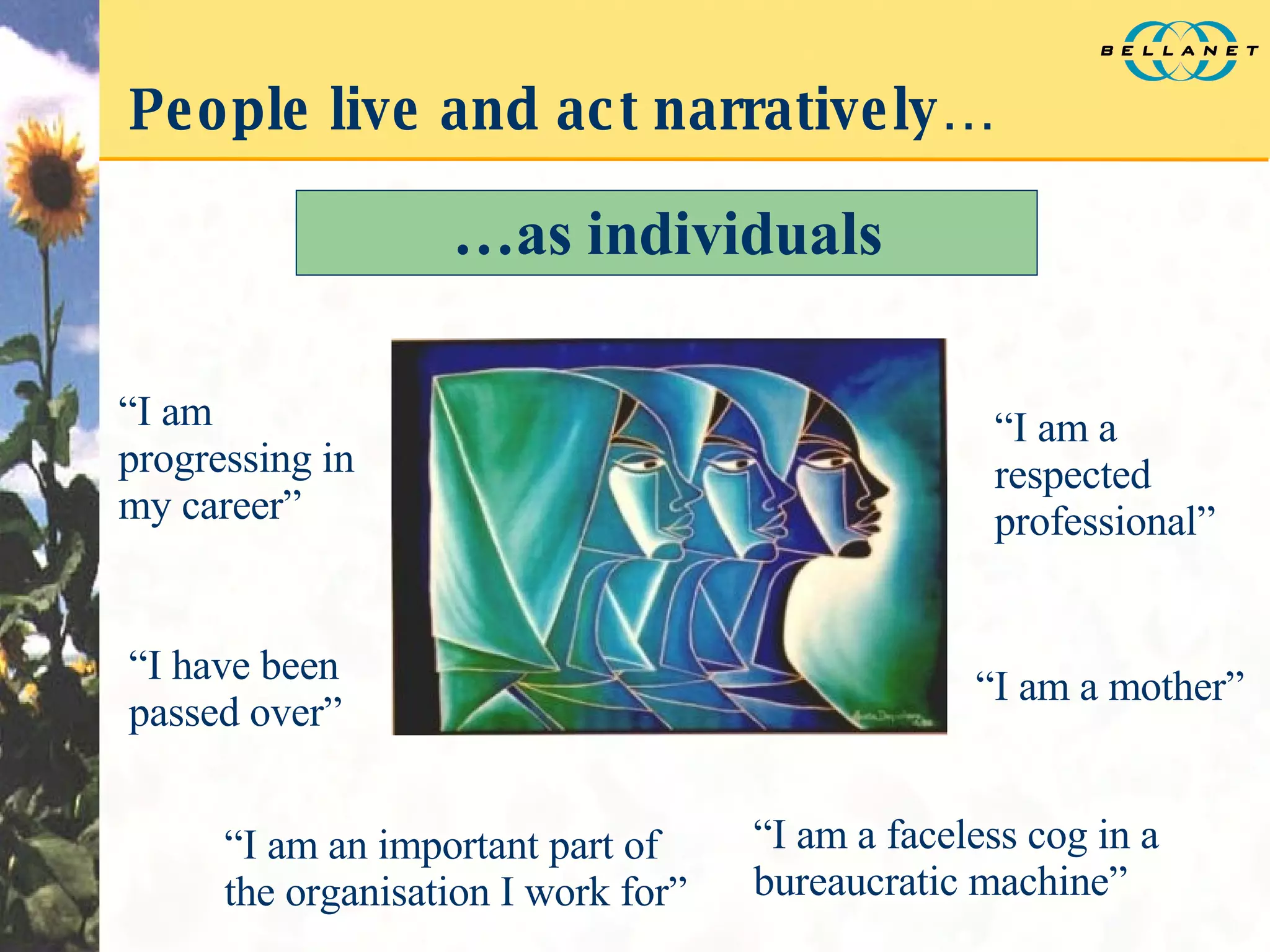
People live and act narratively… … as individuals “ I am a respected professional” “ I am a mother” “ I am progressing in my career” “ I have been passed over” “ I am an important part of the organisation I work for” “ I am a faceless cog in a bureaucratic machine”
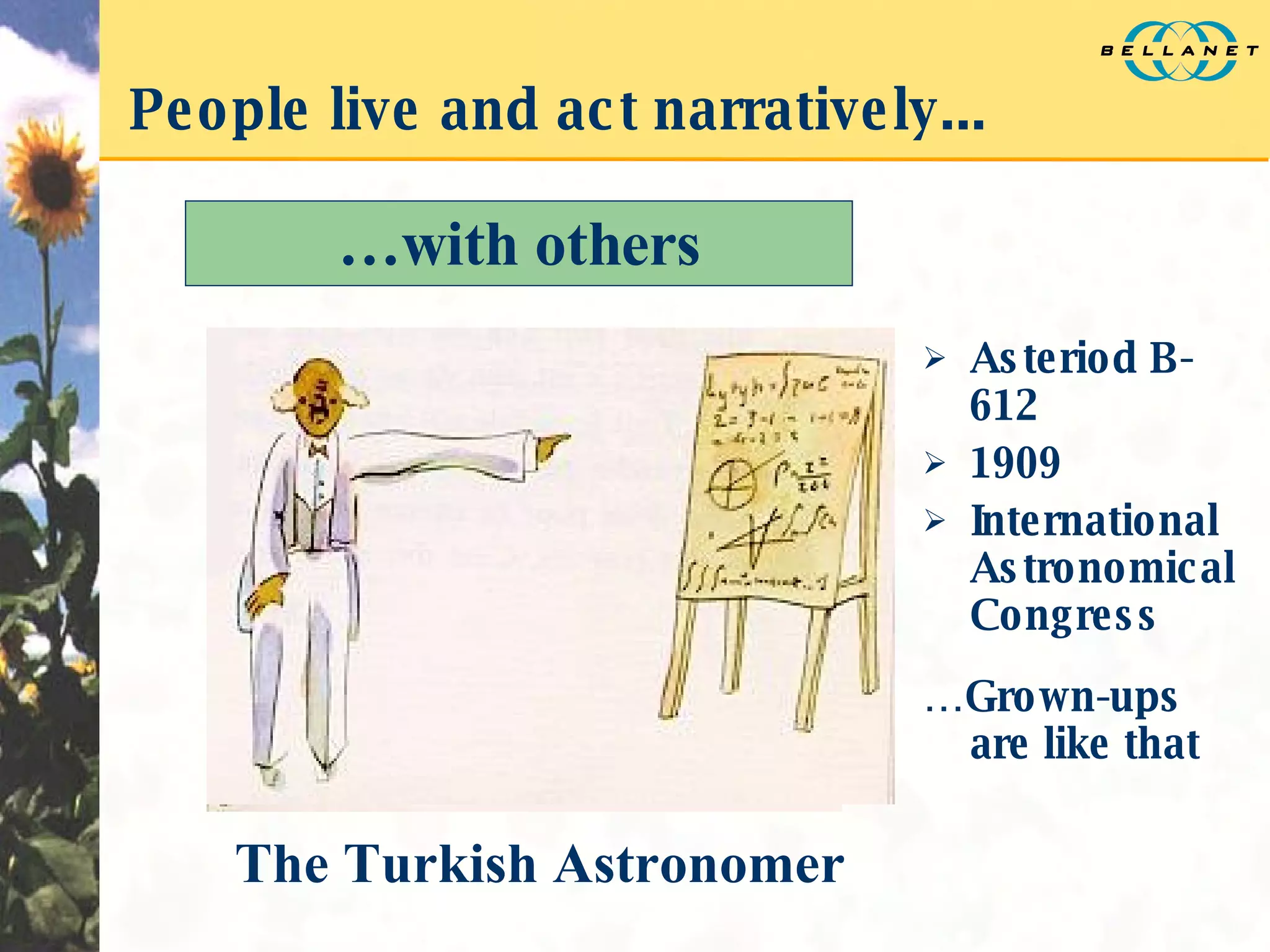
People live and act narratively... Asteriod B-612 1909 International Astronomical Congress … with others The Turkish Astronomer … Grown-ups are like that
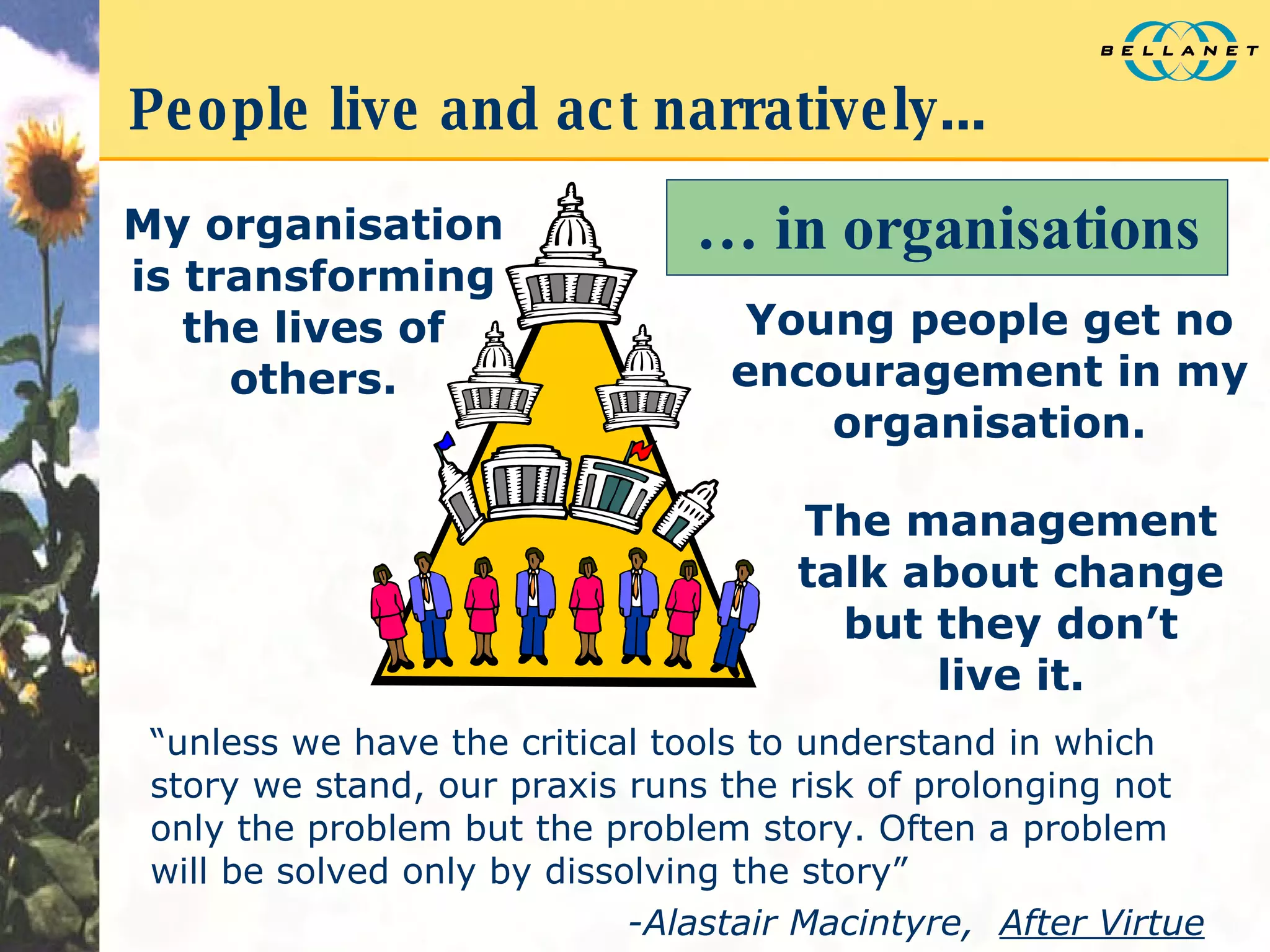
People live and act narratively... “ unless we have the critical tools to understand in which story we stand, our praxis runs the risk of prolonging not only the problem but the problem story. Often a problem will be solved only by dissolving the story” -Alastair Macintyre,  After Virtue …  in organisations My organisation is transforming the lives of others. The management talk about change but they don’t live it. Young people get no encouragement in my organisation.
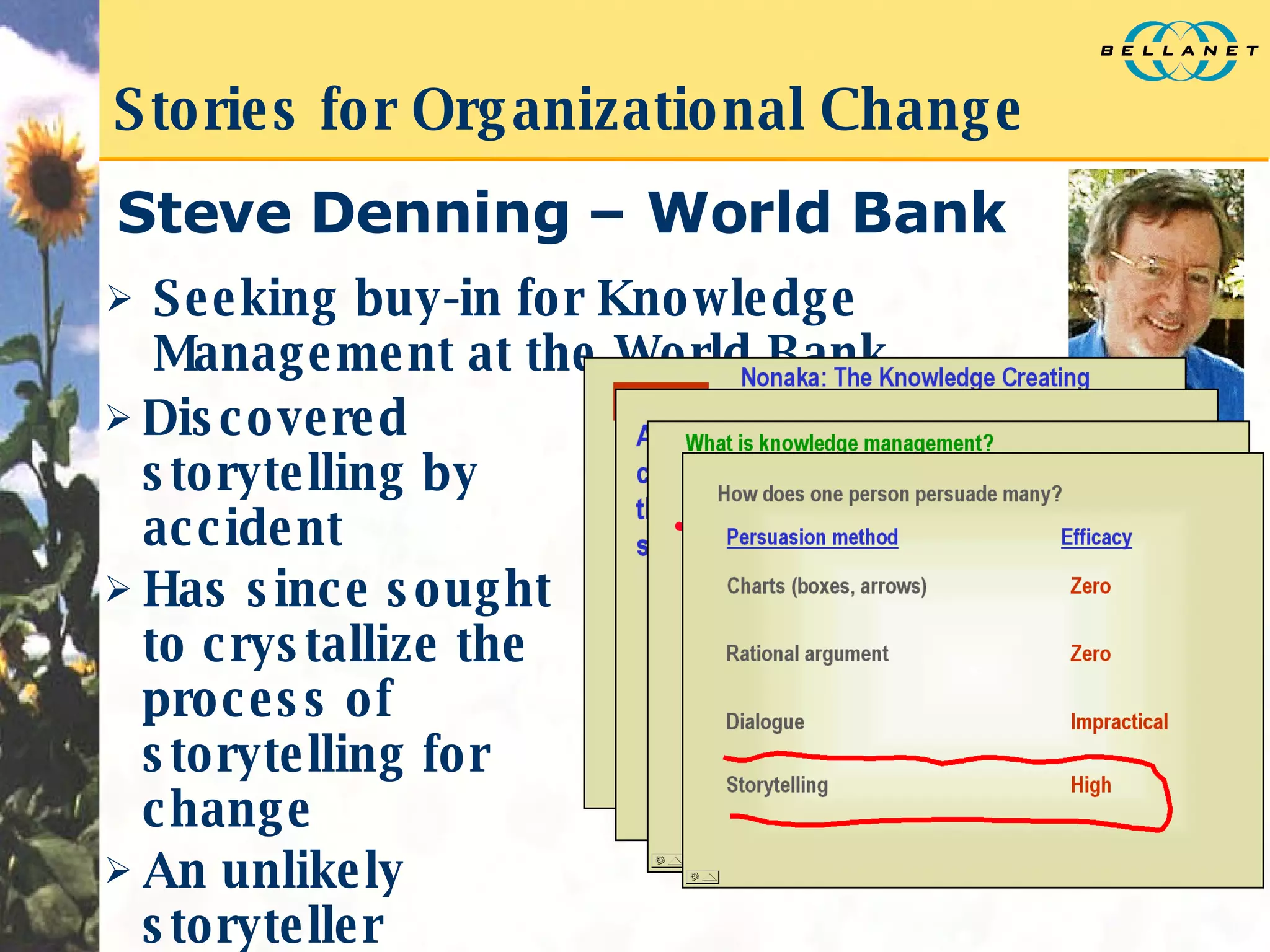
Stories for Organizational Change Seeking buy-in for Knowledge Management at the World Bank Steve Denning – World Bank Discovered storytelling by accident Has since sought to crystallize the process of storytelling for change An unlikely storyteller
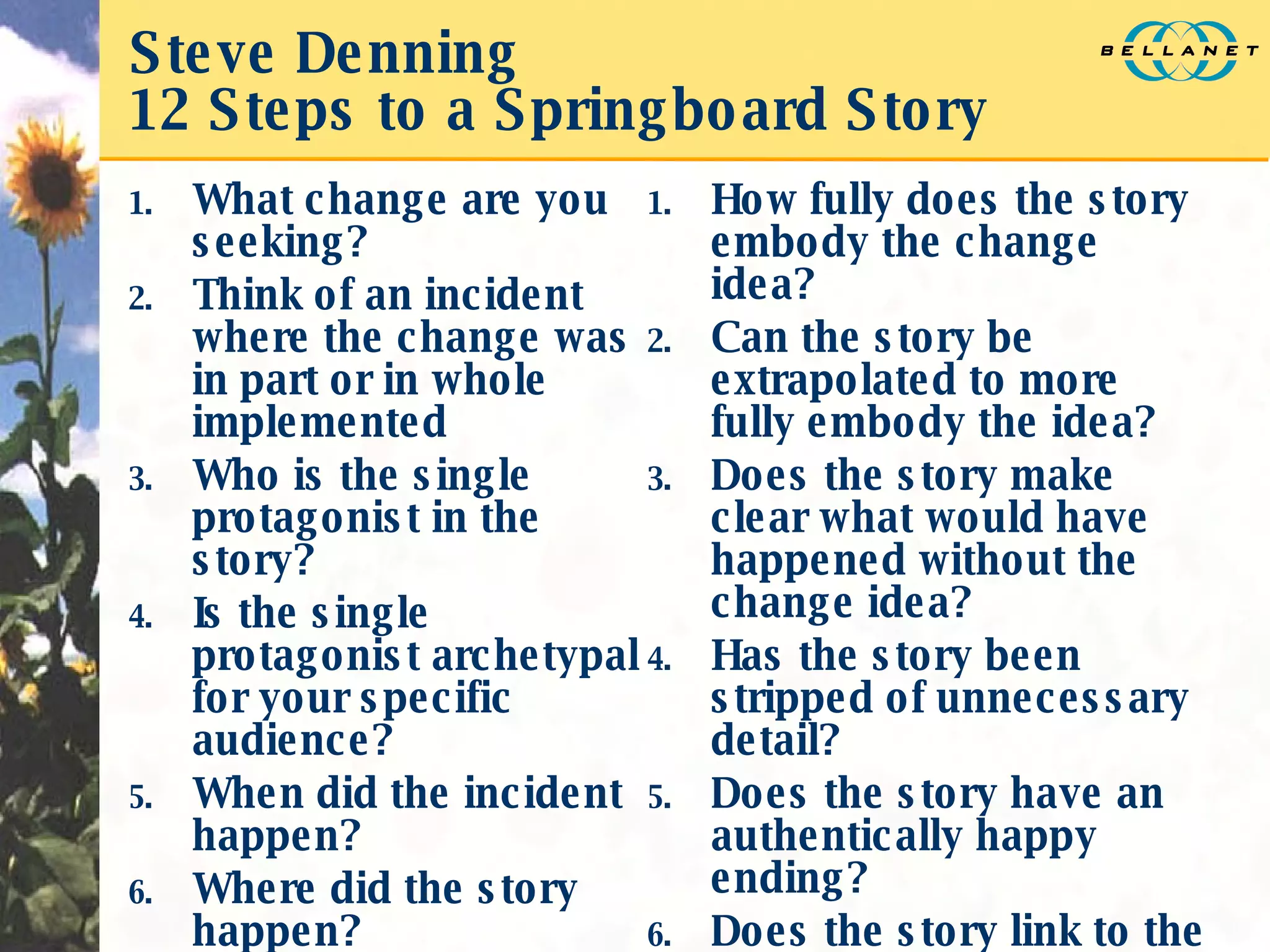
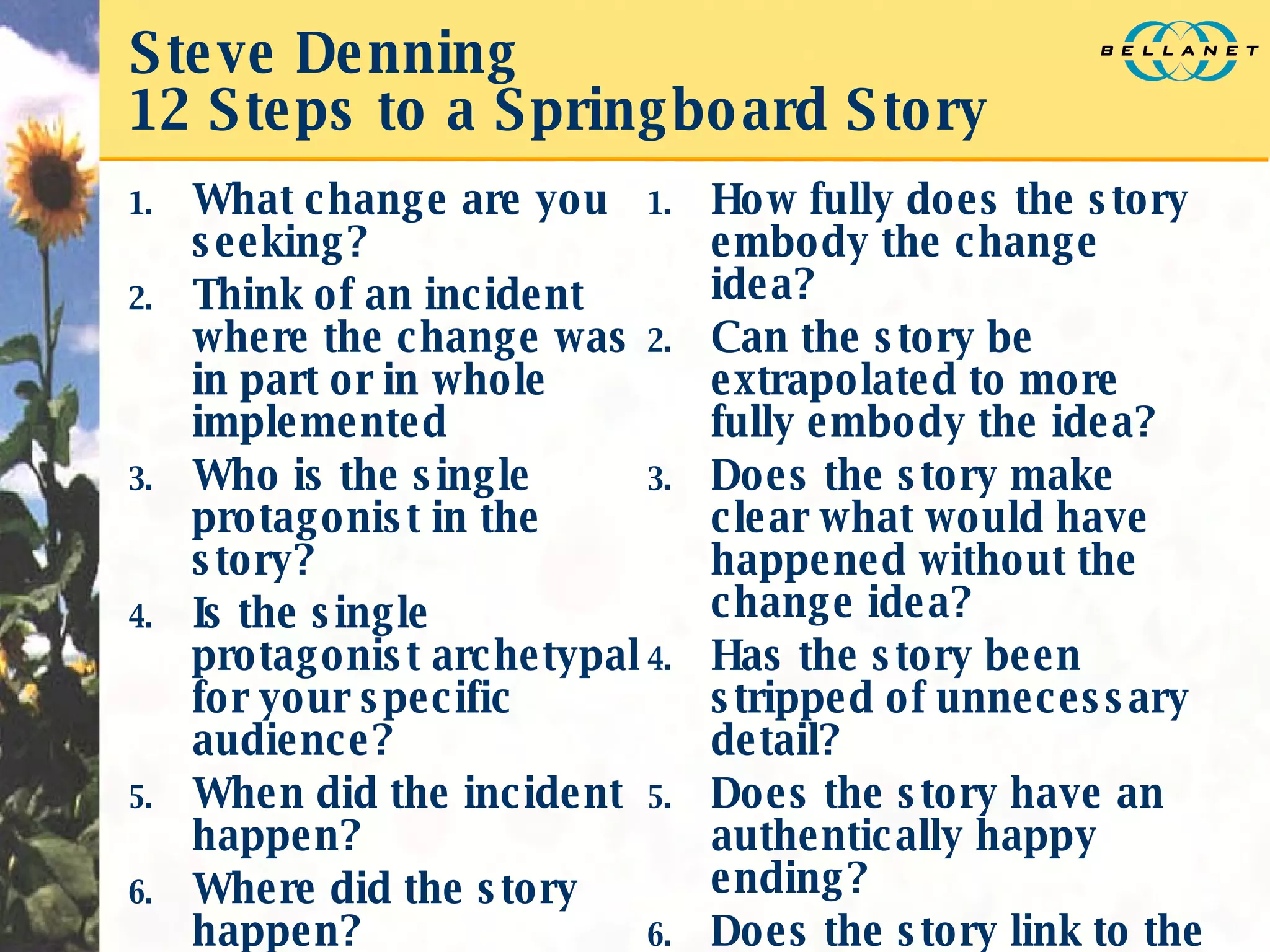
Steve Denning 12 Steps to a Springboard Story What change are you seeking? Think of an incident where the change was in part or in whole implemented Who is the single protagonist in the story? Is the single protagonist archetypal for your specific audience? When did the incident happen? Where did the story happen? How fully does the story embody the change idea? Can the story be extrapolated to more fully embody the idea? Does the story make clear what would have happened without the change idea? Has the story been stripped of unnecessary detail? Does the story have an authentically happy ending? Does the story link to the purpose to be achieved in telling it?
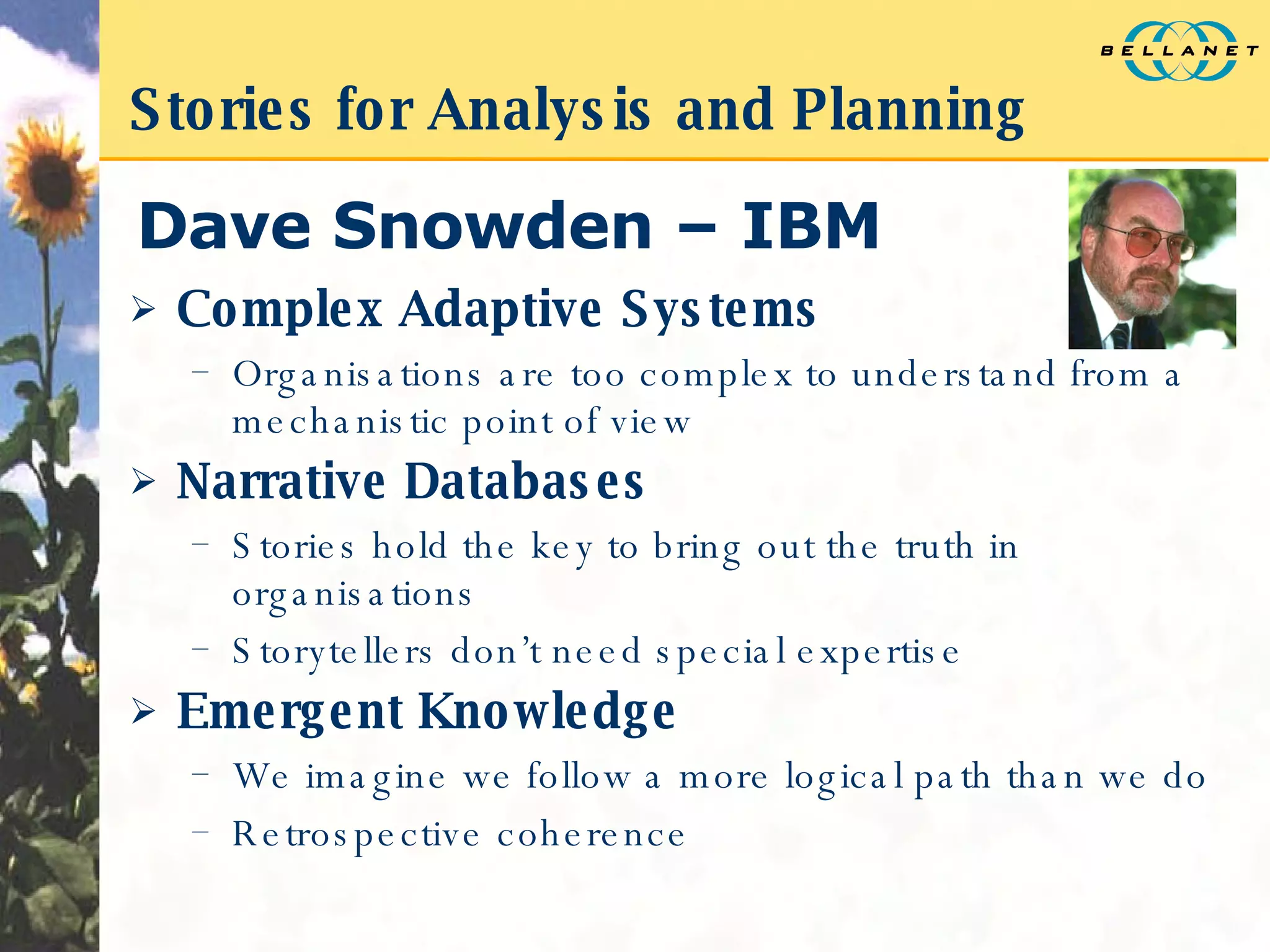
Stories for Analysis and Planning Dave Snowden – IBM Complex Adaptive Systems Organisations are too complex to understand from a mechanistic point of view Narrative Databases Stories hold the key to bring out the truth in organisations Storytellers don’t need special expertise Emergent Knowledge We imagine we follow a more logical path than we do Retrospective coherence
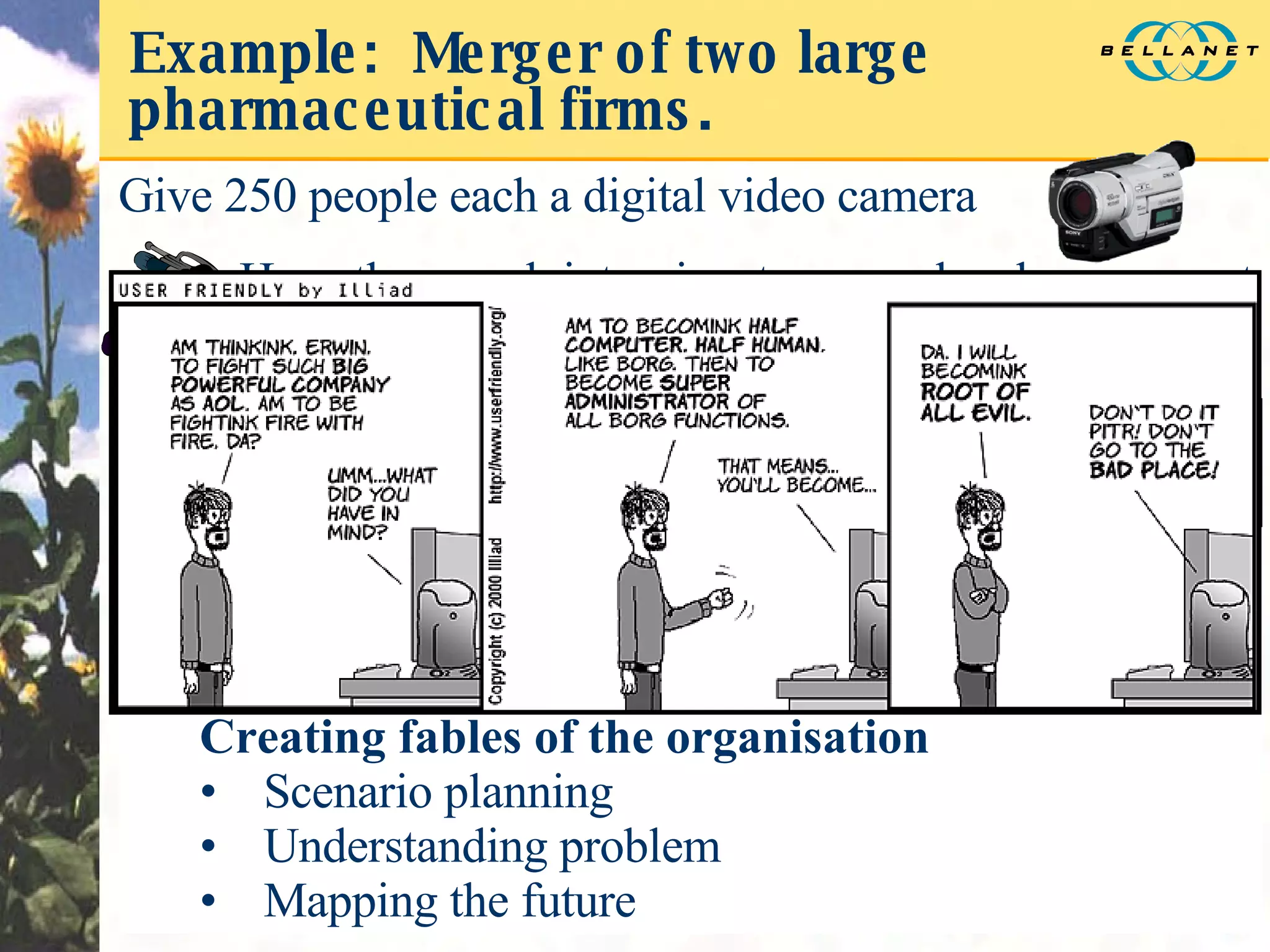
Example:  Merger of two large pharmaceutical firms. Ask questions like:  “Your daughter is an eco-activist. How do you convince her to work for your firm?” At a workshop, have staff watch random samplings of stories and bring out archetypal themes / characters. Have graphic artists render images of the archetypes. Creating fables of the organisation Scenario planning Understanding problem Mapping the future Give 250 people each a digital video camera Have them each interview two people who represent the future and the past of the organisation Capture the results in a narrative database containing video, audio, and text The Cynic The Young Idealist
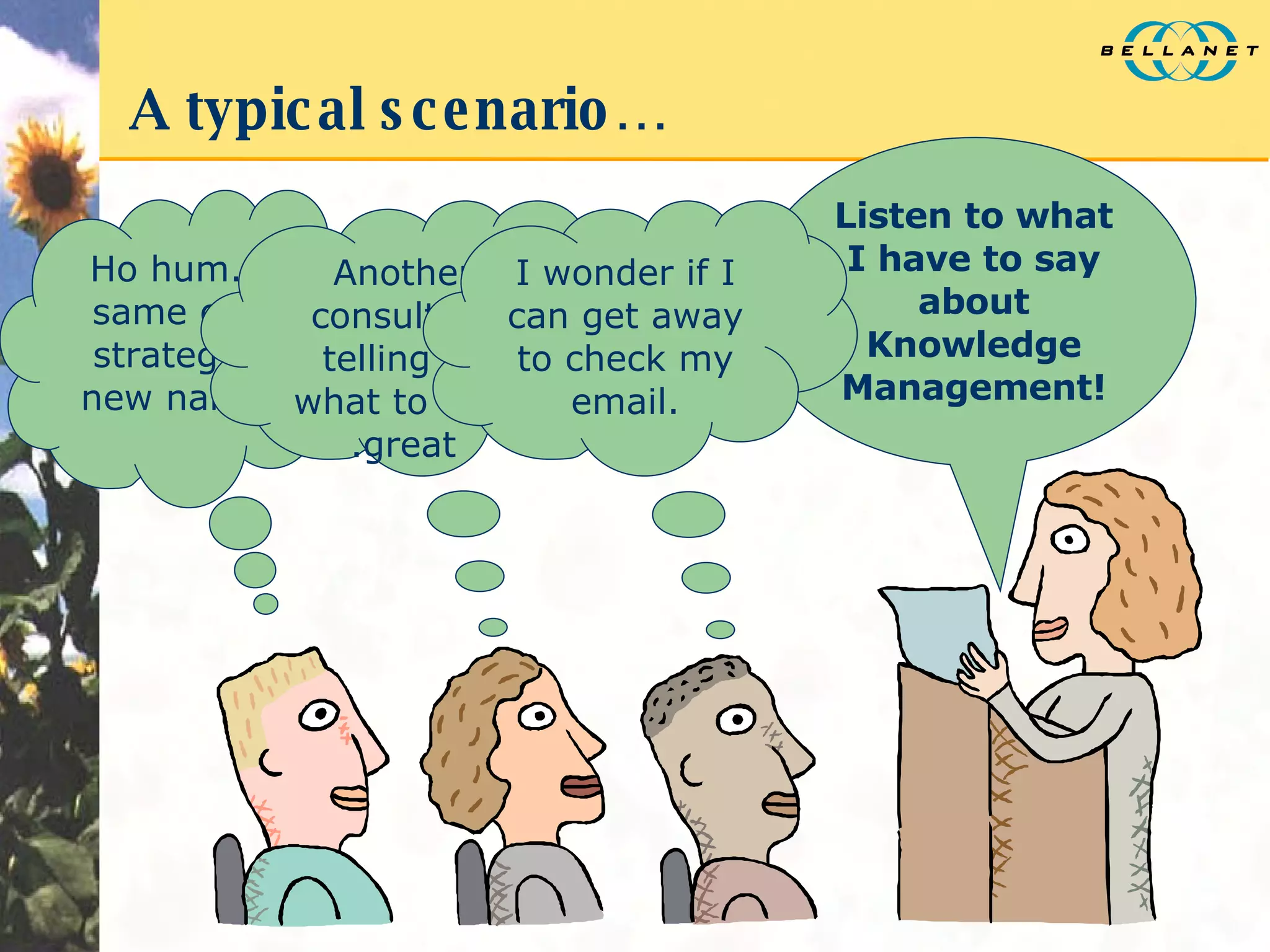
A typical scenario… Listen to what I have to say about Knowledge Management! Ho hum.. same old strategy, new name Another consultant telling us what to do….great I wonder if I can get away to check my email.
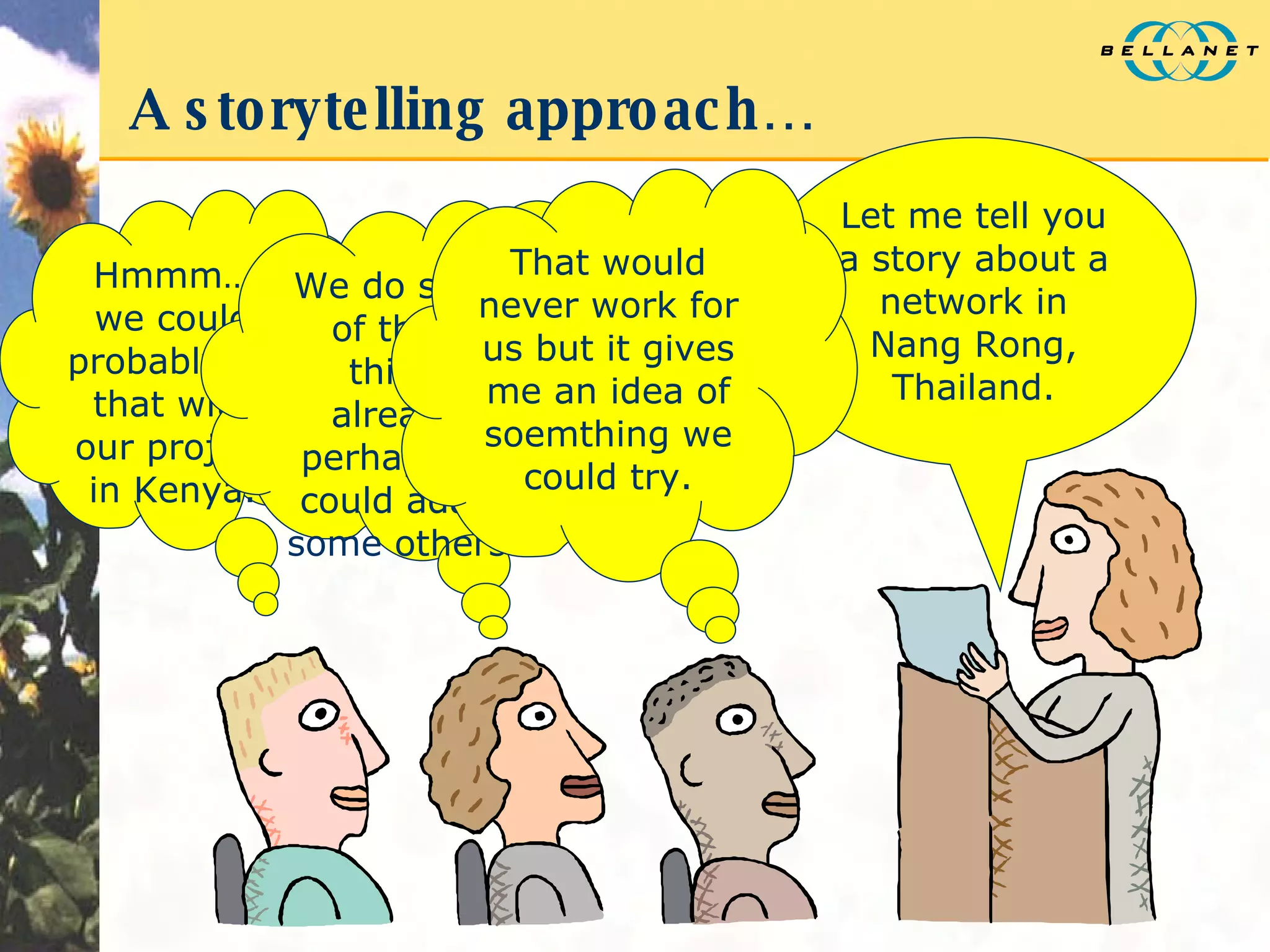
A storytelling approach… Let me tell you a story about a network in Nang Rong, Thailand. Hmmm… we could probably do that with our project in Kenya. We do some of those things already, perhaps we could adapt some others. That would never work for us but it gives me an idea of soemthing we could try.
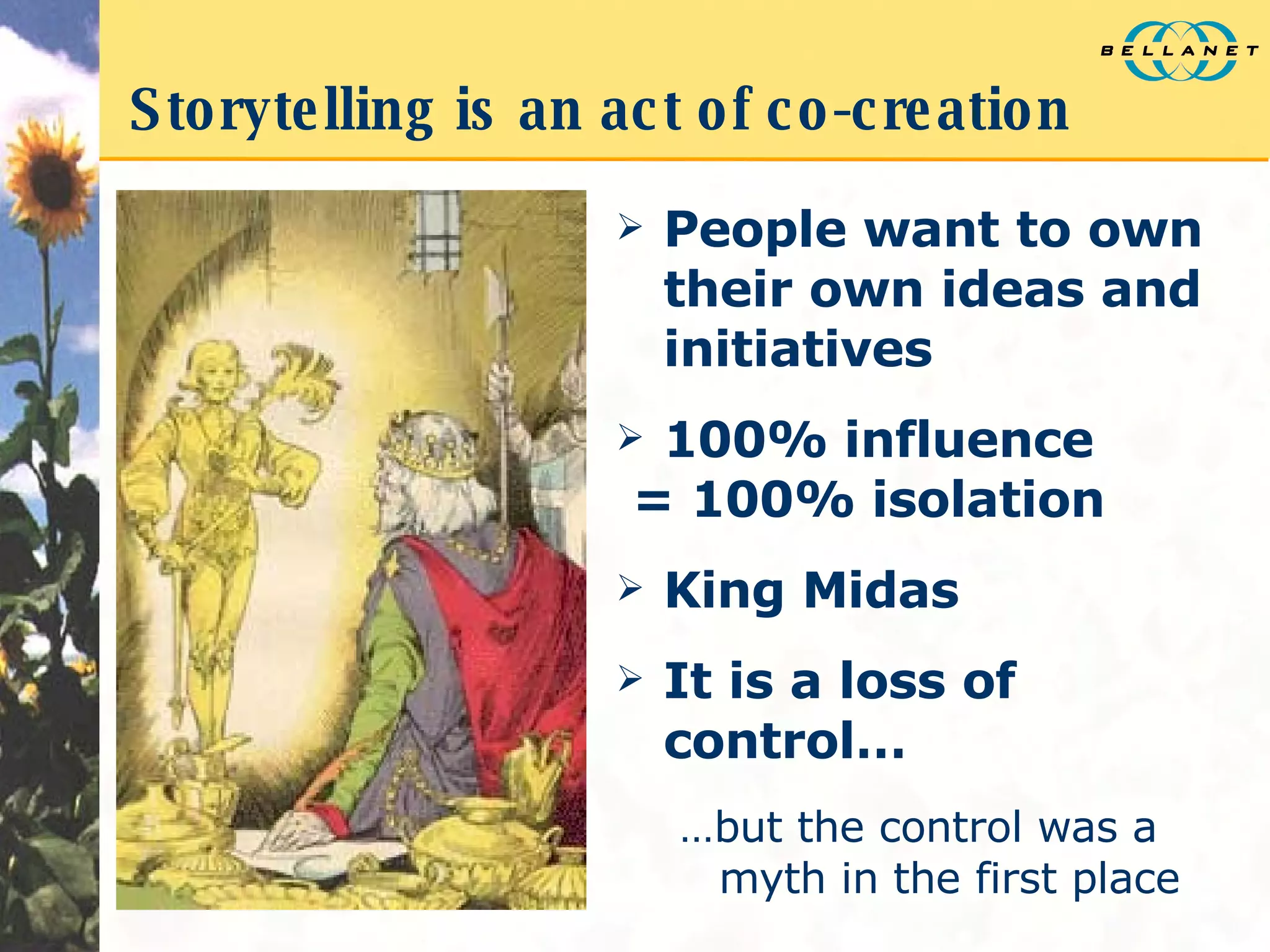
Storytelling is an act of co-creation People want to own their own ideas and initiatives 100% influence = 100% isolation  King Midas It is a loss of control… … but the control was a myth in the first place
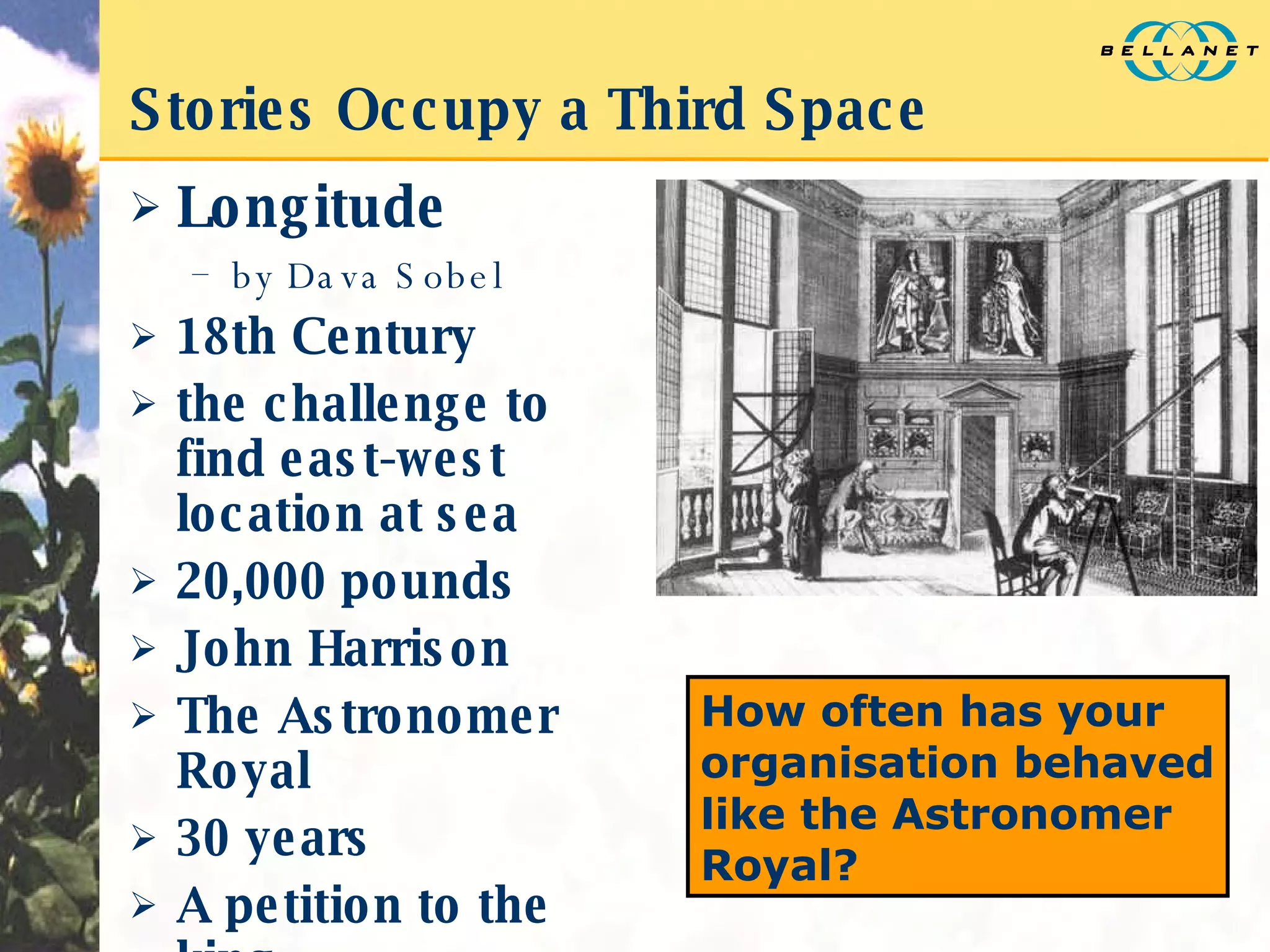
Stories Occupy a Third Space Longitude  by Dava Sobel 18th Century the challenge to find east-west location at sea 20,000 pounds John Harrison The Astronomer Royal 30 years A petition to the king How often has your organisation behaved like the Astronomer Royal?
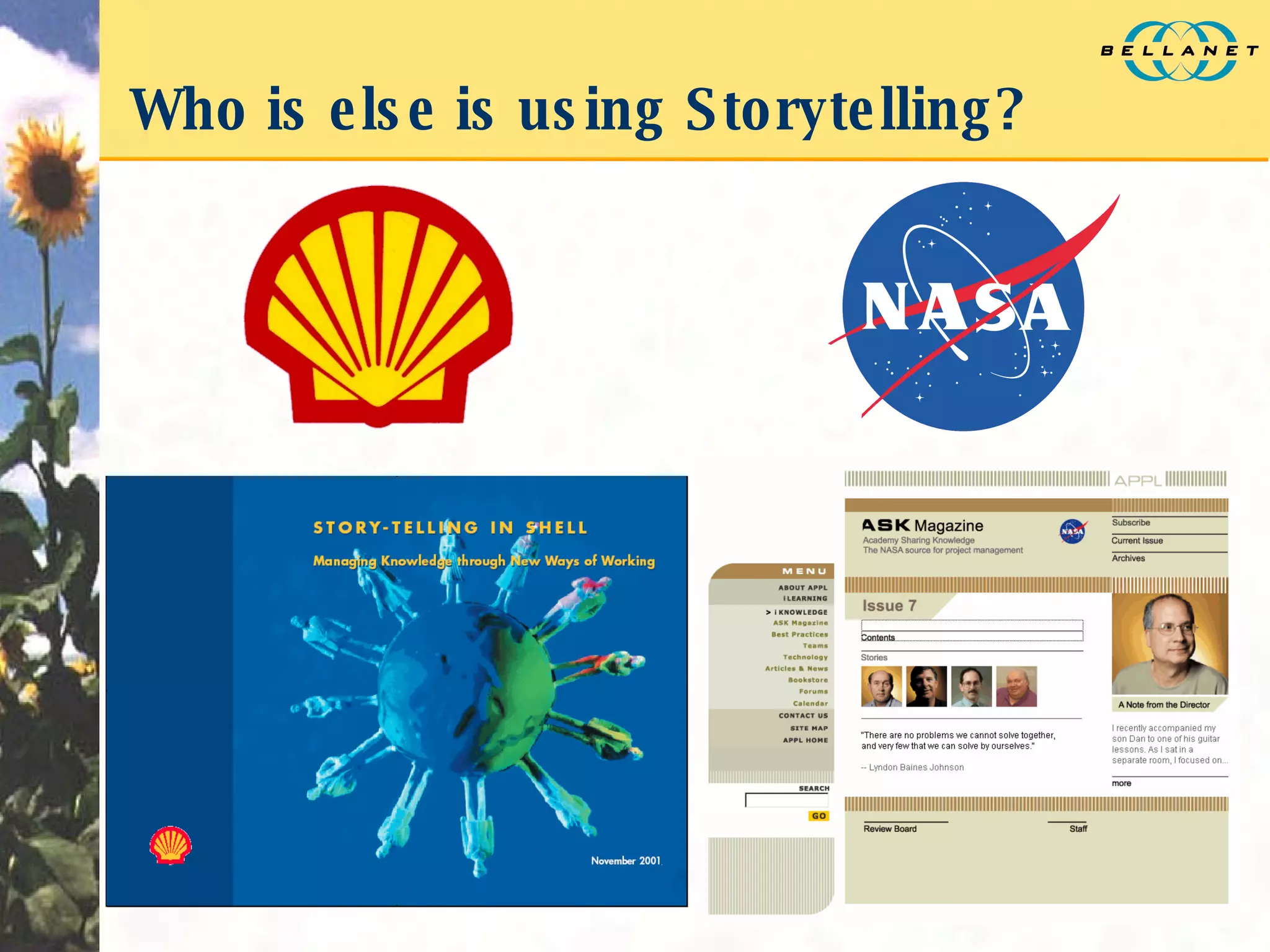
Who is else is using Storytelling?
Comments..  Questions…  Reactions…  Stories…
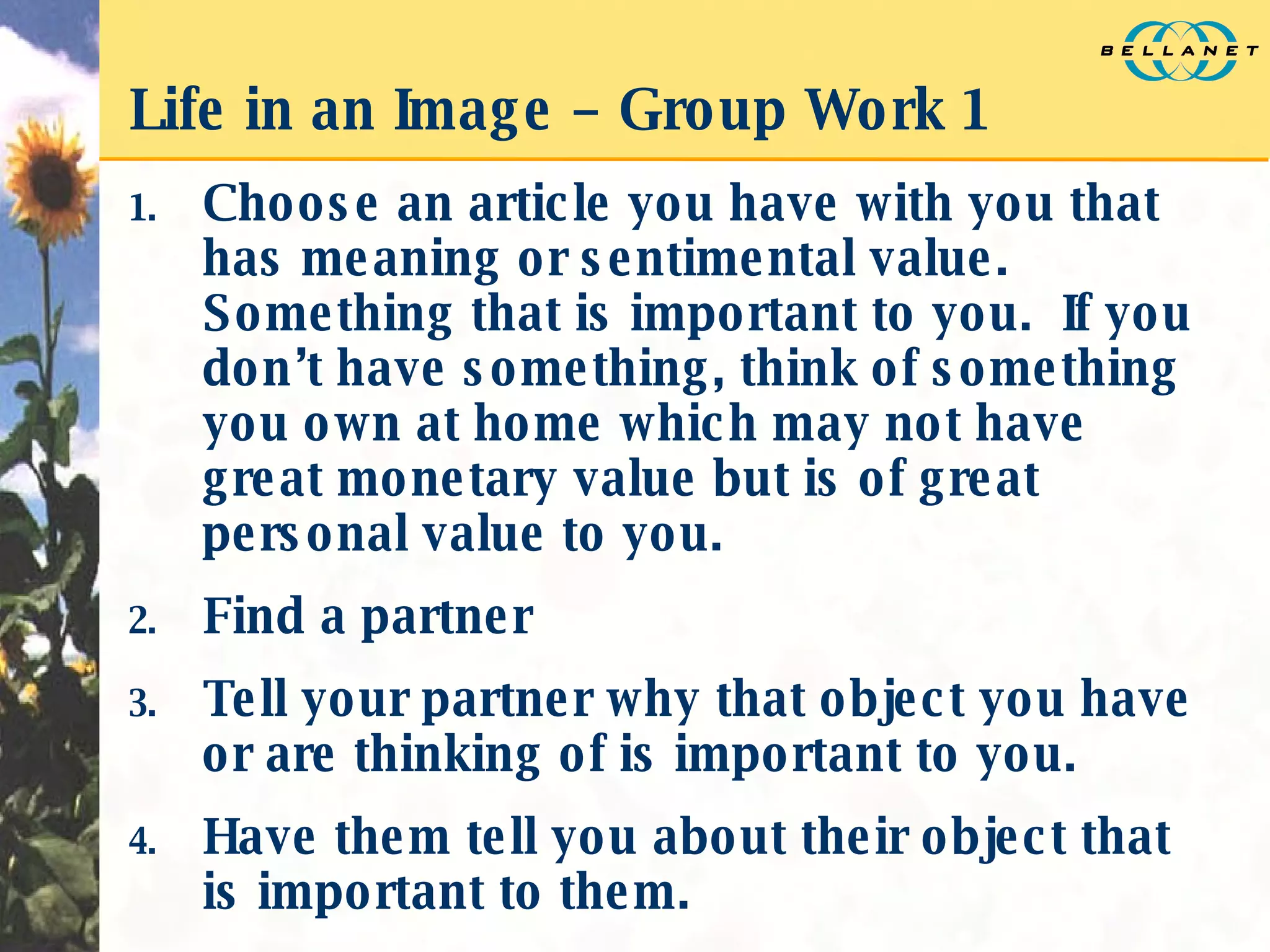
Life in an Image – Group Work 1 Choose an article you have with you that has meaning or sentimental value.  Something that is important to you.  If you don’t have something, think of something you own at home which may not have great monetary value but is of great personal value to you. Find a partner Tell your partner why that object you have or are thinking of is important to you. Have them tell you about their object that is important to them.
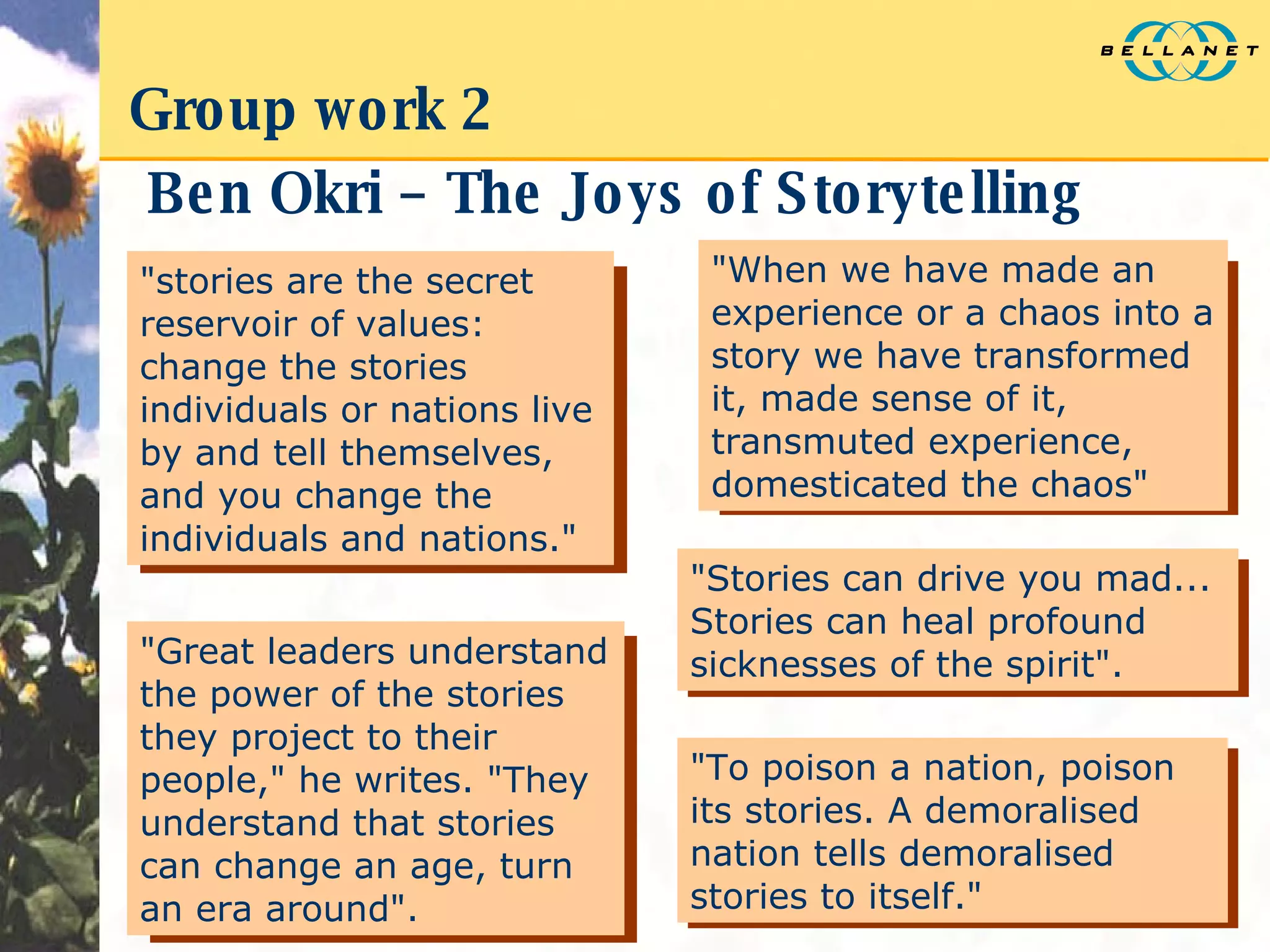
Group work 2 Ben Okri – The Joys of Storytelling "stories are the secret reservoir of values: change the stories individuals or nations live by and tell themselves, and you change the individuals and nations." "When we have made an experience or a chaos into a story we have transformed it, made sense of it, transmuted experience, domesticated the chaos"  "Great leaders understand the power of the stories they project to their people," he writes. "They understand that stories can change an age, turn an era around". "Stories can drive you mad... Stories can heal profound sicknesses of the spirit".  "To poison a nation, poison its stories. A demoralised nation tells demoralised stories to itself."
Steve Denning 12 Steps to a Springboard Story What change are you seeking? Think of an incident where the change was in part or in whole implemented Who is the single protagonist in the story? Is the single protagonist archetypal for your specific audience? When did the incident happen? Where did the story happen? How fully does the story embody the change idea? Can the story be extrapolated to more fully embody the idea? Does the story make clear what would have happened without the change idea? Has the story been stripped of unnecessary detail? Does the story have an authentically happy ending? Does the story link to the purpose to be achieved in telling it?

Storytelling and Knowledge Management

  • 1.
    Storytelling andNarrative The Role of Storytelling in Knowledge Sharing and Organisational Change 29-31 May 2002 KM Champions in Africa Knowledge Management Workshop Maputo, Mozambique
  • 2.
    Story.. a definitionStory n., pl. –rie A narration of a chain of events told or written in prose or verse
  • 3.
    People live andact narratively… … as individuals “ I am a respected professional” “ I am a mother” “ I am progressing in my career” “ I have been passed over” “ I am an important part of the organisation I work for” “ I am a faceless cog in a bureaucratic machine”
  • 4.
    People live andact narratively... Asteriod B-612 1909 International Astronomical Congress … with others The Turkish Astronomer … Grown-ups are like that
  • 5.
    People live andact narratively... “ unless we have the critical tools to understand in which story we stand, our praxis runs the risk of prolonging not only the problem but the problem story. Often a problem will be solved only by dissolving the story” -Alastair Macintyre, After Virtue … in organisations My organisation is transforming the lives of others. The management talk about change but they don’t live it. Young people get no encouragement in my organisation.
  • 6.
    Stories for OrganizationalChange Seeking buy-in for Knowledge Management at the World Bank Steve Denning – World Bank Discovered storytelling by accident Has since sought to crystallize the process of storytelling for change An unlikely storyteller
  • 7.
    Steve Denning 12Steps to a Springboard Story What change are you seeking? Think of an incident where the change was in part or in whole implemented Who is the single protagonist in the story? Is the single protagonist archetypal for your specific audience? When did the incident happen? Where did the story happen? How fully does the story embody the change idea? Can the story be extrapolated to more fully embody the idea? Does the story make clear what would have happened without the change idea? Has the story been stripped of unnecessary detail? Does the story have an authentically happy ending? Does the story link to the purpose to be achieved in telling it?
  • 8.
    Stories for Analysisand Planning Dave Snowden – IBM Complex Adaptive Systems Organisations are too complex to understand from a mechanistic point of view Narrative Databases Stories hold the key to bring out the truth in organisations Storytellers don’t need special expertise Emergent Knowledge We imagine we follow a more logical path than we do Retrospective coherence
  • 9.
    Example: Mergerof two large pharmaceutical firms. Ask questions like: “Your daughter is an eco-activist. How do you convince her to work for your firm?” At a workshop, have staff watch random samplings of stories and bring out archetypal themes / characters. Have graphic artists render images of the archetypes. Creating fables of the organisation Scenario planning Understanding problem Mapping the future Give 250 people each a digital video camera Have them each interview two people who represent the future and the past of the organisation Capture the results in a narrative database containing video, audio, and text The Cynic The Young Idealist
  • 10.
    A typical scenario…Listen to what I have to say about Knowledge Management! Ho hum.. same old strategy, new name Another consultant telling us what to do….great I wonder if I can get away to check my email.
  • 11.
    A storytelling approach…Let me tell you a story about a network in Nang Rong, Thailand. Hmmm… we could probably do that with our project in Kenya. We do some of those things already, perhaps we could adapt some others. That would never work for us but it gives me an idea of soemthing we could try.
  • 12.
    Storytelling is anact of co-creation People want to own their own ideas and initiatives 100% influence = 100% isolation King Midas It is a loss of control… … but the control was a myth in the first place
  • 13.
    Stories Occupy aThird Space Longitude by Dava Sobel 18th Century the challenge to find east-west location at sea 20,000 pounds John Harrison The Astronomer Royal 30 years A petition to the king How often has your organisation behaved like the Astronomer Royal?
  • 14.
    Who is elseis using Storytelling?
  • 15.
    Comments.. Questions… Reactions… Stories…
  • 16.
    Life in anImage – Group Work 1 Choose an article you have with you that has meaning or sentimental value. Something that is important to you. If you don’t have something, think of something you own at home which may not have great monetary value but is of great personal value to you. Find a partner Tell your partner why that object you have or are thinking of is important to you. Have them tell you about their object that is important to them.
  • 17.
    Group work 2Ben Okri – The Joys of Storytelling "stories are the secret reservoir of values: change the stories individuals or nations live by and tell themselves, and you change the individuals and nations." "When we have made an experience or a chaos into a story we have transformed it, made sense of it, transmuted experience, domesticated the chaos" "Great leaders understand the power of the stories they project to their people," he writes. "They understand that stories can change an age, turn an era around". "Stories can drive you mad... Stories can heal profound sicknesses of the spirit". "To poison a nation, poison its stories. A demoralised nation tells demoralised stories to itself."
  • 18.
    Steve Denning 12Steps to a Springboard Story What change are you seeking? Think of an incident where the change was in part or in whole implemented Who is the single protagonist in the story? Is the single protagonist archetypal for your specific audience? When did the incident happen? Where did the story happen? How fully does the story embody the change idea? Can the story be extrapolated to more fully embody the idea? Does the story make clear what would have happened without the change idea? Has the story been stripped of unnecessary detail? Does the story have an authentically happy ending? Does the story link to the purpose to be achieved in telling it?