Advertising effectiveness & budget
decision
Definition
Philip kotler
“Advertising is any paid form of non-personal and promotion of ideas,
goods or service through mass media by an identified sponsor.”
Advertising Association of the UK
“Advertising is a means of communication with the users of a product or service.
Advertisements are messages paid for by those who send them and are intended
to Inform or influence people who receive them.”
Objectives
 To inform
 To support the
company’s sales force
 To counter competitors’
advertising
 To ensure success of sales
promotion schemes
 To announce the change
 To expand the market
Types of Advertising
 Consumer Advertising
 National Advertising
 Retail (local) Advertising
 Co-operative Advertising
 End-product Advertising
 Direct-Response Advertising
 Classified Ads
Consumer Advertising National advertising
 Most of the consumer goods
produces engage in consumer
product what is consumer
advertising.
 It is done for the ultimate
user of the product.
 Done by using Radio, TV,
Newspapers, Magazines,
Direct mail, etc.
 Erg. Toothpaste, soap, cold
drinks etc.
 The mostly by the marketer
of Branded product or
services , sold through
different outlets in the
distribution channel,
wherever they may be
located.
 In reality this does not
necessarily mean that the
product is sold nationwide.
 E.g. McDonald, Tata, reliance
etc.
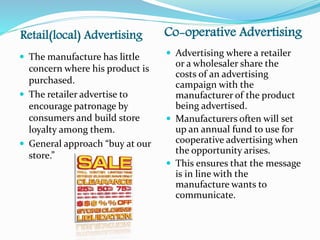
Retail(local) Advertising Co-operative Advertising
 The manufacture has little
concern where his product is
purchased.
 The retailer advertise to
encourage patronage by
consumers and build store
loyalty among them.
 General approach “buy at our
store.”
 Advertising where a retailer
or a wholesaler share the
costs of an advertising
campaign with the
manufacturer of the product
being advertised.
 Manufacturers often will set
up an annual fund to use for
cooperative advertising when
the opportunity arises.
 This ensures that the message
is in line with the
manufacture wants to
communicate.
End product Advertising Direct –response Advertising
 There are many products that
are rarely purchased direct by
consumers. They are usually
bought as part or ingredient in
other products.
 example, there is Teflon
(DuPont product), Pentium
(Intel Corporation’s computer
processor chip),
 NutraSweet and Canderel, a
brand name for the artificial
sweetener Aspartame in the
food industry (Coca-Cola light)
 This type of advertising
encourages the consumer to
respond either by providing
feedback to the advertising or
placing the order with the
advertiser either by
telephone, mail, or the
internet.
Classified Ads
 These are arranges under subheads that’s describe the
class of goods or the needs, ads seek to satisfy.
 E.g. real estate, coaching, employment, and business
opportunities etc.
Advertising Media Decisions
1. Print Media
 Advertising in
newspaper, magazines
etc., can called print
media.
 Print media is also an
important sources of
finance for the print and
press media.
Electronic media Outdoor media
 Radio
 Television
 Cinema
 Internet
 Audio-video CDs
 Posters
 Sign boards
 Vehicular
 Wall writing
 Sandwich man
 Sky advertising
 Bill board displys
Direct mail advertising Other media
 Sales letters
 Circular letters
 Booklets and catalogues
 Brochures‘
 folders
 Specialty advertising
 Directories
 Loudspeakers
Factors influencing advertising media decision
 The objective of advertising
 Nature of the market
 Nature of the product
 nature of message
 Media cost
 Media used by the competitors
 Media availability
 Characteristics of buyers
 Size and nature of business enterprise
 Image of the media
Measurement of Advertising Effectiveness
Why test? Advertising is an investment by the
organization. It should be measured the effectiveness:
1. To determine that to what extent advertising
campaign has achieved its objectives.
2. to determine the effectiveness of various ad copies
to ascertain out of which one will be the best.
3. To determine relative strengths and weaknesses of
various media.
What to Measure?
 1.Message: The headline, its illustration, the body text,
the layout and the typography can be tested for
message appeal.
 Media: It includes the various types of media, the size
of space and duration in case of electronic media.
 Timing: advertising timing, frequency of
advertisement and continuity can be tested.
When to test?
Testing of advertising may take place at any stage of
advertising process from the planning stage to
execution.
If an attempt is made to measure the effectiveness of a
campaign before it has run, it is known as pre-testing.
Testing after advertising campaign has launched to
measure its effectiveness is called post-testing.
DAGMAR Approach
Developed by Rassell colley stands for Defining
advertising goal for measured advertising results.
Awareness
Comprehension
conviction
Action
Budget
 objective and task method
 % on sale
 Unit of sale
 Competitive spending
 Quantitative methods
 Affordable method
 Arbitrary method

Advertising effectiveness

  • 1.
  • 2.
    Definition Philip kotler “Advertising isany paid form of non-personal and promotion of ideas, goods or service through mass media by an identified sponsor.” Advertising Association of the UK “Advertising is a means of communication with the users of a product or service. Advertisements are messages paid for by those who send them and are intended to Inform or influence people who receive them.”
  • 3.
    Objectives  To inform To support the company’s sales force  To counter competitors’ advertising  To ensure success of sales promotion schemes  To announce the change  To expand the market
  • 4.
    Types of Advertising Consumer Advertising  National Advertising  Retail (local) Advertising  Co-operative Advertising  End-product Advertising  Direct-Response Advertising  Classified Ads
  • 5.
    Consumer Advertising Nationaladvertising  Most of the consumer goods produces engage in consumer product what is consumer advertising.  It is done for the ultimate user of the product.  Done by using Radio, TV, Newspapers, Magazines, Direct mail, etc.  Erg. Toothpaste, soap, cold drinks etc.  The mostly by the marketer of Branded product or services , sold through different outlets in the distribution channel, wherever they may be located.  In reality this does not necessarily mean that the product is sold nationwide.  E.g. McDonald, Tata, reliance etc.
  • 6.
    Retail(local) Advertising Co-operativeAdvertising  The manufacture has little concern where his product is purchased.  The retailer advertise to encourage patronage by consumers and build store loyalty among them.  General approach “buy at our store.”  Advertising where a retailer or a wholesaler share the costs of an advertising campaign with the manufacturer of the product being advertised.  Manufacturers often will set up an annual fund to use for cooperative advertising when the opportunity arises.  This ensures that the message is in line with the manufacture wants to communicate.
  • 7.
    End product AdvertisingDirect –response Advertising  There are many products that are rarely purchased direct by consumers. They are usually bought as part or ingredient in other products.  example, there is Teflon (DuPont product), Pentium (Intel Corporation’s computer processor chip),  NutraSweet and Canderel, a brand name for the artificial sweetener Aspartame in the food industry (Coca-Cola light)  This type of advertising encourages the consumer to respond either by providing feedback to the advertising or placing the order with the advertiser either by telephone, mail, or the internet.
  • 8.
    Classified Ads  Theseare arranges under subheads that’s describe the class of goods or the needs, ads seek to satisfy.  E.g. real estate, coaching, employment, and business opportunities etc.
  • 9.
    Advertising Media Decisions 1.Print Media  Advertising in newspaper, magazines etc., can called print media.  Print media is also an important sources of finance for the print and press media.
  • 10.
    Electronic media Outdoormedia  Radio  Television  Cinema  Internet  Audio-video CDs  Posters  Sign boards  Vehicular  Wall writing  Sandwich man  Sky advertising  Bill board displys
  • 11.
    Direct mail advertisingOther media  Sales letters  Circular letters  Booklets and catalogues  Brochures‘  folders  Specialty advertising  Directories  Loudspeakers
  • 12.
    Factors influencing advertisingmedia decision  The objective of advertising  Nature of the market  Nature of the product  nature of message  Media cost  Media used by the competitors  Media availability  Characteristics of buyers  Size and nature of business enterprise  Image of the media
  • 13.
    Measurement of AdvertisingEffectiveness Why test? Advertising is an investment by the organization. It should be measured the effectiveness: 1. To determine that to what extent advertising campaign has achieved its objectives. 2. to determine the effectiveness of various ad copies to ascertain out of which one will be the best. 3. To determine relative strengths and weaknesses of various media.
  • 14.
    What to Measure? 1.Message: The headline, its illustration, the body text, the layout and the typography can be tested for message appeal.  Media: It includes the various types of media, the size of space and duration in case of electronic media.  Timing: advertising timing, frequency of advertisement and continuity can be tested.
  • 15.
    When to test? Testingof advertising may take place at any stage of advertising process from the planning stage to execution. If an attempt is made to measure the effectiveness of a campaign before it has run, it is known as pre-testing. Testing after advertising campaign has launched to measure its effectiveness is called post-testing.
  • 16.
    DAGMAR Approach Developed byRassell colley stands for Defining advertising goal for measured advertising results. Awareness Comprehension conviction Action
  • 17.
    Budget  objective andtask method  % on sale  Unit of sale  Competitive spending  Quantitative methods  Affordable method  Arbitrary method