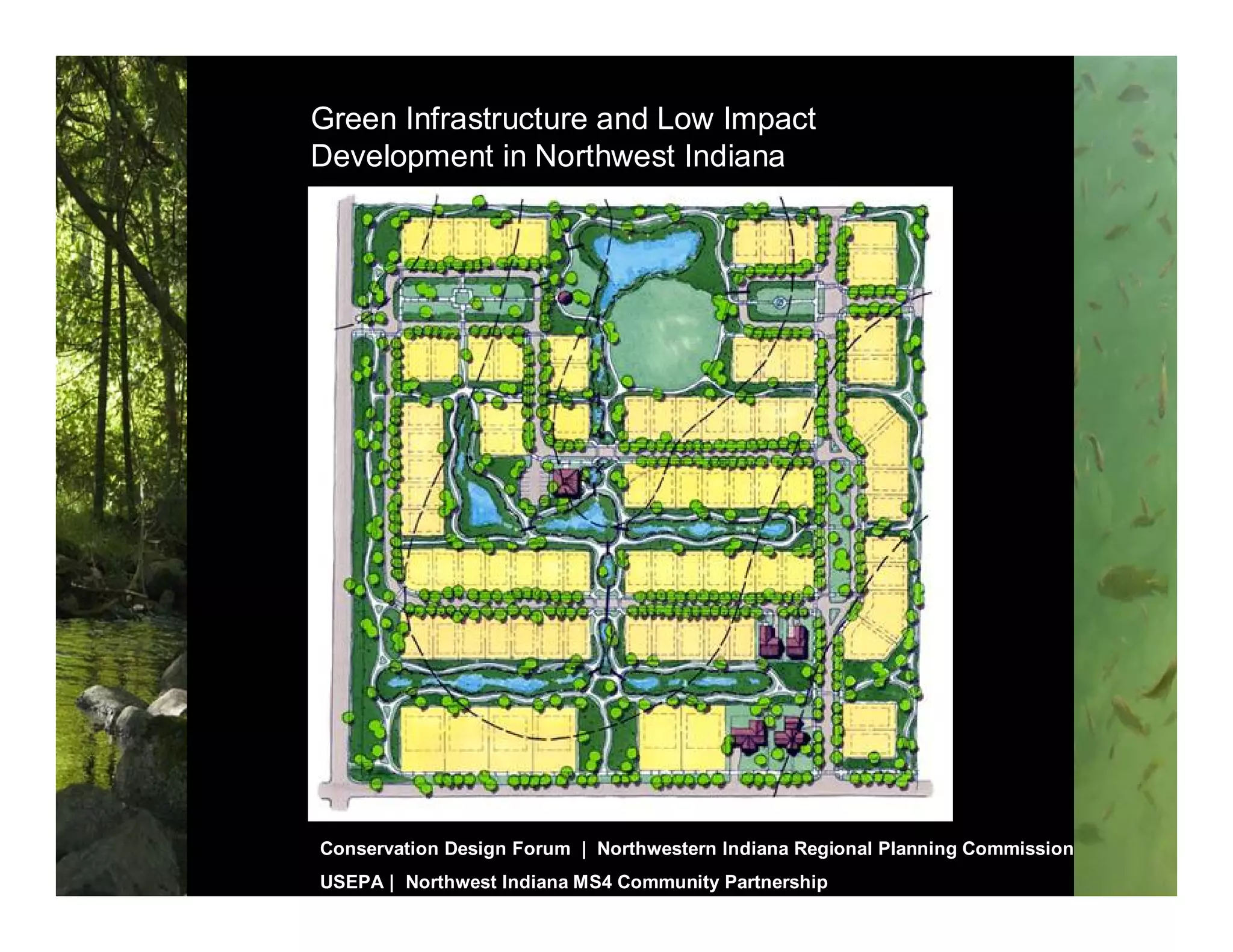
Green Infrastructure and Low Impact
Development in Northwest Indiana


Conservation Design Forum | Northwestern Indiana Regional Planning Commission
USEPA | Northwest Indiana MS4 Community Partnership
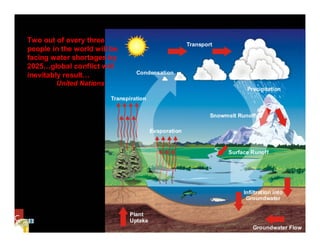
Two out of every three
people in the world will be
facing water shortages by
2025…global conflict will
inevitably result…
        United Nations
Low Impact Development is a planning approach that

                 •   concentrates site development on areas least
                     sensitive to disturbance
                 •   uses distributed, on-site stormwater best
                     management practices (BMPs) to emulate natural
                     hydrology, reduce runoff, and improve water quality.
                 •   BMPs can be simple, nonstructural, low-tech, and
                     low cost (e.g., vegetation), more complex when
                     necessary
                 •   helps address: wet weather flows, Combined Sewer
                     Overflows, National Pollutant Discharge Elimination
                     System permits, Total Maximum Daily Load permits,
                     and Nonpoint Source Pollution Program goals.
                 •   can be applied to almost any element of the
                     developed landscape—buildings, yards, driveways,
                     roads, walkways, open
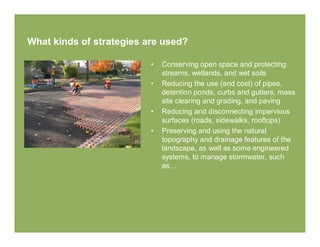
What kinds of strategies are used?

                          •   Conserving open space and protecting
                              streams, wetlands, and wet soils
                          •   Reducing the use (and cost) of pipes,
                              detention ponds, curbs and gutters, mass
                              site clearing and grading, and paving
                          •   Reducing and disconnecting impervious
                              surfaces (roads, sidewalks, rooftops)
                          •   Preserving and using the natural
                              topography and drainage features of the
                              landscape, as well as some engineered
                              systems, to manage stormwater, such
                              as…
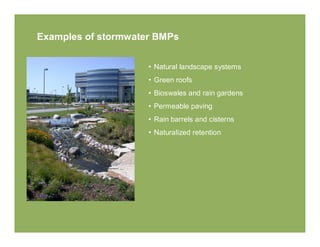
Examples of stormwater BMPs


                     • Natural landscape systems
                     • Green roofs
                     • Bioswales and rain gardens
                     • Permeable paving
                     • Rain barrels and cisterns
                     • Naturalized retention
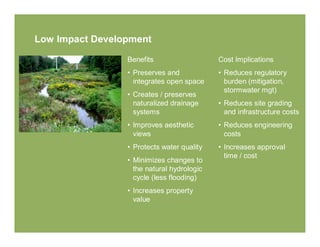
Low Impact Development

                 Benefits                   Cost Implications
                 • Preserves and            • Reduces regulatory
                   integrates open space      burden (mitigation,
                                              stormwater mgt)
                 • Creates / preserves
                   naturalized drainage     • Reduces site grading
                   systems                    and infrastructure costs
                 • Improves aesthetic       • Reduces engineering
                   views                      costs
                 • Protects water quality   • Increases approval
                                              time / cost
                 • Minimizes changes to
                   the natural hydrologic
                   cycle (less flooding)
                 • Increases property
                   value
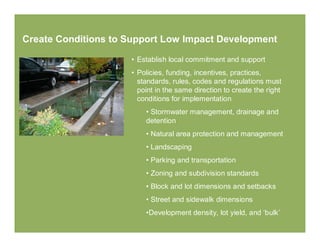
Create Conditions to Support Low Impact Development

                     • Establish local commitment and support
                     • Policies, funding, incentives, practices,
                       standards, rules, codes and regulations must
                       point in the same direction to create the right
                       conditions for implementation
                         • Stormwater management, drainage and
                         detention
                         • Natural area protection and management
                         • Landscaping
                         • Parking and transportation
                         • Zoning and subdivision standards
                         • Block and lot dimensions and setbacks
                         • Street and sidewalk dimensions
                         •Development density, lot yield, and ‘bulk’
How are these practices integrated into development?


                   Site Design
Site Design “First Principles”

•    Identify and protect natural features and open
     space early
•    Use site topography and natural drainage patterns
     to guide site layout and stormwater management
•    Use the natural landscape and engineered,
     naturalized drainage and detention BMPs to filter
     and infiltrate stormwater on site
•    Reduce the impervious area of development
•    Allow flexibility in lot size, street, block, and lot
     layout
•    Calculate site yield based on developable space—
     the total site area minus floodplains, wetlands,
     waterways, steep slopes, natural areas…
•    Concentrate built areas in a range of lot sizes and
     orientations to create views, privacy, and amenities
     for each home
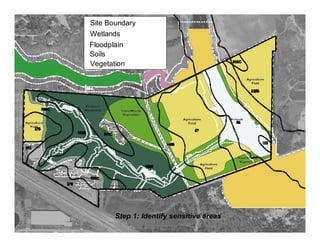
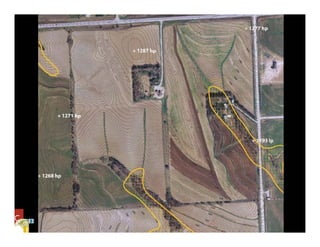
Site Boundary
Wetlands
Floodplain
Soils
Vegetation


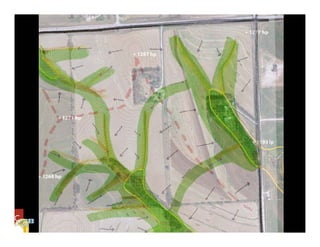
       Step 1: Identify sensitive areas
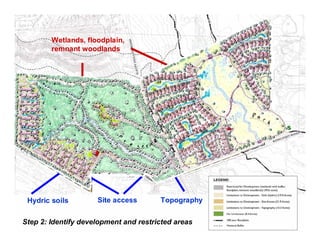
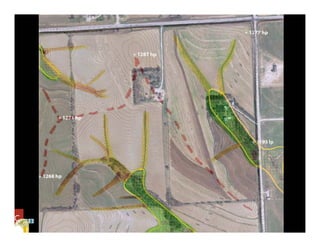
Wetlands, floodplain,
        remnant woodlands


                                                    No limitations


 Hydric soils        Site access       Topography


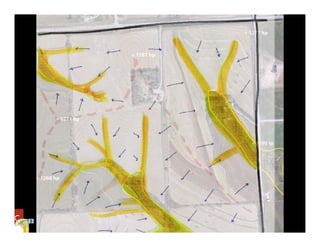
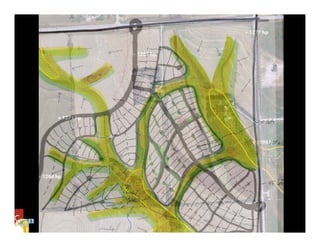
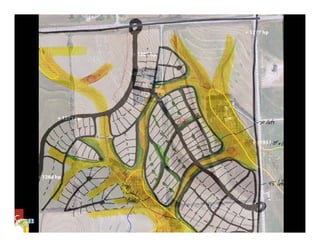
Step 2: Identify development and restricted areas
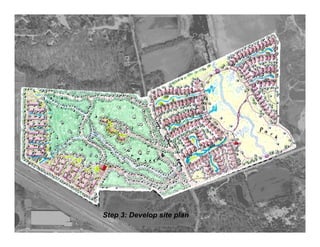
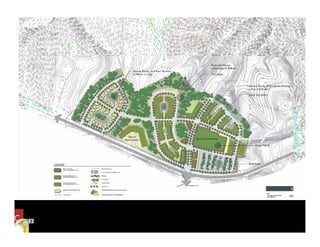
Step 3: Develop site plan
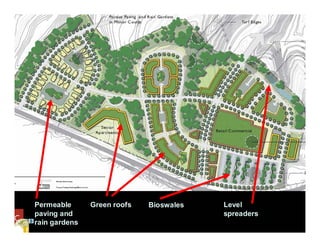
Permeable      Green roofs   Bioswales   Level
paving and                               spreaders
rain gardens
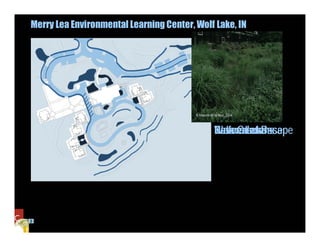
Merry Lea Environmental Learning Center, Wolf Lake, IN


                                             Water Landscape
                                             Rain Gardens
                                             Bioswales
                                             Pavement Base
                                             Native reuse
Conservation Design Templates


         Moderate-Density Residential
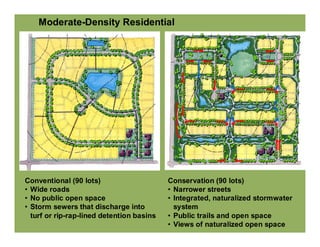
Moderate-Density Residential


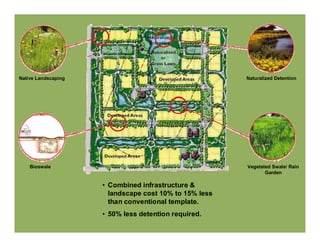
Conventional (90 lots)                     Conservation (90 lots)
• Wide roads                               • Narrower streets
• No public open space                     • Integrated, naturalized stormwater
• Storm sewers that discharge into           system
  turf or rip-rap-lined detention basins   • Public trails and open space
                                           • Views of naturalized open space
Native Landscaping                                      Naturalized Detention


    Bioswale                                            Vegetated Swale/ Rain
                                                               Garden

                     • Combined infrastructure &
                       landscape cost 10% to 15% less
                       than conventional template.
                     • 50% less detention required.
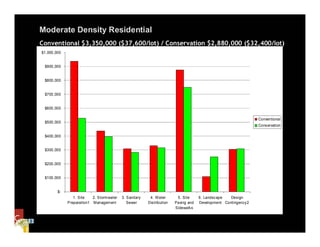
Moderate Density Residential
Conventional $3,350,000 ($37,600/lot) / Conservation $2,880,000 ($32,400/lot)
$1,000,000


 $900,000


 $800,000


 $700,000


 $600,000

                                                                                                               Conventional
 $500,000
                                                                                                               Conservation

 $400,000


 $300,000


 $200,000


 $100,000


        $-
                1. Site   2. Stormwater   3. Sanitary    4. Water       5. Site     6. Landscape   Design
             Preparation1 Management         Sewer      Distribution   Paving and   Development Contingency2
                                                                       Sidewalks
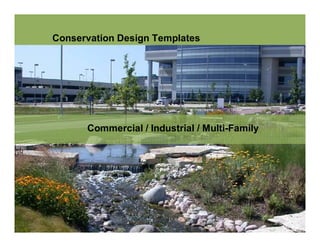
Conservation Design Templates


      Commercial / Industrial / Multi-Family
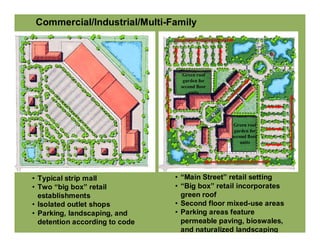
Commercial/Industrial/Multi-Family


                                  Green roof
                                  garden for
                                 second floor
                                    units


                                                 Green roof
                                                 garden for
                                                second floor
                                                   units


• Typical strip mall            • “Main Street” retail setting
• Two “big box” retail          • “Big box” retail incorporates
  establishments                  green roof
• Isolated outlet shops         • Second floor mixed-use areas
• Parking, landscaping, and     • Parking areas feature
  detention according to code     permeable paving, bioswales,
                                  and naturalized landscaping
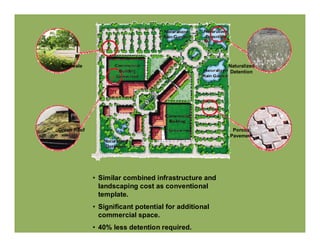
Bioswale                                             Naturalized
                                                       Detention


Green Roof                                             Porous
                                                      Pavement


             • Similar combined infrastructure and
               landscaping cost as conventional
               template.
             • Significant potential for additional
               commercial space.
             • 40% less detention required.
Conservation Design Templates


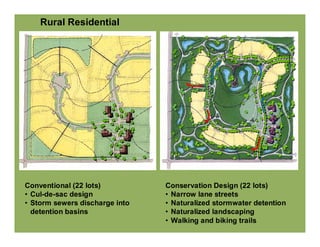
             Rural Residential
Rural Residential


Conventional (22 lots)          Conservation Design (22 lots)
• Cul-de-sac design             • Narrow lane streets
• Storm sewers discharge into   • Naturalized stormwater detention
  detention basins              • Naturalized landscaping
                                • Walking and biking trails
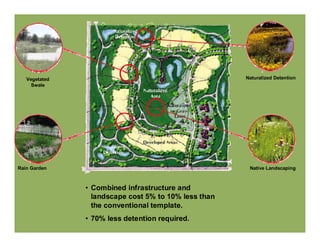
Vegetated                                          Naturalized Detention
     Swale


Rain Garden                                            Native Landscaping


               • Combined infrastructure and
                 landscape cost 5% to 10% less than
                 the conventional template.
               • 70% less detention required.
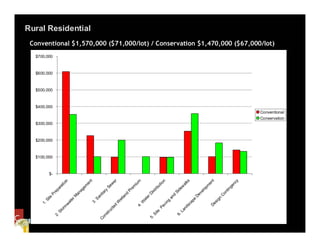
Rural Residential
 Conventional $1,570,000 ($71,000/lot) / Conservation $1,470,000 ($67,000/lot)
  $700,000


  $600,000


  $500,000


  $400,000
                                                                                                                                                                     Conventional
                                                                                                                                                                     Conservation
  $300,000


  $200,000


  $100,000


         $-

                                                                                                                           ks


                                                                                                                                                                 y
                     n


                                       t


                                                                                                        n


                                                                                                                                             t
                                                                                  m
                                                         er
                                   en


                                                                                                                                            en


                                                                                                                                                               nc
                   io


                                                                                                   tio
                                                                               iu
                                                        w


                                                                                                                         al
                 at


                                  em


                                                                                                                                         m


                                                                                                                                                              ge
                                                     Se


                                                                          m


                                                                                                    u


                                                                                                                     w
               ar


                                                                                                rib


                                                                                                                                      op
                                                                           e


                                                                                                                   de


                                                                                                                                                         tin
                              ag
              ep


                                                                        Pr
                                                ry


                                                                                             st


                                                                                                                                        l
                                                                                                                                     ve
                                                                                                                 Si


                                                                                                                                                          n
                             an


                                                ta


                                                                                           Di
         Pr


                                                                   d


                                                                                                                                                       Co
                                                                                                                                  De
                                                                                                                d
                                             ni


                                                                    n
                           rM


                                                                                          er


                                                                                                            an
                                                                 la
        te


                                           Sa


                                                                                                                                                  n
                                                              et


                                                                                      at


                                                                                                                                e
      Si


                                                                                                                                                   g
                         te


                                                                                                            g


                                                                                                                             ap


                                                                                                                                                si
                                                             W


                                                                                      W
                                        3.


                                                                                                         in
                      wa
    1.


                                                                                                                                             De
                                                                                                                           sc
                                                                                                      v
                                                         d


                                                                                4.


                                                                                                   Pa
                     m


                                                         e


                                                                                                                         nd
                                                      ct
                   or


                                                                                                                     La
                                                    ru
               St


                                                                                                 te
                                                 st


                                                                                               Si


                                                                                                                    6.
              2.


                                                n
                                             Co


                                                                                           5.
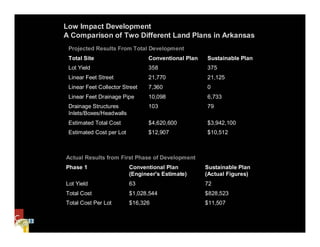
Low Impact Development
A Comparison of Two Different Land Plans in Arkansas
 Projected Results From Total Development
 Total Site                      Conventional Plan   Sustainable Plan
 Lot Yield                       358                 375
 Linear Feet Street              21,770              21,125
 Linear Feet Collector Street    7,360               0
 Linear Feet Drainage Pipe       10,098              6,733
 Drainage Structures             103                 79
 Inlets/Boxes/Headwalls
 Estimated Total Cost            $4,620,600          $3,942,100
 Estimated Cost per Lot          $12,907             $10,512


Actual Results from First Phase of Development
Phase 1                   Conventional Plan          Sustainable Plan
                          (Engineer's Estimate)      (Actual Figures)
Lot Yield                 63                         72
Total Cost                $1,028,544                 $828,523
Total Cost Per Lot        $16,326                    $11,507
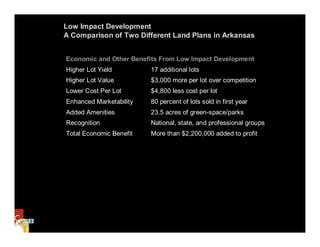
Low Impact Development
A Comparison of Two Different Land Plans in Arkansas


Economic and Other Benefits From Low Impact Development
Higher Lot Yield         17 additional lots
Higher Lot Value         $3,000 more per lot over competition
Lower Cost Per Lot       $4,800 less cost per lot
Enhanced Marketability   80 percent of lots sold in first year
Added Amenities          23.5 acres of green-space/parks
Recognition              National, state, and professional groups
Total Economic Benefit   More than $2,200,000 added to profit
IN: Green Infrastructure and Low Impact Development

IN: Green Infrastructure and Low Impact Development

  • 1.
    Green Infrastructure andLow Impact Development in Northwest Indiana Conservation Design Forum | Northwestern Indiana Regional Planning Commission USEPA | Northwest Indiana MS4 Community Partnership
  • 10.
    Two out ofevery three people in the world will be facing water shortages by 2025…global conflict will inevitably result… United Nations
  • 11.
    Low Impact Developmentis a planning approach that • concentrates site development on areas least sensitive to disturbance • uses distributed, on-site stormwater best management practices (BMPs) to emulate natural hydrology, reduce runoff, and improve water quality. • BMPs can be simple, nonstructural, low-tech, and low cost (e.g., vegetation), more complex when necessary • helps address: wet weather flows, Combined Sewer Overflows, National Pollutant Discharge Elimination System permits, Total Maximum Daily Load permits, and Nonpoint Source Pollution Program goals. • can be applied to almost any element of the developed landscape—buildings, yards, driveways, roads, walkways, open
  • 12.
    What kinds ofstrategies are used? • Conserving open space and protecting streams, wetlands, and wet soils • Reducing the use (and cost) of pipes, detention ponds, curbs and gutters, mass site clearing and grading, and paving • Reducing and disconnecting impervious surfaces (roads, sidewalks, rooftops) • Preserving and using the natural topography and drainage features of the landscape, as well as some engineered systems, to manage stormwater, such as…
  • 13.
    Examples of stormwaterBMPs • Natural landscape systems • Green roofs • Bioswales and rain gardens • Permeable paving • Rain barrels and cisterns • Naturalized retention
  • 14.
    Low Impact Development Benefits Cost Implications • Preserves and • Reduces regulatory integrates open space burden (mitigation, stormwater mgt) • Creates / preserves naturalized drainage • Reduces site grading systems and infrastructure costs • Improves aesthetic • Reduces engineering views costs • Protects water quality • Increases approval time / cost • Minimizes changes to the natural hydrologic cycle (less flooding) • Increases property value
  • 15.
    Create Conditions toSupport Low Impact Development • Establish local commitment and support • Policies, funding, incentives, practices, standards, rules, codes and regulations must point in the same direction to create the right conditions for implementation • Stormwater management, drainage and detention • Natural area protection and management • Landscaping • Parking and transportation • Zoning and subdivision standards • Block and lot dimensions and setbacks • Street and sidewalk dimensions •Development density, lot yield, and ‘bulk’
  • 16.
    How are thesepractices integrated into development? Site Design
  • 17.
    Site Design “FirstPrinciples” • Identify and protect natural features and open space early • Use site topography and natural drainage patterns to guide site layout and stormwater management • Use the natural landscape and engineered, naturalized drainage and detention BMPs to filter and infiltrate stormwater on site • Reduce the impervious area of development • Allow flexibility in lot size, street, block, and lot layout • Calculate site yield based on developable space— the total site area minus floodplains, wetlands, waterways, steep slopes, natural areas… • Concentrate built areas in a range of lot sizes and orientations to create views, privacy, and amenities for each home
  • 18.
  • 19.
    Wetlands, floodplain, remnant woodlands No limitations Hydric soils Site access Topography Step 2: Identify development and restricted areas
  • 20.
    Step 3: Developsite plan
  • 28.
    Permeable Green roofs Bioswales Level paving and spreaders rain gardens
  • 30.
    Merry Lea EnvironmentalLearning Center, Wolf Lake, IN Water Landscape Rain Gardens Bioswales Pavement Base Native reuse
  • 34.
    Conservation Design Templates Moderate-Density Residential
  • 35.
    Moderate-Density Residential Conventional (90lots) Conservation (90 lots) • Wide roads • Narrower streets • No public open space • Integrated, naturalized stormwater • Storm sewers that discharge into system turf or rip-rap-lined detention basins • Public trails and open space • Views of naturalized open space
  • 36.
    Native Landscaping Naturalized Detention Bioswale Vegetated Swale/ Rain Garden • Combined infrastructure & landscape cost 10% to 15% less than conventional template. • 50% less detention required.
  • 37.
    Moderate Density Residential Conventional$3,350,000 ($37,600/lot) / Conservation $2,880,000 ($32,400/lot) $1,000,000 $900,000 $800,000 $700,000 $600,000 Conventional $500,000 Conservation $400,000 $300,000 $200,000 $100,000 $- 1. Site 2. Stormwater 3. Sanitary 4. Water 5. Site 6. Landscape Design Preparation1 Management Sewer Distribution Paving and Development Contingency2 Sidewalks
  • 38.
    Conservation Design Templates Commercial / Industrial / Multi-Family
  • 39.
    Commercial/Industrial/Multi-Family Green roof garden for second floor units Green roof garden for second floor units • Typical strip mall • “Main Street” retail setting • Two “big box” retail • “Big box” retail incorporates establishments green roof • Isolated outlet shops • Second floor mixed-use areas • Parking, landscaping, and • Parking areas feature detention according to code permeable paving, bioswales, and naturalized landscaping
  • 40.
    Bioswale Naturalized Detention Green Roof Porous Pavement • Similar combined infrastructure and landscaping cost as conventional template. • Significant potential for additional commercial space. • 40% less detention required.
  • 41.
  • 42.
    Rural Residential Conventional (22lots) Conservation Design (22 lots) • Cul-de-sac design • Narrow lane streets • Storm sewers discharge into • Naturalized stormwater detention detention basins • Naturalized landscaping • Walking and biking trails
  • 43.
    Vegetated Naturalized Detention Swale Rain Garden Native Landscaping • Combined infrastructure and landscape cost 5% to 10% less than the conventional template. • 70% less detention required.
  • 44.
    Rural Residential Conventional$1,570,000 ($71,000/lot) / Conservation $1,470,000 ($67,000/lot) $700,000 $600,000 $500,000 $400,000 Conventional Conservation $300,000 $200,000 $100,000 $- ks y n t n t m er en en nc io tio iu w al at em m ge Se m u w ar rib op e de tin ag ep Pr ry st l ve Si n an ta Di Pr d Co De d ni n rM er an la te Sa n et at e Si g te g ap si W W 3. in wa 1. De sc v d 4. Pa m e nd ct or La ru St te st Si 6. 2. n Co 5.
  • 45.
    Low Impact Development AComparison of Two Different Land Plans in Arkansas Projected Results From Total Development Total Site Conventional Plan Sustainable Plan Lot Yield 358 375 Linear Feet Street 21,770 21,125 Linear Feet Collector Street 7,360 0 Linear Feet Drainage Pipe 10,098 6,733 Drainage Structures 103 79 Inlets/Boxes/Headwalls Estimated Total Cost $4,620,600 $3,942,100 Estimated Cost per Lot $12,907 $10,512 Actual Results from First Phase of Development Phase 1 Conventional Plan Sustainable Plan (Engineer's Estimate) (Actual Figures) Lot Yield 63 72 Total Cost $1,028,544 $828,523 Total Cost Per Lot $16,326 $11,507
  • 46.
    Low Impact Development AComparison of Two Different Land Plans in Arkansas Economic and Other Benefits From Low Impact Development Higher Lot Yield 17 additional lots Higher Lot Value $3,000 more per lot over competition Lower Cost Per Lot $4,800 less cost per lot Enhanced Marketability 80 percent of lots sold in first year Added Amenities 23.5 acres of green-space/parks Recognition National, state, and professional groups Total Economic Benefit More than $2,200,000 added to profit