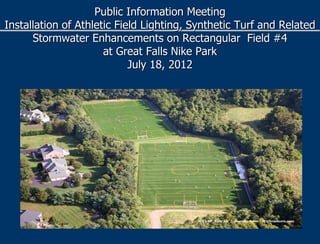
Public Information Meeting
Installation of Athletic Field Lighting, Synthetic Turf and Related
Stormwater Enhancements on Rectangular Field #4
at Great Falls Nike Park
July 18, 2012
Introductions
Dranesville District Supervisor’s Office
 John Foust, Supervisor
Dranesville District Park Authority Board Member
 Kevin Fay
Department of Public Works and Environmental Services
 Craig Carinci, Director Stormwater Planning
 Fred Rose, Chief Watershed Planning and Assessment
 Emma Gutzler, Ecologist, Stormwater Planning
Fairfax County Public Schools
 Steve Nicholson
Fairfax County Park Authority
 David Bowden, Director Planning & Development Division
 John Lehman, Manager, Project Management Branch
 Deb Garris, Manager, Synthetic Turf Branch
Meeting Agenda
 Presentation: Park Authority
Overview of Project to Include Athletic Field Lighting Technology and
Performance Standards and Synthetic Turf Field Development
 Presentation: Department of Public Works and
Environmental Services (DPWES)
Overview of Proposed Stormwater Enhancement Measures
 Informal Discussions
Funding Partnerships
 Great Falls Nike #4 is a partnership between
Great Falls Lacrosse and Department of
Neighborhood and Community Services and
Park Authority.
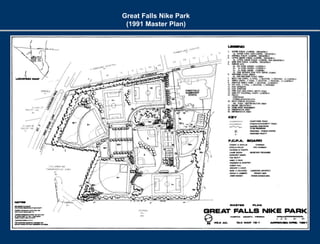
Great Falls Nike Park
(1991 Master Plan)
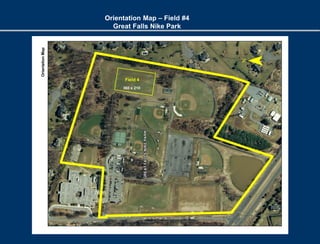
Orientation Map – Field #4
Great Falls Nike Park
 Increased Playability
 Estimated to increase playing capacity by 62% in
conjunction with the addition of lights, when compared
to natural turf. Increases capacity on lighted existing
field sites lessening the need for constructing additional
fields.
 Increased Durability
 Reduces field closure due to overuse, allowing fields to
remain open for the length of the season. Eliminates
divots, bald spots, and uneven terrain of rigorously used
natural turf fields.
Why Synthetic Turf?
Why Synthetic Turf?
 Lower Maintenance Costs
 Requires no mowing, fertilizing, pesticides or re-seeding.
Regular maintenance includes grooming and debris
removal.
(continued)
Quality
 Synthetic turf systems provide water quality improvement by
reducing phosphorus runoff to nearby streams and
tributaries.
 The synthetic turf system acts as a filter, capturing small
amounts of physical and chemical contaminants.
 Natural grass athletic fields often do not have healthy stands
of grass due to over-use. The lack of healthy stands of grass
increases the amount of sediment present in
stormwater runoff.
 Synthetic turf fields do not require the use of fertilizer and
other chemicals that ultimately enter the natural stormwater
system.
Stormwater Management Benefits of Synthetic Turf
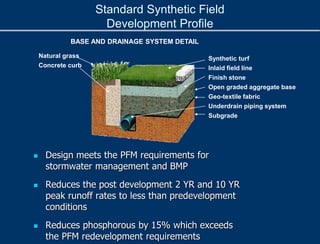
Standard Synthetic Field
Development Profile
Synthetic turf
Inlaid field line
Finish stone
Open graded aggregate base
Geo-textile fabric
Underdrain piping system
Subgrade
Natural grass
Concrete curb
BASE AND DRAINAGE SYSTEM DETAIL
 Design meets the PFM requirements for
stormwater management and BMP
 Reduces the post development 2 YR and 10 YR
peak runoff rates to less than predevelopment
conditions
 Reduces phosphorous by 15% which exceeds
the PFM redevelopment requirements
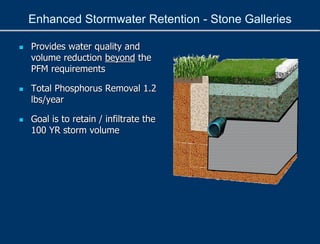
Enhanced Stormwater Retention - Stone Galleries
 Provides water quality and
volume reduction beyond the
PFM requirements
 Total Phosphorus Removal 1.2
lbs/year
 Goal is to retain / infiltrate the
100 YR storm volume
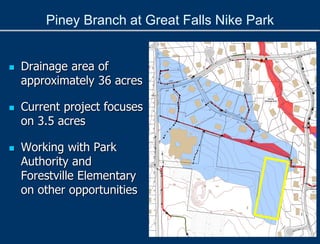
Piney Branch at Great Falls Nike Park
 Drainage area of
approximately 36 acres
 Current project focuses
on 3.5 acres
 Working with Park
Authority and
Forestville Elementary
on other opportunities
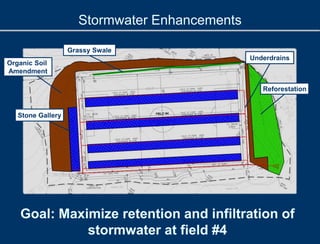
Stormwater Enhancements
Goal: Maximize retention and infiltration of
stormwater at field #4
Reforestation
Organic Soil
Amendment
Stone Gallery
Underdrains
Grassy Swale
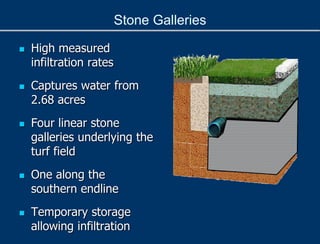
Stone Galleries
 High measured
infiltration rates
 Captures water from
2.68 acres
 Four linear stone
galleries underlying the
turf field
 One along the
southern endline
 Temporary storage
allowing infiltration
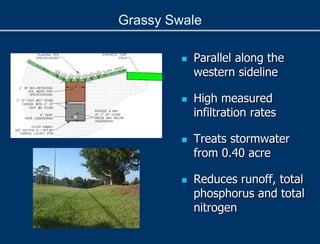
Grassy Swale
 Parallel along the
western sideline
 High measured
infiltration rates
 Treats stormwater
from 0.40 acre
 Reduces runoff, total
phosphorus and total
nitrogen
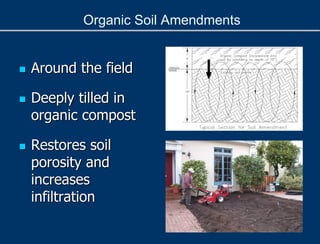
Organic Soil Amendments
 Around the field
 Deeply tilled in
organic compost
 Restores soil
porosity and
increases
infiltration
Insert close up photo of
compost (in hands??)
Insert photo of soil
amendments being
incorporated
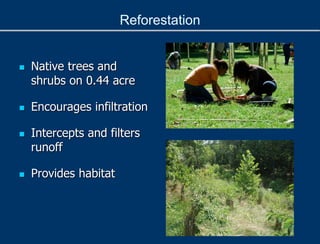
Reforestation
 Native trees and
shrubs on 0.44 acre
 Encourages infiltration
 Intercepts and filters
runoff
 Provides habitat
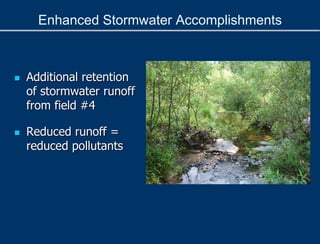
Enhanced Stormwater Accomplishments
 Additional retention
of stormwater runoff
from field #4
 Reduced runoff =
reduced pollutants
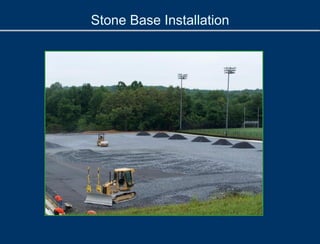
Stone Base Installation
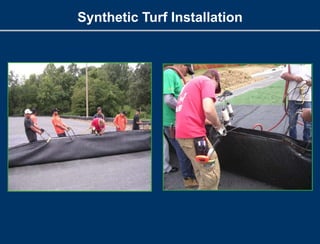
Synthetic Turf Installation
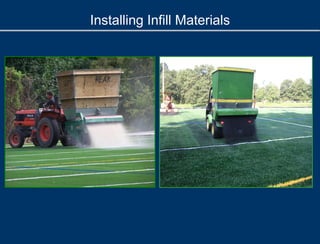
Installing Infill Materials
Proposed Synthetic Turf Infill Options
 “FutrFill – TPE (Thermo Plastic Elastomer)
derived from an environmentally inert
material process and Silica Sand Mixture
 “PureFill” – Cork which is a totally organic
product, 100% recyclable with no waste
by‐products harvested from cork oak
trees every nine years and Silica Sand
Mixture
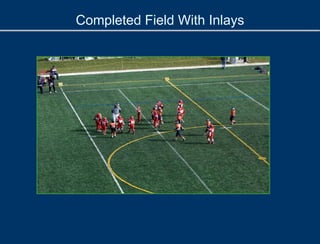
Completed Field With Inlays
Replacement of Synthetic Turf
 A well engineered sub-surface drainage
system should be sustainable for two or
three synthetic turf replacements
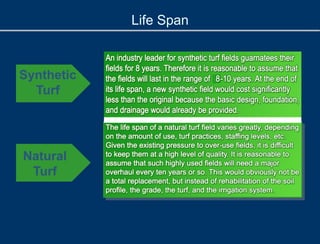
Life Span
Synthetic
Turf
Natural
Turf
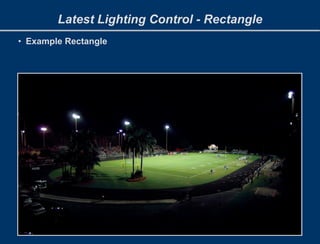
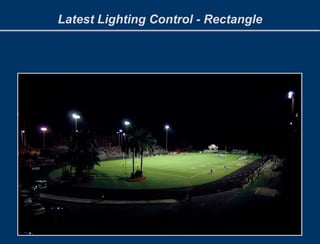
Latest Lighting Control - Rectangle
• Example Rectangle
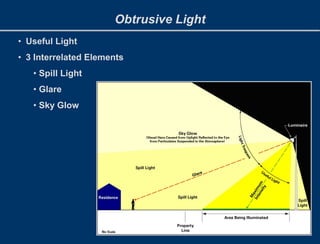
Obtrusive Light
• Useful Light
• 3 Interrelated Elements
• Spill Light
• Glare
• Sky Glow
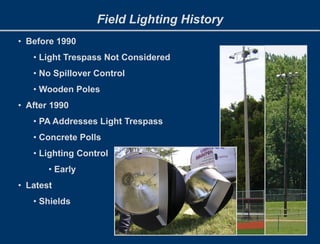
Field Lighting History
• Before 1990
• Light Trespass Not Considered
• No Spillover Control
• Wooden Poles
• After 1990
• PA Addresses Light Trespass
• Concrete Polls
• Lighting Control
• Early
• Latest
• Shields
Control of Obtrusive Light
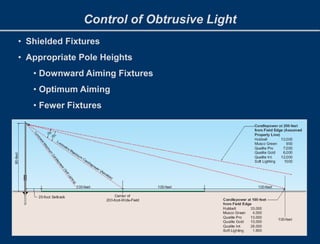
• Shielded Fixtures
• Appropriate Pole Heights
• Downward Aiming Fixtures
• Optimum Aiming
• Fewer Fixtures
Control of Obtrusive Light
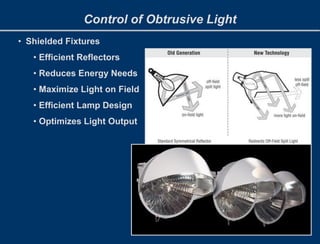
• Shielded Fixtures
• Efficient Reflectors
• Reduces Energy Needs
• Maximize Light on Field
• Efficient Lamp Design
• Optimizes Light Output
Light System Control
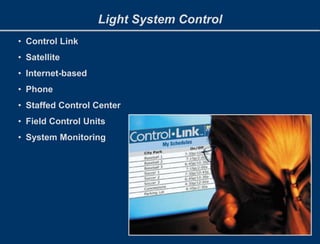
• Control Link
• Satellite
• Internet-based
• Phone
• Staffed Control Center
• Field Control Units
• System Monitoring
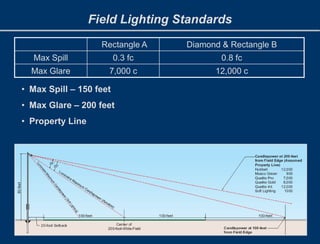
Field Lighting Standards
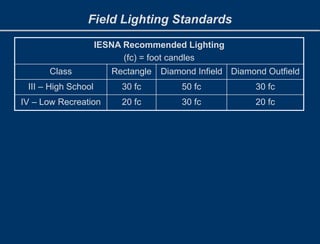
IESNA Recommended Lighting
(fc) = foot candles
Class Rectangle Diamond Infield Diamond Outfield
III – High School 30 fc 50 fc 30 fc
IV – Low Recreation 20 fc 30 fc 20 fc
Field Lighting Standards
Rectangle A Diamond & Rectangle B
Max Spill 0.3 fc 0.8 fc
Max Glare 7,000 c 12,000 c
• Max Spill – 150 feet
• Max Glare – 200 feet
• Property Line
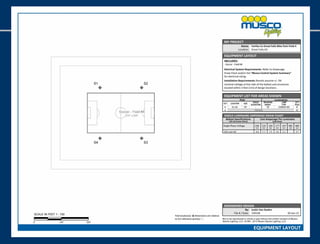
Saved for New Slide from Deb
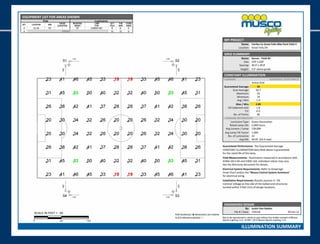
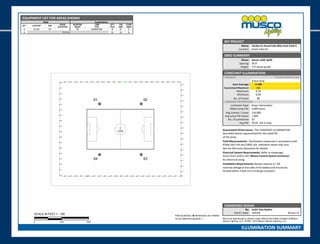
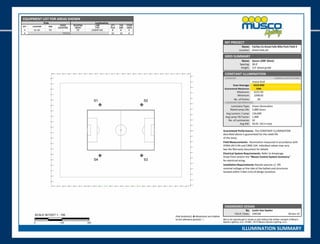
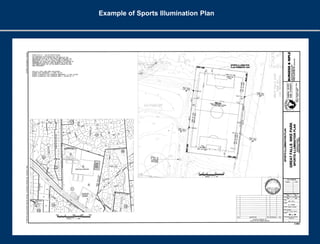
Example of Sports Illumination Plan
Latest Lighting Control - Rectangle
For more information contact:
 Stormwater Planning
 Emma Gutzler or Irene Haske
 703-324-5500, TTY 711
 Park Authority
 Charles Mends-Cole
 703-324-8640, TTY 711
 www.fairfaxcounty.gov

Great Falls Nike Field Stormwater Enhancements 2012

  • 1.
    Public Information Meeting Installationof Athletic Field Lighting, Synthetic Turf and Related Stormwater Enhancements on Rectangular Field #4 at Great Falls Nike Park July 18, 2012
  • 2.
    Introductions Dranesville District Supervisor’sOffice  John Foust, Supervisor Dranesville District Park Authority Board Member  Kevin Fay Department of Public Works and Environmental Services  Craig Carinci, Director Stormwater Planning  Fred Rose, Chief Watershed Planning and Assessment  Emma Gutzler, Ecologist, Stormwater Planning Fairfax County Public Schools  Steve Nicholson Fairfax County Park Authority  David Bowden, Director Planning & Development Division  John Lehman, Manager, Project Management Branch  Deb Garris, Manager, Synthetic Turf Branch
  • 3.
    Meeting Agenda  Presentation:Park Authority Overview of Project to Include Athletic Field Lighting Technology and Performance Standards and Synthetic Turf Field Development  Presentation: Department of Public Works and Environmental Services (DPWES) Overview of Proposed Stormwater Enhancement Measures  Informal Discussions
  • 4.
    Funding Partnerships  GreatFalls Nike #4 is a partnership between Great Falls Lacrosse and Department of Neighborhood and Community Services and Park Authority.
  • 5.
    Great Falls NikePark (1991 Master Plan)
  • 6.
    Orientation Map –Field #4 Great Falls Nike Park
  • 7.
     Increased Playability Estimated to increase playing capacity by 62% in conjunction with the addition of lights, when compared to natural turf. Increases capacity on lighted existing field sites lessening the need for constructing additional fields.  Increased Durability  Reduces field closure due to overuse, allowing fields to remain open for the length of the season. Eliminates divots, bald spots, and uneven terrain of rigorously used natural turf fields. Why Synthetic Turf?
  • 8.
    Why Synthetic Turf? Lower Maintenance Costs  Requires no mowing, fertilizing, pesticides or re-seeding. Regular maintenance includes grooming and debris removal. (continued)
  • 9.
    Quality  Synthetic turfsystems provide water quality improvement by reducing phosphorus runoff to nearby streams and tributaries.  The synthetic turf system acts as a filter, capturing small amounts of physical and chemical contaminants.  Natural grass athletic fields often do not have healthy stands of grass due to over-use. The lack of healthy stands of grass increases the amount of sediment present in stormwater runoff.  Synthetic turf fields do not require the use of fertilizer and other chemicals that ultimately enter the natural stormwater system. Stormwater Management Benefits of Synthetic Turf
  • 10.
    Standard Synthetic Field DevelopmentProfile Synthetic turf Inlaid field line Finish stone Open graded aggregate base Geo-textile fabric Underdrain piping system Subgrade Natural grass Concrete curb BASE AND DRAINAGE SYSTEM DETAIL  Design meets the PFM requirements for stormwater management and BMP  Reduces the post development 2 YR and 10 YR peak runoff rates to less than predevelopment conditions  Reduces phosphorous by 15% which exceeds the PFM redevelopment requirements
  • 11.
    Enhanced Stormwater Retention- Stone Galleries  Provides water quality and volume reduction beyond the PFM requirements  Total Phosphorus Removal 1.2 lbs/year  Goal is to retain / infiltrate the 100 YR storm volume
  • 12.
    Piney Branch atGreat Falls Nike Park  Drainage area of approximately 36 acres  Current project focuses on 3.5 acres  Working with Park Authority and Forestville Elementary on other opportunities
  • 13.
    Stormwater Enhancements Goal: Maximizeretention and infiltration of stormwater at field #4 Reforestation Organic Soil Amendment Stone Gallery Underdrains Grassy Swale
  • 14.
    Stone Galleries  Highmeasured infiltration rates  Captures water from 2.68 acres  Four linear stone galleries underlying the turf field  One along the southern endline  Temporary storage allowing infiltration
  • 15.
    Grassy Swale  Parallelalong the western sideline  High measured infiltration rates  Treats stormwater from 0.40 acre  Reduces runoff, total phosphorus and total nitrogen
  • 16.
    Organic Soil Amendments Around the field  Deeply tilled in organic compost  Restores soil porosity and increases infiltration Insert close up photo of compost (in hands??) Insert photo of soil amendments being incorporated
  • 17.
    Reforestation  Native treesand shrubs on 0.44 acre  Encourages infiltration  Intercepts and filters runoff  Provides habitat
  • 18.
    Enhanced Stormwater Accomplishments Additional retention of stormwater runoff from field #4  Reduced runoff = reduced pollutants
  • 19.
  • 20.
  • 21.
  • 22.
    Proposed Synthetic TurfInfill Options  “FutrFill – TPE (Thermo Plastic Elastomer) derived from an environmentally inert material process and Silica Sand Mixture  “PureFill” – Cork which is a totally organic product, 100% recyclable with no waste by‐products harvested from cork oak trees every nine years and Silica Sand Mixture
  • 23.
  • 24.
    Replacement of SyntheticTurf  A well engineered sub-surface drainage system should be sustainable for two or three synthetic turf replacements
  • 25.
  • 26.
    Latest Lighting Control- Rectangle • Example Rectangle
  • 27.
    Obtrusive Light • UsefulLight • 3 Interrelated Elements • Spill Light • Glare • Sky Glow
  • 28.
    Field Lighting History •Before 1990 • Light Trespass Not Considered • No Spillover Control • Wooden Poles • After 1990 • PA Addresses Light Trespass • Concrete Polls • Lighting Control • Early • Latest • Shields
  • 29.
    Control of ObtrusiveLight • Shielded Fixtures • Appropriate Pole Heights • Downward Aiming Fixtures • Optimum Aiming • Fewer Fixtures
  • 30.
    Control of ObtrusiveLight • Shielded Fixtures • Efficient Reflectors • Reduces Energy Needs • Maximize Light on Field • Efficient Lamp Design • Optimizes Light Output
  • 31.
    Light System Control •Control Link • Satellite • Internet-based • Phone • Staffed Control Center • Field Control Units • System Monitoring
  • 32.
    Field Lighting Standards IESNARecommended Lighting (fc) = foot candles Class Rectangle Diamond Infield Diamond Outfield III – High School 30 fc 50 fc 30 fc IV – Low Recreation 20 fc 30 fc 20 fc
  • 33.
    Field Lighting Standards RectangleA Diamond & Rectangle B Max Spill 0.3 fc 0.8 fc Max Glare 7,000 c 12,000 c • Max Spill – 150 feet • Max Glare – 200 feet • Property Line
  • 34.
    Saved for NewSlide from Deb
  • 38.
    Example of SportsIllumination Plan
  • 39.
  • 40.
    For more informationcontact:  Stormwater Planning  Emma Gutzler or Irene Haske  703-324-5500, TTY 711  Park Authority  Charles Mends-Cole  703-324-8640, TTY 711  www.fairfaxcounty.gov