Prof. Vasudha Kamat
Member, National Education Policy, GoI
Former Vice Chancellor
SNDT Women’s University, Mumbai
kamatvasudhav@gmail.com
National Seminar
Rejuvenation of Undergraduate Education in India
8/10/2018 Prof. Vasudha Kamat 2
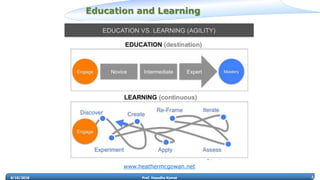
Education and Learning
www.heathermcgowan.net
8/10/2018 Prof. Vasudha Kamat 3
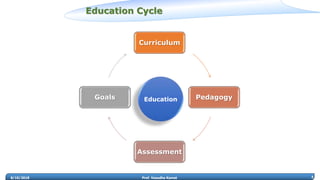
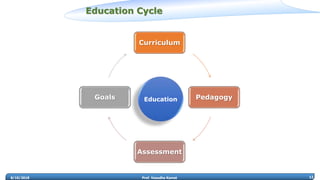
Education Cycle
Curriculum
Pedagogy
Assessment
Goals Education
8/10/2018 Prof. Vasudha Kamat 4
4th Industrial Revolution
Manufacturing2020Report:byColumbus
http://res.cloudinary.com/yumyoshojin/image/upload/v1/pdf/manufacturing-2020.pdf
8/10/2018 Prof. Vasudha Kamat 5
4th Industrial Revolution
Manufacturing2020Report:byColumbus
http://res.cloudinary.com/yumyoshojin/image/upload/v1/pdf/manufacturing-2020.pdf
Steam and Water Electricity to mass produce things
Blurring the real world with the
technological world
Internet, communication
technologies, digitalization of
everything
Forbes:https://www.forbes.com/sites/jacobmorgan/2016/02/19/what-is-the-4th-
industrial-revolution/
8/10/2018 Prof. Vasudha Kamat 6
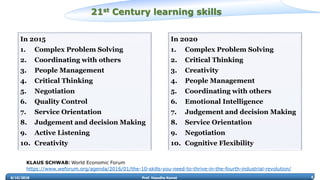
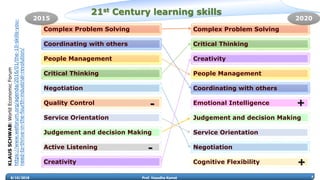
21st Century learning skills
In 2020
1. Complex Problem Solving
2. Critical Thinking
3. Creativity
4. People Management
5. Coordinating with others
6. Emotional Intelligence
7. Judgement and decision Making
8. Service Orientation
9. Negotiation
10. Cognitive Flexibility
In 2015
1. Complex Problem Solving
2. Coordinating with others
3. People Management
4. Critical Thinking
5. Negotiation
6. Quality Control
7. Service Orientation
8. Judgement and decision Making
9. Active Listening
10. Creativity
KLAUS SCHWAB: World Economic Forum
https://www.weforum.org/agenda/2016/01/the-10-skills-you-need-to-thrive-in-the-fourth-industrial-revolution/
8/10/2018 Prof. Vasudha Kamat 7
21st Century learning skillsKLAUSSCHWAB:WorldEconomicForum
https://www.weforum.org/agenda/2016/01/the-10-skills-you-
need-to-thrive-in-the-fourth-industrial-revolution/
Complex Problem Solving
Critical Thinking
Creativity
People Management
Coordinating with others
Emotional Intelligence
Judgement and decision Making
Service Orientation
Negotiation
Cognitive Flexibility
Complex Problem Solving
Coordinating with others
People Management
Critical Thinking
Negotiation
Quality Control
Service Orientation
Judgement and decision Making
Active Listening
Creativity
-
+
2015 2020
-
+
8/10/2018 Prof. Vasudha Kamat 8
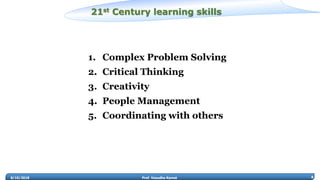
21st Century learning skills
1. Complex Problem Solving
2. Critical Thinking
3. Creativity
4. People Management
5. Coordinating with others
8/10/2018 Prof. Vasudha Kamat 9
Education Cycle
Curriculum
Pedagogy
Assessment
Goals Education
8/10/2018 Prof. Vasudha Kamat 10
The Organisation for Economic Cooperation and
Development (OECD) is strongly advocating
curricula that integrate knowledge, across
subject disciplines, with skills development
Curriculum for 4th Industrial Revolution
https://www.oecd.org/site/eduistp2012/49850576.pdf
Preparing Teachers and Developing School Leaders for the 21st Century: Andreas Schleicher (Ed)
8/10/2018 Prof. Vasudha Kamat 11
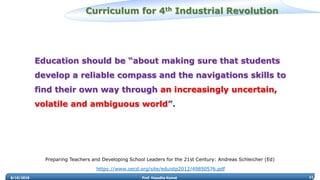
Education should be “about making sure that students
develop a reliable compass and the navigations skills to
find their own way through an increasingly uncertain,
volatile and ambiguous world”.
Curriculum for 4th Industrial Revolution
https://www.oecd.org/site/eduistp2012/49850576.pdf
Preparing Teachers and Developing School Leaders for the 21st Century: Andreas Schleicher (Ed)
8/10/2018 Prof. Vasudha Kamat 12
Education Cycle
Curriculum
Pedagogy
Assessment
Goals Education
8/10/2018 Prof. Vasudha Kamat 13
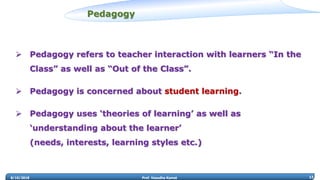
 Pedagogy refers to teacher interaction with learners “In the
Class” as well as “Out of the Class”.
 Pedagogy is concerned about student learning.
 Pedagogy uses ‘theories of learning’ as well as
‘understanding about the learner’
(needs, interests, learning styles etc.)
Pedagogy
8/10/2018 Prof. Vasudha Kamat 14
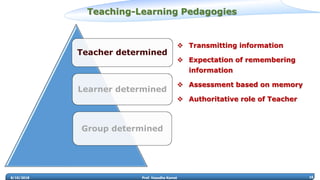
Teacher determined
Learner determined
Group determined
Teaching-Learning Pedagogies
8/10/2018 Prof. Vasudha Kamat 15
Teaching-Learning Pedagogies
Teacher determined
Learner determined
Group determined
8/10/2018 Prof. Vasudha Kamat 16
Teacher determined
Learner determined
Group determined
 Transmitting information
 Expectation of remembering
information
 Assessment based on memory
 Authoritative role of Teacher
Teaching-Learning Pedagogies
8/10/2018 Prof. Vasudha Kamat 17
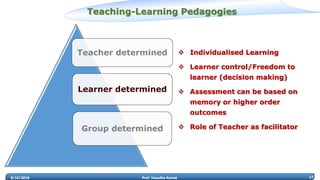
Teacher determined
Learner determined
Group determined
 Individualised Learning
 Learner control/Freedom to
learner (decision making)
 Assessment can be based on
memory or higher order
outcomes
 Role of Teacher as facilitator
Teaching-Learning Pedagogies
8/10/2018 Prof. Vasudha Kamat 18
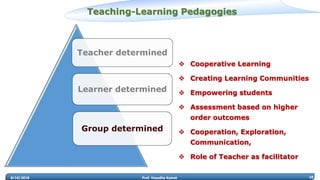
Teacher determined
Learner determined
Group determined
 Cooperative Learning
 Creating Learning Communities
 Empowering students
 Assessment based on higher
order outcomes
 Cooperation, Exploration,
Communication,
 Role of Teacher as facilitator
Teaching-Learning Pedagogies
8/10/2018 Prof. Vasudha Kamat 19
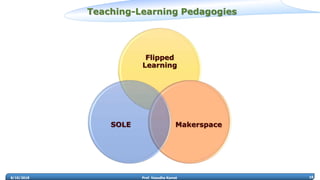
Teaching-Learning Pedagogies
Flipped
Learning
MakerspaceSOLE
8/10/2018 Prof. Vasudha Kamat 20
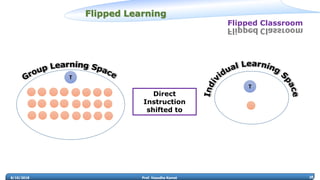
T
Direct
Instruction
shifted to
T
Flipped Classroom
Flipped Learning
8/10/2018 Prof. Vasudha Kamat 21
T
Flipped Classroom
Flipped Learning
8/10/2018 Prof. Vasudha Kamat 22
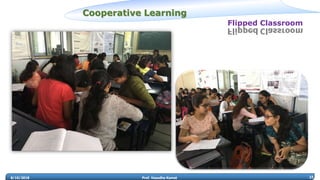
Cooperative Learning
Flipped Classroom
8/10/2018 Prof. Vasudha Kamat 23
Flipped Classroom
Cooperative Learning
8/10/2018 Prof. Vasudha Kamat 24
Group (Cooperative) Learning
Davies, W. M. (2009). Groupwork as a form of assessment: common problems and recommended solutions.
Promotes
 Deep Learning as opposed to Surface Learning
 Active Learning as opposed to Passive Learning
 Experiential learning and Collaborative Learning
 Construction of knowledge and enhancement of
problem-based learning among students
8/10/2018 Prof. Vasudha Kamat 25
Cooperative Learning Strategies
 Jigsaw
 Fishbowl
 One Stray
 Four Corners
 Brainstorming (Round Robin)
 Team-Pair-Solo
 Six Thinking Hats
 Three Step Interview
 Peer Instruction (PI)
 Think-Pair-Share (TPS)
 Predict-Observe-Explain (POE)
 Process Oriented Guided Inquiry Learning (POGIL)
8/10/2018 Prof. Vasudha Kamat 26
Makerspaces
A makerspace is a physical location where people
gather to share resources and knowledge, work on
projects, network, and build.
Makerspaces provide tools and space in a community
environment - a library, community center, private
organization, or campus.
https://library.educause.edu/resources/2013/4/7-things-you-should-know-about-makerspaces
8/10/2018 Prof. Vasudha Kamat 27
BEFORE: Verrado Middle School’s Computer Lab
AFTER: the same room at Verrado, transformed to a Makerspace
Makerspaces
8/10/2018 Prof. Vasudha Kamat 28
 Students take control of their own learning, take ownership
of projects they have not just designed but defined.
 Students often appreciate the hands-on use of emerging
technologies.
 Enjoy comfortable acquaintance with the experimentation
that leads to a completed project.
 They provide a physical laboratory for inquiry-based learning.
https://library.educause.edu/resources/2013/4/7-things-you-should-know-about-makerspaces
Implications for Teaching-Learning
Makerspaces
8/10/2018 Prof. Vasudha Kamat 29
Self Organising Learning Environment
 Within a SOLE students are given the freedom to
learn collaboratively using the internet.
 An educator poses a Big Question and students form
small groups to find an answer.
 During a SOLE session students are free to move
around, change groups and share information at any
time.
 Towards the end of a session they have the
opportunity to share what they learned with the
whole group.
http://school-in-the-cloud.dev.indigo.ws/how-to/benefits-of-sole/
What is a SOLE
SOLE
sessions are
characterised
by discovery,
sharing,
spontaneity
and limited
teacher
intervention.
8/10/2018 Prof. Vasudha Kamat 30
Self Organising Learning Environment
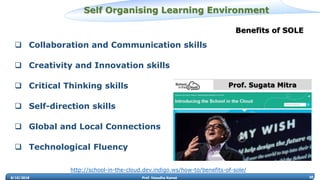
Benefits of SOLE
 Collaboration and Communication skills
 Creativity and Innovation skills
 Critical Thinking skills
 Self-direction skills
 Global and Local Connections
 Technological Fluency
http://school-in-the-cloud.dev.indigo.ws/how-to/benefits-of-sole/
Prof. Sugata Mitra
Prof. Vasudha Kamat
Member, National Education Policy, GoI
Former Vice Chancellor
SNDT Women’s University, Mumbai
kamatvasudhav@gmail.com
National Seminar
Rejuvenation of Undergraduate Education in India
Thank you!!!

Stimulating Classroom Environment

  • 1.
    Prof. Vasudha Kamat Member,National Education Policy, GoI Former Vice Chancellor SNDT Women’s University, Mumbai kamatvasudhav@gmail.com National Seminar Rejuvenation of Undergraduate Education in India
  • 2.
    8/10/2018 Prof. VasudhaKamat 2 Education and Learning www.heathermcgowan.net
  • 3.
    8/10/2018 Prof. VasudhaKamat 3 Education Cycle Curriculum Pedagogy Assessment Goals Education
  • 4.
    8/10/2018 Prof. VasudhaKamat 4 4th Industrial Revolution Manufacturing2020Report:byColumbus http://res.cloudinary.com/yumyoshojin/image/upload/v1/pdf/manufacturing-2020.pdf
  • 5.
    8/10/2018 Prof. VasudhaKamat 5 4th Industrial Revolution Manufacturing2020Report:byColumbus http://res.cloudinary.com/yumyoshojin/image/upload/v1/pdf/manufacturing-2020.pdf Steam and Water Electricity to mass produce things Blurring the real world with the technological world Internet, communication technologies, digitalization of everything Forbes:https://www.forbes.com/sites/jacobmorgan/2016/02/19/what-is-the-4th- industrial-revolution/
  • 6.
    8/10/2018 Prof. VasudhaKamat 6 21st Century learning skills In 2020 1. Complex Problem Solving 2. Critical Thinking 3. Creativity 4. People Management 5. Coordinating with others 6. Emotional Intelligence 7. Judgement and decision Making 8. Service Orientation 9. Negotiation 10. Cognitive Flexibility In 2015 1. Complex Problem Solving 2. Coordinating with others 3. People Management 4. Critical Thinking 5. Negotiation 6. Quality Control 7. Service Orientation 8. Judgement and decision Making 9. Active Listening 10. Creativity KLAUS SCHWAB: World Economic Forum https://www.weforum.org/agenda/2016/01/the-10-skills-you-need-to-thrive-in-the-fourth-industrial-revolution/
  • 7.
    8/10/2018 Prof. VasudhaKamat 7 21st Century learning skillsKLAUSSCHWAB:WorldEconomicForum https://www.weforum.org/agenda/2016/01/the-10-skills-you- need-to-thrive-in-the-fourth-industrial-revolution/ Complex Problem Solving Critical Thinking Creativity People Management Coordinating with others Emotional Intelligence Judgement and decision Making Service Orientation Negotiation Cognitive Flexibility Complex Problem Solving Coordinating with others People Management Critical Thinking Negotiation Quality Control Service Orientation Judgement and decision Making Active Listening Creativity - + 2015 2020 - +
  • 8.
    8/10/2018 Prof. VasudhaKamat 8 21st Century learning skills 1. Complex Problem Solving 2. Critical Thinking 3. Creativity 4. People Management 5. Coordinating with others
  • 9.
    8/10/2018 Prof. VasudhaKamat 9 Education Cycle Curriculum Pedagogy Assessment Goals Education
  • 10.
    8/10/2018 Prof. VasudhaKamat 10 The Organisation for Economic Cooperation and Development (OECD) is strongly advocating curricula that integrate knowledge, across subject disciplines, with skills development Curriculum for 4th Industrial Revolution https://www.oecd.org/site/eduistp2012/49850576.pdf Preparing Teachers and Developing School Leaders for the 21st Century: Andreas Schleicher (Ed)
  • 11.
    8/10/2018 Prof. VasudhaKamat 11 Education should be “about making sure that students develop a reliable compass and the navigations skills to find their own way through an increasingly uncertain, volatile and ambiguous world”. Curriculum for 4th Industrial Revolution https://www.oecd.org/site/eduistp2012/49850576.pdf Preparing Teachers and Developing School Leaders for the 21st Century: Andreas Schleicher (Ed)
  • 12.
    8/10/2018 Prof. VasudhaKamat 12 Education Cycle Curriculum Pedagogy Assessment Goals Education
  • 13.
    8/10/2018 Prof. VasudhaKamat 13  Pedagogy refers to teacher interaction with learners “In the Class” as well as “Out of the Class”.  Pedagogy is concerned about student learning.  Pedagogy uses ‘theories of learning’ as well as ‘understanding about the learner’ (needs, interests, learning styles etc.) Pedagogy
  • 14.
    8/10/2018 Prof. VasudhaKamat 14 Teacher determined Learner determined Group determined Teaching-Learning Pedagogies
  • 15.
    8/10/2018 Prof. VasudhaKamat 15 Teaching-Learning Pedagogies Teacher determined Learner determined Group determined
  • 16.
    8/10/2018 Prof. VasudhaKamat 16 Teacher determined Learner determined Group determined  Transmitting information  Expectation of remembering information  Assessment based on memory  Authoritative role of Teacher Teaching-Learning Pedagogies
  • 17.
    8/10/2018 Prof. VasudhaKamat 17 Teacher determined Learner determined Group determined  Individualised Learning  Learner control/Freedom to learner (decision making)  Assessment can be based on memory or higher order outcomes  Role of Teacher as facilitator Teaching-Learning Pedagogies
  • 18.
    8/10/2018 Prof. VasudhaKamat 18 Teacher determined Learner determined Group determined  Cooperative Learning  Creating Learning Communities  Empowering students  Assessment based on higher order outcomes  Cooperation, Exploration, Communication,  Role of Teacher as facilitator Teaching-Learning Pedagogies
  • 19.
    8/10/2018 Prof. VasudhaKamat 19 Teaching-Learning Pedagogies Flipped Learning MakerspaceSOLE
  • 20.
    8/10/2018 Prof. VasudhaKamat 20 T Direct Instruction shifted to T Flipped Classroom Flipped Learning
  • 21.
    8/10/2018 Prof. VasudhaKamat 21 T Flipped Classroom Flipped Learning
  • 22.
    8/10/2018 Prof. VasudhaKamat 22 Cooperative Learning Flipped Classroom
  • 23.
    8/10/2018 Prof. VasudhaKamat 23 Flipped Classroom Cooperative Learning
  • 24.
    8/10/2018 Prof. VasudhaKamat 24 Group (Cooperative) Learning Davies, W. M. (2009). Groupwork as a form of assessment: common problems and recommended solutions. Promotes  Deep Learning as opposed to Surface Learning  Active Learning as opposed to Passive Learning  Experiential learning and Collaborative Learning  Construction of knowledge and enhancement of problem-based learning among students
  • 25.
    8/10/2018 Prof. VasudhaKamat 25 Cooperative Learning Strategies  Jigsaw  Fishbowl  One Stray  Four Corners  Brainstorming (Round Robin)  Team-Pair-Solo  Six Thinking Hats  Three Step Interview  Peer Instruction (PI)  Think-Pair-Share (TPS)  Predict-Observe-Explain (POE)  Process Oriented Guided Inquiry Learning (POGIL)
  • 26.
    8/10/2018 Prof. VasudhaKamat 26 Makerspaces A makerspace is a physical location where people gather to share resources and knowledge, work on projects, network, and build. Makerspaces provide tools and space in a community environment - a library, community center, private organization, or campus. https://library.educause.edu/resources/2013/4/7-things-you-should-know-about-makerspaces
  • 27.
    8/10/2018 Prof. VasudhaKamat 27 BEFORE: Verrado Middle School’s Computer Lab AFTER: the same room at Verrado, transformed to a Makerspace Makerspaces
  • 28.
    8/10/2018 Prof. VasudhaKamat 28  Students take control of their own learning, take ownership of projects they have not just designed but defined.  Students often appreciate the hands-on use of emerging technologies.  Enjoy comfortable acquaintance with the experimentation that leads to a completed project.  They provide a physical laboratory for inquiry-based learning. https://library.educause.edu/resources/2013/4/7-things-you-should-know-about-makerspaces Implications for Teaching-Learning Makerspaces
  • 29.
    8/10/2018 Prof. VasudhaKamat 29 Self Organising Learning Environment  Within a SOLE students are given the freedom to learn collaboratively using the internet.  An educator poses a Big Question and students form small groups to find an answer.  During a SOLE session students are free to move around, change groups and share information at any time.  Towards the end of a session they have the opportunity to share what they learned with the whole group. http://school-in-the-cloud.dev.indigo.ws/how-to/benefits-of-sole/ What is a SOLE SOLE sessions are characterised by discovery, sharing, spontaneity and limited teacher intervention.
  • 30.
    8/10/2018 Prof. VasudhaKamat 30 Self Organising Learning Environment Benefits of SOLE  Collaboration and Communication skills  Creativity and Innovation skills  Critical Thinking skills  Self-direction skills  Global and Local Connections  Technological Fluency http://school-in-the-cloud.dev.indigo.ws/how-to/benefits-of-sole/ Prof. Sugata Mitra
  • 31.
    Prof. Vasudha Kamat Member,National Education Policy, GoI Former Vice Chancellor SNDT Women’s University, Mumbai kamatvasudhav@gmail.com National Seminar Rejuvenation of Undergraduate Education in India Thank you!!!