STEROIDOGENESIS
Steroidogenesis
Ahtesham Hanifi
Integrated MSc Life Sciences -3rd year,
Department of Biotechnology, Central University of Tamil Nadu, India.
Reg. No- I200602.
Loop profile – 1661752
https://orcid.org/0000-0002-6666-0058
https://researchgate.net/profile/Ahtesham-Hanifi
ahteshamh20@students.cutn.ac.in
+91 8807095178
The process of conversion of cholesterol into biologically active steroid hormone, is known as
steroidogenesis.
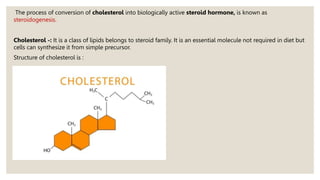
Cholesterol -: It is a class of lipids belongs to steroid family. It is an essential molecule not required in diet but
cells can synthesize it from simple precursor.
Structure of cholesterol is :
Steroid hormone:- Any type of steroid that act as a chemical messanger to the cells, is called steroid
hormone.
There are two classes of steroid hormones:
1. Corticosteroids = Glucocorticoids & Mineralocorticoid .
2. Sex steroids = Androgens, Estrogens & Progesterone.
Steroid hormones have important role in growth, development, sexual differentiation and reproduction
.................. Steroidogenesis is important.
Steroidogenesis is a multistep process that occur in two organelles: Endoplasmic reticulum and Mitochondria.
Mitochondria. This process is involved by various enzymes.
Requirements -: Cholesterol ( Raw material ), Enzymes and Organelles.
Cholesterol
1. Cholesterol is a class of lipids belongs to the steroid family.
2. The first and rate determining step in steroidogenesis is transfer of cholesterol to the inner
mitochondrial membrane ( IMM ) .
3. IMM contains number of steroidogenic enzymes.
4. Low density lipo-protein receptor ( LDLR ) and Scavenger receptor BI ( SR-BI ) are the first two
receptor that brings lipo-protein particles having esterified cholesterol to steroidogenic
processing cell.
5. Low density lipo-protein is a primary source of cholesterol for steroidogenesis in human .
However, SR-BI is mostly serves as a cholesterol provider receptor in rodents.
6. After processing of lipo-protein, the formed cholesterol movement out of lysosome is facilitated
by Niemann Pick type C1 ( NPC1 ).
6. NPC1 localized in late endosomes along with lipid transfer protein MLN64 and NPC2 that
travel along microtubules track. Thus, cytoskeleton plays a key role in directing the positioning
of cholesterol in steroidogenic organelles i.e, mitochondria and endoplasmic reticulum.
Enzymes involved in steroidogenesis
1. Steroidogenesis is an enzymatically active process which is involved by various types of
enzymes.
2. Notable enzymes are : CYP450 & HSDs .
3. All type of steroidogenic enzymes are functionally unidirectional i.e, irreversible, so the
accumulation of products doesn’t drive flux back to the precursor ; except HSDs .
4. HSDs reactions are mechanistically reversible and can run in either directions under certain
condition .
A. CYP450 enzyme
1. CYP450 stands for Cytochrome Pigment 450.
2. Belongs to the family of CYP enzymes and absorbs all lights at wavelength of 450nm.
3. Total of 57 CYP450 enzymes are present in our human genome.
3. Two types of CYP450 enzymes :
a. Type 1 : These types of CYP450 enzymes targets mitochondria. It is 7 in number.
b. Type 2 : These types of CYP450 enzymes targets endoplasmic reticulum. It is 50 in number.
4. Presence of heme in the centre of these enzymes and it activated molecular oxygen. These
CYP450 also adds electrons from reduced form of NADPH.
5. Out of 57 , only 6 are involved in steroidogenesis, called CYP450s.c.c ; Cytochrome Pigment 450
cholesterol sidescain cleavage enzyme.
B. Hydroxysteroid dehydrogenases (
HSDs ) .
1. Molecular mass = 35 to 45 kDa .
2. Do not have Heme group.
3. Requires NADH/NAD+ or NADPH/NADP+ as a co-factors to either oxidise or reduce a steroid
by two electrons via hydride transfer mechanism.
4. Having reversible activity.
5. Classified into two categories based on structures :-
a. Short chain dehydrogenase/reductase ( SDR ) : It is beta-alpha-beta protein, where upto 7
parallel beta sterols fan across the centre of molecule formed Rossmann folds.
b. Aldo-keto reductase ( AKR ) :- Soluble protein contains beta-triose phosphate isomerase.
6. In both types of HSDs, active site is consists of critical pair of tyrosine and lysine residue that
participates in proton transfer to steroid alcohol during catalysis.
Mechanism of steroidogenesis
Steroidogenesis is multi step process but it’s mechanism is of two steps , for shake of convenience.
These two steps of mechanisms are :-
1. Delivery of cholesterol to mitochondria &
2. Processing inside the mitochondria and endoplasmic reticulum.
1. Delivery of cholesterol to mitochondria.
A. Cholesterol synthesized in endoplasmic reticulum from acetate via complex pathway by de
Novo but for the activity of steroidogenesis, cholesterol are derived from lipo-protein, either
low density or high density.
B. Scavenger receptor BI are used in taking up of HDLs while LDLs are taken up by receptor
mediated endocytosis via low density lipo-protein receptor ( LDLR ).
C. The regulation of cholesterol uptake, intracellular transport and utilisation is coordinated by
family of basic helix-loop-helix transcription factor, called sterol regulatory element binding
proteins ( SREBPs ) .
D. After association with receptor, LDL gets internalised by endocytosis resulting into fusion of
endosomal vesicles with lysosomes.
E. This fusion leads a proteolytic degradation of LDL, liberating the Cholesteryl esters( CE )
F. This CE again hydrolysed into free cholesterol ( C ) by an enzyme , called lysosomal acid
lipase ( LAL ).
G. The free cholesterol stored as lipid droplets in lysosome. From here, NPC1 or NPC2 protein
participates in cholesterol transport.
H. Now, START-domain protein appears to be principle mean of free cholesterol transport from
lipid droplets to mitochondria.
Diagram of transport of free cholesterol to mitochondria
2. Processing inside the mitochondria
and endoplasmic reticulum.
A. Movement of free cholesterol from OMM to IMM, is called initiation step of steroidogenesis.
The mechanism of transfer from OMM to IMM is still under investigation.
B. IMM has CYP450scc enzyme that activates the process of steroidogenesis by cleaving the
insoluble bond of cholesterol and produces pregnenolone – the first stable product in
steroidogenesis.
C. Now, pregnenolone converted into progesterone by 3 beta-HSD enzyme. After this conversion,
pregnenolone enters into endoplasmic reticulum from mitochondria.
# Steroidogenic reactions in endoplasmic reticulum.
1. Pregnenolone produces 17-hydroxypregnenolone by enzyme P450C17.
2. 17-hydroxyprognenolone undergoes conversion with P450C17 and gives
Dehydroepiandrosterone ( DHEP ) .
3. DHEA transformed into androstenedione by 3 beta-HSD. This androstenedione undergoes
two pathways by two different enzymes:
a. P450C19 : androstenedione give rise to estrone by this enzyme. This estrone converted into
17- beta estradiol by 17 beta HSD.
b. 17 beta HSD : androstenedione converted into testosterone by this enzyme. Again
testosterone undergoes transformation and give rise to 17 -beta estradiol by P450C19 enzyme.
Note :- Testosterone and 17- beta estradiol are the two major products of steroidogenesis in
endoplasmic reticulum.
4. Progesterone from pregnenolone in endoplasmic reticulum undergoes two enzymatic
pathways :-
a. P450C17 : 17- hydroxy progesterone synthesized from progesterone by this P450C17
enzyme. This 17 hydroxy progesterone converted into 11- deoxy cortisol by P450C21. Now, 11-
deoxy cortisol enters into mitochondria and getting converted into cortisol by P450C11 beta
enzyme.
Cortisol is a precursor of corticoids = Glucocorticoids and Mineralocorticoids .
b. P450C21 : Deoxycortisterone is synthesized from progesterone by P450C21 enzymes. This
Deoxycortisterone again enters into mitochondria and converted into corticosterone by P450C11
P450C11 beta enzyme. Corticosterone give rise to 18-hydroxy corticosterone by P450aldo
enzyme. Now, 18-hydroxy corticosterone synthesized aldosterone by P450aldo.
Diagram of mechanism of steroidogenesis
Thank you
Thank you

Steroidogenesis 1.pptx

  • 1.
  • 2.
    Steroidogenesis Ahtesham Hanifi Integrated MScLife Sciences -3rd year, Department of Biotechnology, Central University of Tamil Nadu, India. Reg. No- I200602. Loop profile – 1661752 https://orcid.org/0000-0002-6666-0058 https://researchgate.net/profile/Ahtesham-Hanifi ahteshamh20@students.cutn.ac.in +91 8807095178
  • 3.
    The process ofconversion of cholesterol into biologically active steroid hormone, is known as steroidogenesis. Cholesterol -: It is a class of lipids belongs to steroid family. It is an essential molecule not required in diet but cells can synthesize it from simple precursor. Structure of cholesterol is :
  • 4.
    Steroid hormone:- Anytype of steroid that act as a chemical messanger to the cells, is called steroid hormone. There are two classes of steroid hormones: 1. Corticosteroids = Glucocorticoids & Mineralocorticoid . 2. Sex steroids = Androgens, Estrogens & Progesterone. Steroid hormones have important role in growth, development, sexual differentiation and reproduction .................. Steroidogenesis is important. Steroidogenesis is a multistep process that occur in two organelles: Endoplasmic reticulum and Mitochondria. Mitochondria. This process is involved by various enzymes. Requirements -: Cholesterol ( Raw material ), Enzymes and Organelles.
  • 5.
    Cholesterol 1. Cholesterol isa class of lipids belongs to the steroid family. 2. The first and rate determining step in steroidogenesis is transfer of cholesterol to the inner mitochondrial membrane ( IMM ) . 3. IMM contains number of steroidogenic enzymes. 4. Low density lipo-protein receptor ( LDLR ) and Scavenger receptor BI ( SR-BI ) are the first two receptor that brings lipo-protein particles having esterified cholesterol to steroidogenic processing cell. 5. Low density lipo-protein is a primary source of cholesterol for steroidogenesis in human . However, SR-BI is mostly serves as a cholesterol provider receptor in rodents. 6. After processing of lipo-protein, the formed cholesterol movement out of lysosome is facilitated by Niemann Pick type C1 ( NPC1 ).
  • 6.
    6. NPC1 localizedin late endosomes along with lipid transfer protein MLN64 and NPC2 that travel along microtubules track. Thus, cytoskeleton plays a key role in directing the positioning of cholesterol in steroidogenic organelles i.e, mitochondria and endoplasmic reticulum. Enzymes involved in steroidogenesis 1. Steroidogenesis is an enzymatically active process which is involved by various types of enzymes. 2. Notable enzymes are : CYP450 & HSDs . 3. All type of steroidogenic enzymes are functionally unidirectional i.e, irreversible, so the accumulation of products doesn’t drive flux back to the precursor ; except HSDs . 4. HSDs reactions are mechanistically reversible and can run in either directions under certain condition .
  • 7.
    A. CYP450 enzyme 1.CYP450 stands for Cytochrome Pigment 450. 2. Belongs to the family of CYP enzymes and absorbs all lights at wavelength of 450nm. 3. Total of 57 CYP450 enzymes are present in our human genome. 3. Two types of CYP450 enzymes : a. Type 1 : These types of CYP450 enzymes targets mitochondria. It is 7 in number. b. Type 2 : These types of CYP450 enzymes targets endoplasmic reticulum. It is 50 in number. 4. Presence of heme in the centre of these enzymes and it activated molecular oxygen. These CYP450 also adds electrons from reduced form of NADPH. 5. Out of 57 , only 6 are involved in steroidogenesis, called CYP450s.c.c ; Cytochrome Pigment 450 cholesterol sidescain cleavage enzyme.
  • 8.
    B. Hydroxysteroid dehydrogenases( HSDs ) . 1. Molecular mass = 35 to 45 kDa . 2. Do not have Heme group. 3. Requires NADH/NAD+ or NADPH/NADP+ as a co-factors to either oxidise or reduce a steroid by two electrons via hydride transfer mechanism. 4. Having reversible activity. 5. Classified into two categories based on structures :- a. Short chain dehydrogenase/reductase ( SDR ) : It is beta-alpha-beta protein, where upto 7 parallel beta sterols fan across the centre of molecule formed Rossmann folds. b. Aldo-keto reductase ( AKR ) :- Soluble protein contains beta-triose phosphate isomerase. 6. In both types of HSDs, active site is consists of critical pair of tyrosine and lysine residue that participates in proton transfer to steroid alcohol during catalysis.
  • 10.
    Mechanism of steroidogenesis Steroidogenesisis multi step process but it’s mechanism is of two steps , for shake of convenience. These two steps of mechanisms are :- 1. Delivery of cholesterol to mitochondria & 2. Processing inside the mitochondria and endoplasmic reticulum. 1. Delivery of cholesterol to mitochondria. A. Cholesterol synthesized in endoplasmic reticulum from acetate via complex pathway by de Novo but for the activity of steroidogenesis, cholesterol are derived from lipo-protein, either low density or high density. B. Scavenger receptor BI are used in taking up of HDLs while LDLs are taken up by receptor mediated endocytosis via low density lipo-protein receptor ( LDLR ).
  • 11.
    C. The regulationof cholesterol uptake, intracellular transport and utilisation is coordinated by family of basic helix-loop-helix transcription factor, called sterol regulatory element binding proteins ( SREBPs ) . D. After association with receptor, LDL gets internalised by endocytosis resulting into fusion of endosomal vesicles with lysosomes. E. This fusion leads a proteolytic degradation of LDL, liberating the Cholesteryl esters( CE ) F. This CE again hydrolysed into free cholesterol ( C ) by an enzyme , called lysosomal acid lipase ( LAL ). G. The free cholesterol stored as lipid droplets in lysosome. From here, NPC1 or NPC2 protein participates in cholesterol transport. H. Now, START-domain protein appears to be principle mean of free cholesterol transport from lipid droplets to mitochondria.
  • 12.
    Diagram of transportof free cholesterol to mitochondria
  • 13.
    2. Processing insidethe mitochondria and endoplasmic reticulum. A. Movement of free cholesterol from OMM to IMM, is called initiation step of steroidogenesis. The mechanism of transfer from OMM to IMM is still under investigation. B. IMM has CYP450scc enzyme that activates the process of steroidogenesis by cleaving the insoluble bond of cholesterol and produces pregnenolone – the first stable product in steroidogenesis. C. Now, pregnenolone converted into progesterone by 3 beta-HSD enzyme. After this conversion, pregnenolone enters into endoplasmic reticulum from mitochondria. # Steroidogenic reactions in endoplasmic reticulum. 1. Pregnenolone produces 17-hydroxypregnenolone by enzyme P450C17. 2. 17-hydroxyprognenolone undergoes conversion with P450C17 and gives Dehydroepiandrosterone ( DHEP ) .
  • 14.
    3. DHEA transformedinto androstenedione by 3 beta-HSD. This androstenedione undergoes two pathways by two different enzymes: a. P450C19 : androstenedione give rise to estrone by this enzyme. This estrone converted into 17- beta estradiol by 17 beta HSD. b. 17 beta HSD : androstenedione converted into testosterone by this enzyme. Again testosterone undergoes transformation and give rise to 17 -beta estradiol by P450C19 enzyme. Note :- Testosterone and 17- beta estradiol are the two major products of steroidogenesis in endoplasmic reticulum. 4. Progesterone from pregnenolone in endoplasmic reticulum undergoes two enzymatic pathways :- a. P450C17 : 17- hydroxy progesterone synthesized from progesterone by this P450C17 enzyme. This 17 hydroxy progesterone converted into 11- deoxy cortisol by P450C21. Now, 11- deoxy cortisol enters into mitochondria and getting converted into cortisol by P450C11 beta enzyme. Cortisol is a precursor of corticoids = Glucocorticoids and Mineralocorticoids .
  • 15.
    b. P450C21 :Deoxycortisterone is synthesized from progesterone by P450C21 enzymes. This Deoxycortisterone again enters into mitochondria and converted into corticosterone by P450C11 P450C11 beta enzyme. Corticosterone give rise to 18-hydroxy corticosterone by P450aldo enzyme. Now, 18-hydroxy corticosterone synthesized aldosterone by P450aldo.
  • 16.
    Diagram of mechanismof steroidogenesis
  • 18.
  • 19.

Editor's Notes

  • #10 R.J Auchus and W.L Miller, endocrine reviews, February 2011, 32( 1): 81-151